S100A8 and S100A9, Endogenous Toll-like Receptor 4 (TLR4) Ligands, Inhibit HIV-1 Replication in Macrophages but not in CD4+ T Cells   Terrence Brann, M.S. SAIC Frederick, Inc., NCI-Frederick,  Frederick, Maryland, USA,
Introduction to S100A8 & S100A9 Expressed by neutrophils and macrophages, secreted during inflammation Recruit lymphocytes to sites of inflammation In this study, we evaluated the effect of soluble S100A8 and S100A9 on HIV-1 replication in primary CD4+ T cells and monocyte-derived macrophages (MDMs)
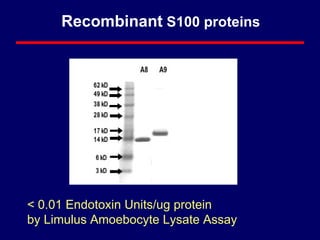
Recombinant  S100 proteins < 0.01 Endotoxin Units/ug protein by Limulus Amoebocyte Lysate Assay
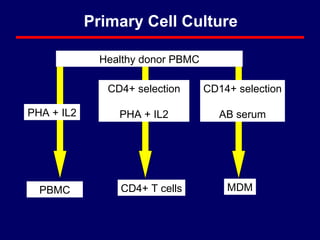
Healthy donor PBMC CD14+ selection AB serum CD4+ selection PHA + IL2 CD4+ T cells MDM PHA + IL2 PBMC Primary Cell Culture
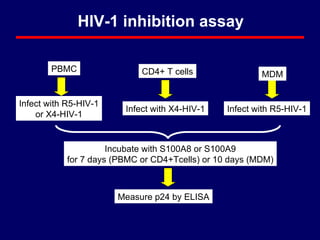
CD4+ T cells MDM PBMC Infect with R5-HIV-1 Incubate with S100A8 or S100A9 for 7 days (PBMC or CD4+Tcells) or 10 days (MDM) Measure p24 by ELISA HIV-1 inhibition assay Infect with X4-HIV-1 Infect with R5-HIV-1 or X4-HIV-1
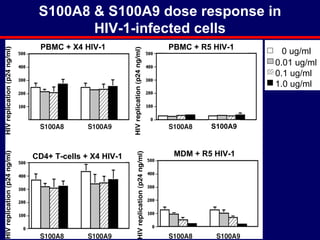
PBMC + X4 HIV-1 MDM + R5 HIV-1 CD4+ T-cells + X4 HIV-1 PBMC + R5 HIV-1 S100A8 & S100A9 dose response in HIV-1-infected cells S100A9 0 ug/ml 0.01 ug/ml 0.1 ug/ml 1.0 ug/ml
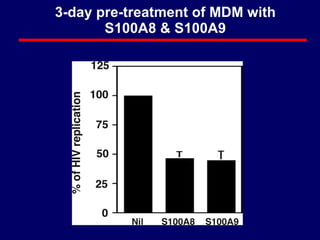
3-day pre-treatment of MDM with S100A8 & S100A9
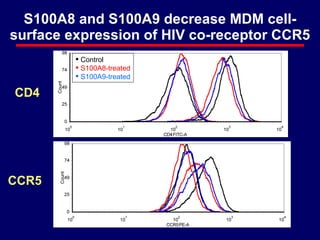
S100A8 and S100A9 decrease MDM cell-surface expression of HIV co-receptor CCR5 CD4 CCR5 Control S100A8-treated S100A9-treated
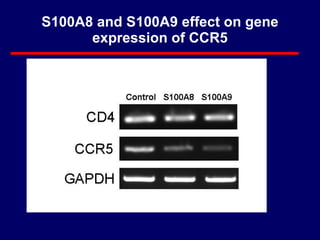
S100A8 and S100A9 effect on gene expression of CCR5
Conclusions S100A8 and S100A9 reduce HIV production in MDM, but not in CD4+ T cells or PBMCs  S100A8 and S100A9 decreased expression of CCR5
Acknowledgements SAIC Frederick, Inc Tom Imamichi Hiromi Imamichi Joseph Adelsberger Michael Baseler NCI-Frederick Munehisa Takahashi Teizo Yoshimura NIAID/NIH H. Clifford Lane Funded by NCI Contract N01-CO-12400

Aids2008talk

  • 1.
    S100A8 and S100A9,Endogenous Toll-like Receptor 4 (TLR4) Ligands, Inhibit HIV-1 Replication in Macrophages but not in CD4+ T Cells Terrence Brann, M.S. SAIC Frederick, Inc., NCI-Frederick, Frederick, Maryland, USA,
  • 2.
    Introduction to S100A8& S100A9 Expressed by neutrophils and macrophages, secreted during inflammation Recruit lymphocytes to sites of inflammation In this study, we evaluated the effect of soluble S100A8 and S100A9 on HIV-1 replication in primary CD4+ T cells and monocyte-derived macrophages (MDMs)
  • 3.
    Recombinant S100proteins < 0.01 Endotoxin Units/ug protein by Limulus Amoebocyte Lysate Assay
  • 4.
    Healthy donor PBMCCD14+ selection AB serum CD4+ selection PHA + IL2 CD4+ T cells MDM PHA + IL2 PBMC Primary Cell Culture
  • 5.
    CD4+ T cellsMDM PBMC Infect with R5-HIV-1 Incubate with S100A8 or S100A9 for 7 days (PBMC or CD4+Tcells) or 10 days (MDM) Measure p24 by ELISA HIV-1 inhibition assay Infect with X4-HIV-1 Infect with R5-HIV-1 or X4-HIV-1
  • 6.
    PBMC + X4HIV-1 MDM + R5 HIV-1 CD4+ T-cells + X4 HIV-1 PBMC + R5 HIV-1 S100A8 & S100A9 dose response in HIV-1-infected cells S100A9 0 ug/ml 0.01 ug/ml 0.1 ug/ml 1.0 ug/ml
  • 7.
    3-day pre-treatment ofMDM with S100A8 & S100A9
  • 8.
    S100A8 and S100A9decrease MDM cell-surface expression of HIV co-receptor CCR5 CD4 CCR5 Control S100A8-treated S100A9-treated
  • 9.
    S100A8 and S100A9effect on gene expression of CCR5
  • 10.
    Conclusions S100A8 andS100A9 reduce HIV production in MDM, but not in CD4+ T cells or PBMCs  S100A8 and S100A9 decreased expression of CCR5
  • 11.
    Acknowledgements SAIC Frederick,Inc Tom Imamichi Hiromi Imamichi Joseph Adelsberger Michael Baseler NCI-Frederick Munehisa Takahashi Teizo Yoshimura NIAID/NIH H. Clifford Lane Funded by NCI Contract N01-CO-12400