Part2 AI as Representation
and Search
Dr. Bernard Chen Ph.D.

University of Central Arkansas
Spring 2011
Outline




Intro to Representation and
Search
Ch3 Structures and strategies for state
space search
Introduction to Representation




The representation function is to capture
the critical features of a problem and make
that information accessible to a problem
solving procedure
Expressiveness (the result of the feature
abstracted) and efficiency (the
computational complexity) are major
dimensions for evaluating knowledge
representation
Introduction to Representation






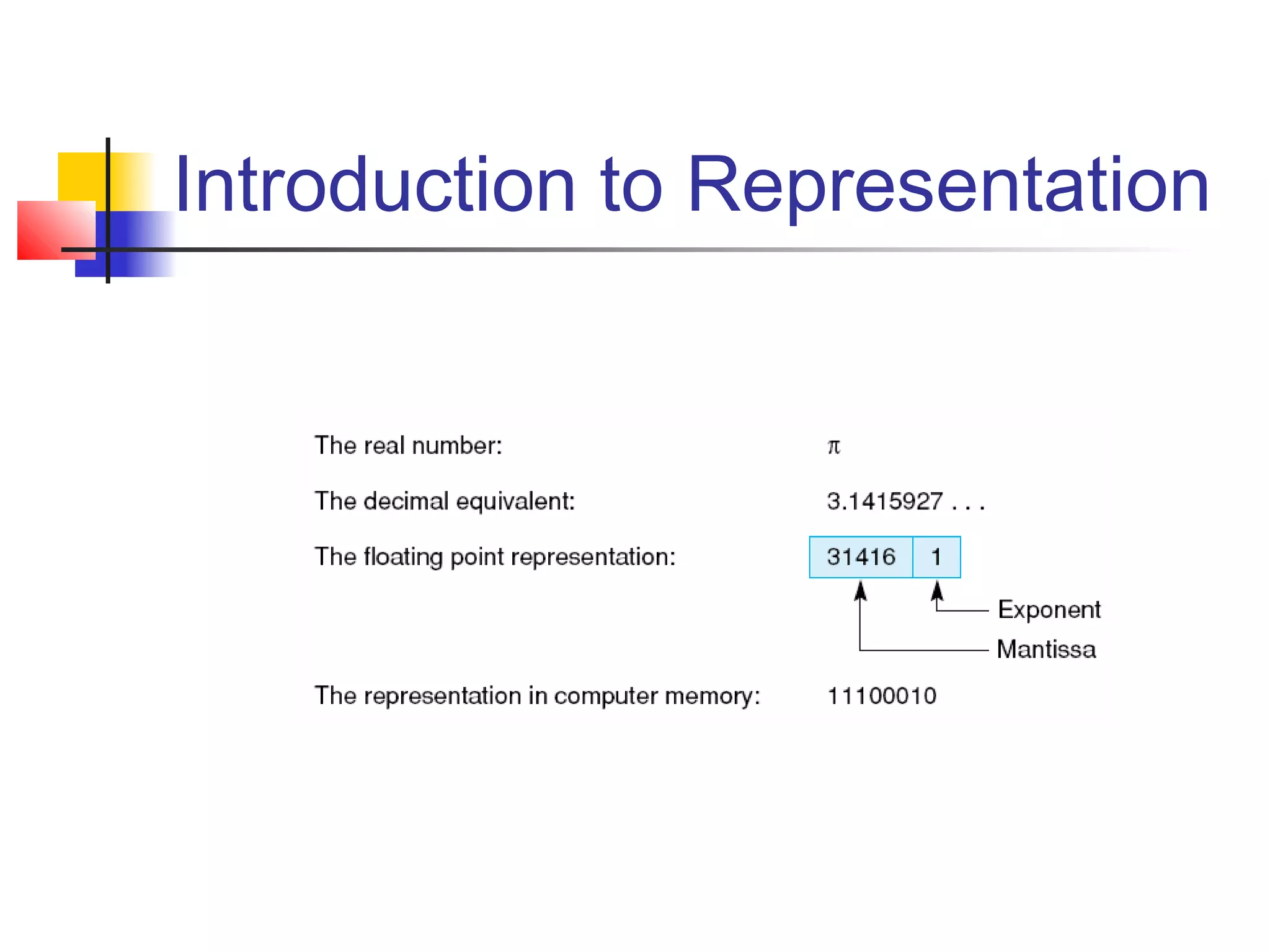
The computer representation of floating-point
numbers illustrate these trade-off
To be precise, real number require an infinite
string of digits to be fully described.
This cannot be accomplished on a finite
device such as computer
Introduction to Representation




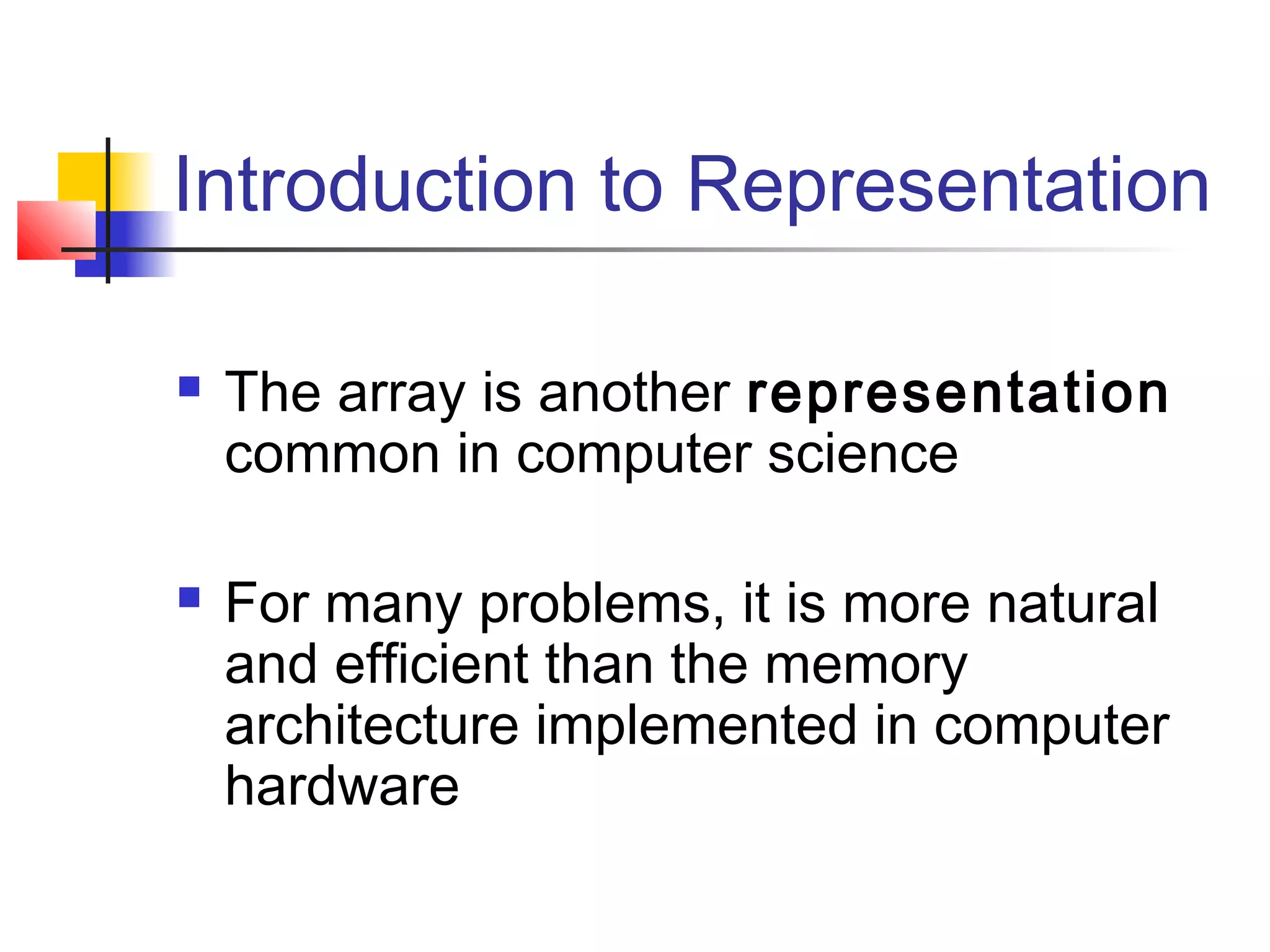
The array is another representation
common in computer science
For many problems, it is more natural
and efficient than the memory
architecture implemented in computer
hardware
Introduction to Representation
Introduction to Search




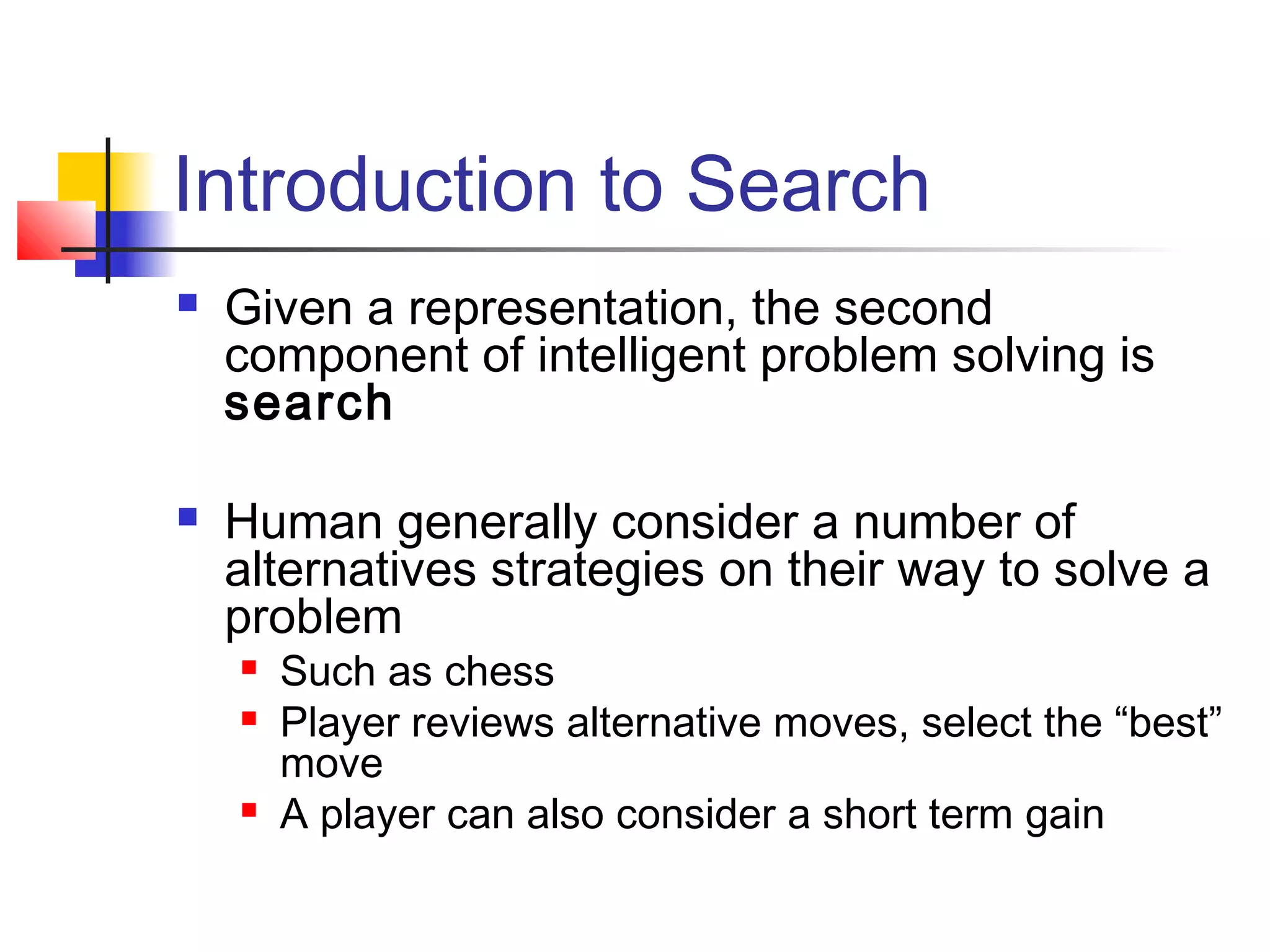
Given a representation, the second
component of intelligent problem solving is
search
Human generally consider a number of
alternatives strategies on their way to solve a
problem





Such as chess
Player reviews alternative moves, select the “best”
move
A player can also consider a short term gain
Introduction to Search


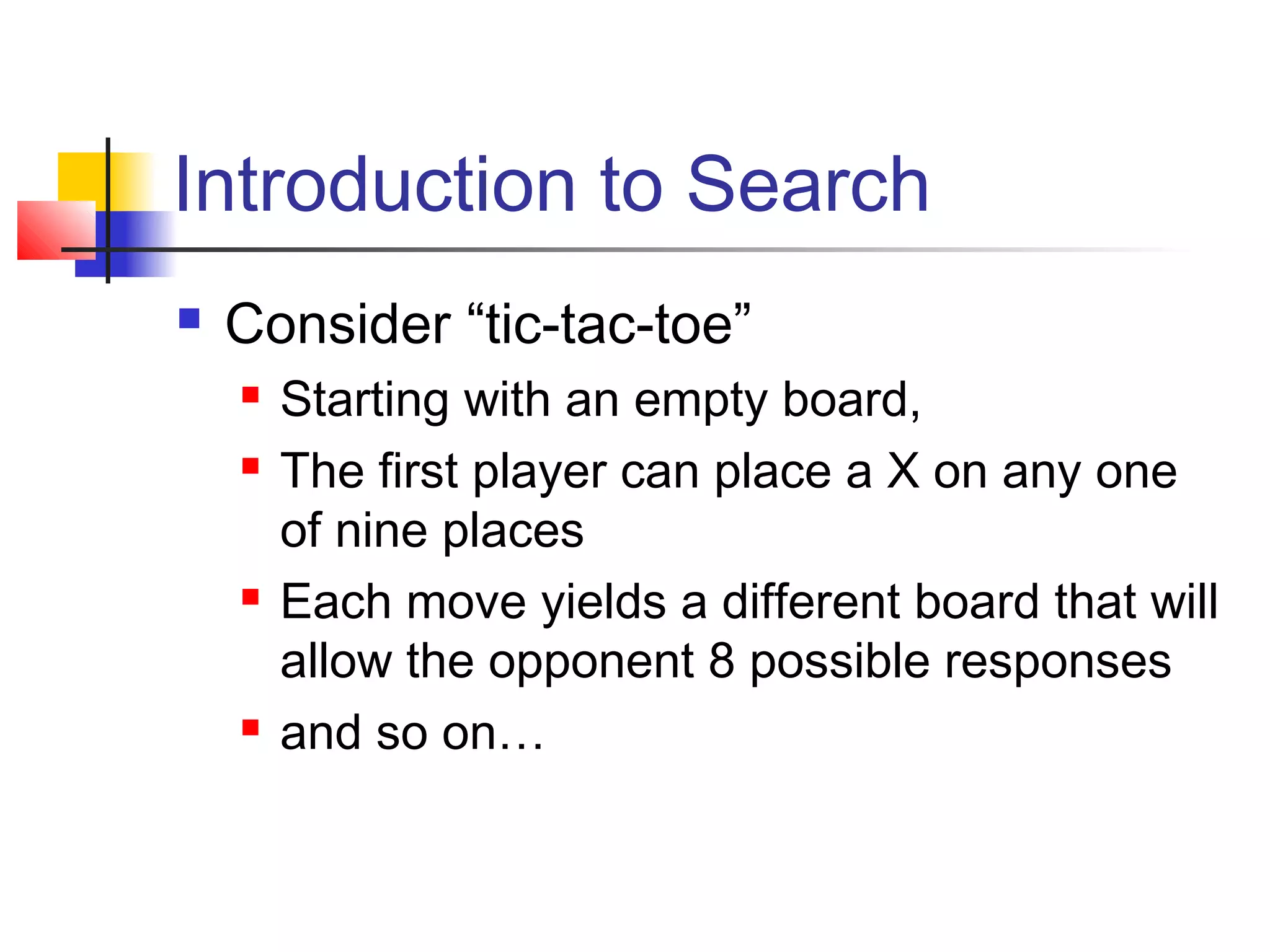
Consider “tic-tac-toe”







Starting with an empty board,
The first player can place a X on any one
of nine places
Each move yields a different board that will
allow the opponent 8 possible responses
and so on…
Introduction to Search






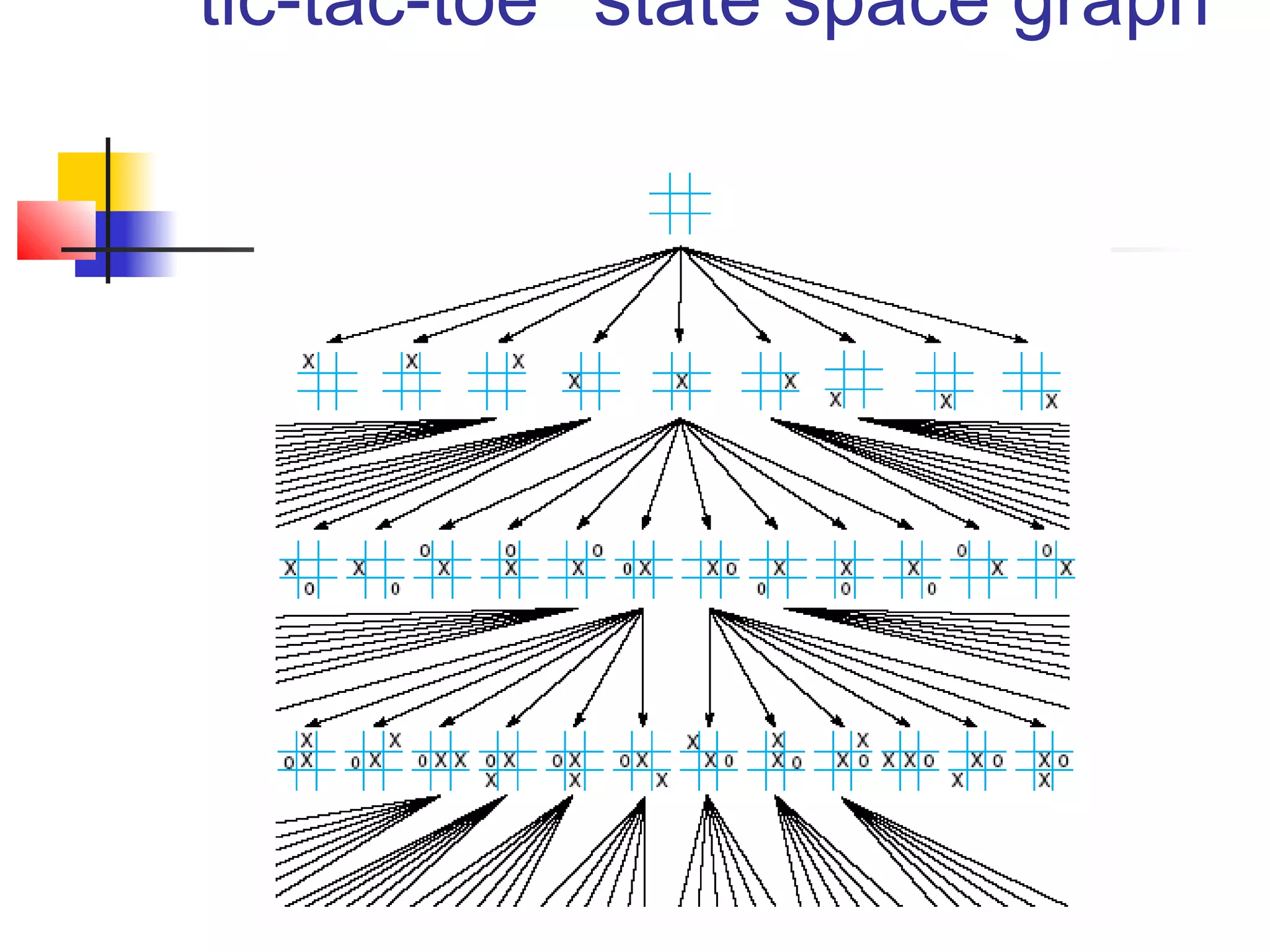
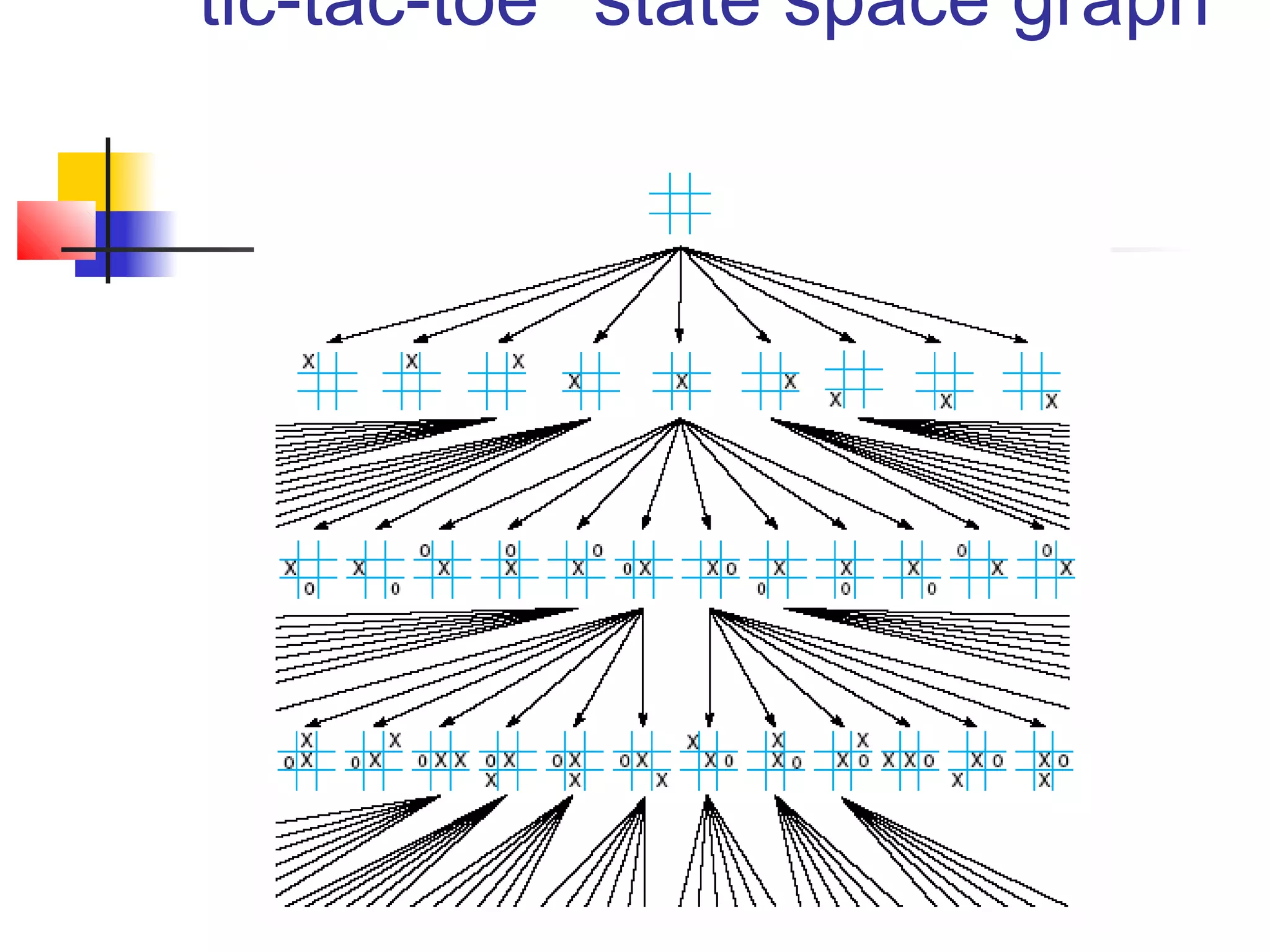
We can represent this collection of possible
moves by regarding each board as a state
in a graph
The link of the graph represent legal move
The resulting structure is a state space
graph
“tic-tac-toe” state space graph
Introduction to Search


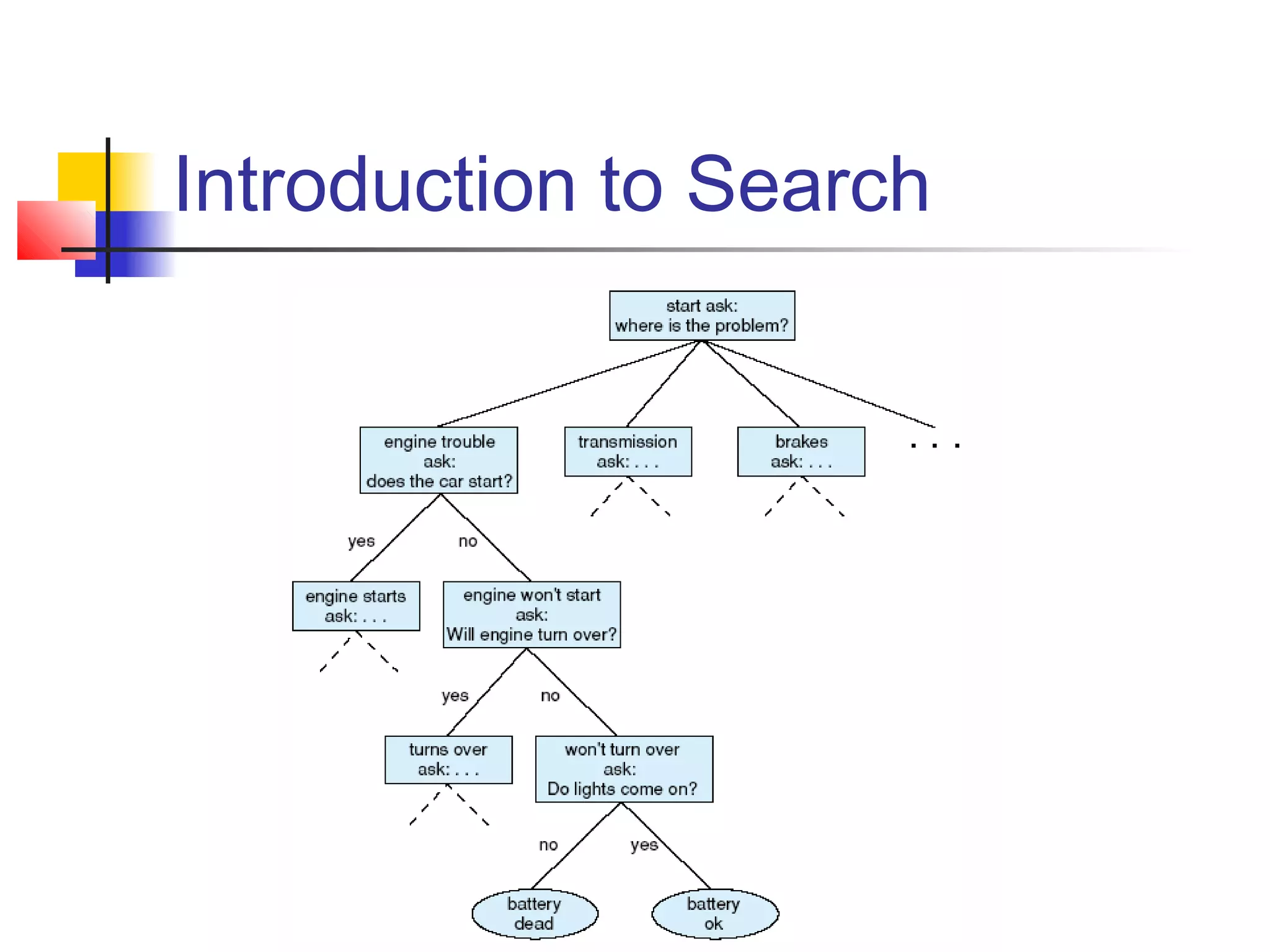
Consider a task of diagnosing a
mechanical fault in an automobile:
Introduction to Search


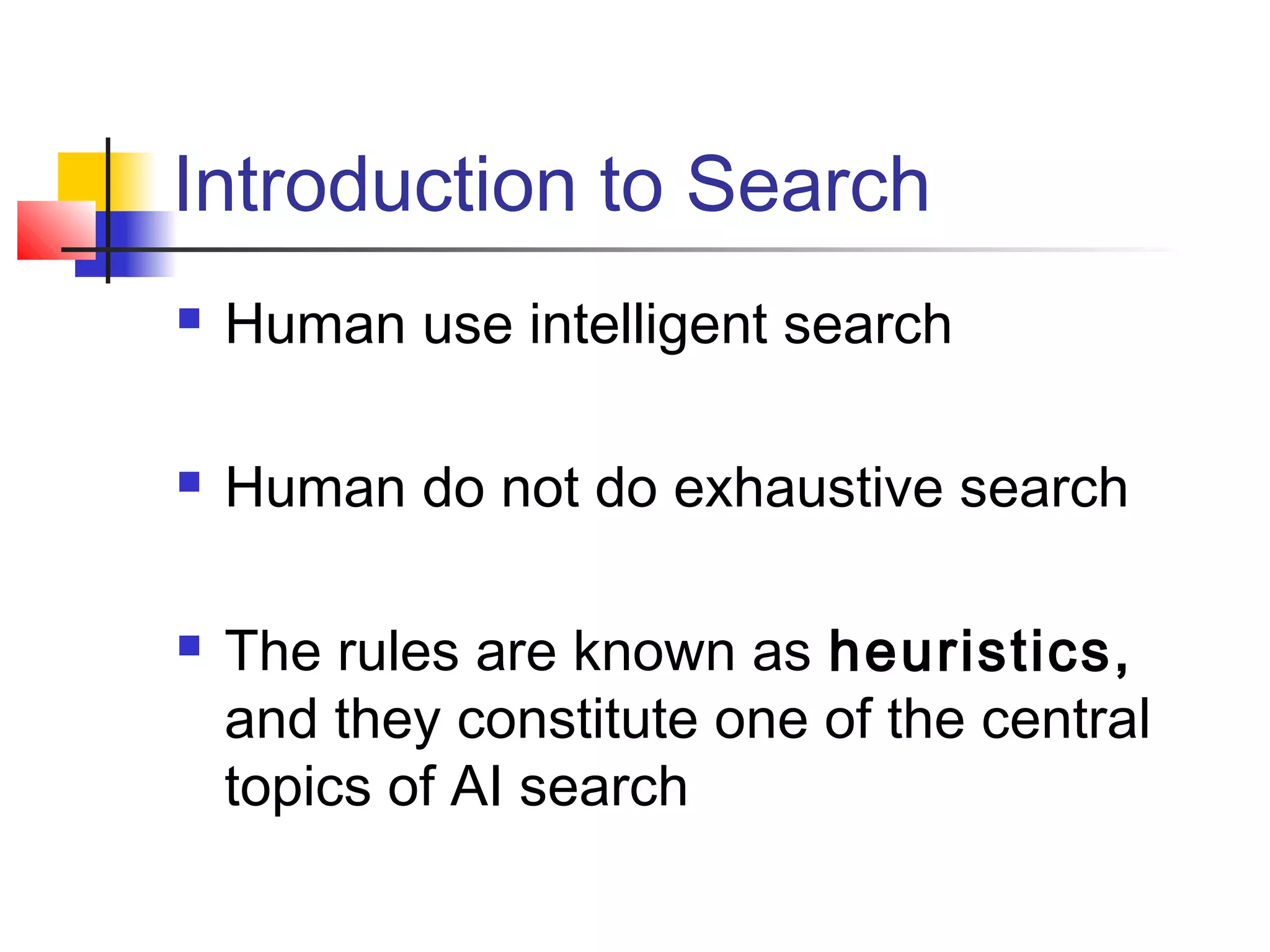
Human use intelligent search



Human do not do exhaustive search



The rules are known as heuristics,
and they constitute one of the central
topics of AI search
Outline



Intro to Representation and Search
Ch3 Structures and strategies for
state space search
State Space Representation






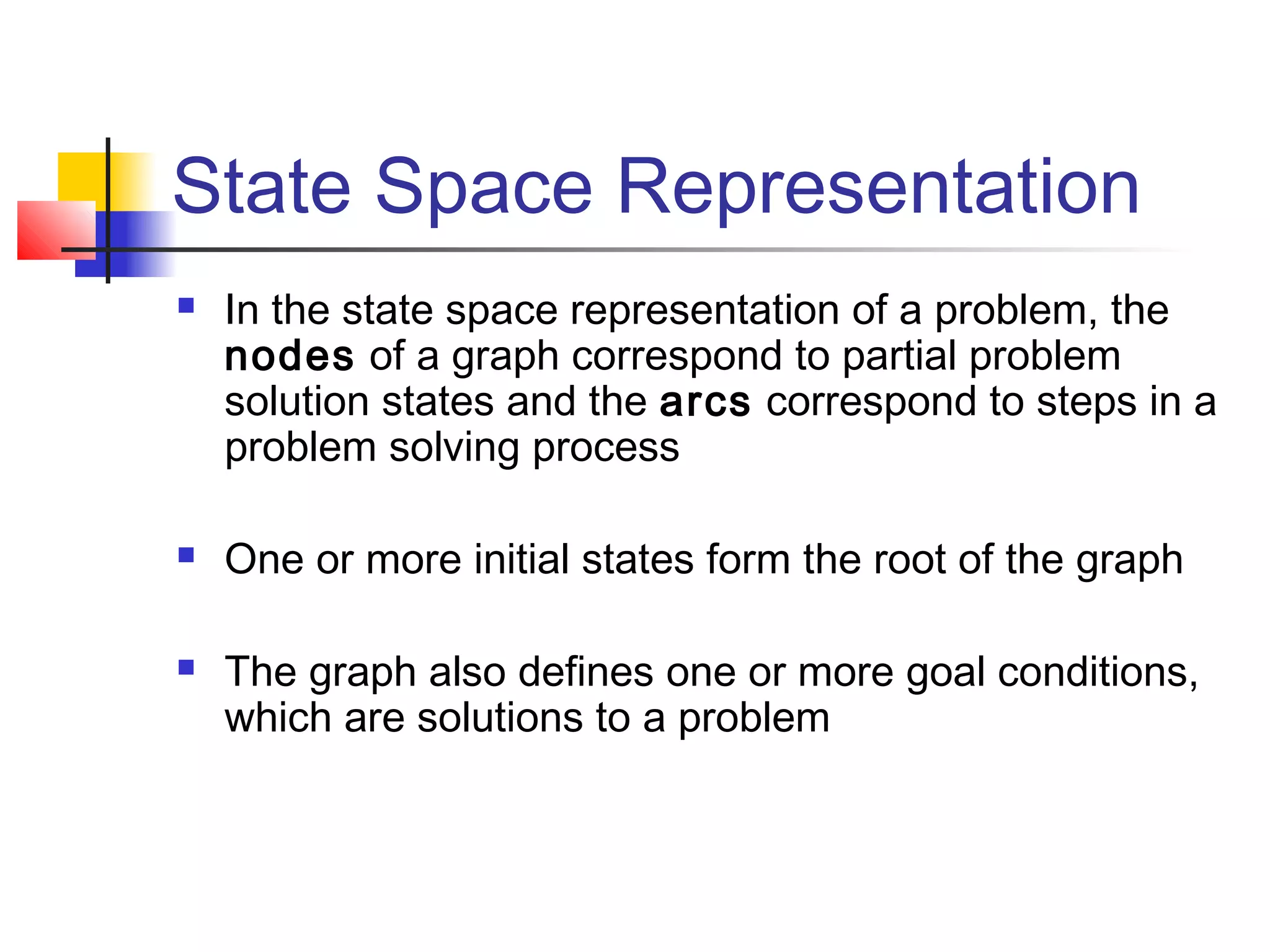
In the state space representation of a problem, the
nodes of a graph correspond to partial problem
solution states and the arcs correspond to steps in a
problem solving process
One or more initial states form the root of the graph
The graph also defines one or more goal conditions,
which are solutions to a problem
State Space Representation




State space search characterizes
problem solving as the process of
finding a solution path form the start
state to a goal
A goal may describe a state, such as
winning board in tic-tac-toe
“tic-tac-toe” state space graph
State Space Representation






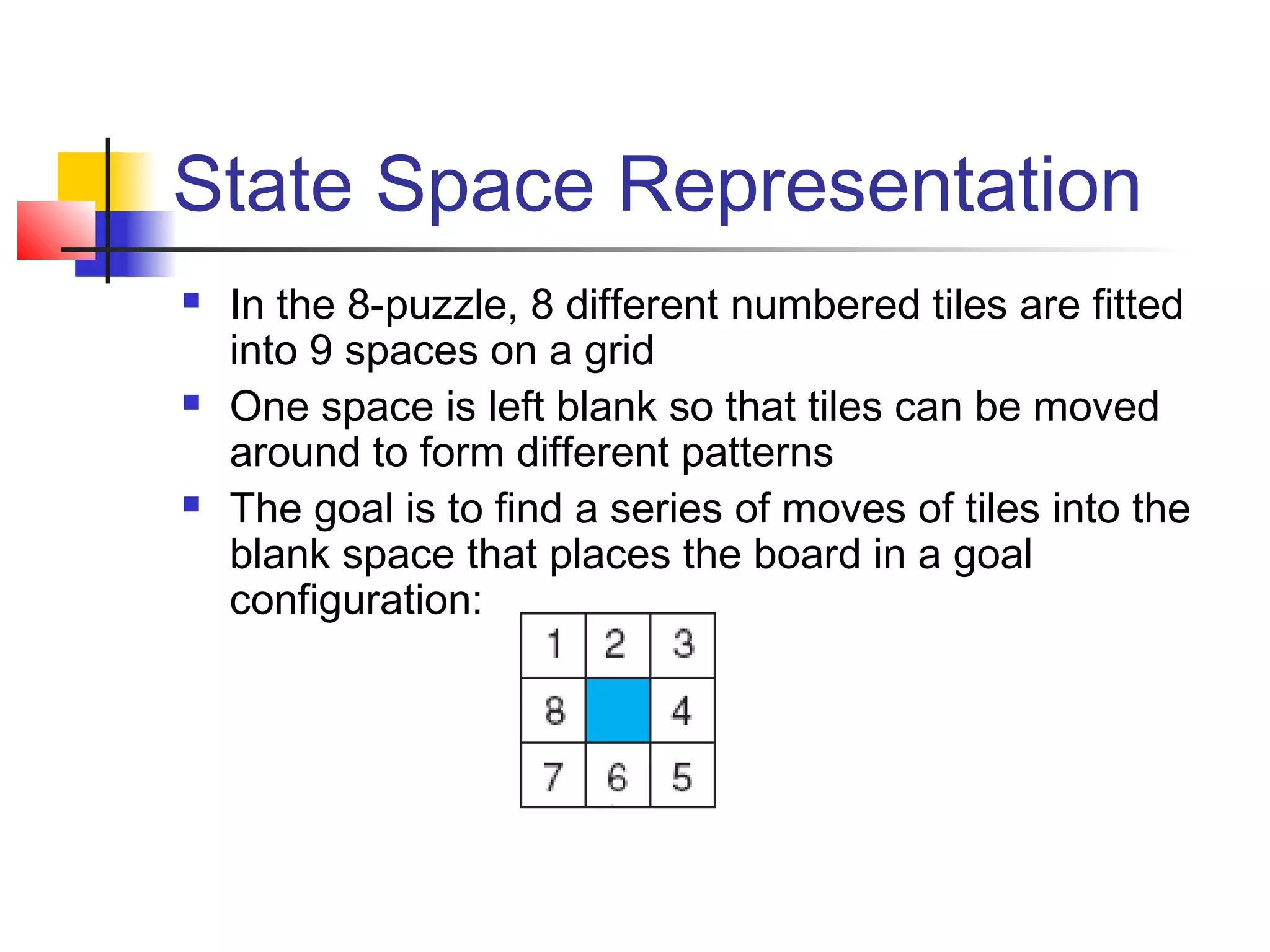
In the 8-puzzle, 8 different numbered tiles are fitted
into 9 spaces on a grid
One space is left blank so that tiles can be moved
around to form different patterns
The goal is to find a series of moves of tiles into the
blank space that places the board in a goal
configuration:
State Space Representation


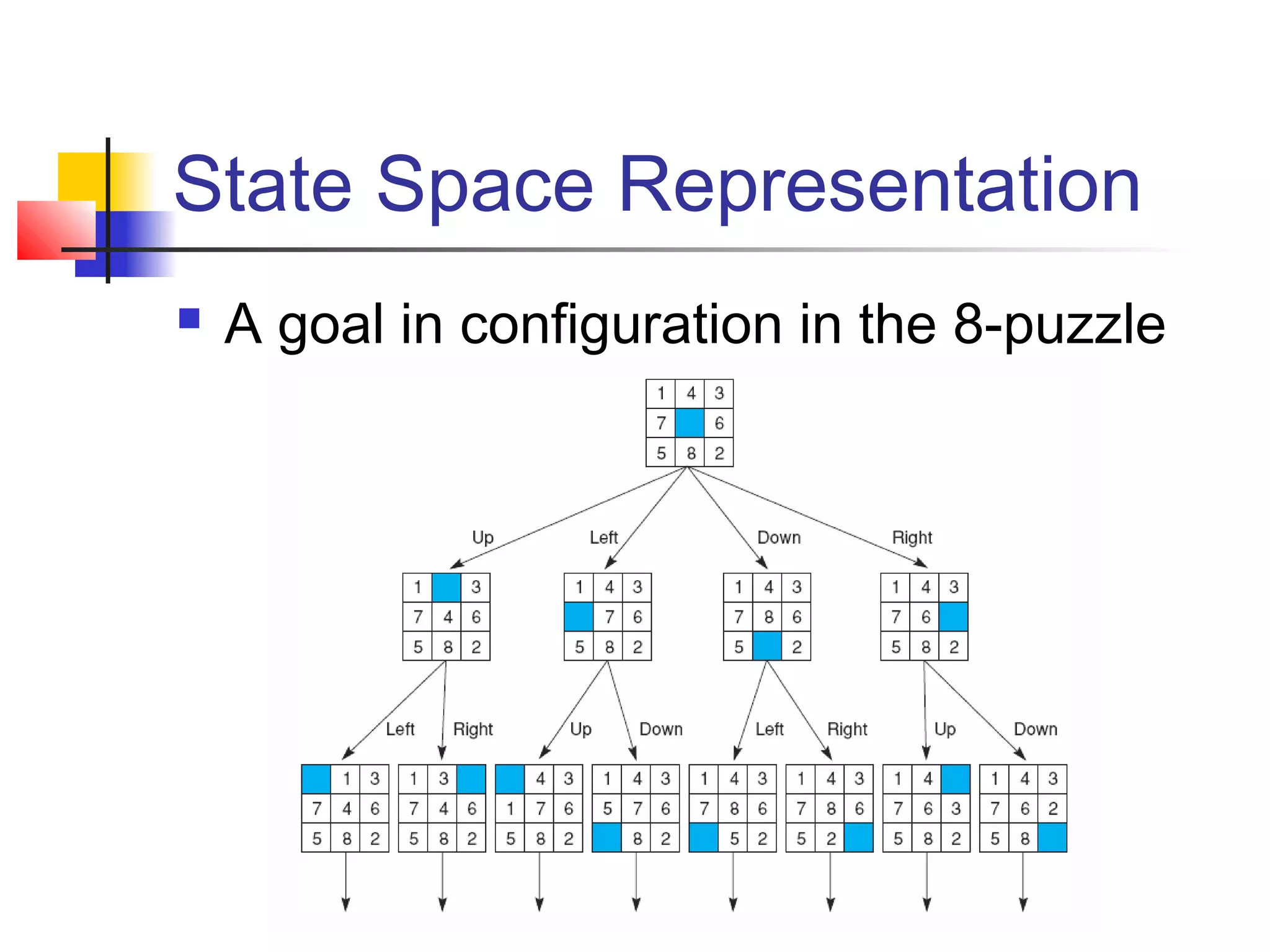
A goal in configuration in the 8-puzzle
State Space Representation


The Traveling salesperson problem




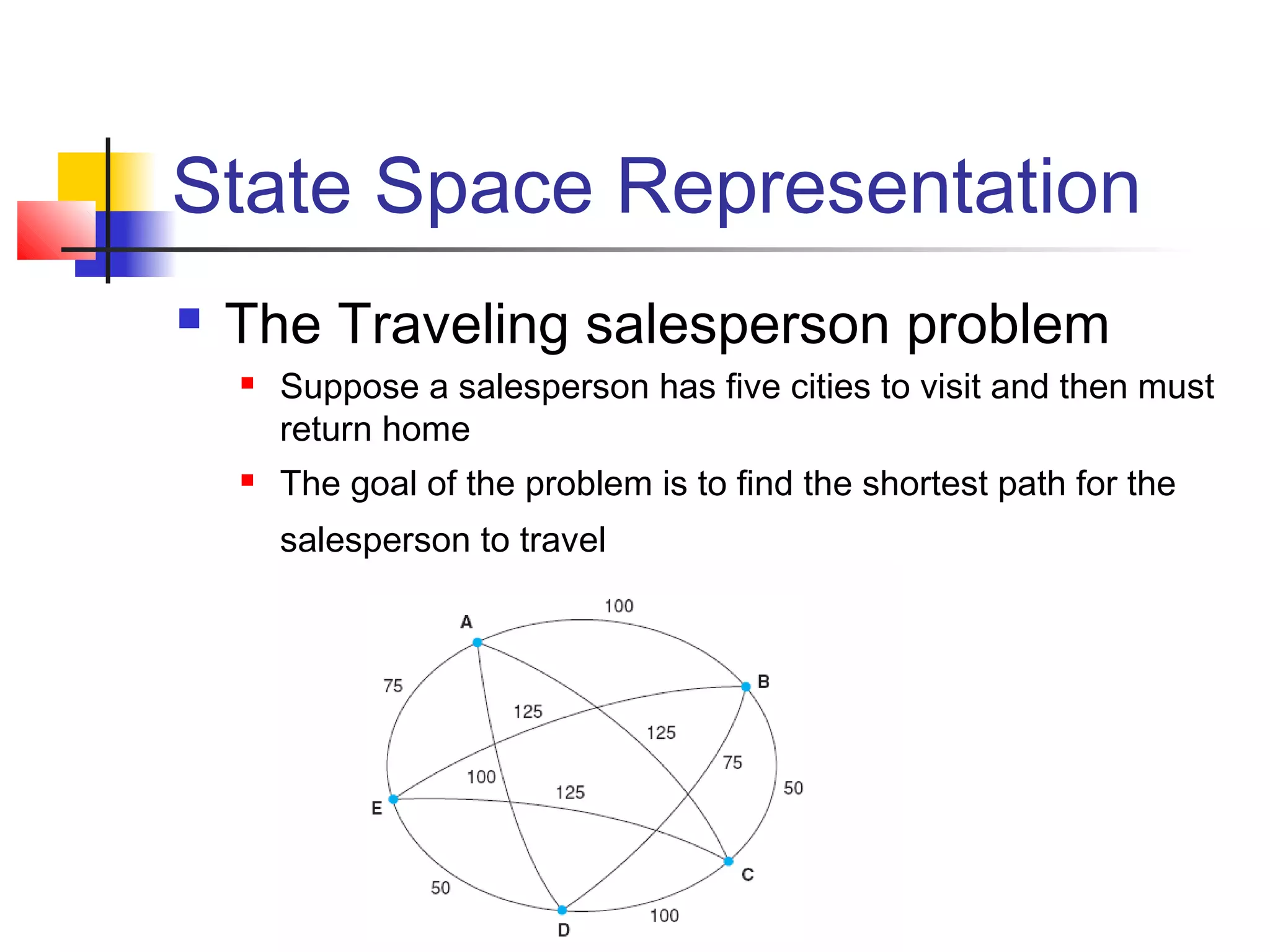
Suppose a salesperson has five cities to visit and then must
return home
The goal of the problem is to find the shortest path for the
salesperson to travel
State Space Representation


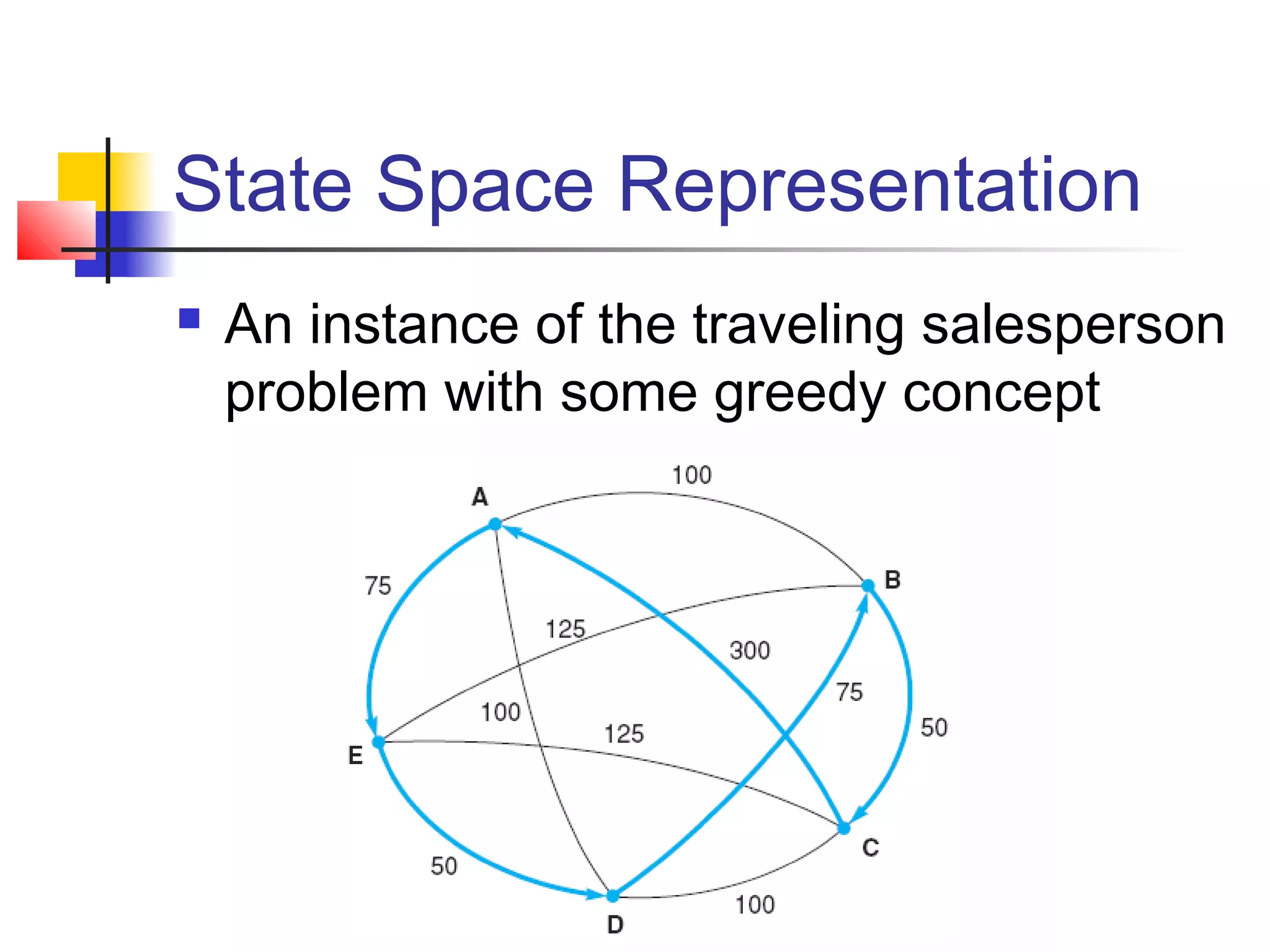
An instance of the traveling salesperson
problem with some greedy concept
State Space Representation




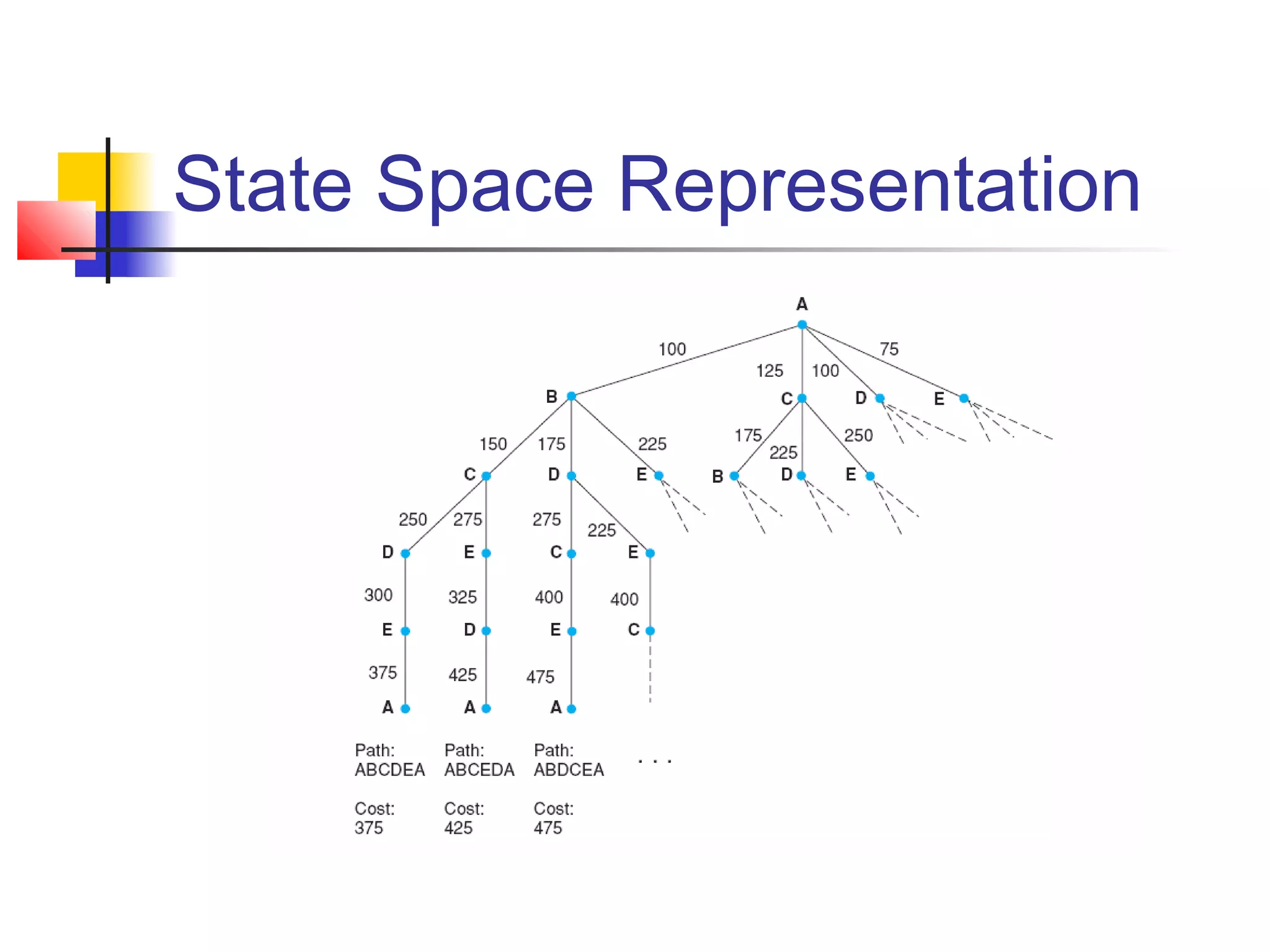
As previous slide suggests, the
complexity of exhaustive search in the
traveling salesperson problem is (N-1)!
It is a NP problem
Outline



Strategies for state space search
Depth-First and Breadth-First Search
Strategies for state space
search


A state may be searched in two
directions:




From the given data of a problem instance
toward a foal or
From a goal to the data
Strategies for state space
search




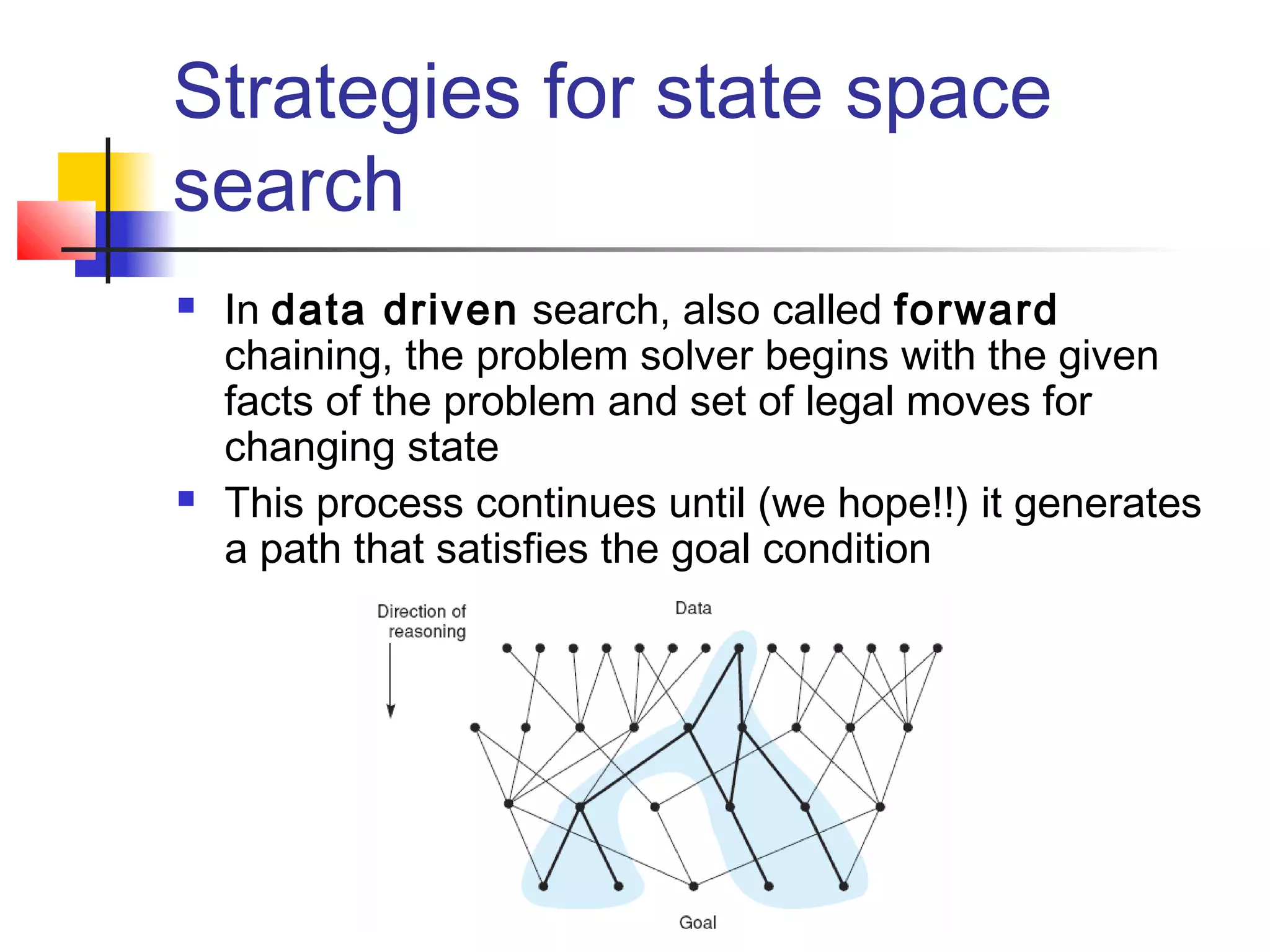
In data driven search, also called forward
chaining, the problem solver begins with the given
facts of the problem and set of legal moves for
changing state
This process continues until (we hope!!) it generates
a path that satisfies the goal condition
Strategies for state space
search







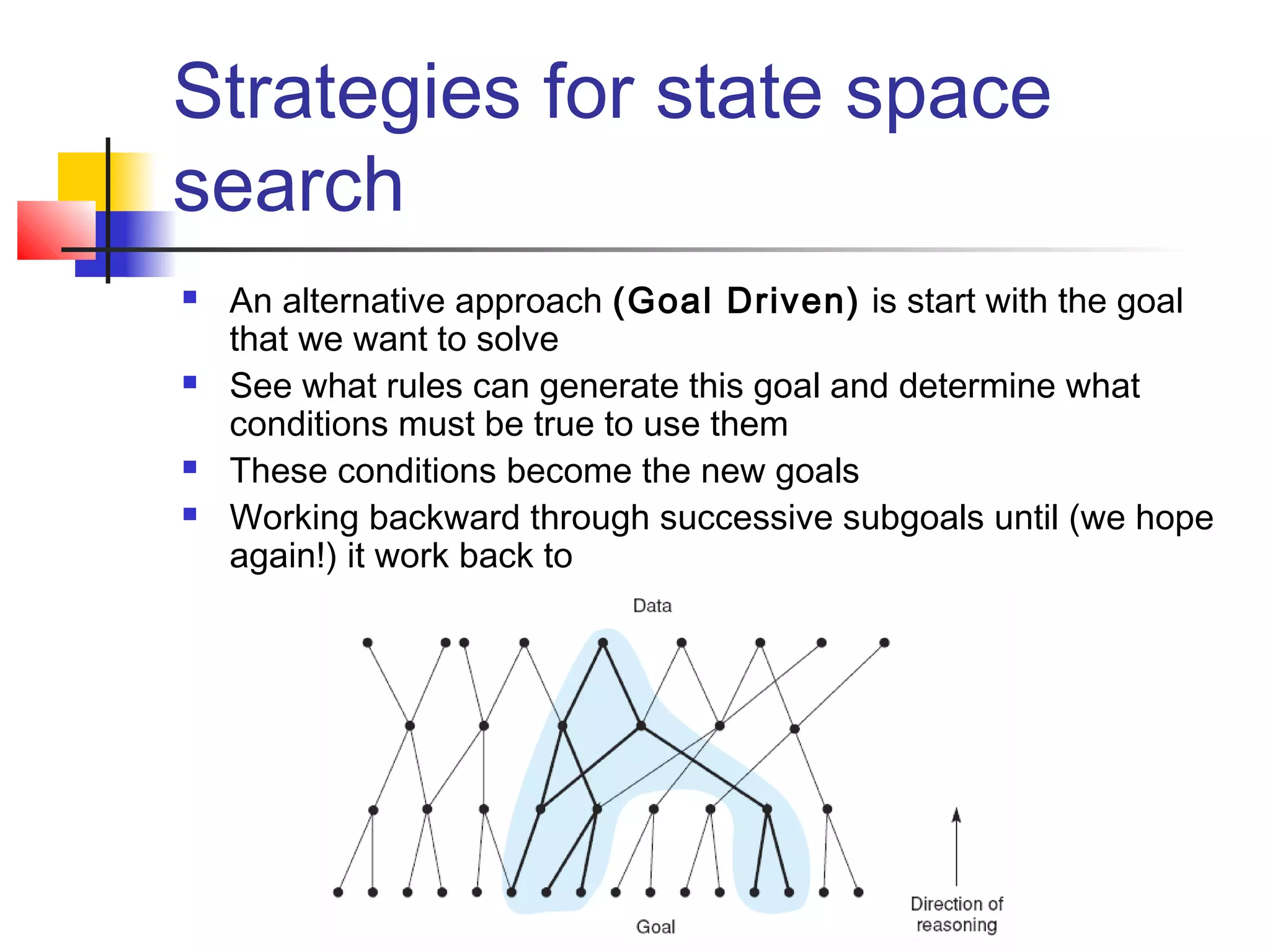
An alternative approach (Goal Driven) is start with the goal
that we want to solve
See what rules can generate this goal and determine what
conditions must be true to use them
These conditions become the new goals
Working backward through successive subgoals until (we hope
again!) it work back to
Strategies for state space
search


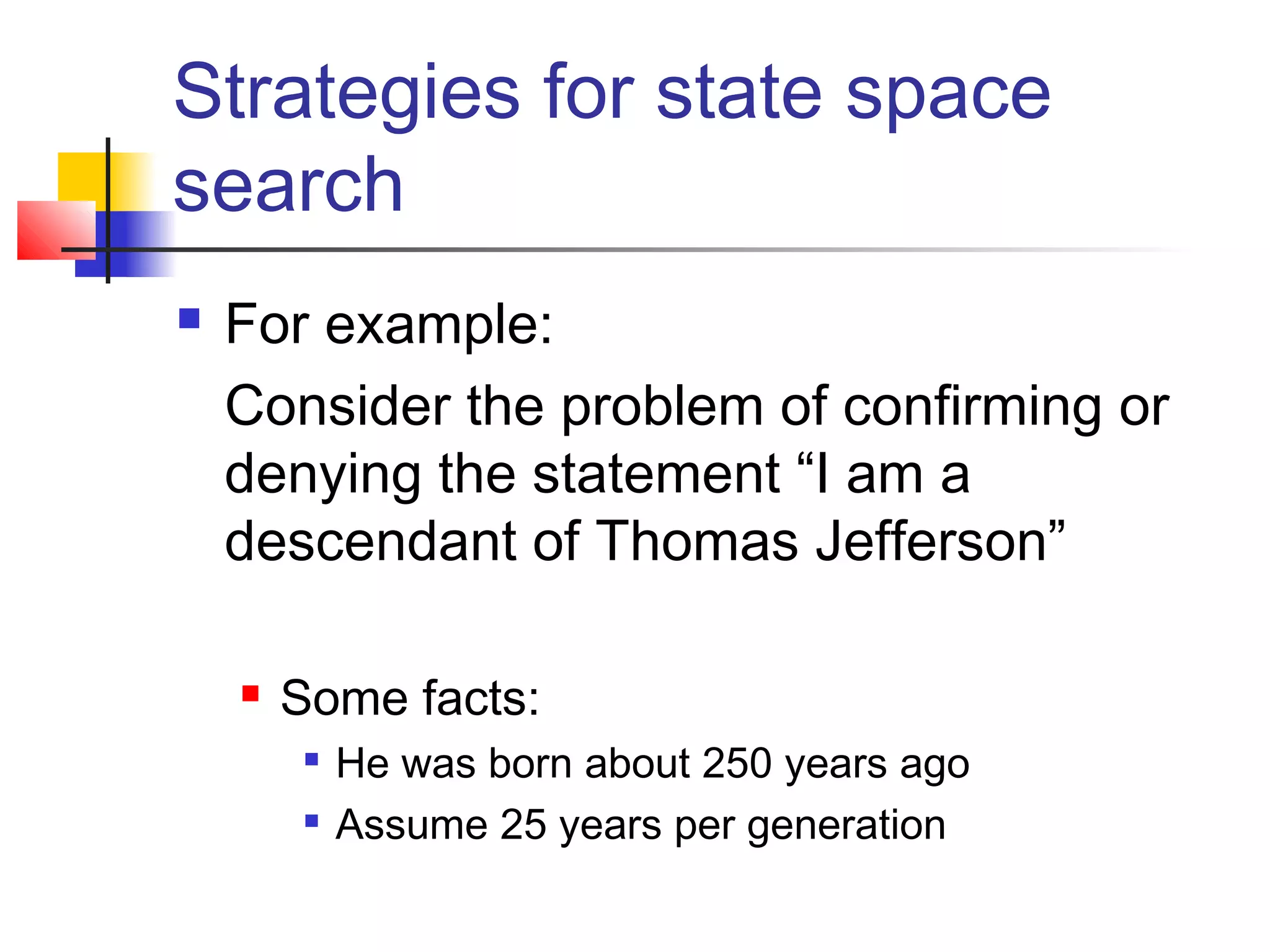
For example:
Consider the problem of confirming or
denying the statement “I am a
descendant of Thomas Jefferson”


Some facts:



He was born about 250 years ago
Assume 25 years per generation
Strategies for state space
search






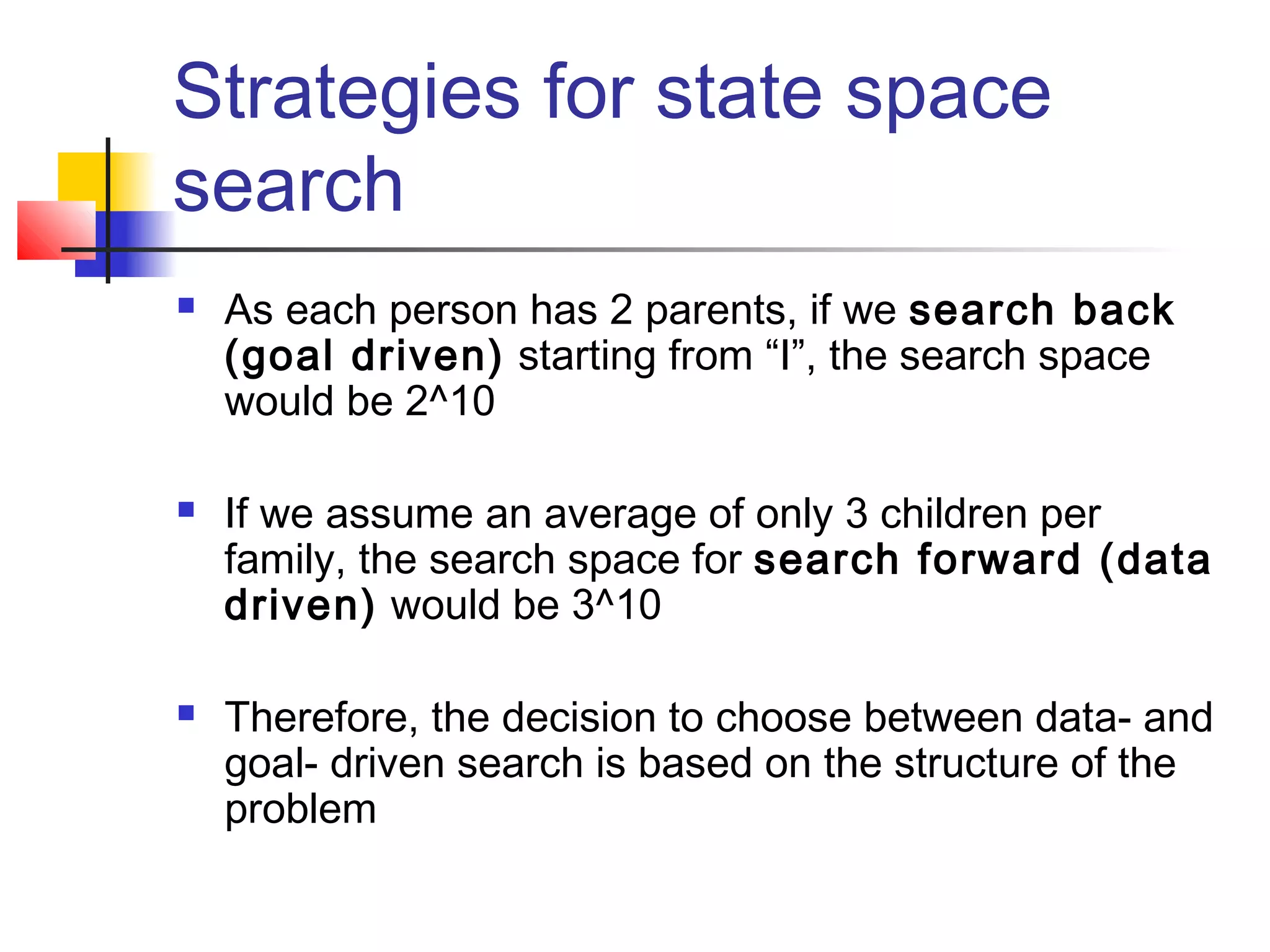
As each person has 2 parents, if we search back
(goal driven) starting from “I”, the search space
would be 2^10
If we assume an average of only 3 children per
family, the search space for search forward (data
driven) would be 3^10
Therefore, the decision to choose between data- and
goal- driven search is based on the structure of the
problem
Outline



Strategies for state space search
Depth-First and Breadth-First
Search
BFS and DFS




In addition to specifying a search direction
(data-driven or goal-driven), a search
algorithm must determine the order in which
states are examined in the graph
Two possibilities:



Depth-first search
Breadth-first search
BFS and DFS




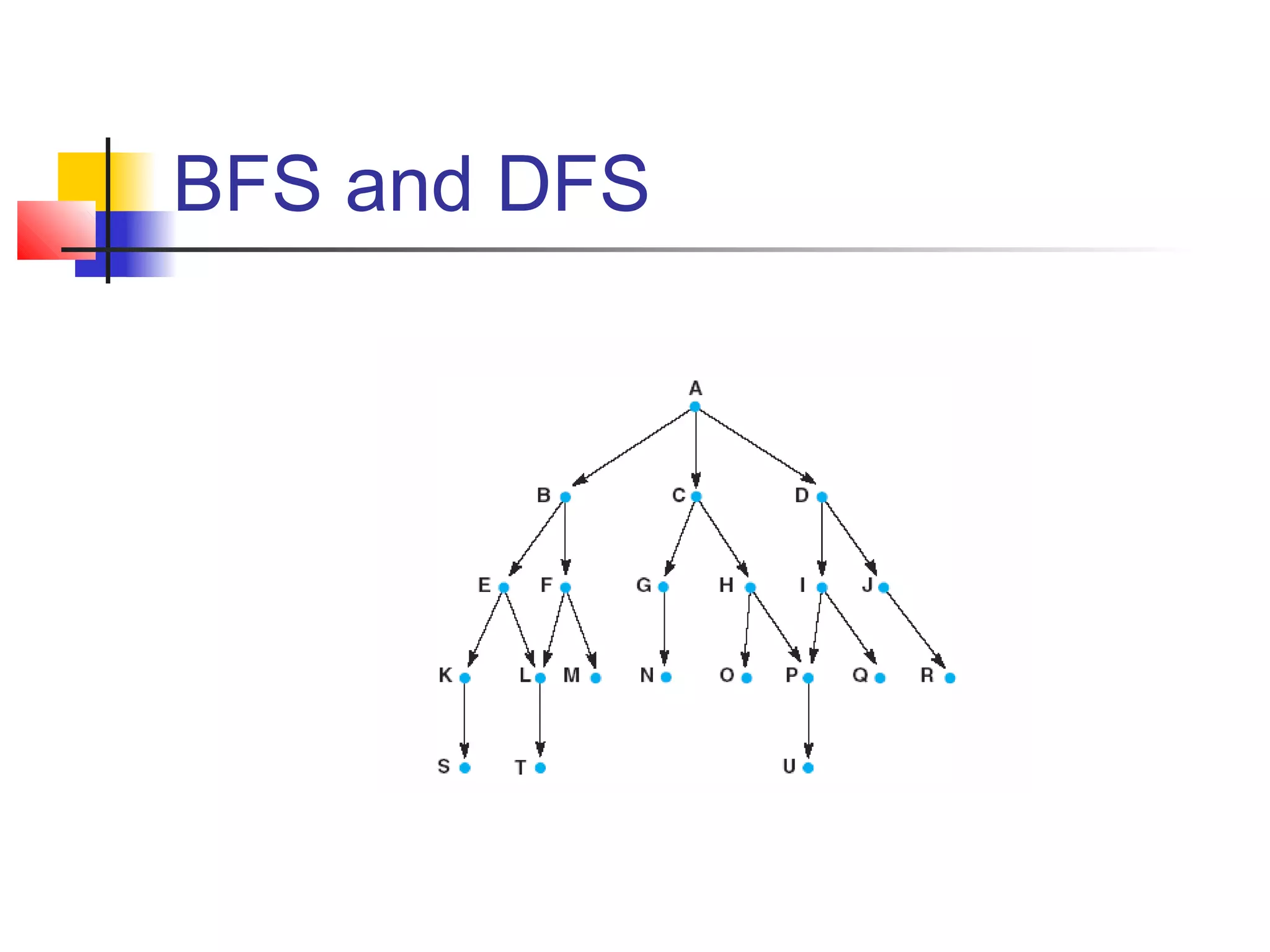
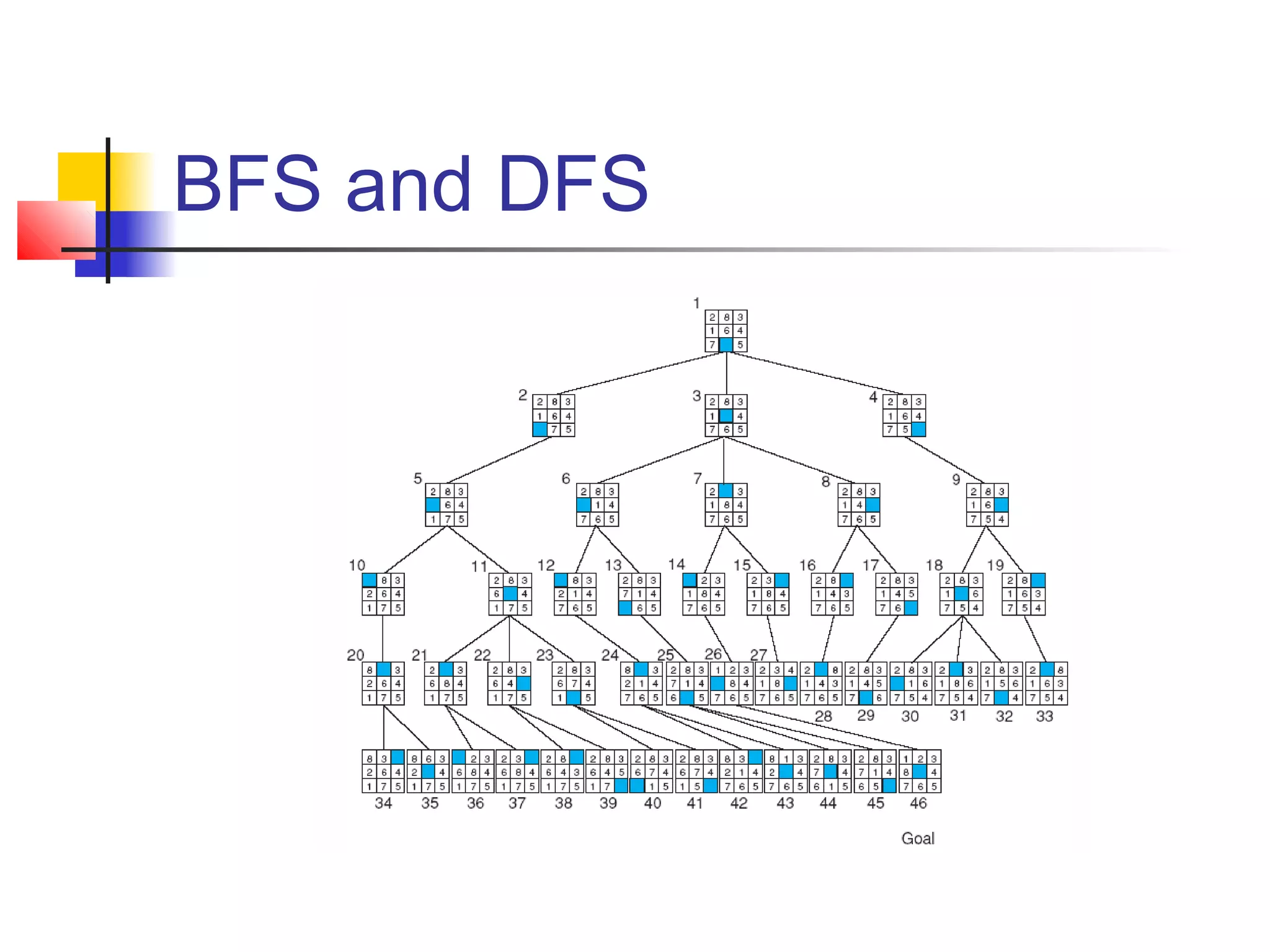
In DFS, when a state is examined, all of
its children and their descendants are
examined before any of its siblings
Breadth-first search explores the space
in a level-by-level fashion
BFS and DFS
BFS and DFS




DFS results:
ABEKSLTFMCGNHOPUDIQJR
BFS results:
ABCDEFGHIJKLMNOPQRSTU
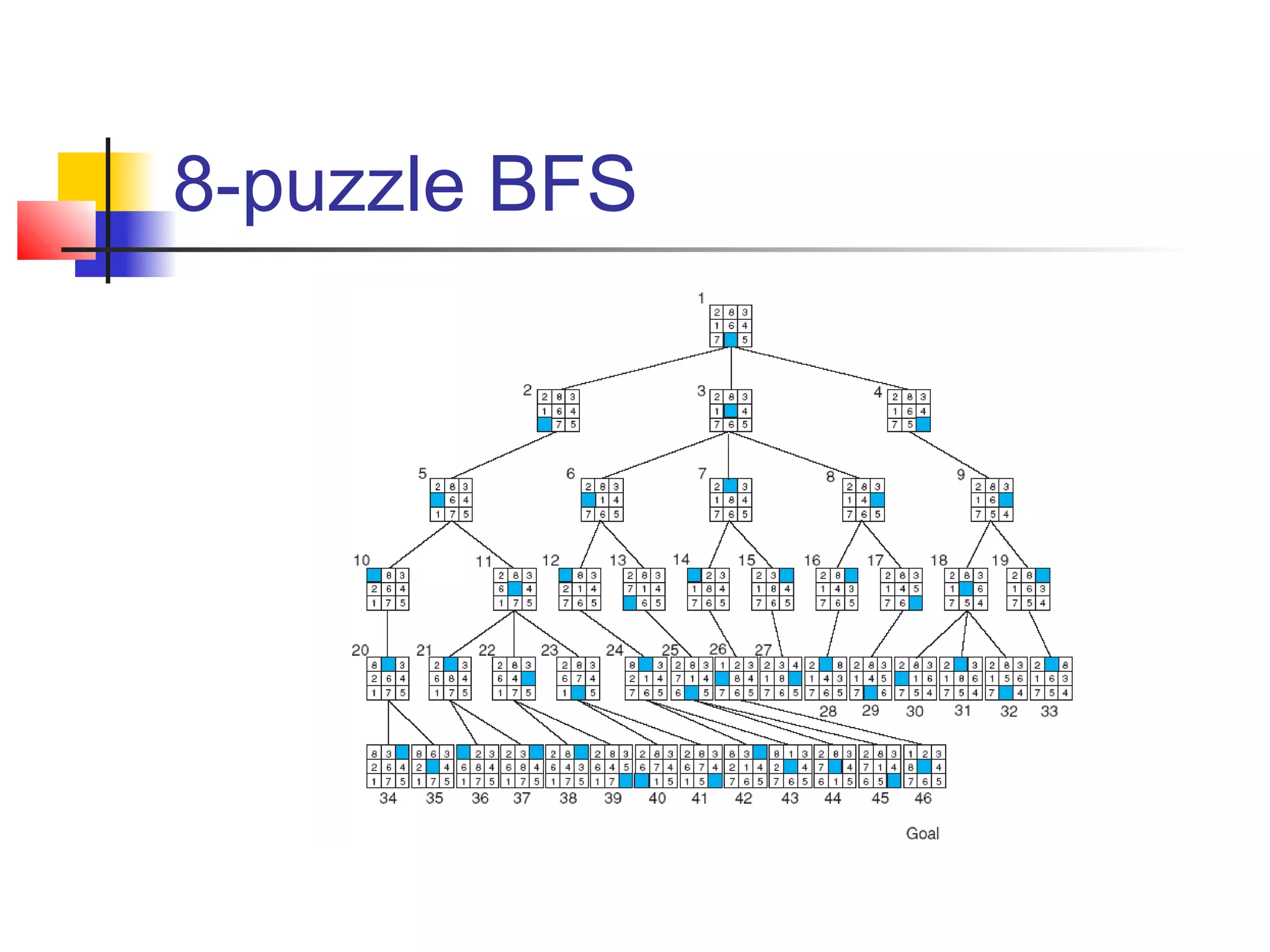
8-puzzle BFS
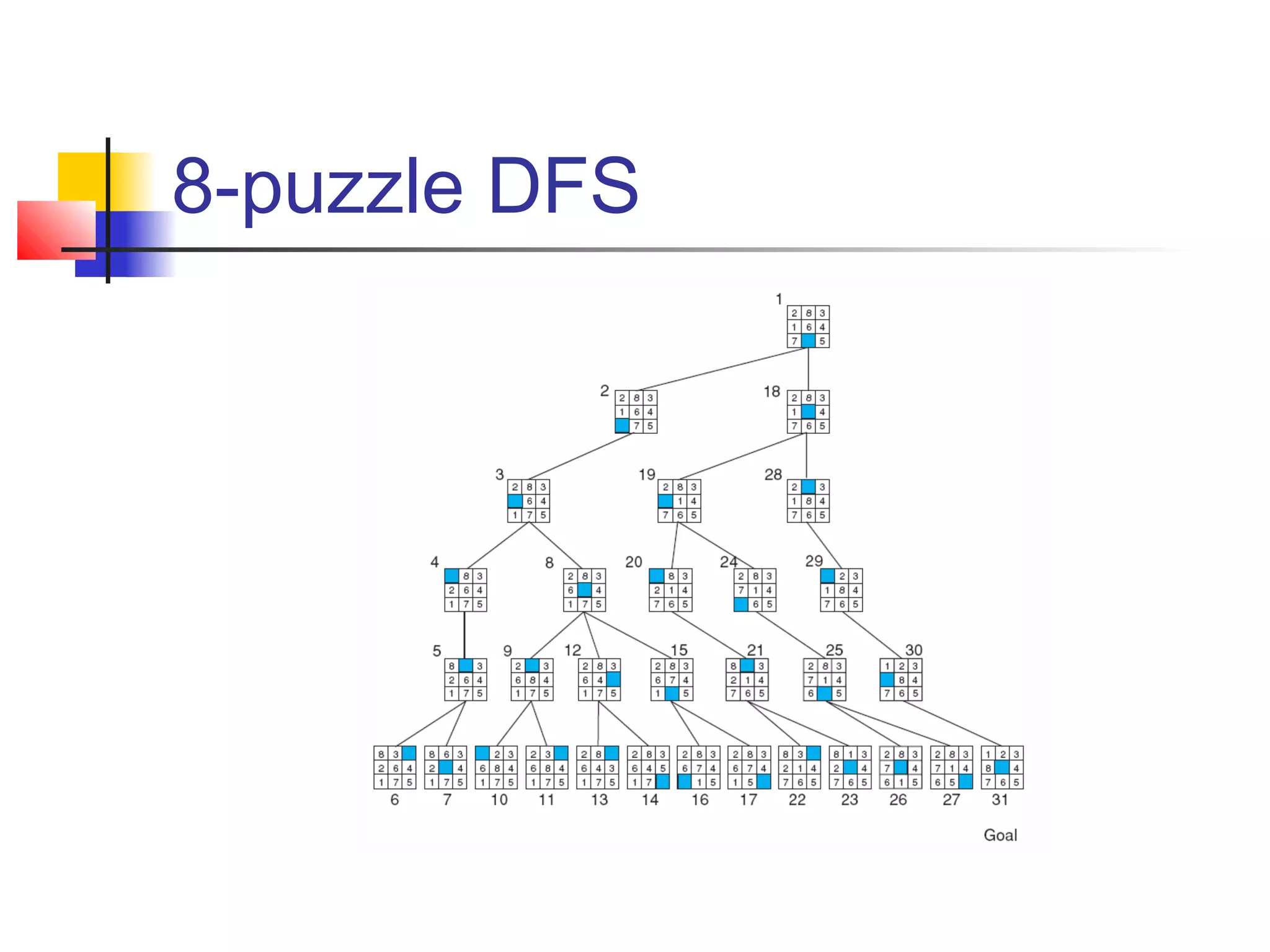
8-puzzle DFS
BFS and DFS


Properties of BFS






Because it always examines all nodes at
level n before proceeding to level n+1, BFS
always finds the shortest path to a goal
In a problem have a simple solution, the
solution will be found
Unfortunately, if the states have a high
average number of children, it may use all
the memory before it find a solution
BFS and DFS


Properties of DFS




If it is known that the solution path will be
long, DFS will not spend time searching a
large number of “shallow” states in the
graph
However, DFS may “lost” deep in a graph,
missing short paths to a goal, or even
stuck in an infinite loop
BFS and DFS




A nice compromise on these trade-offs
is to use a depth bound on DFS
New slide shows a DFS with a depth
bound of 5
BFS and DFS
BFS and DFS




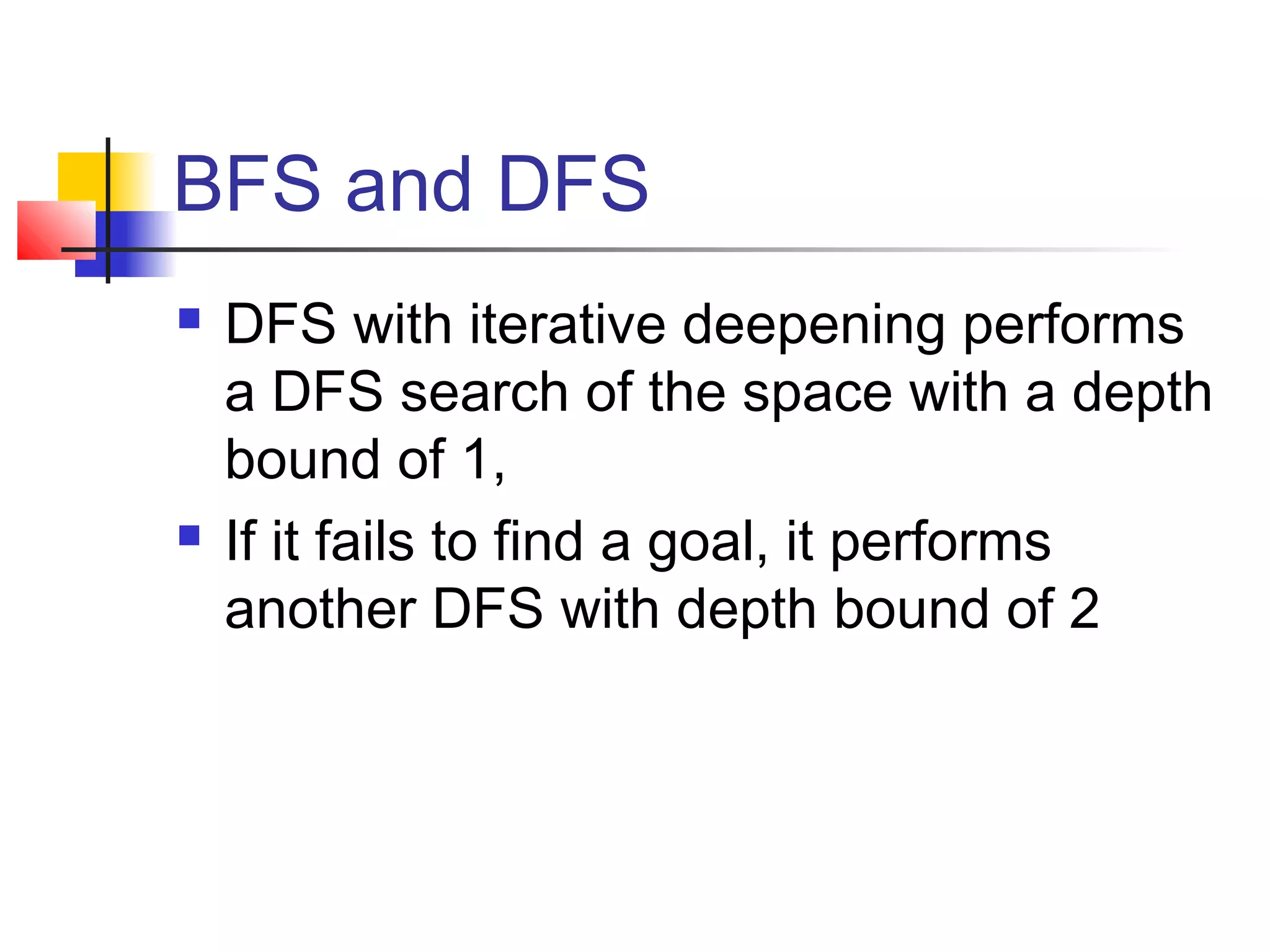
DFS with iterative deepening performs
a DFS search of the space with a depth
bound of 1,
If it fails to find a goal, it performs
another DFS with depth bound of 2
BFS and DFS






Unfortunately, all the search strategies
discussed in this chapter may be shown to
have worst-case exponential time complexity
This is true for all uniformed search
algorithms
Any other search algorithms???

Ai ch2

  • 1.
    Part2 AI asRepresentation and Search Dr. Bernard Chen Ph.D. University of Central Arkansas Spring 2011
  • 2.
    Outline   Intro to Representationand Search Ch3 Structures and strategies for state space search
  • 3.
    Introduction to Representation   Therepresentation function is to capture the critical features of a problem and make that information accessible to a problem solving procedure Expressiveness (the result of the feature abstracted) and efficiency (the computational complexity) are major dimensions for evaluating knowledge representation
  • 4.
    Introduction to Representation    Thecomputer representation of floating-point numbers illustrate these trade-off To be precise, real number require an infinite string of digits to be fully described. This cannot be accomplished on a finite device such as computer
  • 5.
  • 6.
    Introduction to Representation   Thearray is another representation common in computer science For many problems, it is more natural and efficient than the memory architecture implemented in computer hardware
  • 7.
  • 8.
    Introduction to Search   Givena representation, the second component of intelligent problem solving is search Human generally consider a number of alternatives strategies on their way to solve a problem    Such as chess Player reviews alternative moves, select the “best” move A player can also consider a short term gain
  • 9.
    Introduction to Search  Consider“tic-tac-toe”     Starting with an empty board, The first player can place a X on any one of nine places Each move yields a different board that will allow the opponent 8 possible responses and so on…
  • 10.
    Introduction to Search    Wecan represent this collection of possible moves by regarding each board as a state in a graph The link of the graph represent legal move The resulting structure is a state space graph
  • 11.
  • 12.
    Introduction to Search  Considera task of diagnosing a mechanical fault in an automobile:
  • 13.
  • 14.
    Introduction to Search  Humanuse intelligent search  Human do not do exhaustive search  The rules are known as heuristics, and they constitute one of the central topics of AI search
  • 15.
    Outline   Intro to Representationand Search Ch3 Structures and strategies for state space search
  • 16.
    State Space Representation    Inthe state space representation of a problem, the nodes of a graph correspond to partial problem solution states and the arcs correspond to steps in a problem solving process One or more initial states form the root of the graph The graph also defines one or more goal conditions, which are solutions to a problem
  • 17.
    State Space Representation   Statespace search characterizes problem solving as the process of finding a solution path form the start state to a goal A goal may describe a state, such as winning board in tic-tac-toe
  • 18.
  • 19.
    State Space Representation    Inthe 8-puzzle, 8 different numbered tiles are fitted into 9 spaces on a grid One space is left blank so that tiles can be moved around to form different patterns The goal is to find a series of moves of tiles into the blank space that places the board in a goal configuration:
  • 20.
    State Space Representation  Agoal in configuration in the 8-puzzle
  • 21.
    State Space Representation  TheTraveling salesperson problem   Suppose a salesperson has five cities to visit and then must return home The goal of the problem is to find the shortest path for the salesperson to travel
  • 22.
    State Space Representation  Aninstance of the traveling salesperson problem with some greedy concept
  • 23.
  • 24.
    State Space Representation   Asprevious slide suggests, the complexity of exhaustive search in the traveling salesperson problem is (N-1)! It is a NP problem
  • 25.
    Outline   Strategies for statespace search Depth-First and Breadth-First Search
  • 26.
    Strategies for statespace search  A state may be searched in two directions:   From the given data of a problem instance toward a foal or From a goal to the data
  • 27.
    Strategies for statespace search   In data driven search, also called forward chaining, the problem solver begins with the given facts of the problem and set of legal moves for changing state This process continues until (we hope!!) it generates a path that satisfies the goal condition
  • 28.
    Strategies for statespace search     An alternative approach (Goal Driven) is start with the goal that we want to solve See what rules can generate this goal and determine what conditions must be true to use them These conditions become the new goals Working backward through successive subgoals until (we hope again!) it work back to
  • 29.
    Strategies for statespace search  For example: Consider the problem of confirming or denying the statement “I am a descendant of Thomas Jefferson”  Some facts:   He was born about 250 years ago Assume 25 years per generation
  • 30.
    Strategies for statespace search    As each person has 2 parents, if we search back (goal driven) starting from “I”, the search space would be 2^10 If we assume an average of only 3 children per family, the search space for search forward (data driven) would be 3^10 Therefore, the decision to choose between data- and goal- driven search is based on the structure of the problem
  • 31.
    Outline   Strategies for statespace search Depth-First and Breadth-First Search
  • 32.
    BFS and DFS   Inaddition to specifying a search direction (data-driven or goal-driven), a search algorithm must determine the order in which states are examined in the graph Two possibilities:   Depth-first search Breadth-first search
  • 33.
    BFS and DFS   InDFS, when a state is examined, all of its children and their descendants are examined before any of its siblings Breadth-first search explores the space in a level-by-level fashion
  • 34.
  • 35.
    BFS and DFS   DFSresults: ABEKSLTFMCGNHOPUDIQJR BFS results: ABCDEFGHIJKLMNOPQRSTU
  • 36.
  • 37.
  • 38.
    BFS and DFS  Propertiesof BFS    Because it always examines all nodes at level n before proceeding to level n+1, BFS always finds the shortest path to a goal In a problem have a simple solution, the solution will be found Unfortunately, if the states have a high average number of children, it may use all the memory before it find a solution
  • 39.
    BFS and DFS  Propertiesof DFS   If it is known that the solution path will be long, DFS will not spend time searching a large number of “shallow” states in the graph However, DFS may “lost” deep in a graph, missing short paths to a goal, or even stuck in an infinite loop
  • 40.
    BFS and DFS   Anice compromise on these trade-offs is to use a depth bound on DFS New slide shows a DFS with a depth bound of 5
  • 41.
  • 42.
    BFS and DFS   DFSwith iterative deepening performs a DFS search of the space with a depth bound of 1, If it fails to find a goal, it performs another DFS with depth bound of 2
  • 43.
    BFS and DFS    Unfortunately,all the search strategies discussed in this chapter may be shown to have worst-case exponential time complexity This is true for all uniformed search algorithms Any other search algorithms???