Agricultural Sciences grade 12 notes
Agricultural Sciences (High School - South Africa)
Scan to open on Studocu
Studocu is not sponsored or endorsed by any college or university
Agricultural Sciences grade 12 notes
Agricultural Sciences (High School - South Africa)
Scan to open on Studocu
Studocu is not sponsored or endorsed by any college or university
Downloaded by Surprise Ramahlo (surpriseramahlo1930@gmail.com)
lOMoARcPSD|29919704
AGRICULTURAL SCIENCES
NOTES
GRADE 12
Downloaded by Surprise Ramahlo (surpriseramahlo1930@gmail.com)
lOMoARcPSD|29919704
2
TABLE OF CONTENTS
Introduction 3
Animal Nutrition 4-7
Animal Production, Protection and Control 8-9
Animal Reproduction 9-11
Agric. Management and Marketing 11- 12
Basic Agricultural Genetics 12-20
Tips And Frequently Asked Questions 21-30
Downloaded by Surprise Ramahlo (surpriseramahlo1930@gmail.com)
lOMoARcPSD|29919704
3
The purpose of these not es is to assist grade 12 learners in preparation for their exams
The activities in this document are meant to be a guide and not to replace any study material/
text book.
The not es focus on selected challenging content topics informed by experience of
dedicated curriculum implementers and analysis of June results 2017
The not es are compiled from several class at t endance
Downloaded by Surprise Ramahlo (surpriseramahlo1930@gmail.com)
lOMoARcPSD|29919704
4
PAPER 1
1 . Animal Nutrition :
A. Concepts
 Ruminant: Animal with a complex/compound stomach [eg. Cattle, Sheep, Goats]
 Non-ruminant (monogastric): Animal with a single/simple stomach [eg. Pigs, Poultry,
Horses]
 Rumination: The process of bringing back the cud/bolus food into the mouth for re-
chewing, re-insalivation and re-swallowing.
 Peristalsis: The movement of food through the alimentary canal / rhythmic contraction
and relaxation of muscles of the alimentary canal.
 Retroperistalsis /regurgitation: The bringing back of food from the stomach to the
mouth cavity.
 Chyme : The contents of the stomach
 Chyle: The contents of the small intestines
 Biological value (BV): The quality of proteins in the feed.
B. Diagrams.
Possible diagrams.
I. Alimentary canal for a pig
Carefully take note of the main parts of the alimentary canal of a pig and locate
their functions in the process of digestion.
Downloaded by Surprise Ramahlo (surpriseramahlo1930@gmail.com)
lOMoARcPSD|29919704
5
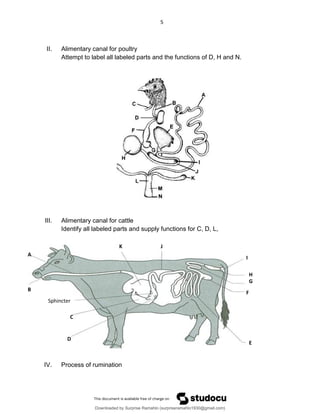
II. Alimentary canal for poultry
Attempt to label all labeled parts and the functions of D, H and N.
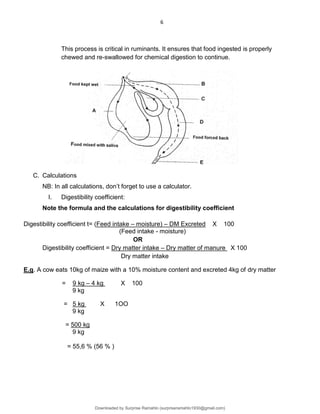
III. Alimentary canal for cattle
Identify all labeled parts and supply functions for C, D, L,
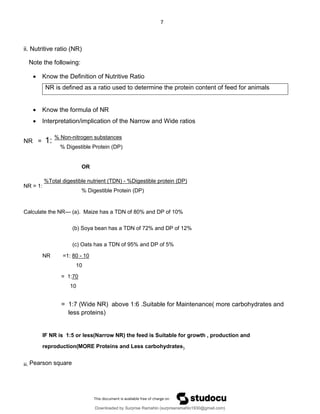
IV. Process of rumination
Sphincter
A
B
C
D
E
F
G
H
I
J
K
Downloaded by Surprise Ramahlo (surpriseramahlo1930@gmail.com)
lOMoARcPSD|29919704
6
This process is critical in ruminants. It ensures that food ingested is properly
chewed and re-swallowed for chemical digestion to continue.
C. Calculations
NB: In all calculations, don’t forget to use a calculator.
I. Digestibility coefficient:
Note the formula and the calculations for digestibility coefficient
Digestibility coefficient t= (Feed intake – moisture) – DM Excreted X 100
(Feed intake - moisture)
OR
Digestibility coefficient = Dry matter intake – Dry matter of manure X 100
Dry matter intake
E.g. A cow eats 10kg of maize with a 10% moisture content and excreted 4kg of dry matter
= 9 kg – 4 kg X 100
9 kg
= 5 kg X 1OO
9 kg
= 500 kg
9 kg
= 55,6 % (56 % )
Downloaded by Surprise Ramahlo (surpriseramahlo1930@gmail.com)
lOMoARcPSD|29919704
7
ii. Nutritive ratio (NR)
Note the following:
 Know the Definition of Nutritive Ratio
NR is defined as a ratio used to determine the protein content of feed for animals
 Know the formula of NR
 Interpretation/implication of the Narrow and Wide ratios
NR = 1: % Non-nitrogen substances
% Digestible Protein (DP)
OR
NR = 1:
%Total digestible nutrient (TDN) - %Digestible protein (DP)
% Digestible Protein (DP)
Calculate the NR— (a). Maize has a TDN of 80% and DP of 10%
(b) Soya bean has a TDN of 72% and DP of 12%
(c) Oats has a TDN of 95% and DP of 5%
NR =1: 80 - 10
10
= 1:70
10
= 1:7 (Wide NR) above 1:6 .Suitable for Maintenance( more carbohydrates and
less proteins)
IF NR is 1:5 or less(Narrow NR) the feed is Suitable for growth , production and
reproduction(MORE Proteins and Less carbohydrates).
iii. Pearson square
Downloaded by Surprise Ramahlo (surpriseramahlo1930@gmail.com)
lOMoARcPSD|29919704
8
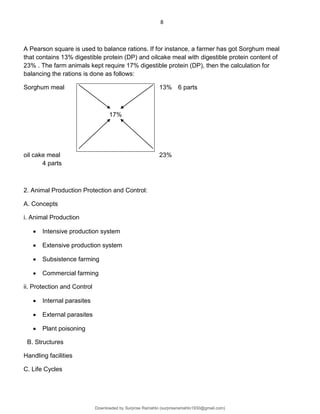
A Pearson square is used to balance rations. If for instance, a farmer has got Sorghum meal
that contains 13% digestible protein (DP) and oilcake meal with digestible protein content of
23% . The farm animals kept require 17% digestible protein (DP), then the calculation for
balancing the rations is done as follows:
Sorghum meal 13% 6 parts
oil cake meal 23%
4 parts
2. Animal Production Protection and Control:
A. Concepts
i. Animal Production
 Intensive production system
 Extensive production system
 Subsistence farming
 Commercial farming
ii. Protection and Control
 Internal parasites
 External parasites
 Plant poisoning
B. Structures
Handling facilities
C. Life Cycles
17%
Downloaded by Surprise Ramahlo (surpriseramahlo1930@gmail.com)
lOMoARcPSD|29919704
9
3. Animal Reproduction : -
A. Concepts
i. Primary and secondary reproductive organs (Male and Female)
ii. Spermatogenesis : -
iii. Oogenesis/Ovigenesis
iv. Ovulation
v. Oestrus
vi. Gestation/Pregnancy
vii. Parturition
viii. Lactation
ix. Dystocia
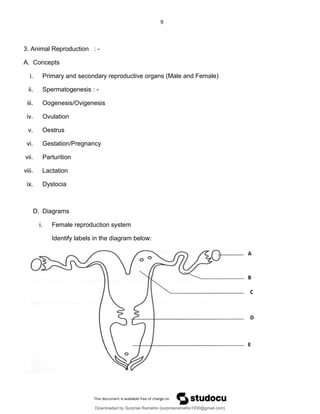
D. Diagrams
i. Female reproduction system
Identify labels in the diagram below:
A
C
B
D
E
Downloaded by Surprise Ramahlo (surpriseramahlo1930@gmail.com)
lOMoARcPSD|29919704
10
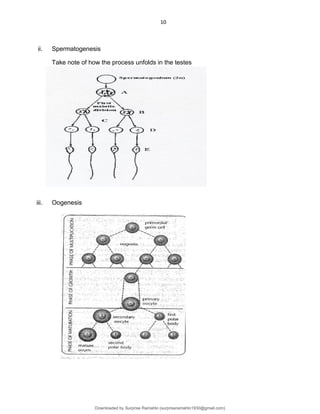
ii. Spermatogenesis
Take note of how the process unfolds in the testes
iii. Oogenesis
Downloaded by Surprise Ramahlo (surpriseramahlo1930@gmail.com)
lOMoARcPSD|29919704
11
PAPER 2
1. Agric. Management and Marketing :-
A. Concepts
i. Demand
ii. Supply
iii. Market equilibrium
vi. Market
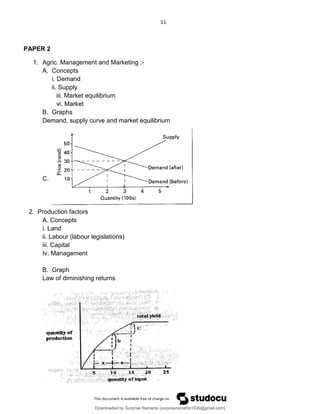
B. Graphs
Demand, supply curve and market equilibrium
C. Diagrams / Pictures
2. Production factors
A. Concepts
i. Land
ii. Labour (labour legislations)
iii. Capital
Iv. Management
B. Graph
Law of diminishing returns
Downloaded by Surprise Ramahlo (surpriseramahlo1930@gmail.com)
lOMoARcPSD|29919704
12
iii.Genotypes
vi.dominance
v. Atavism
vi. Prepotency
vii. Mutation
viii. Variation
xi. Selection
x. Monohybrid & Dihybrid crosses(Mendel’s laws)
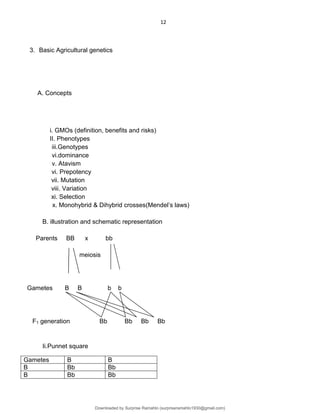
B. illustration and schematic representation
Parents BB x bb
meiosis
Gametes B B b b
F1 generation Bb Bb Bb Bb
Ii.Punnet square
Gametes B B
B Bb Bb
B Bb Bb
3. Basic Agricultural genetics
i. GMOs (definition, benefits and risks)
II. Phenotypes
A. Concepts
Downloaded by Surprise Ramahlo (surpriseramahlo1930@gmail.com)
lOMoARcPSD|29919704
13
A. GENETIC CONCEPTS:
*Monohybrid cross /monohybridism= when a single factor is involved in cross
breeding. Eg Tallness x shortness
*Dihybrid cross /dihybridism = when two factors are involved in cross
breeding. eg Tall &Light x short & dark
*Phenotype ======= physical/outward appearance of an organism
*Genotype ======= genetic composition of an organism
*Alleles ======= alternate forms of genes/pairs of
Genes (TT, Tt, tt, WW, Ww, ww)
*Homozygous alleles== similar/identical pairs of
Genes (TT, tt ,WW, ww, BB, bb)
*Heterozygous alleles== dissimilar pairs of genes(Tt, Ww, Bb Zz, Ll, Dd)
*Prepotency======= ability of an organism/individual to transmit its
characteristics to the offspring/progeny.
*Atavism======== Reappearance of ancestral characteristics
BASIC GENETICS IN DETAIL
Downloaded by Surprise Ramahlo (surpriseramahlo1930@gmail.com)
lOMoARcPSD|29919704
14
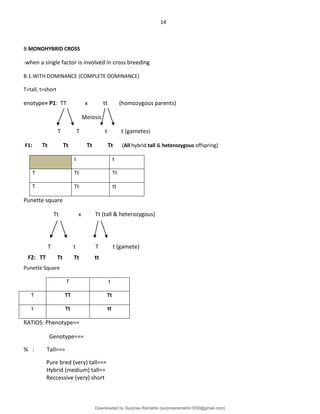
B.MONOHYBRID CROSS
-when a single factor is involved in cross breeding
B.1.WITH DOMINANCE (COMPLETE DOMINANCE)
T=tall, t=short
enotype= P1: TT x tt (homozygous parents)
Meiosis
T T t t (gametes)
F1: Tt Tt Tt Tt (All hybrid tall & heterozygous offspring)
t t
T Tt Tt
T Tt tt
Punette square
Tt x Tt (tall & heterozygous)
T t T t (gamete)
F2: TT Tt Tt tt
Punette Square
T t
T TT Tt
t Tt tt
RATIOS: Phenotype==
Genotype===
% : Tall===
Pure bred (very) tall===
Hybrid (medium) tall==
Reccessive (very) short
Downloaded by Surprise Ramahlo (surpriseramahlo1930@gmail.com)
lOMoARcPSD|29919704
15
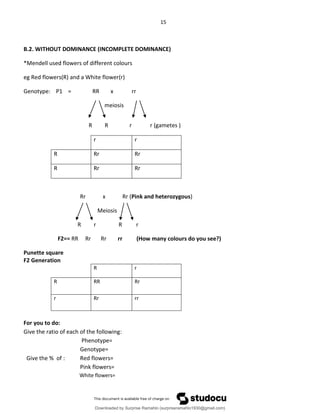
B.2. WITHOUT DOMINANCE (INCOMPLETE DOMINANCE)
*Mendell used flowers of different colours
eg Red flowers(R) and a White flower(r)
Genotype: P1 = RR x rr
meiosis
R R r r (gametes )
r r
R Rr Rr
R Rr Rr
Rr x Rr (Pink and heterozygous)
Meiosis
R r R r
F2== RR Rr Rr rr (How many colours do you see?)
Punette square
F2 Generation
R r
R RR Rr
r Rr rr
For you to do:
Give the ratio of each of the following:
Phenotype=
Genotype=
Give the % of : Red flowers=
Pink flowers=
White flowers=
Downloaded by Surprise Ramahlo (surpriseramahlo1930@gmail.com)
lOMoARcPSD|29919704
16
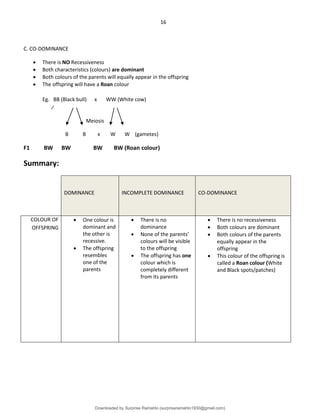
C. CO-DOMINANCE
 There is NO Recessiveness
 Both characteristics (colours) are dominant
 Both colours of the parents will equally appear in the offspring
 The offspring will have a Roan colour
Eg. BB (Black bull) x WW (White cow)
∕
Meiosis
B B x W W (gametes)
F1 BW BW BW BW (Roan colour)
Summary:
DOMINANCE INCOMPLETE DOMINANCE CO-DOMINANCE
COLOUR OF
OFFSPRING
 One colour is
dominant and
the other is
recessive.
 The offspring
resembles
one of the
parents
 There is no
dominance
 None of the parents’
colours will be visible
to the offspring
 The offspring has one
colour which is
completely different
from its parents
 There is no recessiveness
 Both colours are dominant
 Both colours of the parents
equally appear in the
offspring
 This colour of the offspring is
called a Roan colour (White
and Black spots/patches)
Downloaded by Surprise Ramahlo (surpriseramahlo1930@gmail.com)
lOMoARcPSD|29919704
17
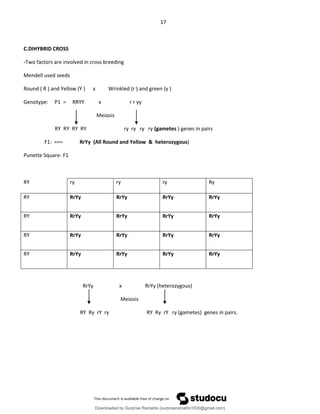
C.DIHYBRID CROSS
-Two factors are involved in cross breeding
Mendell used seeds
Round ( R ) and Yellow (Y ) x Wrinkled (r ) and green (y )
Genotype: P1 = RRYY x r r yy
Meiosis
RY RY RY RY ry ry ry ry (gametes ) genes in pairs
F1: === RrYy (All Round and Yellow & heterozygous)
Punette Square- F1
RY ry ry ry Ry
RY RrYy RrYy RrYy RrYy
RrYy x RrYy (heterozygous)
Meiosis
RY Ry rY ry RY Ry rY ry (gametes) genes in pairs.
Downloaded by Surprise Ramahlo (surpriseramahlo1930@gmail.com)
lOMoARcPSD|29919704
Copyright reserved
Punette Square
RY Ry rY ry
RY
Ry
rY
Ry
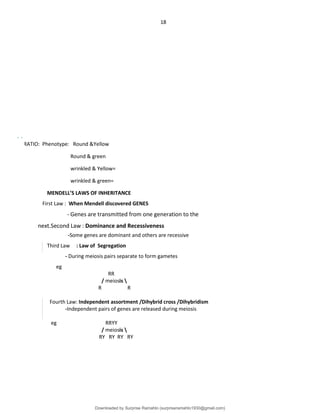
RATIO: Phenotype: Round &Yellow
Round & green
wrinkled & Yellow=
wrinkled & green=
MENDELL’S LAWS OF INHERITANCE
First Law : When Mendell discovered GENES
-Some genes are dominant and others are recessive
Third Law : Law of Segregation
- During meiosis pairs separate to form gametes
eg
RR
/ meiosis 
R R
Fourth Law: Independent assortment /Dihybrid cross /Dihybridism
-Independent pairs of genes are released during meiosis
eg RRYY
/ meiosis 
RY RY RY RY
- Genes are transmitted from one generation to the
next.Second Law : Dominance and Recessiveness
18
Downloaded by Surprise Ramahlo (surpriseramahlo1930@gmail.com)
lOMoARcPSD|29919704
19
1.TIPS FOR SUCCESS IN AGRICULTURAL SCIENCES: GRADE 12
Do your learners often struggle with the data response questions in the final exam? Try these hints to help
them cope:
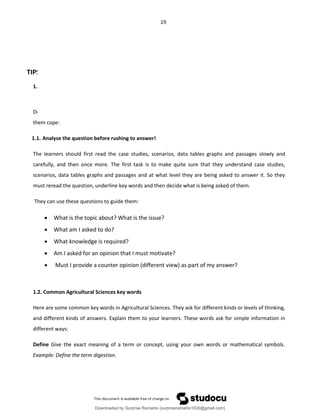
1.1. Analyse the question before rushing to answer!
The learners should first read the case studies, scenarios, data tables graphs and passages slowly and
carefully, and then once more. The first task is to make quite sure that they understand case studies,
scenarios, data tables graphs and passages and at what level they are being asked to answer it. So they
must reread the question, underline key words and then decide what is being asked of them.
They can use these questions to guide them:
 What is the topic about? What is the issue?
 What am I asked to do?
 What knowledge is required?
 Am I asked for an opinion that I must motivate?
 Must I provide a counter opinion (different view) as part of my answer?
1.2. Common Agricultural Sciences key words
Here are some common key words in Agricultural Sciences. They ask for different kinds or levels of thinking,
and different kinds of answers. Explain them to your learners. These words ask for simple information in
different ways:
Define Give the exact meaning of a term or concept, using your own words or mathematical symbols.
Example: Define the term digestion.
TIPS AND FREQUENTLY ASKED QUESTIONS
Downloaded by Surprise Ramahlo (surpriseramahlo1930@gmail.com)
lOMoARcPSD|29919704
20
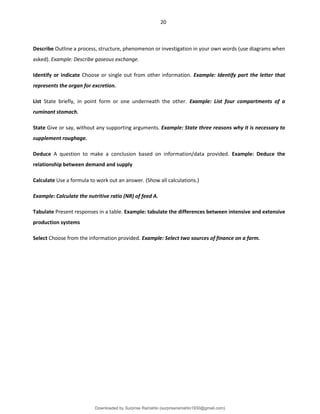
Describe Outline a process, structure, phenomenon or investigation in your own words (use diagrams when
asked). Example: Describe gaseous exchange.
Identify or indicate Choose or single out from other information. Example: Identify part the letter that
represents the organ for excretion.
List State briefly, in point form or one underneath the other. Example: List four compartments of a
ruminant stomach.
State Give or say, without any supporting arguments. Example: State three reasons why it is necessary to
supplement roughage.
Deduce A question to make a conclusion based on information/data provided. Example: Deduce the
relationship between demand and supply
Calculate Use a formula to work out an answer. (Show all calculations.)
Example: Calculate the nutritive ratio (NR) of feed A.
Tabulate Present responses in a table. Example: tabulate the differences between intensive and extensive
production systems
Select Choose from the information provided. Example: Select two sources of finance on a farm.
Downloaded by Surprise Ramahlo (surpriseramahlo1930@gmail.com)
lOMoARcPSD|29919704
PAPER 1
TOPICS 2012 November 2013 November 2014 November 2015 November
1. Animal
Nutrition
Alimentary canal of a ruminant(
Labeling, Requirements of rumen
micro organisms
Alimentary canal of a ruminant(
Labeling, functions of major parts)
Diagram illustrating the route
of food in ruminant stomach
Alimentary canal of a non-
ruminant( Labeling , functions
of major parts)
Calculation of (digestibility co-
efficient.
Calculation of digestibility co-
efficient – implication of calculated
value
Calculation of digestibility co-
efficient – implication of
calculated value
Calculation of (digestibility co-
efficient).
Processes used to improve
digestibility of feeds
Calculation of nutritive ratio NR) Calculation of nutritive ratio
NR(Suitability of NR)
Calculation of nutritive ratio
NR(Suitability of NR)
 Calculation of Pearson
Square
Calculation of Pearson –
Square(ratio & percentage of feeds)
Calculation of Pearson –
Square(ratio & percentage of
feeds
 Fodder flow
programme (bar
graph – cost effective
measures for better
utilization of feeds)
 Calculation of Pearson
Square
 Fodder Flow (
Calculation)
FREQUENTLY ASKED QUESTIONS (FOR THE PAST FOUR YEARS)
Downloaded by Surprise Ramahlo (surpriseramahlo1930@gmail.com)
lOMoARcPSD|29919704
 Enzymatic digestion
 Structure of the villus
(Labeling and absorption)
 Adaptation of parts for
absorption)
 Absorption of fat
molecules
Nutritional value of pasture on
micro organisms
Vitamin A (Functions and deficiency
symptoms)
Methods of supplementing
vitamins & minerals
 Deficiency symptoms of
vitamins & minerals
vitamins & minerals Water (functions) Deficiency
symptoms of vitamins &
minerals
2. Animal
production,
protection
and control
 Extensive production
system( optimizing
production, primary
products)
Characteristics of intensive
production system
Extensive and intensive
production system (
characteristics, measures to
increase production in an
extensive system)
Free range production system
(advantages & disadvantages
Extensive and intensive
production
system(Differences)
 Animal handling and
behavior( Behavioural
patterns)
 Animal behaviour
 Impact of temperature on
production
 Handling and
management of farm
animals (structure
used to handle
animals)
Downloaded by Surprise Ramahlo (surpriseramahlo1930@gmail.com)
lOMoARcPSD|29919704
 External parasites( passage
on ticks, economical value
of ticks, life cycle of bont
tick, biological control of
external parasites
 Vaccination programme
 The role of state in animal
protection
 Pest and disease
management
 Indigenous farm animals
(case study)
 Disease control measures
(indigenous v/s chemical)
 External parasites(
control & diseases)
 The role of state over
medication
 Characteristics of eco-
 friendly chemicals
 Plant
poisoning(examples
and control measures)
External parasites( method
used to administer remedies)
 Fat content(graph)  Feed consumption v/s
production
 Broiler production
 Impact of
temperature on
production

3. Animal
reproduction
 Male reproductive system
(spermatogenesis, structure
of spermatozoon)
 Artificial insemination(AI)
 Pregnancy (stages)
 Female reproductive
system(labeling)
 Parturition( stages in
pictures)
 Signs of parturition
Downloaded by Surprise Ramahlo (surpriseramahlo1930@gmail.com)
lOMoARcPSD|29919704
 Hormones [graph]
(oestrogen & progesterone)
 Hormones [graph]
(oestrogen & progesterone)
 Signs of oestrus
 Adaptability of
infundibulum to
 capture ova
 Oestrogen &
progesterone (role in
oestrus cycle)
 Structure of
spermatozoon(labelin
g &
 functions)
 Artificial
insemination(AI) –
definition &
requirements
 Embryo transfer(ET)
– stages and benefits
 Hormones[graph]
Oestrogen &
progesterone)
 Oogenesis
 Cloning
ADD YOUR OWN NOTES:
Downloaded by Surprise Ramahlo (surpriseramahlo1930@gmail.com)
lOMoARcPSD|29919704
PAPER 2
TOPICS 2012 November 2013 November 2014 November 2015 November
1. Agricultural
marketing and
management
 Supply and demand (market
equilibrium, inelasticity of
supply, role of processing in
supply)
 Developing marketing
strategy(marketing
elements)
 Business plan(items to be
included
 Characteristics of
successful entrepreneur
 Marketing systems
 Comparing prices using a
bar graph
 Agri-business chain
 Demand and supply
 Price trend in a market
system
 Sequence in decision
making process
 Line graph on
supply
 Market strategy to
increase supply
 Agri-business chain
 Economic reasons
for decrease in supply
 Marketing strategies
and procedures
 SWOT analysis
 Aspects of feasibility
study
 Marketing type
 Relationship between
price , supply and
demand
 Graph
2. Production
factors
 Case study on production
factors
 Forms of assets
 Problems of capital and
 Case study on land ( land
reform policy, aims of equity
schemes)
 Capital (forms and
sources)
 Labour contracts
(type of farm labour
signing a contract)
 Labour legislation
 Impact of HIV/AIDS
 Case study
Downloaded by Surprise Ramahlo (surpriseramahlo1930@gmail.com)
lOMoARcPSD|29919704
ways to increase capital
 Management as a
production factor
 Land (Ways to improve
land productivity)
 Labour (ways to improve
labour productivity,
HIV/AIDS on labour
productivity)
 Net value (definition &
calculation)
 Law of diminishing returns
(causes of decrease in
production output)
 Farm labour
(characteristics of a
permanent labourer, causes
for loss of farm labour)
on farm labour
 Capital (examples
from a diagram, assets
and liabilities)
 Land (law of
diminishing returns,
measures to increase
land productivity)
 External factors
impacting on farm
business
 Essential farm
records
 Labour legislation
 Labour (ways to
improve labour
productivity
 Land (law of
diminishing returns,
measures to increase
land productivity)
Downloaded by Surprise Ramahlo (surpriseramahlo1930@gmail.com)
lOMoARcPSD|29919704
3. Basic
agricultural
genetics
 GMOs (dangers of GMO
food, benefits of GMO food)
 Phenotypic and genotypic
ratios
 Drawing of a Punnet square
 Selection and variation(
uses of variation in
breeding, importance of
variation)
 Importance of index value
 Cloning (Steps and
importance/advantages)
 Role of co-dominance
 Incomplete and co-
dominance
 Genotypic and phenotypic
percentages
 Calculation of Estimated
breeding value(EBV)
 Species
crossing(importance)
 GMO (techniques used,
conventional seeds vs GMO
seeds, advantages of GMO)
 Hybrid
crossing(phenotype and
genotype)
 Drawing of a Punnett
square
 Comparison of
upgrading, line breeding
and crossbreeding.
Disadvantages of line
breeding
 The difference between
co-dominance and
incomplete dominance
 GMO (methods /
techniques used,
disadvantages.)
 Differences between
continuous and
discontinuous variation
 Selection ( methods and
definition)
 Monohybrid cross
 Breeding system
(upgrading)
 Difference in
yield(GMO & non-
GMO)
 Pontential benefits
(Advantages)
 Pontential risks (
Disadvantages)
Downloaded by Surprise Ramahlo (surpriseramahlo1930@gmail.com)
lOMoARcPSD|29919704

agricultural-sciences-grade-12-notes.pdf

  • 1.
    Agricultural Sciences grade12 notes Agricultural Sciences (High School - South Africa) Scan to open on Studocu Studocu is not sponsored or endorsed by any college or university Agricultural Sciences grade 12 notes Agricultural Sciences (High School - South Africa) Scan to open on Studocu Studocu is not sponsored or endorsed by any college or university Downloaded by Surprise Ramahlo (surpriseramahlo1930@gmail.com) lOMoARcPSD|29919704
  • 2.
    AGRICULTURAL SCIENCES NOTES GRADE 12 Downloadedby Surprise Ramahlo (surpriseramahlo1930@gmail.com) lOMoARcPSD|29919704
  • 3.
    2 TABLE OF CONTENTS Introduction3 Animal Nutrition 4-7 Animal Production, Protection and Control 8-9 Animal Reproduction 9-11 Agric. Management and Marketing 11- 12 Basic Agricultural Genetics 12-20 Tips And Frequently Asked Questions 21-30 Downloaded by Surprise Ramahlo (surpriseramahlo1930@gmail.com) lOMoARcPSD|29919704
  • 4.
    3 The purpose ofthese not es is to assist grade 12 learners in preparation for their exams The activities in this document are meant to be a guide and not to replace any study material/ text book. The not es focus on selected challenging content topics informed by experience of dedicated curriculum implementers and analysis of June results 2017 The not es are compiled from several class at t endance Downloaded by Surprise Ramahlo (surpriseramahlo1930@gmail.com) lOMoARcPSD|29919704
  • 5.
    4 PAPER 1 1 .Animal Nutrition : A. Concepts  Ruminant: Animal with a complex/compound stomach [eg. Cattle, Sheep, Goats]  Non-ruminant (monogastric): Animal with a single/simple stomach [eg. Pigs, Poultry, Horses]  Rumination: The process of bringing back the cud/bolus food into the mouth for re- chewing, re-insalivation and re-swallowing.  Peristalsis: The movement of food through the alimentary canal / rhythmic contraction and relaxation of muscles of the alimentary canal.  Retroperistalsis /regurgitation: The bringing back of food from the stomach to the mouth cavity.  Chyme : The contents of the stomach  Chyle: The contents of the small intestines  Biological value (BV): The quality of proteins in the feed. B. Diagrams. Possible diagrams. I. Alimentary canal for a pig Carefully take note of the main parts of the alimentary canal of a pig and locate their functions in the process of digestion. Downloaded by Surprise Ramahlo (surpriseramahlo1930@gmail.com) lOMoARcPSD|29919704
  • 6.
    5 II. Alimentary canalfor poultry Attempt to label all labeled parts and the functions of D, H and N. III. Alimentary canal for cattle Identify all labeled parts and supply functions for C, D, L, IV. Process of rumination Sphincter A B C D E F G H I J K Downloaded by Surprise Ramahlo (surpriseramahlo1930@gmail.com) lOMoARcPSD|29919704
  • 7.
    6 This process iscritical in ruminants. It ensures that food ingested is properly chewed and re-swallowed for chemical digestion to continue. C. Calculations NB: In all calculations, don’t forget to use a calculator. I. Digestibility coefficient: Note the formula and the calculations for digestibility coefficient Digestibility coefficient t= (Feed intake – moisture) – DM Excreted X 100 (Feed intake - moisture) OR Digestibility coefficient = Dry matter intake – Dry matter of manure X 100 Dry matter intake E.g. A cow eats 10kg of maize with a 10% moisture content and excreted 4kg of dry matter = 9 kg – 4 kg X 100 9 kg = 5 kg X 1OO 9 kg = 500 kg 9 kg = 55,6 % (56 % ) Downloaded by Surprise Ramahlo (surpriseramahlo1930@gmail.com) lOMoARcPSD|29919704
  • 8.
    7 ii. Nutritive ratio(NR) Note the following:  Know the Definition of Nutritive Ratio NR is defined as a ratio used to determine the protein content of feed for animals  Know the formula of NR  Interpretation/implication of the Narrow and Wide ratios NR = 1: % Non-nitrogen substances % Digestible Protein (DP) OR NR = 1: %Total digestible nutrient (TDN) - %Digestible protein (DP) % Digestible Protein (DP) Calculate the NR— (a). Maize has a TDN of 80% and DP of 10% (b) Soya bean has a TDN of 72% and DP of 12% (c) Oats has a TDN of 95% and DP of 5% NR =1: 80 - 10 10 = 1:70 10 = 1:7 (Wide NR) above 1:6 .Suitable for Maintenance( more carbohydrates and less proteins) IF NR is 1:5 or less(Narrow NR) the feed is Suitable for growth , production and reproduction(MORE Proteins and Less carbohydrates). iii. Pearson square Downloaded by Surprise Ramahlo (surpriseramahlo1930@gmail.com) lOMoARcPSD|29919704
  • 9.
    8 A Pearson squareis used to balance rations. If for instance, a farmer has got Sorghum meal that contains 13% digestible protein (DP) and oilcake meal with digestible protein content of 23% . The farm animals kept require 17% digestible protein (DP), then the calculation for balancing the rations is done as follows: Sorghum meal 13% 6 parts oil cake meal 23% 4 parts 2. Animal Production Protection and Control: A. Concepts i. Animal Production  Intensive production system  Extensive production system  Subsistence farming  Commercial farming ii. Protection and Control  Internal parasites  External parasites  Plant poisoning B. Structures Handling facilities C. Life Cycles 17% Downloaded by Surprise Ramahlo (surpriseramahlo1930@gmail.com) lOMoARcPSD|29919704
  • 10.
    9 3. Animal Reproduction: - A. Concepts i. Primary and secondary reproductive organs (Male and Female) ii. Spermatogenesis : - iii. Oogenesis/Ovigenesis iv. Ovulation v. Oestrus vi. Gestation/Pregnancy vii. Parturition viii. Lactation ix. Dystocia D. Diagrams i. Female reproduction system Identify labels in the diagram below: A C B D E Downloaded by Surprise Ramahlo (surpriseramahlo1930@gmail.com) lOMoARcPSD|29919704
  • 11.
    10 ii. Spermatogenesis Take noteof how the process unfolds in the testes iii. Oogenesis Downloaded by Surprise Ramahlo (surpriseramahlo1930@gmail.com) lOMoARcPSD|29919704
  • 12.
    11 PAPER 2 1. Agric.Management and Marketing :- A. Concepts i. Demand ii. Supply iii. Market equilibrium vi. Market B. Graphs Demand, supply curve and market equilibrium C. Diagrams / Pictures 2. Production factors A. Concepts i. Land ii. Labour (labour legislations) iii. Capital Iv. Management B. Graph Law of diminishing returns Downloaded by Surprise Ramahlo (surpriseramahlo1930@gmail.com) lOMoARcPSD|29919704
  • 13.
    12 iii.Genotypes vi.dominance v. Atavism vi. Prepotency vii.Mutation viii. Variation xi. Selection x. Monohybrid & Dihybrid crosses(Mendel’s laws) B. illustration and schematic representation Parents BB x bb meiosis Gametes B B b b F1 generation Bb Bb Bb Bb Ii.Punnet square Gametes B B B Bb Bb B Bb Bb 3. Basic Agricultural genetics i. GMOs (definition, benefits and risks) II. Phenotypes A. Concepts Downloaded by Surprise Ramahlo (surpriseramahlo1930@gmail.com) lOMoARcPSD|29919704
  • 14.
    13 A. GENETIC CONCEPTS: *Monohybridcross /monohybridism= when a single factor is involved in cross breeding. Eg Tallness x shortness *Dihybrid cross /dihybridism = when two factors are involved in cross breeding. eg Tall &Light x short & dark *Phenotype ======= physical/outward appearance of an organism *Genotype ======= genetic composition of an organism *Alleles ======= alternate forms of genes/pairs of Genes (TT, Tt, tt, WW, Ww, ww) *Homozygous alleles== similar/identical pairs of Genes (TT, tt ,WW, ww, BB, bb) *Heterozygous alleles== dissimilar pairs of genes(Tt, Ww, Bb Zz, Ll, Dd) *Prepotency======= ability of an organism/individual to transmit its characteristics to the offspring/progeny. *Atavism======== Reappearance of ancestral characteristics BASIC GENETICS IN DETAIL Downloaded by Surprise Ramahlo (surpriseramahlo1930@gmail.com) lOMoARcPSD|29919704
  • 15.
    14 B.MONOHYBRID CROSS -when asingle factor is involved in cross breeding B.1.WITH DOMINANCE (COMPLETE DOMINANCE) T=tall, t=short enotype= P1: TT x tt (homozygous parents) Meiosis T T t t (gametes) F1: Tt Tt Tt Tt (All hybrid tall & heterozygous offspring) t t T Tt Tt T Tt tt Punette square Tt x Tt (tall & heterozygous) T t T t (gamete) F2: TT Tt Tt tt Punette Square T t T TT Tt t Tt tt RATIOS: Phenotype== Genotype=== % : Tall=== Pure bred (very) tall=== Hybrid (medium) tall== Reccessive (very) short Downloaded by Surprise Ramahlo (surpriseramahlo1930@gmail.com) lOMoARcPSD|29919704
  • 16.
    15 B.2. WITHOUT DOMINANCE(INCOMPLETE DOMINANCE) *Mendell used flowers of different colours eg Red flowers(R) and a White flower(r) Genotype: P1 = RR x rr meiosis R R r r (gametes ) r r R Rr Rr R Rr Rr Rr x Rr (Pink and heterozygous) Meiosis R r R r F2== RR Rr Rr rr (How many colours do you see?) Punette square F2 Generation R r R RR Rr r Rr rr For you to do: Give the ratio of each of the following: Phenotype= Genotype= Give the % of : Red flowers= Pink flowers= White flowers= Downloaded by Surprise Ramahlo (surpriseramahlo1930@gmail.com) lOMoARcPSD|29919704
  • 17.
    16 C. CO-DOMINANCE  Thereis NO Recessiveness  Both characteristics (colours) are dominant  Both colours of the parents will equally appear in the offspring  The offspring will have a Roan colour Eg. BB (Black bull) x WW (White cow) ∕ Meiosis B B x W W (gametes) F1 BW BW BW BW (Roan colour) Summary: DOMINANCE INCOMPLETE DOMINANCE CO-DOMINANCE COLOUR OF OFFSPRING  One colour is dominant and the other is recessive.  The offspring resembles one of the parents  There is no dominance  None of the parents’ colours will be visible to the offspring  The offspring has one colour which is completely different from its parents  There is no recessiveness  Both colours are dominant  Both colours of the parents equally appear in the offspring  This colour of the offspring is called a Roan colour (White and Black spots/patches) Downloaded by Surprise Ramahlo (surpriseramahlo1930@gmail.com) lOMoARcPSD|29919704
  • 18.
    17 C.DIHYBRID CROSS -Two factorsare involved in cross breeding Mendell used seeds Round ( R ) and Yellow (Y ) x Wrinkled (r ) and green (y ) Genotype: P1 = RRYY x r r yy Meiosis RY RY RY RY ry ry ry ry (gametes ) genes in pairs F1: === RrYy (All Round and Yellow & heterozygous) Punette Square- F1 RY ry ry ry Ry RY RrYy RrYy RrYy RrYy RY RrYy RrYy RrYy RrYy RY RrYy RrYy RrYy RrYy RY RrYy RrYy RrYy RrYy RrYy x RrYy (heterozygous) Meiosis RY Ry rY ry RY Ry rY ry (gametes) genes in pairs. Downloaded by Surprise Ramahlo (surpriseramahlo1930@gmail.com) lOMoARcPSD|29919704
  • 19.
    Copyright reserved Punette Square RYRy rY ry RY Ry rY Ry RATIO: Phenotype: Round &Yellow Round & green wrinkled & Yellow= wrinkled & green= MENDELL’S LAWS OF INHERITANCE First Law : When Mendell discovered GENES -Some genes are dominant and others are recessive Third Law : Law of Segregation - During meiosis pairs separate to form gametes eg RR / meiosis R R Fourth Law: Independent assortment /Dihybrid cross /Dihybridism -Independent pairs of genes are released during meiosis eg RRYY / meiosis RY RY RY RY - Genes are transmitted from one generation to the next.Second Law : Dominance and Recessiveness 18 Downloaded by Surprise Ramahlo (surpriseramahlo1930@gmail.com) lOMoARcPSD|29919704
  • 20.
    19 1.TIPS FOR SUCCESSIN AGRICULTURAL SCIENCES: GRADE 12 Do your learners often struggle with the data response questions in the final exam? Try these hints to help them cope: 1.1. Analyse the question before rushing to answer! The learners should first read the case studies, scenarios, data tables graphs and passages slowly and carefully, and then once more. The first task is to make quite sure that they understand case studies, scenarios, data tables graphs and passages and at what level they are being asked to answer it. So they must reread the question, underline key words and then decide what is being asked of them. They can use these questions to guide them:  What is the topic about? What is the issue?  What am I asked to do?  What knowledge is required?  Am I asked for an opinion that I must motivate?  Must I provide a counter opinion (different view) as part of my answer? 1.2. Common Agricultural Sciences key words Here are some common key words in Agricultural Sciences. They ask for different kinds or levels of thinking, and different kinds of answers. Explain them to your learners. These words ask for simple information in different ways: Define Give the exact meaning of a term or concept, using your own words or mathematical symbols. Example: Define the term digestion. TIPS AND FREQUENTLY ASKED QUESTIONS Downloaded by Surprise Ramahlo (surpriseramahlo1930@gmail.com) lOMoARcPSD|29919704
  • 21.
    20 Describe Outline aprocess, structure, phenomenon or investigation in your own words (use diagrams when asked). Example: Describe gaseous exchange. Identify or indicate Choose or single out from other information. Example: Identify part the letter that represents the organ for excretion. List State briefly, in point form or one underneath the other. Example: List four compartments of a ruminant stomach. State Give or say, without any supporting arguments. Example: State three reasons why it is necessary to supplement roughage. Deduce A question to make a conclusion based on information/data provided. Example: Deduce the relationship between demand and supply Calculate Use a formula to work out an answer. (Show all calculations.) Example: Calculate the nutritive ratio (NR) of feed A. Tabulate Present responses in a table. Example: tabulate the differences between intensive and extensive production systems Select Choose from the information provided. Example: Select two sources of finance on a farm. Downloaded by Surprise Ramahlo (surpriseramahlo1930@gmail.com) lOMoARcPSD|29919704
  • 22.
    PAPER 1 TOPICS 2012November 2013 November 2014 November 2015 November 1. Animal Nutrition Alimentary canal of a ruminant( Labeling, Requirements of rumen micro organisms Alimentary canal of a ruminant( Labeling, functions of major parts) Diagram illustrating the route of food in ruminant stomach Alimentary canal of a non- ruminant( Labeling , functions of major parts) Calculation of (digestibility co- efficient. Calculation of digestibility co- efficient – implication of calculated value Calculation of digestibility co- efficient – implication of calculated value Calculation of (digestibility co- efficient). Processes used to improve digestibility of feeds Calculation of nutritive ratio NR) Calculation of nutritive ratio NR(Suitability of NR) Calculation of nutritive ratio NR(Suitability of NR)  Calculation of Pearson Square Calculation of Pearson – Square(ratio & percentage of feeds) Calculation of Pearson – Square(ratio & percentage of feeds  Fodder flow programme (bar graph – cost effective measures for better utilization of feeds)  Calculation of Pearson Square  Fodder Flow ( Calculation) FREQUENTLY ASKED QUESTIONS (FOR THE PAST FOUR YEARS) Downloaded by Surprise Ramahlo (surpriseramahlo1930@gmail.com) lOMoARcPSD|29919704
  • 23.
     Enzymatic digestion Structure of the villus (Labeling and absorption)  Adaptation of parts for absorption)  Absorption of fat molecules Nutritional value of pasture on micro organisms Vitamin A (Functions and deficiency symptoms) Methods of supplementing vitamins & minerals  Deficiency symptoms of vitamins & minerals vitamins & minerals Water (functions) Deficiency symptoms of vitamins & minerals 2. Animal production, protection and control  Extensive production system( optimizing production, primary products) Characteristics of intensive production system Extensive and intensive production system ( characteristics, measures to increase production in an extensive system) Free range production system (advantages & disadvantages Extensive and intensive production system(Differences)  Animal handling and behavior( Behavioural patterns)  Animal behaviour  Impact of temperature on production  Handling and management of farm animals (structure used to handle animals) Downloaded by Surprise Ramahlo (surpriseramahlo1930@gmail.com) lOMoARcPSD|29919704
  • 24.
     External parasites(passage on ticks, economical value of ticks, life cycle of bont tick, biological control of external parasites  Vaccination programme  The role of state in animal protection  Pest and disease management  Indigenous farm animals (case study)  Disease control measures (indigenous v/s chemical)  External parasites( control & diseases)  The role of state over medication  Characteristics of eco-  friendly chemicals  Plant poisoning(examples and control measures) External parasites( method used to administer remedies)  Fat content(graph)  Feed consumption v/s production  Broiler production  Impact of temperature on production  3. Animal reproduction  Male reproductive system (spermatogenesis, structure of spermatozoon)  Artificial insemination(AI)  Pregnancy (stages)  Female reproductive system(labeling)  Parturition( stages in pictures)  Signs of parturition Downloaded by Surprise Ramahlo (surpriseramahlo1930@gmail.com) lOMoARcPSD|29919704
  • 25.
     Hormones [graph] (oestrogen& progesterone)  Hormones [graph] (oestrogen & progesterone)  Signs of oestrus  Adaptability of infundibulum to  capture ova  Oestrogen & progesterone (role in oestrus cycle)  Structure of spermatozoon(labelin g &  functions)  Artificial insemination(AI) – definition & requirements  Embryo transfer(ET) – stages and benefits  Hormones[graph] Oestrogen & progesterone)  Oogenesis  Cloning ADD YOUR OWN NOTES: Downloaded by Surprise Ramahlo (surpriseramahlo1930@gmail.com) lOMoARcPSD|29919704
  • 26.
    PAPER 2 TOPICS 2012November 2013 November 2014 November 2015 November 1. Agricultural marketing and management  Supply and demand (market equilibrium, inelasticity of supply, role of processing in supply)  Developing marketing strategy(marketing elements)  Business plan(items to be included  Characteristics of successful entrepreneur  Marketing systems  Comparing prices using a bar graph  Agri-business chain  Demand and supply  Price trend in a market system  Sequence in decision making process  Line graph on supply  Market strategy to increase supply  Agri-business chain  Economic reasons for decrease in supply  Marketing strategies and procedures  SWOT analysis  Aspects of feasibility study  Marketing type  Relationship between price , supply and demand  Graph 2. Production factors  Case study on production factors  Forms of assets  Problems of capital and  Case study on land ( land reform policy, aims of equity schemes)  Capital (forms and sources)  Labour contracts (type of farm labour signing a contract)  Labour legislation  Impact of HIV/AIDS  Case study Downloaded by Surprise Ramahlo (surpriseramahlo1930@gmail.com) lOMoARcPSD|29919704
  • 27.
    ways to increasecapital  Management as a production factor  Land (Ways to improve land productivity)  Labour (ways to improve labour productivity, HIV/AIDS on labour productivity)  Net value (definition & calculation)  Law of diminishing returns (causes of decrease in production output)  Farm labour (characteristics of a permanent labourer, causes for loss of farm labour) on farm labour  Capital (examples from a diagram, assets and liabilities)  Land (law of diminishing returns, measures to increase land productivity)  External factors impacting on farm business  Essential farm records  Labour legislation  Labour (ways to improve labour productivity  Land (law of diminishing returns, measures to increase land productivity) Downloaded by Surprise Ramahlo (surpriseramahlo1930@gmail.com) lOMoARcPSD|29919704
  • 28.
    3. Basic agricultural genetics  GMOs(dangers of GMO food, benefits of GMO food)  Phenotypic and genotypic ratios  Drawing of a Punnet square  Selection and variation( uses of variation in breeding, importance of variation)  Importance of index value  Cloning (Steps and importance/advantages)  Role of co-dominance  Incomplete and co- dominance  Genotypic and phenotypic percentages  Calculation of Estimated breeding value(EBV)  Species crossing(importance)  GMO (techniques used, conventional seeds vs GMO seeds, advantages of GMO)  Hybrid crossing(phenotype and genotype)  Drawing of a Punnett square  Comparison of upgrading, line breeding and crossbreeding. Disadvantages of line breeding  The difference between co-dominance and incomplete dominance  GMO (methods / techniques used, disadvantages.)  Differences between continuous and discontinuous variation  Selection ( methods and definition)  Monohybrid cross  Breeding system (upgrading)  Difference in yield(GMO & non- GMO)  Pontential benefits (Advantages)  Pontential risks ( Disadvantages) Downloaded by Surprise Ramahlo (surpriseramahlo1930@gmail.com) lOMoARcPSD|29919704