Agri - Crop Production Quarter 3 - Module 4 Required Personal Protective Equipment (PPE) in Nursery Work
Safety First
Agri - Crop Production Quarter 3 - Module 4 Required Personal Protective Equipment (PPE) in Nursery Work
Required Personal
Protective
Equipment (PPE) in
Nursery Work
Agri - Crop Production Quarter 3 - Module 4 Required Personal Protective Equipment (PPE) in Nursery Work
Knowing about safety can help
prevent accidents. Accidents
are actions that occur
unintentionally. Accidents
cannot be predicted, but they are
more likely to occur in hazardous
situations. They can happen
anywhere, including in the home,
Agri - Crop Production Quarter 3 - Module 4 Required Personal Protective Equipment (PPE) in Nursery Work
Major areas of concern in doing
horticultural work includes safety
practices in pest control, safety
with machinery tools, and safety
with tractors and large equipment.
Knowing how to properly use
these items can help reduce risk
and help prevent accidents.
Personal protective equipment,
commonly referred to as "PPE", is
equipment worn to minimize exposure to
hazards that cause serious workplace
injuries and illnesses.
These injuries and illnesses may
result from contact with chemical,
radiological, physical, electrical,
mechanical, or other workplace
hazards.
The lungs, e.g. from breathing in
contaminated air
The head and feet, e.g. from falling
materials
The eyes, e.g. from flying particles or
splashes of corrosive liquids
Choose products which are CE marked in
accordance with the Personal Protective
Equipment (Enforcement) Regulations
2018 – suppliers can advise you.
When selecting and
using PPE
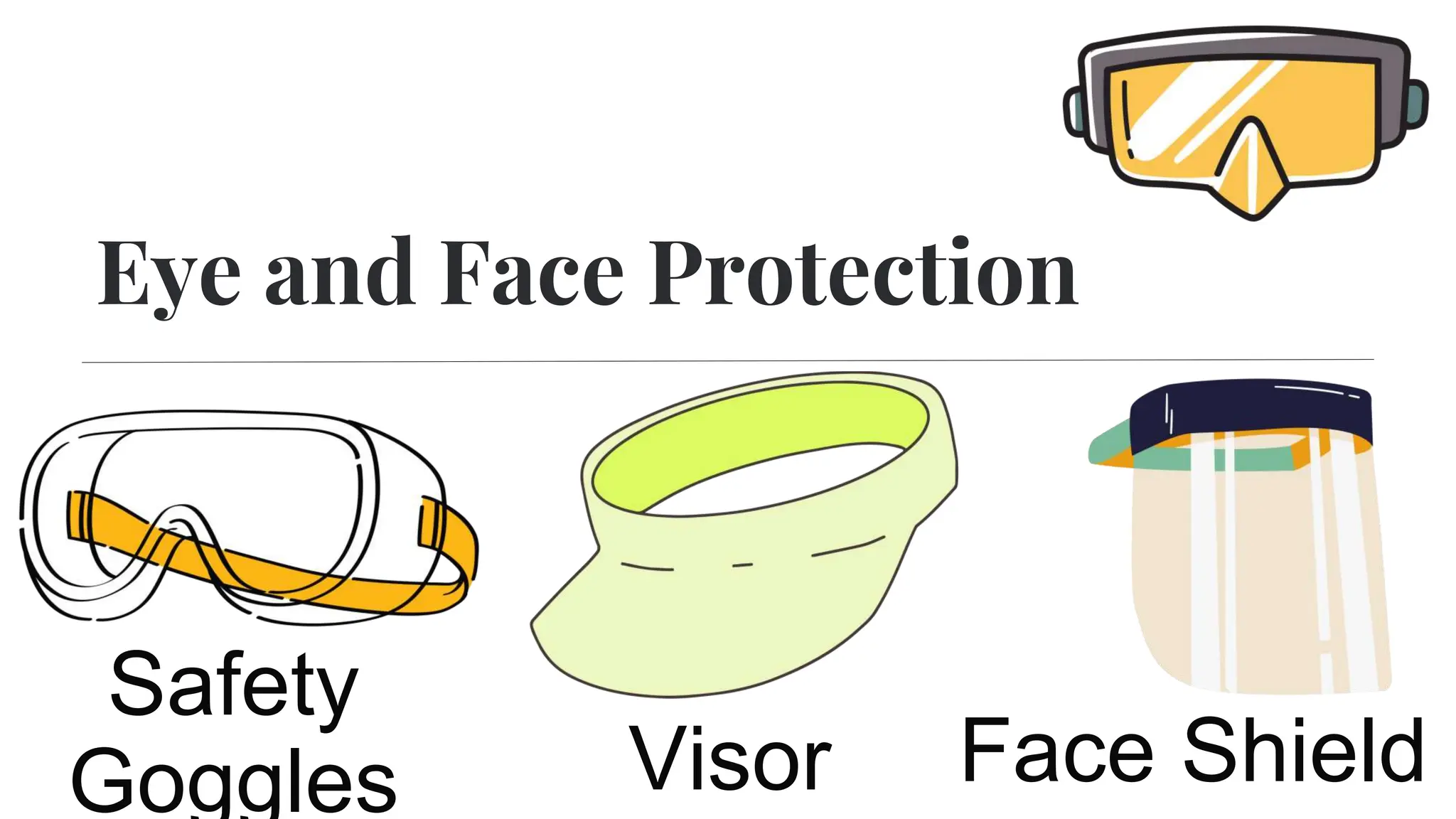
Eye and Face Protection – to
provide protection during
EXPOSURE to hazards like
flying particles, metals or
sparks, liquid chemicals,
caustic liquids, and light
radiation, i.e., welding lasers.
To provide protection during
exposure to hazards like flying
particles, liquid chemicals, and
light radiation.
Eye and Face Protection
Safety
Goggles Visor Face Shield
Hearing Protection – to
provide protection during
exposure to high pitch and
loud noise levels.
To provide protection
during exposure to high
pitch and loud noise
levels.
Hearing Protection
Hearing Protection
Ear Plugs Ear Muffs
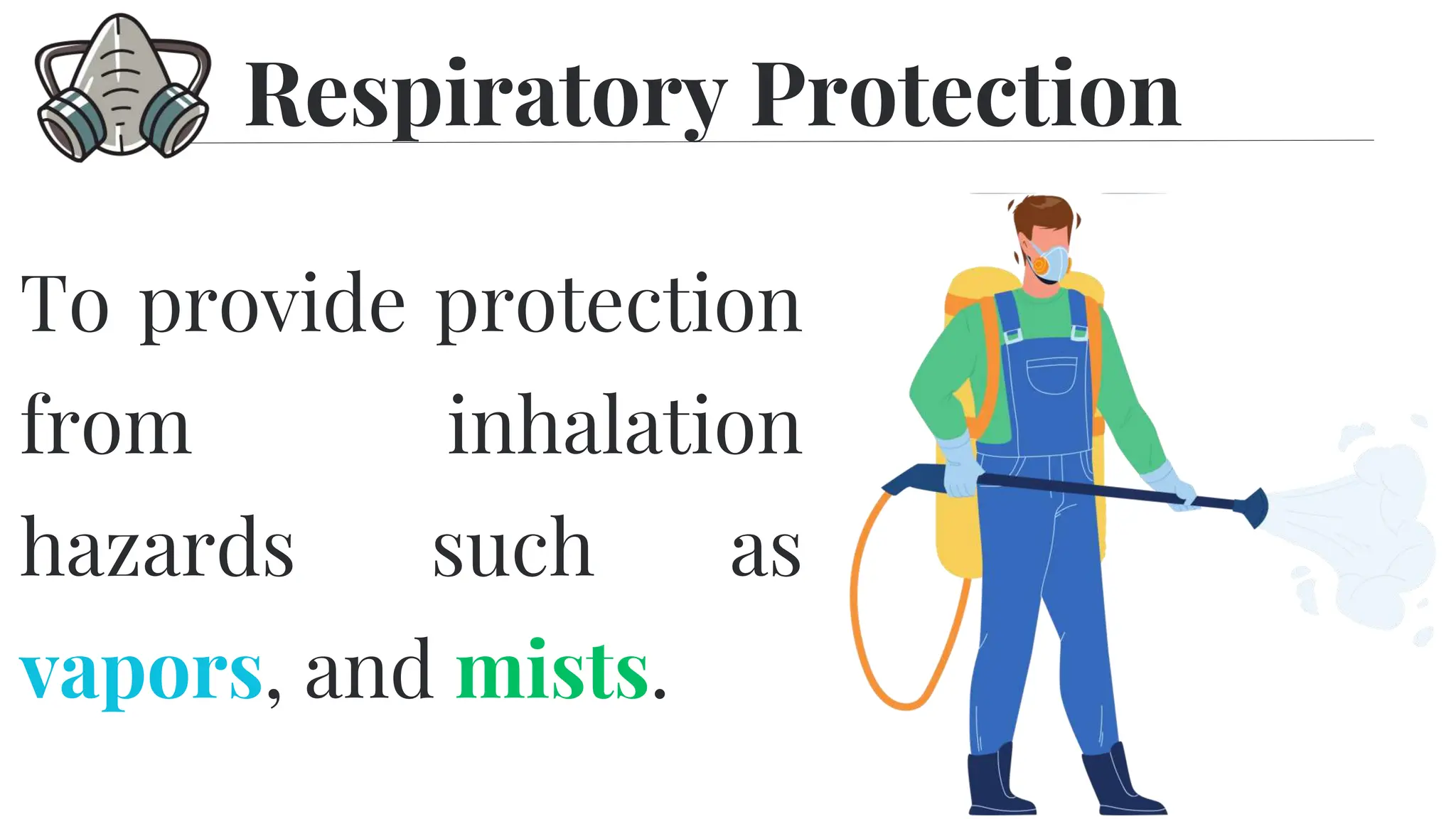
Respiratory Protection – to
provide protection from
inhalation hazards such as
vapors, mists, particulates,
pesticides, and gases.
To provide protection
from inhalation
hazards such as
vapors, and mists.
Respiratory Protection
Facemask Respirator
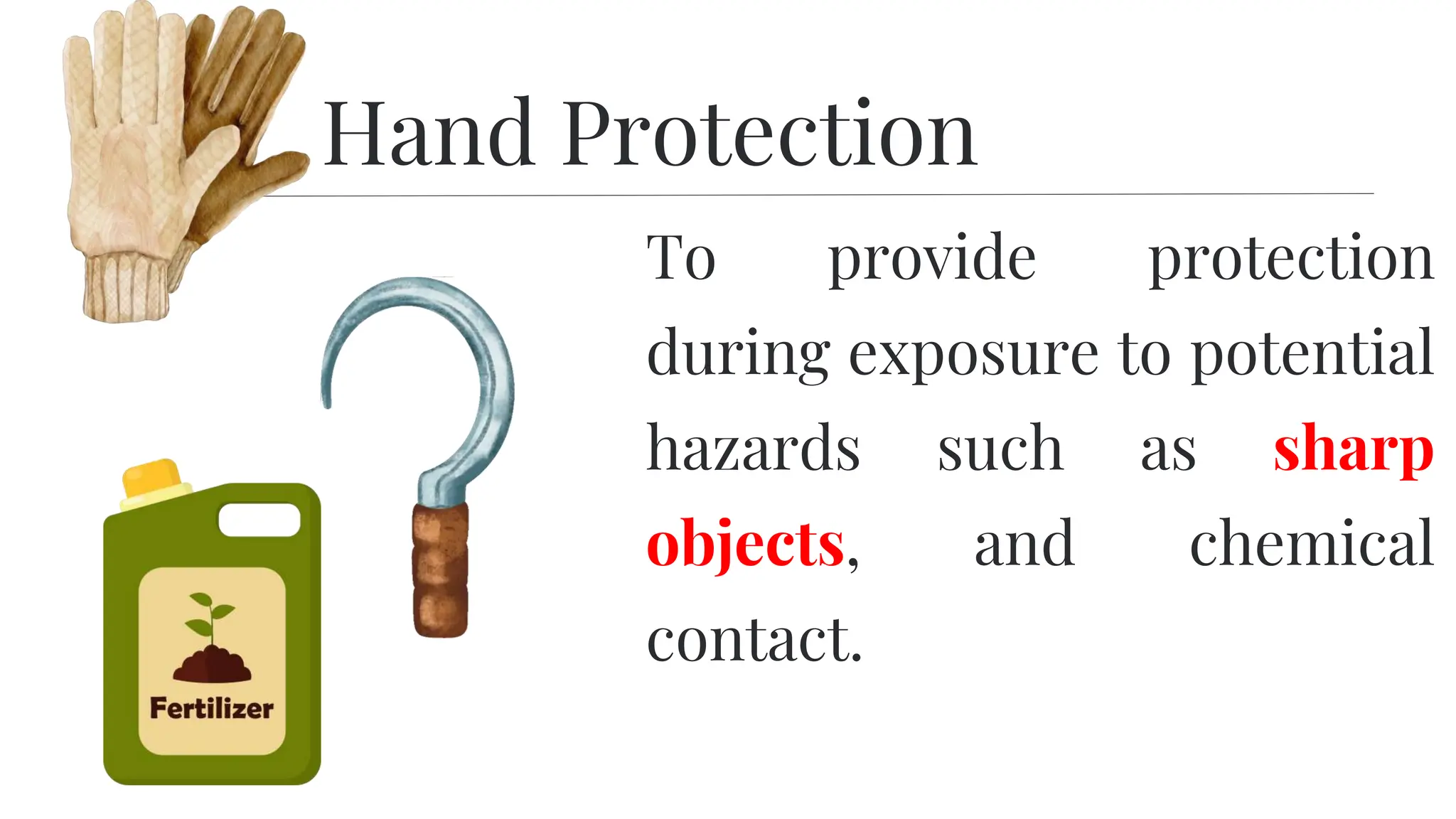
Hand Protection – to provide
protection during exposure to
potential hazards such as sharp
objects, abrasive surfaces,
temperature extremes and
chemical contact.
To provide protection
during exposure to potential
hazards such as sharp
objects, and chemical
contact.
Hand Protection
Hand Protection
Gloves with
cuff
Disposable
Gloves
Head Protection – to provide
protection to potential hazards
such as falling objects, striking
against low-hanging objects,
electrical hazards, or chemical
application.
To provide protection to
potential hazards such as
falling objects and
striking against low-
hanging objects.
Head Protection
Head Protection
Hard Hat Hairnet
Foot Protection -to provide protection
for situations with the potential of
injuries such as falling or rolling
objects, chemical or liquid exposures,
piercing objects, and where feet are
exposed to electrical hazards.
To provide protection for situations
with the potential of injuries such
as falling or rolling objects and wet
grounds.
Foot Protection
Foot Protection
Boots
Safety
Shoes
Clothing Protection – to
provide protection from
potential hazards such as
entanglement, skin
cancer, bodily injury, and
pesticide contamination.
Agri - Crop Production Quarter 3 - Module 4 Required Personal Protective Equipment (PPE) in Nursery Work

agrcrcops 9 - occupatonal health and safety

  • 1.
    Agri - CropProduction Quarter 3 - Module 4 Required Personal Protective Equipment (PPE) in Nursery Work Safety First
  • 2.
    Agri - CropProduction Quarter 3 - Module 4 Required Personal Protective Equipment (PPE) in Nursery Work Required Personal Protective Equipment (PPE) in Nursery Work
  • 3.
    Agri - CropProduction Quarter 3 - Module 4 Required Personal Protective Equipment (PPE) in Nursery Work
  • 4.
    Agri - CropProduction Quarter 3 - Module 4 Required Personal Protective Equipment (PPE) in Nursery Work
  • 5.
    Agri - CropProduction Quarter 3 - Module 4 Required Personal Protective Equipment (PPE) in Nursery Work Knowing about safety can help prevent accidents. Accidents are actions that occur unintentionally. Accidents cannot be predicted, but they are more likely to occur in hazardous situations. They can happen anywhere, including in the home,
  • 6.
    Agri - CropProduction Quarter 3 - Module 4 Required Personal Protective Equipment (PPE) in Nursery Work Major areas of concern in doing horticultural work includes safety practices in pest control, safety with machinery tools, and safety with tractors and large equipment. Knowing how to properly use these items can help reduce risk and help prevent accidents.
  • 7.
    Personal protective equipment, commonlyreferred to as "PPE", is equipment worn to minimize exposure to hazards that cause serious workplace injuries and illnesses.
  • 8.
    These injuries andillnesses may result from contact with chemical, radiological, physical, electrical, mechanical, or other workplace hazards. The lungs, e.g. from breathing in contaminated air The head and feet, e.g. from falling materials The eyes, e.g. from flying particles or splashes of corrosive liquids
  • 9.
    Choose products whichare CE marked in accordance with the Personal Protective Equipment (Enforcement) Regulations 2018 – suppliers can advise you. When selecting and using PPE
  • 10.
    Eye and FaceProtection – to provide protection during EXPOSURE to hazards like flying particles, metals or sparks, liquid chemicals, caustic liquids, and light radiation, i.e., welding lasers.
  • 11.
    To provide protectionduring exposure to hazards like flying particles, liquid chemicals, and light radiation. Eye and Face Protection
  • 12.
    Eye and FaceProtection Safety Goggles Visor Face Shield
  • 13.
    Hearing Protection –to provide protection during exposure to high pitch and loud noise levels.
  • 14.
    To provide protection duringexposure to high pitch and loud noise levels. Hearing Protection
  • 15.
  • 16.
    Respiratory Protection –to provide protection from inhalation hazards such as vapors, mists, particulates, pesticides, and gases.
  • 17.
    To provide protection frominhalation hazards such as vapors, and mists. Respiratory Protection
  • 18.
  • 19.
    Hand Protection –to provide protection during exposure to potential hazards such as sharp objects, abrasive surfaces, temperature extremes and chemical contact.
  • 20.
    To provide protection duringexposure to potential hazards such as sharp objects, and chemical contact. Hand Protection
  • 21.
  • 22.
    Head Protection –to provide protection to potential hazards such as falling objects, striking against low-hanging objects, electrical hazards, or chemical application.
  • 23.
    To provide protectionto potential hazards such as falling objects and striking against low- hanging objects. Head Protection
  • 24.
  • 25.
    Foot Protection -toprovide protection for situations with the potential of injuries such as falling or rolling objects, chemical or liquid exposures, piercing objects, and where feet are exposed to electrical hazards.
  • 26.
    To provide protectionfor situations with the potential of injuries such as falling or rolling objects and wet grounds. Foot Protection
  • 27.
  • 28.
    Clothing Protection –to provide protection from potential hazards such as entanglement, skin cancer, bodily injury, and pesticide contamination.
  • 29.
    Agri - CropProduction Quarter 3 - Module 4 Required Personal Protective Equipment (PPE) in Nursery Work