Chapter 3 – Agile Software Development
Pepper
modification of Sommerville presentation
& Colm O’hEocha – AgileInnovation Ltd presentation
1
Chapter 3 Agile software development
Topics covered
 Agile methods
 Plan-driven and agile development
 Extreme programming
 Agile project management
 Scaling agile methods
2
Chapter 3 Agile software development
Rapid software development
 Why?
 Need to react to changes more quickly than 2 year long waterfall projects
 2 years and then you got the design wrong anyway! Small deliveries
aren't abstract
 How?
 Goal - Deliver working software quickly
• Compromise - less functionality in a delivery, not lower quality
• Less documentation
 Focus on the code rather than the design
 Interleave
• Specification, design and implementation are inter-leaved
 Deliver small versions and get user (stakeholder) input
3
Chapter 3 Agile software development
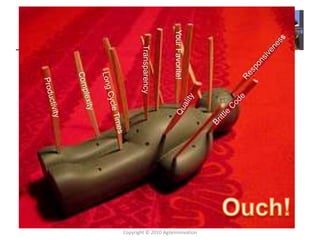
Painpoints
Your
Favorite!
Transparency
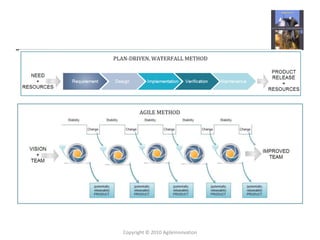
Copyright © 2010 AgileInnovation
Agile manifesto
 Our values:
 Individuals and interactions over processes and tools
 Working software over comprehensive documentation
 Customer collaboration over contract negotiation
 Responding to change over following a plan
 That is, while there is value in the items on the right,
we value the items on the left more.
Chapter 3 Agile software development 5
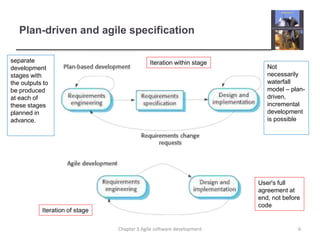
Plan-driven and agile specification
6
Chapter 3 Agile software development
separate
development
stages with
the outputs to
be produced
at each of
these stages
planned in
advance.
Not
necessarily
waterfall
model – plan-
driven,
incremental
development
is possible
Iteration within stage
Iteration of stage
User's full
agreement at
end, not before
code
Copyright © 2010 AgileInnovation
Problems with agile methods
 It can be difficult to keep the interest of customers / users who are involved
in the process.
 Team members may be unsuited to the intense involvement that
characterizes agile methods.
 Prioritizing changes can be difficult where there are multiple stakeholders.
 Maintaining simplicity requires extra work.
 Contracts may be a problem as with other approaches to iterative
development.
 Because of their focus on small, tightly-integrated teams, there are
problems in scaling agile methods to large systems.
 Less emphasis on documentation - harder to maintain when you get a new
team for maintenance
8
Chapter 3 Agile software development
Balance plan driven and agile
 Not great for Agile:
 What type of system is being developed?
• Plan-driven approaches may be required for systems that require a lot of analysis before
implementation (e.g. real-time system with complex timing requirements).
 What is the expected system lifetime?
• Long-lifetime systems may require more design documentation to communicate the
original intentions of the system developers to the support team.
 What technologies are available to support system development?
• Agile methods rely on good tools to keep track of an evolving design
 How is the development team organized?
• Many teams; Outsourcing ---> need design documents to control borders
 Culture or contract needs detailed specification
 Is rapid feedback from users realistic?
 Large scale, not co-located may require more formal communication methods
 Need high level programming skills - refactoring, work with little spec
 Outside regulation documentation requirements
9
Chapter 3 Agile software development
Extreme programming
 A popular form of Agile
 Extreme Programming (XP) takes an ‘extreme’ approach to iterative
development.
 New versions may be built several times per day;
 Increments are delivered to customers every 2 weeks;
 All tests must be run for every build and the build is only accepted if tests run
successfully.
 Customer involvement means full-time customer engagement with the
team. - Specifications through user stories broken into tasks
 People not process : pair programming, collective ownership and a process
that avoids long working hours.
 Regular system releases. - release set of user stories
 Maintaining simplicity through constant refactoring of code.
10
Chapter 3 Agile software development
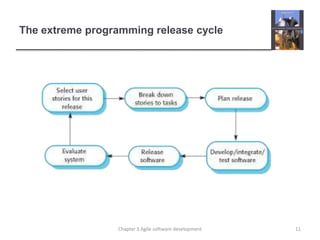
The extreme programming release cycle
11
Chapter 3 Agile software development
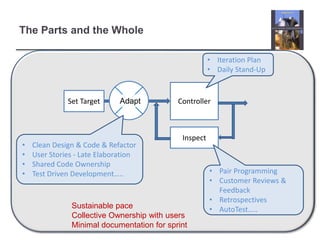
The Parts and the Whole
Controller
Inspect
Set Target Adapt
• Clean Design & Code & Refactor
• User Stories - Late Elaboration
• Shared Code Ownership
• Test Driven Development…..
• Iteration Plan
• Daily Stand-Up
• Pair Programming
• Customer Reviews &
Feedback
• Retrospectives
• AutoTest…..
Sustainable pace
Collective Ownership with users
Minimal documentation for sprint
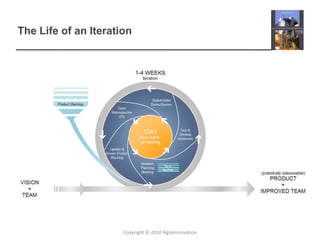
The Life of an Iteration
Copyright © 2010 AgileInnovation
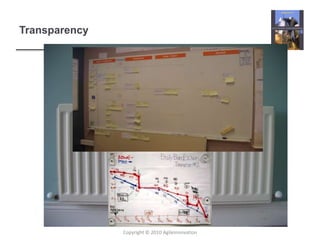
“Tell me how you will measure
me and I’ll tell you how I’ll
behave”
Transparency
Copyright © 2010 AgileInnovation
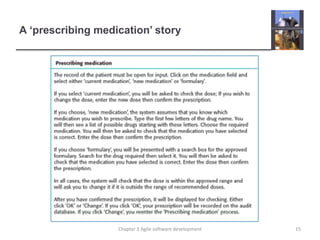
A ‘prescribing medication’ story
15
Chapter 3 Agile software development
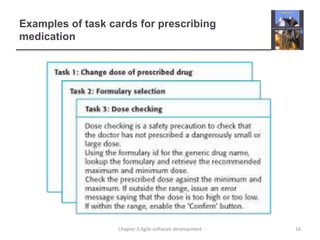
Examples of task cards for prescribing
medication
16
Chapter 3 Agile software development
Refactoring
 Programming team look for possible software improvements and
make these improvements even where there is no immediate need
for them.
 This improves the understandability of the software and so reduces
the need for documentation.
 Changes are easier to make because the code is well-structured
and clear.
 However, some changes requires architecture refactoring and this is
much more expensive.
 RISK:
 Changes the user does not test
 Changes to working software break it
Chapter 3 Agile software development 18
Examples of refactoring
 Re-organization of a class hierarchy to remove duplicate
code.
 Tidying up and renaming attributes and methods to make
them easier to understand.
 The replacement of inline code with calls to methods that
have been included in a program library.
Chapter 3 Agile software development 19
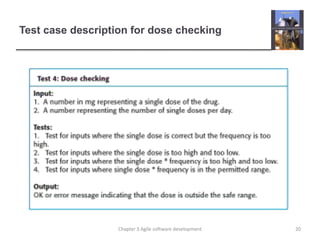
Test case description for dose checking
20
Chapter 3 Agile software development
Test automation
 Automate tests (junit)
 Run upon checkin
 Difficulties:
 Time constraints
 Programmer preferences to not test
 Test coverage
Chapter 3 Agile software development 21
Pair programming
 In XP, programmers work in pairs, sitting together to
develop code.
 Common ownership
 Knowledge spread
 Informal review
 Refactoring
 Similar output to two people coding
22
Chapter 3 Agile software development
Scrum
 Project Manager's job: - Deliver needed system on time
within budget
 The Scrum approach - manage the iterations
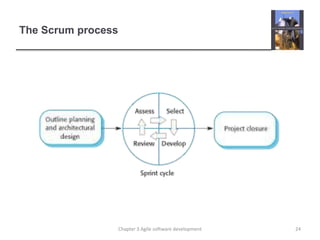
 There are three phases in Scrum.
 outline planning phase - general picture and architecture
 Sprint cycles releasing increments of the system.
 The project closure phase - final delivery, documentation and
review of lessons learned.
Chapter 3 Agile software development 23
The Scrum process
24
Chapter 3 Agile software development
The Sprint cycle
 Every 2–4 weeks (a fixed length).
 1) Project team with customer: Look at product backlog -
select stories to implement
 2) implement with all customer communication through
scrum master (protecting pgmr at this point)
 Scrum master has project manager role during sprint
 Daily 15 min meetings
Stand up often
Team presents progress and impediments
Scrum master tasked with removing impediments
 3) Review system release with user
25
Chapter 3 Agile software development
Scrum benefits
 The product is broken down into a set of manageable
and understandable chunks.
 Unstable requirements do not hold up progress.
 The whole team have visibility of everything and
consequently team communication is improved.
 Customers see on-time delivery of increments and gain
feedback on how the product works.
 Trust between customers and developers is established
and a positive culture is created in which everyone
expects the project to succeed.
Chapter 3 Agile software development 26
Summary
 Plan Driven (Ex: Waterfall) vs Incremental (Ex: Agile )
 Structure and benefits and downfalls
 XP - an implementation of Agile - Power to the Programmer
 User story requirements
 Test driven design with continual retest and integration
 Pair Programming
 Refactoring encouraged
 Scrum - project management of Agile using sprints
 Iterations of full team contact / Scrum master protection of
programmers / full team release review
27
Chapter 3 Agile software development

agile.ppt

  • 1.
    Chapter 3 –Agile Software Development Pepper modification of Sommerville presentation & Colm O’hEocha – AgileInnovation Ltd presentation 1 Chapter 3 Agile software development
  • 2.
    Topics covered  Agilemethods  Plan-driven and agile development  Extreme programming  Agile project management  Scaling agile methods 2 Chapter 3 Agile software development
  • 3.
    Rapid software development Why?  Need to react to changes more quickly than 2 year long waterfall projects  2 years and then you got the design wrong anyway! Small deliveries aren't abstract  How?  Goal - Deliver working software quickly • Compromise - less functionality in a delivery, not lower quality • Less documentation  Focus on the code rather than the design  Interleave • Specification, design and implementation are inter-leaved  Deliver small versions and get user (stakeholder) input 3 Chapter 3 Agile software development
  • 4.
  • 5.
    Agile manifesto  Ourvalues:  Individuals and interactions over processes and tools  Working software over comprehensive documentation  Customer collaboration over contract negotiation  Responding to change over following a plan  That is, while there is value in the items on the right, we value the items on the left more. Chapter 3 Agile software development 5
  • 6.
    Plan-driven and agilespecification 6 Chapter 3 Agile software development separate development stages with the outputs to be produced at each of these stages planned in advance. Not necessarily waterfall model – plan- driven, incremental development is possible Iteration within stage Iteration of stage User's full agreement at end, not before code
  • 7.
    Copyright © 2010AgileInnovation
  • 8.
    Problems with agilemethods  It can be difficult to keep the interest of customers / users who are involved in the process.  Team members may be unsuited to the intense involvement that characterizes agile methods.  Prioritizing changes can be difficult where there are multiple stakeholders.  Maintaining simplicity requires extra work.  Contracts may be a problem as with other approaches to iterative development.  Because of their focus on small, tightly-integrated teams, there are problems in scaling agile methods to large systems.  Less emphasis on documentation - harder to maintain when you get a new team for maintenance 8 Chapter 3 Agile software development
  • 9.
    Balance plan drivenand agile  Not great for Agile:  What type of system is being developed? • Plan-driven approaches may be required for systems that require a lot of analysis before implementation (e.g. real-time system with complex timing requirements).  What is the expected system lifetime? • Long-lifetime systems may require more design documentation to communicate the original intentions of the system developers to the support team.  What technologies are available to support system development? • Agile methods rely on good tools to keep track of an evolving design  How is the development team organized? • Many teams; Outsourcing ---> need design documents to control borders  Culture or contract needs detailed specification  Is rapid feedback from users realistic?  Large scale, not co-located may require more formal communication methods  Need high level programming skills - refactoring, work with little spec  Outside regulation documentation requirements 9 Chapter 3 Agile software development
  • 10.
    Extreme programming  Apopular form of Agile  Extreme Programming (XP) takes an ‘extreme’ approach to iterative development.  New versions may be built several times per day;  Increments are delivered to customers every 2 weeks;  All tests must be run for every build and the build is only accepted if tests run successfully.  Customer involvement means full-time customer engagement with the team. - Specifications through user stories broken into tasks  People not process : pair programming, collective ownership and a process that avoids long working hours.  Regular system releases. - release set of user stories  Maintaining simplicity through constant refactoring of code. 10 Chapter 3 Agile software development
  • 11.
    The extreme programmingrelease cycle 11 Chapter 3 Agile software development
  • 12.
    The Parts andthe Whole Controller Inspect Set Target Adapt • Clean Design & Code & Refactor • User Stories - Late Elaboration • Shared Code Ownership • Test Driven Development….. • Iteration Plan • Daily Stand-Up • Pair Programming • Customer Reviews & Feedback • Retrospectives • AutoTest….. Sustainable pace Collective Ownership with users Minimal documentation for sprint
  • 13.
    The Life ofan Iteration Copyright © 2010 AgileInnovation
  • 14.
    “Tell me howyou will measure me and I’ll tell you how I’ll behave” Transparency Copyright © 2010 AgileInnovation
  • 15.
    A ‘prescribing medication’story 15 Chapter 3 Agile software development
  • 16.
    Examples of taskcards for prescribing medication 16 Chapter 3 Agile software development
  • 18.
    Refactoring  Programming teamlook for possible software improvements and make these improvements even where there is no immediate need for them.  This improves the understandability of the software and so reduces the need for documentation.  Changes are easier to make because the code is well-structured and clear.  However, some changes requires architecture refactoring and this is much more expensive.  RISK:  Changes the user does not test  Changes to working software break it Chapter 3 Agile software development 18
  • 19.
    Examples of refactoring Re-organization of a class hierarchy to remove duplicate code.  Tidying up and renaming attributes and methods to make them easier to understand.  The replacement of inline code with calls to methods that have been included in a program library. Chapter 3 Agile software development 19
  • 20.
    Test case descriptionfor dose checking 20 Chapter 3 Agile software development
  • 21.
    Test automation  Automatetests (junit)  Run upon checkin  Difficulties:  Time constraints  Programmer preferences to not test  Test coverage Chapter 3 Agile software development 21
  • 22.
    Pair programming  InXP, programmers work in pairs, sitting together to develop code.  Common ownership  Knowledge spread  Informal review  Refactoring  Similar output to two people coding 22 Chapter 3 Agile software development
  • 23.
    Scrum  Project Manager'sjob: - Deliver needed system on time within budget  The Scrum approach - manage the iterations  There are three phases in Scrum.  outline planning phase - general picture and architecture  Sprint cycles releasing increments of the system.  The project closure phase - final delivery, documentation and review of lessons learned. Chapter 3 Agile software development 23
  • 24.
    The Scrum process 24 Chapter3 Agile software development
  • 25.
    The Sprint cycle Every 2–4 weeks (a fixed length).  1) Project team with customer: Look at product backlog - select stories to implement  2) implement with all customer communication through scrum master (protecting pgmr at this point)  Scrum master has project manager role during sprint  Daily 15 min meetings Stand up often Team presents progress and impediments Scrum master tasked with removing impediments  3) Review system release with user 25 Chapter 3 Agile software development
  • 26.
    Scrum benefits  Theproduct is broken down into a set of manageable and understandable chunks.  Unstable requirements do not hold up progress.  The whole team have visibility of everything and consequently team communication is improved.  Customers see on-time delivery of increments and gain feedback on how the product works.  Trust between customers and developers is established and a positive culture is created in which everyone expects the project to succeed. Chapter 3 Agile software development 26
  • 27.
    Summary  Plan Driven(Ex: Waterfall) vs Incremental (Ex: Agile )  Structure and benefits and downfalls  XP - an implementation of Agile - Power to the Programmer  User story requirements  Test driven design with continual retest and integration  Pair Programming  Refactoring encouraged  Scrum - project management of Agile using sprints  Iterations of full team contact / Scrum master protection of programmers / full team release review 27 Chapter 3 Agile software development