Agile Software Development Principles Patterns
And Practices 1st Edition Robert C Martin
download
https://ebookbell.com/product/agile-software-development-
principles-patterns-and-practices-1st-edition-robert-c-
martin-55613898
Explore and download more ebooks at ebookbell.com
Here are some recommended products that we believe you will be
interested in. You can click the link to download.
Agile Software Development Principles Patterns And Practices Pearson
New International Editionfirst Edition Martin
https://ebookbell.com/product/agile-software-development-principles-
patterns-and-practices-pearson-new-international-editionfirst-edition-
martin-21976766
Agile Software Development Principles Patterns And Practices Robert C
Martin
https://ebookbell.com/product/agile-software-development-principles-
patterns-and-practices-robert-c-martin-53569794
Lean Business Analysis For Agile Teams Introducing Lean Principles
That Supercharge Your Requirements Discovery Process In Agile And
Traditional Software Development Hathaway
https://ebookbell.com/product/lean-business-analysis-for-agile-teams-
introducing-lean-principles-that-supercharge-your-requirements-
discovery-process-in-agile-and-traditional-software-development-
hathaway-232067616
Agile Software Development Susheela Hooda Vandana Mohindru Sood
https://ebookbell.com/product/agile-software-development-susheela-
hooda-vandana-mohindru-sood-49119034
Agile Software Development Peter Wlodarczak
https://ebookbell.com/product/agile-software-development-peter-
wlodarczak-53629920
Agile Software Development Quality Assurance Ioannis G Stamelos
Panagiotis Sfetsos
https://ebookbell.com/product/agile-software-development-quality-
assurance-ioannis-g-stamelos-panagiotis-sfetsos-4096816
Agile Software Development Best Practices For Large Software
Development Projects 1st Edition Thomas Stober
https://ebookbell.com/product/agile-software-development-best-
practices-for-large-software-development-projects-1st-edition-thomas-
stober-4201686
Agile Software Development Current Research And Future Directions 1st
Edition Torgeir Dingsyr
https://ebookbell.com/product/agile-software-development-current-
research-and-future-directions-1st-edition-torgeir-dingsyr-4398922
Agile Software Development The Cooperative Game 2nd Edition Cockburn
https://ebookbell.com/product/agile-software-development-the-
cooperative-game-2nd-edition-cockburn-44437844
9 781292 025940
ISBN 978-1-29202-594-0
Agile Software Development,
Principles, Patterns, and Practices
Robert C. Martin
First Edition
Agile
Software
Development
Martin
First
Edition
Agile Software Development,
Principles, Patterns, and Practices
Robert C. Martin
First Edition
Pearson Education Limited
Edinburgh Gate
Harlow
Essex CM20 2JE
England and Associated Companies throughout the world
Visit us on the World Wide Web at: www.pearsoned.co.uk
© Pearson Education Limited 2014
All rights reserved. No part of this publication may be reproduced, stored in a retrieval system, or transmitted
in any form or by any means, electronic, mechanical, photocopying, recording or otherwise, without either the
prior written permission of the publisher or a licence permitting restricted copying in the United Kingdom
issued by the Copyright Licensing Agency Ltd, Saffron House, 6–10 Kirby Street, London EC1N 8TS.
All trademarks used herein are the property of their respective owners. The use of any trademark
in this text does not vest in the author or publisher any trademark ownership rights in such
trademarks, nor does the use of such trademarks imply any affiliation with or endorsement of this
book by such owners.
British Library Cataloguing-in-Publication Data
A catalogue record for this book is available from the British Library
Printed in the United States of America
ISBN 10: 1-292-02594-8
ISBN 13: 978-1-292-02594-0
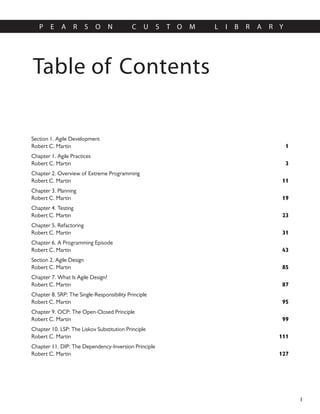
Table of Contents
P E A R S O N C U S T O M L I B R A R Y
I
Section 1. Agile Development
1
Robert C. Martin
Chapter 1. Agile Practices
3
Robert C. Martin
Chapter 2. Overview of Extreme Programming
11
Robert C. Martin
Chapter 3. Planning
19
Robert C. Martin
Chapter 4. Testing
23
Robert C. Martin
Chapter 5. Refactoring
31
Robert C. Martin
Chapter 6. A Programming Episode
43
Robert C. Martin
Section 2. Agile Design
85
Robert C. Martin
Chapter 7. What Is Agile Design?
87
Robert C. Martin
Chapter 8. SRP: The Single-Responsibility Principle
95
Robert C. Martin
Chapter 9. OCP: The Open-Closed Principle
99
Robert C. Martin
Chapter 10. LSP: The Liskov Substitution Principle
111
Robert C. Martin
Chapter 11. DIP: The Dependency-Inversion Principle
127
Robert C. Martin
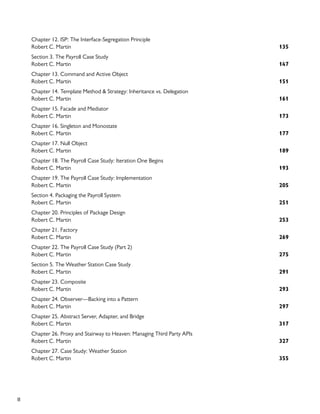
II
Chapter 12. ISP: The Interface-Segregation Principle
135
Robert C. Martin
Section 3. The Payroll Case Study
147
Robert C. Martin
Chapter 13. Command and Active Object
151
Robert C. Martin
Chapter 14. Template Method & Strategy: Inheritance vs. Delegation
161
Robert C. Martin
Chapter 15. Facade and Mediator
173
Robert C. Martin
Chapter 16. Singleton and Monostate
177
Robert C. Martin
Chapter 17. Null Object
189
Robert C. Martin
Chapter 18. The Payroll Case Study: Iteration One Begins
193
Robert C. Martin
Chapter 19. The Payroll Case Study: Implementation
205
Robert C. Martin
Section 4. Packaging the Payroll System
251
Robert C. Martin
Chapter 20. Principles of Package Design
253
Robert C. Martin
Chapter 21. Factory
269
Robert C. Martin
Chapter 22. The Payroll Case Study (Part 2)
275
Robert C. Martin
Section 5. The Weather Station Case Study
291
Robert C. Martin
Chapter 23. Composite
293
Robert C. Martin
Chapter 24. Observer—Backing into a Pattern
297
Robert C. Martin
Chapter 25. Abstract Server, Adapter, and Bridge
317
Robert C. Martin
Chapter 26. Proxy and Stairway to Heaven: Managing Third Party APIs
327
Robert C. Martin
Chapter 27. Case Study: Weather Station
355
Robert C. Martin
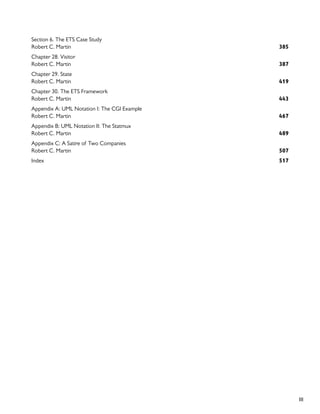
III
Section 6. The ETS Case Study
385
Robert C. Martin
Chapter 28. Visitor
387
Robert C. Martin
Chapter 29. State
419
Robert C. Martin
Chapter 30. The ETS Framework
443
Robert C. Martin
Appendix A: UML Notation I: The CGI Example
467
Robert C. Martin
Appendix B: UML Notation II: The Statmux
489
Robert C. Martin
Appendix C: A Satire of Two Companies
507
Robert C. Martin
517
Index
IV
SECTION 1
Agile Development
“Human Interactions are complicated and never very crisp and clean in their effects, but they
matter more than any other aspect of the work.”
—Tom DeMarco and Timothy Lister
Peopleware, p. 5
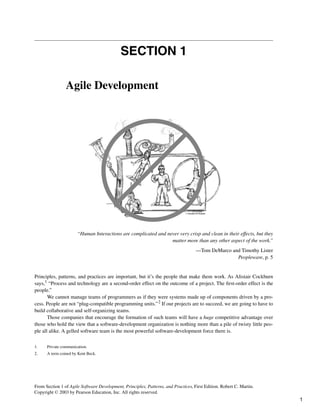
Principles, patterns, and practices are important, but it’s the people that make them work. As Alistair Cockburn
says,1 “Process and technology are a second-order effect on the outcome of a project. The first-order effect is the
people.”
We cannot manage teams of programmers as if they were systems made up of components driven by a pro-
cess. People are not “plug-compatible programming units.”2 If our projects are to succeed, we are going to have to
build collaborative and self-organizing teams.
Those companies that encourage the formation of such teams will have a huge competitive advantage over
those who hold the view that a software-development organization is nothing more than a pile of twisty little peo-
ple all alike. A gelled software team is the most powerful software-development force there is.
1. Private communication.
2. A term coined by Kent Beck.
From Section 1 of Agile Software Development, Principles, Patterns, and Practices, First Edition. Robert C. Martin.
Copyright © 2003 by Pearson Education, Inc. All rights reserved.
1
2
1
Agile Practices
The weather-cock on the church spire, though made of iron, would soon be broken
by the storm-wind if it did not understand the noble art of turning to every wind.
—Heinrich Heine
Many of us have lived through the nightmare of a project with no practices to guide it. The lack of effective prac-
tices leads to unpredictability, repeated error, and wasted effort. Customers are disappointed by slipping schedules,
growing budgets, and poor quality. Developers are disheartened by working ever longer hours to produce ever
poorer software.
Once we have experienced such a fiasco, we become afraid of repeating the experience. Our fears motivate
us to create a process that constrains our activities and demands certain outputs and artifacts. We draw these con-
straints and outputs from past experience, choosing things that appeared to work well in previous projects. Our
hope is that they will work again and take away our fears.
However, projects are not so simple that a few constraints and artifacts can reliably prevent error. As errors
continue to be made, we diagnose those errors and put in place even more constraints and artifacts in order to pre-
vent those errors in the future. After many, projects we may find ourselves overloaded with a huge cumbersome
process that greatly impedes our ability to get anything done.
A big cumbersome process can create the very problems that it is designed to prevent. It can slow the team to
the extent that schedules slip and budgets bloat. It can reduce responsiveness of the team to the point where they
From Chapter 1 of Agile Software Development, Principles, Patterns, and Practices, First Edition. Robert C. Martin.
Copyright © 2003 by Pearson Education, Inc. All rights reserved.
3
Chapter 1 • Agile Practices
are always creating the wrong product. Unfortunately, this leads many teams to believe that they don’t have
enough process. So, in a kind of runaway-process inflation, they make their process ever larger.
Runaway-process inflation is a good description of the state of affairs in many software companies circa
2000 A.D. Though there were still many teams operating without a process, the adoption of very large, heavy-
weight processes is rapidly growing, especially in large corporations. (See Appendix C.)
The Agile Alliance
In early 2001, motivated by the observation that software teams in many corporations were stuck in a quagmire of
ever-increasing process, a group of industry experts met to outline the values and principles that would allow soft-
ware teams to work quickly and respond to change. They called themselves the Agile Alliance.1 Over the next sev-
eral months, they worked to create a statement of values. The result was The Manifesto of the Agile Alliance.
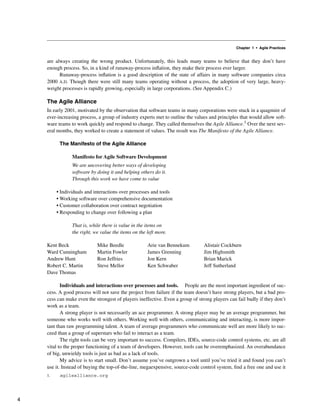
The Manifesto of the Agile Alliance
Manifesto for Agile Software Development
We are uncovering better ways of developing
software by doing it and helping others do it.
Through this work we have come to value
• Individuals and interactions over processes and tools
• Working software over comprehensive documentation
• Customer collaboration over contract negotiation
• Responding to change over following a plan
That is, while there is value in the items on
the right, we value the items on the left more.
Kent Beck Mike Beedle Arie van Bennekum Alistair Cockburn
Ward Cunningham Martin Fowler James Grenning Jim Highsmith
Andrew Hunt Ron Jeffries Jon Kern Brian Marick
Robert C. Martin Steve Mellor Ken Schwaber Jeff Sutherland
Dave Thomas
Individuals and interactions over processes and tools. People are the most important ingredient of suc-
cess. A good process will not save the project from failure if the team doesn’t have strong players, but a bad pro-
cess can make even the strongest of players ineffective. Even a group of strong players can fail badly if they don’t
work as a team.
A strong player is not necessarily an ace programmer. A strong player may be an average programmer, but
someone who works well with others. Working well with others, communicating and interacting, is more impor-
tant than raw programming talent. A team of average programmers who communicate well are more likely to suc-
ceed than a group of superstars who fail to interact as a team.
The right tools can be very important to success. Compilers, IDEs, source-code control systems, etc. are all
vital to the proper functioning of a team of developers. However, tools can be overemphasized. An overabundance
of big, unwieldy tools is just as bad as a lack of tools.
My advice is to start small. Don’t assume you’ve outgrown a tool until you’ve tried it and found you can’t
use it. Instead of buying the top-of-the-line, megaexpensive, source-code control system, find a free one and use it
1. agilealliance.org
4
The Agile Alliance
until you can demonstrate that you’ve outgrown it. Before you buy team licenses for the best of all CASE tools,
use white boards and graph paper until you can reasonably show that you need more. Before you commit to the
top-shelf behemoth database system, try flat files. Don’t assume that bigger and better tools will automatically help
you do better. Often they hinder more than they help.
Remember, building the team is more important than building the environment. Many teams and managers
make the mistake of building the environment first and expecting the team to gel automatically. Instead, work to
create the team, and then let the team configure the environment on the basis of need.
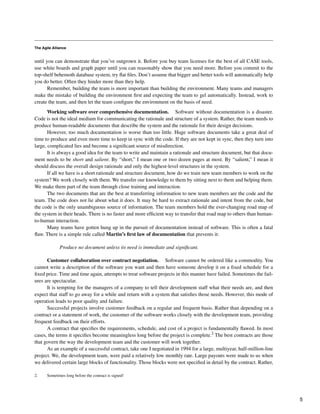
Working software over comprehensive documentation. Software without documentation is a disaster.
Code is not the ideal medium for communicating the rationale and structure of a system. Rather, the team needs to
produce human-readable documents that describe the system and the rationale for their design decisions.
However, too much documentation is worse than too little. Huge software documents take a great deal of
time to produce and even more time to keep in sync with the code. If they are not kept in sync, then they turn into
large, complicated lies and become a significant source of misdirection.
It is always a good idea for the team to write and maintain a rationale and structure document, but that docu-
ment needs to be short and salient. By “short,” I mean one or two dozen pages at most. By “salient,” I mean it
should discuss the overall design rationale and only the highest-level structures in the system.
If all we have is a short rationale and structure document, how do we train new team members to work on the
system? We work closely with them. We transfer our knowledge to them by sitting next to them and helping them.
We make them part of the team through close training and interaction.
The two documents that are the best at transferring information to new team members are the code and the
team. The code does not lie about what it does. It may be hard to extract rationale and intent from the code, but
the code is the only unambiguous source of information. The team members hold the ever-changing road map of
the system in their heads. There is no faster and more efficient way to transfer that road map to others than human-
to-human interaction.
Many teams have gotten hung up in the pursuit of documentation instead of software. This is often a fatal
flaw. There is a simple rule called Martin’s first law of documentation that prevents it:
Produce no document unless its need is immediate and significant.
Customer collaboration over contract negotiation. Software cannot be ordered like a commodity. You
cannot write a description of the software you want and then have someone develop it on a fixed schedule for a
fixed price. Time and time again, attempts to treat software projects in this manner have failed. Sometimes the fail-
ures are spectacular.
It is tempting for the managers of a company to tell their development staff what their needs are, and then
expect that staff to go away for a while and return with a system that satisfies those needs. However, this mode of
operation leads to poor quality and failure.
Successful projects involve customer feedback on a regular and frequent basis. Rather than depending on a
contract or a statement of work, the customer of the software works closely with the development team, providing
frequent feedback on their efforts.
A contract that specifies the requirements, schedule, and cost of a project is fundamentally flawed. In most
cases, the terms it specifies become meaningless long before the project is complete.2 The best contracts are those
that govern the way the development team and the customer will work together.
As an example of a successful contract, take one I negotiated in 1994 for a large, multiyear, half-million-line
project. We, the development team, were paid a relatively low monthly rate. Large payouts were made to us when
we delivered certain large blocks of functionality. Those blocks were not specified in detail by the contract. Rather,
2. Sometimes long before the contract is signed!
5
Chapter 1 • Agile Practices
the contract stated that the payout would be made for a block when the block passed the customer’s acceptance
test. The details of those acceptance tests were not specified in the contract.
During the course of this project, we worked very closely with the customer. We released the software to him
almost every Friday. By Monday or Tuesday of the following week, he would have a list of changes for us to put
into the software. We would prioritize those changes together and then schedule them into subsequent weeks. The
customer worked so closely with us that acceptance tests were never an issue. He knew when a block of function-
ality satisfied his needs because he watched it evolve from week to week.
The requirements for this project were in a constant state of flux. Major changes were not uncommon. There
were whole blocks of functionality that were removed and others that were inserted. Yet the contract, and the
project, survived and succeeded. The key to this success was the intense collaboration with the customer and a
contract that governed that collaboration rather than trying to specify the details of scope and schedule for a
fixed cost.
Responding to change over following a plan. It is the ability to respond to change that often determines
the success or failure of a software project. When we build plans, we need to make sure that our plans are flexible
and ready to adapt to changes in the business and technology.
The course of a software project cannot be planned very far into the future. First of all, the business environ-
ment is likely to change, causing the requirements to shift. Second, customers are likely to alter the requirements
once they see the system start to function. Finally, even if we know the requirements, and we are sure they won’t
change, we are not very good at estimating how long it will take to develop them.
It is tempting for novice managers to create a nice PERT or Gantt chart of the whole project and tape it to the
wall. They may feel that this chart gives them control over the project. They can track the individual tasks and
cross them off the chart as they are completed. They can compare the actual dates with the planned dates on the
chart and react to any discrepancies.
What really happens is that the structure of the chart degrades. As the team gains knowledge about the sys-
tem, and as the customers gain knowledge about their needs, certain tasks on the chart become unnecessary. Other
tasks will be discovered and will need to be added. In short, the plan will undergo changes in shape, not just
changes in dates.
A better planning strategy is to make detailed plans for the next two weeks, very rough plans for the next
three months, and extremely crude plans beyond that. We should know the tasks we will be working on for the next
two weeks. We should roughly know the requirements we will be working on for the next three months. And we
should have only a vague idea what the system will do after a year.
This decreasing resolution of the plan means that we are only investing in a detailed plan for those tasks that
are immediate. Once the detailed plan is made, it is hard to change since the team will have a lot of momentum and
commitment. However, since that plan only governs a few weeks’ worth of time, the rest of the plan remains
flexible.
Principles
The above values inspired the following 12 principles, which are the characteristics that differentiate a set of agile
practices from a heavyweight process:
• Our highest priority is to satisfy the customer through early and continuous delivery of valuable software.
The MIT Sloan Management Review published an analysis of software development practices that help
companies build high-quality products.3 The article found a number of practices that had a significant impact
on the quality of the final system. One practice was a strong correlation between quality and the early deliv-
3. Product-Development Practices That Work: How Internet Companies Build Software, MIT Sloan Management Review, Winter 2001,
Reprint number 4226.
6
Principles
ery of a partially functioning system. The article reported that the less functional the initial delivery, the
higher the quality in the final delivery.
Another finding of this article is a strong correlation between final quality and frequent deliveries of
increasing functionality. The more frequent the deliveries, the higher the final quality.
An agile set of practices delivers early and often. We strive to deliver a rudimentary system within the
first few weeks of the start of the project. Then, we strive to continue to deliver systems of increasing func-
tionality every two weeks.
Customers may choose to put these systems into production if they think that they are functional
enough. Or they may choose simply to review the existing functionality and report on changes they want
made.
• Welcome changing requirements, even late in development. Agile processes harness change for the cus-
tomer's competitive advantage.
This is a statement of attitude. The participants in an agile process are not afraid of change. They view
changes to the requirements as good things, because those changes mean that the team has learned more
about what it will take to satisfy the market.
An agile team works very hard to keep the structure of its software flexible so that when requirements
change, the impact to the system is minimal. Later in this book we will learn the principles and patterns of
object-oriented design that help us to maintain this kind of flexibility.
• Deliver working software frequently, from a couple of weeks to a couple of months, with a preference to the
shorter time scale.
We deliver working software, and we delivery it early (after the first few weeks) and often (every few
weeks thereafter). We are not content with delivering bundles of documents or plans. We don’t count those
as true deliveries. Our eye is on the goal of delivering software that satisfies the customer’s needs.
• Business people and developers must work together daily throughout the project.
In order for a project to be agile, there must be significant and frequent interaction between the cus-
tomers, developers, and stakeholders. A software project is not like a fire-and-forget weapon. A software
project must be continuously guided.
• Build projects around motivated individuals. Give them the environment and support they need, and trust
them to get the job done.
An agile project is one in which people are considered the most important factor of success. All other
factors—process, environment, management, etc.—are considered to be second order effects, and they are
subject to change if they are having an adverse effect upon the people.
For example, if the office environment is an obstacle to the team, the office environment must be
changed. If certain process steps are an obstacle to the team, the process steps must be changed.
• The most efficient and effective method of conveying information to and within a development team is face-
to-face conversation.
In an agile project, people talk to each other. The primary mode of communication is conversation.
Documents may be created, but there is no attempt to capture all project information in writing. An agile
project team does not demand written specs, written plans, or written designs. Team members may create
them if they perceive an immediate and significant need, but they are not the default. The default is
conversation.
• Working software is the primary measure of progress.
Agile projects measure their progress by measuring the amount of software that is currently meeting
the customer’s need. They don’t measure their progress in terms of the phase that they are in or by the vol-
ume of documentation that has been produced or by the amount of infrastructure code they have created.
They are 30% done when 30% of the necessary functionality is working.
7
Chapter 1 • Agile Practices
• Agile processes promote sustainable development. The sponsors, developers, and users should be able to
maintain a constant pace indefinitely.
An agile project is not run like a 50-yard dash; it is run like a marathon. The team does not take off at
full speed and try to maintain that speed for the duration. Rather, they run at a fast, but sustainable, pace.
Running too fast leads to burnout, shortcuts, and debacle. Agile teams pace themselves. They don’t
allow themselves to get too tired. They don’t borrow tomorrow’s energy to get a bit more done today. They
work at a rate that allows them to maintain the highest quality standards for the duration of the project.
• Continuous attention to technical excellence and good design enhances agility.
High quality is the key to high speed. The way to go fast is to keep the software as clean and robust as
possible. Thus, all agile team members are committed to producing only the highest quality code they can.
They do not make messes and then tell themselves they’ll clean it up when they have more time. If they
make a mess, they clean it up before they finish for the day.
• Simplicity—the art of maximizing the amount of work not done—is essential.
Agile teams do not try to build the grand system in the sky. Rather, they always take the simplest path
that is consistent with their goals. They don’t put a lot of importance on anticipating tomorrow’s problems,
nor do they try to defend against all of them today. Instead, they do the simplest and highest-quality work
today, confident that it will be easy to change if and when tomorrow’s problems arise.
• The best architectures, requirements, and designs emerge from self-organizing teams.
An agile team is a self-organizing team. Responsibilities are not handed to individual team members
from the outside. Responsibilities are communicated to the team as a whole, and the team determines the
best way to fulfill them.
Agile team members work together on all aspects of the project. Each is allowed input into the whole.
No single team member is responsible for the architecture or the requirements or the tests. The team shares
those responsibilities, and each team member has influence over them.
• At regular intervals, the team reflects on how to become more effective, then tunes and adjusts its behavior
accordingly.
An agile team continually adjusts its organization, rules, conventions, relationships, etc. An agile team
knows that its environment is continuously changing and knows that they must change with that environ-
ment to remain agile.
Conclusion
The professional goal of every software developer and every development team is to deliver the highest possible
value to their employers and customers. And yet our projects fail, or fail to deliver value, at a dismaying rate.
Though well intentioned, the upward spiral of process inflation is culpable for at least some of this failure. The
principles and values of agile software development were formed as a way to help teams break the cycle of process
inflation and to focus on simple techniques for reaching their goals.
At the time of this writing, there were many agile processes to choose from. These include SCRUM,4
Crystal,5 Feature Driven Development,6 Adaptive Software Development (ADP),7 and most significantly, Extreme
Programming.8
4. www.controlchaos.com
5. crystalmethodologies.org
6. Java Modeling In Color With UML: Enterprise Components and Process, Peter Coad, Eric Lefebvre, and Jeff De Luca, Prentice Hall,
1999.
7. [Highsmith2000].
8. [Beck1999], [Newkirk2001].
8
Conclusion
Bibliography
1. Beck, Kent. Extreme Programming Explained: Embracing Change. Reading, MA: Addison–Wesley, 1999.
2. Newkirk, James, and Robert C. Martin. Extreme Programming in Practice. Upper Saddle River, NJ: Addison–Wesley, 2001.
3. Highsmith, James A. Adaptive Software Development: A Collaborative Approach to Managing Complex Systems. NewYork, NY: Dorset
House, 2000.
9
10
2
Overview of Extreme Programming
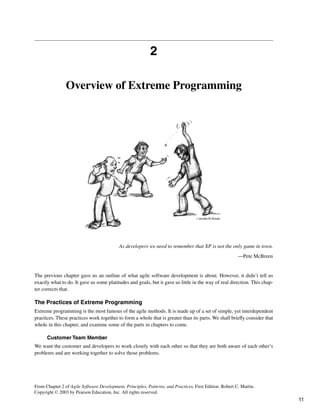
As developers we need to remember that XP is not the only game in town.
—Pete McBreen
The previous chapter gave us an outline of what agile software development is about. However, it didn’t tell us
exactly what to do. It gave us some platitudes and goals, but it gave us little in the way of real direction. This chap-
ter corrects that.
The Practices of Extreme Programming
Extreme programming is the most famous of the agile methods. It is made up of a set of simple, yet interdependent
practices. These practices work together to form a whole that is greater than its parts. We shall briefly consider that
whole in this chapter, and examine some of the parts in chapters to come.
Customer Team Member
We want the customer and developers to work closely with each other so that they are both aware of each other’s
problems and are working together to solve those problems.
From Chapter 2 of Agile Software Development, Principles, Patterns, and Practices, First Edition. Robert C. Martin.
Copyright © 2003 by Pearson Education, Inc. All rights reserved.
11
Chapter 2 • Overview of Extreme Programming
Who is the customer? The customer of an XP team is the person or group who defines and prioritizes fea-
tures. Sometimes, the customer is a group of business analysts or marketing specialists working in the same com-
pany as the developers. Sometimes, the customer is a user representative commissioned by the body of users.
Sometimes the customer is in fact the paying customer. But in an XP project, whoever the customers are, they are
members of, and available to, the team.
The best case is for the customer to work in the same room as the developers. Next best is if the customer
works in within 100 feet of the developers. The larger the distance, the harder it is for the customer to be a true
team member. If the customer is in another building or another state, it is very difficult to integrate him or her into
the team.
What do you do if the customer simply cannot be close by? My advice is to find someone who can be close
by and who is willing and able to stand in for the true customer.
User Stories
In order to plan a project, we must know something about the requirements, but we don’t need to know very much.
For planning purposes, we only need to know enough about a requirement to estimate it. You may think that in
order to estimate a requirement you need to know all its details, but that’s not quite true. You have to know that
there are details, and you have to know roughly the kinds of details there are, but you don’t have to know the
specifics.
The specific details of a requirement are likely to change with time, especially once the customer begins to
see the system come together. There is nothing that focuses requirements better than seeing the nascent system
come to life. Therefore, capturing the specific details about a requirement long before it is implemented is likely to
result in wasted effort and premature focusing.
When using XP, we get the sense of the details of the requirements by talking them over with the customer,
but we do not capture that detail. Rather, the customer writes a few words on an index card that we agree will remind
us of the conversation. The developers write an estimate on the card at roughly the same time that the customer
writes it. They base that estimate on the sense of detail they got during their conversations with the customer.
A user story is a mnemonic token of an ongoing conversation about a requirement. It is a planning tool that
the customer uses to schedule the implementation of a requirement based upon its priority and estimated cost.
Short Cycles
An XP project delivers working software every two weeks. Each of these two-week iterations produces working
software that addresses some of the needs of the stakeholders. At the end of each iteration, the system is demon-
strated to the stakeholders in order to get their feedback.
The Iteration Plan. An iteration is usually two weeks in length. It represents a minor delivery that may or
may not be put into production. It is a collection of user stories selected by the customer according to a budget
established by the developers.
The developers set the budget for an iteration by measuring how much they got done in the previous itera-
tion. The customer may select any number of stories for the iteration, so long as the total of their estimates does
not exceed that budget.
Once an iteration has been started, the customer agrees not to change the definition or priority of the stories
in that iteration. During this time, the developers are free to cut the stories up in to tasks and to develop the tasks in
the order that makes the most technical and business sense.
The Release Plan. XP teams often create a release plan that maps out the next six iterations or so. That
plan is known as a release plan. A release is usually three months worth of work. It represents a major delivery that
can usually be put into production. A release plan consists of prioritized collections of user stories that have been
selected by the customer according to a budget given by the developers.
12
The Practices of Extreme Programming
The developers set the budget for the release by measuring how much they got done in the previous release.
The customer may select any number of stories for the release so long as the total of the estimates does not exceed
that budget. The customer also determines the order in which the stories will be implemented in the release. If the
team so desires, they can map out the first few iterations of the release by showing which stories will be completed
in which iterations.
Releases are not cast in stone. The customer can change the content at any time. He or she can cancel stories,
write new stories, or change the priority of a story.
Acceptance Tests
The details about the user stories are captured in the form of acceptance tests specified by the customer. The accep-
tance tests for a story are written immediately preceding, or even concurrent with, the implementation of that story.
They are written in some kind of scripting language that allows them to be run automatically and repeatedly.
Together, they act to verify that the system is behaving as the customers have specified.
The language of the acceptance tests grows and evolves with the system. The customers may recruit the
developers to create a simple scripting system, or they may have a separate quality assurance (QA) department that
can develop it. Many customers enlist the help of QA in developing the acceptance-testing tool and with writing
the acceptance tests themselves.
Once an acceptance test passes, it is added to the body of passing acceptance tests and is never allowed to
fail again. This growing body of acceptance tests is run several times per day, every time the system is built. If an
acceptance tests fails, the build is declared a failure. Thus, once a requirement is implemented, it is never broken.
The system migrates from one working state to another and is never allowed to be inoperative for longer than a few
hours.
Pair Programming
All production code is written by pairs of programmers working together at the same workstation. One member of
each pair drives the keyboard and types the code. The other member of the pair watches the code being typed,
looking for errors and improvements.1 The two interact intensely. Both are completely engaged in the act of writ-
ing software.
The roles change frequently. The driver may get tired or stuck, and his pair partner will grab the keyboard
and start to drive. The keyboard will move back and forth between them several times in an hour. The resultant
code is designed and authored by both members. Neither can take more than half the credit.
Pair membership changes at least once per day so that every programmer works in two different pairs each
day. Over the course of an iteration, every member of the team should have worked with every other member of the
team, and they should have worked on just about everything that was going on in the iteration.
This dramatically increases the spread of knowledge through the team. While specialties remain and tasks
that require certain specialties will usually belong to the appropriate specialists, those specialists will pair with
nearly everyone else on the team. This will spread the specialty out through the team such that other team mem-
bers can fill in for the specialists in a pinch.
Studies by Laurie Williams2 and Nosek3 have suggested that pairing does not reduce the efficiency of the
programming staff, yet it significantly reduces the defect rate.
1. I have seen pairs in which one member controls the keyboard and the other controls the mouse.
2. [Williams2000], [Cockburn2001].
3. [Nosek].
13
Chapter 2 • Overview of Extreme Programming
Test-Driven Development
Chapter 4, which is on testing, discusses test-driven development in great detail. The following paragraphs provide
a quick overview.
All production code is written in order to make failing unit tests pass. First we write a unit test that fails
because the functionality for which it is testing doesn’t exist. Then we write the code that makes that test pass.
This iteration between writing test cases and code is very rapid, on the order of a minute or so. The test cases
and code evolve together, with the test cases leading the code by a very small fraction. (See “A Programming Epi-
sode” in Chapter 6 for an example.)
As a result, a very complete body of test cases grows along with the code. These tests allow the programmers
to check whether the program works. If a pair makes a small change, they can run the tests to ensure that they
haven’t broken anything. This greatly facilitates refactoring (discussed later).
When you write code in order to make test cases pass, that code is, by definition, testable. In addition, there
is a strong motivation to decouple modules from each other so that they can be independently tested. Thus, the
design of code that is written in this fashion tends to be much less coupled. The principles of object-oriented
design play a powerful role in helping you with this decoupling.4
Collective Ownership
A pair has the right to check out any module and improve it. No programmers are individually responsible for any
one particular module or technology. Everybody works on the GUI.5 Everybody works on the middleware. Every-
body works on the database. Nobody has more authority over a module or a technology than anybody else.
This doesn’t mean that XP denies specialties. If your specialty is the GUI, you are most likely to work on
GUI tasks, but you will also be asked to pair on middleware and database tasks. If you decide to learn a second
specialty, you can sign up for tasks and work with specialists who will teach it to you.You are not confined to your
specialty.
Continuous Integration
The programmers check in their code and integrate several times per day. The rule is simple. The first one to check
in wins, everybody else merges.
XP teams use nonblocking source control. This means that programmers are allowed to check any module
out at any time, regardless of who else may have it checked out. When the programmer checks the module back in
after modifying it, he must be prepared to merge it with any changes made by anyone who checked the module in
ahead of him. To avoid long merge sessions, the members of the team check in their modules very frequently.
A pair will work for an hour or two on a task. They create test cases and production code. At some conve-
nient breaking point, probably long before the task is complete, the pair decides to check the code back in. They
first make sure that all the tests run. They integrate their new code into the existing code base. If there is a merge to
do, they do it. If necessary, they consult with the programmers who beat them to the check in. Once their changes
are integrated, they build the new system. They run every test in the system, including all currently running accep-
tance tests. If they broke anything that used to work, they fix it. Once all the tests run, they finish the check in.
Thus, XP teams will build the system many times each day. They build the whole system from end to end.6 If
the final result of a system is a CD, they cut the CD. If the final result of the system is an active Web site, they
install that Web site, probably on a testing server.
4. See Section II.
5. I’m not advocating a three-tiered architecture here. I just chose three common partitions of software technology.
6. Ron Jeffries says, “End to end is farther than you think.”
14
The Practices of Extreme Programming
Sustainable Pace
A software project is not a sprint; it is a marathon. A team that leaps off the starting line and starts racing as fast as
it can will burn out long before they are close to finishing. In order to finish quickly, the team must run at a sustain-
able pace; it must conserve its energy and alertness. It must intentionally run at a steady, moderate pace.
The XP rule is that a team is not allowed to work overtime. The only exception to that rule is the last week in
a release. If the team is within striking distance of its release goal and can sprint to the finish, then overtime is per-
missible.
Open Workspace
The team works together in an open room. There are tables set up with workstations on them. Each table has two
or three such workstations. There are two chairs in front of each workstation for pairs to sit in. The walls are cov-
ered with status charts, task breakdowns, UML diagrams, etc.
The sound in this room is a low buzz of conversation. Each pair is within earshot of every other. Each has the
opportunity to hear when another is in trouble. Each knows the state of the other. The programmers are in a posi-
tion to communicate intensely.
One might think that this would be a distracting environment. It would be easy to fear that you’d never get
anything done because of the constant noise and distraction. In fact, this doesn’t turn out to be the case. Moreover,
instead of interfering with productivity, a University of Michigan study suggested that working in a “war room”
environment may increase productivity by a factor of two.7
The Planning Game
The next chapter, “Planning,” goes into great detail about the XP
planning game. I’ll describe it briefly here.
The essence of the planning game is the division of responsi-
bility between business and development. The business people (a.k.a.
the customers) decide how important a feature is, and the developers
decide how much that feature will cost to implement.
At the beginning of each release and each iteration, the devel-
opers give the customers a budget, based on how much they were
able to get done in the last iteration or in the last release. The customers choose stories whose costs total up to, but
do not exceed that budget.
With these simple rules in place, and with short iterations and frequent releases, it won’t be long before the
customers and developers get used to the rhythm of the project. The customers will get a sense for how fast the
developers are going. Based on that sense, the customers will be able to determine how long their project will take
and how much it will cost.
Simple Design
An XP team makes their designs as simple and expressive as they can be. Furthermore, they narrow their focus to
consider only the stories that are planned for the current iteration. They don’t worry about stories to come. Instead,
they migrate the design of the system, from iteration to iteration, to be the best design for the stories that the sys-
tem currently implements.
This means that an XP team will probably not start with infrastructure. They probably won’t select the data-
base first. They probably won’t select the middleware first. The team’s first act will be to get the first batch of sto-
ries working in the simplest way possible. The team will only add the infrastructure when a story comes along that
forces them to do so.
7. http://www.sciencedaily.com/releases/2000/12/001206144705.htm
15
Chapter 2 • Overview of Extreme Programming
The following three XP mantras guide the developer:
Consider the Simplest Thing That Could Possibly Work. XP teams always try to find the simplest pos-
sible design option for the current batch of stories. If we can make the current stories work with flat files, we might
not use a database or EJB. If we can make the current stories work with a simple socket connection, we might not
use an ORB or RMI. If we can make the current stories work without multithreading, we might not include
mutithreading. We try to consider the simplest way to implement the current stories. Then we choose a solution
that is as close to that simplicity as we can practically get.
You Aren’t Going to Need It. Yeah, but we know we’re going to need that database one day. We know
we’re going to need an ORB one day. We know we’re going to have to support multiple users one day. So we need
to put the hooks in for those things now, don’t we?
An XP team seriously considers what will happen if they resist the temptation to add infrastructure before it
is strictly needed. They start from the assumption that they aren’t going to need that infrastructure. The team puts
in the infrastructure, only if they have proof, or at least very compelling evidence, that putting in the infrastructure
now will be more cost effective than waiting.
Once and Only Once. XPers don’t tolerate code duplication. Wherever they find it, they eliminate it.
There are many sources of code duplication. The most obvious are those stretches of code that were captured
with a mouse and plopped down in multiple places. When we find those, we eliminate them by creating a function
or a base class. Sometimes two or more algorithms may be remarkably similar, and yet they differ in subtle ways.
We turn those into functions or employ the TEMPLATE METHOD pattern.8 Whatever the source of duplication, once
discovered, we won’t tolerate it.
The best way to eliminate redundancy is to create abstractions. After all, if two things are similar, there must
be some abstraction that unifies them. Thus, the act of eliminating redundancy forces the team to create many
abstractions and further reduce coupling.
Refactoring9
I cover this topic in more detail in Chapter 5. What follows is a brief overview.
Code tends to rot. As we add feature after feature and deal with bug after bug, the structure of the code
degrades. Left unchecked, this degradation leads to a tangled, unmaintainable mess.
XP teams reverse this degradation through frequent refactoring. Refactoring is the practice of making a
series of tiny transformations that improve the structure of the system without affecting its behavior. Each transfor-
mation is trivial, hardly worth doing. But together, they combine into significant transformations of the design and
architecture of the system.
After each tiny transformation, we run the unit tests to make sure we haven’t broken anything. Then we do
the next transformation and the next and the next, running the tests after each. In this manner we keep the system
working while transforming its design.
Refactoring is done continuously rather than at the end of the project, the end of the release, the end of the
iteration, or even the end of the day. Refactoring is something we do every hour or every half hour. Through refac-
toring, we continuously keep the code as clean, simple, and expressive as possible.
Metaphor
Metaphor is the least understood of all the practices of XP. XPers are pragmatists at heart, and this lack of concrete
definition makes us uncomfortable. Indeed, the proponents of XP have often discussed removing metaphor as a
practice. And yet, in some sense, metaphor is one of the most important practices of all.
8. See Chapter 14, “Template Method & Strategy: Inheritance v. Delegation.”
9. [Fowler99].
16
Conclusion
Think of a jigsaw puzzle. How do you know how the pieces go together? Clearly, each piece abuts others,
and its shape must be perfectly complimentary to the pieces it touches. If you were blind and you had a very good
sense of touch, you could put the puzzle together by diligently sifting through each piece and trying it in position
after position.
But there is something more powerful than the shape of the pieces binding the puzzle together. There is a
picture. The picture is the true guide. The picture is so powerful that if two adjacent pieces of the picture do not
have complementary shapes, then you know that the puzzle maker made a mistake.
That is the metaphor. It’s the big picture that ties the whole system together. It’s the vision of the system that
makes the location and shape of all the individual modules obvious. If a module’s shape is inconsistent with the
metaphor, then you know it is the module that is wrong.
Often a metaphor boils down to a system of names. The names provide a vocabulary for elements in the sys-
tem and help to define their relationships.
For example, I once worked on a system that transmitted text to a screen at 60 characters per second. At that
rate, a screen fill could take some time. So we’d allow the program that was generating the text to fill a buffer.
When the buffer was full, we’d swap the program out to disk. When the buffer got close to empty, we’d swap the
program back in and let it run more.
We spoke about this system in terms of dump trucks hauling garbage. The buffers were little trucks. The dis-
play screen was the dump. The program was the garbage producer. The names all fit together and helped us think
about the system as a whole.
As another example, I once worked on a system that analyzed network traffic. Every thirty minutes, it would
poll dozens of network adapters and pull down the monitoring data from them. Each network adapter gave us a
small block of data composed of several individual variables. We called these blocks “slices.” The slices were raw
data that needed to be analyzed. The analysis program “cooked” the slices, so it was called “The Toaster.” We
called the individual variables within the slices, “crumbs.” All in all, it was a useful and entertaining metaphor.
Conclusion
Extreme programming is a set of simple and concrete practices that combines into an agile development process.
That process has been used on many teams with good results.
XP is a good general-purpose method for developing software. Many project teams will be able to adopt it as
is. Many others will be able to adapt it by adding or modifying practices.
Bibliography
1. Dahl, Dijkstra. Structured Programming. New York: Hoare, Academic Press, 1972.
2. Conner, Daryl R. Leading at the Edge of Chaos. Wiley, 1998.
3. Cockburn, Alistair. The Methodology Space. Humans and Technology technical report HaT TR.97.03 (dated 97.10.03),
http://members.aol.com/acockburn/papers/methyspace/methyspace.htm.
4. Beck, Kent. Extreme Programming Explained: Embracing Change. Reading, MA: Addison–Wesley, 1999.
5. Newkirk, James, and Robert C. Martin. Extreme Programming in Practice. Upper Saddle River, NJ: Addison–Wesley, 2001.
6. Williams, Laurie, Robert R. Kessler, Ward Cunningham, Ron Jeffries. Strengthening the Case for Pair Programming. IEEE Software,
July–Aug. 2000.
7. Cockburn, Alistair, and Laurie Williams. The Costs and Benefits of Pair Programming. XP2000 Conference in Sardinia, reproduced in
Extreme Programming Examined, Giancarlo Succi, Michele Marchesi. Addison–Wesley, 2001.
8. Nosek, J. T. The Case for Collaborative Programming. Communications of the ACM (1998): 105–108.
9. Fowler, Martin. Refactoring: Improving the Design of Existing Code. Reading, MA: Addison–Wesley, 1999.
17
18
3
Planning
“When you can measure what you are speaking about, and express it in numbers, you know
something about it; but when you cannot measure it, when you cannot express it in numbers,
your knowledge is of a meager and unsatisfactory kind.”
—Lord Kelvin, 1883
What follows is a description of the planning game from Extreme Programming (XP).1 It is similar to the way
planning is done in several of the other agile2 methods like SCRUM,3 Crystal,4 feature-driven development,5 and
adaptive software development (ADP).6 However, none of those processes spell it out in as much detail and rigor.
1. [Beck99], [Newkirk2001].
2. www.AgileAlliance.org
3. www.controlchaos.com
4. crystalmethodologies.org
5. Java Modeling In Color With UML: Enterprise Components and Process by Peter Coad, Eric Lefebvre, and Jeff De Luca, Prentice
Hall, 1999.
6. [Highsmith2000].
From Chapter 3 of Agile Software Development, Principles, Patterns, and Practices, First Edition. Robert C. Martin.
Copyright © 2003 by Pearson Education, Inc. All rights reserved.
19
Chapter 3 • Planning
Initial Exploration
At the start of the project, the developers and customers try to identify all the really significant user stories they
can. However, they don’t try to identify all user stories. As the project proceeds, the customers will continue to
write new user stories. The flow of user stories will not shut off until the project is over.
The developers work together to estimate the stories. The estimates are relative, not absolute. We write a
number of “points” on a story card to represent the relative cost of the story. We may not be sure just how much
time a story point represents, but we do know that a story with eight points will take twice as long as a story with
four points.
Spiking, Splitting, and Velocity
Stories that are too large or too small are hard to estimate. Developers tend to underestimate large stories and over-
estimate small ones. Any story that is too big should be split into pieces that aren’t too big. Any story that is too
small should be merged with other small stories.
For example, consider the story, “Users can securely transfer money into, out of, and between their
accounts.” This is a big story. Estimating will be hard and probably inaccurate. However, we can split it as follow,
into many stories that are much easier to estimate:
• Users can log in.
• Users can log out.
• Users can deposit money into their account.
• Users can withdraw money from their account.
• Users can transfer money from their account to another account.
When a story is split or merged, it should be reestimated. It is not wise to simply add or subtract the estimate.
The main reason to split or merge a story is to get it to a size where estimation is accurate. It is not surprising to
find that a story estimated at five points breaks up into stories that add up to ten! Ten is the more accurate estimate.
Relative estimates don’t tell us the absolute size of the stories, so they don’t help us determine when to split
or merge them. In order to know the true size of a story, we need a factor that we call velocity. If we have an accu-
rate velocity, we can multiply the estimate of any story by the velocity to get the actual time estimate for that story.
For example, if our velocity is “2 days per story point,” and we have a story with a relative estimate of four points,
then the story should take eight days to implement.
As the project proceeds, the measure of velocity will become ever more accurate because we’ll be able to
measure the number of story points completed per iteration. However, the developers will probably not have a very
good idea of their velocity at the start. They must create an initial guess by whatever means they feel will give the
best results. The need for accuracy at this point is not particularly grave, so they don’t need to spend an inordinate
amount of time on it. Often, it is sufficient to spend a few days prototyping a story or two to get an idea of the
team’s velocity. Such a prototype session is called a spike.
Release Planning
Given a velocity, the customers can get an idea of the cost of each of the stories. They also know the business value
and priority of each story. This allows them to choose the stories they want done first. This choice is not purely a
matter of priority. Something that is important, but also expensive, may be delayed in favor of something that is
less important but much less expensive. Choices like this are business decisions. The business folks decide which
stories give them the most bang for the buck.
The developers and customers agree on a date for the first release of the project. This is usually a matter of
2–4 months in the future. The customers pick the stories they want implemented within that release and the rough
20
Task Planning
order in which they want them implemented. The customers cannot choose more stories than will fit according to
the current velocity. Since the velocity is initially inaccurate, this selection is crude. But accuracy is not very
important at this point in time. The release plan can be adjusted as velocity becomes more accurate.
Iteration Planning
Next, the developers and customers choose an iteration size. This is typically two weeks long. Once again, the cus-
tomers choose the stories that they want implemented in the first iteration. They cannot choose more stories than
will fit according to the current velocity.
The order of the stories within the iteration is a technical decision. The developers implement the stories in
the order that makes the most technical sense. They may work on the stories serially, finishing each one after the
next, or they may divvy up the stories and work on them all concurrently. It’s entirely up to them.
The customers cannot change the stories in the iteration once the iteration has begun. They are free to change
or reorder any other story in the project, but not the ones that the developers are currently working on.
The iteration ends on the specified date, even if all the stories aren’t done. The estimates for all the com-
pleted stories are totaled, and the velocity for that iteration is calculated. This measure of velocity is then used to
plan the next iteration. The rule is very simple. The planned velocity for each iteration is the measured velocity of
the previous iteration. If the team got 31 story points done last iteration, then they should plan to get 31 story
points done in the next. Their velocity is 31 points per iteration.
This feedback of velocity helps to keep the planning in sync with the team. If the team gains in expertise and
skill, the velocity will rise commensurately. If someone is lost from the team, the velocity will fall. If an architec-
ture evolves that facilitates development, the velocity will rise.
Task Planning
At the start of a new iteration, the developers and customers get together to plan. The developers break the stories
down into development tasks. A task is something that one developer can implement in 4–16 hours. The stories are
analyzed, with the customers’ help, and the tasks are enumerated as completely as possible.
A list of the tasks is created on a flip chart, whiteboard, or some other convenient medium. Then, one by one,
the developers sign up for the tasks they want to implement. As each developer signs up for a task, he or she esti-
mates that task in arbitrary task points.7
Developers may sign up for any kind of task. Database guys are not constrained to sign up for database
tasks. GUI guys can sign up for database tasks if they like. This may seem inefficient, but as you’ll see, there is a
mechanism that manages this. The benefit is obvious. The more the developers know about the whole project, the
healthier and more informed the project team is. We want knowledge of the project to spread through the team irre-
spective of specialty.
Each developer knows how many task points he or she managed to implement in the last iteration. This num-
ber is their personal budget. No one signs up for more points than they have in their budget.
Task selection continues until either all tasks are assigned or all developers have used their budgets. If there
are tasks remaining, then the developers negotiate with each other, trading tasks based on their various skills. If
this doesn’t make enough room to get all the tasks assigned, then the developers ask the customers to remove tasks
or stories from the iteration. If all the tasks are signed up and the developers still have room in their budgets for
more work, they ask the customers for more stories.
7. Many developers find it helpful to use “perfect programming hours” as their task points.
21
Chapter 3 • Planning
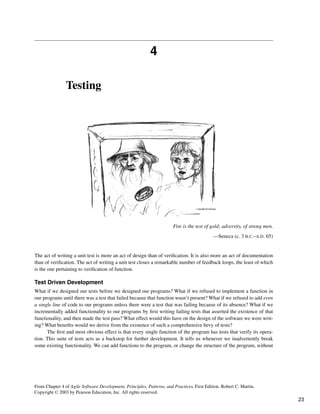
The Halfway Point
Halfway through the iteration, the team holds a meeting. At this
point, half of the stories scheduled for the iteration should be
complete. If half the stories aren’t complete, then the team tries
to reapportion tasks and responsibilities to ensure that all the sto-
ries will be complete by the end of the iteration. If the developers
cannot find such a reapportionment, then the customers need to
be told. The customers may decide to pull a task or story from
the iteration. At the very least, they will name the lowest priority
tasks and stories so that the developers avoid working on them.
For example, suppose the customers selected eight stories totalling 24 story points for the iteration. Suppose
also that these were broken down into 42 tasks. At the halfway point of the iteration, we would expect to have 21
tasks and 12 story points complete. Those 12 story points must represent wholly completed stories. Our goal is to
complete stories, not just tasks. The nightmare scenario is to get to the end of the iteration with 90% of the tasks
complete, but no stories complete. At the halfway point, we want to see completed stories that represent half the
story points for the iteration.
Iterating
Every two weeks, the current iteration ends and the next begins. At the end of each iteration, the current running
executable is demonstrated to the customers. The customers are asked to evaluate the look, feel, and performance
of the project. They will provide their feedback in terms of new user stories.
The customers see progress frequently. They can measure velocity. They can predict how fast the team is
going, and they can schedule high-priority stories early. In short, they have all the data and control they need to
manage the project to their liking.
Conclusion
From iteration to iteration and release to release, the project falls into a predictable and comfortable rhythm.
Everyone knows what to expect and when to expect it. Stakeholders see progress frequently and substantially.
Rather than being shown notebooks full of diagrams and plans, they are shown working software that they can
touch, feel, and provide feedback on.
Developers see a reasonable plan based upon their own estimates and controlled by their own measured
velocity. They choose the tasks on which they feel comfortable working and keep the quality of their workmanship
high.
Managers receive data every iteration. They use this data to control and manage the project. They don’t have
to resort to pressure, threats, or appeals to loyalty to meet an arbitrary and unrealistic date.
If this sounds like blue sky and apple pie, it’s not. The stakeholders won’t always be happy with the data that
the process produces, especially not at first. Using an agile method does not mean that the stakeholders will get
what they want. It simply means that they’ll be able to control the team to get the most business value for the least
cost.
Bibliography
1. Beck, Kent. Extreme Programming Explained: Embrace Change. Reading, MA: Addison–Wesley, 1999.
2. Newkirk, James, and Robert C. Martin. Extreme Programming in Practice. Upper Saddle River, NJ: Addison–Wesley, 2001.
3. Highsmith, James A. Adaptive Software Development: A Collaborative Approach to Managing Complex Systems. New York: Dorset
House, 2000.
22
4
Testing
Fire is the test of gold; adversity, of strong men.
—Seneca (c. 3 B.C.–A.D. 65)
The act of writing a unit test is more an act of design than of verification. It is also more an act of documentation
than of verification. The act of writing a unit test closes a remarkable number of feedback loops, the least of which
is the one pertaining to verification of function.
Test Driven Development
What if we designed our tests before we designed our programs? What if we refused to implement a function in
our programs until there was a test that failed because that function wasn’t present? What if we refused to add even
a single line of code to our programs unless there were a test that was failing because of its absence? What if we
incrementally added functionality to our programs by first writing failing tests that asserted the existence of that
functionality, and then made the test pass? What effect would this have on the design of the software we were writ-
ing? What benefits would we derive from the existence of such a comprehensive bevy of tests?
The first and most obvious effect is that every single function of the program has tests that verify its opera-
tion. This suite of tests acts as a backstop for further development. It tells us whenever we inadvertently break
some existing functionality. We can add functions to the program, or change the structure of the program, without
From Chapter 4 of Agile Software Development, Principles, Patterns, and Practices, First Edition. Robert C. Martin.
Copyright © 2003 by Pearson Education, Inc. All rights reserved.
23
Chapter 4 • Testing
fear that we will break something important in the process. The tests tell us that the program is still behaving prop-
erly. We are thus much freer to make changes and improvement to our program.
A more important, but less obvious, effect is that the act of writing the test first forces us into a different
point of view. We must view the program we are about to write from the vantage point of a caller of that program.
Thus, we are immediately concerned with the interface of the program as well as its function. By writing the test
first, we design the software to be conveniently callable.
What’s more, by writing the test first, we force ourselves to design the program to be testable. Designing the
program to be callable and testable is remarkably important. In order to be callable and testable, the software has
to be decoupled from its surroundings. Thus, the act of writing tests first forces us to decouple the software!
Another important effect of writing tests first is that the tests act as an invaluable form of documentation. If
you want to know how to call a function or create an object, there is a test that shows you. The tests act as a suite
of examples that help other programmers figure out how to work with the code. This documentation is compileable
and executable. It will stay current. It cannot lie.
An Example of Test-First Design
I recently wrote a version of Hunt the Wumpus, just for fun. This program is a simple adventure game in which the
player moves through a cave trying to kill the Wumpus before the Wumpus eats him. The cave is a set of rooms
that are connected to each other by passageways. Each room may have passages to the north, south, east, or west.
The player moves about by telling the computer which direction to go.
One of the first tests I wrote for this program was testMove in Listing 4-1. This function creates a new
WumpusGame, connects room 4 to room 5 via an east passage, places the player in room 4, issues the command to
move east, and then asserts that the player should be in room 5.
Listing 4-1
public void testMove()
{
WumpusGame g = new WumpusGame();
g.connect(4,5,"E");
g.setPlayerRoom(4);
g.east();
assertEquals(5, g.getPlayerRoom());
}
All this code was written before any part of WumpusGame was written. I took Ward Cunningham’s advice
and wrote the test the way I wanted it to read. I trusted that I could make the test pass by writing the code that con-
formed to the structure implied by the test. This is called intentional programming. You state your intent in a test
before you implement it, making your intent as simple and readable as possible. You trust that this simplicity and
clarity points to a good structure for the program.
Programming by intent immediately led me to an interesting design decision. The test makes no use of a
Room class. The action of connecting one room to another communicates my intent. I don’t seem to need a Room
class to facilitate that communication. Instead, I can just use integers to represent the rooms.
This may seem counter intuitive to you. After all, this program may appear to you to be all about rooms;
moving between rooms; finding out what rooms contain; etc. Is the design implied by my intent flawed because it
lacks a Room class?
I could argue that the concept of connections is far more central to the Wumpus game than the concept of
room. I could argue that this initial test pointed out a good way to solve the problem. Indeed, I think that is the
case, but it is not the point I’m trying to make. The point is that the test illuminated a central design issue at a very
early stage. The act of writing tests first is an act of discerning between design decisions.
24
Test Driven Development
Notice that the test tells you how the program works. Most of us could easily write the four named methods
of WumpusGame from this simple specification. We could also name and write the three other direction commands
without much trouble. If later we want to know how to connect two rooms or move in a particular direction, this
test will show us how to do it in no uncertain terms. This test acts as a compileable and executable document that
describes the program.
Test Isolation
The act of writing tests before production code often exposes areas in the software that ought to be decoupled. For
example, Figure 4-1 shows a simple UML diagram1 of a payroll application. The Payroll class uses the
EmployeeDatabase class to fetch an Employee object. It asks the Employee to calculate its pay. Then it passes
that pay to the CheckWriter object to produce a check. Finally, it posts the payment to the Employee object and
writes the object back to the database.
Presume that we haven’t written any of this code yet. So far, this diagram is just sitting on a whiteboard after
a quick design session.2 Now, we need to write the tests that specify the behavior of the Payroll object. There are
a number of problems associated with writing these tests. First, what database do we use? Payroll needs to read
from some kind of database. Must we write a fully functioning database before we can test the Payroll class?
What data do we load into it? Second, how do we verify that the appropriate check got printed? We can’t write an
automated test that looks on the printer for a check and verifies the amount on it!
The solution to these problems is to use the MOCK OBJECT pattern.3 We can insert interfaces between all the
collaborators of Payroll and create test stubs that implement these interfaces.
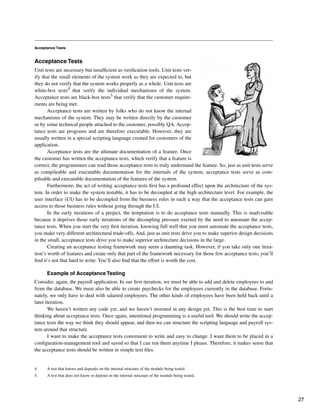
Figure 4-2 shows the structure. The Payroll class now uses interfaces to communicate with the
EmployeeDatabase, CheckWriter, and Employee. Three MOCK OBJECTS have been created that implement
these interfaces. These MOCK OBJECTS are queried by the PayrollTest object to see if the Payroll object man-
ages them correctly.
Listing 4-2 shows the intent of the test. It creates the appropriate mock objects, passes them to the Payroll
object, tells the Payroll object to pay all the employees, and then asks the mock objects to verify that all the
checks were written correctly and that all the payments were posted correctly.
1. If you don’t know UML, there are two appendices that describes it in great detail. See Appendices A and B, starting on page 467.
Figure 4-1 Coupled Payroll Model
2. [Jeffries2001].
3. [Mackinnon2000].
CheckWriter
+ writeCheck()
Employee
+ calculatePay()
+ postPayment()
Employee
Database
+ getEmployee
+ putEmployee
Payroll
25
Chapter 4 • Testing
Listing 4-2
TestPayroll
public void testPayroll()
{
MockEmployeeDatabase db = new MockEmployeeDatabase();
MockCheckWriter w = new MockCheckWriter();
Payroll p = new Payroll(db, w);
p.payEmployees();
assert(w.checksWereWrittenCorrectly());
assert(db.paymentsWerePostedCorrectly());
}
Of course all this test is checking is that Payroll called all the right functions with all the right data. It’s not
actually checking that checks were written. It’s not actually checking that a true database was properly updated.
Rather, it is checking that the Payroll class is behaving as it should in isolation.
You might wonder what the MockEmployee is for. It seems feasible that the real Employee class could be
used instead of a mock. If that were so, then I would have no compunction about using it. In this case, I presumed
that the Employee class was more complex than needed to check the function of Payroll.
Serendipitous Decoupling
The decoupling of Payroll is a good thing. It allows us to swap in different databases and check writers, both for
the purpose of testing and for extension of the application. I think it is interesting that this decoupling was driven
by the need to test. Apparently, the need to isolate the module under test forces us to decouple in ways that are ben-
eficial to the overall structure of the program. Writing tests before code improves our designs.
A large part of this book is about design principles for managing dependencies. Those principles give you
some guidelines and techniques for decoupling classes and packages.You will find these principles most beneficial
if you practice them as part of your unit testing strategy. It is the unit tests that will provide much of the impetus
and direction for decoupling.
Figure 4-2 Decoupled Payroll using Mock Objects for testing
Mock
CheckWriter
«interface»
CheckWriter
Mock
Employee
PayrollTest
Payroll
Mock
Employee
Database
+ writeCheck()
«interface»
Employee
+ calculatePay()
+ postPayment()
«interface»
Employee
Database
+ getEmployee
+ putEmployee
26
Acceptance Tests
Acceptance Tests
Unit tests are necessary but insufficient as verification tools. Unit tests ver-
ify that the small elements of the system work as they are expected to, but
they do not verify that the system works properly as a whole. Unit tests are
white-box tests4 that verify the individual mechanisms of the system.
Acceptance tests are black-box tests5 that verify that the customer require-
ments are being met.
Acceptance tests are written by folks who do not know the internal
mechanisms of the system. They may be written directly by the customer
or by some technical people attached to the customer, possibly QA. Accep-
tance tests are programs and are therefore executable. However, they are
usually written in a special scripting language created for customers of the
application.
Acceptance tests are the ultimate documentation of a feature. Once
the customer has written the acceptance tests, which verify that a feature is
correct, the programmers can read those acceptance tests to truly understand the feature. So, just as unit tests serve
as compileable and executable documentation for the internals of the system, acceptance tests serve as com-
pileable and executable documentation of the features of the system.
Furthermore, the act of writing acceptance tests first has a profound effect upon the architecture of the sys-
tem. In order to make the system testable, it has to be decoupled at the high architecture level. For example, the
user interface (UI) has to be decoupled from the business rules in such a way that the acceptance tests can gain
access to those business rules without going through the UI.
In the early iterations of a project, the temptation is to do acceptance tests manually. This is inadvisable
because it deprives those early iterations of the decoupling pressure exerted by the need to automate the accep-
tance tests. When you start the very first iteration, knowing full well that you must automate the acceptance tests,
you make very different architectural trade-offs. And, just as unit tests drive you to make superior design decisions
in the small, acceptance tests drive you to make superior architecture decisions in the large.
Creating an acceptance testing framework may seem a daunting task. However, if you take only one itera-
tion’s worth of features and create only that part of the framework necessary for those few acceptance tests, you’ll
find it’s not that hard to write. You’ll also find that the effort is worth the cost.
Example of Acceptance Testing
Consider, again, the payroll application. In our first iteration, we must be able to add and delete employees to and
from the database. We must also be able to create paychecks for the employees currently in the database. Fortu-
nately, we only have to deal with salaried employees. The other kinds of employees have been held back until a
later iteration.
We haven’t written any code yet, and we haven’t invested in any design yet. This is the best time to start
thinking about acceptance tests. Once again, intentional programming is a useful tool. We should write the accep-
tance tests the way we think they should appear, and then we can structure the scripting language and payroll sys-
tem around that structure.
I want to make the acceptance tests convenient to write and easy to change. I want them to be placed in a
configuration-management tool and saved so that I can run them anytime I please. Therefore, it makes sense that
the acceptance tests should be written in simple text files.
4. A test that knows and depends on the internal structure of the module being tested.
5. A test that does not know or depend on the internal structure of the module being tested.
27
Chapter 4 • Testing
The following is an example of an acceptance-test script:
AddEmp 1429 “Robert Martin” 3215.88
Payday
Verify Paycheck EmpId 1429 GrossPay 3215.88
In this example, we add employee number 1429 to the database. His name is “Robert Martin,” and his
monthly pay is $3215.88. Next, we tell the system that it is payday and that it needs to pay all the employees.
Finally, we verify that a paycheck was generated for employee 1429 with a GrossPay field of $3215.88.
Clearly, this kind of script will be very easy for customers to write. Also, it will be easy to add new function-
ality to this kind of script. However, think about what it implies about the structure of the system.
The first two lines of the script are functions of the payroll application. We might call these lines payroll
transactions. These are functions that payroll users expect. However, the Verify line is not a transaction that the
users of payroll would expect. This line is a directive that is specific to the acceptance test.
Thus, our acceptance testing framework will have to parse this text file, separating the payroll transactions
from the acceptance-testing directives. It must send the payroll transactions to the payroll application and then use
the acceptance-testing directives to query the payroll application in order to verify data.
This already puts architectural stress on the payroll program. The payroll program is going to have to accept
input directly from users and also from the acceptance-testing framework. We want to bring those two paths of
input together as early as possible. So, it looks as if the payroll program will need a transaction processor that can
deal with transactions of the form AddEmp and Payday coming from more than one source. We need to find some
common form for those transactions so that the amount of specialized code is kept to a minimum.
One solution would be to feed the transactions into the payroll application in XML. The acceptance-testing
framework could certainly generate XML, and it seems likely that the UI of the payroll system could also generate
XML. Thus, we might see transactions that looked like the following:
<AddEmp PayType=Salaried>
<EmpId>1429</EmpId>
<Name>Robert Martin</Name>
<Salary>3215.88</Salary>
</AddEmp>
These transactions might enter the payroll application through a subroutine call, a socket, or even a batch
input file. Indeed, it would be a trivial matter to change from one to the other during the course of development. So
during the early iterations, we could decide to read transactions from a file, migrating to an API or socket much
later.
How does the acceptance-test framework invoke the Verify directive? Clearly it must have some way to
access the data produced by the payroll application. Once again, we don’t want the acceptance-testing framework
to have to try to read the writing on a printed check, but we can do the next best thing.
We can have the payroll application produce its paychecks in XML. The acceptance-testing framework can
then catch this XML and query it for the appropriate data. The final step of printing the check from the XML may
be trivial enough to handle through manual acceptance tests.
Therefore, the payroll application can create an XML document that contains all the paychecks. It might
look like this:
<Paycheck>
<EmpId>1429</EmpId>
<Name>Robert Martin</Name>
<GrossPay>3215.88</GrossPay>
</Paycheck>
28
Conclusion
Clearly, the acceptance-testing framework can execute the Verify directive when supplied with this XML.
Once again, we can spit the XML out through a socket, through an API, or into a file. For the initial itera-
tions, a file is probably easiest. Therefore, the payroll application will begin its life reading XML transactions in
from a file and outputting XML paychecks to a file. The acceptance-testing framework will read transactions in
text form, translating them to XML and writing them to a file. It will then invoke the payroll program. Finally, it
will read the output XML from the payroll program and invoke the Verify directives.
Serendipitous Architecture
Notice the pressure that the acceptance tests placed upon the architecture of the payroll system. The very fact that
we considered the tests first led us to the notion of XML input and output very quickly. This architecture has
decoupled the transaction sources from the payroll application. It has also decoupled the paycheck printing mech-
anism from the payroll application. These are good architectural decisions.
Conclusion
The simpler it is to run a suite of tests, the more often those tests will be run. The more the tests are run, the faster
any deviation from those tests will be found. If we can run all the tests several times a day, then the system will
never be broken for more than a few minutes. This is a reasonable goal. We simply don’t allow the system to back-
slide. Once it works to a certain level, it never backslides to a lower level.
Yet verification is just one of the benefits of writing tests. Both unit tests and acceptance tests are a form of
documentation. That documentation is compileable and executable; therefore, it is accurate and reliable. More-
over, these tests are written in unambiguous languages that are made to be readable by their audience. Program-
mers can read unit tests because they are written in their programming language. Customers can read acceptance
tests because they are written in a language that they themselves designed.
Possibly the most important benefit of all this testing is the impact it has on architecture and design. To make
a module or an application testable, it must also be decoupled. The more testable it is, the more decoupled it is.
The act of considering comprehensive acceptance and unit tests has a profoundly positive effect upon the structure
of the software.
Bibliography
1. Mackinnon, Tim, Steve Freeman, and Philip Craig. Endo-Testing: Unit Testing with Mock Objects. Extreme Programming Examined.
Addison–Wesley, 2001.
2. Jeffries, Ron, et al., Extreme Programming Installed. Upper Saddle River, NJ: Addison–Wesley, 2001.
29
30
5
Refactoring
The only factor becoming scarce in a world of abundance is human attention.
—Kevin Kelly, in Wired
This chapter is about human attention. It is about paying attention to what you are doing and making sure you are
doing your best. It is about the difference between getting something to work and getting something right. It is
about the value we place in the structure of our code.
In his classic book, Refactoring, Martin Fowler defines refactoring as “...the process of changing a software
system in such a way that it does not alter the external behavior of the code yet improves its internal structure.”1
But why would we want to improve the structure of working code? What about the old saw, “if it’s not broken,
don’t fix it!”?
Every software module has three functions. First, there is the function it performs while executing. This
function is the reason for the module’s existence. The second function of a module is to afford change. Almost all
modules will change in the course of their lives, and it is the responsibility of the developers to make sure that such
changes are as simple as possible to make. A module that is hard to change is broken and needs fixing, even though
it works. The third function of a module is to communicate to its readers. Developers unfamiliar with the module
should be able to read and understand it without undue mental gymnastics. A module that does not communicate is
broken and needs to be fixed.
1. [Fowler99], p. xvi.
From Chapter 5 of Agile Software Development, Principles, Patterns, and Practices, First Edition. Robert C. Martin.
Copyright © 2003 by Pearson Education, Inc. All rights reserved.
31
Chapter 5 • Refactoring
What does it take to make a module easy to read and easy to change? Much of this book is dedicated to prin-
ciples and patterns whose primary goal is to help you create modules that are flexible and adaptable. However, it
takes something more than just principles and patterns to make a module that is easy to read and change. It takes
attention. It takes discipline. It takes a passion for creating beauty.
Generating Primes: A Simple Example of Refactoring2
Consider the code in Listing 5–1. This program generates prime numbers. It is one big function with many single
letter variables and comments to help us read it.
Listing 5-1
GeneratePrimes.java version 1
/**
* This class generates prime numbers up to a user-specified
* maximum. The algorithm used is the Sieve of Eratosthenes.
* <p>
* Eratosthenes of Cyrene, b. c. 276 BC, Cyrene, Libya --
* d. c. 194, Alexandria. The first man to calculate the
* circumference of the Earth. Also known for working on
* calendars with leap years, he ran the library at Alexandria.
* <p>
* The algorithm is quite simple. Given an array of integers
* starting at 2. Cross out all multiples of 2. Find the next
* uncrossed integer, and cross out all of its multiples.
* Repeat until you have passed the square root of the maximum
* value.
*
* @author Robert C. Martin
* @version 9 Dec 1999 rcm
*/
import java.util.*;
public class GeneratePrimes
{
/**
* @param maxValue is the generation limit.
*/
public static int[] generatePrimes(int maxValue)
{
if (maxValue >= 2) // the only valid case
{
// declarations
int s = maxValue + 1; // size of array
boolean[] f = new boolean[s];
int i;
// initialize array to true.
for (i = 0; i < s; i++)
f[i] = true;
2. I initially wrote this program for XP Immersion I using tests written by Jim Newkirk. Kent Beck and Jim Newkirk refactored it in front
of the students. I have tried to recreate that refactoring here.
32
Generating Primes: A Simple Example of Refactoring
// get rid of known non-primes
f[0] = f[1] = false;
// sieve
int j;
for (i = 2; i < Math.sqrt(s) + 1; i++)
{
if (f[i]) // if i is uncrossed, cross its multiples.
{
for (j = 2 * i; j < s; j += i)
f[j] = false; // multiple is not prime
}
}
// how many primes are there?
int count = 0;
for (i = 0; i < s; i++)
{
if (f[i])
count++; // bump count.
}
int[] primes = new int[count];
// move the primes into the result
for (i = 0, j = 0; i < s; i++)
{
if (f[i]) // if prime
primes[j++] = i;
}
return primes; // return the primes
}
else // maxValue < 2
return new int[0]; // return null array if bad input.
}
}
The unit test for GeneratePrimes is shown in Listing 5–2. It takes a statistical approach, checking to see if
the generator can generate primes up to 0, 2, 3, and 100. In the first case there should be no primes. In the second
there should be one prime, and it should be 2. In the third there should be two primes, and they should be 2 and 3.
In the last case there should be 25 primes, the last of which is 97. If all these tests pass, then I make the assumption
that the generator is working. I doubt this is foolproof, but I can’t think of a reasonable scenario where these tests
would pass and yet the function would fail.
Listing 5-2
TestGeneratePrimes.java
import junit.framework.*;
import java.util.*;
public class TestGeneratePrimes extends TestCase
{
public static void main(String args[])
33
Chapter 5 • Refactoring
{
junit.swingui.TestRunner.main(
new String[] {"TestGeneratePrimes"});
}
public TestGeneratePrimes(String name)
{
super(name);
}
public void testPrimes()
{
int[] nullArray = GeneratePrimes.generatePrimes(0);
assertEquals(nullArray.length, 0);
int[] minArray = GeneratePrimes.generatePrimes(2);
assertEquals(minArray.length, 1);
assertEquals(minArray[0], 2);
int[] threeArray = GeneratePrimes.generatePrimes(3);
assertEquals(threeArray.length, 2);
assertEquals(threeArray[0], 2);
assertEquals(threeArray[1], 3);
int[] centArray = GeneratePrimes.generatePrimes(100);
assertEquals(centArray.length, 25);
assertEquals(centArray[24], 97);
}
}
To help me refactor this program, I am using the Idea refactoring browser from IntelliJ. This tool makes it
trivial to extract methods and rename variables and classes.
It seems pretty clear that the main function wants to be three separate functions. The first initializes all the
variables and sets up the sieve. The second actually executes the sieve, and the third loads the sieved results into an
integer array. To expose this structure more clearly in Listing 5–3, I extracted those functions into three separate
methods. I also removed a few unnecessary comments and changed the name of the class to PrimeGenerator.
The tests all still ran.
Extracting the three functions forced me to promote some of the variables of the function to static fields of
the class. I think this clarifies which variables are local and which have wider influence.
Listing 5-3
PrimeGenerator.java, version 2
/**
* This class generates prime numbers up to a user-specified
* maximum. The algorithm used is the Sieve of Eratosthenes.
* Given an array of integers starting at 2:
* Find the first uncrossed integer, and cross out all its
* multiples. Repeat until the first uncrossed integer exceeds
* the square root of the maximum value.
*/
import java.util.*;
34
Generating Primes: A Simple Example of Refactoring
public class PrimeGenerator
{
private static int s;
private static boolean[] f;
private static int[] primes;
public static int[] generatePrimes(int maxValue)
{
if (maxValue < 2)
return new int[0];
else
{
initializeSieve(maxValue);
sieve();
loadPrimes();
return primes; // return the primes
}
}
private static void loadPrimes()
{
int i;
int j;
// how many primes are there?
int count = 0;
for (i = 0; i < s; i++)
{
if (f[i])
count++; // bump count.
}
primes = new int[count];
// move the primes into the result
for (i = 0, j = 0; i < s; i++)
{
if (f[i]) // if prime
primes[j++] = i;
}
}
private static void sieve()
{
int i;
int j;
for (i = 2; i < Math.sqrt(s) + 1; i++)
{
if (f[i]) // if i is uncrossed, cross out its multiples.
{
for (j = 2 * i; j < s; j += i)
f[j] = false; // multiple is not prime
}
}
}
35
Chapter 5 • Refactoring
private static void initializeSieve(int maxValue)
{
// declarations
s = maxValue + 1; // size of array
f = new boolean[s];
int i;
// initialize array to true.
for (i = 0; i < s; i++)
f[i] = true;
// get rid of known non-primes
f[0] = f[1] = false;
}
}
The initializeSieve function is a little messy, so in Listing 5–4, I cleaned it up considerably. First, I
replaced all usages of the s variable with f.length. Then, I changed the names of the three functions to
something a bit more expressive. Finally, I rearranged the innards of initializeArrayOfIntegers (née
initializeSieve) to be a little nicer to read. The tests all still ran.
Listing 5-4
PrimeGenerator.java, version 3 (partial)
public class PrimeGenerator
{
private static boolean[] f;
private static int[] result;
public static int[] generatePrimes(int maxValue)
{
if (maxValue < 2)
return new int[0];
else
{
initializeArrayOfIntegers(maxValue);
crossOutMultiples();
putUncrossedIntegersIntoResult();
return result;
}
}
private static void initializeArrayOfIntegers(int maxValue)
{
f = new boolean[maxValue + 1];
f[0] = f[1] = false; //neither primes nor multiples.
for (int i = 2; i < f.length; i++)
f[i] = true;
}
Next, I looked at crossOutMultiples. There were a number of statements in this function, and in others,
of the form if(f[i] == true). The intent was to check to see if i was uncrossed, so I changed the name of f to
unCrossed. But this lead to ugly statements like unCrossed[i] = false. I found the double negative confus-
ing. So I changed the name of the array to isCrossed and changed the sense of all the booleans. The tests all
still ran.
36
Generating Primes: A Simple Example of Refactoring
I got rid of the initialization that set isCrossed[0] and isCrossed[1] to true and just made sure that no
part of the function used the isCrossed array for indexes less than 2. I extracted the inner loop of the
crossOutMultiples function and called it crossOutMultiplesOf. I also thought that if(isCrossed[i]
== false) was confusing, so I created a function called notCrossed and changed the if statement to if
(notCrossed(i)). The tests all still ran.
I spent a bit of time writing a comment that tried to explain why you only have to iterate up to the square root
of the array size. This led me to extract the calculation into a function, where I could put the explanatory comment.
In writing the comment, I realized that the square root is the maximum prime factor of any integer in the array. So
I chose that name for the variables and functions that dealt with it. The result of all these refactorings are in Listing
5–5. The tests all still ran.
Listing 5-5
PrimeGenerator.java version 4 (partial)
public class PrimeGenerator
{
private static boolean[] isCrossed;
private static int[] result;
public static int[] generatePrimes(int maxValue)
{
if (maxValue < 2)
return new int[0];
else
{
initializeArrayOfIntegers(maxValue);
crossOutMultiples();
putUncrossedIntegersIntoResult();
return result;
}
}
private static void initializeArrayOfIntegers(int maxValue)
{
isCrossed = new boolean[maxValue + 1];
for (int i = 2; i < isCrossed.length; i++)
isCrossed[i] = false;
}
private static void crossOutMultiples()
{
int maxPrimeFactor = calcMaxPrimeFactor();
for (int i = 2; i <= maxPrimeFactor; i++)
if (notCrossed(i))
crossOutMultiplesOf(i);
}
private static int calcMaxPrimeFactor()
{
// We cross out all multiples of p, where p is prime.
// Thus, all crossed out multiples have p and q for
// factors. If p > sqrt of the size of the array, then
// q will never be greater than 1. Thus p is the
// largest prime factor in the array, and is also
// the iteration limit.
37
Chapter 5 • Refactoring
double maxPrimeFactor = Math.sqrt(isCrossed.length) + 1;
return (int) maxPrimeFactor;
}
private static void crossOutMultiplesOf(int i)
{
for (int multiple = 2*i;
multiple < isCrossed.length;
multiple += i)
isCrossed[multiple] = true;
}
private static boolean notCrossed(int i)
{
return isCrossed[i] == false;
}
The last function to refactor is putUncrossedIntegersIntoResult. This method has two parts. The first
counts the number of uncrossed integers in the array and creates the result array of that size. The second moves the
uncrossed integers into the result array. I extracted the first part into its own function and did some miscellaneous
cleanup. The tests all still ran.
Listing 5-6
PrimeGenerator.java, version 5 (partial)
private static void putUncrossedIntegersIntoResult()
{
result = new int[numberOfUncrossedIntegers()];
for (int j = 0, i = 2; i < isCrossed.length; i++)
if (notCrossed(i))
result[j++] = i;
}
private static int numberOfUncrossedIntegers()
{
int count = 0;
for (int i = 2; i < isCrossed.length; i++)
if (notCrossed(i))
count++;
return count;
}
The Final Reread
Next, I made one final pass over the whole program, reading it from beginning
to end, rather like one would read a geometric proof. This is an important step.
So far, I’ve been refactoring fragments. Now, I want to see if the whole pro-
gram hangs together as a readable whole.
First, I realize that I don’t like the name initializeArrayOf-
Integers. What’s being initialized is not, in fact, an array of integers, it’s an
array of booleans. However, initializeArrayOfBooleans is not an
improvement. What we are really doing in this method is uncrossing all the relevant integers so that we can then
cross out the multiples. So I change the name to uncrossIntegersUpTo. I also realize that I don’t like the name
isCrossed for the array of booleans. So I change it to crossedOut. The tests all still run.
38
Generating Primes: A Simple Example of Refactoring
One might think I’m being frivolous with these name changes, but with a refactoring browser you can afford
to do these kinds of tweaks—they cost virtually nothing. Even without a refactoring browser, a simple search and
replace is pretty cheap. And the tests strongly mitigate any chance that we might unknowingly break something.
I don’t know what I was smoking when I wrote all that maxPrimeFactor stuff. Yikes! The square root of
the size of the array is not necessarily prime. That method did not calculate the maximum prime factor. The
explanatory comment was just wrong. So I rewrote the comment to better explain the rationale behind the square
root and renamed all the variables appropriately.3 The tests all still run.
What the devil is that +1 doing in there? I think it must have been paranoia. I was afraid that a fractional
square root would convert to an integer that was too small to serve as the iteration limit. But that’s silly. The true
iteration limit is the largest prime less than or equal to the square root of the size of the array. I’ll get rid of the +1.
The tests all run, but that last change makes me pretty nervous. I understand the rationale behind the square
root, but I’ve got a nagging feeling that there may be some corner cases that aren’t being covered. So I’ll write
another test to check that there are no multiples in any of the prime lists between 2 and 500. (See the
testExhaustive function in Listing 5–8.) The new test passes, and my fears are allayed.
The rest of the code reads pretty nicely. So I think we’re done. The final version is shown in Listings 5–7
and 5–8.
Listing 5-7
PrimeGenerator.java (final)
/**
* This class generates prime numbers up to a user specified
* maximum. The algorithm used is the Sieve of Eratosthenes.
* Given an array of integers starting at 2:
* Find the first uncrossed integer, and cross out all its
* multiples. Repeat until there are no more multiples
* in the array.
*/
public class PrimeGenerator
{
private static boolean[] crossedOut;
private static int[] result;
public static int[] generatePrimes(int maxValue)
{
if (maxValue < 2)
return new int[0];
else
{
uncrossIntegersUpTo(maxValue);
crossOutMultiples();
putUncrossedIntegersIntoResult();
return result;
}
}
private static void uncrossIntegersUpTo(int maxValue)
{
3. When Kent Beck and Jim Newkirk refactored this program, they did away with the square root altogether. Kent’s rationale was that the
square root was hard to understand, and there was no test that failed if you iterated right up to the size of the array. I can’t bring myself
to give up the efficiency. I guess that shows my assembly-language roots.
39
Chapter 5 • Refactoring
crossedOut = new boolean[maxValue + 1];
for (int i = 2; i < crossedOut.length; i++)
crossedOut[i] = false;
}
private static void crossOutMultiples()
{
int limit = determineIterationLimit();
for (int i = 2; i <= limit; i++)
if (notCrossed(i))
crossOutMultiplesOf(i);
}
private static int determineIterationLimit()
{
// Every multiple in the array has a prime factor that
// is less than or equal to the sqrt of the array size,
// so we don't have to cross out multiples of numbers
// larger than that root.
double iterationLimit = Math.sqrt(crossedOut.length);
return (int) iterationLimit;
}
private static void crossOutMultiplesOf(int i)
{
for (int multiple = 2*i;
multiple < crossedOut.length;
multiple += i)
crossedOut[multiple] = true;
}
private static boolean notCrossed(int i)
{
return crossedOut[i] == false;
}
private static void putUncrossedIntegersIntoResult()
{
result = new int[numberOfUncrossedIntegers()];
for (int j = 0, i = 2; i < crossedOut.length; i++)
if (notCrossed(i))
result[j++] = i;
}
private static int numberOfUncrossedIntegers()
{
int count = 0;
for (int i = 2; i < crossedOut.length; i++)
if (notCrossed(i))
count++;
return count;
}
}
40
Generating Primes: A Simple Example of Refactoring
Listing 5-8
TestGeneratePrimes.java (final)
import junit.framework.*;
public class TestGeneratePrimes extends TestCase
{
public static void main(String args[])
{
junit.swingui.TestRunner.main(
new String[] {"TestGeneratePrimes"});
}
public TestGeneratePrimes(String name)
{
super(name);
}
public void testPrimes()
{
int[] nullArray = PrimeGenerator.generatePrimes(0);
assertEquals(nullArray.length, 0);
int[] minArray = PrimeGenerator.generatePrimes(2);
assertEquals(minArray.length, 1);
assertEquals(minArray[0], 2);
int[] threeArray = PrimeGenerator.generatePrimes(3);
assertEquals(threeArray.length, 2);
assertEquals(threeArray[0], 2);
assertEquals(threeArray[1], 3);
int[] centArray = PrimeGenerator.generatePrimes(100);
assertEquals(centArray.length, 25);
assertEquals(centArray[24], 97);
}
public void testExhaustive()
{
for (int i = 2; i<500; i++)
verifyPrimeList(PrimeGenerator.generatePrimes(i));
}
private void verifyPrimeList(int[] list)
{
for (int i=0; i<list.length; i++)
verifyPrime(list[i]);
}
private void verifyPrime(int n)
{
for (int factor=2; factor<n; factor++)
assert(n%factor != 0);
}
}
41
Chapter 5 • Refactoring
Conclusion
The end result of this program reads much better than it did at the start. The program also works a bit better. I’m
pretty pleased with the outcome. The program is much easier to understand and is therefore much easier to change.
Also, the structure of the program has isolated its parts from one another. This also makes the program much easier
to change.
You might be worried that extracting functions that are only called once might adversely affect performance.
I think the increased readability is worth a few extra nanoseconds in most cases. However, there may be deep inner
loops where those few nanoseconds will be costly. My advice is to assume that the cost will be negligible and wait
to be proven wrong.
Was this worth the time we invested in it? After all, the function worked when we started. I strongly recom-
mend that you always practice such refactoring for every module you write and for every module you maintain.
The time investment is very small compared to the effort you’ll be saving yourself and others in the near future.
Refactoring is like cleaning up the kitchen after dinner. The first time you skip it, you are done with dinner
more quickly. But that lack of clean dishes and clear working space makes dinner take longer to prepare the next
day. This makes you want to skip cleaning again. Indeed, you can always finish dinner faster today if you skip
cleaning, but the mess builds and builds. Eventually you are spending an inordinate amount of time hunting for the
right cooking utensils, chiseling the encrusted dried food off the dishes, and scrubbing them down so that they are
suitable to cook with. Dinner takes forever. Skipping the cleanup does not really make dinner go faster.
The goal of refactoring, as depicted in this chapter, is to clean your code every day. We don’t want the mess
to build. We don’t want to have to chisel and scrub the encrusted bits that accumulate over time. We want to be able
to extend and modify our system with a minimum of effort. The most important enabler of that ability is the clean-
liness of the code.
I can’t stress this enough. All the principles and patterns in this book come to naught if the code they are
employed within is a mess. Before investing in principles and patterns, invest in clean code.
Bibliography
1. Fowler, Martin. Refactoring: Improving the Design of Existing Code. Reading, MA: Addison–Wesley, 1999.
42
6
A Programming Episode
Design and programming are human activities; forget that and all is lost.
—Bjarne Stroustrup, 1991
In order to demonstrate the XP programming practices, Bob Koss (RSK) and Bob Martin (RCM) will pair pro-
gram a simple application while you watch like a fly on the wall. We will use test-driven development and a lot of
refactoring to create our application. What follows is a pretty faithful reenactment of a programming episode that
the two Bobs actually did in a hotel room in late 2000.
We made lots of mistakes while doing this. Some of the mistakes are in code, some are in logic, some are in
design, and some are in requirements. As you read, you will see us flail around in all these areas, identifying and
then dealing with our errors and misconceptions. The process is messy—as are all human processes. The result …
well, it’s amazing the order that can arise out of such a messy process.
The program calculates the score of a game of bowling, so it helps if you know the rules. If you don’t know
the rules of bowling, then check out the accompanying sidebar.
From Chapter 6 of Agile Software Development, Principles, Patterns, and Practices, First Edition. Robert C. Martin.
Copyright © 2003 by Pearson Education, Inc. All rights reserved.
43
Random documents with unrelated
content Scribd suggests to you:
vaivaamme aivojamme näiden entisten asioiden pohtimisella, sillä
meillä ei ole muuta neuvoa. Kirjoitan alle, Cornelius Richter, joka oli
kolmantena perämiehenämme, ja te Jacob Vantreat, muistakaa se."
"Hyvä", vastasi Filip kääntyen pois kuin haluten jäädä yksikseen
omine ajatuksineen. Krantz huomasi sen, paneutui pitkäkseen
suojaiseen paikkaan ja nukkui heti.
XXXI.
Väsyneenä edellisen päivän vaivoista oli Filip heittäytynyt Krantzin
viereen ja nukkunut. Varhain seuraavana aamuna hän heräsi
komentajan ääneen ja hänen sapelinsa kalinaan. Krantzkin nousi ja
kun komentaja vihdoinkin huomasi heidät, käski hän tiukasti heitä
seuraamaan mukanaan asuntoonsa. Heidän tultuaan sinne kysyi hän
heiltä, olivatko he valmiit allekirjoittamaan tuon pyydetyn paperin vai
halusivatko he palata vankilaan. Krantz vastasi heidän ajatelleen
asiaa perinpohjin ja koska he olivat varmoja kapteenin kuolemasta,
suostuisivat he mielellään allekirjoittamaan todistuksen. Kuultuaan
tämän vastauksen muuttui komentaja heti hyvin armolliseksi ja
sittenkuin hän oli saanut haluamansa kirjoitusneuvot, kirjoitti hän
itse todistuksen ja Filip ja Krantz kirjoittivat nimensä sen alle. Heti
kun se oli tehty ja pieni mies oli saanut paperin käteensä, tuli hän
niin iloiseksi, että hän pyysi entisiä vankejaan aamiaiselle luokseen.
Aamiaisen kuluessa lupasi hän päästää heidät pois saarelta
ensimmäisessä sopivassa tilaisuudessa. Hän pyysi heitä
päivällisellekin, koska Krantz osasi olla hänelle hyvin mieliksi. Kun he
myöhemmin polttelivat sikarejaan, uskalsi Krantz, huomattuaan
komentajan olevan puhetuulella, kysyä häneltä, miksi hän niin
välttämättä oli halunnut saada todistuksen kapteenin kuolemasta.
Komentaja vastasi Filipin suureksi hämmästykseksi, että Amine oli
luvannut mennä hänen kanssaan naimisiin, jos hän vain voi näyttää
sellaisen todistuksen.
"Mahdotonta!" huudahti Filip hypäten seisoalleen.
"Mahdotontako, herra? Mutta miksi?" kysyi komentaja
hämmästyneenä sivellen viiksiään vihaisesti.
"Minäkin olen melkein taipuvainen yhtymään toverini
mielipiteeseen", sanoi Krantz huomattuaan Filipin
ajattelemattomuuden seuraukset, "ja olisittepa tekin vain, herra
komentaja, nähnyt, miten äärettömästi tuo nainen piti miehestään,
olisitte tekin ollut aivan samaa mieltä kanssamme, mutta naiset ovat
nyt kerran naisia eivätkä he milloinkaan ole voineet vastustaa
sotilaita. Voimme ehkä senvuoksi antaa hänelle anteeksi. Maljanne,
toivotan teille onnea!"
"Aion juuri sanoa samaa", lisäsi Filip huomattuaan Krantzin
tarkoituksen. "En voi muuta kuin antaa hänelle anteeksi, komentaja,
semminkin kun vertaan teitä hänen mieheensä."
Leppyen tästä imartelusta vastasi komentaja: "Niin,
sanotaankinhan, että meillä sotilailla on onnea naisten joukossa.
Hyvät herrat, juokaamme hänen onnekseen. Eläköön kaunis Amine
Vanderdecken!"
"Niin, eläköön hän!" huudahti Krantzkin kohottaen lasinsa.
"Kauniin Amine Vanderdeckenin malja!" toisti Filipkin. "Mutta,
herra komentaja, ettekö pelkää hänen oloaan Goassa, jossa on niin
paljon kaikenlaisia vaaroja naisille?"
"En ollenkaan, sillä olen varma, että hän rakastaa minua; niin, jos
puhun totta, hän jumaloi minua vallan."
"Valehtelette!" huudahti Filip.
"Kuinka, herra, puhutteko minulle?" huusi komentaja tarttuen
pöydällä olevaan miekkaansa.
"En", vastasi Filip koettaen tyyntyä. "Muistelen vain miten usein
kuulin hänen vannovan, ettei hän milloinkaan katsahdakaan muihin
miehiin kuin omaan Filipiinsä."
"Siinäkö kaikki?" huudahti komentaja. "Rakas ystäväni, ette tunne
naisia ollenkaan."
"Ei hän niistä erikoisesti väittäkään", vastasi Krantz kumartuen
komentajaan päin ja kuiskaten hiljaa: "Hän on aina tuollainen, kun
tulee puhe naisista. Naimisissa ollessaan tuli hän julmasti petetyksi
ja senvuoksi vihaa hän nyt koko sukua."
"Meidän pitää siinä tapauksessa antaa hänelle anteeksi", vastasi
pieni upseeri. "Vaihtakaamme puheenaihetta."
Kun he jälleen tulivat omaan huoneeseensa, pyysi Krantz Filipiä
hillitsemään tunteensa, ettei heitä suljettaisi uudestaan vankilaan.
"Voiko olla mahdollista, että hän on ollut niin petollinen?" huudahti
Filip surullisesti. "Voisin melkein uskoa sen todeksi, kun ajattelen,
miten innokkaasti komentaja halusi tuota paperia."
Krantz rauhoitti nyt Filipiä sillä, että Amine tietysti oli suostunut
komentajan ehdotukseen päästäkseen pois, ja Filip rauhoittuikin.
Myöhemmin uskotteli hän komentajalle, että Filip on hyvin hienoa
hollantilaista sukua, ja vannoi, että hänellä on mahtavia omaisia
Portugalissakin. Tämän keskustelun jälkeen huomattiin
portugalilaisen komentajan suuresti muuttuvan, sillä hän kunnioitti
äärettömästi aateluutta. Hän toivoi nähtävästi saavuttavansa joitakin
etuja vaikutusvaltaisen tuttavansa avulla.
Muutamia päiviä tämän keskustelun jälkeen, kun he kaikki kolme
istuivat pöydässä, tuli korpraali huoneeseen, tervehti komentajaa ja
ilmoitti hänelle, että muudan hollantilainen matruusi oli tullut
linnoitukseen. Hän sanoi halunneensa vain kysyä, pitääkö hänen
tuoda mies komentajan puheille. Kuultuaan tämän ilmoituksen
kalpenivat Filip ja Krantz. He tunsivat jonkun onnettomuuden olevan
tulossa, mutta ei kumpainenkaan sanonut mitään. Komentaja käski
korpraalin tuoda matruusin sisään ja parin minuutin kuluttua ilmestyi
huoneeseen heidän katkerin vihollisensa Schriften. Huomattuaan
Filipin ja Krantzin istuvan pöydässä huudahti hän heti: "Ah, kapteeni
Filip Vanderdecken ja hyvä ystäväni, herra Krantz, Utrechtin
ensimmäinen perämies, miten iloinen olenkaan tapaamisestamme!"
"Kapteeni Filip Vanderdeckenkö?" huudahti komentaja hypäten
seisoalleen. "Peijakas, onko minua sittenkin vedetty nenästä?" Hän
keskeytti hengittäen kiivaasti, mutta hänen otsasuonensa paisuivat
kuin ne olisivat olleet halkeamaisillaan. Hän voi kuitenkin jatkaa
tyynemmin hetkisen kuluttua: "Hyvä herra, kiitän teitä, mutta nyt on
minun vuoroni. Korpraali, tuokaa heti sotilaita tänne!"
Filip ja Krantz huomasivat, ettei kieltäminen auttaisi mitään.
Filip pani käsivartensa ristiin rinnalleen, mutta Krantz huomautti:
"Ajateltuanne hieman asiaa, herra, huomaatte vihanne
aiheettomaksi."
"Aiheettomaksiko?" toisti komentaja nauraen ivallisesti. "Olette
pettänyt minua, mutta nyt olette joutuneet vangiksi omaan
verkkoonne. Minulla on allekirjoittamanne paperi hallussani enkä aio
jättää sitä käyttämättä. Olette kuollut, kapteeni, minulla on teidän
itsenne antama todistus siitä ja vaimonne uskoo varmasti mielellään
ilmoituksen."
"Hän on pettänyt teidät, komentaja, vapautuakseen vallastanne,
siinä kaikki", vastasi Filip. "Hän ei huolisi noin mitättömästä ja
laihasta kääpiöstä, vaikka hän olisikin vapaa kuin tuuli."
"Jatkakaa vain, kohta on minun vuoroni. Korpraali, sulkekaa nämä
miehet vankilaan ja asettakaa vahti ovelle. Viekää heidät pois.
Jalosukuinen herra, ehkä voivat Hollannissa ja Espanjassa olevat
vaikutusvaltaiset ystävänne vapauttaa teidät sieltä."
Sotamiehet veivät Filipin ja Krantzin mukanaan kummastellen
suuresti kohtelun muutosta. Schriften seurasi heitä ja heidän
kulkiessaan portaita vallien yli vankilaan riistäytyi Krantz raivoissaan
irti vartijoittensa käsistä ja potkaisi Schrifteniä niin voimakkaasti, että
tämä pyörähti ympäri monta kertaa jääden lopulta suulleen
makaamaan.
"Olipa se kunnollinen potku, hi, hi", sanoi Schriften päästyään
jälleen jaloilleen ja katsoen hymyillen Krantziin.
Sotamiesten joukossa oli muudan, joka ymmärtäväisesti nyökäytti
heille heidän laskeutuessaan vankilaan. Pedro ei ollut unhottanut
hyväntekijöitään ja vangitut tiesivät nyt saaneensa hänestä sellaisen
liittolaisen, joka koettaisi kaikkensa auttaakseen heitä. Hänen
ystävyytensä lohdutti heitä ja oli kuin auringon säde, joka antoi
heille toivoa ja rohkeutta heidän kuunnellessaan raskaan avaimen
kiertymistä lukossa, kun heidät vielä kerran suljettiin kolkkoon
vankilaan.
XXXII.
"Nyt ovat siis kaikki yrityksemme menneet myttyyn", sanoi Filip
alakuloisesti. "Voimmeko mitenkään enää pelastua tuo pienen
tyrannin kynsistä?"
"Kyllä jossakin sopivassa tilaisuudessa", vastasi Krantz. "Myönnän,
että mahdollisuudet näyttävät nyt tällä haavaa melko huonoilta,
mutta toivokaamme parasta. Minulla on muudan suunnitelma, joka
ehkä voi onnistua sittenkuin tuon pienen miehen viha on haihtunut."
"Millainen sitten?"
"Vaikka hän rakastaakin vaimoanne äärettömästi, rakastaa hän
kuitenkin enemmän kilisevää kultaa. Koska tiedämme, mihin koko
aarre on piilotettu, luulen hänen vapauttavan meidät, jos
luovutamme sen hänelle."
"Se voi olla hyvinkin mahdollista", vastasi Filip. "Kirottu olkoon tuo
Schriften-roisto! Kuten sanoitte, ei hän varmaankaan ole peräisin
tästä maailmasta. Hän on vainonnut minua koko elämäni ajan eikä
hän näytä toimivan omasta aloitteestaan."
Tyynnyttyään hieman käski komentaja tuoda Schriftenin jälleen
luokseen kuulustellakseen häntä tarkemmin, mutta häntä ei löydetty
mistään, vaikka kaikki paikat pengottiin nurin. Portilla oleva vahti
vannoi, ettei Schriften ollut mennyt sen kautta, jolloin toimitettiin
uusi etsiminen, mutta turhaan.
"Onko hän mahdollisesti joutunut muiden vankien joukkoon?"
ajatteli komentaja. "Minusta tuntuu se mahdottomalta, mutta
voinhan kuitenkin katsoa."
Hän laskeutui portaita vankilaan, katsoi sinne ja aikoi juuri
perääntyä, kun Krantz sanoi haluavansa puhutella häntä. Komentaja
suostui kuuntelemaan ja Krantz ilmoitti tietävänsä tärkeän
salaisuuden, jonka hän suostuu kertomaan, jos heidät vapautetaan
ja huoneet annetaan heille takaisin.
Komentaja ei oikein tiennyt, mitä hänen pitäisi tehdä, mutta
suostui vihdoin Krantzin pyyntöön. Filip meni huoneeseensa, mutta
Krantz seurasi komentajaa tämän työhuoneeseen. Komentaja oli niin
ymmällä, että hän oli hyvin naurettavan näköinen; hän ei ollut
selvillä, puhutteliko hän laivan ensimmäistä perämiestä vai jotakin
muuta, oliko hän loukannut aatelismiestä vai oliko tavallinen
matruusi vetänyt häntä nenästä. Hän istuutui sohvaansa ja Krantz
kertoi hänelle seuraavaa:
"Olemme salanneet teiltä osan totuudesta, herra komentaja.
Tullessamme tänne emme ilmaisseet teille oikeaa asemaamme,
koska emme tienneet, millaiseksi kohtalomme muodostuu.
Myöhemmin kerroin teille ystäväni arvon ja aseman. Nyt aion
ilmoittaa peittelemättä, miten hänen laivansa joutui haaksirikkoon."
Hän kertoi nyt komentajalle pitkän jutun sanoen laivan joutuneen
perikatoon senvuoksi, että laivassa oli ollut suuri rahasumma, joka
oli määrätty vietäväksi Goaan muutamalle kirkolle. Tuo rahasumma
oli kuulunut eräälle Amsterdamista kotoisin olevalle koronkiskurille,
jonka haamu oli vahtinut sitä alituisesti. Hänen poikansa oli
lahjoittanut testamentissaan nuo rahat kirkolle. Katolilainen piispa oli
sitten määrännyt nuo varat Goan kirkoille, ja ne oli senvuoksi viety
Filipin laivaan luovutettavaksi ensimmäiselle portugalilaiselle
viranomaiselle siellä. Hän uskotteli vielä komentajalle, että Schriften
oli tuo hänen mainitsemansa haamu, ilmoittaen lopuksi, että Filip oli
haaksirikon jälkeen piilottanut aarteen tuohon pieneen saareen,
jonne he olivat pelastuneet.
"Kummallista, hyvin kummallista! Tuohon saareen on siis piilotettu
melkoinen rahasumma?"
"Niin on."
"Haamu on luullakseni luopunut aarteestaan, koska hän tuli
tänne."
"Tietysti."
"Miksi luulette hänen tehneen niin?"
"Otaksuttavasti senvuoksi, että hän halusi ilmaista aikeensa ja
kehoittaa Filipiä hakemaan aarteen pois, mutta kuten muistanette, ei
hän voinut toimittaa asiaansa."
"Aivan niin, mutta tehän sanoitte ystäväänne Vanderdeckeniksi."
"Hän käyttää sitä nimeä matkoillaan."
"Aminellakin on sama sukunimi."
"On kyllä. Filip tutustui häneen Hyväntoivonniemellä ja otti hänet
mukaansa."
"Amine on siis hänen vaimonsa."
"Siihen kysymykseen en voi vastata. Tiedän vain, että Filip
kohtelee häntä kuin vaimoaan."
"Vai niin. Mutta tuo aarre? Sanoitte ainoastaan ystävänne tietävän,
minne se on piilotettu."
"Niin."
"Ettekö tahdo sanoa hänelle, että olen hyvin pahoillani äskeisestä
tapahtumasta, ja ilmoittaa, että haluaisin mielelläni puhutella häntä
huomenna?"
"Kyllä, herra komentaja", vastasi Krantz, nousi, toivotti
komentajalle hyvää yötä ja poistui.
"Himoitsin toista, mutta löysinkin toisen", mumisi komentaja
itsekseen. "Hän oli varmaankin haamu, mutta rohkea hänen pitää
olla, jos hän haluaa estää minut anastamasta rahoja. Voinhan
sitäpaitsi kutsua papit avukseni. Kuinkahan se nyt kävisikään päinsä?
Jos päästän nuo miehet vapaiksi ehdolla että he ilmoittavat minulle
aarteen piilopaikan, ei minun silti ole pakko luopua tuosta nuoresta
naisesta. Saan hänet varmasti omakseni, jos lähetän hänelle tämän
paperin, mutta minun täytyy ensin vapautua hänen miehestään.
Noista molemmista valitsen mieluummin rahat. Mutta enkö voi saada
kumpaakin? Anastan kaikissa tapauksissa rahat ensin. Olen
paremmin niiden tarpeessa kuin kirkko, mutta nuo molemmat miehet
voivat ilmaista minut, jos todellakin saan aarteen haltuuni. Minun
pitää senvuoksi tukkia heidän suunsa ikuisiksi ajoiksi, ja silloin saan
ehkä kauniin Aminenkin omakseni. Niin, heidän kuolemansa on
välttämätön saadakseni molemmat, tarkoitan, sittenkuin olen
onnellisesti saanut aarteen haltuuni. Minun pitää nyt suunnitella
kaikki perinpohjin."
Hän kulki vielä hetkisen edestakaisin huoneessaan miettien
parasta menettelytapaa. Vihdoin hän mumisi tyytyväisenä: "Paitsi
heistä pitää minun vapautua kaikista muistakin, jotka auttavat minua
aarteen etsimisessä. Silloin — kuka siellä taasen on? Pedroko?"
"Niin, herra komentaja."
"Oletko jo ollut täällä kauankin?"
"Ainoastaan muutamia silmänräpäyksiä. Olin kuulevinani teidän
huutavan."
"Saat poistua, sillä en ole minkään tarpeessa." Pedro meni, mutta
hän oli ollut huoneessa niin kauan, että hän oli kuullut komentajan
koko yksinpuhelun.
XXXIII.
Oli ihana aamu, kun portugalilainen laiva, jossa Amine oli, purjehti
Goan lahteen ja satamaan. Goa oli siihen aikaan loistonsa
kukkuloilla. Se sijaitsi kauniilla paikalla, oli komeasti rakennettu,
sinne oli koottu äärettömiä rikkauksia, varakuningas asui siellä ja se
oli julistettu Idän pääkaupungiksi. Kun laiva lähestyi jokea, jonka
molemmat haarat ympäröivät saarta, jolle Goa on rakennettu, olivat
kaikki matkustajat kannella ja portugalilainen kapteeni, joka oli
käynyt kaupungissa ennenkin monta kertaa, teki selkoa Aminelle sen
huomattavimmista rakennuksista. Sivuutettuaan linnoituksen pääsi
alus jokeen, jonka rannat olivat täynnä ylimysten huviloita. Ne olivat
kauniita pomeranssilehtojen keskellä olevia rakennuksia, lehtojen,
joiden suloinen tuoksu täytti ilman.
"Tuolla, rouva, on varakuninkaan kesäasunto", sanoi kapteeni
viitaten erääseen suureen rakennukseen.
Laiva purjehti nyt eteenpäin, kunnes se saapui melkein kaupungin
kohdalle. Aminen huomio kiintyi nyt kirkkoihin ja muiden korkeiden
rakennusten torneihin, sillä hän oli nähnyt vain harvoja
suurkaupunkeja ennen, kuten lukija ehkä muistaakin.
"Tuolta näkyy jesuiittain kirkko ja heidän koulunsa", sanoi kapteeni
viitaten muutamaan komeaan rakennukseen. "Tuossa kirkossa
säilytetään kuuluisan pyhimyksen Fransiskuksen luurankoa. Hän
uhrasi henkensä levittäessään evankeliumia näihin pakanamaihin."
"Olen kuullut isä Mathiaksen kertovan hänestä", vastasi Amine.
"Mutta mikä rakennus tuolta näkyy?"
"Augustinilaisluostari ja sen vieressä on dominikaneilla
samanlainen."
"Suurenmoista kerrassaan!" huomautti Amine.
"Tuolla rannalla näette varakuninkaan palatsin, tuo tuolla oikealla
on paljasjalkaisten karmeliittien luostari, tuolta siintää pyhän
Katarinan korkea kirkontorni ja tuo kaunis ja siro rakennuskin on
kirkko. Näettekö tuolta varakuninkaan palatsin takaa erään
kupoolin?"
"Kyllä."
"Siellä on pyhän inkvisitionin vankila."
Vaikka Amine oli kuullutkin Filipin kertovan inkvisitionista, tiesi hän
kuitenkin hyvin vähän sen tarkoituksesta. Kuullessaan sen nimen
värisytti häntä, hänen voimatta ymmärtää sen syytä.
Muutamia minuutteja myöhemmin ankkuroi laiva tullihuoneen
edustalle. Kapteeni ja muut matkustajat menivät maihin, paitsi
Amine, joka jäi laivaan odottamaan isä Mathiaksen paluuta. Pappi oli
nimittäin luvannut hankkia hänelle asunnon kaupungista. Amine oli
antanut hänelle kahdeksansadan tukaatin arvoisen
timanttisormuksensa, jonka isä myi kahdestasadasta taalarista ja
vuokrasi Aminelle huoneet eräältä leskeltä.
Rakennus, johon Amine muutti asumaan, oli erään suuren torin,
Terra di Sabion, varrella. Hänen huoneensa olivat torille päin ja ne
olivat ilmavat ja mukavat. Emäntä seurasi häntä sisään näyttääkseen
ne hänelle ja Amine kysyi nyt häneltä, miksi torin toisella laidalla
olevaa kirkkoa sanotaan.
"Se on Taivaaseenastumisenkirkko", vastasi rouva. "Siellä soitetaan
hyvin kauniisti. Jos teitä haluttaa, menemme huomenna sinne
kuuntelemaan."
"Entä tuo vastapäätä oleva jykevä rakennus?"
"Se on pyhän inkvisitionin vankila", vastasi leski ristien silmänsä.
Aminea värisytti jälleen hänen voimatta sanoa, miksi. "Onko tuo
poika lapsenne?" kysyi hän noin kahdentoista vuotiaan pojan tullessa
huoneeseen.
"Kyllä. Muut lapseni ovat kuolleet. Suojelkoon Jumala häntä!"
Poika oli kaunis ja ymmärtäväinen ja Aminella oli omat syynsä,
miksi hän koetti päästä hänen ystäväkseen. Hän onnistuikin
täydellisesti aikeessaan.
XXXIV.
Amine oli juuri palannut kotiin iltapäiväkävelyltään. Hän oli ostellut
kaikenlaista pientä basaarista ja kantanut ostoksensa kotiin viittansa
alla. "Olen siis vihdoinkin kotona, Jumalalle kiitos, eikä minua täällä
kukaan vakoile", huudahti hän istuutuen sohvalle. "Filip, missä
oletkaan?" jatkoi hän. "Nyt minulla on hallussani sellainen keino, että
saan sen pian tietää."
Lesken poika pieni Pedro tuli nyt huoneeseen, juoksi Aminen
luokse ja suuteli häntä. "Sano minulle, Pedro, missä äitisi on?" kysyi
Amine.
"Hän on mennyt vieraisille ystäviensä luokse ja me olemme aivan
kahden koko talossa. Saanko olla luonasi?"
"Kyllä, poikaseni. Sano minulle nyt, voitko säilyttää salaisuuden."
"Kyllä, kerro se vain minulle."
"Minulla ei ole mitään sinulle kerrottavaa, mutta aion tehdä
jotakin.
Olen keksinyt erään leikin ja sinä saat katsella jotakin kädessäsi."
"Ah, näytä se minulle heti!"
"Jos vain lupaat, ettet kerro siitä kenellekään."
"Vannon pyhän neitsyen nimessä, että vaikenen."
"No, siinä tapauksessa näytän sen sinulle."
Hän sytytti tulen lattialla olevaan pataan, kirjoitti musteella
muutamia kirjaimia paperikaistaleelle ja alkoi sitten juosta padan
ympäri mumisten sanoja, joita hänen nuori apulaisensa ei
ymmärtänyt. Pysähdyttyään heitti hän suitsutusaineita ja korianderin
siemeniä pataan, josta alkoi kohota voimakasta hyvältä tuoksuavaa
savua, ja käski Pedron istuutua pienelle jakkaralle ottaen pojan
oikean käden omaansa. Piirrettyään pojan käteen nelikulmion ja sen
kummallekin puolelle muutamia kirjaimia kaasi hän kämmenelle
hieman mustetta niin, että siihen muodostui musta puolen kruunun
suuruinen kuvastin.
"Nyt on kaikki kunnossa", sanoi Amine. "Katso nyt, mitä näet
musteessa.",
"Omat kasvoni."
Amine heitti enemmän suitsutusaineita pataan, kunnes huone oli
aivan täynnä savua, ja alkoi laulaa:
"Turshoon, Turshoon, tule alas! Kaikki noiden nimien palvelijat,
tulkaa tänne! Vetäkää huntu syrjään ja antakaa oikeita vastauksia."
Kirjoittamansa suikaleet oli hän leikellyt palasiksi saksilla. Hän otti
nyt tuollaisen palasen heittäen sen pataan päästämättä pojan kättä
irti.
"Sano minulle, Pedro, mitä nyt näet."
"Näen erään miehen kulkevan ohi", vastasi Pedro peloissaan.
"Älä pelkää, Pedro, näet vielä enemmänkin. Onko hän mennyt jo
kokonaan ohi?"
"On."
Amine mumisi muutamia käsittämättömiä sanoja ja heitti
viimeisetkin paperikappaleet pataan. "Sano nyt, Pedro: 'Filip
Vanderdecken, tule esille!'"
"Filip Vanderdecken, tule esille!" toisti poika vapisten.
"Kerro minulle nyt, mitä näet, mutta puhu totta", sanoi Amine
levotonna.
"Näen erään miehen makaavan valkoisella hiekalla. En pidä tästä
leikistä ollenkaan."
"Älä pelkää, Pedro, saat namusia aivan heti. Näetkö, miten mies
on puettu?"
"Hänellä on yllään lyhyt jakku ja valkoiset housut. Hän katselee
ympärilleen ja ottaa poveltaan jotakin, jota hän suutelee."
"Ah, hän elää siis! Kiitän sinua, Jumala! Näetkö vielä muutakin,
poikaseni?"
"Hän nousee seisoalleen ja… En pidä tästä leikistä. Minua
peloittaa."
"Älä viitsi olla peloissasi."
"Mutta minä olen. En uskalla enää", sanoi Pedro polvistuen. "Ole
nyt niin kiltti ja anna minun mennä."
Pedro oli kääntänyt kätensä ja kaatanut musteen maahan. Lumous
oli nyt haihtunut, eikä Amine voinut saada tietää enempää. Hän
koetti tyynnyttää poikaa lahjoilla, vaati häneltä vielä kerran
vaitiololupauksen ja päätti vasta sitten jatkaa tiedustelujaan, kun
poika tyyntyy ja on valmis jatkamaan leikkiä.
"Mutta Filip elää! Rakas äiti, kiitän sinua!"
Eräänä iltapäivänä, kun leski oli ulkona, tuli Pedro huoneeseen ja
kysyi Aminelta: "Emmekö rupea jälleen leikkimään tuota leikkiä?"
Amine, joka paloi halusta saada tietää enemmän, tuli iloiseksi ja
laittoi pian kaikki kuntoon. Huone tuli vielä kerran täyteen
hyvänhajuista savua, hän toisti vielä kerran manauksensa,
salaperäinen kuvastin oli valmiina Pedron kädessä ja Pedro oli juuri
ennättänyt huutaa: "Filip Vanderdecken, tule esille!" kun ovi
murrettiin auki ja isä Mathias, leski ja muutamia muita henkilöitä tuli
huoneeseen. Amine nousi äkkiä ja Pedro huudahti juosten äitinsä
turviin.
"En siis erehtynyt Terneusessakaan!" huudahti isä Mathias katsoen
Amineen vihaisesti. "Kirottu noita, olette nyt paljastettu!"
Amine katsoi halveksivasti häneen ja vastasi tyynesti: "En
tunnusta uskoanne, tiedätte kai sen? Kuunteleminen näyttää
kuuluvan uskontonne määräyksiin. Olen omassa huoneessani. Tämä
ei ole ensimmäinen kerta, kun minun pitää pyytää teitä poistumaan
luotani. Teen sen nytkin ja rukoilen samalla muitakin lähtemään."
"Ottakaa ensin kaikki nämä loihtimisvälineet talteen", sanoi isä
Mathias seuralaisilleen. Pata ja Aminen käyttämät muutkin esineet
koottiin, minkä jälkeen tuo hurjapäinen pappi ja muut poistuivat
huoneesta jättäen Aminen yksikseen.
Hän aavisti olevansa hukassa, sillä hän tiesi katolilaisten luulevan
noituutta mitä kauheimmaksi synniksi, ja hänet oli tavattu sitä
harjoittamasta. "No niin", ajatteli hän, "kohtaloni on nyt kerran
sellainen ja minä voin uhmata kaikista pahimpaakin."
Aminen yllättäminen oli käynyt seuraavasti: Pieni Pedro oli
unhottanut lupauksensa ja kertonut äidilleen Aminen kanssa
leikkimästään leikistä. Äiti taasen oli peloissaan uskoutunut isä
Mathiakselle, ja isä oli päättänyt yllättää Aminen.
Puoli tuntia myöhemmin tuli pari mustiin viittoihin pukeutunutta
miestä Aminen huoneeseen pyytäen Aminea mukaansa. Amine ei
vastustellut, he kulkivat torin poikki, suuren rakennuksen portti
aukeni ja miehet käskivät Aminen mennä siitä sisälle taloon.
Muutamia minuutteja myöhemmin suljettiin Amine inkvisitionin
vankilaan.
XXXV.
Ennenkuin jatkamme kertomustamme tahdomme hieman selittää
lukijoillemme inkvisitionin luonnetta, juhlamenoja ja muita toimia,
jotka ovat samanlaisia kaikkialla, niin Goassa kuin muuallakin.
Santa Casa eli Goan inkvisitioni on muutaman suuren torin, Terra
di Sabaion, varrella. Se on mahtava kivirakennus, jonka julkisivussa
on kolme porttia. Niistä on keskimmäinen suurempi kuin muut ja
siitä mennään oikeussaliin. Molemmat sivuovet johtavat tilaviin ja
kauniihin yksityisasuntoihin, jotka on laitettu kuntoon tuomareille ja
muille inkvisitionin virkamiehille.
Noiden asuntojen takana ovat inkvisitionin vankikopit. Ne ovat
kahden pitkän käytävän molemmilla puolilla, ne on varustettu
kaksinkertaisilla ovilla ja kunkin sellaisen lattiapinta-ala on noin
kymmenen neliöjalkaa. Tuollaisia koppeja on siellä melkein parisataa.
Toiset niistä ovat siinä suhteessa toisia paremmat, että niihin pääsee
valoa ja raitista ilmaa, kun taasen toiset ovat aivan pimeitä. Vahdit
kulkevat alituisesti käytävissä, joihin kuuluu pieninkin risahdus
kopeista. Vangit saavat hyvää ruokaa ja lääkkeitä, jos he ovat niiden
tarpeessa, mutta papit eivät saa antaa heille uskonnon lohdutusta ja
jos he kuolevat, haudataan heidät juhlallisuuksitta.
Suurinkvisiittori ja hänen apulaisensa tuomitsevat syytetyn.
Inkvisitionin ystävät auttavat taasen heitä vakoillen ihmisiä ja
syyttäen sellaisia, jotka joko puheissaan tahi teoissaan häpäisevät
pyhää kirkkoa. Ei kukaan uskalla vastustaa inkvisitionin käskyjä; jos
sellaista joskus tapahtuu, nousee koko kansa tukemaan noita
määräyksiä. Tuohon vankilaan joutuneiden ei sallita seurustella
toistensa kanssa eikä heidän anneta puhuakaan. Sellaiset, jotka
valittavat tahi rukoilevat ääneen heitä ympäröivässä kauheassa
pimeydessä, saavat selkäänsä, kunnes he oppivat olemaan hiljaa.
Ainoastaan kidutettujen valitushuudot kaikuvat käytävissä
säikäyttäen kaikkia muita, joita odottaa sama kohtalo.
Inkvisitionista luullaan, että se tuomitsee oikeudenmukaisesti, ja
tarvitaan seitsemän todistajaa, ennenkuin joku voidaan julistaa
syylliseksi, mutta kun ei todistajia milloinkaan kuulustella yhdessä
syytetyn kanssa ja kun syytettyjä usein kidutetaan, ei tarvittavien
todistusten hankkiminen tuota syyttäjälle suurtakaan vaivaa. Usea
on menettänyt henkensä senvuoksi, että joku todistaja on vannonut
väärin pelastaakseen henkensä. Inkvisitionin käsittelemät
päärikokset ovat: noituus, vääräoppisuus ja Jumalan pilkkaaminen.
Tulos riippuu suuresti siitä, paljonko syytetty omistaa, koska koko
hänen omaisuutensa joutuu inkvisitionille, kun hänet tuomitaan.
Heille annetaan kultaisia lupauksia vapaudesta, jos he tunnustavat
heti, mutta jos he vastustavat, uhataan heitä kidutuksella. Pahinta
on kuitenkin, että heidän on pakko aina syyttää toisia, jotka ovat
muka osallisia heidän rikoksiinsa, eikä noita lupauksia vapaudesta
juuri milloinkaan täytetä.
Goassa on noituudesta syytettyjen lukumäärä tavallisesti paljon
suurempi kuin muualla, mikä johtuu siitä, että hindujen
juhlamenoissa on niin paljon mitä ajattelemattominta taikauskoa.
Hindut ja muista maista kotoisin olevat orjat kääntyvät usein
kristinuskoon tehdäkseen isännilleen mieliksi, mutta jos heidät vain
ennätetään kastaa, tuomitaan heidät armotta poltettaviksi, jos heidät
myöhemmin voidaan todistaa syyllisiksi johonkin rikokseen. Mutta
ellei heitä ole kastettu, pääsevät he asiasta joko selkäsaunalla tai
vankeudella tahi lähetetään heidät kaleereille. Ainoastaan siitä syystä
kieltäytyvät useat kääntymästä kristinuskoon.
Olemme nyt kertoneet sen verran kuin lukijan tarvitsee tietää
edeltäpäin. Loput hän kyllä käsittää kertomuksen kulusta.
XXXVI.
Sittenkuin Amine oli viettänyt muutamia tunteja kopissaan, tuli sinne
pari vartijaa. Puhumatta hänelle sanaakaan aukaisivat he hänen
silkinhienon tukkansa leikaten sen poikki juurta myöten.
Halveksivasti hymyillen ja vastustelematta salli Amine sen tapahtua.
Toimitettuaan tehtävänsä miehet poistuivat.
Seuraavana päivänä tulivat vartijat uudestaan, käskivät hänen
riisua kengät jaloistaan ja seurata heitä. Amine katsoi heihin ja he
katsoivat häneen. "Ellette seuraa meitä vastustelematta, on meidän
pakko…", sanoi toinen säälien Aminen kauneutta ja nuoruutta.
Amine totteli kehoitusta ja meni heidän mukanaan tuomiosaliin,
jossa olivat ainoastaan suurinkvisiittori ja sihteeri.
Katsottuaan häneen muutamia minuutteja alkoi sihteeri kuulustella
häntä kysyen häneltä monta kertaa, oliko hänellä paljonkin rahaa.
"Miksi he haluavat saada sen tietää?" ajatteli Amine. "Elleivät he
tahdo muuta, saavat he ottaa ne mielellään. Mitähän he aikovat
tehdä minulle? No niin, sen saan kyllä tietää parin päivän kuluttua."
Hän erehtyi kumminkin suuresti. Olisi ehkä voinut kulua vuosiakin
asian kehittymättä sen pitemmälle, ellei neljän kuukauden kuluttua
hänen vangitsemisestaan olisi pantu toimeen suurta roviollapolttoa.
He olivat vielä muutamien uhrien tarpeessa, että juhlallisuudesta
tulisi oikein vaikuttava, ja senvuoksi kului kuukausi sietämättömässä
tuskassa ja jännityksessä, ennenkuin Amine jälleen vietiin tuomarien
eteen.
Häneltä kysyttiin jälleen, haluaako hän tunnustaa.
"Olenhan sanonut teille kerta kaikkiaan, ettei minulla ole mitään
tunnustettavaa. Menetelkää kanssani miten ikinä vain haluatte,
mutta tehkää se pian", vastasi hän kiivaasti.
"Kidutus taivuttaa teidät kyllä tunnustamaan."
"Voittehan koettaa sitäkin, julma mies", sanoi hän tyynesti, "ja jos
voitte pakottaa minut puhumaan, saatte sanoa minua kurjaksi
raukaksi. Olen vain nainen, mutta uhmaan teitä sittenkin."
Hänen tuomarinsa olivat kuulleet harvoin tuollaisia sanoja ja
katselleet sellaisesta päättäväisyydestä leimuavia kasvoja. Kidutusta
ei käytetty kuitenkaan milloinkaan, ennenkuin syytös luettiin julki ja
siihen vastattiin.
"Sittenpähän nähdään", sanoi tuomari. "Viekää pois hänet!"
Amine vietiin takaisin koppiinsa. Isä Mathias oli kuukauden
kuluessa neuvotellut usein suurinkvisiittorin kanssa. Vaikka hän
vihoissaan olikin syyttänyt Aminea ja hankkinut tarvittavat todistajat,
oli hän kumminkin peloissaan ja levoton. Hänen pitkäaikainen olonsa
Aminen luona, Aminen jatkuva hyväntahtoisuus häntä kohtaan aina
tuohon onnettomaan yöhön asti, jolloin hän oli vakoillut Aminea,
hänen tietonsa, ettei Amine ollut vielä kääntynytkään, Aminen
reippaus ja rohkeus, niin, hänen nuoruutensa ja kauneutensa, kaikki
nuo seikat puhuivat ehdottomasti hänen edukseen. Isän ainoa
päämäärä oli nyt saada Amine tunnustamaan menetelleensä väärin,
kääntää hänet kristinuskoon ja pelastaa hänet. Tässä tarkoituksessa
oli hän pyytänyt ja saanut pyhältä säädyltä luvan käydä katsomassa
Aminea vankilassa. Kolme päivää toisen kuulustelun jälkeen tuli isä
Mathias hänen luokseen koppiin. "Lapseni, lapseni!" huudahti hän
suruissaan.
"No mutta, isä, miten julkenette tulla luokseni? Tehän itse
toimititte minut tänne. Poistukaa heti täältä!"
"Syytöksenne on kyllä tosi, mutta nyt haluan pelastaa teidät
täältä, jos vain annatte minulle luvan."
"Seuraan teitä hyvin mielelläni, isä."
"Ei, ei, meidän pitää keskustella ensin hieman. Ihmiset eivät pääse
tästä vankilasta vapaiksi niinkään helposti."
"Sanokaa sitten minulle sanottavanne ja neuvokaa minua."
"Niin aion tehdäkin."
"Odottakaahan sentään hieman. Vastatkaa minulle ensin sielunne
autuuden nimessä, oletteko kuullut mitään Filipistä?"
"Olen kyllä. Hän voi hyvin."
"Missä hän on?"
"Hän tulee pian tänne."
"Jumalalle olkoon kiitos! Saanko puhutella häntä?"
Welcome to our website – the perfect destination for book lovers and
knowledge seekers. We believe that every book holds a new world,
offering opportunities for learning, discovery, and personal growth.
That’s why we are dedicated to bringing you a diverse collection of
books, ranging from classic literature and specialized publications to
self-development guides and children's books.
More than just a book-buying platform, we strive to be a bridge
connecting you with timeless cultural and intellectual values. With an
elegant, user-friendly interface and a smart search system, you can
quickly find the books that best suit your interests. Additionally,
our special promotions and home delivery services help you save time
and fully enjoy the joy of reading.
Join us on a journey of knowledge exploration, passion nurturing, and
personal growth every day!
ebookbell.com

Agile Software Development Principles Patterns And Practices 1st Edition Robert C Martin

  • 1.
    Agile Software DevelopmentPrinciples Patterns And Practices 1st Edition Robert C Martin download https://ebookbell.com/product/agile-software-development- principles-patterns-and-practices-1st-edition-robert-c- martin-55613898 Explore and download more ebooks at ebookbell.com

  • 2.
    Here are somerecommended products that we believe you will be interested in. You can click the link to download. Agile Software Development Principles Patterns And Practices Pearson New International Editionfirst Edition Martin https://ebookbell.com/product/agile-software-development-principles- patterns-and-practices-pearson-new-international-editionfirst-edition- martin-21976766 Agile Software Development Principles Patterns And Practices Robert C Martin https://ebookbell.com/product/agile-software-development-principles- patterns-and-practices-robert-c-martin-53569794 Lean Business Analysis For Agile Teams Introducing Lean Principles That Supercharge Your Requirements Discovery Process In Agile And Traditional Software Development Hathaway https://ebookbell.com/product/lean-business-analysis-for-agile-teams- introducing-lean-principles-that-supercharge-your-requirements- discovery-process-in-agile-and-traditional-software-development- hathaway-232067616 Agile Software Development Susheela Hooda Vandana Mohindru Sood https://ebookbell.com/product/agile-software-development-susheela- hooda-vandana-mohindru-sood-49119034
  • 3.
    Agile Software DevelopmentPeter Wlodarczak https://ebookbell.com/product/agile-software-development-peter- wlodarczak-53629920 Agile Software Development Quality Assurance Ioannis G Stamelos Panagiotis Sfetsos https://ebookbell.com/product/agile-software-development-quality- assurance-ioannis-g-stamelos-panagiotis-sfetsos-4096816 Agile Software Development Best Practices For Large Software Development Projects 1st Edition Thomas Stober https://ebookbell.com/product/agile-software-development-best- practices-for-large-software-development-projects-1st-edition-thomas- stober-4201686 Agile Software Development Current Research And Future Directions 1st Edition Torgeir Dingsyr https://ebookbell.com/product/agile-software-development-current- research-and-future-directions-1st-edition-torgeir-dingsyr-4398922 Agile Software Development The Cooperative Game 2nd Edition Cockburn https://ebookbell.com/product/agile-software-development-the- cooperative-game-2nd-edition-cockburn-44437844
  • 5.
    9 781292 025940 ISBN978-1-29202-594-0 Agile Software Development, Principles, Patterns, and Practices Robert C. Martin First Edition Agile Software Development Martin First Edition
  • 6.
    Agile Software Development, Principles,Patterns, and Practices Robert C. Martin First Edition
  • 7.
    Pearson Education Limited EdinburghGate Harlow Essex CM20 2JE England and Associated Companies throughout the world Visit us on the World Wide Web at: www.pearsoned.co.uk © Pearson Education Limited 2014 All rights reserved. No part of this publication may be reproduced, stored in a retrieval system, or transmitted in any form or by any means, electronic, mechanical, photocopying, recording or otherwise, without either the prior written permission of the publisher or a licence permitting restricted copying in the United Kingdom issued by the Copyright Licensing Agency Ltd, Saffron House, 6–10 Kirby Street, London EC1N 8TS. All trademarks used herein are the property of their respective owners. The use of any trademark in this text does not vest in the author or publisher any trademark ownership rights in such trademarks, nor does the use of such trademarks imply any affiliation with or endorsement of this book by such owners. British Library Cataloguing-in-Publication Data A catalogue record for this book is available from the British Library Printed in the United States of America ISBN 10: 1-292-02594-8 ISBN 13: 978-1-292-02594-0
  • 8.
    Table of Contents PE A R S O N C U S T O M L I B R A R Y I Section 1. Agile Development 1 Robert C. Martin Chapter 1. Agile Practices 3 Robert C. Martin Chapter 2. Overview of Extreme Programming 11 Robert C. Martin Chapter 3. Planning 19 Robert C. Martin Chapter 4. Testing 23 Robert C. Martin Chapter 5. Refactoring 31 Robert C. Martin Chapter 6. A Programming Episode 43 Robert C. Martin Section 2. Agile Design 85 Robert C. Martin Chapter 7. What Is Agile Design? 87 Robert C. Martin Chapter 8. SRP: The Single-Responsibility Principle 95 Robert C. Martin Chapter 9. OCP: The Open-Closed Principle 99 Robert C. Martin Chapter 10. LSP: The Liskov Substitution Principle 111 Robert C. Martin Chapter 11. DIP: The Dependency-Inversion Principle 127 Robert C. Martin
  • 9.
    II Chapter 12. ISP:The Interface-Segregation Principle 135 Robert C. Martin Section 3. The Payroll Case Study 147 Robert C. Martin Chapter 13. Command and Active Object 151 Robert C. Martin Chapter 14. Template Method & Strategy: Inheritance vs. Delegation 161 Robert C. Martin Chapter 15. Facade and Mediator 173 Robert C. Martin Chapter 16. Singleton and Monostate 177 Robert C. Martin Chapter 17. Null Object 189 Robert C. Martin Chapter 18. The Payroll Case Study: Iteration One Begins 193 Robert C. Martin Chapter 19. The Payroll Case Study: Implementation 205 Robert C. Martin Section 4. Packaging the Payroll System 251 Robert C. Martin Chapter 20. Principles of Package Design 253 Robert C. Martin Chapter 21. Factory 269 Robert C. Martin Chapter 22. The Payroll Case Study (Part 2) 275 Robert C. Martin Section 5. The Weather Station Case Study 291 Robert C. Martin Chapter 23. Composite 293 Robert C. Martin Chapter 24. Observer—Backing into a Pattern 297 Robert C. Martin Chapter 25. Abstract Server, Adapter, and Bridge 317 Robert C. Martin Chapter 26. Proxy and Stairway to Heaven: Managing Third Party APIs 327 Robert C. Martin Chapter 27. Case Study: Weather Station 355 Robert C. Martin
  • 10.
    III Section 6. TheETS Case Study 385 Robert C. Martin Chapter 28. Visitor 387 Robert C. Martin Chapter 29. State 419 Robert C. Martin Chapter 30. The ETS Framework 443 Robert C. Martin Appendix A: UML Notation I: The CGI Example 467 Robert C. Martin Appendix B: UML Notation II: The Statmux 489 Robert C. Martin Appendix C: A Satire of Two Companies 507 Robert C. Martin 517 Index
  • 11.
  • 12.
    SECTION 1 Agile Development “HumanInteractions are complicated and never very crisp and clean in their effects, but they matter more than any other aspect of the work.” —Tom DeMarco and Timothy Lister Peopleware, p. 5 Principles, patterns, and practices are important, but it’s the people that make them work. As Alistair Cockburn says,1 “Process and technology are a second-order effect on the outcome of a project. The first-order effect is the people.” We cannot manage teams of programmers as if they were systems made up of components driven by a pro- cess. People are not “plug-compatible programming units.”2 If our projects are to succeed, we are going to have to build collaborative and self-organizing teams. Those companies that encourage the formation of such teams will have a huge competitive advantage over those who hold the view that a software-development organization is nothing more than a pile of twisty little peo- ple all alike. A gelled software team is the most powerful software-development force there is. 1. Private communication. 2. A term coined by Kent Beck. From Section 1 of Agile Software Development, Principles, Patterns, and Practices, First Edition. Robert C. Martin. Copyright © 2003 by Pearson Education, Inc. All rights reserved. 1
  • 13.
  • 14.
    1 Agile Practices The weather-cockon the church spire, though made of iron, would soon be broken by the storm-wind if it did not understand the noble art of turning to every wind. —Heinrich Heine Many of us have lived through the nightmare of a project with no practices to guide it. The lack of effective prac- tices leads to unpredictability, repeated error, and wasted effort. Customers are disappointed by slipping schedules, growing budgets, and poor quality. Developers are disheartened by working ever longer hours to produce ever poorer software. Once we have experienced such a fiasco, we become afraid of repeating the experience. Our fears motivate us to create a process that constrains our activities and demands certain outputs and artifacts. We draw these con- straints and outputs from past experience, choosing things that appeared to work well in previous projects. Our hope is that they will work again and take away our fears. However, projects are not so simple that a few constraints and artifacts can reliably prevent error. As errors continue to be made, we diagnose those errors and put in place even more constraints and artifacts in order to pre- vent those errors in the future. After many, projects we may find ourselves overloaded with a huge cumbersome process that greatly impedes our ability to get anything done. A big cumbersome process can create the very problems that it is designed to prevent. It can slow the team to the extent that schedules slip and budgets bloat. It can reduce responsiveness of the team to the point where they From Chapter 1 of Agile Software Development, Principles, Patterns, and Practices, First Edition. Robert C. Martin. Copyright © 2003 by Pearson Education, Inc. All rights reserved. 3
  • 15.
    Chapter 1 •Agile Practices are always creating the wrong product. Unfortunately, this leads many teams to believe that they don’t have enough process. So, in a kind of runaway-process inflation, they make their process ever larger. Runaway-process inflation is a good description of the state of affairs in many software companies circa 2000 A.D. Though there were still many teams operating without a process, the adoption of very large, heavy- weight processes is rapidly growing, especially in large corporations. (See Appendix C.) The Agile Alliance In early 2001, motivated by the observation that software teams in many corporations were stuck in a quagmire of ever-increasing process, a group of industry experts met to outline the values and principles that would allow soft- ware teams to work quickly and respond to change. They called themselves the Agile Alliance.1 Over the next sev- eral months, they worked to create a statement of values. The result was The Manifesto of the Agile Alliance. The Manifesto of the Agile Alliance Manifesto for Agile Software Development We are uncovering better ways of developing software by doing it and helping others do it. Through this work we have come to value • Individuals and interactions over processes and tools • Working software over comprehensive documentation • Customer collaboration over contract negotiation • Responding to change over following a plan That is, while there is value in the items on the right, we value the items on the left more. Kent Beck Mike Beedle Arie van Bennekum Alistair Cockburn Ward Cunningham Martin Fowler James Grenning Jim Highsmith Andrew Hunt Ron Jeffries Jon Kern Brian Marick Robert C. Martin Steve Mellor Ken Schwaber Jeff Sutherland Dave Thomas Individuals and interactions over processes and tools. People are the most important ingredient of suc- cess. A good process will not save the project from failure if the team doesn’t have strong players, but a bad pro- cess can make even the strongest of players ineffective. Even a group of strong players can fail badly if they don’t work as a team. A strong player is not necessarily an ace programmer. A strong player may be an average programmer, but someone who works well with others. Working well with others, communicating and interacting, is more impor- tant than raw programming talent. A team of average programmers who communicate well are more likely to suc- ceed than a group of superstars who fail to interact as a team. The right tools can be very important to success. Compilers, IDEs, source-code control systems, etc. are all vital to the proper functioning of a team of developers. However, tools can be overemphasized. An overabundance of big, unwieldy tools is just as bad as a lack of tools. My advice is to start small. Don’t assume you’ve outgrown a tool until you’ve tried it and found you can’t use it. Instead of buying the top-of-the-line, megaexpensive, source-code control system, find a free one and use it 1. agilealliance.org 4
  • 16.
    The Agile Alliance untilyou can demonstrate that you’ve outgrown it. Before you buy team licenses for the best of all CASE tools, use white boards and graph paper until you can reasonably show that you need more. Before you commit to the top-shelf behemoth database system, try flat files. Don’t assume that bigger and better tools will automatically help you do better. Often they hinder more than they help. Remember, building the team is more important than building the environment. Many teams and managers make the mistake of building the environment first and expecting the team to gel automatically. Instead, work to create the team, and then let the team configure the environment on the basis of need. Working software over comprehensive documentation. Software without documentation is a disaster. Code is not the ideal medium for communicating the rationale and structure of a system. Rather, the team needs to produce human-readable documents that describe the system and the rationale for their design decisions. However, too much documentation is worse than too little. Huge software documents take a great deal of time to produce and even more time to keep in sync with the code. If they are not kept in sync, then they turn into large, complicated lies and become a significant source of misdirection. It is always a good idea for the team to write and maintain a rationale and structure document, but that docu- ment needs to be short and salient. By “short,” I mean one or two dozen pages at most. By “salient,” I mean it should discuss the overall design rationale and only the highest-level structures in the system. If all we have is a short rationale and structure document, how do we train new team members to work on the system? We work closely with them. We transfer our knowledge to them by sitting next to them and helping them. We make them part of the team through close training and interaction. The two documents that are the best at transferring information to new team members are the code and the team. The code does not lie about what it does. It may be hard to extract rationale and intent from the code, but the code is the only unambiguous source of information. The team members hold the ever-changing road map of the system in their heads. There is no faster and more efficient way to transfer that road map to others than human- to-human interaction. Many teams have gotten hung up in the pursuit of documentation instead of software. This is often a fatal flaw. There is a simple rule called Martin’s first law of documentation that prevents it: Produce no document unless its need is immediate and significant. Customer collaboration over contract negotiation. Software cannot be ordered like a commodity. You cannot write a description of the software you want and then have someone develop it on a fixed schedule for a fixed price. Time and time again, attempts to treat software projects in this manner have failed. Sometimes the fail- ures are spectacular. It is tempting for the managers of a company to tell their development staff what their needs are, and then expect that staff to go away for a while and return with a system that satisfies those needs. However, this mode of operation leads to poor quality and failure. Successful projects involve customer feedback on a regular and frequent basis. Rather than depending on a contract or a statement of work, the customer of the software works closely with the development team, providing frequent feedback on their efforts. A contract that specifies the requirements, schedule, and cost of a project is fundamentally flawed. In most cases, the terms it specifies become meaningless long before the project is complete.2 The best contracts are those that govern the way the development team and the customer will work together. As an example of a successful contract, take one I negotiated in 1994 for a large, multiyear, half-million-line project. We, the development team, were paid a relatively low monthly rate. Large payouts were made to us when we delivered certain large blocks of functionality. Those blocks were not specified in detail by the contract. Rather, 2. Sometimes long before the contract is signed! 5
  • 17.
    Chapter 1 •Agile Practices the contract stated that the payout would be made for a block when the block passed the customer’s acceptance test. The details of those acceptance tests were not specified in the contract. During the course of this project, we worked very closely with the customer. We released the software to him almost every Friday. By Monday or Tuesday of the following week, he would have a list of changes for us to put into the software. We would prioritize those changes together and then schedule them into subsequent weeks. The customer worked so closely with us that acceptance tests were never an issue. He knew when a block of function- ality satisfied his needs because he watched it evolve from week to week. The requirements for this project were in a constant state of flux. Major changes were not uncommon. There were whole blocks of functionality that were removed and others that were inserted. Yet the contract, and the project, survived and succeeded. The key to this success was the intense collaboration with the customer and a contract that governed that collaboration rather than trying to specify the details of scope and schedule for a fixed cost. Responding to change over following a plan. It is the ability to respond to change that often determines the success or failure of a software project. When we build plans, we need to make sure that our plans are flexible and ready to adapt to changes in the business and technology. The course of a software project cannot be planned very far into the future. First of all, the business environ- ment is likely to change, causing the requirements to shift. Second, customers are likely to alter the requirements once they see the system start to function. Finally, even if we know the requirements, and we are sure they won’t change, we are not very good at estimating how long it will take to develop them. It is tempting for novice managers to create a nice PERT or Gantt chart of the whole project and tape it to the wall. They may feel that this chart gives them control over the project. They can track the individual tasks and cross them off the chart as they are completed. They can compare the actual dates with the planned dates on the chart and react to any discrepancies. What really happens is that the structure of the chart degrades. As the team gains knowledge about the sys- tem, and as the customers gain knowledge about their needs, certain tasks on the chart become unnecessary. Other tasks will be discovered and will need to be added. In short, the plan will undergo changes in shape, not just changes in dates. A better planning strategy is to make detailed plans for the next two weeks, very rough plans for the next three months, and extremely crude plans beyond that. We should know the tasks we will be working on for the next two weeks. We should roughly know the requirements we will be working on for the next three months. And we should have only a vague idea what the system will do after a year. This decreasing resolution of the plan means that we are only investing in a detailed plan for those tasks that are immediate. Once the detailed plan is made, it is hard to change since the team will have a lot of momentum and commitment. However, since that plan only governs a few weeks’ worth of time, the rest of the plan remains flexible. Principles The above values inspired the following 12 principles, which are the characteristics that differentiate a set of agile practices from a heavyweight process: • Our highest priority is to satisfy the customer through early and continuous delivery of valuable software. The MIT Sloan Management Review published an analysis of software development practices that help companies build high-quality products.3 The article found a number of practices that had a significant impact on the quality of the final system. One practice was a strong correlation between quality and the early deliv- 3. Product-Development Practices That Work: How Internet Companies Build Software, MIT Sloan Management Review, Winter 2001, Reprint number 4226. 6
  • 18.
    Principles ery of apartially functioning system. The article reported that the less functional the initial delivery, the higher the quality in the final delivery. Another finding of this article is a strong correlation between final quality and frequent deliveries of increasing functionality. The more frequent the deliveries, the higher the final quality. An agile set of practices delivers early and often. We strive to deliver a rudimentary system within the first few weeks of the start of the project. Then, we strive to continue to deliver systems of increasing func- tionality every two weeks. Customers may choose to put these systems into production if they think that they are functional enough. Or they may choose simply to review the existing functionality and report on changes they want made. • Welcome changing requirements, even late in development. Agile processes harness change for the cus- tomer's competitive advantage. This is a statement of attitude. The participants in an agile process are not afraid of change. They view changes to the requirements as good things, because those changes mean that the team has learned more about what it will take to satisfy the market. An agile team works very hard to keep the structure of its software flexible so that when requirements change, the impact to the system is minimal. Later in this book we will learn the principles and patterns of object-oriented design that help us to maintain this kind of flexibility. • Deliver working software frequently, from a couple of weeks to a couple of months, with a preference to the shorter time scale. We deliver working software, and we delivery it early (after the first few weeks) and often (every few weeks thereafter). We are not content with delivering bundles of documents or plans. We don’t count those as true deliveries. Our eye is on the goal of delivering software that satisfies the customer’s needs. • Business people and developers must work together daily throughout the project. In order for a project to be agile, there must be significant and frequent interaction between the cus- tomers, developers, and stakeholders. A software project is not like a fire-and-forget weapon. A software project must be continuously guided. • Build projects around motivated individuals. Give them the environment and support they need, and trust them to get the job done. An agile project is one in which people are considered the most important factor of success. All other factors—process, environment, management, etc.—are considered to be second order effects, and they are subject to change if they are having an adverse effect upon the people. For example, if the office environment is an obstacle to the team, the office environment must be changed. If certain process steps are an obstacle to the team, the process steps must be changed. • The most efficient and effective method of conveying information to and within a development team is face- to-face conversation. In an agile project, people talk to each other. The primary mode of communication is conversation. Documents may be created, but there is no attempt to capture all project information in writing. An agile project team does not demand written specs, written plans, or written designs. Team members may create them if they perceive an immediate and significant need, but they are not the default. The default is conversation. • Working software is the primary measure of progress. Agile projects measure their progress by measuring the amount of software that is currently meeting the customer’s need. They don’t measure their progress in terms of the phase that they are in or by the vol- ume of documentation that has been produced or by the amount of infrastructure code they have created. They are 30% done when 30% of the necessary functionality is working. 7
  • 19.
    Chapter 1 •Agile Practices • Agile processes promote sustainable development. The sponsors, developers, and users should be able to maintain a constant pace indefinitely. An agile project is not run like a 50-yard dash; it is run like a marathon. The team does not take off at full speed and try to maintain that speed for the duration. Rather, they run at a fast, but sustainable, pace. Running too fast leads to burnout, shortcuts, and debacle. Agile teams pace themselves. They don’t allow themselves to get too tired. They don’t borrow tomorrow’s energy to get a bit more done today. They work at a rate that allows them to maintain the highest quality standards for the duration of the project. • Continuous attention to technical excellence and good design enhances agility. High quality is the key to high speed. The way to go fast is to keep the software as clean and robust as possible. Thus, all agile team members are committed to producing only the highest quality code they can. They do not make messes and then tell themselves they’ll clean it up when they have more time. If they make a mess, they clean it up before they finish for the day. • Simplicity—the art of maximizing the amount of work not done—is essential. Agile teams do not try to build the grand system in the sky. Rather, they always take the simplest path that is consistent with their goals. They don’t put a lot of importance on anticipating tomorrow’s problems, nor do they try to defend against all of them today. Instead, they do the simplest and highest-quality work today, confident that it will be easy to change if and when tomorrow’s problems arise. • The best architectures, requirements, and designs emerge from self-organizing teams. An agile team is a self-organizing team. Responsibilities are not handed to individual team members from the outside. Responsibilities are communicated to the team as a whole, and the team determines the best way to fulfill them. Agile team members work together on all aspects of the project. Each is allowed input into the whole. No single team member is responsible for the architecture or the requirements or the tests. The team shares those responsibilities, and each team member has influence over them. • At regular intervals, the team reflects on how to become more effective, then tunes and adjusts its behavior accordingly. An agile team continually adjusts its organization, rules, conventions, relationships, etc. An agile team knows that its environment is continuously changing and knows that they must change with that environ- ment to remain agile. Conclusion The professional goal of every software developer and every development team is to deliver the highest possible value to their employers and customers. And yet our projects fail, or fail to deliver value, at a dismaying rate. Though well intentioned, the upward spiral of process inflation is culpable for at least some of this failure. The principles and values of agile software development were formed as a way to help teams break the cycle of process inflation and to focus on simple techniques for reaching their goals. At the time of this writing, there were many agile processes to choose from. These include SCRUM,4 Crystal,5 Feature Driven Development,6 Adaptive Software Development (ADP),7 and most significantly, Extreme Programming.8 4. www.controlchaos.com 5. crystalmethodologies.org 6. Java Modeling In Color With UML: Enterprise Components and Process, Peter Coad, Eric Lefebvre, and Jeff De Luca, Prentice Hall, 1999. 7. [Highsmith2000]. 8. [Beck1999], [Newkirk2001]. 8
  • 20.
    Conclusion Bibliography 1. Beck, Kent.Extreme Programming Explained: Embracing Change. Reading, MA: Addison–Wesley, 1999. 2. Newkirk, James, and Robert C. Martin. Extreme Programming in Practice. Upper Saddle River, NJ: Addison–Wesley, 2001. 3. Highsmith, James A. Adaptive Software Development: A Collaborative Approach to Managing Complex Systems. NewYork, NY: Dorset House, 2000. 9
  • 21.
  • 22.
    2 Overview of ExtremeProgramming As developers we need to remember that XP is not the only game in town. —Pete McBreen The previous chapter gave us an outline of what agile software development is about. However, it didn’t tell us exactly what to do. It gave us some platitudes and goals, but it gave us little in the way of real direction. This chap- ter corrects that. The Practices of Extreme Programming Extreme programming is the most famous of the agile methods. It is made up of a set of simple, yet interdependent practices. These practices work together to form a whole that is greater than its parts. We shall briefly consider that whole in this chapter, and examine some of the parts in chapters to come. Customer Team Member We want the customer and developers to work closely with each other so that they are both aware of each other’s problems and are working together to solve those problems. From Chapter 2 of Agile Software Development, Principles, Patterns, and Practices, First Edition. Robert C. Martin. Copyright © 2003 by Pearson Education, Inc. All rights reserved. 11
  • 23.
    Chapter 2 •Overview of Extreme Programming Who is the customer? The customer of an XP team is the person or group who defines and prioritizes fea- tures. Sometimes, the customer is a group of business analysts or marketing specialists working in the same com- pany as the developers. Sometimes, the customer is a user representative commissioned by the body of users. Sometimes the customer is in fact the paying customer. But in an XP project, whoever the customers are, they are members of, and available to, the team. The best case is for the customer to work in the same room as the developers. Next best is if the customer works in within 100 feet of the developers. The larger the distance, the harder it is for the customer to be a true team member. If the customer is in another building or another state, it is very difficult to integrate him or her into the team. What do you do if the customer simply cannot be close by? My advice is to find someone who can be close by and who is willing and able to stand in for the true customer. User Stories In order to plan a project, we must know something about the requirements, but we don’t need to know very much. For planning purposes, we only need to know enough about a requirement to estimate it. You may think that in order to estimate a requirement you need to know all its details, but that’s not quite true. You have to know that there are details, and you have to know roughly the kinds of details there are, but you don’t have to know the specifics. The specific details of a requirement are likely to change with time, especially once the customer begins to see the system come together. There is nothing that focuses requirements better than seeing the nascent system come to life. Therefore, capturing the specific details about a requirement long before it is implemented is likely to result in wasted effort and premature focusing. When using XP, we get the sense of the details of the requirements by talking them over with the customer, but we do not capture that detail. Rather, the customer writes a few words on an index card that we agree will remind us of the conversation. The developers write an estimate on the card at roughly the same time that the customer writes it. They base that estimate on the sense of detail they got during their conversations with the customer. A user story is a mnemonic token of an ongoing conversation about a requirement. It is a planning tool that the customer uses to schedule the implementation of a requirement based upon its priority and estimated cost. Short Cycles An XP project delivers working software every two weeks. Each of these two-week iterations produces working software that addresses some of the needs of the stakeholders. At the end of each iteration, the system is demon- strated to the stakeholders in order to get their feedback. The Iteration Plan. An iteration is usually two weeks in length. It represents a minor delivery that may or may not be put into production. It is a collection of user stories selected by the customer according to a budget established by the developers. The developers set the budget for an iteration by measuring how much they got done in the previous itera- tion. The customer may select any number of stories for the iteration, so long as the total of their estimates does not exceed that budget. Once an iteration has been started, the customer agrees not to change the definition or priority of the stories in that iteration. During this time, the developers are free to cut the stories up in to tasks and to develop the tasks in the order that makes the most technical and business sense. The Release Plan. XP teams often create a release plan that maps out the next six iterations or so. That plan is known as a release plan. A release is usually three months worth of work. It represents a major delivery that can usually be put into production. A release plan consists of prioritized collections of user stories that have been selected by the customer according to a budget given by the developers. 12
  • 24.
    The Practices ofExtreme Programming The developers set the budget for the release by measuring how much they got done in the previous release. The customer may select any number of stories for the release so long as the total of the estimates does not exceed that budget. The customer also determines the order in which the stories will be implemented in the release. If the team so desires, they can map out the first few iterations of the release by showing which stories will be completed in which iterations. Releases are not cast in stone. The customer can change the content at any time. He or she can cancel stories, write new stories, or change the priority of a story. Acceptance Tests The details about the user stories are captured in the form of acceptance tests specified by the customer. The accep- tance tests for a story are written immediately preceding, or even concurrent with, the implementation of that story. They are written in some kind of scripting language that allows them to be run automatically and repeatedly. Together, they act to verify that the system is behaving as the customers have specified. The language of the acceptance tests grows and evolves with the system. The customers may recruit the developers to create a simple scripting system, or they may have a separate quality assurance (QA) department that can develop it. Many customers enlist the help of QA in developing the acceptance-testing tool and with writing the acceptance tests themselves. Once an acceptance test passes, it is added to the body of passing acceptance tests and is never allowed to fail again. This growing body of acceptance tests is run several times per day, every time the system is built. If an acceptance tests fails, the build is declared a failure. Thus, once a requirement is implemented, it is never broken. The system migrates from one working state to another and is never allowed to be inoperative for longer than a few hours. Pair Programming All production code is written by pairs of programmers working together at the same workstation. One member of each pair drives the keyboard and types the code. The other member of the pair watches the code being typed, looking for errors and improvements.1 The two interact intensely. Both are completely engaged in the act of writ- ing software. The roles change frequently. The driver may get tired or stuck, and his pair partner will grab the keyboard and start to drive. The keyboard will move back and forth between them several times in an hour. The resultant code is designed and authored by both members. Neither can take more than half the credit. Pair membership changes at least once per day so that every programmer works in two different pairs each day. Over the course of an iteration, every member of the team should have worked with every other member of the team, and they should have worked on just about everything that was going on in the iteration. This dramatically increases the spread of knowledge through the team. While specialties remain and tasks that require certain specialties will usually belong to the appropriate specialists, those specialists will pair with nearly everyone else on the team. This will spread the specialty out through the team such that other team mem- bers can fill in for the specialists in a pinch. Studies by Laurie Williams2 and Nosek3 have suggested that pairing does not reduce the efficiency of the programming staff, yet it significantly reduces the defect rate. 1. I have seen pairs in which one member controls the keyboard and the other controls the mouse. 2. [Williams2000], [Cockburn2001]. 3. [Nosek]. 13
  • 25.
    Chapter 2 •Overview of Extreme Programming Test-Driven Development Chapter 4, which is on testing, discusses test-driven development in great detail. The following paragraphs provide a quick overview. All production code is written in order to make failing unit tests pass. First we write a unit test that fails because the functionality for which it is testing doesn’t exist. Then we write the code that makes that test pass. This iteration between writing test cases and code is very rapid, on the order of a minute or so. The test cases and code evolve together, with the test cases leading the code by a very small fraction. (See “A Programming Epi- sode” in Chapter 6 for an example.) As a result, a very complete body of test cases grows along with the code. These tests allow the programmers to check whether the program works. If a pair makes a small change, they can run the tests to ensure that they haven’t broken anything. This greatly facilitates refactoring (discussed later). When you write code in order to make test cases pass, that code is, by definition, testable. In addition, there is a strong motivation to decouple modules from each other so that they can be independently tested. Thus, the design of code that is written in this fashion tends to be much less coupled. The principles of object-oriented design play a powerful role in helping you with this decoupling.4 Collective Ownership A pair has the right to check out any module and improve it. No programmers are individually responsible for any one particular module or technology. Everybody works on the GUI.5 Everybody works on the middleware. Every- body works on the database. Nobody has more authority over a module or a technology than anybody else. This doesn’t mean that XP denies specialties. If your specialty is the GUI, you are most likely to work on GUI tasks, but you will also be asked to pair on middleware and database tasks. If you decide to learn a second specialty, you can sign up for tasks and work with specialists who will teach it to you.You are not confined to your specialty. Continuous Integration The programmers check in their code and integrate several times per day. The rule is simple. The first one to check in wins, everybody else merges. XP teams use nonblocking source control. This means that programmers are allowed to check any module out at any time, regardless of who else may have it checked out. When the programmer checks the module back in after modifying it, he must be prepared to merge it with any changes made by anyone who checked the module in ahead of him. To avoid long merge sessions, the members of the team check in their modules very frequently. A pair will work for an hour or two on a task. They create test cases and production code. At some conve- nient breaking point, probably long before the task is complete, the pair decides to check the code back in. They first make sure that all the tests run. They integrate their new code into the existing code base. If there is a merge to do, they do it. If necessary, they consult with the programmers who beat them to the check in. Once their changes are integrated, they build the new system. They run every test in the system, including all currently running accep- tance tests. If they broke anything that used to work, they fix it. Once all the tests run, they finish the check in. Thus, XP teams will build the system many times each day. They build the whole system from end to end.6 If the final result of a system is a CD, they cut the CD. If the final result of the system is an active Web site, they install that Web site, probably on a testing server. 4. See Section II. 5. I’m not advocating a three-tiered architecture here. I just chose three common partitions of software technology. 6. Ron Jeffries says, “End to end is farther than you think.” 14
  • 26.
    The Practices ofExtreme Programming Sustainable Pace A software project is not a sprint; it is a marathon. A team that leaps off the starting line and starts racing as fast as it can will burn out long before they are close to finishing. In order to finish quickly, the team must run at a sustain- able pace; it must conserve its energy and alertness. It must intentionally run at a steady, moderate pace. The XP rule is that a team is not allowed to work overtime. The only exception to that rule is the last week in a release. If the team is within striking distance of its release goal and can sprint to the finish, then overtime is per- missible. Open Workspace The team works together in an open room. There are tables set up with workstations on them. Each table has two or three such workstations. There are two chairs in front of each workstation for pairs to sit in. The walls are cov- ered with status charts, task breakdowns, UML diagrams, etc. The sound in this room is a low buzz of conversation. Each pair is within earshot of every other. Each has the opportunity to hear when another is in trouble. Each knows the state of the other. The programmers are in a posi- tion to communicate intensely. One might think that this would be a distracting environment. It would be easy to fear that you’d never get anything done because of the constant noise and distraction. In fact, this doesn’t turn out to be the case. Moreover, instead of interfering with productivity, a University of Michigan study suggested that working in a “war room” environment may increase productivity by a factor of two.7 The Planning Game The next chapter, “Planning,” goes into great detail about the XP planning game. I’ll describe it briefly here. The essence of the planning game is the division of responsi- bility between business and development. The business people (a.k.a. the customers) decide how important a feature is, and the developers decide how much that feature will cost to implement. At the beginning of each release and each iteration, the devel- opers give the customers a budget, based on how much they were able to get done in the last iteration or in the last release. The customers choose stories whose costs total up to, but do not exceed that budget. With these simple rules in place, and with short iterations and frequent releases, it won’t be long before the customers and developers get used to the rhythm of the project. The customers will get a sense for how fast the developers are going. Based on that sense, the customers will be able to determine how long their project will take and how much it will cost. Simple Design An XP team makes their designs as simple and expressive as they can be. Furthermore, they narrow their focus to consider only the stories that are planned for the current iteration. They don’t worry about stories to come. Instead, they migrate the design of the system, from iteration to iteration, to be the best design for the stories that the sys- tem currently implements. This means that an XP team will probably not start with infrastructure. They probably won’t select the data- base first. They probably won’t select the middleware first. The team’s first act will be to get the first batch of sto- ries working in the simplest way possible. The team will only add the infrastructure when a story comes along that forces them to do so. 7. http://www.sciencedaily.com/releases/2000/12/001206144705.htm 15
  • 27.
    Chapter 2 •Overview of Extreme Programming The following three XP mantras guide the developer: Consider the Simplest Thing That Could Possibly Work. XP teams always try to find the simplest pos- sible design option for the current batch of stories. If we can make the current stories work with flat files, we might not use a database or EJB. If we can make the current stories work with a simple socket connection, we might not use an ORB or RMI. If we can make the current stories work without multithreading, we might not include mutithreading. We try to consider the simplest way to implement the current stories. Then we choose a solution that is as close to that simplicity as we can practically get. You Aren’t Going to Need It. Yeah, but we know we’re going to need that database one day. We know we’re going to need an ORB one day. We know we’re going to have to support multiple users one day. So we need to put the hooks in for those things now, don’t we? An XP team seriously considers what will happen if they resist the temptation to add infrastructure before it is strictly needed. They start from the assumption that they aren’t going to need that infrastructure. The team puts in the infrastructure, only if they have proof, or at least very compelling evidence, that putting in the infrastructure now will be more cost effective than waiting. Once and Only Once. XPers don’t tolerate code duplication. Wherever they find it, they eliminate it. There are many sources of code duplication. The most obvious are those stretches of code that were captured with a mouse and plopped down in multiple places. When we find those, we eliminate them by creating a function or a base class. Sometimes two or more algorithms may be remarkably similar, and yet they differ in subtle ways. We turn those into functions or employ the TEMPLATE METHOD pattern.8 Whatever the source of duplication, once discovered, we won’t tolerate it. The best way to eliminate redundancy is to create abstractions. After all, if two things are similar, there must be some abstraction that unifies them. Thus, the act of eliminating redundancy forces the team to create many abstractions and further reduce coupling. Refactoring9 I cover this topic in more detail in Chapter 5. What follows is a brief overview. Code tends to rot. As we add feature after feature and deal with bug after bug, the structure of the code degrades. Left unchecked, this degradation leads to a tangled, unmaintainable mess. XP teams reverse this degradation through frequent refactoring. Refactoring is the practice of making a series of tiny transformations that improve the structure of the system without affecting its behavior. Each transfor- mation is trivial, hardly worth doing. But together, they combine into significant transformations of the design and architecture of the system. After each tiny transformation, we run the unit tests to make sure we haven’t broken anything. Then we do the next transformation and the next and the next, running the tests after each. In this manner we keep the system working while transforming its design. Refactoring is done continuously rather than at the end of the project, the end of the release, the end of the iteration, or even the end of the day. Refactoring is something we do every hour or every half hour. Through refac- toring, we continuously keep the code as clean, simple, and expressive as possible. Metaphor Metaphor is the least understood of all the practices of XP. XPers are pragmatists at heart, and this lack of concrete definition makes us uncomfortable. Indeed, the proponents of XP have often discussed removing metaphor as a practice. And yet, in some sense, metaphor is one of the most important practices of all. 8. See Chapter 14, “Template Method & Strategy: Inheritance v. Delegation.” 9. [Fowler99]. 16
  • 28.
    Conclusion Think of ajigsaw puzzle. How do you know how the pieces go together? Clearly, each piece abuts others, and its shape must be perfectly complimentary to the pieces it touches. If you were blind and you had a very good sense of touch, you could put the puzzle together by diligently sifting through each piece and trying it in position after position. But there is something more powerful than the shape of the pieces binding the puzzle together. There is a picture. The picture is the true guide. The picture is so powerful that if two adjacent pieces of the picture do not have complementary shapes, then you know that the puzzle maker made a mistake. That is the metaphor. It’s the big picture that ties the whole system together. It’s the vision of the system that makes the location and shape of all the individual modules obvious. If a module’s shape is inconsistent with the metaphor, then you know it is the module that is wrong. Often a metaphor boils down to a system of names. The names provide a vocabulary for elements in the sys- tem and help to define their relationships. For example, I once worked on a system that transmitted text to a screen at 60 characters per second. At that rate, a screen fill could take some time. So we’d allow the program that was generating the text to fill a buffer. When the buffer was full, we’d swap the program out to disk. When the buffer got close to empty, we’d swap the program back in and let it run more. We spoke about this system in terms of dump trucks hauling garbage. The buffers were little trucks. The dis- play screen was the dump. The program was the garbage producer. The names all fit together and helped us think about the system as a whole. As another example, I once worked on a system that analyzed network traffic. Every thirty minutes, it would poll dozens of network adapters and pull down the monitoring data from them. Each network adapter gave us a small block of data composed of several individual variables. We called these blocks “slices.” The slices were raw data that needed to be analyzed. The analysis program “cooked” the slices, so it was called “The Toaster.” We called the individual variables within the slices, “crumbs.” All in all, it was a useful and entertaining metaphor. Conclusion Extreme programming is a set of simple and concrete practices that combines into an agile development process. That process has been used on many teams with good results. XP is a good general-purpose method for developing software. Many project teams will be able to adopt it as is. Many others will be able to adapt it by adding or modifying practices. Bibliography 1. Dahl, Dijkstra. Structured Programming. New York: Hoare, Academic Press, 1972. 2. Conner, Daryl R. Leading at the Edge of Chaos. Wiley, 1998. 3. Cockburn, Alistair. The Methodology Space. Humans and Technology technical report HaT TR.97.03 (dated 97.10.03), http://members.aol.com/acockburn/papers/methyspace/methyspace.htm. 4. Beck, Kent. Extreme Programming Explained: Embracing Change. Reading, MA: Addison–Wesley, 1999. 5. Newkirk, James, and Robert C. Martin. Extreme Programming in Practice. Upper Saddle River, NJ: Addison–Wesley, 2001. 6. Williams, Laurie, Robert R. Kessler, Ward Cunningham, Ron Jeffries. Strengthening the Case for Pair Programming. IEEE Software, July–Aug. 2000. 7. Cockburn, Alistair, and Laurie Williams. The Costs and Benefits of Pair Programming. XP2000 Conference in Sardinia, reproduced in Extreme Programming Examined, Giancarlo Succi, Michele Marchesi. Addison–Wesley, 2001. 8. Nosek, J. T. The Case for Collaborative Programming. Communications of the ACM (1998): 105–108. 9. Fowler, Martin. Refactoring: Improving the Design of Existing Code. Reading, MA: Addison–Wesley, 1999. 17
  • 29.
  • 30.
    3 Planning “When you canmeasure what you are speaking about, and express it in numbers, you know something about it; but when you cannot measure it, when you cannot express it in numbers, your knowledge is of a meager and unsatisfactory kind.” —Lord Kelvin, 1883 What follows is a description of the planning game from Extreme Programming (XP).1 It is similar to the way planning is done in several of the other agile2 methods like SCRUM,3 Crystal,4 feature-driven development,5 and adaptive software development (ADP).6 However, none of those processes spell it out in as much detail and rigor. 1. [Beck99], [Newkirk2001]. 2. www.AgileAlliance.org 3. www.controlchaos.com 4. crystalmethodologies.org 5. Java Modeling In Color With UML: Enterprise Components and Process by Peter Coad, Eric Lefebvre, and Jeff De Luca, Prentice Hall, 1999. 6. [Highsmith2000]. From Chapter 3 of Agile Software Development, Principles, Patterns, and Practices, First Edition. Robert C. Martin. Copyright © 2003 by Pearson Education, Inc. All rights reserved. 19
  • 31.
    Chapter 3 •Planning Initial Exploration At the start of the project, the developers and customers try to identify all the really significant user stories they can. However, they don’t try to identify all user stories. As the project proceeds, the customers will continue to write new user stories. The flow of user stories will not shut off until the project is over. The developers work together to estimate the stories. The estimates are relative, not absolute. We write a number of “points” on a story card to represent the relative cost of the story. We may not be sure just how much time a story point represents, but we do know that a story with eight points will take twice as long as a story with four points. Spiking, Splitting, and Velocity Stories that are too large or too small are hard to estimate. Developers tend to underestimate large stories and over- estimate small ones. Any story that is too big should be split into pieces that aren’t too big. Any story that is too small should be merged with other small stories. For example, consider the story, “Users can securely transfer money into, out of, and between their accounts.” This is a big story. Estimating will be hard and probably inaccurate. However, we can split it as follow, into many stories that are much easier to estimate: • Users can log in. • Users can log out. • Users can deposit money into their account. • Users can withdraw money from their account. • Users can transfer money from their account to another account. When a story is split or merged, it should be reestimated. It is not wise to simply add or subtract the estimate. The main reason to split or merge a story is to get it to a size where estimation is accurate. It is not surprising to find that a story estimated at five points breaks up into stories that add up to ten! Ten is the more accurate estimate. Relative estimates don’t tell us the absolute size of the stories, so they don’t help us determine when to split or merge them. In order to know the true size of a story, we need a factor that we call velocity. If we have an accu- rate velocity, we can multiply the estimate of any story by the velocity to get the actual time estimate for that story. For example, if our velocity is “2 days per story point,” and we have a story with a relative estimate of four points, then the story should take eight days to implement. As the project proceeds, the measure of velocity will become ever more accurate because we’ll be able to measure the number of story points completed per iteration. However, the developers will probably not have a very good idea of their velocity at the start. They must create an initial guess by whatever means they feel will give the best results. The need for accuracy at this point is not particularly grave, so they don’t need to spend an inordinate amount of time on it. Often, it is sufficient to spend a few days prototyping a story or two to get an idea of the team’s velocity. Such a prototype session is called a spike. Release Planning Given a velocity, the customers can get an idea of the cost of each of the stories. They also know the business value and priority of each story. This allows them to choose the stories they want done first. This choice is not purely a matter of priority. Something that is important, but also expensive, may be delayed in favor of something that is less important but much less expensive. Choices like this are business decisions. The business folks decide which stories give them the most bang for the buck. The developers and customers agree on a date for the first release of the project. This is usually a matter of 2–4 months in the future. The customers pick the stories they want implemented within that release and the rough 20
  • 32.
    Task Planning order inwhich they want them implemented. The customers cannot choose more stories than will fit according to the current velocity. Since the velocity is initially inaccurate, this selection is crude. But accuracy is not very important at this point in time. The release plan can be adjusted as velocity becomes more accurate. Iteration Planning Next, the developers and customers choose an iteration size. This is typically two weeks long. Once again, the cus- tomers choose the stories that they want implemented in the first iteration. They cannot choose more stories than will fit according to the current velocity. The order of the stories within the iteration is a technical decision. The developers implement the stories in the order that makes the most technical sense. They may work on the stories serially, finishing each one after the next, or they may divvy up the stories and work on them all concurrently. It’s entirely up to them. The customers cannot change the stories in the iteration once the iteration has begun. They are free to change or reorder any other story in the project, but not the ones that the developers are currently working on. The iteration ends on the specified date, even if all the stories aren’t done. The estimates for all the com- pleted stories are totaled, and the velocity for that iteration is calculated. This measure of velocity is then used to plan the next iteration. The rule is very simple. The planned velocity for each iteration is the measured velocity of the previous iteration. If the team got 31 story points done last iteration, then they should plan to get 31 story points done in the next. Their velocity is 31 points per iteration. This feedback of velocity helps to keep the planning in sync with the team. If the team gains in expertise and skill, the velocity will rise commensurately. If someone is lost from the team, the velocity will fall. If an architec- ture evolves that facilitates development, the velocity will rise. Task Planning At the start of a new iteration, the developers and customers get together to plan. The developers break the stories down into development tasks. A task is something that one developer can implement in 4–16 hours. The stories are analyzed, with the customers’ help, and the tasks are enumerated as completely as possible. A list of the tasks is created on a flip chart, whiteboard, or some other convenient medium. Then, one by one, the developers sign up for the tasks they want to implement. As each developer signs up for a task, he or she esti- mates that task in arbitrary task points.7 Developers may sign up for any kind of task. Database guys are not constrained to sign up for database tasks. GUI guys can sign up for database tasks if they like. This may seem inefficient, but as you’ll see, there is a mechanism that manages this. The benefit is obvious. The more the developers know about the whole project, the healthier and more informed the project team is. We want knowledge of the project to spread through the team irre- spective of specialty. Each developer knows how many task points he or she managed to implement in the last iteration. This num- ber is their personal budget. No one signs up for more points than they have in their budget. Task selection continues until either all tasks are assigned or all developers have used their budgets. If there are tasks remaining, then the developers negotiate with each other, trading tasks based on their various skills. If this doesn’t make enough room to get all the tasks assigned, then the developers ask the customers to remove tasks or stories from the iteration. If all the tasks are signed up and the developers still have room in their budgets for more work, they ask the customers for more stories. 7. Many developers find it helpful to use “perfect programming hours” as their task points. 21
  • 33.
    Chapter 3 •Planning The Halfway Point Halfway through the iteration, the team holds a meeting. At this point, half of the stories scheduled for the iteration should be complete. If half the stories aren’t complete, then the team tries to reapportion tasks and responsibilities to ensure that all the sto- ries will be complete by the end of the iteration. If the developers cannot find such a reapportionment, then the customers need to be told. The customers may decide to pull a task or story from the iteration. At the very least, they will name the lowest priority tasks and stories so that the developers avoid working on them. For example, suppose the customers selected eight stories totalling 24 story points for the iteration. Suppose also that these were broken down into 42 tasks. At the halfway point of the iteration, we would expect to have 21 tasks and 12 story points complete. Those 12 story points must represent wholly completed stories. Our goal is to complete stories, not just tasks. The nightmare scenario is to get to the end of the iteration with 90% of the tasks complete, but no stories complete. At the halfway point, we want to see completed stories that represent half the story points for the iteration. Iterating Every two weeks, the current iteration ends and the next begins. At the end of each iteration, the current running executable is demonstrated to the customers. The customers are asked to evaluate the look, feel, and performance of the project. They will provide their feedback in terms of new user stories. The customers see progress frequently. They can measure velocity. They can predict how fast the team is going, and they can schedule high-priority stories early. In short, they have all the data and control they need to manage the project to their liking. Conclusion From iteration to iteration and release to release, the project falls into a predictable and comfortable rhythm. Everyone knows what to expect and when to expect it. Stakeholders see progress frequently and substantially. Rather than being shown notebooks full of diagrams and plans, they are shown working software that they can touch, feel, and provide feedback on. Developers see a reasonable plan based upon their own estimates and controlled by their own measured velocity. They choose the tasks on which they feel comfortable working and keep the quality of their workmanship high. Managers receive data every iteration. They use this data to control and manage the project. They don’t have to resort to pressure, threats, or appeals to loyalty to meet an arbitrary and unrealistic date. If this sounds like blue sky and apple pie, it’s not. The stakeholders won’t always be happy with the data that the process produces, especially not at first. Using an agile method does not mean that the stakeholders will get what they want. It simply means that they’ll be able to control the team to get the most business value for the least cost. Bibliography 1. Beck, Kent. Extreme Programming Explained: Embrace Change. Reading, MA: Addison–Wesley, 1999. 2. Newkirk, James, and Robert C. Martin. Extreme Programming in Practice. Upper Saddle River, NJ: Addison–Wesley, 2001. 3. Highsmith, James A. Adaptive Software Development: A Collaborative Approach to Managing Complex Systems. New York: Dorset House, 2000. 22
  • 34.
    4 Testing Fire is thetest of gold; adversity, of strong men. —Seneca (c. 3 B.C.–A.D. 65) The act of writing a unit test is more an act of design than of verification. It is also more an act of documentation than of verification. The act of writing a unit test closes a remarkable number of feedback loops, the least of which is the one pertaining to verification of function. Test Driven Development What if we designed our tests before we designed our programs? What if we refused to implement a function in our programs until there was a test that failed because that function wasn’t present? What if we refused to add even a single line of code to our programs unless there were a test that was failing because of its absence? What if we incrementally added functionality to our programs by first writing failing tests that asserted the existence of that functionality, and then made the test pass? What effect would this have on the design of the software we were writ- ing? What benefits would we derive from the existence of such a comprehensive bevy of tests? The first and most obvious effect is that every single function of the program has tests that verify its opera- tion. This suite of tests acts as a backstop for further development. It tells us whenever we inadvertently break some existing functionality. We can add functions to the program, or change the structure of the program, without From Chapter 4 of Agile Software Development, Principles, Patterns, and Practices, First Edition. Robert C. Martin. Copyright © 2003 by Pearson Education, Inc. All rights reserved. 23
  • 35.
    Chapter 4 •Testing fear that we will break something important in the process. The tests tell us that the program is still behaving prop- erly. We are thus much freer to make changes and improvement to our program. A more important, but less obvious, effect is that the act of writing the test first forces us into a different point of view. We must view the program we are about to write from the vantage point of a caller of that program. Thus, we are immediately concerned with the interface of the program as well as its function. By writing the test first, we design the software to be conveniently callable. What’s more, by writing the test first, we force ourselves to design the program to be testable. Designing the program to be callable and testable is remarkably important. In order to be callable and testable, the software has to be decoupled from its surroundings. Thus, the act of writing tests first forces us to decouple the software! Another important effect of writing tests first is that the tests act as an invaluable form of documentation. If you want to know how to call a function or create an object, there is a test that shows you. The tests act as a suite of examples that help other programmers figure out how to work with the code. This documentation is compileable and executable. It will stay current. It cannot lie. An Example of Test-First Design I recently wrote a version of Hunt the Wumpus, just for fun. This program is a simple adventure game in which the player moves through a cave trying to kill the Wumpus before the Wumpus eats him. The cave is a set of rooms that are connected to each other by passageways. Each room may have passages to the north, south, east, or west. The player moves about by telling the computer which direction to go. One of the first tests I wrote for this program was testMove in Listing 4-1. This function creates a new WumpusGame, connects room 4 to room 5 via an east passage, places the player in room 4, issues the command to move east, and then asserts that the player should be in room 5. Listing 4-1 public void testMove() { WumpusGame g = new WumpusGame(); g.connect(4,5,"E"); g.setPlayerRoom(4); g.east(); assertEquals(5, g.getPlayerRoom()); } All this code was written before any part of WumpusGame was written. I took Ward Cunningham’s advice and wrote the test the way I wanted it to read. I trusted that I could make the test pass by writing the code that con- formed to the structure implied by the test. This is called intentional programming. You state your intent in a test before you implement it, making your intent as simple and readable as possible. You trust that this simplicity and clarity points to a good structure for the program. Programming by intent immediately led me to an interesting design decision. The test makes no use of a Room class. The action of connecting one room to another communicates my intent. I don’t seem to need a Room class to facilitate that communication. Instead, I can just use integers to represent the rooms. This may seem counter intuitive to you. After all, this program may appear to you to be all about rooms; moving between rooms; finding out what rooms contain; etc. Is the design implied by my intent flawed because it lacks a Room class? I could argue that the concept of connections is far more central to the Wumpus game than the concept of room. I could argue that this initial test pointed out a good way to solve the problem. Indeed, I think that is the case, but it is not the point I’m trying to make. The point is that the test illuminated a central design issue at a very early stage. The act of writing tests first is an act of discerning between design decisions. 24
  • 36.
    Test Driven Development Noticethat the test tells you how the program works. Most of us could easily write the four named methods of WumpusGame from this simple specification. We could also name and write the three other direction commands without much trouble. If later we want to know how to connect two rooms or move in a particular direction, this test will show us how to do it in no uncertain terms. This test acts as a compileable and executable document that describes the program. Test Isolation The act of writing tests before production code often exposes areas in the software that ought to be decoupled. For example, Figure 4-1 shows a simple UML diagram1 of a payroll application. The Payroll class uses the EmployeeDatabase class to fetch an Employee object. It asks the Employee to calculate its pay. Then it passes that pay to the CheckWriter object to produce a check. Finally, it posts the payment to the Employee object and writes the object back to the database. Presume that we haven’t written any of this code yet. So far, this diagram is just sitting on a whiteboard after a quick design session.2 Now, we need to write the tests that specify the behavior of the Payroll object. There are a number of problems associated with writing these tests. First, what database do we use? Payroll needs to read from some kind of database. Must we write a fully functioning database before we can test the Payroll class? What data do we load into it? Second, how do we verify that the appropriate check got printed? We can’t write an automated test that looks on the printer for a check and verifies the amount on it! The solution to these problems is to use the MOCK OBJECT pattern.3 We can insert interfaces between all the collaborators of Payroll and create test stubs that implement these interfaces. Figure 4-2 shows the structure. The Payroll class now uses interfaces to communicate with the EmployeeDatabase, CheckWriter, and Employee. Three MOCK OBJECTS have been created that implement these interfaces. These MOCK OBJECTS are queried by the PayrollTest object to see if the Payroll object man- ages them correctly. Listing 4-2 shows the intent of the test. It creates the appropriate mock objects, passes them to the Payroll object, tells the Payroll object to pay all the employees, and then asks the mock objects to verify that all the checks were written correctly and that all the payments were posted correctly. 1. If you don’t know UML, there are two appendices that describes it in great detail. See Appendices A and B, starting on page 467. Figure 4-1 Coupled Payroll Model 2. [Jeffries2001]. 3. [Mackinnon2000]. CheckWriter + writeCheck() Employee + calculatePay() + postPayment() Employee Database + getEmployee + putEmployee Payroll 25
  • 37.
    Chapter 4 •Testing Listing 4-2 TestPayroll public void testPayroll() { MockEmployeeDatabase db = new MockEmployeeDatabase(); MockCheckWriter w = new MockCheckWriter(); Payroll p = new Payroll(db, w); p.payEmployees(); assert(w.checksWereWrittenCorrectly()); assert(db.paymentsWerePostedCorrectly()); } Of course all this test is checking is that Payroll called all the right functions with all the right data. It’s not actually checking that checks were written. It’s not actually checking that a true database was properly updated. Rather, it is checking that the Payroll class is behaving as it should in isolation. You might wonder what the MockEmployee is for. It seems feasible that the real Employee class could be used instead of a mock. If that were so, then I would have no compunction about using it. In this case, I presumed that the Employee class was more complex than needed to check the function of Payroll. Serendipitous Decoupling The decoupling of Payroll is a good thing. It allows us to swap in different databases and check writers, both for the purpose of testing and for extension of the application. I think it is interesting that this decoupling was driven by the need to test. Apparently, the need to isolate the module under test forces us to decouple in ways that are ben- eficial to the overall structure of the program. Writing tests before code improves our designs. A large part of this book is about design principles for managing dependencies. Those principles give you some guidelines and techniques for decoupling classes and packages.You will find these principles most beneficial if you practice them as part of your unit testing strategy. It is the unit tests that will provide much of the impetus and direction for decoupling. Figure 4-2 Decoupled Payroll using Mock Objects for testing Mock CheckWriter «interface» CheckWriter Mock Employee PayrollTest Payroll Mock Employee Database + writeCheck() «interface» Employee + calculatePay() + postPayment() «interface» Employee Database + getEmployee + putEmployee 26
  • 38.
    Acceptance Tests Acceptance Tests Unittests are necessary but insufficient as verification tools. Unit tests ver- ify that the small elements of the system work as they are expected to, but they do not verify that the system works properly as a whole. Unit tests are white-box tests4 that verify the individual mechanisms of the system. Acceptance tests are black-box tests5 that verify that the customer require- ments are being met. Acceptance tests are written by folks who do not know the internal mechanisms of the system. They may be written directly by the customer or by some technical people attached to the customer, possibly QA. Accep- tance tests are programs and are therefore executable. However, they are usually written in a special scripting language created for customers of the application. Acceptance tests are the ultimate documentation of a feature. Once the customer has written the acceptance tests, which verify that a feature is correct, the programmers can read those acceptance tests to truly understand the feature. So, just as unit tests serve as compileable and executable documentation for the internals of the system, acceptance tests serve as com- pileable and executable documentation of the features of the system. Furthermore, the act of writing acceptance tests first has a profound effect upon the architecture of the sys- tem. In order to make the system testable, it has to be decoupled at the high architecture level. For example, the user interface (UI) has to be decoupled from the business rules in such a way that the acceptance tests can gain access to those business rules without going through the UI. In the early iterations of a project, the temptation is to do acceptance tests manually. This is inadvisable because it deprives those early iterations of the decoupling pressure exerted by the need to automate the accep- tance tests. When you start the very first iteration, knowing full well that you must automate the acceptance tests, you make very different architectural trade-offs. And, just as unit tests drive you to make superior design decisions in the small, acceptance tests drive you to make superior architecture decisions in the large. Creating an acceptance testing framework may seem a daunting task. However, if you take only one itera- tion’s worth of features and create only that part of the framework necessary for those few acceptance tests, you’ll find it’s not that hard to write. You’ll also find that the effort is worth the cost. Example of Acceptance Testing Consider, again, the payroll application. In our first iteration, we must be able to add and delete employees to and from the database. We must also be able to create paychecks for the employees currently in the database. Fortu- nately, we only have to deal with salaried employees. The other kinds of employees have been held back until a later iteration. We haven’t written any code yet, and we haven’t invested in any design yet. This is the best time to start thinking about acceptance tests. Once again, intentional programming is a useful tool. We should write the accep- tance tests the way we think they should appear, and then we can structure the scripting language and payroll sys- tem around that structure. I want to make the acceptance tests convenient to write and easy to change. I want them to be placed in a configuration-management tool and saved so that I can run them anytime I please. Therefore, it makes sense that the acceptance tests should be written in simple text files. 4. A test that knows and depends on the internal structure of the module being tested. 5. A test that does not know or depend on the internal structure of the module being tested. 27
  • 39.
    Chapter 4 •Testing The following is an example of an acceptance-test script: AddEmp 1429 “Robert Martin” 3215.88 Payday Verify Paycheck EmpId 1429 GrossPay 3215.88 In this example, we add employee number 1429 to the database. His name is “Robert Martin,” and his monthly pay is $3215.88. Next, we tell the system that it is payday and that it needs to pay all the employees. Finally, we verify that a paycheck was generated for employee 1429 with a GrossPay field of $3215.88. Clearly, this kind of script will be very easy for customers to write. Also, it will be easy to add new function- ality to this kind of script. However, think about what it implies about the structure of the system. The first two lines of the script are functions of the payroll application. We might call these lines payroll transactions. These are functions that payroll users expect. However, the Verify line is not a transaction that the users of payroll would expect. This line is a directive that is specific to the acceptance test. Thus, our acceptance testing framework will have to parse this text file, separating the payroll transactions from the acceptance-testing directives. It must send the payroll transactions to the payroll application and then use the acceptance-testing directives to query the payroll application in order to verify data. This already puts architectural stress on the payroll program. The payroll program is going to have to accept input directly from users and also from the acceptance-testing framework. We want to bring those two paths of input together as early as possible. So, it looks as if the payroll program will need a transaction processor that can deal with transactions of the form AddEmp and Payday coming from more than one source. We need to find some common form for those transactions so that the amount of specialized code is kept to a minimum. One solution would be to feed the transactions into the payroll application in XML. The acceptance-testing framework could certainly generate XML, and it seems likely that the UI of the payroll system could also generate XML. Thus, we might see transactions that looked like the following: <AddEmp PayType=Salaried> <EmpId>1429</EmpId> <Name>Robert Martin</Name> <Salary>3215.88</Salary> </AddEmp> These transactions might enter the payroll application through a subroutine call, a socket, or even a batch input file. Indeed, it would be a trivial matter to change from one to the other during the course of development. So during the early iterations, we could decide to read transactions from a file, migrating to an API or socket much later. How does the acceptance-test framework invoke the Verify directive? Clearly it must have some way to access the data produced by the payroll application. Once again, we don’t want the acceptance-testing framework to have to try to read the writing on a printed check, but we can do the next best thing. We can have the payroll application produce its paychecks in XML. The acceptance-testing framework can then catch this XML and query it for the appropriate data. The final step of printing the check from the XML may be trivial enough to handle through manual acceptance tests. Therefore, the payroll application can create an XML document that contains all the paychecks. It might look like this: <Paycheck> <EmpId>1429</EmpId> <Name>Robert Martin</Name> <GrossPay>3215.88</GrossPay> </Paycheck> 28
  • 40.
    Conclusion Clearly, the acceptance-testingframework can execute the Verify directive when supplied with this XML. Once again, we can spit the XML out through a socket, through an API, or into a file. For the initial itera- tions, a file is probably easiest. Therefore, the payroll application will begin its life reading XML transactions in from a file and outputting XML paychecks to a file. The acceptance-testing framework will read transactions in text form, translating them to XML and writing them to a file. It will then invoke the payroll program. Finally, it will read the output XML from the payroll program and invoke the Verify directives. Serendipitous Architecture Notice the pressure that the acceptance tests placed upon the architecture of the payroll system. The very fact that we considered the tests first led us to the notion of XML input and output very quickly. This architecture has decoupled the transaction sources from the payroll application. It has also decoupled the paycheck printing mech- anism from the payroll application. These are good architectural decisions. Conclusion The simpler it is to run a suite of tests, the more often those tests will be run. The more the tests are run, the faster any deviation from those tests will be found. If we can run all the tests several times a day, then the system will never be broken for more than a few minutes. This is a reasonable goal. We simply don’t allow the system to back- slide. Once it works to a certain level, it never backslides to a lower level. Yet verification is just one of the benefits of writing tests. Both unit tests and acceptance tests are a form of documentation. That documentation is compileable and executable; therefore, it is accurate and reliable. More- over, these tests are written in unambiguous languages that are made to be readable by their audience. Program- mers can read unit tests because they are written in their programming language. Customers can read acceptance tests because they are written in a language that they themselves designed. Possibly the most important benefit of all this testing is the impact it has on architecture and design. To make a module or an application testable, it must also be decoupled. The more testable it is, the more decoupled it is. The act of considering comprehensive acceptance and unit tests has a profoundly positive effect upon the structure of the software. Bibliography 1. Mackinnon, Tim, Steve Freeman, and Philip Craig. Endo-Testing: Unit Testing with Mock Objects. Extreme Programming Examined. Addison–Wesley, 2001. 2. Jeffries, Ron, et al., Extreme Programming Installed. Upper Saddle River, NJ: Addison–Wesley, 2001. 29
  • 41.
  • 42.
    5 Refactoring The only factorbecoming scarce in a world of abundance is human attention. —Kevin Kelly, in Wired This chapter is about human attention. It is about paying attention to what you are doing and making sure you are doing your best. It is about the difference between getting something to work and getting something right. It is about the value we place in the structure of our code. In his classic book, Refactoring, Martin Fowler defines refactoring as “...the process of changing a software system in such a way that it does not alter the external behavior of the code yet improves its internal structure.”1 But why would we want to improve the structure of working code? What about the old saw, “if it’s not broken, don’t fix it!”? Every software module has three functions. First, there is the function it performs while executing. This function is the reason for the module’s existence. The second function of a module is to afford change. Almost all modules will change in the course of their lives, and it is the responsibility of the developers to make sure that such changes are as simple as possible to make. A module that is hard to change is broken and needs fixing, even though it works. The third function of a module is to communicate to its readers. Developers unfamiliar with the module should be able to read and understand it without undue mental gymnastics. A module that does not communicate is broken and needs to be fixed. 1. [Fowler99], p. xvi. From Chapter 5 of Agile Software Development, Principles, Patterns, and Practices, First Edition. Robert C. Martin. Copyright © 2003 by Pearson Education, Inc. All rights reserved. 31
  • 43.
    Chapter 5 •Refactoring What does it take to make a module easy to read and easy to change? Much of this book is dedicated to prin- ciples and patterns whose primary goal is to help you create modules that are flexible and adaptable. However, it takes something more than just principles and patterns to make a module that is easy to read and change. It takes attention. It takes discipline. It takes a passion for creating beauty. Generating Primes: A Simple Example of Refactoring2 Consider the code in Listing 5–1. This program generates prime numbers. It is one big function with many single letter variables and comments to help us read it. Listing 5-1 GeneratePrimes.java version 1 /** * This class generates prime numbers up to a user-specified * maximum. The algorithm used is the Sieve of Eratosthenes. * <p> * Eratosthenes of Cyrene, b. c. 276 BC, Cyrene, Libya -- * d. c. 194, Alexandria. The first man to calculate the * circumference of the Earth. Also known for working on * calendars with leap years, he ran the library at Alexandria. * <p> * The algorithm is quite simple. Given an array of integers * starting at 2. Cross out all multiples of 2. Find the next * uncrossed integer, and cross out all of its multiples. * Repeat until you have passed the square root of the maximum * value. * * @author Robert C. Martin * @version 9 Dec 1999 rcm */ import java.util.*; public class GeneratePrimes { /** * @param maxValue is the generation limit. */ public static int[] generatePrimes(int maxValue) { if (maxValue >= 2) // the only valid case { // declarations int s = maxValue + 1; // size of array boolean[] f = new boolean[s]; int i; // initialize array to true. for (i = 0; i < s; i++) f[i] = true; 2. I initially wrote this program for XP Immersion I using tests written by Jim Newkirk. Kent Beck and Jim Newkirk refactored it in front of the students. I have tried to recreate that refactoring here. 32
  • 44.
    Generating Primes: ASimple Example of Refactoring // get rid of known non-primes f[0] = f[1] = false; // sieve int j; for (i = 2; i < Math.sqrt(s) + 1; i++) { if (f[i]) // if i is uncrossed, cross its multiples. { for (j = 2 * i; j < s; j += i) f[j] = false; // multiple is not prime } } // how many primes are there? int count = 0; for (i = 0; i < s; i++) { if (f[i]) count++; // bump count. } int[] primes = new int[count]; // move the primes into the result for (i = 0, j = 0; i < s; i++) { if (f[i]) // if prime primes[j++] = i; } return primes; // return the primes } else // maxValue < 2 return new int[0]; // return null array if bad input. } } The unit test for GeneratePrimes is shown in Listing 5–2. It takes a statistical approach, checking to see if the generator can generate primes up to 0, 2, 3, and 100. In the first case there should be no primes. In the second there should be one prime, and it should be 2. In the third there should be two primes, and they should be 2 and 3. In the last case there should be 25 primes, the last of which is 97. If all these tests pass, then I make the assumption that the generator is working. I doubt this is foolproof, but I can’t think of a reasonable scenario where these tests would pass and yet the function would fail. Listing 5-2 TestGeneratePrimes.java import junit.framework.*; import java.util.*; public class TestGeneratePrimes extends TestCase { public static void main(String args[]) 33
  • 45.
    Chapter 5 •Refactoring { junit.swingui.TestRunner.main( new String[] {"TestGeneratePrimes"}); } public TestGeneratePrimes(String name) { super(name); } public void testPrimes() { int[] nullArray = GeneratePrimes.generatePrimes(0); assertEquals(nullArray.length, 0); int[] minArray = GeneratePrimes.generatePrimes(2); assertEquals(minArray.length, 1); assertEquals(minArray[0], 2); int[] threeArray = GeneratePrimes.generatePrimes(3); assertEquals(threeArray.length, 2); assertEquals(threeArray[0], 2); assertEquals(threeArray[1], 3); int[] centArray = GeneratePrimes.generatePrimes(100); assertEquals(centArray.length, 25); assertEquals(centArray[24], 97); } } To help me refactor this program, I am using the Idea refactoring browser from IntelliJ. This tool makes it trivial to extract methods and rename variables and classes. It seems pretty clear that the main function wants to be three separate functions. The first initializes all the variables and sets up the sieve. The second actually executes the sieve, and the third loads the sieved results into an integer array. To expose this structure more clearly in Listing 5–3, I extracted those functions into three separate methods. I also removed a few unnecessary comments and changed the name of the class to PrimeGenerator. The tests all still ran. Extracting the three functions forced me to promote some of the variables of the function to static fields of the class. I think this clarifies which variables are local and which have wider influence. Listing 5-3 PrimeGenerator.java, version 2 /** * This class generates prime numbers up to a user-specified * maximum. The algorithm used is the Sieve of Eratosthenes. * Given an array of integers starting at 2: * Find the first uncrossed integer, and cross out all its * multiples. Repeat until the first uncrossed integer exceeds * the square root of the maximum value. */ import java.util.*; 34
  • 46.
    Generating Primes: ASimple Example of Refactoring public class PrimeGenerator { private static int s; private static boolean[] f; private static int[] primes; public static int[] generatePrimes(int maxValue) { if (maxValue < 2) return new int[0]; else { initializeSieve(maxValue); sieve(); loadPrimes(); return primes; // return the primes } } private static void loadPrimes() { int i; int j; // how many primes are there? int count = 0; for (i = 0; i < s; i++) { if (f[i]) count++; // bump count. } primes = new int[count]; // move the primes into the result for (i = 0, j = 0; i < s; i++) { if (f[i]) // if prime primes[j++] = i; } } private static void sieve() { int i; int j; for (i = 2; i < Math.sqrt(s) + 1; i++) { if (f[i]) // if i is uncrossed, cross out its multiples. { for (j = 2 * i; j < s; j += i) f[j] = false; // multiple is not prime } } } 35
  • 47.
    Chapter 5 •Refactoring private static void initializeSieve(int maxValue) { // declarations s = maxValue + 1; // size of array f = new boolean[s]; int i; // initialize array to true. for (i = 0; i < s; i++) f[i] = true; // get rid of known non-primes f[0] = f[1] = false; } } The initializeSieve function is a little messy, so in Listing 5–4, I cleaned it up considerably. First, I replaced all usages of the s variable with f.length. Then, I changed the names of the three functions to something a bit more expressive. Finally, I rearranged the innards of initializeArrayOfIntegers (née initializeSieve) to be a little nicer to read. The tests all still ran. Listing 5-4 PrimeGenerator.java, version 3 (partial) public class PrimeGenerator { private static boolean[] f; private static int[] result; public static int[] generatePrimes(int maxValue) { if (maxValue < 2) return new int[0]; else { initializeArrayOfIntegers(maxValue); crossOutMultiples(); putUncrossedIntegersIntoResult(); return result; } } private static void initializeArrayOfIntegers(int maxValue) { f = new boolean[maxValue + 1]; f[0] = f[1] = false; //neither primes nor multiples. for (int i = 2; i < f.length; i++) f[i] = true; } Next, I looked at crossOutMultiples. There were a number of statements in this function, and in others, of the form if(f[i] == true). The intent was to check to see if i was uncrossed, so I changed the name of f to unCrossed. But this lead to ugly statements like unCrossed[i] = false. I found the double negative confus- ing. So I changed the name of the array to isCrossed and changed the sense of all the booleans. The tests all still ran. 36
  • 48.
    Generating Primes: ASimple Example of Refactoring I got rid of the initialization that set isCrossed[0] and isCrossed[1] to true and just made sure that no part of the function used the isCrossed array for indexes less than 2. I extracted the inner loop of the crossOutMultiples function and called it crossOutMultiplesOf. I also thought that if(isCrossed[i] == false) was confusing, so I created a function called notCrossed and changed the if statement to if (notCrossed(i)). The tests all still ran. I spent a bit of time writing a comment that tried to explain why you only have to iterate up to the square root of the array size. This led me to extract the calculation into a function, where I could put the explanatory comment. In writing the comment, I realized that the square root is the maximum prime factor of any integer in the array. So I chose that name for the variables and functions that dealt with it. The result of all these refactorings are in Listing 5–5. The tests all still ran. Listing 5-5 PrimeGenerator.java version 4 (partial) public class PrimeGenerator { private static boolean[] isCrossed; private static int[] result; public static int[] generatePrimes(int maxValue) { if (maxValue < 2) return new int[0]; else { initializeArrayOfIntegers(maxValue); crossOutMultiples(); putUncrossedIntegersIntoResult(); return result; } } private static void initializeArrayOfIntegers(int maxValue) { isCrossed = new boolean[maxValue + 1]; for (int i = 2; i < isCrossed.length; i++) isCrossed[i] = false; } private static void crossOutMultiples() { int maxPrimeFactor = calcMaxPrimeFactor(); for (int i = 2; i <= maxPrimeFactor; i++) if (notCrossed(i)) crossOutMultiplesOf(i); } private static int calcMaxPrimeFactor() { // We cross out all multiples of p, where p is prime. // Thus, all crossed out multiples have p and q for // factors. If p > sqrt of the size of the array, then // q will never be greater than 1. Thus p is the // largest prime factor in the array, and is also // the iteration limit. 37
  • 49.
    Chapter 5 •Refactoring double maxPrimeFactor = Math.sqrt(isCrossed.length) + 1; return (int) maxPrimeFactor; } private static void crossOutMultiplesOf(int i) { for (int multiple = 2*i; multiple < isCrossed.length; multiple += i) isCrossed[multiple] = true; } private static boolean notCrossed(int i) { return isCrossed[i] == false; } The last function to refactor is putUncrossedIntegersIntoResult. This method has two parts. The first counts the number of uncrossed integers in the array and creates the result array of that size. The second moves the uncrossed integers into the result array. I extracted the first part into its own function and did some miscellaneous cleanup. The tests all still ran. Listing 5-6 PrimeGenerator.java, version 5 (partial) private static void putUncrossedIntegersIntoResult() { result = new int[numberOfUncrossedIntegers()]; for (int j = 0, i = 2; i < isCrossed.length; i++) if (notCrossed(i)) result[j++] = i; } private static int numberOfUncrossedIntegers() { int count = 0; for (int i = 2; i < isCrossed.length; i++) if (notCrossed(i)) count++; return count; } The Final Reread Next, I made one final pass over the whole program, reading it from beginning to end, rather like one would read a geometric proof. This is an important step. So far, I’ve been refactoring fragments. Now, I want to see if the whole pro- gram hangs together as a readable whole. First, I realize that I don’t like the name initializeArrayOf- Integers. What’s being initialized is not, in fact, an array of integers, it’s an array of booleans. However, initializeArrayOfBooleans is not an improvement. What we are really doing in this method is uncrossing all the relevant integers so that we can then cross out the multiples. So I change the name to uncrossIntegersUpTo. I also realize that I don’t like the name isCrossed for the array of booleans. So I change it to crossedOut. The tests all still run. 38
  • 50.
    Generating Primes: ASimple Example of Refactoring One might think I’m being frivolous with these name changes, but with a refactoring browser you can afford to do these kinds of tweaks—they cost virtually nothing. Even without a refactoring browser, a simple search and replace is pretty cheap. And the tests strongly mitigate any chance that we might unknowingly break something. I don’t know what I was smoking when I wrote all that maxPrimeFactor stuff. Yikes! The square root of the size of the array is not necessarily prime. That method did not calculate the maximum prime factor. The explanatory comment was just wrong. So I rewrote the comment to better explain the rationale behind the square root and renamed all the variables appropriately.3 The tests all still run. What the devil is that +1 doing in there? I think it must have been paranoia. I was afraid that a fractional square root would convert to an integer that was too small to serve as the iteration limit. But that’s silly. The true iteration limit is the largest prime less than or equal to the square root of the size of the array. I’ll get rid of the +1. The tests all run, but that last change makes me pretty nervous. I understand the rationale behind the square root, but I’ve got a nagging feeling that there may be some corner cases that aren’t being covered. So I’ll write another test to check that there are no multiples in any of the prime lists between 2 and 500. (See the testExhaustive function in Listing 5–8.) The new test passes, and my fears are allayed. The rest of the code reads pretty nicely. So I think we’re done. The final version is shown in Listings 5–7 and 5–8. Listing 5-7 PrimeGenerator.java (final) /** * This class generates prime numbers up to a user specified * maximum. The algorithm used is the Sieve of Eratosthenes. * Given an array of integers starting at 2: * Find the first uncrossed integer, and cross out all its * multiples. Repeat until there are no more multiples * in the array. */ public class PrimeGenerator { private static boolean[] crossedOut; private static int[] result; public static int[] generatePrimes(int maxValue) { if (maxValue < 2) return new int[0]; else { uncrossIntegersUpTo(maxValue); crossOutMultiples(); putUncrossedIntegersIntoResult(); return result; } } private static void uncrossIntegersUpTo(int maxValue) { 3. When Kent Beck and Jim Newkirk refactored this program, they did away with the square root altogether. Kent’s rationale was that the square root was hard to understand, and there was no test that failed if you iterated right up to the size of the array. I can’t bring myself to give up the efficiency. I guess that shows my assembly-language roots. 39
  • 51.
    Chapter 5 •Refactoring crossedOut = new boolean[maxValue + 1]; for (int i = 2; i < crossedOut.length; i++) crossedOut[i] = false; } private static void crossOutMultiples() { int limit = determineIterationLimit(); for (int i = 2; i <= limit; i++) if (notCrossed(i)) crossOutMultiplesOf(i); } private static int determineIterationLimit() { // Every multiple in the array has a prime factor that // is less than or equal to the sqrt of the array size, // so we don't have to cross out multiples of numbers // larger than that root. double iterationLimit = Math.sqrt(crossedOut.length); return (int) iterationLimit; } private static void crossOutMultiplesOf(int i) { for (int multiple = 2*i; multiple < crossedOut.length; multiple += i) crossedOut[multiple] = true; } private static boolean notCrossed(int i) { return crossedOut[i] == false; } private static void putUncrossedIntegersIntoResult() { result = new int[numberOfUncrossedIntegers()]; for (int j = 0, i = 2; i < crossedOut.length; i++) if (notCrossed(i)) result[j++] = i; } private static int numberOfUncrossedIntegers() { int count = 0; for (int i = 2; i < crossedOut.length; i++) if (notCrossed(i)) count++; return count; } } 40
  • 52.
    Generating Primes: ASimple Example of Refactoring Listing 5-8 TestGeneratePrimes.java (final) import junit.framework.*; public class TestGeneratePrimes extends TestCase { public static void main(String args[]) { junit.swingui.TestRunner.main( new String[] {"TestGeneratePrimes"}); } public TestGeneratePrimes(String name) { super(name); } public void testPrimes() { int[] nullArray = PrimeGenerator.generatePrimes(0); assertEquals(nullArray.length, 0); int[] minArray = PrimeGenerator.generatePrimes(2); assertEquals(minArray.length, 1); assertEquals(minArray[0], 2); int[] threeArray = PrimeGenerator.generatePrimes(3); assertEquals(threeArray.length, 2); assertEquals(threeArray[0], 2); assertEquals(threeArray[1], 3); int[] centArray = PrimeGenerator.generatePrimes(100); assertEquals(centArray.length, 25); assertEquals(centArray[24], 97); } public void testExhaustive() { for (int i = 2; i<500; i++) verifyPrimeList(PrimeGenerator.generatePrimes(i)); } private void verifyPrimeList(int[] list) { for (int i=0; i<list.length; i++) verifyPrime(list[i]); } private void verifyPrime(int n) { for (int factor=2; factor<n; factor++) assert(n%factor != 0); } } 41
  • 53.
    Chapter 5 •Refactoring Conclusion The end result of this program reads much better than it did at the start. The program also works a bit better. I’m pretty pleased with the outcome. The program is much easier to understand and is therefore much easier to change. Also, the structure of the program has isolated its parts from one another. This also makes the program much easier to change. You might be worried that extracting functions that are only called once might adversely affect performance. I think the increased readability is worth a few extra nanoseconds in most cases. However, there may be deep inner loops where those few nanoseconds will be costly. My advice is to assume that the cost will be negligible and wait to be proven wrong. Was this worth the time we invested in it? After all, the function worked when we started. I strongly recom- mend that you always practice such refactoring for every module you write and for every module you maintain. The time investment is very small compared to the effort you’ll be saving yourself and others in the near future. Refactoring is like cleaning up the kitchen after dinner. The first time you skip it, you are done with dinner more quickly. But that lack of clean dishes and clear working space makes dinner take longer to prepare the next day. This makes you want to skip cleaning again. Indeed, you can always finish dinner faster today if you skip cleaning, but the mess builds and builds. Eventually you are spending an inordinate amount of time hunting for the right cooking utensils, chiseling the encrusted dried food off the dishes, and scrubbing them down so that they are suitable to cook with. Dinner takes forever. Skipping the cleanup does not really make dinner go faster. The goal of refactoring, as depicted in this chapter, is to clean your code every day. We don’t want the mess to build. We don’t want to have to chisel and scrub the encrusted bits that accumulate over time. We want to be able to extend and modify our system with a minimum of effort. The most important enabler of that ability is the clean- liness of the code. I can’t stress this enough. All the principles and patterns in this book come to naught if the code they are employed within is a mess. Before investing in principles and patterns, invest in clean code. Bibliography 1. Fowler, Martin. Refactoring: Improving the Design of Existing Code. Reading, MA: Addison–Wesley, 1999. 42
  • 54.
    6 A Programming Episode Designand programming are human activities; forget that and all is lost. —Bjarne Stroustrup, 1991 In order to demonstrate the XP programming practices, Bob Koss (RSK) and Bob Martin (RCM) will pair pro- gram a simple application while you watch like a fly on the wall. We will use test-driven development and a lot of refactoring to create our application. What follows is a pretty faithful reenactment of a programming episode that the two Bobs actually did in a hotel room in late 2000. We made lots of mistakes while doing this. Some of the mistakes are in code, some are in logic, some are in design, and some are in requirements. As you read, you will see us flail around in all these areas, identifying and then dealing with our errors and misconceptions. The process is messy—as are all human processes. The result … well, it’s amazing the order that can arise out of such a messy process. The program calculates the score of a game of bowling, so it helps if you know the rules. If you don’t know the rules of bowling, then check out the accompanying sidebar. From Chapter 6 of Agile Software Development, Principles, Patterns, and Practices, First Edition. Robert C. Martin. Copyright © 2003 by Pearson Education, Inc. All rights reserved. 43
  • 55.
    Random documents withunrelated content Scribd suggests to you:
  • 56.
    vaivaamme aivojamme näidenentisten asioiden pohtimisella, sillä meillä ei ole muuta neuvoa. Kirjoitan alle, Cornelius Richter, joka oli kolmantena perämiehenämme, ja te Jacob Vantreat, muistakaa se." "Hyvä", vastasi Filip kääntyen pois kuin haluten jäädä yksikseen omine ajatuksineen. Krantz huomasi sen, paneutui pitkäkseen suojaiseen paikkaan ja nukkui heti.
  • 57.
    XXXI. Väsyneenä edellisen päivänvaivoista oli Filip heittäytynyt Krantzin viereen ja nukkunut. Varhain seuraavana aamuna hän heräsi komentajan ääneen ja hänen sapelinsa kalinaan. Krantzkin nousi ja kun komentaja vihdoinkin huomasi heidät, käski hän tiukasti heitä seuraamaan mukanaan asuntoonsa. Heidän tultuaan sinne kysyi hän heiltä, olivatko he valmiit allekirjoittamaan tuon pyydetyn paperin vai halusivatko he palata vankilaan. Krantz vastasi heidän ajatelleen asiaa perinpohjin ja koska he olivat varmoja kapteenin kuolemasta, suostuisivat he mielellään allekirjoittamaan todistuksen. Kuultuaan tämän vastauksen muuttui komentaja heti hyvin armolliseksi ja sittenkuin hän oli saanut haluamansa kirjoitusneuvot, kirjoitti hän itse todistuksen ja Filip ja Krantz kirjoittivat nimensä sen alle. Heti kun se oli tehty ja pieni mies oli saanut paperin käteensä, tuli hän niin iloiseksi, että hän pyysi entisiä vankejaan aamiaiselle luokseen. Aamiaisen kuluessa lupasi hän päästää heidät pois saarelta ensimmäisessä sopivassa tilaisuudessa. Hän pyysi heitä päivällisellekin, koska Krantz osasi olla hänelle hyvin mieliksi. Kun he myöhemmin polttelivat sikarejaan, uskalsi Krantz, huomattuaan komentajan olevan puhetuulella, kysyä häneltä, miksi hän niin välttämättä oli halunnut saada todistuksen kapteenin kuolemasta.
  • 58.
    Komentaja vastasi Filipinsuureksi hämmästykseksi, että Amine oli luvannut mennä hänen kanssaan naimisiin, jos hän vain voi näyttää sellaisen todistuksen. "Mahdotonta!" huudahti Filip hypäten seisoalleen. "Mahdotontako, herra? Mutta miksi?" kysyi komentaja hämmästyneenä sivellen viiksiään vihaisesti. "Minäkin olen melkein taipuvainen yhtymään toverini mielipiteeseen", sanoi Krantz huomattuaan Filipin ajattelemattomuuden seuraukset, "ja olisittepa tekin vain, herra komentaja, nähnyt, miten äärettömästi tuo nainen piti miehestään, olisitte tekin ollut aivan samaa mieltä kanssamme, mutta naiset ovat nyt kerran naisia eivätkä he milloinkaan ole voineet vastustaa sotilaita. Voimme ehkä senvuoksi antaa hänelle anteeksi. Maljanne, toivotan teille onnea!" "Aion juuri sanoa samaa", lisäsi Filip huomattuaan Krantzin tarkoituksen. "En voi muuta kuin antaa hänelle anteeksi, komentaja, semminkin kun vertaan teitä hänen mieheensä." Leppyen tästä imartelusta vastasi komentaja: "Niin, sanotaankinhan, että meillä sotilailla on onnea naisten joukossa. Hyvät herrat, juokaamme hänen onnekseen. Eläköön kaunis Amine Vanderdecken!" "Niin, eläköön hän!" huudahti Krantzkin kohottaen lasinsa. "Kauniin Amine Vanderdeckenin malja!" toisti Filipkin. "Mutta, herra komentaja, ettekö pelkää hänen oloaan Goassa, jossa on niin paljon kaikenlaisia vaaroja naisille?"
  • 59.
    "En ollenkaan, silläolen varma, että hän rakastaa minua; niin, jos puhun totta, hän jumaloi minua vallan." "Valehtelette!" huudahti Filip. "Kuinka, herra, puhutteko minulle?" huusi komentaja tarttuen pöydällä olevaan miekkaansa. "En", vastasi Filip koettaen tyyntyä. "Muistelen vain miten usein kuulin hänen vannovan, ettei hän milloinkaan katsahdakaan muihin miehiin kuin omaan Filipiinsä." "Siinäkö kaikki?" huudahti komentaja. "Rakas ystäväni, ette tunne naisia ollenkaan." "Ei hän niistä erikoisesti väittäkään", vastasi Krantz kumartuen komentajaan päin ja kuiskaten hiljaa: "Hän on aina tuollainen, kun tulee puhe naisista. Naimisissa ollessaan tuli hän julmasti petetyksi ja senvuoksi vihaa hän nyt koko sukua." "Meidän pitää siinä tapauksessa antaa hänelle anteeksi", vastasi pieni upseeri. "Vaihtakaamme puheenaihetta." Kun he jälleen tulivat omaan huoneeseensa, pyysi Krantz Filipiä hillitsemään tunteensa, ettei heitä suljettaisi uudestaan vankilaan. "Voiko olla mahdollista, että hän on ollut niin petollinen?" huudahti Filip surullisesti. "Voisin melkein uskoa sen todeksi, kun ajattelen, miten innokkaasti komentaja halusi tuota paperia." Krantz rauhoitti nyt Filipiä sillä, että Amine tietysti oli suostunut komentajan ehdotukseen päästäkseen pois, ja Filip rauhoittuikin. Myöhemmin uskotteli hän komentajalle, että Filip on hyvin hienoa
  • 60.
    hollantilaista sukua, javannoi, että hänellä on mahtavia omaisia Portugalissakin. Tämän keskustelun jälkeen huomattiin portugalilaisen komentajan suuresti muuttuvan, sillä hän kunnioitti äärettömästi aateluutta. Hän toivoi nähtävästi saavuttavansa joitakin etuja vaikutusvaltaisen tuttavansa avulla. Muutamia päiviä tämän keskustelun jälkeen, kun he kaikki kolme istuivat pöydässä, tuli korpraali huoneeseen, tervehti komentajaa ja ilmoitti hänelle, että muudan hollantilainen matruusi oli tullut linnoitukseen. Hän sanoi halunneensa vain kysyä, pitääkö hänen tuoda mies komentajan puheille. Kuultuaan tämän ilmoituksen kalpenivat Filip ja Krantz. He tunsivat jonkun onnettomuuden olevan tulossa, mutta ei kumpainenkaan sanonut mitään. Komentaja käski korpraalin tuoda matruusin sisään ja parin minuutin kuluttua ilmestyi huoneeseen heidän katkerin vihollisensa Schriften. Huomattuaan Filipin ja Krantzin istuvan pöydässä huudahti hän heti: "Ah, kapteeni Filip Vanderdecken ja hyvä ystäväni, herra Krantz, Utrechtin ensimmäinen perämies, miten iloinen olenkaan tapaamisestamme!" "Kapteeni Filip Vanderdeckenkö?" huudahti komentaja hypäten seisoalleen. "Peijakas, onko minua sittenkin vedetty nenästä?" Hän keskeytti hengittäen kiivaasti, mutta hänen otsasuonensa paisuivat kuin ne olisivat olleet halkeamaisillaan. Hän voi kuitenkin jatkaa tyynemmin hetkisen kuluttua: "Hyvä herra, kiitän teitä, mutta nyt on minun vuoroni. Korpraali, tuokaa heti sotilaita tänne!" Filip ja Krantz huomasivat, ettei kieltäminen auttaisi mitään. Filip pani käsivartensa ristiin rinnalleen, mutta Krantz huomautti: "Ajateltuanne hieman asiaa, herra, huomaatte vihanne aiheettomaksi."
  • 61.
    "Aiheettomaksiko?" toisti komentajanauraen ivallisesti. "Olette pettänyt minua, mutta nyt olette joutuneet vangiksi omaan verkkoonne. Minulla on allekirjoittamanne paperi hallussani enkä aio jättää sitä käyttämättä. Olette kuollut, kapteeni, minulla on teidän itsenne antama todistus siitä ja vaimonne uskoo varmasti mielellään ilmoituksen." "Hän on pettänyt teidät, komentaja, vapautuakseen vallastanne, siinä kaikki", vastasi Filip. "Hän ei huolisi noin mitättömästä ja laihasta kääpiöstä, vaikka hän olisikin vapaa kuin tuuli." "Jatkakaa vain, kohta on minun vuoroni. Korpraali, sulkekaa nämä miehet vankilaan ja asettakaa vahti ovelle. Viekää heidät pois. Jalosukuinen herra, ehkä voivat Hollannissa ja Espanjassa olevat vaikutusvaltaiset ystävänne vapauttaa teidät sieltä." Sotamiehet veivät Filipin ja Krantzin mukanaan kummastellen suuresti kohtelun muutosta. Schriften seurasi heitä ja heidän kulkiessaan portaita vallien yli vankilaan riistäytyi Krantz raivoissaan irti vartijoittensa käsistä ja potkaisi Schrifteniä niin voimakkaasti, että tämä pyörähti ympäri monta kertaa jääden lopulta suulleen makaamaan. "Olipa se kunnollinen potku, hi, hi", sanoi Schriften päästyään jälleen jaloilleen ja katsoen hymyillen Krantziin. Sotamiesten joukossa oli muudan, joka ymmärtäväisesti nyökäytti heille heidän laskeutuessaan vankilaan. Pedro ei ollut unhottanut hyväntekijöitään ja vangitut tiesivät nyt saaneensa hänestä sellaisen liittolaisen, joka koettaisi kaikkensa auttaakseen heitä. Hänen ystävyytensä lohdutti heitä ja oli kuin auringon säde, joka antoi heille toivoa ja rohkeutta heidän kuunnellessaan raskaan avaimen
  • 62.
    kiertymistä lukossa, kunheidät vielä kerran suljettiin kolkkoon vankilaan.
  • 63.
    XXXII. "Nyt ovat siiskaikki yrityksemme menneet myttyyn", sanoi Filip alakuloisesti. "Voimmeko mitenkään enää pelastua tuo pienen tyrannin kynsistä?" "Kyllä jossakin sopivassa tilaisuudessa", vastasi Krantz. "Myönnän, että mahdollisuudet näyttävät nyt tällä haavaa melko huonoilta, mutta toivokaamme parasta. Minulla on muudan suunnitelma, joka ehkä voi onnistua sittenkuin tuon pienen miehen viha on haihtunut." "Millainen sitten?" "Vaikka hän rakastaakin vaimoanne äärettömästi, rakastaa hän kuitenkin enemmän kilisevää kultaa. Koska tiedämme, mihin koko aarre on piilotettu, luulen hänen vapauttavan meidät, jos luovutamme sen hänelle." "Se voi olla hyvinkin mahdollista", vastasi Filip. "Kirottu olkoon tuo Schriften-roisto! Kuten sanoitte, ei hän varmaankaan ole peräisin tästä maailmasta. Hän on vainonnut minua koko elämäni ajan eikä hän näytä toimivan omasta aloitteestaan."
  • 64.
    Tyynnyttyään hieman käskikomentaja tuoda Schriftenin jälleen luokseen kuulustellakseen häntä tarkemmin, mutta häntä ei löydetty mistään, vaikka kaikki paikat pengottiin nurin. Portilla oleva vahti vannoi, ettei Schriften ollut mennyt sen kautta, jolloin toimitettiin uusi etsiminen, mutta turhaan. "Onko hän mahdollisesti joutunut muiden vankien joukkoon?" ajatteli komentaja. "Minusta tuntuu se mahdottomalta, mutta voinhan kuitenkin katsoa." Hän laskeutui portaita vankilaan, katsoi sinne ja aikoi juuri perääntyä, kun Krantz sanoi haluavansa puhutella häntä. Komentaja suostui kuuntelemaan ja Krantz ilmoitti tietävänsä tärkeän salaisuuden, jonka hän suostuu kertomaan, jos heidät vapautetaan ja huoneet annetaan heille takaisin. Komentaja ei oikein tiennyt, mitä hänen pitäisi tehdä, mutta suostui vihdoin Krantzin pyyntöön. Filip meni huoneeseensa, mutta Krantz seurasi komentajaa tämän työhuoneeseen. Komentaja oli niin ymmällä, että hän oli hyvin naurettavan näköinen; hän ei ollut selvillä, puhutteliko hän laivan ensimmäistä perämiestä vai jotakin muuta, oliko hän loukannut aatelismiestä vai oliko tavallinen matruusi vetänyt häntä nenästä. Hän istuutui sohvaansa ja Krantz kertoi hänelle seuraavaa: "Olemme salanneet teiltä osan totuudesta, herra komentaja. Tullessamme tänne emme ilmaisseet teille oikeaa asemaamme, koska emme tienneet, millaiseksi kohtalomme muodostuu. Myöhemmin kerroin teille ystäväni arvon ja aseman. Nyt aion ilmoittaa peittelemättä, miten hänen laivansa joutui haaksirikkoon." Hän kertoi nyt komentajalle pitkän jutun sanoen laivan joutuneen perikatoon senvuoksi, että laivassa oli ollut suuri rahasumma, joka
  • 65.
    oli määrätty vietäväksiGoaan muutamalle kirkolle. Tuo rahasumma oli kuulunut eräälle Amsterdamista kotoisin olevalle koronkiskurille, jonka haamu oli vahtinut sitä alituisesti. Hänen poikansa oli lahjoittanut testamentissaan nuo rahat kirkolle. Katolilainen piispa oli sitten määrännyt nuo varat Goan kirkoille, ja ne oli senvuoksi viety Filipin laivaan luovutettavaksi ensimmäiselle portugalilaiselle viranomaiselle siellä. Hän uskotteli vielä komentajalle, että Schriften oli tuo hänen mainitsemansa haamu, ilmoittaen lopuksi, että Filip oli haaksirikon jälkeen piilottanut aarteen tuohon pieneen saareen, jonne he olivat pelastuneet. "Kummallista, hyvin kummallista! Tuohon saareen on siis piilotettu melkoinen rahasumma?" "Niin on." "Haamu on luullakseni luopunut aarteestaan, koska hän tuli tänne." "Tietysti." "Miksi luulette hänen tehneen niin?" "Otaksuttavasti senvuoksi, että hän halusi ilmaista aikeensa ja kehoittaa Filipiä hakemaan aarteen pois, mutta kuten muistanette, ei hän voinut toimittaa asiaansa." "Aivan niin, mutta tehän sanoitte ystäväänne Vanderdeckeniksi." "Hän käyttää sitä nimeä matkoillaan." "Aminellakin on sama sukunimi."
  • 66.
    "On kyllä. Filiptutustui häneen Hyväntoivonniemellä ja otti hänet mukaansa." "Amine on siis hänen vaimonsa." "Siihen kysymykseen en voi vastata. Tiedän vain, että Filip kohtelee häntä kuin vaimoaan." "Vai niin. Mutta tuo aarre? Sanoitte ainoastaan ystävänne tietävän, minne se on piilotettu." "Niin." "Ettekö tahdo sanoa hänelle, että olen hyvin pahoillani äskeisestä tapahtumasta, ja ilmoittaa, että haluaisin mielelläni puhutella häntä huomenna?" "Kyllä, herra komentaja", vastasi Krantz, nousi, toivotti komentajalle hyvää yötä ja poistui. "Himoitsin toista, mutta löysinkin toisen", mumisi komentaja itsekseen. "Hän oli varmaankin haamu, mutta rohkea hänen pitää olla, jos hän haluaa estää minut anastamasta rahoja. Voinhan sitäpaitsi kutsua papit avukseni. Kuinkahan se nyt kävisikään päinsä? Jos päästän nuo miehet vapaiksi ehdolla että he ilmoittavat minulle aarteen piilopaikan, ei minun silti ole pakko luopua tuosta nuoresta naisesta. Saan hänet varmasti omakseni, jos lähetän hänelle tämän paperin, mutta minun täytyy ensin vapautua hänen miehestään. Noista molemmista valitsen mieluummin rahat. Mutta enkö voi saada kumpaakin? Anastan kaikissa tapauksissa rahat ensin. Olen paremmin niiden tarpeessa kuin kirkko, mutta nuo molemmat miehet voivat ilmaista minut, jos todellakin saan aarteen haltuuni. Minun
  • 67.
    pitää senvuoksi tukkiaheidän suunsa ikuisiksi ajoiksi, ja silloin saan ehkä kauniin Aminenkin omakseni. Niin, heidän kuolemansa on välttämätön saadakseni molemmat, tarkoitan, sittenkuin olen onnellisesti saanut aarteen haltuuni. Minun pitää nyt suunnitella kaikki perinpohjin." Hän kulki vielä hetkisen edestakaisin huoneessaan miettien parasta menettelytapaa. Vihdoin hän mumisi tyytyväisenä: "Paitsi heistä pitää minun vapautua kaikista muistakin, jotka auttavat minua aarteen etsimisessä. Silloin — kuka siellä taasen on? Pedroko?" "Niin, herra komentaja." "Oletko jo ollut täällä kauankin?" "Ainoastaan muutamia silmänräpäyksiä. Olin kuulevinani teidän huutavan." "Saat poistua, sillä en ole minkään tarpeessa." Pedro meni, mutta hän oli ollut huoneessa niin kauan, että hän oli kuullut komentajan koko yksinpuhelun. XXXIII. Oli ihana aamu, kun portugalilainen laiva, jossa Amine oli, purjehti Goan lahteen ja satamaan. Goa oli siihen aikaan loistonsa kukkuloilla. Se sijaitsi kauniilla paikalla, oli komeasti rakennettu, sinne oli koottu äärettömiä rikkauksia, varakuningas asui siellä ja se oli julistettu Idän pääkaupungiksi. Kun laiva lähestyi jokea, jonka molemmat haarat ympäröivät saarta, jolle Goa on rakennettu, olivat kaikki matkustajat kannella ja portugalilainen kapteeni, joka oli käynyt kaupungissa ennenkin monta kertaa, teki selkoa Aminelle sen
  • 68.
    huomattavimmista rakennuksista. Sivuutettuaanlinnoituksen pääsi alus jokeen, jonka rannat olivat täynnä ylimysten huviloita. Ne olivat kauniita pomeranssilehtojen keskellä olevia rakennuksia, lehtojen, joiden suloinen tuoksu täytti ilman. "Tuolla, rouva, on varakuninkaan kesäasunto", sanoi kapteeni viitaten erääseen suureen rakennukseen. Laiva purjehti nyt eteenpäin, kunnes se saapui melkein kaupungin kohdalle. Aminen huomio kiintyi nyt kirkkoihin ja muiden korkeiden rakennusten torneihin, sillä hän oli nähnyt vain harvoja suurkaupunkeja ennen, kuten lukija ehkä muistaakin. "Tuolta näkyy jesuiittain kirkko ja heidän koulunsa", sanoi kapteeni viitaten muutamaan komeaan rakennukseen. "Tuossa kirkossa säilytetään kuuluisan pyhimyksen Fransiskuksen luurankoa. Hän uhrasi henkensä levittäessään evankeliumia näihin pakanamaihin." "Olen kuullut isä Mathiaksen kertovan hänestä", vastasi Amine. "Mutta mikä rakennus tuolta näkyy?" "Augustinilaisluostari ja sen vieressä on dominikaneilla samanlainen." "Suurenmoista kerrassaan!" huomautti Amine. "Tuolla rannalla näette varakuninkaan palatsin, tuo tuolla oikealla on paljasjalkaisten karmeliittien luostari, tuolta siintää pyhän Katarinan korkea kirkontorni ja tuo kaunis ja siro rakennuskin on kirkko. Näettekö tuolta varakuninkaan palatsin takaa erään kupoolin?" "Kyllä."
  • 69.
    "Siellä on pyhäninkvisitionin vankila." Vaikka Amine oli kuullutkin Filipin kertovan inkvisitionista, tiesi hän kuitenkin hyvin vähän sen tarkoituksesta. Kuullessaan sen nimen värisytti häntä, hänen voimatta ymmärtää sen syytä. Muutamia minuutteja myöhemmin ankkuroi laiva tullihuoneen edustalle. Kapteeni ja muut matkustajat menivät maihin, paitsi Amine, joka jäi laivaan odottamaan isä Mathiaksen paluuta. Pappi oli nimittäin luvannut hankkia hänelle asunnon kaupungista. Amine oli antanut hänelle kahdeksansadan tukaatin arvoisen timanttisormuksensa, jonka isä myi kahdestasadasta taalarista ja vuokrasi Aminelle huoneet eräältä leskeltä. Rakennus, johon Amine muutti asumaan, oli erään suuren torin, Terra di Sabion, varrella. Hänen huoneensa olivat torille päin ja ne olivat ilmavat ja mukavat. Emäntä seurasi häntä sisään näyttääkseen ne hänelle ja Amine kysyi nyt häneltä, miksi torin toisella laidalla olevaa kirkkoa sanotaan. "Se on Taivaaseenastumisenkirkko", vastasi rouva. "Siellä soitetaan hyvin kauniisti. Jos teitä haluttaa, menemme huomenna sinne kuuntelemaan." "Entä tuo vastapäätä oleva jykevä rakennus?" "Se on pyhän inkvisitionin vankila", vastasi leski ristien silmänsä. Aminea värisytti jälleen hänen voimatta sanoa, miksi. "Onko tuo poika lapsenne?" kysyi hän noin kahdentoista vuotiaan pojan tullessa huoneeseen. "Kyllä. Muut lapseni ovat kuolleet. Suojelkoon Jumala häntä!"
  • 70.
    Poika oli kaunisja ymmärtäväinen ja Aminella oli omat syynsä, miksi hän koetti päästä hänen ystäväkseen. Hän onnistuikin täydellisesti aikeessaan.
  • 71.
    XXXIV. Amine oli juuripalannut kotiin iltapäiväkävelyltään. Hän oli ostellut kaikenlaista pientä basaarista ja kantanut ostoksensa kotiin viittansa alla. "Olen siis vihdoinkin kotona, Jumalalle kiitos, eikä minua täällä kukaan vakoile", huudahti hän istuutuen sohvalle. "Filip, missä oletkaan?" jatkoi hän. "Nyt minulla on hallussani sellainen keino, että saan sen pian tietää." Lesken poika pieni Pedro tuli nyt huoneeseen, juoksi Aminen luokse ja suuteli häntä. "Sano minulle, Pedro, missä äitisi on?" kysyi Amine. "Hän on mennyt vieraisille ystäviensä luokse ja me olemme aivan kahden koko talossa. Saanko olla luonasi?" "Kyllä, poikaseni. Sano minulle nyt, voitko säilyttää salaisuuden." "Kyllä, kerro se vain minulle." "Minulla ei ole mitään sinulle kerrottavaa, mutta aion tehdä jotakin. Olen keksinyt erään leikin ja sinä saat katsella jotakin kädessäsi."
  • 72.
    "Ah, näytä seminulle heti!" "Jos vain lupaat, ettet kerro siitä kenellekään." "Vannon pyhän neitsyen nimessä, että vaikenen." "No, siinä tapauksessa näytän sen sinulle." Hän sytytti tulen lattialla olevaan pataan, kirjoitti musteella muutamia kirjaimia paperikaistaleelle ja alkoi sitten juosta padan ympäri mumisten sanoja, joita hänen nuori apulaisensa ei ymmärtänyt. Pysähdyttyään heitti hän suitsutusaineita ja korianderin siemeniä pataan, josta alkoi kohota voimakasta hyvältä tuoksuavaa savua, ja käski Pedron istuutua pienelle jakkaralle ottaen pojan oikean käden omaansa. Piirrettyään pojan käteen nelikulmion ja sen kummallekin puolelle muutamia kirjaimia kaasi hän kämmenelle hieman mustetta niin, että siihen muodostui musta puolen kruunun suuruinen kuvastin. "Nyt on kaikki kunnossa", sanoi Amine. "Katso nyt, mitä näet musteessa.", "Omat kasvoni." Amine heitti enemmän suitsutusaineita pataan, kunnes huone oli aivan täynnä savua, ja alkoi laulaa: "Turshoon, Turshoon, tule alas! Kaikki noiden nimien palvelijat, tulkaa tänne! Vetäkää huntu syrjään ja antakaa oikeita vastauksia." Kirjoittamansa suikaleet oli hän leikellyt palasiksi saksilla. Hän otti nyt tuollaisen palasen heittäen sen pataan päästämättä pojan kättä irti.
  • 73.
    "Sano minulle, Pedro,mitä nyt näet." "Näen erään miehen kulkevan ohi", vastasi Pedro peloissaan. "Älä pelkää, Pedro, näet vielä enemmänkin. Onko hän mennyt jo kokonaan ohi?" "On." Amine mumisi muutamia käsittämättömiä sanoja ja heitti viimeisetkin paperikappaleet pataan. "Sano nyt, Pedro: 'Filip Vanderdecken, tule esille!'" "Filip Vanderdecken, tule esille!" toisti poika vapisten. "Kerro minulle nyt, mitä näet, mutta puhu totta", sanoi Amine levotonna. "Näen erään miehen makaavan valkoisella hiekalla. En pidä tästä leikistä ollenkaan." "Älä pelkää, Pedro, saat namusia aivan heti. Näetkö, miten mies on puettu?" "Hänellä on yllään lyhyt jakku ja valkoiset housut. Hän katselee ympärilleen ja ottaa poveltaan jotakin, jota hän suutelee." "Ah, hän elää siis! Kiitän sinua, Jumala! Näetkö vielä muutakin, poikaseni?" "Hän nousee seisoalleen ja… En pidä tästä leikistä. Minua peloittaa." "Älä viitsi olla peloissasi."
  • 74.
    "Mutta minä olen.En uskalla enää", sanoi Pedro polvistuen. "Ole nyt niin kiltti ja anna minun mennä." Pedro oli kääntänyt kätensä ja kaatanut musteen maahan. Lumous oli nyt haihtunut, eikä Amine voinut saada tietää enempää. Hän koetti tyynnyttää poikaa lahjoilla, vaati häneltä vielä kerran vaitiololupauksen ja päätti vasta sitten jatkaa tiedustelujaan, kun poika tyyntyy ja on valmis jatkamaan leikkiä. "Mutta Filip elää! Rakas äiti, kiitän sinua!" Eräänä iltapäivänä, kun leski oli ulkona, tuli Pedro huoneeseen ja kysyi Aminelta: "Emmekö rupea jälleen leikkimään tuota leikkiä?" Amine, joka paloi halusta saada tietää enemmän, tuli iloiseksi ja laittoi pian kaikki kuntoon. Huone tuli vielä kerran täyteen hyvänhajuista savua, hän toisti vielä kerran manauksensa, salaperäinen kuvastin oli valmiina Pedron kädessä ja Pedro oli juuri ennättänyt huutaa: "Filip Vanderdecken, tule esille!" kun ovi murrettiin auki ja isä Mathias, leski ja muutamia muita henkilöitä tuli huoneeseen. Amine nousi äkkiä ja Pedro huudahti juosten äitinsä turviin. "En siis erehtynyt Terneusessakaan!" huudahti isä Mathias katsoen Amineen vihaisesti. "Kirottu noita, olette nyt paljastettu!" Amine katsoi halveksivasti häneen ja vastasi tyynesti: "En tunnusta uskoanne, tiedätte kai sen? Kuunteleminen näyttää kuuluvan uskontonne määräyksiin. Olen omassa huoneessani. Tämä ei ole ensimmäinen kerta, kun minun pitää pyytää teitä poistumaan luotani. Teen sen nytkin ja rukoilen samalla muitakin lähtemään."
  • 75.
    "Ottakaa ensin kaikkinämä loihtimisvälineet talteen", sanoi isä Mathias seuralaisilleen. Pata ja Aminen käyttämät muutkin esineet koottiin, minkä jälkeen tuo hurjapäinen pappi ja muut poistuivat huoneesta jättäen Aminen yksikseen. Hän aavisti olevansa hukassa, sillä hän tiesi katolilaisten luulevan noituutta mitä kauheimmaksi synniksi, ja hänet oli tavattu sitä harjoittamasta. "No niin", ajatteli hän, "kohtaloni on nyt kerran sellainen ja minä voin uhmata kaikista pahimpaakin." Aminen yllättäminen oli käynyt seuraavasti: Pieni Pedro oli unhottanut lupauksensa ja kertonut äidilleen Aminen kanssa leikkimästään leikistä. Äiti taasen oli peloissaan uskoutunut isä Mathiakselle, ja isä oli päättänyt yllättää Aminen. Puoli tuntia myöhemmin tuli pari mustiin viittoihin pukeutunutta miestä Aminen huoneeseen pyytäen Aminea mukaansa. Amine ei vastustellut, he kulkivat torin poikki, suuren rakennuksen portti aukeni ja miehet käskivät Aminen mennä siitä sisälle taloon. Muutamia minuutteja myöhemmin suljettiin Amine inkvisitionin vankilaan.
  • 76.
    XXXV. Ennenkuin jatkamme kertomustammetahdomme hieman selittää lukijoillemme inkvisitionin luonnetta, juhlamenoja ja muita toimia, jotka ovat samanlaisia kaikkialla, niin Goassa kuin muuallakin. Santa Casa eli Goan inkvisitioni on muutaman suuren torin, Terra di Sabaion, varrella. Se on mahtava kivirakennus, jonka julkisivussa on kolme porttia. Niistä on keskimmäinen suurempi kuin muut ja siitä mennään oikeussaliin. Molemmat sivuovet johtavat tilaviin ja kauniihin yksityisasuntoihin, jotka on laitettu kuntoon tuomareille ja muille inkvisitionin virkamiehille. Noiden asuntojen takana ovat inkvisitionin vankikopit. Ne ovat kahden pitkän käytävän molemmilla puolilla, ne on varustettu kaksinkertaisilla ovilla ja kunkin sellaisen lattiapinta-ala on noin kymmenen neliöjalkaa. Tuollaisia koppeja on siellä melkein parisataa. Toiset niistä ovat siinä suhteessa toisia paremmat, että niihin pääsee valoa ja raitista ilmaa, kun taasen toiset ovat aivan pimeitä. Vahdit kulkevat alituisesti käytävissä, joihin kuuluu pieninkin risahdus kopeista. Vangit saavat hyvää ruokaa ja lääkkeitä, jos he ovat niiden tarpeessa, mutta papit eivät saa antaa heille uskonnon lohdutusta ja jos he kuolevat, haudataan heidät juhlallisuuksitta.
  • 77.
    Suurinkvisiittori ja hänenapulaisensa tuomitsevat syytetyn. Inkvisitionin ystävät auttavat taasen heitä vakoillen ihmisiä ja syyttäen sellaisia, jotka joko puheissaan tahi teoissaan häpäisevät pyhää kirkkoa. Ei kukaan uskalla vastustaa inkvisitionin käskyjä; jos sellaista joskus tapahtuu, nousee koko kansa tukemaan noita määräyksiä. Tuohon vankilaan joutuneiden ei sallita seurustella toistensa kanssa eikä heidän anneta puhuakaan. Sellaiset, jotka valittavat tahi rukoilevat ääneen heitä ympäröivässä kauheassa pimeydessä, saavat selkäänsä, kunnes he oppivat olemaan hiljaa. Ainoastaan kidutettujen valitushuudot kaikuvat käytävissä säikäyttäen kaikkia muita, joita odottaa sama kohtalo. Inkvisitionista luullaan, että se tuomitsee oikeudenmukaisesti, ja tarvitaan seitsemän todistajaa, ennenkuin joku voidaan julistaa syylliseksi, mutta kun ei todistajia milloinkaan kuulustella yhdessä syytetyn kanssa ja kun syytettyjä usein kidutetaan, ei tarvittavien todistusten hankkiminen tuota syyttäjälle suurtakaan vaivaa. Usea on menettänyt henkensä senvuoksi, että joku todistaja on vannonut väärin pelastaakseen henkensä. Inkvisitionin käsittelemät päärikokset ovat: noituus, vääräoppisuus ja Jumalan pilkkaaminen. Tulos riippuu suuresti siitä, paljonko syytetty omistaa, koska koko hänen omaisuutensa joutuu inkvisitionille, kun hänet tuomitaan. Heille annetaan kultaisia lupauksia vapaudesta, jos he tunnustavat heti, mutta jos he vastustavat, uhataan heitä kidutuksella. Pahinta on kuitenkin, että heidän on pakko aina syyttää toisia, jotka ovat muka osallisia heidän rikoksiinsa, eikä noita lupauksia vapaudesta juuri milloinkaan täytetä. Goassa on noituudesta syytettyjen lukumäärä tavallisesti paljon suurempi kuin muualla, mikä johtuu siitä, että hindujen
  • 78.
    juhlamenoissa on niinpaljon mitä ajattelemattominta taikauskoa. Hindut ja muista maista kotoisin olevat orjat kääntyvät usein kristinuskoon tehdäkseen isännilleen mieliksi, mutta jos heidät vain ennätetään kastaa, tuomitaan heidät armotta poltettaviksi, jos heidät myöhemmin voidaan todistaa syyllisiksi johonkin rikokseen. Mutta ellei heitä ole kastettu, pääsevät he asiasta joko selkäsaunalla tai vankeudella tahi lähetetään heidät kaleereille. Ainoastaan siitä syystä kieltäytyvät useat kääntymästä kristinuskoon. Olemme nyt kertoneet sen verran kuin lukijan tarvitsee tietää edeltäpäin. Loput hän kyllä käsittää kertomuksen kulusta.
  • 79.
    XXXVI. Sittenkuin Amine oliviettänyt muutamia tunteja kopissaan, tuli sinne pari vartijaa. Puhumatta hänelle sanaakaan aukaisivat he hänen silkinhienon tukkansa leikaten sen poikki juurta myöten. Halveksivasti hymyillen ja vastustelematta salli Amine sen tapahtua. Toimitettuaan tehtävänsä miehet poistuivat. Seuraavana päivänä tulivat vartijat uudestaan, käskivät hänen riisua kengät jaloistaan ja seurata heitä. Amine katsoi heihin ja he katsoivat häneen. "Ellette seuraa meitä vastustelematta, on meidän pakko…", sanoi toinen säälien Aminen kauneutta ja nuoruutta. Amine totteli kehoitusta ja meni heidän mukanaan tuomiosaliin, jossa olivat ainoastaan suurinkvisiittori ja sihteeri. Katsottuaan häneen muutamia minuutteja alkoi sihteeri kuulustella häntä kysyen häneltä monta kertaa, oliko hänellä paljonkin rahaa. "Miksi he haluavat saada sen tietää?" ajatteli Amine. "Elleivät he tahdo muuta, saavat he ottaa ne mielellään. Mitähän he aikovat tehdä minulle? No niin, sen saan kyllä tietää parin päivän kuluttua." Hän erehtyi kumminkin suuresti. Olisi ehkä voinut kulua vuosiakin asian kehittymättä sen pitemmälle, ellei neljän kuukauden kuluttua
  • 80.
    hänen vangitsemisestaan olisipantu toimeen suurta roviollapolttoa. He olivat vielä muutamien uhrien tarpeessa, että juhlallisuudesta tulisi oikein vaikuttava, ja senvuoksi kului kuukausi sietämättömässä tuskassa ja jännityksessä, ennenkuin Amine jälleen vietiin tuomarien eteen. Häneltä kysyttiin jälleen, haluaako hän tunnustaa. "Olenhan sanonut teille kerta kaikkiaan, ettei minulla ole mitään tunnustettavaa. Menetelkää kanssani miten ikinä vain haluatte, mutta tehkää se pian", vastasi hän kiivaasti. "Kidutus taivuttaa teidät kyllä tunnustamaan." "Voittehan koettaa sitäkin, julma mies", sanoi hän tyynesti, "ja jos voitte pakottaa minut puhumaan, saatte sanoa minua kurjaksi raukaksi. Olen vain nainen, mutta uhmaan teitä sittenkin." Hänen tuomarinsa olivat kuulleet harvoin tuollaisia sanoja ja katselleet sellaisesta päättäväisyydestä leimuavia kasvoja. Kidutusta ei käytetty kuitenkaan milloinkaan, ennenkuin syytös luettiin julki ja siihen vastattiin. "Sittenpähän nähdään", sanoi tuomari. "Viekää pois hänet!" Amine vietiin takaisin koppiinsa. Isä Mathias oli kuukauden kuluessa neuvotellut usein suurinkvisiittorin kanssa. Vaikka hän vihoissaan olikin syyttänyt Aminea ja hankkinut tarvittavat todistajat, oli hän kumminkin peloissaan ja levoton. Hänen pitkäaikainen olonsa Aminen luona, Aminen jatkuva hyväntahtoisuus häntä kohtaan aina tuohon onnettomaan yöhön asti, jolloin hän oli vakoillut Aminea, hänen tietonsa, ettei Amine ollut vielä kääntynytkään, Aminen
  • 81.
    reippaus ja rohkeus,niin, hänen nuoruutensa ja kauneutensa, kaikki nuo seikat puhuivat ehdottomasti hänen edukseen. Isän ainoa päämäärä oli nyt saada Amine tunnustamaan menetelleensä väärin, kääntää hänet kristinuskoon ja pelastaa hänet. Tässä tarkoituksessa oli hän pyytänyt ja saanut pyhältä säädyltä luvan käydä katsomassa Aminea vankilassa. Kolme päivää toisen kuulustelun jälkeen tuli isä Mathias hänen luokseen koppiin. "Lapseni, lapseni!" huudahti hän suruissaan. "No mutta, isä, miten julkenette tulla luokseni? Tehän itse toimititte minut tänne. Poistukaa heti täältä!" "Syytöksenne on kyllä tosi, mutta nyt haluan pelastaa teidät täältä, jos vain annatte minulle luvan." "Seuraan teitä hyvin mielelläni, isä." "Ei, ei, meidän pitää keskustella ensin hieman. Ihmiset eivät pääse tästä vankilasta vapaiksi niinkään helposti." "Sanokaa sitten minulle sanottavanne ja neuvokaa minua." "Niin aion tehdäkin." "Odottakaahan sentään hieman. Vastatkaa minulle ensin sielunne autuuden nimessä, oletteko kuullut mitään Filipistä?" "Olen kyllä. Hän voi hyvin." "Missä hän on?" "Hän tulee pian tänne." "Jumalalle olkoon kiitos! Saanko puhutella häntä?"
  • 82.
    Welcome to ourwebsite – the perfect destination for book lovers and knowledge seekers. We believe that every book holds a new world, offering opportunities for learning, discovery, and personal growth. That’s why we are dedicated to bringing you a diverse collection of books, ranging from classic literature and specialized publications to self-development guides and children's books. More than just a book-buying platform, we strive to be a bridge connecting you with timeless cultural and intellectual values. With an elegant, user-friendly interface and a smart search system, you can quickly find the books that best suit your interests. Additionally, our special promotions and home delivery services help you save time and fully enjoy the joy of reading. Join us on a journey of knowledge exploration, passion nurturing, and personal growth every day! ebookbell.com