You May Say I’m A Dreamer
Agile 2.0: An Arduous Pilgrimage Towards Agile Learning Organisations
Otti Vogt
COO C&G, ING
Disclaimer
Any opinions expressed in this presentation are solely those of the
author and not necessarily reflect those of any of the organisations or
individuals mentioned.
MVP
1.1
An Arduous
Pilgrimage Towards
Agile Learning Organisations
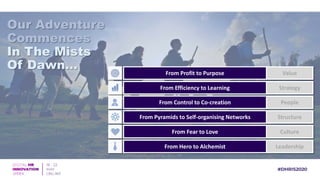
Our Adventure
Commences
In The Mists
Of Dawn… From Profit to Purpose Value
From Efficiency to Learning Strategy
From Control to Co-creation People
From Pyramids to Self-organising Networks Structure
From Fear to Love Culture
From Hero to Alchemist Leadership
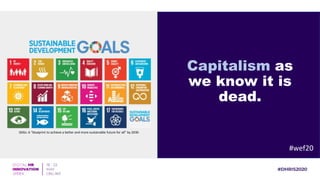
Capitalism as
we know it is
dead.
#wef20
SDGs: A “blueprint to achieve a better and more sustainable future for all” by 2030
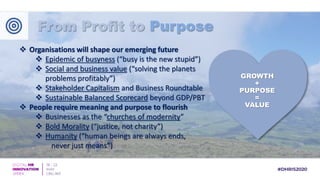
From Profit to Purpose
 Organisations will shape our emerging future
 Epidemic of busyness (“busy is the new stupid”)
 Social and business value (“solving the planets
problems profitably”)
 Stakeholder Capitalism and Business Roundtable
 Sustainable Balanced Scorecard beyond GDP/PBT
 People require meaning and purpose to flourish
 Businesses as the “churches of modernity”
 Bold Morality (“justice, not charity”)
 Humanity (“human beings are always ends,
never just means”)
GROWTH
+
PURPOSE
=
VALUE
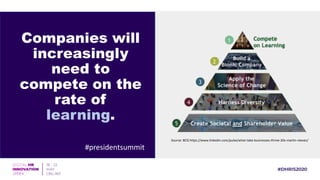
Companies will
increasingly
need to
compete on the
rate of
learning.
#presidentsummit
Source: BCG https://www.linkedin.com/pulse/what-take-businesses-thrive-20s-martin-reeves/
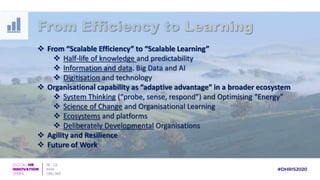
 From “Scalable Efficiency” to “Scalable Learning”
 Half-life of knowledge and predictability
 Information and data. Big Data and AI
 Digitisation and technology
 Organisational capability as “adaptive advantage” in a broader ecosystem
 System Thinking (“probe, sense, respond”) and Optimising “Energy”
 Science of Change and Organisational Learning
 Ecosystems and platforms
 Deliberately Developmental Organisations
 Agility and Resilience
 Future of Work
From Efficiency to Learning
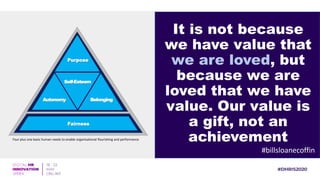
Purpose
Self-Esteem
Autonomy Belonging
Fairness
It is not because
we have value that
we are loved, but
because we are
loved that we have
value. Our value is
a gift, not an
achievement
#billsloanecoffin
Four plus one basic human needs to enable organisational flourishing and performance
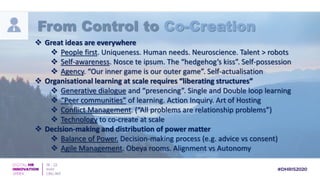
 Great ideas are everywhere
 People first. Uniqueness. Human needs. Neuroscience. Talent > robots
 Self-awareness. Nosce te ipsum. The “hedgehog’s kiss”. Self-possession
 Agency. “Our inner game is our outer game”. Self-actualisation
 Organisational learning at scale requires “liberating structures”
 Generative dialogue and “presencing”. Single and Double loop learning
 “Peer communities” of learning. Action Inquiry. Art of Hosting
 Conflict Management. (“All problems are relationship problems”)
 Technology to co-create at scale
 Decision-making and distribution of power matter
 Balance of Power. Decision-making process (e.g. advice vs consent)
 Agile Management. Obeya rooms. Alignment vs Autonomy
From Control to Co-Creation
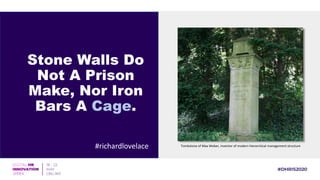
Stone Walls Do
Not A Prison
Make, Nor Iron
Bars A Cage.
#richardlovelace Tombstone of Max Weber, inventor of modern hierarchical management structure
From Pyramids to Networks
 Organisations will become fluid and modular
 Role vs skill (purpose vs craft)
 Ambidextrous organisations and internal marketplaces
 Portfolio of de-centralised experiments. Continuous adaptation
 Dynamic resource allocation (“kill the budget cycle”)
 Boundaryless collaboration trumps competition
 Orchestration of adaptive networks of players towards mutual goals
 Market-oriented Ecosystems and Platforms
 “Dialogic” Org Design will enable adaptive self-organisation
 Outside-in and end-to-end customer journeys
 Cross-functional and self-organising teams. Sociocracy and Holacracy
 Free flow of knowledge and power. Circles, tribes, guilds, chapters…
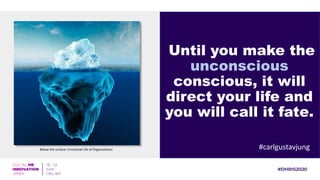
Until you make the
unconscious
conscious, it will
direct your life and
you will call it fate.
#carlgustavjungBelow the surface: Emotional Life of Organisations
 Emotions are fundamental: fear kills creativity
 Psychological Safety (Amy Edmondson) & Trust Your People. Care > Control
 Radical Candour (Kim Scott). Ongoing learning. Coaching
 Joy, fun and play. Wellbeing. Kindness. Community > individual
 Context matters: think energy fields
 Transparency of information. Self-organising. Bottom-up and top-down
 Growth mindset. Entrepreneurialism. Experimentation. Fail-fast
 Wholeness. Authentizoic organisations (Manfred Kets de Vries)
 Higher purpose and values. Integrity. Resilience. Diversity. Fairness
 Culture is a “derivative” property
 Behaviours/decisions, systems, signature practice, hero stories, symbols
 Incongruency is sensed immediately
From Fear to Love
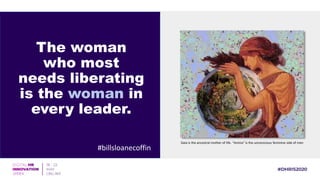
The woman
who most
needs liberating
is the woman in
every leader.
#billsloanecoffin
Gaia is the ancestral mother of life. “Anima” is the unconscious feminine side of men
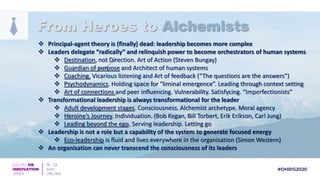
 Principal-agent theory is (finally) dead: leadership becomes more complex
 Leaders delegate “radically” and relinquish power to become orchestrators of human systems
 Destination, not Direction. Art of Action (Steven Bungay)
 Guardian of purpose and Architect of human systems
 Coaching. Vicarious listening and Art of feedback (“The questions are the answers”)
 Psychodynamics. Holding space for “liminal emergence”. Leading through context setting
 Art of connections and peer influencing. Vulnerability. Satisfycing. “Imperfectionists”
 Transformational leadership is always transformational for the leader
 Adult development stages. Consciousness. Alchemist archetype. Moral agency
 Heroine’s Journey. Individuation. (Bob Kegan, Bill Torbert, Erik Erikson, Carl Jung)
 Leading beyond the ego. Serving leadership. Letting go
 Leadership is not a role but a capability of the system to generate focused energy
 Eco-leadership is fluid and lives everywhere in the organisation (Simon Western)
 An organisation can never transcend the consciousness of its leaders
From Heroes to Alchemists
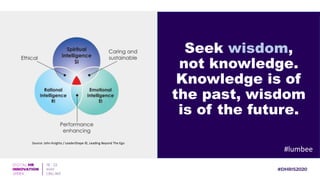
Seek wisdom,
not knowledge.
Knowledge is of
the past, wisdom
is of the future.
#lumbee
Source: John Knights / LeaderShape ©, Leading Beyond The Ego
My question is how
organizations can
lead us not toward
some predictable
goal, but toward a
greater and greater
capacity to handle
unpredictability, and
with it, a greater
capacity to love and
care about other
people.
A Living
Organisation #margaretwheatley
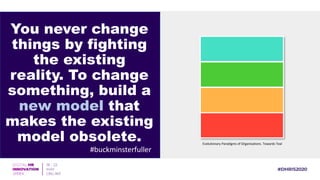
You never change
things by fighting
the existing
reality. To change
something, build a
new model that
makes the existing
model obsolete.
#buckminsterfuller
Evolutionary Paradigms of Organisations. Towards Teal
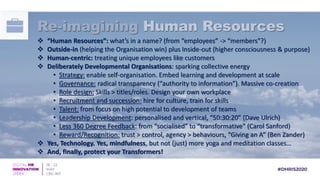
 “Human Resources”: what’s in a name? (from “employees” -> “members”?)
 Outside-in (helping the Organisation win) plus Inside-out (higher consciousness & purpose)
 Human-centric: treating unique employees like customers
 Deliberately Developmental Organisations: sparking collective energy
• Strategy: enable self-organisation. Embed learning and development at scale
• Governance: radical transparency (“authority to information”). Massive co-creation
• Role design: Skills > titles/roles. Design your own workplace
• Recruitment and succession: hire for culture, train for skills
• Talent: from focus on high potential to development of teams
• Leadership Development: personalised and vertical, “50:30:20” (Dave Ulrich)
• Less 360 Degree Feedback: from “socialised” to “transformative” (Carol Sanford)
• Reward/Recognition: trust > control, agency > behaviours, “Giving an A” (Ben Zander)
 Yes, Technology. Yes, mindfulness, but not (just) more yoga and meditation classes…
 And, finally, protect your Transformers!
Re-imagining Human Resources
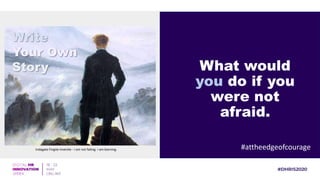
What would
you do if you
were not
afraid.
#attheedgeofcourage
Write
Your Own
Story
Indagate Fingite Invenite - I am not failing. I am learning.
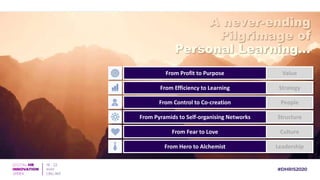
A never-ending
Pilgrimage of
Personal Learning…
From Profit to Purpose Value
From Efficiency to Learning Strategy
From Control to Co-creation People
From Pyramids to Self-organising Networks Structure
From Fear to Love Culture
From Hero to Alchemist Leadership
Dave Ulrich, Amy Edmondson, Gianpiero Petriglieri, Rita
McGrath, Simon Western, Antoinette Weibel, Michael
Gelb, John Knights, Julian Birkinshaw, Bill Torbert, Otto
Scharmer, Emanuele Quintarelli, Ben Zander, Sesil Pir,
Don Beck, Mihaly Nagy, Manfred Kets de Vries, Sergio
Caredda, Ville Pellinen, Dave Logan, Frederic Laloux,
Jon Ingham, Yuri van Geest, Justin Hughes, James
Hollis, Nora Bateson, Margaret Wheatley, Bob Kegan,
Daniel Pinchbeck, Celine Mullins, Karen Tobiasen, Bryan
Ungard, Vitaly Geyman, Corporate Rebels, Danah Zohar,
Srikumaro Rao, Norman Wolfe, Marielle Mooijekind,
Carlo Giardinetti, the whole ING Team & many more…
Thank you
& Slides
linkedin.com/in/ottivogt
Join Us Now
THANK YOU!
Questions?

Agile Learning Organisations 2.0

  • 1.
    You May SayI’m A Dreamer Agile 2.0: An Arduous Pilgrimage Towards Agile Learning Organisations Otti Vogt COO C&G, ING
  • 2.
    Disclaimer Any opinions expressedin this presentation are solely those of the author and not necessarily reflect those of any of the organisations or individuals mentioned.
  • 3.
  • 4.
    Our Adventure Commences In TheMists Of Dawn… From Profit to Purpose Value From Efficiency to Learning Strategy From Control to Co-creation People From Pyramids to Self-organising Networks Structure From Fear to Love Culture From Hero to Alchemist Leadership
  • 5.
    Capitalism as we knowit is dead. #wef20 SDGs: A “blueprint to achieve a better and more sustainable future for all” by 2030
  • 6.
    From Profit toPurpose  Organisations will shape our emerging future  Epidemic of busyness (“busy is the new stupid”)  Social and business value (“solving the planets problems profitably”)  Stakeholder Capitalism and Business Roundtable  Sustainable Balanced Scorecard beyond GDP/PBT  People require meaning and purpose to flourish  Businesses as the “churches of modernity”  Bold Morality (“justice, not charity”)  Humanity (“human beings are always ends, never just means”) GROWTH + PURPOSE = VALUE
  • 7.
    Companies will increasingly need to competeon the rate of learning. #presidentsummit Source: BCG https://www.linkedin.com/pulse/what-take-businesses-thrive-20s-martin-reeves/
  • 8.
     From “ScalableEfficiency” to “Scalable Learning”  Half-life of knowledge and predictability  Information and data. Big Data and AI  Digitisation and technology  Organisational capability as “adaptive advantage” in a broader ecosystem  System Thinking (“probe, sense, respond”) and Optimising “Energy”  Science of Change and Organisational Learning  Ecosystems and platforms  Deliberately Developmental Organisations  Agility and Resilience  Future of Work From Efficiency to Learning
  • 9.
    Purpose Self-Esteem Autonomy Belonging Fairness It isnot because we have value that we are loved, but because we are loved that we have value. Our value is a gift, not an achievement #billsloanecoffin Four plus one basic human needs to enable organisational flourishing and performance
  • 10.
     Great ideasare everywhere  People first. Uniqueness. Human needs. Neuroscience. Talent > robots  Self-awareness. Nosce te ipsum. The “hedgehog’s kiss”. Self-possession  Agency. “Our inner game is our outer game”. Self-actualisation  Organisational learning at scale requires “liberating structures”  Generative dialogue and “presencing”. Single and Double loop learning  “Peer communities” of learning. Action Inquiry. Art of Hosting  Conflict Management. (“All problems are relationship problems”)  Technology to co-create at scale  Decision-making and distribution of power matter  Balance of Power. Decision-making process (e.g. advice vs consent)  Agile Management. Obeya rooms. Alignment vs Autonomy From Control to Co-Creation
  • 11.
    Stone Walls Do NotA Prison Make, Nor Iron Bars A Cage. #richardlovelace Tombstone of Max Weber, inventor of modern hierarchical management structure
  • 12.
    From Pyramids toNetworks  Organisations will become fluid and modular  Role vs skill (purpose vs craft)  Ambidextrous organisations and internal marketplaces  Portfolio of de-centralised experiments. Continuous adaptation  Dynamic resource allocation (“kill the budget cycle”)  Boundaryless collaboration trumps competition  Orchestration of adaptive networks of players towards mutual goals  Market-oriented Ecosystems and Platforms  “Dialogic” Org Design will enable adaptive self-organisation  Outside-in and end-to-end customer journeys  Cross-functional and self-organising teams. Sociocracy and Holacracy  Free flow of knowledge and power. Circles, tribes, guilds, chapters…
  • 13.
    Until you makethe unconscious conscious, it will direct your life and you will call it fate. #carlgustavjungBelow the surface: Emotional Life of Organisations
  • 14.
     Emotions arefundamental: fear kills creativity  Psychological Safety (Amy Edmondson) & Trust Your People. Care > Control  Radical Candour (Kim Scott). Ongoing learning. Coaching  Joy, fun and play. Wellbeing. Kindness. Community > individual  Context matters: think energy fields  Transparency of information. Self-organising. Bottom-up and top-down  Growth mindset. Entrepreneurialism. Experimentation. Fail-fast  Wholeness. Authentizoic organisations (Manfred Kets de Vries)  Higher purpose and values. Integrity. Resilience. Diversity. Fairness  Culture is a “derivative” property  Behaviours/decisions, systems, signature practice, hero stories, symbols  Incongruency is sensed immediately From Fear to Love
  • 15.
    The woman who most needsliberating is the woman in every leader. #billsloanecoffin Gaia is the ancestral mother of life. “Anima” is the unconscious feminine side of men
  • 16.
     Principal-agent theoryis (finally) dead: leadership becomes more complex  Leaders delegate “radically” and relinquish power to become orchestrators of human systems  Destination, not Direction. Art of Action (Steven Bungay)  Guardian of purpose and Architect of human systems  Coaching. Vicarious listening and Art of feedback (“The questions are the answers”)  Psychodynamics. Holding space for “liminal emergence”. Leading through context setting  Art of connections and peer influencing. Vulnerability. Satisfycing. “Imperfectionists”  Transformational leadership is always transformational for the leader  Adult development stages. Consciousness. Alchemist archetype. Moral agency  Heroine’s Journey. Individuation. (Bob Kegan, Bill Torbert, Erik Erikson, Carl Jung)  Leading beyond the ego. Serving leadership. Letting go  Leadership is not a role but a capability of the system to generate focused energy  Eco-leadership is fluid and lives everywhere in the organisation (Simon Western)  An organisation can never transcend the consciousness of its leaders From Heroes to Alchemists
  • 17.
    Seek wisdom, not knowledge. Knowledgeis of the past, wisdom is of the future. #lumbee Source: John Knights / LeaderShape ©, Leading Beyond The Ego
  • 18.
    My question ishow organizations can lead us not toward some predictable goal, but toward a greater and greater capacity to handle unpredictability, and with it, a greater capacity to love and care about other people. A Living Organisation #margaretwheatley
  • 19.
    You never change thingsby fighting the existing reality. To change something, build a new model that makes the existing model obsolete. #buckminsterfuller Evolutionary Paradigms of Organisations. Towards Teal
  • 20.
     “Human Resources”:what’s in a name? (from “employees” -> “members”?)  Outside-in (helping the Organisation win) plus Inside-out (higher consciousness & purpose)  Human-centric: treating unique employees like customers  Deliberately Developmental Organisations: sparking collective energy • Strategy: enable self-organisation. Embed learning and development at scale • Governance: radical transparency (“authority to information”). Massive co-creation • Role design: Skills > titles/roles. Design your own workplace • Recruitment and succession: hire for culture, train for skills • Talent: from focus on high potential to development of teams • Leadership Development: personalised and vertical, “50:30:20” (Dave Ulrich) • Less 360 Degree Feedback: from “socialised” to “transformative” (Carol Sanford) • Reward/Recognition: trust > control, agency > behaviours, “Giving an A” (Ben Zander)  Yes, Technology. Yes, mindfulness, but not (just) more yoga and meditation classes…  And, finally, protect your Transformers! Re-imagining Human Resources
  • 21.
    What would you doif you were not afraid. #attheedgeofcourage Write Your Own Story Indagate Fingite Invenite - I am not failing. I am learning.
  • 22.
    A never-ending Pilgrimage of PersonalLearning… From Profit to Purpose Value From Efficiency to Learning Strategy From Control to Co-creation People From Pyramids to Self-organising Networks Structure From Fear to Love Culture From Hero to Alchemist Leadership
  • 23.
    Dave Ulrich, AmyEdmondson, Gianpiero Petriglieri, Rita McGrath, Simon Western, Antoinette Weibel, Michael Gelb, John Knights, Julian Birkinshaw, Bill Torbert, Otto Scharmer, Emanuele Quintarelli, Ben Zander, Sesil Pir, Don Beck, Mihaly Nagy, Manfred Kets de Vries, Sergio Caredda, Ville Pellinen, Dave Logan, Frederic Laloux, Jon Ingham, Yuri van Geest, Justin Hughes, James Hollis, Nora Bateson, Margaret Wheatley, Bob Kegan, Daniel Pinchbeck, Celine Mullins, Karen Tobiasen, Bryan Ungard, Vitaly Geyman, Corporate Rebels, Danah Zohar, Srikumaro Rao, Norman Wolfe, Marielle Mooijekind, Carlo Giardinetti, the whole ING Team & many more… Thank you & Slides linkedin.com/in/ottivogt Join Us Now
  • 24.