Agile Leaders
                                        Raj Mudhar
                                        http://rajile.com


                            Licensed under Creative Commons, 2010, Raj Mudhar - rajile.com


Monday, August 16, 2010
Attribution
                          This slide deck is adapted from the work
                          of Catherine Louis, Cll-Group.com. A
                          grateful thanks to her for this material,
                          and her permission to use it! The
                          original presentation is here: http://
                          www.slideshare.net/jujucath/shaping-
                          behaviors-agile-carolinas
                          B.F. Skinner, I. Pavlov, & C. Lloyd
                          Morgan
                                    Licensed under Creative Commons, 2010, Raj Mudhar - rajile.com


Monday, August 16, 2010
Re-Use
                          You may freely re-use this presentation
                          and workshop material under the
                          following conditions:
                          Provide attribution to the author(s).
                          Follow Creative Commons Licensing
                          Rules.
                          Thank you!

                                    Licensed under Creative Commons, 2010, Raj Mudhar - rajile.com


Monday, August 16, 2010
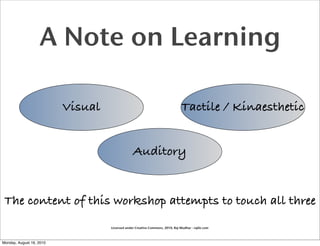
A Note on Learning

                          Visual                                               Tactile / Kinaesthetic


                                                Auditory


 The content of this workshop attempts to touch all three
                                   Licensed under Creative Commons, 2010, Raj Mudhar - rajile.com


Monday, August 16, 2010
Why?
                          Licensed under Creative Commons, 2010, Raj Mudhar - rajile.com


Monday, August 16, 2010
Because...

                          Learn from each other
                          Change the culture
                          Make the workplace better for everyone
                          Adopt Servant Leadership


                                   Licensed under Creative Commons, 2010, Raj Mudhar - rajile.com


Monday, August 16, 2010
About you...
                          Who are you?

                          Why are you here?

                          What do you want to
                          get out of this
                          workshop?

                          What else would you
                          like to know about
                          your colleagues?

                                         Licensed under Creative Commons, 2010, Raj Mudhar - rajile.com


Monday, August 16, 2010
Introduction
                            Licensed under Creative Commons, 2010, Raj Mudhar - rajile.com


Monday, August 16, 2010
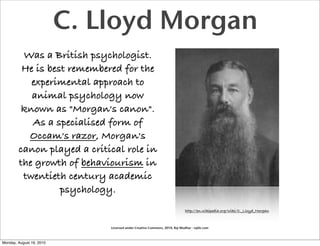
C. Lloyd Morgan
         Was a British psychologist.
         He is best remembered for the
           experimental approach to
           animal psychology now
         known as "Morgan's canon".
           As a specialised form of
          Occam's razor, Morgan's
        canon played a critical role in
        the growth of behaviourism in
         twentieth century academic
                  psychology.
                                                                             http://en.wikipedia.org/wiki/C._Lloyd_Morgan


                              Licensed under Creative Commons, 2010, Raj Mudhar - rajile.com


Monday, August 16, 2010
Morgan’s Canon
                            “In no case is an animal activity to be
                                interpreted in terms of higher
                          psychological processes, if it can be fairly
                            interpreted in terms of processes which
                           stand lower in the scale of psychological
                                 evolution and development.”


       - C. Lloyd Morgan, British psychologist -1890
                                     Licensed under Creative Commons, 2010, Raj Mudhar - rajile.com


Monday, August 16, 2010
Horses
                          “They start nickering knowing that
                          they are going to be fed!”
                          What’s really happening?
                           Enter the barn, pull feed, mix up the beet
                           pulp... the sound of the containers
                           opening, etc.
                           Cues tell you something is going to
                           happen
                                   Licensed under Creative Commons, 2010, Raj Mudhar - rajile.com


Monday, August 16, 2010
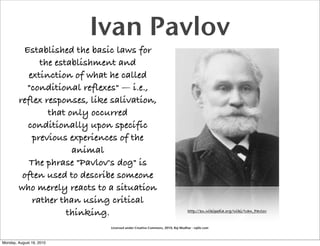
Ivan Pavlov
         Established the basic laws for
              the establishment and
           extinction of what he called
          "conditional reflexes" — i.e.,
        reflex responses, like salivation,
                that only occurred
          conditionally upon specific
            previous experiences of the
                      animal
           The phrase "Pavlov's dog" is
         often used to describe someone
        who merely reacts to a situation
            rather than using critical
                     thinking.                                                http://en.wikipedia.org/wiki/Ivan_Pavlov


                              Licensed under Creative Commons, 2010, Raj Mudhar - rajile.com


Monday, August 16, 2010
Example - neutral
                              stimuli
                          Horses know it’s time for turnout.
                          The gate chain rattles
                          Barn doors open
                          Lead shanks and halters are pulled from
                          the hook...
                          They start to shuffle, ears perk up

                                    Licensed under Creative Commons, 2010, Raj Mudhar - rajile.com


Monday, August 16, 2010
Exercise
                          5 minutes

                          Discuss / list examples
                          of Morgan’s Cannon
                          in the workplace. (Any
                          leadership examples?)

                          Discuss / list examples
                          of Pavlov’s neutral
                          stimuli in the
                          workplace. (Any
                          leadership examples?)
                                        Licensed under Creative Commons, 2010, Raj Mudhar - rajile.com


Monday, August 16, 2010
Good Leadership
                              Licensed under Creative Commons, 2010, Raj Mudhar - rajile.com


Monday, August 16, 2010
Exercise
                          5 minutes

                          Think of the best
                          leader you ever had.

                          Write down examples
                          of what this good
                          leader did. One
                          example per sticky
                          note.

                                        Licensed under Creative Commons, 2010, Raj Mudhar - rajile.com


Monday, August 16, 2010
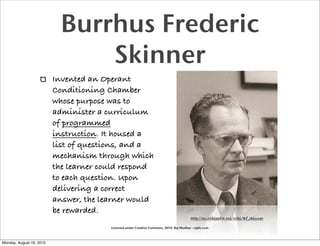
Burrhus Frederic
                                Skinner
                          Invented an Operant
                          Conditioning Chamber
                          whose purpose was to
                          administer a curriculum
                          of programmed
                          instruction. It housed a
                          list of questions, and a
                          mechanism through which
                          the learner could respond
                          to each question. Upon
                          delivering a correct
                          answer, the learner would
                          be rewarded.
                                                                                          http://en.wikipedia.org/wiki/Bf_skinner

                                        Licensed under Creative Commons, 2010, Raj Mudhar - rajile.com


Monday, August 16, 2010
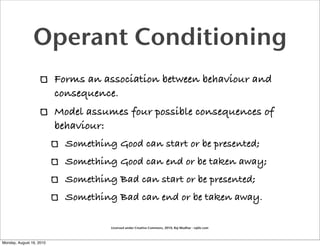
Operant Conditioning
                          Forms an association between behaviour and
                          consequence.
                          Model assumes four possible consequences of
                          behaviour:
                            Something Good can start or be presented;
                            Something Good can end or be taken away;
                            Something Bad can start or be presented;
                            Something Bad can end or be taken away.

                                     Licensed under Creative Commons, 2010, Raj Mudhar - rajile.com


Monday, August 16, 2010
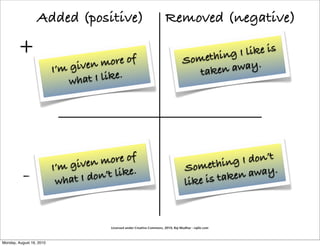
Added (positive)                                        Removed (negative)

        +                                                                                ething I like is
                              given   more of                                        Som
                                                                                              away.
                          I’m                                                           taken
                              wha t I like.


                              given m
                                         ore of                                             ething  I don’t
                          I’m                                                         Som             away.
          -                wha t I don’ t like.
                                                                                      like i s taken


                                        Licensed under Creative Commons, 2010, Raj Mudhar - rajile.com


Monday, August 16, 2010
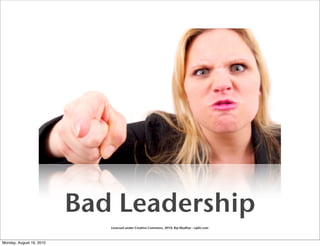
Bad Leadership
                             Licensed under Creative Commons, 2010, Raj Mudhar - rajile.com


Monday, August 16, 2010
Exercise

                          5 minutes

                          Think about the worst
                          leader you ever had.

                          Write down examples
                          of what this bad leader
                          did. One example per
                          sticky note.


                                        Licensed under Creative Commons, 2010, Raj Mudhar - rajile.com


Monday, August 16, 2010
Exercise

                          10 minutes

                          Take the examples you
                          have and plot them in
                          the 4 quadrants

                          Readout from each
                          team after the exercise!


                                         Licensed under Creative Commons, 2010, Raj Mudhar - rajile.com


Monday, August 16, 2010
Servant Leadership
                          Licensed under Creative Commons, 2010, Raj Mudhar - rajile.com


Monday, August 16, 2010
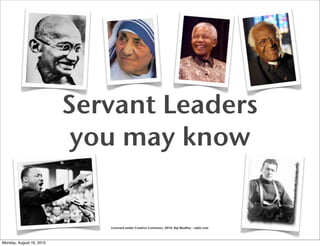
Servant Leaders
                           you may know


                             Licensed under Creative Commons, 2010, Raj Mudhar - rajile.com


Monday, August 16, 2010
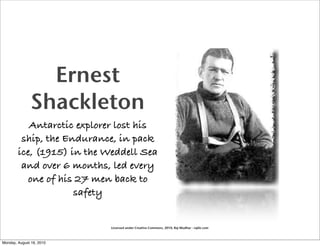
Ernest
               Shackleton
           Antarctic explorer lost his
         ship, the Endurance, in pack
        ice, (1915) in the Weddell Sea
         and over 6 months, led every
           one of his 27 men back to
                     safety


                            Licensed under Creative Commons, 2010, Raj Mudhar - rajile.com


Monday, August 16, 2010
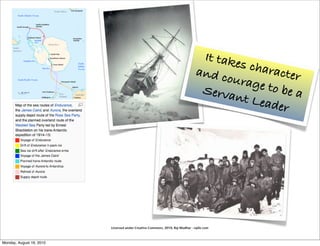
It take
                                                                                       s char
                                                                               and c          acter
                                                                                     ourag
                                                                                Serva      e to be
                                                                                      nt Lea       a
                                                                                              der


                          Licensed under Creative Commons, 2010, Raj Mudhar - rajile.com


Monday, August 16, 2010
“People are the heart and spirit of all that counts.”
                           -- Max DePree, author and founder of Herman Miller Office Furniture

            “Leadership is about people and the intricate
            relationships between them.”
                    -- Chuck Ferguson, Indomitable Spirit: Life Changing Lessons in Leadership

            “Being a leader changes everything. Before you are a
            leader, success is all about you. Nothing you do
            anymore as an individual matters except how you
            increase their self-confidence. Put another way: Your
            success as a leader will come not from what you do but
            from the reflected glory of your team.”
                                                                --Jack Welch, former CEO of General Electric


                                        Licensed under Creative Commons, 2010, Raj Mudhar - rajile.com


Monday, August 16, 2010
"The servant-leader is servant first... Becoming a servant-
    leader begins with the natural feeling that one wants to serve,
      to serve first. Then conscious choice brings one to aspire to
     lead. That person is sharply different from one who is leader
                                 first...
        The difference manifests itself in the care taken by the
     servant first to make sure that other people's highest priority
     needs are being served. The best test, and the most difficult to
     administer, is this: Do those served grow as persons? Do they,
        while being served, become healthier, wiser, freer, more
       autonomous, more likely themselves to become servants?"
                                                                                           Robert K. Greenleaf


                          Licensed under Creative Commons, 2010, Raj Mudhar - rajile.com


Monday, August 16, 2010
Principles of Servant
                                 Leadership
                          Servant leaders value people and relationships.
                             Respecting, serving, communicating and forgiving is how we show
                             people we value them.
                          Servant leaders use their personal influence.
                             Choosing to influence through character and integrity is more
                             successful than influencing with power and control.
                          Servant leaders recognize that each person has a purpose and a passion.
                             Recognizing and tapping into each person’s unique experiences,
                             gifts and abilities empowers them to add their value.
                          Servant leaders understand the importance of creating a work
                          environment and culture that is founded on trust.
                             Creating an atmosphere of “we” as opposed to “me” gives people
                             greater significance and voice because they play a meaningful role
                             in something larger than themselves.

                                                                                                       Source: Marshall Christensen Foundation
                                           Licensed under Creative Commons, 2010, Raj Mudhar - rajile.com


Monday, August 16, 2010
Principles of Servant
                               Leadership

                          Servant leaders bring change and innovation.
                             Creating an environment where change and innovation is
                             encouraged and rewarded improves the team, the product, the
                             process, and how we serve customers and one another.
                          Servant leaders model leadership and service to employees and
                          customers.
                             Modeling service teaches employees how to serve each other and
                             our customers.
                          Servant leaders mentor others who can replace them as leaders.
                             Giving away power and responsibility to those who can lead
                             creates the next generation of servant leaders.


                                                                                                    Source: Marshall Christensen Foundation
                                        Licensed under Creative Commons, 2010, Raj Mudhar - rajile.com


Monday, August 16, 2010
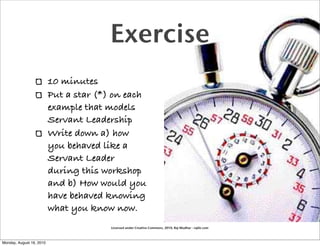
Exercise
                          10 minutes
                          Put a star (*) on each
                          example that models
                          Servant Leadership
                          Write down a) how
                          you behaved like a
                          Servant Leader
                          during this workshop
                          and b) How would you
                          have behaved knowing
                          what you know now.
                                        Licensed under Creative Commons, 2010, Raj Mudhar - rajile.com


Monday, August 16, 2010
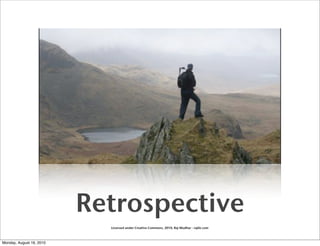
Retrospective
                            Licensed under Creative Commons, 2010, Raj Mudhar - rajile.com


Monday, August 16, 2010
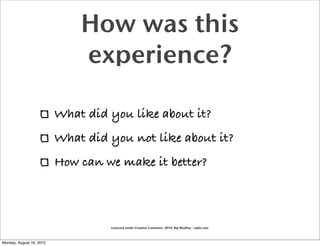
How was this
                              experience?

                          What did you like about it?
                          What did you not like about it?
                          How can we make it better?


                                   Licensed under Creative Commons, 2010, Raj Mudhar - rajile.com


Monday, August 16, 2010
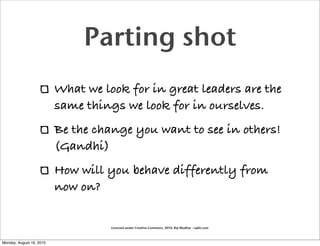
Parting shot
                          What we look for in great leaders are the
                          same things we look for in ourselves.
                          Be the change you want to see in others!
                          (Gandhi)
                          How will you behave differently from
                          now on?

                                    Licensed under Creative Commons, 2010, Raj Mudhar - rajile.com


Monday, August 16, 2010

Agile Leaders

  • 1.
    Agile Leaders Raj Mudhar http://rajile.com Licensed under Creative Commons, 2010, Raj Mudhar - rajile.com Monday, August 16, 2010
  • 2.
    Attribution This slide deck is adapted from the work of Catherine Louis, Cll-Group.com. A grateful thanks to her for this material, and her permission to use it! The original presentation is here: http:// www.slideshare.net/jujucath/shaping- behaviors-agile-carolinas B.F. Skinner, I. Pavlov, & C. Lloyd Morgan Licensed under Creative Commons, 2010, Raj Mudhar - rajile.com Monday, August 16, 2010
  • 3.
    Re-Use You may freely re-use this presentation and workshop material under the following conditions: Provide attribution to the author(s). Follow Creative Commons Licensing Rules. Thank you! Licensed under Creative Commons, 2010, Raj Mudhar - rajile.com Monday, August 16, 2010
  • 4.
    A Note onLearning Visual Tactile / Kinaesthetic Auditory The content of this workshop attempts to touch all three Licensed under Creative Commons, 2010, Raj Mudhar - rajile.com Monday, August 16, 2010
  • 5.
    Why? Licensed under Creative Commons, 2010, Raj Mudhar - rajile.com Monday, August 16, 2010
  • 6.
    Because... Learn from each other Change the culture Make the workplace better for everyone Adopt Servant Leadership Licensed under Creative Commons, 2010, Raj Mudhar - rajile.com Monday, August 16, 2010
  • 7.
    About you... Who are you? Why are you here? What do you want to get out of this workshop? What else would you like to know about your colleagues? Licensed under Creative Commons, 2010, Raj Mudhar - rajile.com Monday, August 16, 2010
  • 8.
    Introduction Licensed under Creative Commons, 2010, Raj Mudhar - rajile.com Monday, August 16, 2010
  • 9.
    C. Lloyd Morgan Was a British psychologist. He is best remembered for the experimental approach to animal psychology now known as "Morgan's canon". As a specialised form of Occam's razor, Morgan's canon played a critical role in the growth of behaviourism in twentieth century academic psychology. http://en.wikipedia.org/wiki/C._Lloyd_Morgan Licensed under Creative Commons, 2010, Raj Mudhar - rajile.com Monday, August 16, 2010
  • 10.
    Morgan’s Canon “In no case is an animal activity to be interpreted in terms of higher psychological processes, if it can be fairly interpreted in terms of processes which stand lower in the scale of psychological evolution and development.” - C. Lloyd Morgan, British psychologist -1890 Licensed under Creative Commons, 2010, Raj Mudhar - rajile.com Monday, August 16, 2010
  • 11.
    Horses “They start nickering knowing that they are going to be fed!” What’s really happening? Enter the barn, pull feed, mix up the beet pulp... the sound of the containers opening, etc. Cues tell you something is going to happen Licensed under Creative Commons, 2010, Raj Mudhar - rajile.com Monday, August 16, 2010
  • 12.
    Ivan Pavlov Established the basic laws for the establishment and extinction of what he called "conditional reflexes" — i.e., reflex responses, like salivation, that only occurred conditionally upon specific previous experiences of the animal The phrase "Pavlov's dog" is often used to describe someone who merely reacts to a situation rather than using critical thinking. http://en.wikipedia.org/wiki/Ivan_Pavlov Licensed under Creative Commons, 2010, Raj Mudhar - rajile.com Monday, August 16, 2010
  • 13.
    Example - neutral stimuli Horses know it’s time for turnout. The gate chain rattles Barn doors open Lead shanks and halters are pulled from the hook... They start to shuffle, ears perk up Licensed under Creative Commons, 2010, Raj Mudhar - rajile.com Monday, August 16, 2010
  • 14.
    Exercise 5 minutes Discuss / list examples of Morgan’s Cannon in the workplace. (Any leadership examples?) Discuss / list examples of Pavlov’s neutral stimuli in the workplace. (Any leadership examples?) Licensed under Creative Commons, 2010, Raj Mudhar - rajile.com Monday, August 16, 2010
  • 15.
    Good Leadership Licensed under Creative Commons, 2010, Raj Mudhar - rajile.com Monday, August 16, 2010
  • 16.
    Exercise 5 minutes Think of the best leader you ever had. Write down examples of what this good leader did. One example per sticky note. Licensed under Creative Commons, 2010, Raj Mudhar - rajile.com Monday, August 16, 2010
  • 17.
    Burrhus Frederic Skinner Invented an Operant Conditioning Chamber whose purpose was to administer a curriculum of programmed instruction. It housed a list of questions, and a mechanism through which the learner could respond to each question. Upon delivering a correct answer, the learner would be rewarded. http://en.wikipedia.org/wiki/Bf_skinner Licensed under Creative Commons, 2010, Raj Mudhar - rajile.com Monday, August 16, 2010
  • 18.
    Operant Conditioning Forms an association between behaviour and consequence. Model assumes four possible consequences of behaviour: Something Good can start or be presented; Something Good can end or be taken away; Something Bad can start or be presented; Something Bad can end or be taken away. Licensed under Creative Commons, 2010, Raj Mudhar - rajile.com Monday, August 16, 2010
  • 19.
    Added (positive) Removed (negative) + ething I like is given more of Som away. I’m taken wha t I like. given m ore of ething I don’t I’m Som away. - wha t I don’ t like. like i s taken Licensed under Creative Commons, 2010, Raj Mudhar - rajile.com Monday, August 16, 2010
  • 20.
    Bad Leadership Licensed under Creative Commons, 2010, Raj Mudhar - rajile.com Monday, August 16, 2010
  • 21.
    Exercise 5 minutes Think about the worst leader you ever had. Write down examples of what this bad leader did. One example per sticky note. Licensed under Creative Commons, 2010, Raj Mudhar - rajile.com Monday, August 16, 2010
  • 22.
    Exercise 10 minutes Take the examples you have and plot them in the 4 quadrants Readout from each team after the exercise! Licensed under Creative Commons, 2010, Raj Mudhar - rajile.com Monday, August 16, 2010
  • 23.
    Servant Leadership Licensed under Creative Commons, 2010, Raj Mudhar - rajile.com Monday, August 16, 2010
  • 24.
    Servant Leaders you may know Licensed under Creative Commons, 2010, Raj Mudhar - rajile.com Monday, August 16, 2010
  • 25.
    Ernest Shackleton Antarctic explorer lost his ship, the Endurance, in pack ice, (1915) in the Weddell Sea and over 6 months, led every one of his 27 men back to safety Licensed under Creative Commons, 2010, Raj Mudhar - rajile.com Monday, August 16, 2010
  • 26.
    It take s char and c acter ourag Serva e to be nt Lea a der Licensed under Creative Commons, 2010, Raj Mudhar - rajile.com Monday, August 16, 2010
  • 27.
    “People are theheart and spirit of all that counts.” -- Max DePree, author and founder of Herman Miller Office Furniture “Leadership is about people and the intricate relationships between them.” -- Chuck Ferguson, Indomitable Spirit: Life Changing Lessons in Leadership “Being a leader changes everything. Before you are a leader, success is all about you. Nothing you do anymore as an individual matters except how you increase their self-confidence. Put another way: Your success as a leader will come not from what you do but from the reflected glory of your team.” --Jack Welch, former CEO of General Electric Licensed under Creative Commons, 2010, Raj Mudhar - rajile.com Monday, August 16, 2010
  • 28.
    "The servant-leader isservant first... Becoming a servant- leader begins with the natural feeling that one wants to serve, to serve first. Then conscious choice brings one to aspire to lead. That person is sharply different from one who is leader first... The difference manifests itself in the care taken by the servant first to make sure that other people's highest priority needs are being served. The best test, and the most difficult to administer, is this: Do those served grow as persons? Do they, while being served, become healthier, wiser, freer, more autonomous, more likely themselves to become servants?" Robert K. Greenleaf Licensed under Creative Commons, 2010, Raj Mudhar - rajile.com Monday, August 16, 2010
  • 29.
    Principles of Servant Leadership Servant leaders value people and relationships. Respecting, serving, communicating and forgiving is how we show people we value them. Servant leaders use their personal influence. Choosing to influence through character and integrity is more successful than influencing with power and control. Servant leaders recognize that each person has a purpose and a passion. Recognizing and tapping into each person’s unique experiences, gifts and abilities empowers them to add their value. Servant leaders understand the importance of creating a work environment and culture that is founded on trust. Creating an atmosphere of “we” as opposed to “me” gives people greater significance and voice because they play a meaningful role in something larger than themselves. Source: Marshall Christensen Foundation Licensed under Creative Commons, 2010, Raj Mudhar - rajile.com Monday, August 16, 2010
  • 30.
    Principles of Servant Leadership Servant leaders bring change and innovation. Creating an environment where change and innovation is encouraged and rewarded improves the team, the product, the process, and how we serve customers and one another. Servant leaders model leadership and service to employees and customers. Modeling service teaches employees how to serve each other and our customers. Servant leaders mentor others who can replace them as leaders. Giving away power and responsibility to those who can lead creates the next generation of servant leaders. Source: Marshall Christensen Foundation Licensed under Creative Commons, 2010, Raj Mudhar - rajile.com Monday, August 16, 2010
  • 31.
    Exercise 10 minutes Put a star (*) on each example that models Servant Leadership Write down a) how you behaved like a Servant Leader during this workshop and b) How would you have behaved knowing what you know now. Licensed under Creative Commons, 2010, Raj Mudhar - rajile.com Monday, August 16, 2010
  • 32.
    Retrospective Licensed under Creative Commons, 2010, Raj Mudhar - rajile.com Monday, August 16, 2010
  • 33.
    How was this experience? What did you like about it? What did you not like about it? How can we make it better? Licensed under Creative Commons, 2010, Raj Mudhar - rajile.com Monday, August 16, 2010
  • 34.
    Parting shot What we look for in great leaders are the same things we look for in ourselves. Be the change you want to see in others! (Gandhi) How will you behave differently from now on? Licensed under Creative Commons, 2010, Raj Mudhar - rajile.com Monday, August 16, 2010