1
AGILE HR ANDFUTURE-
FOCUSED PRACTICES
Presented by
Mr Lionel Lesley Sasalande
Msc in Information Systems Management
Bsc in Information Technology
Graduate Diploma in Internet Technologies
2.
Development Training International(DTI) 2
INTRODUCTION TO AGILE HR
Agile HR is a modern approach to human resources management that
applies the principles of agility, typically used in software development, to
HR practices. It emphasizes collaboration, flexibility, and rapid iteration to
help organizations adapt to changing business demands. Agile HR aims to
streamline HR functions, empower cross-functional teams, and foster a
more responsive and employee-centric environment. .
Core principles include:
• Iterative development
• Collaboration
• Rapid feedback loops
• Transparency
8/7/2025
3.
Development Training International(DTI) 3
WHY AGILE IN HR?
• Respond to rapid organizational change
• Co-create employee-centered solutions
• Shorten decision-making cycles
• Increase HR’s impact on innovation
8/7/2025
4.
Development Training International(DTI) 4
KEY AGILE HR PRACTICES
• Sprint Planning: Iterative projects
• Kanban Boards: Visual task tracking
• Daily Standups: Quick status updates
• MVPs: Test small before scaling
• Retrospectives: Continuous improvement
8/7/2025
5.
Development Training International(DTI) 5
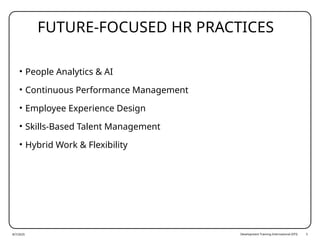
FUTURE-FOCUSED HR PRACTICES
• People Analytics & AI
• Continuous Performance Management
• Employee Experience Design
• Skills-Based Talent Management
• Hybrid Work & Flexibility
8/7/2025
6.
Development Training International(DTI) 6
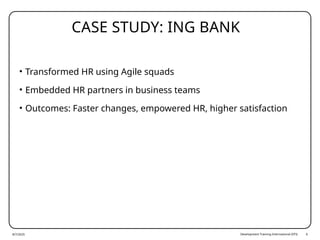
CASE STUDY: ING BANK
• Transformed HR using Agile squads
• Embedded HR partners in business teams
• Outcomes: Faster changes, empowered HR, higher satisfaction
8/7/2025
7.
Development Training International(DTI) 7
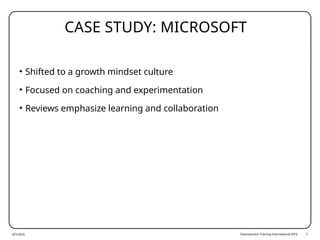
CASE STUDY: MICROSOFT
• Shifted to a growth mindset culture
• Focused on coaching and experimentation
• Reviews emphasize learning and collaboration
8/7/2025
8.
Development Training International(DTI) 8
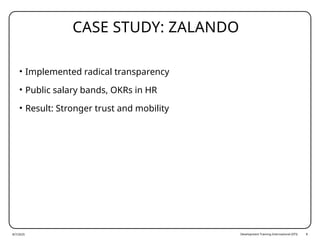
CASE STUDY: ZALANDO
• Implemented radical transparency
• Public salary bands, OKRs in HR
• Result: Stronger trust and mobility
8/7/2025
9.
Development Training International(DTI) 9
WORKSHOP ACTIVITIES
• Agile HR Simulation Game
• Retrospective Role Play
• Kanban Board Creation
• Case Study Reflection Sessions
8/7/2025
10.
Development Training International(DTI) 10
KEY TAKEAWAYS
• Agile HR = adaptable, transparent, collaborative
• Future-focused HR = data-driven, employee-centered
• Combined, they future-proof HR practices
8/7/2025
Editor's Notes
#2 🚀 What Is Agile HR?
Agile HR is a transformative approach to human resources that applies agile principles—originally developed for software development—to HR processes and culture. Instead of rigid, top-down planning and long cycles, Agile HR promotes adaptability, continuous improvement, and employee empowerment.
It’s designed to help HR teams respond quickly to changing business needs, support innovation, and create a more engaging employee experience.
🧭 Core Principles of Agile HR
Iterative Development HR initiatives (like performance management, recruitment, or learning programs) are developed in small, manageable cycles. This allows for frequent adjustments based on feedback and changing priorities, rather than waiting for a big annual rollout.
Collaboration Agile HR breaks down silos by encouraging cross-functional teamwork. HR works closely with other departments—like IT, finance, and operations—to co-create solutions that are aligned with business goals and employee needs.
Rapid Feedback Loops Continuous feedback is central to Agile HR. Whether it’s employee surveys, one-on-one check-ins, or peer reviews, the goal is to gather insights quickly and use them to improve processes and experiences in real time.
Transparency Agile HR promotes open communication and visibility into goals, progress, and decision-making. This builds trust and ensures everyone is aligned and informed.
🛠 How Agile HR Is Applied
Recruitment: Using short sprints to test and refine hiring strategies, involving hiring managers early, and iterating job descriptions based on market feedback.
Performance Management: Moving away from annual reviews to continuous performance conversations and real-time coaching.
Learning & Development: Creating modular, on-demand learning experiences that evolve based on employee needs and business priorities.
Employee Engagement: Running frequent pulse surveys and acting on feedback quickly to improve culture and morale.
🌱 Benefits of Agile HR
Faster response to business changes
More engaged and empowered employees
Better alignment between HR and organizational strategy
Increased innovation and experimentation
Reduced waste and inefficiency in HR processes
Agile HR isn’t just a methodology—it’s a mindset shift. It requires HR professionals to think like product managers, treating employees as customers and HR services as evolving products. Would you like help designing an Agile HR roadmap or applying these principles to a specific HR function like onboarding or performance reviews?
#3 1. Respond to Rapid Organizational Change
Modern organizations face constant disruption—technological advancements, economic shifts, changing employee expectations, and hybrid work models. Traditional HR methods (e.g., annual planning, static policies) are too slow and rigid.
Example: During the COVID-19 pandemic, HR teams using agile methods quickly implemented remote work policies, wellness programs, and virtual onboarding—while others struggled to adapt.
👥 2. Co-create Employee-Centered Solutions
Agile HR encourages design thinking and continuous feedback. Instead of designing HR programs for employees, Agile HR creates them with employees.
Example: An HR team co-develops a new performance review process by prototyping with a small group of managers and employees, gathering feedback every two weeks, and iterating until adoption.
⏱️ 3. Shorten Decision-Making Cycles
Agile uses sprints, standups, and real-time data to speed up decisions. This reduces HR project delays and ensures policies stay relevant.
Example: Rather than taking 6 months to design a training program, an agile HR team launches a pilot version in 4 weeks, measures effectiveness, and scales based on real feedback.
🚀 4. Increase HR’s Impact on Innovation
Agile HR shifts from being a compliance-focused function to a strategic partner that fosters a culture of experimentation, adaptability, and innovation.
Example: At Spotify, HR played a key role in creating autonomous squads with flexibility and psychological safety, driving faster product innovation and high employee satisfaction.
#4 🗓️ Sprint Planning – Iterative Projects
Agile HR work is broken into short time-boxed periods (sprints), usually 1–4 weeks. Teams focus on completing a manageable set of tasks with clear goals during each sprint.
Example: An HR team launches a sprint to redesign the onboarding process. In 2 weeks, they interview new hires, map the current journey, and create a prototype onboarding checklist.
🗂️ Kanban Boards – Visual Task Tracking
A Kanban board visualizes workflow and helps manage HR tasks and bottlenecks. Boards typically include columns like “To Do,” “In Progress,” and “Done.”
Example: Recruitment teams track candidates through stages (Application → Screening → Interview → Offer) using Trello or Jira.
📣 Daily Standups – Quick Status Updates
A 10–15 minute daily meeting where HR team members share what they did yesterday, what they plan for today, and what’s blocking them.
Example: During a wellness program rollout, the HR team holds daily standups to ensure smooth execution and resolve roadblocks (e.g., delays in communication materials).
🧪 Minimum Viable Products (MVPs) – Test Small Before Scaling
MVPs are small, testable versions of HR solutions. This reduces risk and enables early feedback before rolling out organization-wide.
Example: Instead of launching a full e-learning platform, HR pilots a single training module with one department and adjusts based on feedback.
🔍 Retrospectives – Continuous Improvement
At the end of each sprint, the team reflects on what went well, what didn’t, and how to improve next time. This builds a learning culture.
Example: After completing a DEI training series, the HR team runs a retrospective to learn from feedback and refine future sessions.
#5 📊 People Analytics & AI
HR uses data and AI to predict trends, personalize experiences, and make better decisions. It moves HR from reactive to proactive.
Example: IBM uses AI to predict employee attrition with 95% accuracy, enabling proactive retention strategies.
Tools: Visier, SAP SuccessFactors, Microsoft Viva Insights
🔁 Continuous Performance Management
Instead of annual reviews, employees receive frequent feedback, coaching, and goal check-ins. This supports agility and growth.
Example: Adobe replaced annual reviews with “Check-Ins,” a real-time feedback system that saved over 100,000 manager hours annually and boosted engagement.
Key Components: Weekly 1-on-1s, peer feedback, OKRs
🎯 Employee Experience Design
Applies design thinking to HR—focusing on understanding the employee journey and co-creating meaningful experiences.
Example: Airbnb mapped the end-to-end employee journey and redesigned touchpoints like onboarding and internal mobility with direct input from staff.
Impact: Higher engagement, improved retention, stronger culture
🧠 Skills-Based Talent Management
Moves away from rigid job descriptions toward dynamic skills mapping and internal talent mobility.
Example: Unilever uses AI to match employees with short-term internal gigs based on their skills, not just job titles.
Benefits: Better workforce agility, continuous development, improved retention
🏡 Hybrid Work & Flexibility
Designs systems where employees have autonomy over how, when, and where they work—while ensuring productivity and well-being.
Example: Spotify’s “Work From Anywhere” policy lets employees choose their location, contributing to global talent acquisition and retention.
Success Factors: Clear policies, digital collaboration tools, trust-based culture
#6 📌 Case Study: ING Bank – Agile HR Transformation
Background:
By 2015, ING—a leading global bank—recognized that traditional HR structures were too siloed, slow, and disconnected from business needs. To align with its company-wide agile transformation, HR itself had to evolve.
Approach:
🔄 Adopted Agile Squads: HR was restructured into cross-functional squads that worked in 2-week sprints on clearly defined outcomes (e.g., talent development, recruitment).
👥 Embedded HR Partners: Strategic HR business partners were embedded directly into product and business “tribes” to improve collaboration and alignment.
📊 Agile Tools and Ceremonies: HR teams used agile rituals like standups, retrospectives, Kanban boards, and sprint reviews to drive transparency and adaptiveness.
Outcomes:
⚡ Faster HR Delivery: Changes to HR policies and tools were delivered in weeks—not months—thanks to continuous feedback loops.
💪 Empowered HR Teams: HR professionals gained autonomy to solve problems and co-create solutions with business teams.
😊 Higher Stakeholder Satisfaction: Internal feedback from managers and employees showed improved trust and satisfaction with HR services.
✅ Key Lesson: When HR transforms itself to mirror an agile organization, it becomes a true enabler of innovation and speed.
#7 📌 Case Study: Microsoft – Embedding a Growth Mindset in HR
Background:
When Satya Nadella became CEO in 2014, Microsoft was known for a competitive, siloed culture. To become more innovative and collaborative, a fundamental cultural shift was needed—starting with HR leadership.
Approach:
🧠 Adopted a Growth Mindset Culture: HR helped drive a company-wide shift toward believing that abilities can be developed through learning, feedback, and experimentation—based on Carol Dweck’s research.
🎯 Performance Management Overhaul: Traditional annual reviews were replaced with a continuous feedback model that emphasized learning over judging.
💬 Coaching-Centered Leadership: HR re-trained managers to act as coaches, encouraging team members to reflect, adapt, and grow.
🧪 Encouraged Experimentation: HR empowered employees to try new approaches without fear of failure, fueling innovation at every level.
Outcomes:
🚀 Increased Collaboration: Cross-functional teams began working more openly and efficiently, reducing internal silos.
🔄 Ongoing Feedback Culture: Employees received more frequent, meaningful performance conversations.
🌱 Higher Engagement: Microsoft saw a rise in employee engagement and innovation ratings across the company.
✅ Key Lesson: HR can act as a culture catalyst—embedding mindset, values, and behaviors that support agile transformation and innovation.
#8 Zalando, Europe’s leading online fashion platform, has been a pioneer in applying Agile HR principles, particularly through its bold move toward radical transparency. This case study offers a compelling look at how transparency can transform organizational culture and employee engagement.
🧠 What Zalando Did: Radical Transparency in HR
Zalando implemented several groundbreaking practices to foster openness and trust:
Public Salary Bands: Instead of keeping compensation details behind closed doors, Zalando made salary ranges visible across the organization. This helped demystify pay structures and reduce perceptions of unfairness.
Transparent OKRs (Objectives and Key Results): HR and other departments shared their goals and progress openly. Employees could see what teams were working on, how success was measured, and where they stood in achieving those goals.
These initiatives were part of a broader shift toward Agile HR, where responsiveness, collaboration, and employee-centricity are prioritized.
🌟 Results and Impact
Stronger Trust: Employees reported higher levels of trust in leadership and HR processes. Transparency helped eliminate suspicion and fostered a culture of openness.
Increased Mobility: With clear visibility into roles, goals, and compensation, employees felt more empowered to explore internal opportunities and career paths.
Cultural Shift: The move aligned with Zalando’s agile transformation, which included autonomous, self-organizing teams and a shift to cloud-native infrastructure.
🧭 Strategic Takeaways
Radical transparency isn’t just about publishing numbers—it’s about creating a culture where information flows freely and decisions are made collaboratively.
When paired with agile practices, transparency can accelerate innovation, improve employee satisfaction, and strengthen organizational alignment.
#9 🎮 Agile HR Simulation Game
Purpose: Immerse participants in agile thinking by simulating real-world HR challenges in a fast-paced, iterative environment.
How it works:
Teams are given HR scenarios (e.g., redesigning performance reviews, launching a new onboarding process).
They work in short sprints (15–30 minutes), using agile tools like user stories, stand-ups, and retrospectives.
Each sprint ends with a demo and feedback round.
Outcomes:
Hands-on understanding of agile workflows
Improved collaboration and problem-solving
Real-time adaptation to changing requirements
🎭 Retrospective Role Play
Purpose: Practice conducting retrospectives—an essential agile ritual—through role play and reflection.
How it works:
Participants take on roles (e.g., HR lead, skeptical manager, enthusiastic employee).
They simulate a retrospective after a sprint or HR initiative.
Use formats like “Start, Stop, Continue” or “Mad, Sad, Glad” to guide discussion.
Outcomes:
Builds facilitation skills
Encourages psychological safety and open feedback
Reinforces continuous improvement mindset
🗂 Kanban Board Creation
Purpose: Visualize HR workflows and promote transparency and flow efficiency.
How it works:
Teams create a Kanban board for an HR process (e.g., recruitment, learning & development).
Columns might include: Backlog, In Progress, Review, Done.
Use sticky notes or digital tools to map tasks and track progress.
Outcomes:
Clear visualization of work in progress
Identifies bottlenecks and inefficiencies
Encourages prioritization and focus
📚 Case Study Reflection Sessions
Purpose: Analyze real-world Agile HR implementations (like Zalando) to extract lessons and inspire action.
How it works:
Present a case study (e.g., radical transparency at Zalando).
Facilitate group discussion around key questions:
What worked well?
What challenges emerged?
How could we apply this in our context?
Encourage participants to link insights to their own HR practices.
Outcomes:
Deepens understanding of agile in action
Sparks ideas for experimentation
Builds strategic thinking and contextual awareness
🧩 Bonus Tip: Combine All Four into a Cohesive Workshop
You could structure a full-day or multi-session Agile HR workshop like this:
Kickoff with Simulation Game – energize and immerse
Kanban Creation – visualize and organize
Retrospective Role Play – reflect and improve
Case Study Reflection – analyze and apply
#10 🔄 Agile HR + Future-Focused HR = Future-Proof HR
In today’s fast-changing business landscape, traditional HR models are too rigid to keep up. The convergence of Agile HR and Future-Focused HR offers a dynamic framework that not only responds to change—but anticipates it.
🧠 Agile HR: Adaptable, Transparent, Collaborative
Agile HR brings the mindset and tools of agility into human resources. It’s about:
Adaptability: HR teams work in short cycles, iterate quickly, and pivot based on feedback.
Transparency: Open communication, visible goals (like OKRs), and shared decision-making build trust.
Collaboration: Cross-functional teams co-create solutions with employees, not just for them.
Agile HR transforms HR from a service provider into a strategic partner embedded in the flow of work.
🔮 Future-Focused HR: Data-Driven, Employee-Centered
Future-focused HR looks ahead, using insights and innovation to shape the employee experience. It emphasizes:
Data-Driven Decisions: Leveraging people analytics to guide hiring, engagement, and retention strategies.
Employee-Centered Design: Creating HR services that reflect real employee needs, preferences, and aspirations.
Technology Integration: Embracing AI, automation, and digital platforms to enhance HR delivery.
This approach ensures HR is not just reactive but proactive—anticipating trends and preparing the workforce for what’s next.
🔐 The Power of Integration: Future-Proofing HR
When Agile HR and Future-Focused HR are combined, organizations unlock a powerful synergy:
Continuous Improvement + Strategic Foresight: HR evolves in real time while keeping an eye on long-term goals.
Empowered Employees + Smart Systems: People are supported by both human-centric design and intelligent tools.
Resilience + Innovation: HR becomes a driver of change, not a follower—ready to lead through uncertainty.