Agile (Goal Oriented)
Roadmaps
Slawa Giterman
June 2018
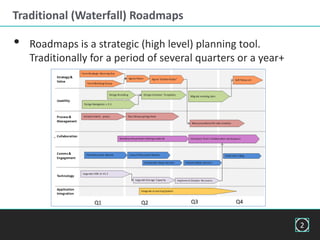
Traditional (Waterfall) Roadmaps
• Roadmaps is a strategic (high level) planning tool.
Traditionally for a period of several quarters or a year+
2
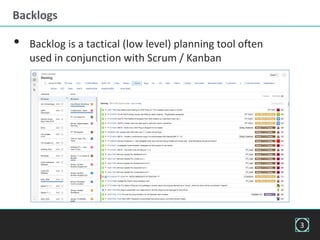
Backlogs
• Backlog is a tactical (low level) planning tool often
used in conjunction with Scrum / Kanban
3
Problems with “Waterfall” Roadmaps
• Waterfall roadmaps represent the initial assumptions =>
Roadmaps quickly become obsolete and are often
abandoned at some point
• Waterfall roadmap ignore new learning (both about the
customers/users and technology)
• Some stakeholders heavily rely on them while others
distrust them => expectations discrepancies
4
Roadmaps and Backlogs
• Some projects use both tools:
Vision => Strategy (roadmaps) => Tactic (Backlog)
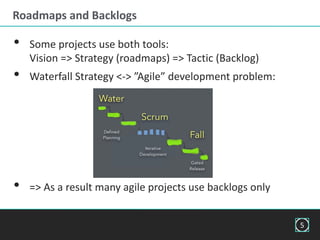
• Waterfall Strategy <-> ”Agile” development problem:
• => As a result many agile projects use backlogs only
5
Problems with Backlogs-Only
• Backlogs often look like an endless shopping list
(representing what?) but the the big picture (why?) is lost:
• the expected outcome for customers and users
• expected business impact for the company
• Many of the features have much less outcome/impact on
the product than initially expected and some are rarely
used at all
• The team concentrates on the velocity and starts to ignore
the real customer needs and pain points as well as the
business goals of the product (“feature factory”)
6
Why do we still need Roadmaps?
• To communicate visions/big picture (why?) to the product
team, stakeholders and customers/users
• Act as decision filter / alignment tool for all parties
involved => enables aligned but autonomous product
team(s) and stakeholders (marketing, sales, IT, etc.)
• To be able to achieve outcome (customer’s and user’s
needs and pain points) and impact (the company business
results) and not only output (delivered features)
– see a good introduction by Jeff Patton (vimeo)
7
Resources
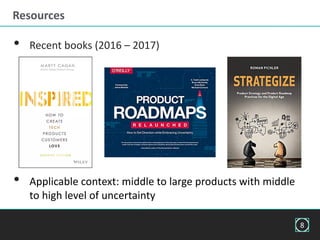
• Recent books (2016 – 2017)
• Applicable context: middle to large products with middle
to high level of uncertainty
8
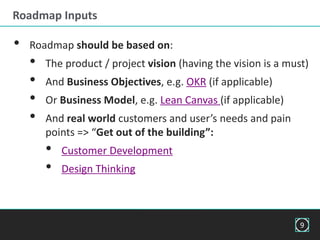
Roadmap Inputs
• Roadmap should be based on:
• The product / project vision (having the vision is a must)
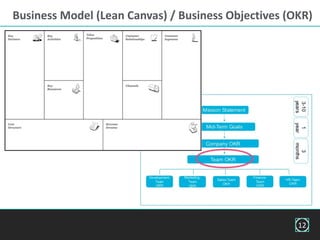
• And Business Objectives, e.g. OKR (if applicable)
• Or Business Model, e.g. Lean Canvas (if applicable)
• And real world customers and user’s needs and pain
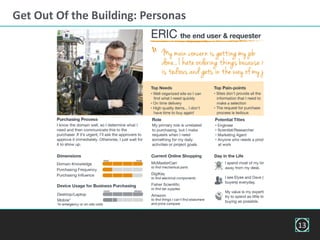
points => “Get out of the building”:
• Customer Development
• Design Thinking
9
• Classical Product Vision Format:
For [customer],
Who [target customer’s need or opportunity],
The [product] Is a: [product category]
That: [product benefit / reason to buy]
Unlike: [competitors] Our product: [differentiation]
• Elevator Pitch
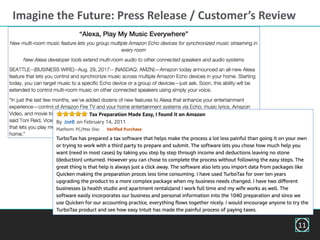
• Imagine the future: write the vision as if the product has
already been released although the it has not been started yet
(s. next slide)
• Press Release (e.g. actively used by Amazon teams)
• Customer’s Review (helps to empathize with the user)
Different Vision Formats
10
Imagine the Future: Press Release / Customer’s Review
11
Business Model (Lean Canvas) / Business Objectives (OKR)
12
Get Out Of the Building: Personas
13
Agile Roadmap Format (see an Example on the Next Slide)
• Roadmap is not a release plan – it is a sequence of
stakeholder (incl. customers’/users’) priorities
• Roadmap is an actionable plan which moves the product
closer to the vision
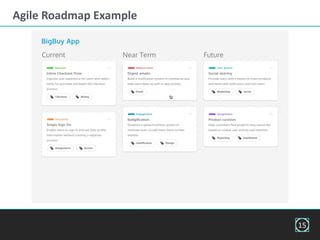
• Use timeframes (e.g. Current, Near Term, Future) instead
of particular dates
• Roadmap should be problem based, i.e. include
outcomes (customer’s needs and pain points) or impacts
(business goals) instead of outputs (features)
• Particular solutions (features, use stories) belong to the
Backlog (see further)
14
Agile Roadmap Example
15
Agile Roadmap Advantages
• When features /user stories are derived from goals:
• It helps to minimize delivering features which do not
relate to the current release goals (e.g. while discussing
the release scope with the stakeholders)
• It helps the team to set its focus on a set of highly
related user stories which minimizes context switching
• It gives the team freedom to choose the optimal
solution (UX, technology, etc.)
• Teams have higher feeling of ownership if they can
select the best solutions themselves instead of building
solutions predefined by stakeholders
16
Example of an Acceptance Criteria
• Just delivering the features (i.e. velocity) is not enough:
goals / acceptance criteria should be met
• Real World Example: “Increase amazon.com conversion rate”:
• Acceptance criteria: Increase the customer conversion rate
by 3%
• Amazon experimented with multiple solutions
• Solution which worked much better then any other:
”free” shipping + quick delivery
Amazon’s Prime members conversion rate is 74% (Millward Brown
Digital, 2015). When Prime members shop with other online
retailers, such as Wal-Mart Stores Inc., Target Inc. and Home Depot
Inc., they convert on average 6% of the time, the study suggests.
17
Backlog
• Each sprint of the release should have its own clearly
defined goals derived from the release goals.
• Measuring velocity, i.e. how much output (features) were
delivered does not show if the outcome / impact were
achieved, so is basically useless
• The aim should be to reach the sprint’s goals and
acceptance criteria
• Backlog should include detailed user stories for the
current / next sprint only. User stories for later sprints and
releases should remain coarse-grained since before their
implementation starts, the team will learn a lot of
additional information
18
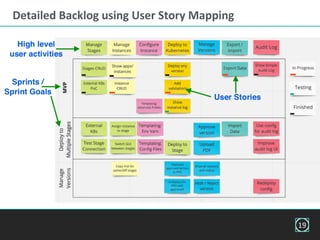
Detailed Backlog using User Story Mapping
19
User Stories Mapping
• User story mapping is a 2 dimensional backlog format:
X axis represent components / high level user activities and
Y axis represent multiple successive sprints
• User story mapping helps to present a clear big picture in
comparison with 1 dimensional formats (e.g. Jira backlog)
• This is why it gives a holistic view of the product, i.e. it helps
to spot the missing pieces of the puzzle and simplifies
prioritization between user stories
• It can be used as an alternative or as addition to Kanban
boards to represent the backlog (e.g. using tools like
https://realtimeboard.com/, etc.)
20
Product Discovery
21
• Product Discovery (i.e. determining “what to delivery?”)
should run in parallel with the Product Delivery during the
whole course of the project
• Use experiments (UX prototypes, technical spikes, etc.) to
determine which features help to reach the release / sprint
goals in the optimal way. Test / validate the prototypes with
the end users is applicable.
• After the release (incl. continuous delivery) actively
measure if the goals were achieved. Use both qualitative
(e.g. end user interviews) and quantitative (e.g. collecting
metrics) analysis

Agile (Goal Oriented) Roadmaps

  • 1.
  • 2.
    Traditional (Waterfall) Roadmaps •Roadmaps is a strategic (high level) planning tool. Traditionally for a period of several quarters or a year+ 2
  • 3.
    Backlogs • Backlog isa tactical (low level) planning tool often used in conjunction with Scrum / Kanban 3
  • 4.
    Problems with “Waterfall”Roadmaps • Waterfall roadmaps represent the initial assumptions => Roadmaps quickly become obsolete and are often abandoned at some point • Waterfall roadmap ignore new learning (both about the customers/users and technology) • Some stakeholders heavily rely on them while others distrust them => expectations discrepancies 4
  • 5.
    Roadmaps and Backlogs •Some projects use both tools: Vision => Strategy (roadmaps) => Tactic (Backlog) • Waterfall Strategy <-> ”Agile” development problem: • => As a result many agile projects use backlogs only 5
  • 6.
    Problems with Backlogs-Only •Backlogs often look like an endless shopping list (representing what?) but the the big picture (why?) is lost: • the expected outcome for customers and users • expected business impact for the company • Many of the features have much less outcome/impact on the product than initially expected and some are rarely used at all • The team concentrates on the velocity and starts to ignore the real customer needs and pain points as well as the business goals of the product (“feature factory”) 6
  • 7.
    Why do westill need Roadmaps? • To communicate visions/big picture (why?) to the product team, stakeholders and customers/users • Act as decision filter / alignment tool for all parties involved => enables aligned but autonomous product team(s) and stakeholders (marketing, sales, IT, etc.) • To be able to achieve outcome (customer’s and user’s needs and pain points) and impact (the company business results) and not only output (delivered features) – see a good introduction by Jeff Patton (vimeo) 7
  • 8.
    Resources • Recent books(2016 – 2017) • Applicable context: middle to large products with middle to high level of uncertainty 8
  • 9.
    Roadmap Inputs • Roadmapshould be based on: • The product / project vision (having the vision is a must) • And Business Objectives, e.g. OKR (if applicable) • Or Business Model, e.g. Lean Canvas (if applicable) • And real world customers and user’s needs and pain points => “Get out of the building”: • Customer Development • Design Thinking 9
  • 10.
    • Classical ProductVision Format: For [customer], Who [target customer’s need or opportunity], The [product] Is a: [product category] That: [product benefit / reason to buy] Unlike: [competitors] Our product: [differentiation] • Elevator Pitch • Imagine the future: write the vision as if the product has already been released although the it has not been started yet (s. next slide) • Press Release (e.g. actively used by Amazon teams) • Customer’s Review (helps to empathize with the user) Different Vision Formats 10
  • 11.
    Imagine the Future:Press Release / Customer’s Review 11
  • 12.
    Business Model (LeanCanvas) / Business Objectives (OKR) 12
  • 13.
    Get Out Ofthe Building: Personas 13
  • 14.
    Agile Roadmap Format(see an Example on the Next Slide) • Roadmap is not a release plan – it is a sequence of stakeholder (incl. customers’/users’) priorities • Roadmap is an actionable plan which moves the product closer to the vision • Use timeframes (e.g. Current, Near Term, Future) instead of particular dates • Roadmap should be problem based, i.e. include outcomes (customer’s needs and pain points) or impacts (business goals) instead of outputs (features) • Particular solutions (features, use stories) belong to the Backlog (see further) 14
  • 15.
  • 16.
    Agile Roadmap Advantages •When features /user stories are derived from goals: • It helps to minimize delivering features which do not relate to the current release goals (e.g. while discussing the release scope with the stakeholders) • It helps the team to set its focus on a set of highly related user stories which minimizes context switching • It gives the team freedom to choose the optimal solution (UX, technology, etc.) • Teams have higher feeling of ownership if they can select the best solutions themselves instead of building solutions predefined by stakeholders 16
  • 17.
    Example of anAcceptance Criteria • Just delivering the features (i.e. velocity) is not enough: goals / acceptance criteria should be met • Real World Example: “Increase amazon.com conversion rate”: • Acceptance criteria: Increase the customer conversion rate by 3% • Amazon experimented with multiple solutions • Solution which worked much better then any other: ”free” shipping + quick delivery Amazon’s Prime members conversion rate is 74% (Millward Brown Digital, 2015). When Prime members shop with other online retailers, such as Wal-Mart Stores Inc., Target Inc. and Home Depot Inc., they convert on average 6% of the time, the study suggests. 17
  • 18.
    Backlog • Each sprintof the release should have its own clearly defined goals derived from the release goals. • Measuring velocity, i.e. how much output (features) were delivered does not show if the outcome / impact were achieved, so is basically useless • The aim should be to reach the sprint’s goals and acceptance criteria • Backlog should include detailed user stories for the current / next sprint only. User stories for later sprints and releases should remain coarse-grained since before their implementation starts, the team will learn a lot of additional information 18
  • 19.
    Detailed Backlog usingUser Story Mapping 19
  • 20.
    User Stories Mapping •User story mapping is a 2 dimensional backlog format: X axis represent components / high level user activities and Y axis represent multiple successive sprints • User story mapping helps to present a clear big picture in comparison with 1 dimensional formats (e.g. Jira backlog) • This is why it gives a holistic view of the product, i.e. it helps to spot the missing pieces of the puzzle and simplifies prioritization between user stories • It can be used as an alternative or as addition to Kanban boards to represent the backlog (e.g. using tools like https://realtimeboard.com/, etc.) 20
  • 21.
    Product Discovery 21 • ProductDiscovery (i.e. determining “what to delivery?”) should run in parallel with the Product Delivery during the whole course of the project • Use experiments (UX prototypes, technical spikes, etc.) to determine which features help to reach the release / sprint goals in the optimal way. Test / validate the prototypes with the end users is applicable. • After the release (incl. continuous delivery) actively measure if the goals were achieved. Use both qualitative (e.g. end user interviews) and quantitative (e.g. collecting metrics) analysis