AGILE APPROACH
Module :-IBM Project
Portal :-Feedback Analysis
By :- Dharam .A.Badheka
INDEX
 Introduction
 Working
 Agile Principles
 Impact
 Why Agile?
INTRODUCTION
The concept of agile approach is not new concept , agile approach also
known as Agile software development is a group of software
development methods based on iterative and incremental development,
where requirements and solutions evolve through collaboration
between self-organizing, cross-functional teams. It promotes adaptive
planning, evolutionary development and delivery, a time-boxed iterative
approach, and encourages rapid and flexible response to change.
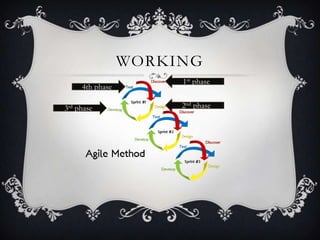
WORKING
1st phase
2nd phase3rd phase
4th phase
PRINCIPLES
1. Our highest priority is to satisfy the customer through early and continuous
delivery of valuable software.
2. Welcome changing requirements, even late in development. Agile processes
harness change for the customer’s competitive advantage.
3. Deliver working software frequently, from a couple of weeks to a couple of
months, with a preference to the shorter time scale.
4. Business people and developers must work together daily throughout the
project.
5. Build projects around motivated individuals. Give them the environment and
support they need, and trust them to get the job done.
PRINCIPLES
6. The most efficient and effective method of conveying information to
and within a development team is face-to-face conversation.
7. Working software is the primary measure of progress.
8. Agile processes promote’s sustainable development.
9. Continuous attention to technical excellence and good design
enhances agility.
10. At regular intervals, the team reflects on how to become more
effective, then tunes and adjusts it’s behavior accordingly.
IMPACT
1. Impact on People and theirs Roles.
2. Impact on Process.
3. Impact on product and quality.
IMPACT
1. Impact on People and theirs Roles:
A key agile principle, "individuals and interactions over processes and tools,"
emphasize communication and collaboration of project team members. Instead of
defining the roles of team members, more importance is given to how well they can
perform tasks as a team and create a working version of software. Teamwork
cannot be overstated in agile processes, as each member can play the part of the
end-user, leader, and engineer. To be truly successful, project managers should allow
team members to wear cross-functional hats, communicate freely, and focus on
team goals instead of individual, or role-based-functions.
IMPACT
2. Impact on Process:
Processes take secondary priority in agile methods. Instead of going
through particular stages of the development lifecycle, rapid and short
iterations move the project forward, allowing for flexibility in changing the
course of the project. Moreover, instead of drowning in documentation
as dictated by requirements and design, most documentation is in the
form of information exchange among project members. Design and
actual product are often inconsistent until the deployment stage.
IMPACT
2. Impact on Product and Quality:
Instead of delivering software that has all the knots and bolts in place
according to its original design, the highest priority is satisfying the need
of the customer with a simple but working version. The adage, "in
perpetual beta" also applies to agile method; software improves with every
iteration until all the "nice to have" features are in place. Simplicity allows
for more flexibility in change requests, especially because end-users and
sponsors or clients eventually discover new requirements along the way.
WHY AGILE?
Agile development methodology provides opportunities to assess the direction of a
project throughout the development lifecycle. This is achieved through regular cadences
of work, known as sprints or iterations, at the end of which teams must present a
potentially shippable product increment. By focusing on the repetition of abbreviated
work cycles as well as the functional product they yield, agile methodology is described as
“iterative” and “incremental.” In waterfall, development teams only have one chance to
get each aspect of a project right. In an agile paradigm, every aspect of development —
requirements, design, etc. — is continually revisited throughout the lifecycle. When a
team stops and re-evaluates the direction of a project every two weeks, there’s always time
to steer it in another direction.
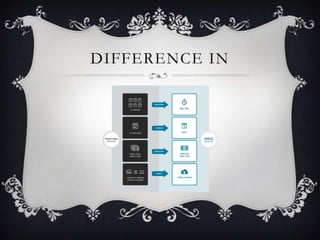
DIFFERENCE IN

Agile approach

  • 1.
    AGILE APPROACH Module :-IBMProject Portal :-Feedback Analysis By :- Dharam .A.Badheka
  • 2.
    INDEX  Introduction  Working Agile Principles  Impact  Why Agile?
  • 3.
    INTRODUCTION The concept ofagile approach is not new concept , agile approach also known as Agile software development is a group of software development methods based on iterative and incremental development, where requirements and solutions evolve through collaboration between self-organizing, cross-functional teams. It promotes adaptive planning, evolutionary development and delivery, a time-boxed iterative approach, and encourages rapid and flexible response to change.
  • 4.
  • 5.
    PRINCIPLES 1. Our highestpriority is to satisfy the customer through early and continuous delivery of valuable software. 2. Welcome changing requirements, even late in development. Agile processes harness change for the customer’s competitive advantage. 3. Deliver working software frequently, from a couple of weeks to a couple of months, with a preference to the shorter time scale. 4. Business people and developers must work together daily throughout the project. 5. Build projects around motivated individuals. Give them the environment and support they need, and trust them to get the job done.
  • 6.
    PRINCIPLES 6. The mostefficient and effective method of conveying information to and within a development team is face-to-face conversation. 7. Working software is the primary measure of progress. 8. Agile processes promote’s sustainable development. 9. Continuous attention to technical excellence and good design enhances agility. 10. At regular intervals, the team reflects on how to become more effective, then tunes and adjusts it’s behavior accordingly.
  • 7.
    IMPACT 1. Impact onPeople and theirs Roles. 2. Impact on Process. 3. Impact on product and quality.
  • 8.
    IMPACT 1. Impact onPeople and theirs Roles: A key agile principle, "individuals and interactions over processes and tools," emphasize communication and collaboration of project team members. Instead of defining the roles of team members, more importance is given to how well they can perform tasks as a team and create a working version of software. Teamwork cannot be overstated in agile processes, as each member can play the part of the end-user, leader, and engineer. To be truly successful, project managers should allow team members to wear cross-functional hats, communicate freely, and focus on team goals instead of individual, or role-based-functions.
  • 9.
    IMPACT 2. Impact onProcess: Processes take secondary priority in agile methods. Instead of going through particular stages of the development lifecycle, rapid and short iterations move the project forward, allowing for flexibility in changing the course of the project. Moreover, instead of drowning in documentation as dictated by requirements and design, most documentation is in the form of information exchange among project members. Design and actual product are often inconsistent until the deployment stage.
  • 10.
    IMPACT 2. Impact onProduct and Quality: Instead of delivering software that has all the knots and bolts in place according to its original design, the highest priority is satisfying the need of the customer with a simple but working version. The adage, "in perpetual beta" also applies to agile method; software improves with every iteration until all the "nice to have" features are in place. Simplicity allows for more flexibility in change requests, especially because end-users and sponsors or clients eventually discover new requirements along the way.
  • 11.
    WHY AGILE? Agile developmentmethodology provides opportunities to assess the direction of a project throughout the development lifecycle. This is achieved through regular cadences of work, known as sprints or iterations, at the end of which teams must present a potentially shippable product increment. By focusing on the repetition of abbreviated work cycles as well as the functional product they yield, agile methodology is described as “iterative” and “incremental.” In waterfall, development teams only have one chance to get each aspect of a project right. In an agile paradigm, every aspect of development — requirements, design, etc. — is continually revisited throughout the lifecycle. When a team stops and re-evaluates the direction of a project every two weeks, there’s always time to steer it in another direction.
  • 12.