Agency Formation and
Development
Bureaucratic Politics
• Introduction
• Bernstein, Marver. 1955. Regulating by Independent Commission.
Princeton, NJ: Princeton University Press
• Book is from 1955, so why do we still read it?
• Helps to understand agency development and behavior.
• Provides evidence as to why many agencies end up being inefficient
and ineffective.
• This is a theory and is largely not scientifically tested.
• Agency life cycle:
• Four stages:
• Gestation
• Youth
• Maturity
• Old Age
Typical Agency Life Cycle of a
Regulatory Commission: Gestation
• A Growing Problem:
• Protracted period of unsatisfactory outcomes or a growing problem.
• Examples:
• Public scandal
• Economic depression/recession
• Development of Interest Groups and Public Support:
• Slow development of relevant interest groups for and against the issue.
• Equilibrium of interests
• Public Support:
• E.E. Schattschneider
• Need for regulatory agency, but not enough support to pass in Congress
• Typically capped by a crisis event
• Public support is very high for the regulation of the economic sector in question
• Battle is over legislation and not goals and objectives of a proposed agency.
• Authorizing Statute:
• Congress rapidly responds with a relatively vague statue creating a regulatory agency.
• Law does not establish clear objectives, goals, or procedures for the agency.
• Law is often out of date because it was enacted after the problem has existed for a
prolonged period of time.
Typical Agency Life Cycle of a
Regulatory Commission: Youth
• Personnel and Budget:
• Very rapid period of growth in terms of personnel and budget
• Attracts ambitious and aggressive employees
• Characterized by energy, ambition, imagination
• A Limited Window of Opportunity:
• Must act quickly while political support exists from Congress, the President
and the public.
• Conflict with the Regulated Industry:
• Inexperienced agency battles a much more experienced industry with
financial and political resources
• Vague agency charter (statute) leaves bureaucrats with unclear objectives
• Court Battles:
• Conflict occurs in very low salience forums (administrative hearings, federal
courts)
• Supreme Court must rule on the “validity and constitutionality of its powers and
authority”.
• Drains agency resources (budget).
Typical Agency Life Cycle of a
Regulatory Commission: Youth
• End of the Youth Phase:
• Difficulty of meeting high expectations for the agency
• Institutionalization of agency-industry-congress relationship
• Revolving door
• Regulators try to get supporters appointed.
• Some commissioners leave the agency and go into the employ
of the industry
• Public Support:
• Public support that existed to pass legislation begins to fade.
• Fading awareness.
Typical Agency Life Cycle of a
Regulatory Commission: Maturity
• Personnel and Budget:
• Personnel and budget begins to level off (still some growth)
• Routinization and Judicialization:
• Court battles lead to a judicialization of procedure and case
handling
• Forms, patterns and routines form
• Accumulation of significant case law
• Backlogs of cases forms
• Public Support:
• Public support/attention has disappeared.
• Regulated industry starts to gain influence because public is
not organized.
Typical Agency Life Cycle of a
Regulatory Commission: Maturity
• Protectionism:
• Avoid conflicts that occurred in the youth phase and have good
relationship with those they are supposed to regulate
• Shift from enforcement to voluntary self-enforcement by the
industry
• Begin to protect the industry
• Fully institutionalized relationship with industry
• Conflict:
• Competition with other agencies over “turf”
• Professionalism:
• Agency becomes dominated by professionals.
• Lawyers, engineers, and economists vie for control of the
policymaking.
Typical Agency Life Cycle of a
Regulatory Commission: Old Age
• Personnel and Budget:
• Personnel and budget growth reach plateau and begin to decline
• Congress and the president will not appropriate additional funds to deal with
backlog of cases.
• Decelerator effect
• Flight of quality personnel
• Agency now depends on industry for expertise and staff.
• Further institutionalizes the agency-industry relationship.
• Diversification:
• Agency may diversify functions to protect against budget cuts
• Other points:
• Agency becomes protector of the industry it regulates
• Protects against new market entrants
• Agency goals are out of date and out of touch with technology.
• Poor management
• Agency may not be able to respond to a problem and there is a crisis
An Agency Life Cycle Example: The
Interstate Commerce Commission
• 1870’s (Gestation)
• Railroads begin to use anti-competitive pricing practices
• Examples:
• Rates not set by weight and distance formulas.
• Rates set based on what the market could bear.
• Competitive areas:
• Lower rates, rebates
• Sometime prices would be higher for shorter hauls than longer hauls as a result of this pricing strategy.
• Collusion
• This would upset the public:
• Agricultural
• Mercantile
• Industrial sectors
• Initially, railroads regulated exclusively by the states
• Established in the Granger cases (1877)
• Munn v. Illinois (1877)
• Some states (Massachusetts and others) establish railroad commissions.
• Corruption of commissioners
• 1885 (Gestation)
• Eight railroad cartels, try to maintain collusive pricing (i.e. regulate themselves) but
there is the temptation to cheat.
• Still want to keep others out of the industry.
An Agency Life Cycle Example: The
Interstate Commerce Commission
• 1886 (Gestation)
• Wabash v. Illinois (1886)
• The Supreme Court says states cannot regulate portions of interstate journeys.
• Rule that one state affects the other (interstate commerce).
• 1887 (Gestation – Youth)
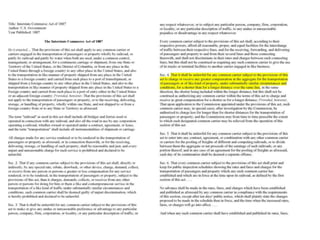
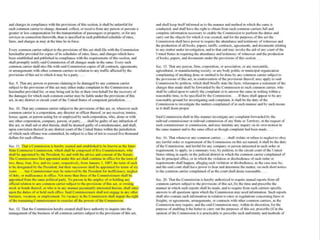
• Interstate Commerce Act passed by Congress which establishes the ICC (first
independent regulatory agency).
• Structure:
• Headed by five commissioners
• Six year terms
• Powers:
• Investigate railroads
• Compel witnesses to testify
• Secure relevant materials
• Require railroads to submit annual reports
• Require railroads to use a uniform accounting system
• Enforcement would occur through the U.S. Circuit Courts of Appeals
• Fuzziness:
• Law made traffic pools illegal but collective rate setting was not
• Prevented charging more for a short haul than a long haul but was qualified by saying “under substantially
similar circumstances.”
An Agency Life Cycle Example: The
Interstate Commerce Commission
• 1888 (Youth)
• Industry and ICC begin to fight over rates and rules.
• ICC lacks enforcement power due to weakness of the Act
• Must have courts enforce their rulings.
• 1893 (Youth?)
• Economy takes a disastrous turn and members of Congress and the President
begin to focus on other items.
• The public has also shifted its attention.
• Railroads suffer heavily as a result of the economy.
• 1897 (Youth)
• The Supreme Court Destroys the Commission:
• ICC v. Cincinnati, New Orleans and Texas Pacific Railway (1897)
• The ICC cannot set rates
• ICC v. Alabama Midland Railroad (1897)
• Created exceptions to the short-haul/long-haul clause that rendered it useless.
• Railroads therefore raised rates.
• Like other businesses at the time, they relied on Sherman Antitrust Act (rate setting) and
the 14th Amendment (equal protection).
An Agency Life Cycle Example: The
Interstate Commerce Commission
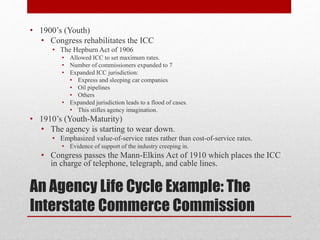
• 1900’s (Youth)
• Congress rehabilitates the ICC
• The Hepburn Act of 1906
• Allowed ICC to set maximum rates.
• Number of commissioners expanded to 7
• Expanded ICC jurisdiction:
• Express and sleeping car companies
• Oil pipelines
• Others
• Expanded jurisdiction leads to a flood of cases.
• This stifles agency imagination.
• 1910’s (Youth-Maturity)
• The agency is starting to wear down.
• Emphasized value-of-service rates rather than cost-of-service rates.
• Evidence of support of the industry creeping in.
• Congress passes the Mann-Elkins Act of 1910 which places the ICC
in charge of telephone, telegraph, and cable lines.
An Agency Life Cycle Example: The
Interstate Commerce Commission
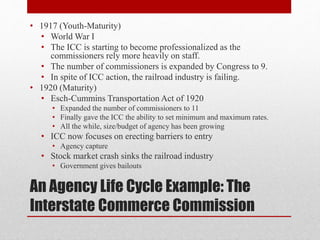
• 1917 (Youth-Maturity)
• World War I
• The ICC is starting to become professionalized as the
commissioners rely more heavily on staff.
• The number of commissioners is expanded by Congress to 9.
• In spite of ICC action, the railroad industry is failing.
• 1920 (Maturity)
• Esch-Cummins Transportation Act of 1920
• Expanded the number of commissioners to 11
• Finally gave the ICC the ability to set minimum and maximum rates.
• All the while, size/budget of agency has been growing
• ICC now focuses on erecting barriers to entry
• Agency capture
• Stock market crash sinks the railroad industry
• Government gives bailouts
An Agency Life Cycle Example: The
Interstate Commerce Commission
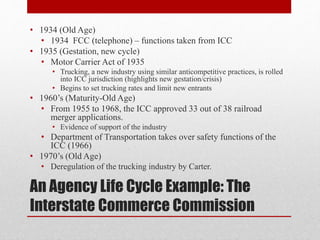
• 1934 (Old Age)
• 1934 FCC (telephone) – functions taken from ICC
• 1935 (Gestation, new cycle)
• Motor Carrier Act of 1935
• Trucking, a new industry using similar anticompetitive practices, is rolled
into ICC jurisdiction (highlights new gestation/crisis)
• Begins to set trucking rates and limit new entrants
• 1960’s (Maturity-Old Age)
• From 1955 to 1968, the ICC approved 33 out of 38 railroad
merger applications.
• Evidence of support of the industry
• Department of Transportation takes over safety functions of the
ICC (1966)
• 1970’s (Old Age)
• Deregulation of the trucking industry by Carter.
An Agency Life Cycle Example: The
Interstate Commerce Commission
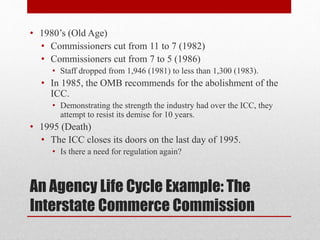
• 1980’s (Old Age)
• Commissioners cut from 11 to 7 (1982)
• Commissioners cut from 7 to 5 (1986)
• Staff dropped from 1,946 (1981) to less than 1,300 (1983).
• In 1985, the OMB recommends for the abolishment of the
ICC.
• Demonstrating the strength the industry had over the ICC, they
attempt to resist its demise for 10 years.
• 1995 (Death)
• The ICC closes its doors on the last day of 1995.
• Is there a need for regulation again?

Agency formation and development

  • 1.
  • 2.
    • Introduction • Bernstein,Marver. 1955. Regulating by Independent Commission. Princeton, NJ: Princeton University Press • Book is from 1955, so why do we still read it? • Helps to understand agency development and behavior. • Provides evidence as to why many agencies end up being inefficient and ineffective. • This is a theory and is largely not scientifically tested. • Agency life cycle: • Four stages: • Gestation • Youth • Maturity • Old Age
  • 3.
    Typical Agency LifeCycle of a Regulatory Commission: Gestation • A Growing Problem: • Protracted period of unsatisfactory outcomes or a growing problem. • Examples: • Public scandal • Economic depression/recession • Development of Interest Groups and Public Support: • Slow development of relevant interest groups for and against the issue. • Equilibrium of interests • Public Support: • E.E. Schattschneider • Need for regulatory agency, but not enough support to pass in Congress • Typically capped by a crisis event • Public support is very high for the regulation of the economic sector in question • Battle is over legislation and not goals and objectives of a proposed agency. • Authorizing Statute: • Congress rapidly responds with a relatively vague statue creating a regulatory agency. • Law does not establish clear objectives, goals, or procedures for the agency. • Law is often out of date because it was enacted after the problem has existed for a prolonged period of time.
  • 5.
    Typical Agency LifeCycle of a Regulatory Commission: Youth • Personnel and Budget: • Very rapid period of growth in terms of personnel and budget • Attracts ambitious and aggressive employees • Characterized by energy, ambition, imagination • A Limited Window of Opportunity: • Must act quickly while political support exists from Congress, the President and the public. • Conflict with the Regulated Industry: • Inexperienced agency battles a much more experienced industry with financial and political resources • Vague agency charter (statute) leaves bureaucrats with unclear objectives • Court Battles: • Conflict occurs in very low salience forums (administrative hearings, federal courts) • Supreme Court must rule on the “validity and constitutionality of its powers and authority”. • Drains agency resources (budget).
  • 6.
    Typical Agency LifeCycle of a Regulatory Commission: Youth • End of the Youth Phase: • Difficulty of meeting high expectations for the agency • Institutionalization of agency-industry-congress relationship • Revolving door • Regulators try to get supporters appointed. • Some commissioners leave the agency and go into the employ of the industry • Public Support: • Public support that existed to pass legislation begins to fade. • Fading awareness.
  • 7.
    Typical Agency LifeCycle of a Regulatory Commission: Maturity • Personnel and Budget: • Personnel and budget begins to level off (still some growth) • Routinization and Judicialization: • Court battles lead to a judicialization of procedure and case handling • Forms, patterns and routines form • Accumulation of significant case law • Backlogs of cases forms • Public Support: • Public support/attention has disappeared. • Regulated industry starts to gain influence because public is not organized.
  • 8.
    Typical Agency LifeCycle of a Regulatory Commission: Maturity • Protectionism: • Avoid conflicts that occurred in the youth phase and have good relationship with those they are supposed to regulate • Shift from enforcement to voluntary self-enforcement by the industry • Begin to protect the industry • Fully institutionalized relationship with industry • Conflict: • Competition with other agencies over “turf” • Professionalism: • Agency becomes dominated by professionals. • Lawyers, engineers, and economists vie for control of the policymaking.
  • 9.
    Typical Agency LifeCycle of a Regulatory Commission: Old Age • Personnel and Budget: • Personnel and budget growth reach plateau and begin to decline • Congress and the president will not appropriate additional funds to deal with backlog of cases. • Decelerator effect • Flight of quality personnel • Agency now depends on industry for expertise and staff. • Further institutionalizes the agency-industry relationship. • Diversification: • Agency may diversify functions to protect against budget cuts • Other points: • Agency becomes protector of the industry it regulates • Protects against new market entrants • Agency goals are out of date and out of touch with technology. • Poor management • Agency may not be able to respond to a problem and there is a crisis
  • 10.
    An Agency LifeCycle Example: The Interstate Commerce Commission • 1870’s (Gestation) • Railroads begin to use anti-competitive pricing practices • Examples: • Rates not set by weight and distance formulas. • Rates set based on what the market could bear. • Competitive areas: • Lower rates, rebates • Sometime prices would be higher for shorter hauls than longer hauls as a result of this pricing strategy. • Collusion • This would upset the public: • Agricultural • Mercantile • Industrial sectors • Initially, railroads regulated exclusively by the states • Established in the Granger cases (1877) • Munn v. Illinois (1877) • Some states (Massachusetts and others) establish railroad commissions. • Corruption of commissioners • 1885 (Gestation) • Eight railroad cartels, try to maintain collusive pricing (i.e. regulate themselves) but there is the temptation to cheat. • Still want to keep others out of the industry.
  • 11.
    An Agency LifeCycle Example: The Interstate Commerce Commission • 1886 (Gestation) • Wabash v. Illinois (1886) • The Supreme Court says states cannot regulate portions of interstate journeys. • Rule that one state affects the other (interstate commerce). • 1887 (Gestation – Youth) • Interstate Commerce Act passed by Congress which establishes the ICC (first independent regulatory agency). • Structure: • Headed by five commissioners • Six year terms • Powers: • Investigate railroads • Compel witnesses to testify • Secure relevant materials • Require railroads to submit annual reports • Require railroads to use a uniform accounting system • Enforcement would occur through the U.S. Circuit Courts of Appeals • Fuzziness: • Law made traffic pools illegal but collective rate setting was not • Prevented charging more for a short haul than a long haul but was qualified by saying “under substantially similar circumstances.”
  • 14.
    An Agency LifeCycle Example: The Interstate Commerce Commission • 1888 (Youth) • Industry and ICC begin to fight over rates and rules. • ICC lacks enforcement power due to weakness of the Act • Must have courts enforce their rulings. • 1893 (Youth?) • Economy takes a disastrous turn and members of Congress and the President begin to focus on other items. • The public has also shifted its attention. • Railroads suffer heavily as a result of the economy. • 1897 (Youth) • The Supreme Court Destroys the Commission: • ICC v. Cincinnati, New Orleans and Texas Pacific Railway (1897) • The ICC cannot set rates • ICC v. Alabama Midland Railroad (1897) • Created exceptions to the short-haul/long-haul clause that rendered it useless. • Railroads therefore raised rates. • Like other businesses at the time, they relied on Sherman Antitrust Act (rate setting) and the 14th Amendment (equal protection).
  • 15.
    An Agency LifeCycle Example: The Interstate Commerce Commission • 1900’s (Youth) • Congress rehabilitates the ICC • The Hepburn Act of 1906 • Allowed ICC to set maximum rates. • Number of commissioners expanded to 7 • Expanded ICC jurisdiction: • Express and sleeping car companies • Oil pipelines • Others • Expanded jurisdiction leads to a flood of cases. • This stifles agency imagination. • 1910’s (Youth-Maturity) • The agency is starting to wear down. • Emphasized value-of-service rates rather than cost-of-service rates. • Evidence of support of the industry creeping in. • Congress passes the Mann-Elkins Act of 1910 which places the ICC in charge of telephone, telegraph, and cable lines.
  • 16.
    An Agency LifeCycle Example: The Interstate Commerce Commission • 1917 (Youth-Maturity) • World War I • The ICC is starting to become professionalized as the commissioners rely more heavily on staff. • The number of commissioners is expanded by Congress to 9. • In spite of ICC action, the railroad industry is failing. • 1920 (Maturity) • Esch-Cummins Transportation Act of 1920 • Expanded the number of commissioners to 11 • Finally gave the ICC the ability to set minimum and maximum rates. • All the while, size/budget of agency has been growing • ICC now focuses on erecting barriers to entry • Agency capture • Stock market crash sinks the railroad industry • Government gives bailouts
  • 17.
    An Agency LifeCycle Example: The Interstate Commerce Commission • 1934 (Old Age) • 1934 FCC (telephone) – functions taken from ICC • 1935 (Gestation, new cycle) • Motor Carrier Act of 1935 • Trucking, a new industry using similar anticompetitive practices, is rolled into ICC jurisdiction (highlights new gestation/crisis) • Begins to set trucking rates and limit new entrants • 1960’s (Maturity-Old Age) • From 1955 to 1968, the ICC approved 33 out of 38 railroad merger applications. • Evidence of support of the industry • Department of Transportation takes over safety functions of the ICC (1966) • 1970’s (Old Age) • Deregulation of the trucking industry by Carter.
  • 18.
    An Agency LifeCycle Example: The Interstate Commerce Commission • 1980’s (Old Age) • Commissioners cut from 11 to 7 (1982) • Commissioners cut from 7 to 5 (1986) • Staff dropped from 1,946 (1981) to less than 1,300 (1983). • In 1985, the OMB recommends for the abolishment of the ICC. • Demonstrating the strength the industry had over the ICC, they attempt to resist its demise for 10 years. • 1995 (Death) • The ICC closes its doors on the last day of 1995. • Is there a need for regulation again?