Agcapita Macro Update
October 2009


                   1
Summary


There has been considerable discussion recently about the
“paradox” of bonds and stocks and commodities going up together
- that the bond market is predicting a continuing recession via low
interest rates and the stock market is predicting a recovery via high
equity prices. Why is the bond market behaving so strangely in the
face of a huge recovery stocks and commodities – surely one of
these indicators must be wrong? Maybe, but perhaps there is an
alternative interpretation that fits the facts.

Markets always appear to act strangely to profit maximisers when
non-profit maximisers are involved. I actually feel that the behavior
of the sovereign debt market makes sense. Virtually every asset
class is exhibiting the short-term effects of a massive monetary
expansion. Once again assets that are liquid and traded - including
LT sovereign debt – are rapidly “increasing” in price in nominal
terms. Monetary authorities have expanded the global money
supply aggressively allowing speculative activities to re-ignite via     Contents
investment and commercial banking intermediaries and at the same         2   US Fiscal Deficit
time they are busy monetizing the rapidly expanding government           2   Failed Government Bond Auction
debts - hence low interest rates and rapidly recovering equity prices.
                                                                         2   US Sovereign Debt:
When cross-correlations between assets classes are very high and         2   Unfunded Debt and Obligations
positive we should always be asking ourselves whether we are in a        3   China Reducing Its Treasury
period of liquidity/money printing induced euphoria.
                                                                             Duration
Ultimately monetary authorities can control exchange rates or            3   Another US Bailout in the Wings?
interest rates but not both. If they decide to sacrifice exchange        4   More Trouble on the Way in the
rates for low interest rates then, in my opinion, inflation is sure to       Banking System
follow.
                                                                         5   Hyperinflation – Quick Facts
Kind Regards

Stephen Johnston - Partner


                                                                                                        1
Global Macro Update


Us FisCal DeFiCit

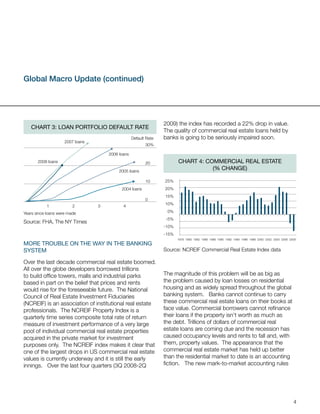
By the end of 2019, according to the administration’s                If you were a foreign government, would you want to
budget numbers, the US federal debt will reach                       increase your holdings of Treasury securities knowing
$23.3 trillion—as compared to $11.9 trillion today.                  the U.S. government has no plans to balance its
The U.S. federal debt was equal to 61.4% of GDP in                   budget during the next decade, let alone achieve a
1999, 70.2% of GDP in 2008 and is now projected                      surplus?
to increase 90.4% in 2009 ultimately reaching 100%
in 2011, after which the projected federal debt will                 FaileD Government BonD aUCtion
continue to equal or exceed the US’s entire annual
economic output through 2019. The Debt to GDP                        Latvia recently tried to raise US$17 million worth of
ratio effectively measures a nation’s capacity to                    6-month bonds. How likely is it that Latvia will default
generate sufficient wealth to repay its creditors. The               in the next six months? Unlikely, and yet the auction
U.S. is thus on track to enter the ranks of those                    failed with no bids. When lenders lose confidence
countries—Zimbabwe, Japan, Lebanon, Singapore,                       in a government’s ability to repay, the consequences
Jamaica, Italy—with the highest government debt-                     can be swift and total - they refuse to lend it money.
to-GDP ratio. In 2008, the U.S. ranked 23rd on the
list—crossing the 100% threshold vaults the US into                  Us sovereiGn DeBt
seventh place.
                                                                     Lenders are still willing to provide the US government
                                                                     30 year financing at a 4% annual yield. For three
                Chart 1: Deeper in DeBt                              month funding they only charge the US government
                                                                     0.066%. For a government heading into massive
Budget surplus/deficit                              As percentage    and prolonged fiscal deficits this seems somewhat
(in billions)                                              of GDP    generous on the part of the markets.
 $500                                                          5%
surplus                                          projections         UnFUnDeD DeBt anD oBliGations
 deficit
                                                               0
                                                                     The Obama Administration, unaware or ignoring the
  500                                                          -5    fact that the total unfunded debts and obligations of
 1000                                                          -10
                                                                     the federal government have grown to nearly $120
                                                                     trillion, continues to pursue a policy of massive fiscal
 1500                                                          -15   deficits.

 2000                                                          -20
           1970s         1980s   1990s   2000s   2010s

Source: OMB (historical); Committee for a Responsible
Federal Budget, CBA (projections)


                                                                                                                                2
Global Macro Update (continued)


                                                                                   another Us BailoUt in the WinGs?
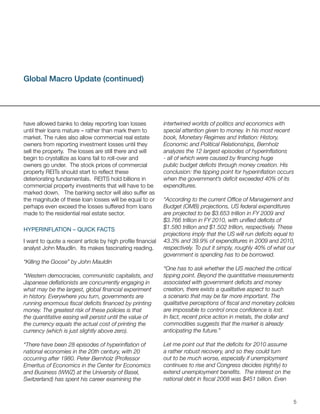
              Chart 2: total U.s. DeBt as a
                   perCent oF GDp                                                  A year ago the US government took over Fannie Mae
                                                                                   and Freddie Mac to prevent them from failing. Now
1,200                                                                  1142        the Federal Housing Administration appears “destined
                                           1012         1025                       for a taxpayer bailout in the next 24 to 36 months”
1,000                                                                              according to Edward Pinto at a recent Congressional
                                                                                   hearing. Edward Pinto, of course, is the former
 800
                                                                                   chief credit officer for Fannie Mae so perhaps he is
 600                                                                               speaking from experience.

 400
                                 311
                                                                                   FHA has managed to repeat all of Fannie and
                     263                                                           Freddie’s mistakes – which of course was what was
 200                                                                               hoped would happen. The FHA stepped in and
         87
                                                                                   became a huge player in the mortgage loan markets
   0
                                                                                   specifically to replace the crippled Fannie and
    Gross Federal,   add;      add; GSE   add; SS/   add; Foreign add; Financial
    State & Local Household,              Medicare      held         sector        Freddie. The proof is in the data - FHA went from
        Gov’t      Business
                                                                                   insuring 6% of new mortgages in 2007 to over 21%
Source: Federal Reserve Z 1, FHFA GSE Report 2008/                                 last year and accelerating in 2009.
RGE Monitor, Richard W Fischer (“Storms on the Horizon,”,
Dallas Fed 5/28/2008), Rather & Kittrell                                           What does that portfolio look like? The FHA insures
                                                                                   5.4 million single-family home mortgages - most
                                                                                   of which require only a 3.5% down payment - at a
                                                                                   value of $675 billion. At the same time the FHA has
China reDUCinG its treasUry DUration
                                                                                   only $30 billion in capital – a 20-1 leverage level that
How to start getting out of the dollar while not                                   proved too much for some of the largest investment
appearing to be getting out of the dollar? One way                                 banks and insurance companies in the world. Of
is to shorten the duration of your bond holdings or to                             course when you provide credit that the market will
announce purchases of hard asset denominated in                                    not, you suffer default rates that reflect the risk you
dollars. This is exactly what is happening. China, for                             are taking on. FHA defaults rates are starting to
instance, continues to accumulate Treasuries -- but                                increase rapidly.
only short-term notes, not long-term bonds -- while
buying up real assets like oil fields and iron ore mines.


                                                                                                                                              3
Global Macro Update (continued)


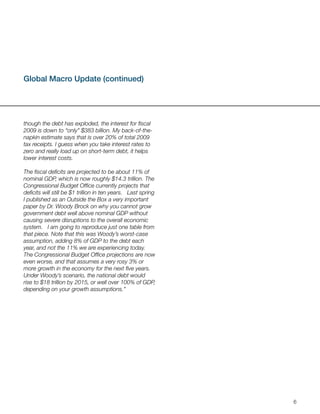
                                                                  2009) the index has recorded a 22% drop in value.
   Chart 3: loan portFolio DeFaUlt rate
                                                                  The quality of commercial real estate loans held by
                                                   Default Rate   banks is going to be seriously impaired soon.
                     2007 loans
                                                          30%

                                      2006 loans
       2008 loans                                         20             Chart 4: CommerCial real estate
                                           2005 loans
                                                                                    (% ChanGe)

                                                          10      25%
                                            2004 loans            20%
                                                                  15%
                                                          0
                                                                  10%
            1            2        3          4
Years since loans were made                                        0%
                                                                   -5%
Source: FHA, The NY Times
                                                                  -10%
                                                                  -15%
                                                                         1978 1980 1982 1986 1988 1990 1992 1994 1996 1998 2000 2002 2004 2006 2008
more troUBle on the Way in the BankinG
system                                                            Source: NCREIF Commercial Real Estate Index data

Over the last decade commercial real estate boomed.
All over the globe developers borrowed trillions
to build office towers, malls and industrial parks                The magnitude of this problem will be as big as
based in part on the belief that prices and rents                 the problem caused by loan losses on residential
would rise for the foreseeable future. The National               housing and as widely spread throughout the global
Council of Real Estate Investment Fiduciaries                     banking system. Banks cannot continue to carry
(NCREIF) is an association of institutional real estate           these commercial real estate loans on their books at
professionals. The NCREIF Property Index is a                     face value. Commercial borrowers cannot refinance
quarterly time series composite total rate of return              their loans if the property isn’t worth as much as
measure of investment performance of a very large                 the debt. Trillions of dollars of commercial real
pool of individual commercial real estate properties              estate loans are coming due and the recession has
acquired in the private market for investment                     caused occupancy levels and rents to fall and, with
purposes only. The NCREIF index makes it clear that               them, property values. The appearance that the
one of the largest drops in US commercial real estate             commercial real estate market has held up better
values is currently underway and it is still the early            than the residential market to date is an accounting
innings. Over the last four quarters (3Q 2008-2Q                  fiction. The new mark-to-market accounting rules


                                                                                                                                                 4
Global Macro Update (continued)


have allowed banks to delay reporting loan losses            intertwined worlds of politics and economics with
until their loans mature – rather than mark them to          special attention given to money. In his most recent
market. The rules also allow commercial real estate          book, Monetary Regimes and Inflation: History,
owners from reporting investment losses until they           Economic and Political Relationships, Bernholz
sell the property. The losses are still there and will       analyzes the 12 largest episodes of hyperinflations
begin to crystallize as loans fail to roll-over and          - all of which were caused by financing huge
owners go under. The stock prices of commercial              public budget deficits through money creation. His
property REITs should start to reflect these                 conclusion: the tipping point for hyperinflation occurs
deteriorating fundamentals. REITS hold billions in           when the government’s deficit exceeded 40% of its
commercial property investments that will have to be         expenditures.
marked down. The banking sector will also suffer as
the magnitude of these loan losses will be equal to or       “According to the current Office of Management and
perhaps even exceed the losses suffered from loans           Budget (OMB) projections, US federal expenditures
made to the residential real estate sector.                  are projected to be $3.653 trillion in FY 2009 and
                                                             $3.766 trillion in FY 2010, with unified deficits of
hyperinFlation – QUiCk FaCts                                 $1.580 trillion and $1.502 trillion, respectively. These
                                                             projections imply that the US will run deficits equal to
I want to quote a recent article by high profile financial   43.3% and 39.9% of expenditures in 2009 and 2010,
analyst John Maudlin. Its makes fascinating reading.         respectively. To put it simply, roughly 40% of what our
                                                             government is spending has to be borrowed.
“Killing the Goose” by John Mauldin
                                                             “One has to ask whether the US reached the critical
“Western democracies, communistic capitalists, and           tipping point. Beyond the quantitative measurements
Japanese deflationists are concurrently engaging in          associated with government deficits and money
what may be the largest, global financial experiment         creation, there exists a qualitative aspect to such
in history. Everywhere you turn, governments are             a scenario that may be far more important. The
running enormous fiscal deficits financed by printing        qualitative perceptions of fiscal and monetary policies
money. The greatest risk of these policies is that           are impossible to control once confidence is lost.
the quantitative easing will persist until the value of      In fact, recent price action in metals, the dollar and
the currency equals the actual cost of printing the          commodities suggests that the market is already
currency (which is just slightly above zero).                anticipating the future.”

“There have been 28 episodes of hyperinflation of            Let me point out that the deficits for 2010 assume
national economies in the 20th century, with 20              a rather robust recovery, and so they could turn
occurring after 1980. Peter Bernholz (Professor              out to be much worse, especially if unemployment
Emeritus of Economics in the Center for Economics            continues to rise and Congress decides (rightly) to
and Business (WWZ) at the University of Basel,               extend unemployment benefits. The interest on the
Switzerland) has spent his career examining the              national debt in fiscal 2008 was $451 billion. Even


                                                                                                                    5
Global Macro Update (continued)


though the debt has exploded, the interest for fiscal
2009 is down to “only” $383 billion. My back-of-the-
napkin estimate says that is over 20% of total 2009
tax receipts. I guess when you take interest rates to
zero and really load up on short-term debt, it helps
lower interest costs.

The fiscal deficits are projected to be about 11% of
nominal GDP, which is now roughly $14.3 trillion. The
Congressional Budget Office currently projects that
deficits will still be $1 trillion in ten years. Last spring
I published as an Outside the Box a very important
paper by Dr. Woody Brock on why you cannot grow
government debt well above nominal GDP without
causing severe disruptions to the overall economic
system. I am going to reproduce just one table from
that piece. Note that this was Woody’s worst-case
assumption, adding 8% of GDP to the debt each
year, and not the 11% we are experiencing today.
The Congressional Budget Office projections are now
even worse, and that assumes a very rosy 3% or
more growth in the economy for the next five years.
Under Woody’s scenario, the national debt would
rise to $18 trillion by 2015, or well over 100% of GDP,
depending on your growth assumptions.”


                                                               6
DisClaimer:

                                  The information, opinions, estimates, projections and other materials
                                  contained herein are provided as of the date hereof and are subject to
                                  change without notice. Some of the information, opinions, estimates,
                                  projections and other materials contained herein have been obtained from
                                  numerous sources and Agcapita Partners LP (“AGCAPITA”) and its affiliates
                                  make every effort to ensure that the contents hereof have been compiled or
                                  derived from sources believed to be reliable and to contain information and
                                  opinions which are accurate and complete. However, neither AGCAPITA
                                  nor its affiliates have independently verified or make any representation or
                                  warranty, express or implied, in respect thereof, take no responsibility for
                                  any errors and omissions which maybe contained herein or accept any
                                  liability whatsoever for any loss arising from any use of or reliance on the
                                  information, opinions, estimates, projections and other materials contained
                                  herein whether relied upon by the recipient or user or any other third
                                  party (including, without limitation, any customer of the recipient or user).
                                  Information may be available to AGCAPITA and/or its affiliates that is not
                                  reflected herein. The information, opinions, estimates, projections and other
                                  materials contained herein are not to be construed as an offer to sell, a
                                  solicitation for or an offer to buy, any products or services referenced herein
                                  (including, without limitation, any commodities, securities or other financial
                                  instruments), nor shall such information, opinions, estimates, projections and
                                  other materials be considered as investment advice or as a recommendation
                                  to enter into any transaction. Additional information is available by contacting
                                  AGCAPITA or its relevant affiliate directly.


#400, 2424 4th street sW   tel: +1.403.218.6506            www.agcapita.com
Calgary, alberta t2s 2t4   Fax: +1.403.266.1541
Canada

Agcapita Oct Macro Briefing

  • 1.
  • 2.
    Summary There has beenconsiderable discussion recently about the “paradox” of bonds and stocks and commodities going up together - that the bond market is predicting a continuing recession via low interest rates and the stock market is predicting a recovery via high equity prices. Why is the bond market behaving so strangely in the face of a huge recovery stocks and commodities – surely one of these indicators must be wrong? Maybe, but perhaps there is an alternative interpretation that fits the facts. Markets always appear to act strangely to profit maximisers when non-profit maximisers are involved. I actually feel that the behavior of the sovereign debt market makes sense. Virtually every asset class is exhibiting the short-term effects of a massive monetary expansion. Once again assets that are liquid and traded - including LT sovereign debt – are rapidly “increasing” in price in nominal terms. Monetary authorities have expanded the global money supply aggressively allowing speculative activities to re-ignite via Contents investment and commercial banking intermediaries and at the same 2 US Fiscal Deficit time they are busy monetizing the rapidly expanding government 2 Failed Government Bond Auction debts - hence low interest rates and rapidly recovering equity prices. 2 US Sovereign Debt: When cross-correlations between assets classes are very high and 2 Unfunded Debt and Obligations positive we should always be asking ourselves whether we are in a 3 China Reducing Its Treasury period of liquidity/money printing induced euphoria. Duration Ultimately monetary authorities can control exchange rates or 3 Another US Bailout in the Wings? interest rates but not both. If they decide to sacrifice exchange 4 More Trouble on the Way in the rates for low interest rates then, in my opinion, inflation is sure to Banking System follow. 5 Hyperinflation – Quick Facts Kind Regards Stephen Johnston - Partner 1
  • 3.
    Global Macro Update UsFisCal DeFiCit By the end of 2019, according to the administration’s If you were a foreign government, would you want to budget numbers, the US federal debt will reach increase your holdings of Treasury securities knowing $23.3 trillion—as compared to $11.9 trillion today. the U.S. government has no plans to balance its The U.S. federal debt was equal to 61.4% of GDP in budget during the next decade, let alone achieve a 1999, 70.2% of GDP in 2008 and is now projected surplus? to increase 90.4% in 2009 ultimately reaching 100% in 2011, after which the projected federal debt will FaileD Government BonD aUCtion continue to equal or exceed the US’s entire annual economic output through 2019. The Debt to GDP Latvia recently tried to raise US$17 million worth of ratio effectively measures a nation’s capacity to 6-month bonds. How likely is it that Latvia will default generate sufficient wealth to repay its creditors. The in the next six months? Unlikely, and yet the auction U.S. is thus on track to enter the ranks of those failed with no bids. When lenders lose confidence countries—Zimbabwe, Japan, Lebanon, Singapore, in a government’s ability to repay, the consequences Jamaica, Italy—with the highest government debt- can be swift and total - they refuse to lend it money. to-GDP ratio. In 2008, the U.S. ranked 23rd on the list—crossing the 100% threshold vaults the US into Us sovereiGn DeBt seventh place. Lenders are still willing to provide the US government 30 year financing at a 4% annual yield. For three Chart 1: Deeper in DeBt month funding they only charge the US government 0.066%. For a government heading into massive Budget surplus/deficit As percentage and prolonged fiscal deficits this seems somewhat (in billions) of GDP generous on the part of the markets. $500 5% surplus projections UnFUnDeD DeBt anD oBliGations deficit 0 The Obama Administration, unaware or ignoring the 500 -5 fact that the total unfunded debts and obligations of 1000 -10 the federal government have grown to nearly $120 trillion, continues to pursue a policy of massive fiscal 1500 -15 deficits. 2000 -20 1970s 1980s 1990s 2000s 2010s Source: OMB (historical); Committee for a Responsible Federal Budget, CBA (projections) 2
  • 4.
    Global Macro Update(continued) another Us BailoUt in the WinGs? Chart 2: total U.s. DeBt as a perCent oF GDp A year ago the US government took over Fannie Mae and Freddie Mac to prevent them from failing. Now 1,200 1142 the Federal Housing Administration appears “destined 1012 1025 for a taxpayer bailout in the next 24 to 36 months” 1,000 according to Edward Pinto at a recent Congressional hearing. Edward Pinto, of course, is the former 800 chief credit officer for Fannie Mae so perhaps he is 600 speaking from experience. 400 311 FHA has managed to repeat all of Fannie and 263 Freddie’s mistakes – which of course was what was 200 hoped would happen. The FHA stepped in and 87 became a huge player in the mortgage loan markets 0 specifically to replace the crippled Fannie and Gross Federal, add; add; GSE add; SS/ add; Foreign add; Financial State & Local Household, Medicare held sector Freddie. The proof is in the data - FHA went from Gov’t Business insuring 6% of new mortgages in 2007 to over 21% Source: Federal Reserve Z 1, FHFA GSE Report 2008/ last year and accelerating in 2009. RGE Monitor, Richard W Fischer (“Storms on the Horizon,”, Dallas Fed 5/28/2008), Rather & Kittrell What does that portfolio look like? The FHA insures 5.4 million single-family home mortgages - most of which require only a 3.5% down payment - at a value of $675 billion. At the same time the FHA has China reDUCinG its treasUry DUration only $30 billion in capital – a 20-1 leverage level that How to start getting out of the dollar while not proved too much for some of the largest investment appearing to be getting out of the dollar? One way banks and insurance companies in the world. Of is to shorten the duration of your bond holdings or to course when you provide credit that the market will announce purchases of hard asset denominated in not, you suffer default rates that reflect the risk you dollars. This is exactly what is happening. China, for are taking on. FHA defaults rates are starting to instance, continues to accumulate Treasuries -- but increase rapidly. only short-term notes, not long-term bonds -- while buying up real assets like oil fields and iron ore mines. 3
  • 5.
    Global Macro Update(continued) 2009) the index has recorded a 22% drop in value. Chart 3: loan portFolio DeFaUlt rate The quality of commercial real estate loans held by Default Rate banks is going to be seriously impaired soon. 2007 loans 30% 2006 loans 2008 loans 20 Chart 4: CommerCial real estate 2005 loans (% ChanGe) 10 25% 2004 loans 20% 15% 0 10% 1 2 3 4 Years since loans were made 0% -5% Source: FHA, The NY Times -10% -15% 1978 1980 1982 1986 1988 1990 1992 1994 1996 1998 2000 2002 2004 2006 2008 more troUBle on the Way in the BankinG system Source: NCREIF Commercial Real Estate Index data Over the last decade commercial real estate boomed. All over the globe developers borrowed trillions to build office towers, malls and industrial parks The magnitude of this problem will be as big as based in part on the belief that prices and rents the problem caused by loan losses on residential would rise for the foreseeable future. The National housing and as widely spread throughout the global Council of Real Estate Investment Fiduciaries banking system. Banks cannot continue to carry (NCREIF) is an association of institutional real estate these commercial real estate loans on their books at professionals. The NCREIF Property Index is a face value. Commercial borrowers cannot refinance quarterly time series composite total rate of return their loans if the property isn’t worth as much as measure of investment performance of a very large the debt. Trillions of dollars of commercial real pool of individual commercial real estate properties estate loans are coming due and the recession has acquired in the private market for investment caused occupancy levels and rents to fall and, with purposes only. The NCREIF index makes it clear that them, property values. The appearance that the one of the largest drops in US commercial real estate commercial real estate market has held up better values is currently underway and it is still the early than the residential market to date is an accounting innings. Over the last four quarters (3Q 2008-2Q fiction. The new mark-to-market accounting rules 4
  • 6.
    Global Macro Update(continued) have allowed banks to delay reporting loan losses intertwined worlds of politics and economics with until their loans mature – rather than mark them to special attention given to money. In his most recent market. The rules also allow commercial real estate book, Monetary Regimes and Inflation: History, owners from reporting investment losses until they Economic and Political Relationships, Bernholz sell the property. The losses are still there and will analyzes the 12 largest episodes of hyperinflations begin to crystallize as loans fail to roll-over and - all of which were caused by financing huge owners go under. The stock prices of commercial public budget deficits through money creation. His property REITs should start to reflect these conclusion: the tipping point for hyperinflation occurs deteriorating fundamentals. REITS hold billions in when the government’s deficit exceeded 40% of its commercial property investments that will have to be expenditures. marked down. The banking sector will also suffer as the magnitude of these loan losses will be equal to or “According to the current Office of Management and perhaps even exceed the losses suffered from loans Budget (OMB) projections, US federal expenditures made to the residential real estate sector. are projected to be $3.653 trillion in FY 2009 and $3.766 trillion in FY 2010, with unified deficits of hyperinFlation – QUiCk FaCts $1.580 trillion and $1.502 trillion, respectively. These projections imply that the US will run deficits equal to I want to quote a recent article by high profile financial 43.3% and 39.9% of expenditures in 2009 and 2010, analyst John Maudlin. Its makes fascinating reading. respectively. To put it simply, roughly 40% of what our government is spending has to be borrowed. “Killing the Goose” by John Mauldin “One has to ask whether the US reached the critical “Western democracies, communistic capitalists, and tipping point. Beyond the quantitative measurements Japanese deflationists are concurrently engaging in associated with government deficits and money what may be the largest, global financial experiment creation, there exists a qualitative aspect to such in history. Everywhere you turn, governments are a scenario that may be far more important. The running enormous fiscal deficits financed by printing qualitative perceptions of fiscal and monetary policies money. The greatest risk of these policies is that are impossible to control once confidence is lost. the quantitative easing will persist until the value of In fact, recent price action in metals, the dollar and the currency equals the actual cost of printing the commodities suggests that the market is already currency (which is just slightly above zero). anticipating the future.” “There have been 28 episodes of hyperinflation of Let me point out that the deficits for 2010 assume national economies in the 20th century, with 20 a rather robust recovery, and so they could turn occurring after 1980. Peter Bernholz (Professor out to be much worse, especially if unemployment Emeritus of Economics in the Center for Economics continues to rise and Congress decides (rightly) to and Business (WWZ) at the University of Basel, extend unemployment benefits. The interest on the Switzerland) has spent his career examining the national debt in fiscal 2008 was $451 billion. Even 5
  • 7.
    Global Macro Update(continued) though the debt has exploded, the interest for fiscal 2009 is down to “only” $383 billion. My back-of-the- napkin estimate says that is over 20% of total 2009 tax receipts. I guess when you take interest rates to zero and really load up on short-term debt, it helps lower interest costs. The fiscal deficits are projected to be about 11% of nominal GDP, which is now roughly $14.3 trillion. The Congressional Budget Office currently projects that deficits will still be $1 trillion in ten years. Last spring I published as an Outside the Box a very important paper by Dr. Woody Brock on why you cannot grow government debt well above nominal GDP without causing severe disruptions to the overall economic system. I am going to reproduce just one table from that piece. Note that this was Woody’s worst-case assumption, adding 8% of GDP to the debt each year, and not the 11% we are experiencing today. The Congressional Budget Office projections are now even worse, and that assumes a very rosy 3% or more growth in the economy for the next five years. Under Woody’s scenario, the national debt would rise to $18 trillion by 2015, or well over 100% of GDP, depending on your growth assumptions.” 6
  • 8.
    DisClaimer: The information, opinions, estimates, projections and other materials contained herein are provided as of the date hereof and are subject to change without notice. Some of the information, opinions, estimates, projections and other materials contained herein have been obtained from numerous sources and Agcapita Partners LP (“AGCAPITA”) and its affiliates make every effort to ensure that the contents hereof have been compiled or derived from sources believed to be reliable and to contain information and opinions which are accurate and complete. However, neither AGCAPITA nor its affiliates have independently verified or make any representation or warranty, express or implied, in respect thereof, take no responsibility for any errors and omissions which maybe contained herein or accept any liability whatsoever for any loss arising from any use of or reliance on the information, opinions, estimates, projections and other materials contained herein whether relied upon by the recipient or user or any other third party (including, without limitation, any customer of the recipient or user). Information may be available to AGCAPITA and/or its affiliates that is not reflected herein. The information, opinions, estimates, projections and other materials contained herein are not to be construed as an offer to sell, a solicitation for or an offer to buy, any products or services referenced herein (including, without limitation, any commodities, securities or other financial instruments), nor shall such information, opinions, estimates, projections and other materials be considered as investment advice or as a recommendation to enter into any transaction. Additional information is available by contacting AGCAPITA or its relevant affiliate directly. #400, 2424 4th street sW tel: +1.403.218.6506 www.agcapita.com Calgary, alberta t2s 2t4 Fax: +1.403.266.1541 Canada