SARDAR PATEL UNIVERSITY OF POLICE,
SECURITY AND CRIMINAL JUSTICE, JODHPUR
Col. Bharat Singh
Yogendra Singh
Presented By:
Prakash Jangid -UG 5th Sem
-UG 5th Sem.
TOPIC
What sections of AFSPA are opposed
by activists?
Critically examine AFSPA, its
history, uses, causes for its opposition,
legal view of Courts and current
debate surrounding it
WHAT IS AFSP ACT 1958
• Armed Forces (Special Powers) Acts (AFSPA),
are Acts of the Parliament of India that grant
special powers to the Indian Armed Forces in
what each act terms "disturbed areas".
• There are 7 Sections in the Act.
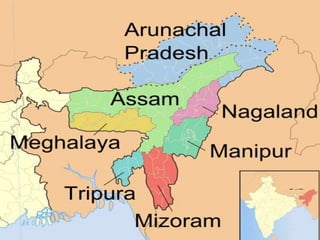
• Currently imposed in Assam, Meghalaya,
Arunachal Pradesh, Mizoram ,Nagaland,
Manipur, Jammu & Kashmir.
Historical Background
The British had promulgated the Armed Forces
Special Powers Ordinance in 1942 to suppress the
Quit India Movement.
On the lines of this ordinance, the Government of
India promulgated four ordinances in 1947 to deal
with internal security issues arising due to
partition in Bengal, Assam, East Bengal and United
Provinces.
These ordinances, which later became acts, were
repealed in 1957 but a year later, re-enacted in
Assam and Manipur as Armed forces (Assam &
Manipur) Special Powers Act 1958 due to
growing Naga insurgency. Gradually, the scope of
the act was extended to all seven states of North
East. Later, extended to
Punjab and Chandigarh Armed Forces(Punjab and Chandigarh) Special Powers Act in
1983
Jammu and Kashmir the Armed Forces (Jammu and Kashmir) Special Powers Act,
1990
This act was withdrawn in 1997
SECTIONS OF AFSPA 1958
Section 1.Short title and extent – (a) This act may be
called [The armed Forces (Special Powers) Act,
1958].
(b) It extends to the whole of the State of [Arunachal
Pradesh, Assam, Manipur, Meghalaya, Mizoram,
Nagaland and Tripura].
Section 2. Definitions: In this Act, unless the context
otherwise requires-
(a) “armed forces’ means the military forces and the
air forces operating as land forces, and includes
other armed forces of the Union so operating.
(b) ‘disturbed area’ means an area which is for the time being
declared by notification under section 3 to be a disturbed area’.
(c) all other words and expressions used herein, but not defined and
defined in the Air Force Act, 1950 (45 of 1950), or the army Act,
1950 (46 of 1950) shall have the meanings respectively to them in
those Acts.
Section 3.Powers to declare areas to be disturbed areas – If, in
relation to any state or Union Territory to which this act extends,
the Governor of that State or the administrator of that Union
Territory or the Central Government, in either case, if of the
opinion that the whole or any part of such State of Union territory,
as the case may be, is in such a disturbed or dangerous condition
that the use of armed forces in aid of the civil power is necessary,
the Governor of that State or the Administrator of that Union
Territory or the Central Government, as the case may be , may by
notification in the Official Gazette, declare the whole or such part
of such State or Union territory to be a disturbed area.
Section 4. Special Powers of the armed forces – Any
commissioned officer, warrant officer, non-
commissioned officer or any other person of equivalent
rank in the armed forces may, in a disturbed area,-
(a) if he is of opinion that it is necessary so to do for the
maintenance of public order, after giving such due
warning as he may consider necessary, fire upon or
otherwise use force, even to the causing of death,
against any person who is acting in contravention of
any law or order for the time being in force in the
disturbed area prohibiting the assembly of five or move
persons or the carrying of weapons or of things capable
of being used as weapons or of fire-arms, ammunition
or explosive substances.
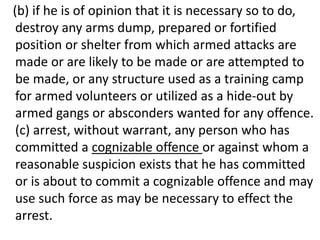
(b) if he is of opinion that it is necessary so to do,
destroy any arms dump, prepared or fortified
position or shelter from which armed attacks are
made or are likely to be made or are attempted to
be made, or any structure used as a training camp
for armed volunteers or utilized as a hide-out by
armed gangs or absconders wanted for any offence.
(c) arrest, without warrant, any person who has
committed a cognizable offence or against whom a
reasonable suspicion exists that he has committed
or is about to commit a cognizable offence and may
use such force as may be necessary to effect the
arrest.
(d) enter and search without warrant any premises to
make any such arrest as aforesaid or to recover any
person believed to be wrongfully restrained or
confined or any property reasonably suspected to
be stolen property or any arms, ammunition or
explosive substances believed to be unlawfully kept
in such premises, and may for that purpose use
such force as may be necessary.
Section 5-Arrested persons to be
made over to the police –Any person
arrested and taken into custody
under this Act shall be made over to
the officer in charge of the nearest
police station with the least possible
delay, together with a report of the
circumstances occasioning the arrest.
Section 6. Protection to persons acting under Act –
No prosecution, suit or other legal proceeding shall
be instituted, except with the previous sanction of
the Central Government, against any person in
respect of anything done or purported to be done
in exercise of the powers conferred by this Act.
Section 7. Repeal and Saving
APPLICATION OF AFSPA
Currently AFSPA is in force in the following States:
Assam
Assam was the first state to have the AFSPA in 1958. Current act
is in force in the state since November 1990, when ULFA’s
activities were at peak. Currently, the entire state except
Guwahati municipal area comes under AFPSPA.
Meghalaya
AFSPA is in force in Meghalaya only in a belt adjacent to 20 km
of its boundary with Assam. This 20 KM belt comes under
disturbed area so that the armed forces in Assam are allowed
to go into it in hot pursuit of the rebels.
Arunachal Pradesh
In Arunachal Pradesh, the AFSPA is in force in three
districts viz. Tirap, Changlang and Longding; and
also a 20KM belt along the Assam Border. In March
2015, the government had brought entire state
under AFSPA but later, withdrew it.
Mizoram
The condition of the act in Mizoram is vague and
unclear. The act has not been “applied” in Mizoram,
since 1986 when Mizo Accord was signed. However,
since there is not clarity, if this act was lifted from
there, AFSPA should be considered a sleeping law in
Mizoram.
Nagaland -(Naga-Akbar Hydari Accord)
The act was in force in Nagaland area even before the state came
into existence in 1961 because at that time, state was Naga Hills
district of Assam. The act is in force in the state since then. Things
are changing gradually there as NSCN(IM) is in talk with centre.
Manipur
The law is in force in Manipur except in Imphal municipal area.
Tripura
Tripura was under AFSPA since 1997. In 2015, the act has been
withdrawn from the state.
Jammu & Kashmir
AFSPA is in force in Jammu & Kashmir since 1990.
PUNJAB-The Armed Forces (Punjab and Chandigarh)
Special Powers Act, 1983
• The outbreak of militancy in Punjab in the early 1980s
necessitated the imposition of the Armed Forces
Special Powers Act in the state. Popular discontentment
amongst the Sikhs over religious and linguistic issues
had been simmering in Punjab since the late 1960s.
• Non-resolution of the demands such as a larger share
of water for irrigation and the return of Chandigarh to
Punjab further intensified the disaffection against the
central government. It was however, the espousing of
the ‘Sikh cause’ by the Akali Dal in 1980 and the
demand for a separate Khalistan for Sikhs in 1982, that
brought matters to a boil.
Criticism of AFSPA
1. The provisions of the act are inherently flawed. The impunity
provided by the law against any prosecution (except by central
government permission) is manifested in cruelty and violation of
human rights (cases of rape, torture etc).
CASE:-Thangjam Manorama Devi
a 34-year-old Manipuri, who was arrested by Assam Rifles in
2004 on grounds of being a member of the banned organization.
It was claimed by her family members that she was raped and
murdered by the security officers. A commission was also formed
to investigate the case but the personnel of the Assam Rifles
repeatedly denied to appear before the commission and justice is
still awaited.
2. The grounds of declaration of a disturbed area have
not been defined in the act.
3. The power to shoot to the extent of causing death,
and search without warrant are in contravention to
the Article 21 of the constitution, the right to life,
which forms the foundation of all other
fundamental rights.
4. Unlike Crpc there are no adequate safeguards in
the implementation of the AFSPA. the Crpc which
lays down a proper procedure for police personnel
regarding arrest.
Criticism of AFSPA
5.The act has not been able to contain insurgency and maintain
law and order in the disturbed regions.
6. Grave human right violations have actually helped the
insurgents to mobilize the people against the government.
AFSPA has further intensified the demand for autonomy by
the people leading to increase in agitations. This gives rise to
a vicious circle of continuing law for indefinite period.
7. Once an area has been declared disturbed it cannot be
subjected to judicial review.
Criticism of AFSPA
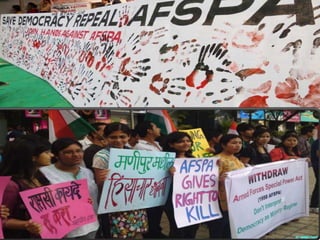
IMAGES
Why the Act is a Necessary Evil?
1.There is no doubt that killings and human rights
violations have occurred due to AFSPA but the
problems posed by an array of internal and external
agents necessitate an act with teeth to deal with
them.
2. A soldier deserves all the legal protection for the
action he does or judgment he makes on the spot
acting in best interest of the country.
3. Our armed forces operate in very difficult
circumstances and are much acquainted with actual
ground situation than the bedroom patriots.
4. The act needs to continue, however, needs more
humane provisions so that state does not take away
the right to life of the people.
5.It was useful in the elimination of the secessionist
demand of Khalistan movement in Punjab.
6.By the time a formal search or arrest warrant is
obtained, the suspect would get ample time to
escape.
COMMENTS
1998 Verdict of Supreme Court in Naga People’s Movement
Case
• Although Central Government is empowered to declare an
area disturbed on its own, it is desirable that it consults the
state before making such declaration.
• The act is not conferring any arbitrary powers to declare an
area as a ‘disturbed area.
• The declaration should be for a limited duration and there
should be periodic review at 6 months.
• The officers should use minimal force necessary for effective
action.
• The authorized officer should strictly follow the ‘Dos and
Don’ts’ issued by the army.
BP Jeevan Reddy Committee
• Justice B P Jeevan Reddy committee was appointed in 2004 to
review the provisions of the act in the north eastern states.
RECOMMENDATION
• AFSPA should be repealed
• the powers of the army / paramilitary officers should be clearly
demarcated
• This committee recommended that grievance cells should be
created in each district where such law is in force
• The report was endorsed by the 2nd ARC report also. But since the
conditions of the North East have not improved, the committee
report was junked by the Central Government
Santosh Hegde Committee
The Supreme Court had constituted the Santosh Hegde Committee
to investigate six separate cases of possible AFSPA abuse in
Manipur.
According to the report of the committee, five out of six killings
were encounters fabricated by both the Assam Rifles and the
Manipur Police.
REPORT
The committee also reported the use of disproportionate force
and intrusion of security forces in areas which are not notified as
disturbed areas. Even the local police was found to be encroaching
its domain in using lethal force thus misusing the immunity
granted to security forces. The Commission even went to the
extent of saying that AFSPA was an impediment to achieving peace
in regions such as Jammu and Kashmir and the northeast.
However the government is yet to act on these recommendations.
THANK YOU

Afspa 1958

  • 1.
    SARDAR PATEL UNIVERSITYOF POLICE, SECURITY AND CRIMINAL JUSTICE, JODHPUR Col. Bharat Singh Yogendra Singh Presented By: Prakash Jangid -UG 5th Sem -UG 5th Sem.
  • 2.
    TOPIC What sections ofAFSPA are opposed by activists? Critically examine AFSPA, its history, uses, causes for its opposition, legal view of Courts and current debate surrounding it
  • 3.
    WHAT IS AFSPACT 1958 • Armed Forces (Special Powers) Acts (AFSPA), are Acts of the Parliament of India that grant special powers to the Indian Armed Forces in what each act terms "disturbed areas". • There are 7 Sections in the Act. • Currently imposed in Assam, Meghalaya, Arunachal Pradesh, Mizoram ,Nagaland, Manipur, Jammu & Kashmir.
  • 5.
    Historical Background The Britishhad promulgated the Armed Forces Special Powers Ordinance in 1942 to suppress the Quit India Movement. On the lines of this ordinance, the Government of India promulgated four ordinances in 1947 to deal with internal security issues arising due to partition in Bengal, Assam, East Bengal and United Provinces.
  • 6.
    These ordinances, whichlater became acts, were repealed in 1957 but a year later, re-enacted in Assam and Manipur as Armed forces (Assam & Manipur) Special Powers Act 1958 due to growing Naga insurgency. Gradually, the scope of the act was extended to all seven states of North East. Later, extended to Punjab and Chandigarh Armed Forces(Punjab and Chandigarh) Special Powers Act in 1983 Jammu and Kashmir the Armed Forces (Jammu and Kashmir) Special Powers Act, 1990 This act was withdrawn in 1997
  • 7.
    SECTIONS OF AFSPA1958 Section 1.Short title and extent – (a) This act may be called [The armed Forces (Special Powers) Act, 1958]. (b) It extends to the whole of the State of [Arunachal Pradesh, Assam, Manipur, Meghalaya, Mizoram, Nagaland and Tripura]. Section 2. Definitions: In this Act, unless the context otherwise requires- (a) “armed forces’ means the military forces and the air forces operating as land forces, and includes other armed forces of the Union so operating.
  • 8.
    (b) ‘disturbed area’means an area which is for the time being declared by notification under section 3 to be a disturbed area’. (c) all other words and expressions used herein, but not defined and defined in the Air Force Act, 1950 (45 of 1950), or the army Act, 1950 (46 of 1950) shall have the meanings respectively to them in those Acts. Section 3.Powers to declare areas to be disturbed areas – If, in relation to any state or Union Territory to which this act extends, the Governor of that State or the administrator of that Union Territory or the Central Government, in either case, if of the opinion that the whole or any part of such State of Union territory, as the case may be, is in such a disturbed or dangerous condition that the use of armed forces in aid of the civil power is necessary, the Governor of that State or the Administrator of that Union Territory or the Central Government, as the case may be , may by notification in the Official Gazette, declare the whole or such part of such State or Union territory to be a disturbed area.
  • 9.
    Section 4. SpecialPowers of the armed forces – Any commissioned officer, warrant officer, non- commissioned officer or any other person of equivalent rank in the armed forces may, in a disturbed area,- (a) if he is of opinion that it is necessary so to do for the maintenance of public order, after giving such due warning as he may consider necessary, fire upon or otherwise use force, even to the causing of death, against any person who is acting in contravention of any law or order for the time being in force in the disturbed area prohibiting the assembly of five or move persons or the carrying of weapons or of things capable of being used as weapons or of fire-arms, ammunition or explosive substances.
  • 10.
    (b) if heis of opinion that it is necessary so to do, destroy any arms dump, prepared or fortified position or shelter from which armed attacks are made or are likely to be made or are attempted to be made, or any structure used as a training camp for armed volunteers or utilized as a hide-out by armed gangs or absconders wanted for any offence. (c) arrest, without warrant, any person who has committed a cognizable offence or against whom a reasonable suspicion exists that he has committed or is about to commit a cognizable offence and may use such force as may be necessary to effect the arrest.
  • 11.
    (d) enter andsearch without warrant any premises to make any such arrest as aforesaid or to recover any person believed to be wrongfully restrained or confined or any property reasonably suspected to be stolen property or any arms, ammunition or explosive substances believed to be unlawfully kept in such premises, and may for that purpose use such force as may be necessary.
  • 12.
    Section 5-Arrested personsto be made over to the police –Any person arrested and taken into custody under this Act shall be made over to the officer in charge of the nearest police station with the least possible delay, together with a report of the circumstances occasioning the arrest.
  • 13.
    Section 6. Protectionto persons acting under Act – No prosecution, suit or other legal proceeding shall be instituted, except with the previous sanction of the Central Government, against any person in respect of anything done or purported to be done in exercise of the powers conferred by this Act. Section 7. Repeal and Saving
  • 14.
    APPLICATION OF AFSPA CurrentlyAFSPA is in force in the following States: Assam Assam was the first state to have the AFSPA in 1958. Current act is in force in the state since November 1990, when ULFA’s activities were at peak. Currently, the entire state except Guwahati municipal area comes under AFPSPA. Meghalaya AFSPA is in force in Meghalaya only in a belt adjacent to 20 km of its boundary with Assam. This 20 KM belt comes under disturbed area so that the armed forces in Assam are allowed to go into it in hot pursuit of the rebels.
  • 15.
    Arunachal Pradesh In ArunachalPradesh, the AFSPA is in force in three districts viz. Tirap, Changlang and Longding; and also a 20KM belt along the Assam Border. In March 2015, the government had brought entire state under AFSPA but later, withdrew it. Mizoram The condition of the act in Mizoram is vague and unclear. The act has not been “applied” in Mizoram, since 1986 when Mizo Accord was signed. However, since there is not clarity, if this act was lifted from there, AFSPA should be considered a sleeping law in Mizoram.
  • 16.
    Nagaland -(Naga-Akbar HydariAccord) The act was in force in Nagaland area even before the state came into existence in 1961 because at that time, state was Naga Hills district of Assam. The act is in force in the state since then. Things are changing gradually there as NSCN(IM) is in talk with centre. Manipur The law is in force in Manipur except in Imphal municipal area. Tripura Tripura was under AFSPA since 1997. In 2015, the act has been withdrawn from the state. Jammu & Kashmir AFSPA is in force in Jammu & Kashmir since 1990.
  • 17.
    PUNJAB-The Armed Forces(Punjab and Chandigarh) Special Powers Act, 1983 • The outbreak of militancy in Punjab in the early 1980s necessitated the imposition of the Armed Forces Special Powers Act in the state. Popular discontentment amongst the Sikhs over religious and linguistic issues had been simmering in Punjab since the late 1960s. • Non-resolution of the demands such as a larger share of water for irrigation and the return of Chandigarh to Punjab further intensified the disaffection against the central government. It was however, the espousing of the ‘Sikh cause’ by the Akali Dal in 1980 and the demand for a separate Khalistan for Sikhs in 1982, that brought matters to a boil.
  • 18.
    Criticism of AFSPA 1.The provisions of the act are inherently flawed. The impunity provided by the law against any prosecution (except by central government permission) is manifested in cruelty and violation of human rights (cases of rape, torture etc). CASE:-Thangjam Manorama Devi a 34-year-old Manipuri, who was arrested by Assam Rifles in 2004 on grounds of being a member of the banned organization. It was claimed by her family members that she was raped and murdered by the security officers. A commission was also formed to investigate the case but the personnel of the Assam Rifles repeatedly denied to appear before the commission and justice is still awaited.
  • 19.
    2. The groundsof declaration of a disturbed area have not been defined in the act. 3. The power to shoot to the extent of causing death, and search without warrant are in contravention to the Article 21 of the constitution, the right to life, which forms the foundation of all other fundamental rights. 4. Unlike Crpc there are no adequate safeguards in the implementation of the AFSPA. the Crpc which lays down a proper procedure for police personnel regarding arrest. Criticism of AFSPA
  • 20.
    5.The act hasnot been able to contain insurgency and maintain law and order in the disturbed regions. 6. Grave human right violations have actually helped the insurgents to mobilize the people against the government. AFSPA has further intensified the demand for autonomy by the people leading to increase in agitations. This gives rise to a vicious circle of continuing law for indefinite period. 7. Once an area has been declared disturbed it cannot be subjected to judicial review. Criticism of AFSPA
  • 21.
  • 25.
    Why the Actis a Necessary Evil? 1.There is no doubt that killings and human rights violations have occurred due to AFSPA but the problems posed by an array of internal and external agents necessitate an act with teeth to deal with them. 2. A soldier deserves all the legal protection for the action he does or judgment he makes on the spot acting in best interest of the country. 3. Our armed forces operate in very difficult circumstances and are much acquainted with actual ground situation than the bedroom patriots.
  • 26.
    4. The actneeds to continue, however, needs more humane provisions so that state does not take away the right to life of the people. 5.It was useful in the elimination of the secessionist demand of Khalistan movement in Punjab. 6.By the time a formal search or arrest warrant is obtained, the suspect would get ample time to escape.
  • 27.
    COMMENTS 1998 Verdict ofSupreme Court in Naga People’s Movement Case • Although Central Government is empowered to declare an area disturbed on its own, it is desirable that it consults the state before making such declaration. • The act is not conferring any arbitrary powers to declare an area as a ‘disturbed area. • The declaration should be for a limited duration and there should be periodic review at 6 months. • The officers should use minimal force necessary for effective action. • The authorized officer should strictly follow the ‘Dos and Don’ts’ issued by the army.
  • 28.
    BP Jeevan ReddyCommittee • Justice B P Jeevan Reddy committee was appointed in 2004 to review the provisions of the act in the north eastern states. RECOMMENDATION • AFSPA should be repealed • the powers of the army / paramilitary officers should be clearly demarcated • This committee recommended that grievance cells should be created in each district where such law is in force • The report was endorsed by the 2nd ARC report also. But since the conditions of the North East have not improved, the committee report was junked by the Central Government
  • 29.
    Santosh Hegde Committee TheSupreme Court had constituted the Santosh Hegde Committee to investigate six separate cases of possible AFSPA abuse in Manipur. According to the report of the committee, five out of six killings were encounters fabricated by both the Assam Rifles and the Manipur Police. REPORT The committee also reported the use of disproportionate force and intrusion of security forces in areas which are not notified as disturbed areas. Even the local police was found to be encroaching its domain in using lethal force thus misusing the immunity granted to security forces. The Commission even went to the extent of saying that AFSPA was an impediment to achieving peace in regions such as Jammu and Kashmir and the northeast. However the government is yet to act on these recommendations.
  • 30.