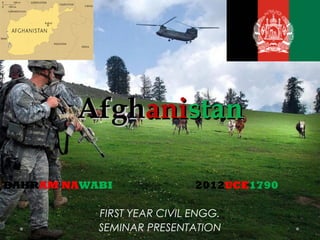
AAffgghhaanniissttaann 
BAHRAM NAWABI 2012UCE1790 
FIRST YEAR CIVIL ENGG. 
SEMINAR PRESENTATION
CCOONNTTEENNTTSS •BASIC FACTS 
•Basic facts about Afghanistan 
•LAND AND PEOPLE 
•Natural setting 
•The people 
•Major cities 
•The flag of Afghanistan 
•POLITI CS 
•Afghanistan is an Islamic republic country 
•Islamic 
•Quran and Hadith 
•Republic 
•Democracy and Pluralism 
•Rise of the Taliban 
•OVERCOMMING THE LEGACY 
•Political reconstruction 
•Economic recovery 
•Human rights 
•Education 
•Health 
•The future 
•CONCLUSION 
•BIBLIOGRAPHY
TThhee BBaassiicc FFaaccttss aabboouutt 
AAffgghhaanniissttaann 
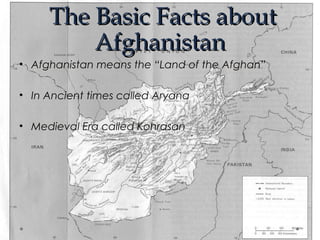
• Afghanistan means the “Land of the Afghan” 
• In Ancient times called Aryana 
• Medieval Era called Kohrasan
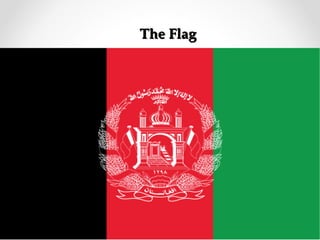
TThhee FFllaagg
RReeggiioonnaall MMaapp 
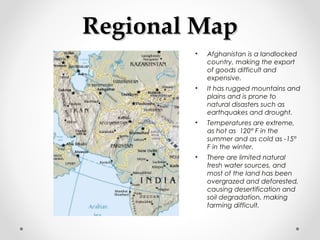
• Afghanistan is a landlocked 
country, making the export 
of goods difficult and 
expensive. 
• It has rugged mountains and 
plains and is prone to 
natural disasters such as 
earthquakes and drought. 
• Temperatures are extreme, 
as hot as 120° F in the 
summer and as cold as -15° 
F in the winter. 
• There are limited natural 
fresh water sources, and 
most of the land has been 
overgrazed and deforested, 
causing desertification and 
soil degradation, making 
farming difficult.
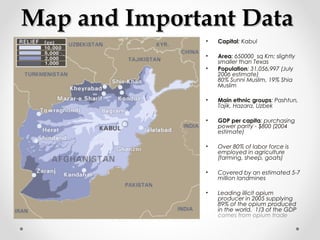
MMaapp aanndd IImmppoorrttaanntt DDaattaa 
• Capital: Kabul 
• Area: 650000 sq Km; slightly 
smaller than Texas 
• Population: 31,056,997 (July 
2006 estimate) 
80% Sunni Muslim, 19% Shia 
Muslim 
• Main ethnic groups: Pashtun, 
Tajik, Hazara, Uzbek 
• GDP per capita: purchasing 
power parity - $800 (2004 
estimate) 
• Over 80% of labor force is 
employed in agriculture 
(farming, sheep, goats) 
• Covered by an estimated 5-7 
million landmines 
• Leading illicit opium 
producer in 2005 supplying 
89% of the opium produced 
in the world. 1/3 of the GDP 
comes from opium trade
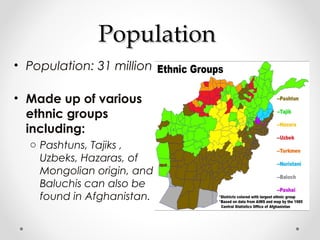
PPooppuullaattiioonn 
• Population: 31 million 
• Made up of various 
ethnic groups 
including: 
o Pashtuns, Tajiks , 
Uzbeks, Hazaras, of 
Mongolian origin, and 
Baluchis can also be 
found in Afghanistan.
TThhee PPeeooppllee 
• The people of Afghanistan are called 
Afghan(s). 
• The people of Afghanistan have a life 
expectancy of only 45 years. 
• Many ethnic groups make up the Afghan 
population. The largest is the Pashtun (38%) 
followed in size by the Tajik (25%).
GGoovveerrnnmmeenntt 
• Afghanistan does not have a 
functioning central government. It is 
ruled by factions. 
• There are presently 36 Afghan 
provinces. 
• The Constitution of 1964 is no longer in 
use.
LLaanngguuaaggee 
• Pashtu and Dari are most common languages 
• Pashtu -National Language of Afghanistan (35%) 
• 11% of the people can speak one of the “Turkic” 
languages. 
• Additionally there are another 30 minor languages 
spoken. 
• Dari – Used for business and government transactions (50%) 
• 55% of the country is illiterate, however Afghan’s are 
wonderful story tellers. 
• Bilingualism is very common in Afghanistan.
VViissiittiinngg 
• Afghans are known to invite others to their home for 
dinner. 
• The front room is used for eating meals. The food 
and drinks are served by children. 
• Male visitors, who are not considered an immediate 
family member, will never get to meet the women. 
• Be prepared to remove your shoes before entering 
a home or building. 
• The people of Afghanistan are known for their 
hospitality
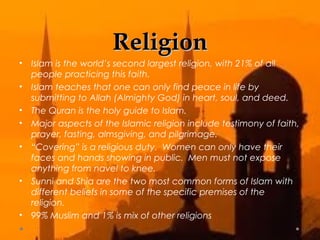
RReelliiggiioonn 
• Islam is the world’s second largest religion, with 21% of all 
people practicing this faith. 
• Islam teaches that one can only find peace in life by 
submitting to Allah (Almighty God) in heart, soul, and deed. 
• The Quran is the holy guide to Islam. 
• Major aspects of the Islamic religion include testimony of faith, 
prayer, fasting, almsgiving, and pilgrimage. 
• “Covering” is a religious duty. Women can only have their 
faces and hands showing in public. Men must not expose 
anything from navel to knee. 
• Sunni and Shia are the two most common forms of Islam with 
different beliefs in some of the specific premises of the 
religion. 
• 99% Muslim and 1% is mix of other religions
GGeeooggrraapphhyy ooff tthhee llaanndd 
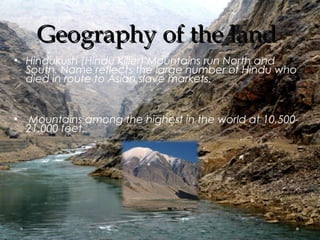
• Hindukush (Hindu Killer) Mountains run North and 
South. Name reflects the large number of Hindu who 
died in route to Asian slave markets. 
• Mountains among the highest in the world at 10,500- 
21,000 feet.
CClliimmaattee aanndd IImmppaacctt 
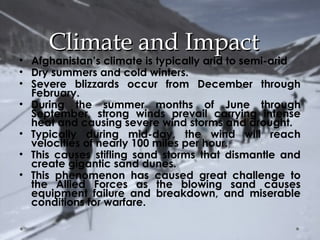
• Afghanistan’s climate is typically arid to semi-arid 
• Dry summers and cold winters. 
• Severe blizzards occur from December through 
February. 
• During the summer months of June through 
September, strong winds prevail carrying intense 
heat and causing severe wind storms and drought. 
• Typically during mid-day, the wind will reach 
velocities of nearly 100 miles per hour. 
• This causes stifling sand storms that dismantle and 
create gigantic sand dunes. 
• This phenomenon has caused great challenge to 
the Allied Forces as the blowing sand causes 
equipment failure and breakdown, and miserable 
conditions for warfare.
TTeerrrraaiinn aanndd PPhhyyssiiccaall 
FFeeaattuurreess 
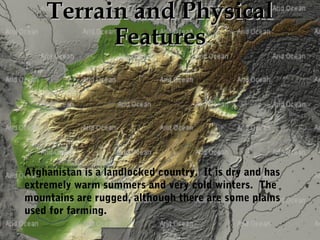
Photo by U.S. Army 10th Mountain Division-Light Infantry Afghanistan is a landlocked country. It is dry and has 
extremely warm summers and very cold winters. The 
mountains are rugged, although there are some plains 
used for farming.
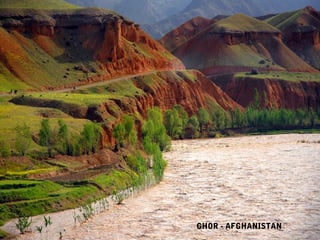
GHOR - AFGHANISTAN
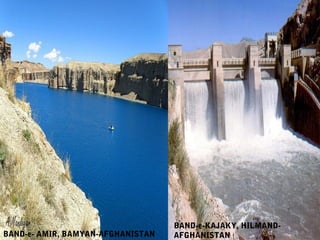
BAND-e- AMIR, BAMYAN-AFGHANISTAN 
BAND-e-KAJAKY, HILMAND-AFGHANISTAN
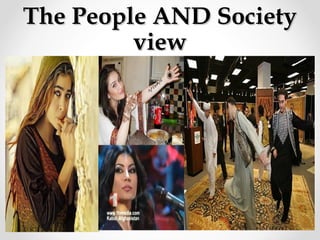
TThhee PPeeooppllee AANNDD SSoocciieettyy 
vviieeww
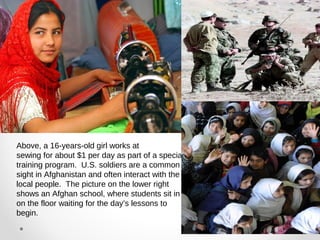
Above, a 16-years-old girl works at 
sewing for about $1 per day as part of a special 
training program. U.S. soldiers are a common 
sight in Afghanistan and often interact with the 
local people. The picture on the lower right 
shows an Afghan school, where students sit in 
on the floor waiting for the day’s lessons to 
begin.
Sharbat Gula (Pashto) 
) pronounced [ˈʃaɾbat]) (born ca. 1972) is 
an Afghan woman who was the subject of 
a famous photograph by journalist Steve 
McCurry. Gula was living as a refugee in 
Pakistan during the time of the Soviet 
occupation of Afghanistan when she was 
photographed. The image brought her 
recognition when it was featured on the 
cover of the June 1985 issue of National 
Geographic Magazine at a time when she 
was approximately 12 years old. Gula 
was known throughout the world simply 
as "the Afghan Girl" until she was 
formally identified in early 2002. The 
photograph has been likened to Leonardo 
da Vinci's painting of the Mona Lisa and 
is sometimes popularly referred to as "the 
Afghan Mona Lisa.
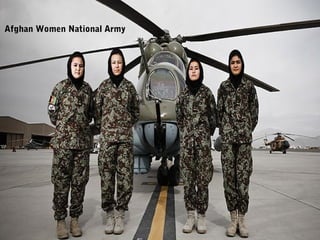
Afghan Women National Army
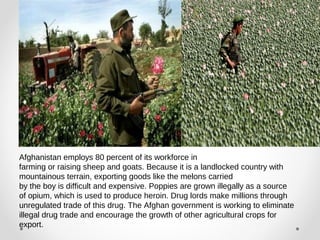
Afghanistan employs 80 percent of its workforce in 
farming or raising sheep and goats. Because it is a landlocked country with 
mountainous terrain, exporting goods like the melons carried 
by the boy is difficult and expensive. Poppies are grown illegally as a source 
of opium, which is used to produce heroin. Drug lords make millions through 
unregulated trade of this drug. The Afghan government is working to eliminate 
illegal drug trade and encourage the growth of other agricultural crops for 
export.
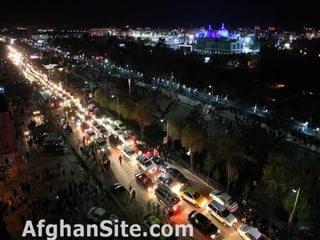
TTrraannssppoorrttaattiioonn 
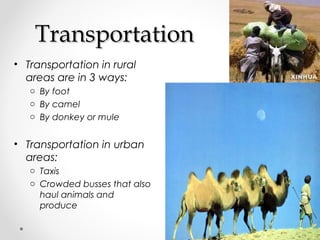
• Transportation in rural 
areas are in 3 ways: 
o By foot 
o By camel 
o By donkey or mule 
• Transportation in urban 
areas: 
o Taxis 
o Crowded busses that also 
haul animals and 
produce
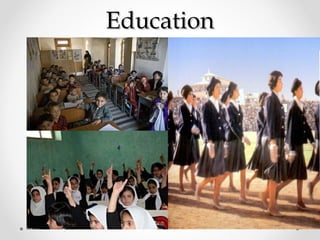
EEdduuccaattiioonn 
• It is the goal of the 
Ministry of Education 
(MoE) that “by 2020 
all children in 
Afghanistan, boys 
and girls alike, will be 
able to complete a 
full course of primary 
education.”
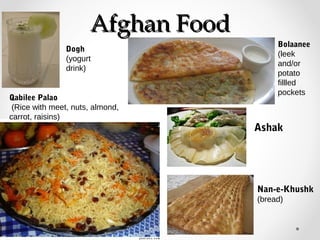
AAffgghhaann FFoooodd 
Dogh 
(yogurt 
drink) 
Bolaanee 
(leek 
and/or 
potato 
fillled 
pockets 
Qabilee Palao 
(Rice with meet, nuts, almond, 
carrot, raisins) 
Ashak 
Nan-e-Khushk 
(bread)
RReeccrreeaattiioonn 
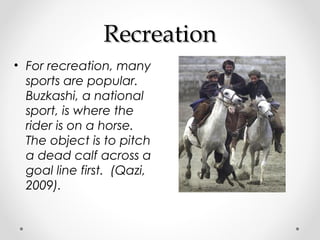
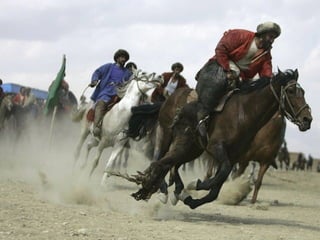
• For recreation, many 
sports are popular. 
Buzkashi, a national 
sport, is where the 
rider is on a horse. 
The object is to pitch 
a dead calf across a 
goal line first. (Qazi, 
2009).
RReeccrreeaattiioonn ccoonntt’’dd 
• Other sports played 
are soccer, basketball, 
Taekwondo, and table 
tennis, to name just a 
few. 
• Other forms of 
recreation include 
chicken fights, hunting 
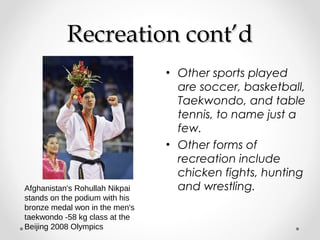
Afghanistan's Rohullah Nikpai and wrestling. 
stands on the podium with his 
bronze medal won in the men's 
taekwondo -58 kg class at the 
Beijing 2008 Olympics
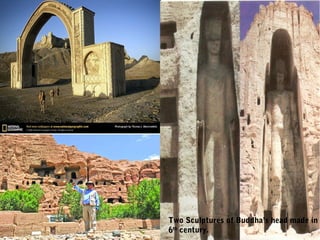
TThhee AArrttss aanndd hheerriittaaggeess 
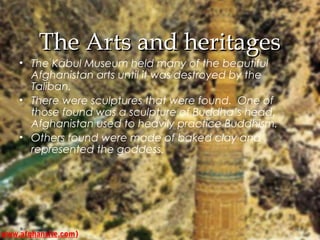
• The Kabul Museum held many of the beautiful 
Afghanistan arts until it was destroyed by the 
Taliban. 
• There were sculptures that were found. One of 
those found was a sculpture of Buddha’s head. 
Afghanistan used to heavily practice Buddhism. 
• Others found were made of baked clay and 
represented the goddess. 
www.afghansite.com)
Two Sculptures of Buddha’s head made in 
6th century.
CCoommmmeerrccee 
• Afghan’s major trading 
partners are, Germany, the US 
India, and Pakistan.. 
• The main industries in 
Afghanistan include the 
following: 
o Carpet 
o Small scale textiles 
o Soaps 
o Furniture 
o Shoes 
o Fertilizer 
o Cement 
o Copper 
o Coal 
o Natural gas 
o Hand woven carpets 
• Exports for Afghanistan 
include: 
o Carpet 
o Opium 
o Fruits 
o Nuts 
o Hand woven carpets 
o Wool 
o Cotton 
o Precious and semi precious 
gems 
o Hides 
o Pelts 
• Imports for Afghanistan 
include: 
o Petroleum products 
o Textiles 
o Capital goods 
o Food 
o etc
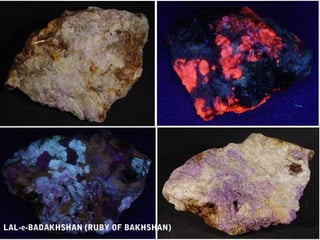
LAL-e-BADAKHSHAN (RUBY OF BAKHSHAN)
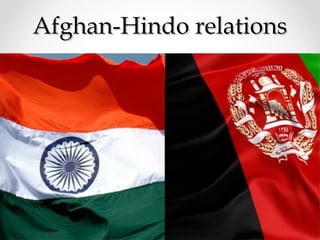
AAffgghhaann--HHiinnddoo rreellaattiioonnss
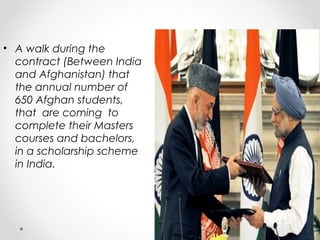
• A walk during the 
contract (Between India 
and Afghanistan) that 
the annual number of 
650 Afghan students, 
that are coming to 
complete their Masters 
courses and bachelors, 
in a scholarship scheme 
in India.
PPoolliittiiccaall HHiissttoorryy 
• In 1979, Afghanistan was invaded and 
eventually controlled by the Soviet Union. 
• In 1989, Afghanistan and the Soviet Union 
signed a peace agreement. 
• In 1995, the Taliban, promising traditional, 
Islamic values came into power, imposing 
strict Islamic law, including revoking many 
women’s rights. 
• In 2001, American troops force the Taliban 
from power. 
• In 2004, Hamid Karzai became the first 
elected Afghan president.
HHiissttoorriiccaall ppeerrssppeeccttiivvee:: 11998800-- 
pprreesseenntt 
• In the 1980’s, millions of Afghan’s lost their lives, and 
the war was with Russia. 
• 1989 Russia left the nation, leaving behind 
devastation and widespread poverty. 
• Millions of Afghan citizens were living as refugees. 
• Civil warring continued
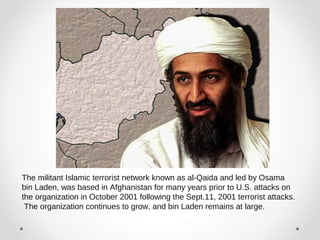
The militant Islamic terrorist network known as al-Qaida and led by Osama 
bin Laden, was based in Afghanistan for many years prior to U.S. attacks on 
the organization in October 2001 following the Sept.11, 2001 terrorist attacks. 
The organization continues to grow, and bin Laden remains at large.
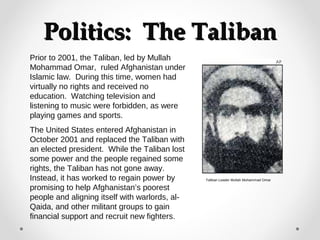
PPoolliittiiccss:: TThhee TTaalliibbaann 
Prior to 2001, the Taliban, led by Mullah 
Mohammad Omar, ruled Afghanistan under 
Islamic law. During this time, women had 
virtually no rights and received no 
education. Watching television and 
listening to music were forbidden, as were 
playing games and sports. 
The United States entered Afghanistan in 
October 2001 and replaced the Taliban with 
an elected president. While the Taliban lost 
some power and the people regained some 
rights, the Taliban has not gone away. 
Instead, it has worked to regain power by 
promising to help Afghanistan’s poorest 
people and aligning itself with warlords, al- 
Qaida, and other militant groups to gain 
financial support and recruit new fighters. 
Taliban Leader Mullah Mohammad Omar
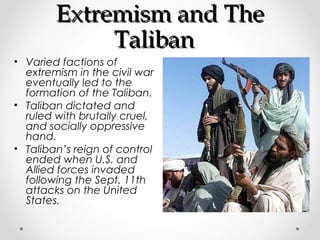
EExxttrreemmiissmm aanndd TThhee 
TTaalliibbaann 
• Varied factions of 
extremism in the civil war 
eventually led to the 
formation of the Taliban. 
• Taliban dictated and 
ruled with brutally cruel, 
and socially oppressive 
hand. 
• Taliban’s reign of control 
ended when U.S. and 
Allied forces invaded 
following the Sept. 11th 
attacks on the United 
States.
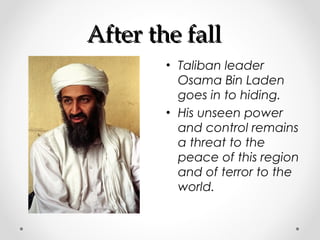
AAfftteerr tthhee ffaallll 
• Taliban leader 
Osama Bin Laden 
goes in to hiding. 
• His unseen power 
and control remains 
a threat to the 
peace of this region 
and of terror to the 
world.
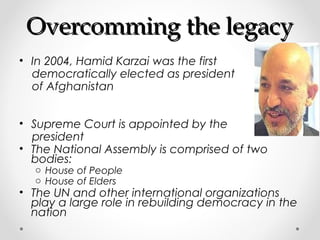
OOvveerrccoommmmiinngg tthhee lleeggaaccyy 
• In 2004, Hamid Karzai was the first 
democratically elected as president 
of Afghanistan 
• Supreme Court is appointed by the 
president 
• The National Assembly is comprised of two 
bodies: 
o House of People 
o House of Elders 
• The UN and other international organizations 
play a large role in rebuilding democracy in the 
nation
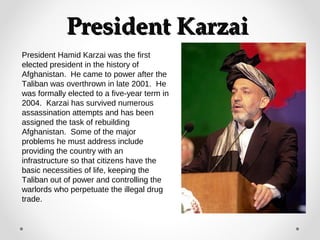
PPrreessiiddeenntt KKaarrzzaaii 
President Hamid Karzai was the first 
elected president in the history of 
Afghanistan. He came to power after the 
Taliban was overthrown in late 2001. He 
was formally elected to a five-year term in 
2004. Karzai has survived numerous 
assassination attempts and has been 
assigned the task of rebuilding 
Afghanistan. Some of the major 
problems he must address include 
providing the country with an 
infrastructure so that citizens have the 
basic necessities of life, keeping the 
Taliban out of power and controlling the 
warlords who perpetuate the illegal drug 
trade.
RReeffeerreenncceess//BBiibblliiooggrraapphhyy 
Afghanistan. (n.d.). Retrieved June 18, 2009, from World Atlas.com: 
http://www.worldatlas.com/webimage/countrys/asia/af.htm 
Afghanistan-History. (n.d.). Retrieved June 18, 2009, from Bookrags.com: 
http://www.bookrags.com/research/afghanistanhistory-ema-01/ 
Afghanistan. (n.d.). Retrieved June 18, 2009, from National Geographic: 
http://travel.nationalgeographic.com/places/countries/country_afghanistan. 
html 
Afghanistan Climate. (n.d.). Retrieved June 18, 2009, from Photius.com: 
http://www.photius.com/countries/afghanistan/climate/afghanistan_climate_ 
climate.html 
BBC Monitoring. (2009). Country Profile: Afghanistan. Retrieved on June 22, 2009 
From News Sources at: 
http://news.bbc.co.uk/2/hi/south_asia/country_profiles/111162668 
Blood, P. ed., (1997). Afghanistan: A Country Study. Washington: GPO for Library 
of 
Congress 2001.
Afghanistan   seminar

Afghanistan seminar

  • 1.
    AAffgghhaanniissttaann BAHRAM NAWABI2012UCE1790 FIRST YEAR CIVIL ENGG. SEMINAR PRESENTATION
  • 2.
    CCOONNTTEENNTTSS •BASIC FACTS •Basic facts about Afghanistan •LAND AND PEOPLE •Natural setting •The people •Major cities •The flag of Afghanistan •POLITI CS •Afghanistan is an Islamic republic country •Islamic •Quran and Hadith •Republic •Democracy and Pluralism •Rise of the Taliban •OVERCOMMING THE LEGACY •Political reconstruction •Economic recovery •Human rights •Education •Health •The future •CONCLUSION •BIBLIOGRAPHY
  • 3.
    TThhee BBaassiicc FFaaccttssaabboouutt AAffgghhaanniissttaann • Afghanistan means the “Land of the Afghan” • In Ancient times called Aryana • Medieval Era called Kohrasan
  • 4.
  • 5.
    RReeggiioonnaall MMaapp •Afghanistan is a landlocked country, making the export of goods difficult and expensive. • It has rugged mountains and plains and is prone to natural disasters such as earthquakes and drought. • Temperatures are extreme, as hot as 120° F in the summer and as cold as -15° F in the winter. • There are limited natural fresh water sources, and most of the land has been overgrazed and deforested, causing desertification and soil degradation, making farming difficult.
  • 6.
    MMaapp aanndd IImmppoorrttaannttDDaattaa • Capital: Kabul • Area: 650000 sq Km; slightly smaller than Texas • Population: 31,056,997 (July 2006 estimate) 80% Sunni Muslim, 19% Shia Muslim • Main ethnic groups: Pashtun, Tajik, Hazara, Uzbek • GDP per capita: purchasing power parity - $800 (2004 estimate) • Over 80% of labor force is employed in agriculture (farming, sheep, goats) • Covered by an estimated 5-7 million landmines • Leading illicit opium producer in 2005 supplying 89% of the opium produced in the world. 1/3 of the GDP comes from opium trade
  • 7.
    PPooppuullaattiioonn • Population:31 million • Made up of various ethnic groups including: o Pashtuns, Tajiks , Uzbeks, Hazaras, of Mongolian origin, and Baluchis can also be found in Afghanistan.
  • 8.
    TThhee PPeeooppllee •The people of Afghanistan are called Afghan(s). • The people of Afghanistan have a life expectancy of only 45 years. • Many ethnic groups make up the Afghan population. The largest is the Pashtun (38%) followed in size by the Tajik (25%).
  • 9.
    GGoovveerrnnmmeenntt • Afghanistandoes not have a functioning central government. It is ruled by factions. • There are presently 36 Afghan provinces. • The Constitution of 1964 is no longer in use.
  • 10.
    LLaanngguuaaggee • Pashtuand Dari are most common languages • Pashtu -National Language of Afghanistan (35%) • 11% of the people can speak one of the “Turkic” languages. • Additionally there are another 30 minor languages spoken. • Dari – Used for business and government transactions (50%) • 55% of the country is illiterate, however Afghan’s are wonderful story tellers. • Bilingualism is very common in Afghanistan.
  • 11.
    VViissiittiinngg • Afghansare known to invite others to their home for dinner. • The front room is used for eating meals. The food and drinks are served by children. • Male visitors, who are not considered an immediate family member, will never get to meet the women. • Be prepared to remove your shoes before entering a home or building. • The people of Afghanistan are known for their hospitality
  • 12.
    RReelliiggiioonn • Islamis the world’s second largest religion, with 21% of all people practicing this faith. • Islam teaches that one can only find peace in life by submitting to Allah (Almighty God) in heart, soul, and deed. • The Quran is the holy guide to Islam. • Major aspects of the Islamic religion include testimony of faith, prayer, fasting, almsgiving, and pilgrimage. • “Covering” is a religious duty. Women can only have their faces and hands showing in public. Men must not expose anything from navel to knee. • Sunni and Shia are the two most common forms of Islam with different beliefs in some of the specific premises of the religion. • 99% Muslim and 1% is mix of other religions
  • 14.
    GGeeooggrraapphhyy ooff tthheellaanndd • Hindukush (Hindu Killer) Mountains run North and South. Name reflects the large number of Hindu who died in route to Asian slave markets. • Mountains among the highest in the world at 10,500- 21,000 feet.
  • 15.
    CClliimmaattee aanndd IImmppaacctt • Afghanistan’s climate is typically arid to semi-arid • Dry summers and cold winters. • Severe blizzards occur from December through February. • During the summer months of June through September, strong winds prevail carrying intense heat and causing severe wind storms and drought. • Typically during mid-day, the wind will reach velocities of nearly 100 miles per hour. • This causes stifling sand storms that dismantle and create gigantic sand dunes. • This phenomenon has caused great challenge to the Allied Forces as the blowing sand causes equipment failure and breakdown, and miserable conditions for warfare.
  • 16.
    TTeerrrraaiinn aanndd PPhhyyssiiccaall FFeeaattuurreess Photo by U.S. Army 10th Mountain Division-Light Infantry Afghanistan is a landlocked country. It is dry and has extremely warm summers and very cold winters. The mountains are rugged, although there are some plains used for farming.
  • 17.
  • 18.
    BAND-e- AMIR, BAMYAN-AFGHANISTAN BAND-e-KAJAKY, HILMAND-AFGHANISTAN
  • 19.
    TThhee PPeeooppllee AANNDDSSoocciieettyy vviieeww
  • 20.
    Above, a 16-years-oldgirl works at sewing for about $1 per day as part of a special training program. U.S. soldiers are a common sight in Afghanistan and often interact with the local people. The picture on the lower right shows an Afghan school, where students sit in on the floor waiting for the day’s lessons to begin.
  • 21.
    Sharbat Gula (Pashto) ) pronounced [ˈʃaɾbat]) (born ca. 1972) is an Afghan woman who was the subject of a famous photograph by journalist Steve McCurry. Gula was living as a refugee in Pakistan during the time of the Soviet occupation of Afghanistan when she was photographed. The image brought her recognition when it was featured on the cover of the June 1985 issue of National Geographic Magazine at a time when she was approximately 12 years old. Gula was known throughout the world simply as "the Afghan Girl" until she was formally identified in early 2002. The photograph has been likened to Leonardo da Vinci's painting of the Mona Lisa and is sometimes popularly referred to as "the Afghan Mona Lisa.
  • 22.
  • 24.
    Afghanistan employs 80percent of its workforce in farming or raising sheep and goats. Because it is a landlocked country with mountainous terrain, exporting goods like the melons carried by the boy is difficult and expensive. Poppies are grown illegally as a source of opium, which is used to produce heroin. Drug lords make millions through unregulated trade of this drug. The Afghan government is working to eliminate illegal drug trade and encourage the growth of other agricultural crops for export.
  • 25.
    TTrraannssppoorrttaattiioonn • Transportationin rural areas are in 3 ways: o By foot o By camel o By donkey or mule • Transportation in urban areas: o Taxis o Crowded busses that also haul animals and produce
  • 27.
    EEdduuccaattiioonn • Itis the goal of the Ministry of Education (MoE) that “by 2020 all children in Afghanistan, boys and girls alike, will be able to complete a full course of primary education.”
  • 29.
    AAffgghhaann FFoooodd Dogh (yogurt drink) Bolaanee (leek and/or potato fillled pockets Qabilee Palao (Rice with meet, nuts, almond, carrot, raisins) Ashak Nan-e-Khushk (bread)
  • 30.
    RReeccrreeaattiioonn • Forrecreation, many sports are popular. Buzkashi, a national sport, is where the rider is on a horse. The object is to pitch a dead calf across a goal line first. (Qazi, 2009).
  • 32.
    RReeccrreeaattiioonn ccoonntt’’dd •Other sports played are soccer, basketball, Taekwondo, and table tennis, to name just a few. • Other forms of recreation include chicken fights, hunting Afghanistan's Rohullah Nikpai and wrestling. stands on the podium with his bronze medal won in the men's taekwondo -58 kg class at the Beijing 2008 Olympics
  • 33.
    TThhee AArrttss aannddhheerriittaaggeess • The Kabul Museum held many of the beautiful Afghanistan arts until it was destroyed by the Taliban. • There were sculptures that were found. One of those found was a sculpture of Buddha’s head. Afghanistan used to heavily practice Buddhism. • Others found were made of baked clay and represented the goddess. www.afghansite.com)
  • 34.
    Two Sculptures ofBuddha’s head made in 6th century.
  • 35.
    CCoommmmeerrccee • Afghan’smajor trading partners are, Germany, the US India, and Pakistan.. • The main industries in Afghanistan include the following: o Carpet o Small scale textiles o Soaps o Furniture o Shoes o Fertilizer o Cement o Copper o Coal o Natural gas o Hand woven carpets • Exports for Afghanistan include: o Carpet o Opium o Fruits o Nuts o Hand woven carpets o Wool o Cotton o Precious and semi precious gems o Hides o Pelts • Imports for Afghanistan include: o Petroleum products o Textiles o Capital goods o Food o etc
  • 36.
  • 37.
  • 38.
    • A walkduring the contract (Between India and Afghanistan) that the annual number of 650 Afghan students, that are coming to complete their Masters courses and bachelors, in a scholarship scheme in India.
  • 39.
    PPoolliittiiccaall HHiissttoorryy •In 1979, Afghanistan was invaded and eventually controlled by the Soviet Union. • In 1989, Afghanistan and the Soviet Union signed a peace agreement. • In 1995, the Taliban, promising traditional, Islamic values came into power, imposing strict Islamic law, including revoking many women’s rights. • In 2001, American troops force the Taliban from power. • In 2004, Hamid Karzai became the first elected Afghan president.
  • 40.
    HHiissttoorriiccaall ppeerrssppeeccttiivvee:: 11998800-- pprreesseenntt • In the 1980’s, millions of Afghan’s lost their lives, and the war was with Russia. • 1989 Russia left the nation, leaving behind devastation and widespread poverty. • Millions of Afghan citizens were living as refugees. • Civil warring continued
  • 41.
    The militant Islamicterrorist network known as al-Qaida and led by Osama bin Laden, was based in Afghanistan for many years prior to U.S. attacks on the organization in October 2001 following the Sept.11, 2001 terrorist attacks. The organization continues to grow, and bin Laden remains at large.
  • 42.
    PPoolliittiiccss:: TThhee TTaalliibbaann Prior to 2001, the Taliban, led by Mullah Mohammad Omar, ruled Afghanistan under Islamic law. During this time, women had virtually no rights and received no education. Watching television and listening to music were forbidden, as were playing games and sports. The United States entered Afghanistan in October 2001 and replaced the Taliban with an elected president. While the Taliban lost some power and the people regained some rights, the Taliban has not gone away. Instead, it has worked to regain power by promising to help Afghanistan’s poorest people and aligning itself with warlords, al- Qaida, and other militant groups to gain financial support and recruit new fighters. Taliban Leader Mullah Mohammad Omar
  • 43.
    EExxttrreemmiissmm aanndd TThhee TTaalliibbaann • Varied factions of extremism in the civil war eventually led to the formation of the Taliban. • Taliban dictated and ruled with brutally cruel, and socially oppressive hand. • Taliban’s reign of control ended when U.S. and Allied forces invaded following the Sept. 11th attacks on the United States.
  • 44.
    AAfftteerr tthhee ffaallll • Taliban leader Osama Bin Laden goes in to hiding. • His unseen power and control remains a threat to the peace of this region and of terror to the world.
  • 45.
    OOvveerrccoommmmiinngg tthhee lleeggaaccyy • In 2004, Hamid Karzai was the first democratically elected as president of Afghanistan • Supreme Court is appointed by the president • The National Assembly is comprised of two bodies: o House of People o House of Elders • The UN and other international organizations play a large role in rebuilding democracy in the nation
  • 46.
    PPrreessiiddeenntt KKaarrzzaaii PresidentHamid Karzai was the first elected president in the history of Afghanistan. He came to power after the Taliban was overthrown in late 2001. He was formally elected to a five-year term in 2004. Karzai has survived numerous assassination attempts and has been assigned the task of rebuilding Afghanistan. Some of the major problems he must address include providing the country with an infrastructure so that citizens have the basic necessities of life, keeping the Taliban out of power and controlling the warlords who perpetuate the illegal drug trade.
  • 47.
    RReeffeerreenncceess//BBiibblliiooggrraapphhyy Afghanistan. (n.d.).Retrieved June 18, 2009, from World Atlas.com: http://www.worldatlas.com/webimage/countrys/asia/af.htm Afghanistan-History. (n.d.). Retrieved June 18, 2009, from Bookrags.com: http://www.bookrags.com/research/afghanistanhistory-ema-01/ Afghanistan. (n.d.). Retrieved June 18, 2009, from National Geographic: http://travel.nationalgeographic.com/places/countries/country_afghanistan. html Afghanistan Climate. (n.d.). Retrieved June 18, 2009, from Photius.com: http://www.photius.com/countries/afghanistan/climate/afghanistan_climate_ climate.html BBC Monitoring. (2009). Country Profile: Afghanistan. Retrieved on June 22, 2009 From News Sources at: http://news.bbc.co.uk/2/hi/south_asia/country_profiles/111162668 Blood, P. ed., (1997). Afghanistan: A Country Study. Washington: GPO for Library of Congress 2001.