AFFIDAVIT- GENERAL
INTRODUCTION
BY
DR. VIJAY SRIVASTAVA
ASSOCIATE PROFESSOR
AMITY LAW SCHOOL
AMITY UNIVERSITY
Affidavit - Introduction
• The term Affidavit refers to a sworn statement in written format
made especially under an oath or affirmation before an
authorized officer or Magistrate.
• In other words, an Affidavit is a declaration of facts made in
writing and sworn before a person having the authority to
administer oath. All affidavits are verified statements and
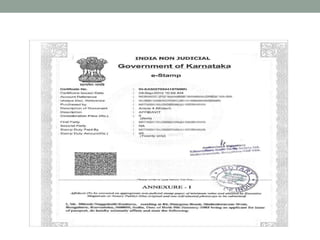
printed on Stamp papers of different denominations.
• All affidavits need to be drawn up in the first person and should
contain facts and not inferences. A person who makes an
affidavit is called a Deponent or an Affiant. The person who has
authority to attest a certificate may be a Magistrate who may in
turn be either a Judicial or an Executive Magistrate, a Notary
Public or a Commissioner of Oaths depending upon the
affidavit which needs to be attested. Indians living abroad can
swear affidavits before Consular officers posted in Indian
missions.
Who Can Create An Affidavit?
• In order to create an affidavit, an individual should have
attained majority and should be in a position to
understand the nature of the contents sworn. In other
words, the person should not be insane or incapacitated
to the extent of not knowing the meaning of the
statements mentioned in the affidavit.
Essential features
• An Affidavit should be in writing
Since an Affidavit is used as a record in court, it has to be
in writing. This is to make the person who makes the
affidavit accountable for the contents sworn in the
affidavit. It also deters people from making false claims
since they amount to punishable offences.
• It must be a declaration made by an individual
An Affidavit can be created only by an individual, and not
by any artificial persons like Companies and other
associations or Groups of individuals.
• It must relate to facts alone
An Affidavit should mention only the facts according to the
best knowledge and belief of the deponent. It should not
be based on mere inferences or assumptions
• It must be made in the first person
Affidavits cannot be created on behalf of other persons. The
purpose is to prevent declaring of things beyond the
reasonable knowledge of a person. It is the duty of the
deponent to state facts which are known to him/her. However it
is subject to the exception where affidavits are sworn on behalf
of minor children or insane individuals.
• It must be sworn before an officer or magistrate who is
authorised to administer oath.
An affidavit can be sworn only before a person having authority
to attest it. For example, a name change affidavit may be
attested either by a Notary Public or by an Executive or Judicial
magistrate for documents created in India; while an affidavit for
lost or damaged passport can be attested only by a Judicial or
Executive Magistrate and it is beyond the authority of a Notary
Public.
Content of Affidavit
• An affidavit should include only those facts that a
deponent is able to prove to his personal knowledge. It
should not contain assumptions and vague beliefs. The
only exception to this rule is Interlocutory Applications
submitted in civil proceedings which may be based on the
belief of the deponent. However, it is subject to to the rule
that the source of the information shall be specified and
that the deponent shall be subject to cross verification by
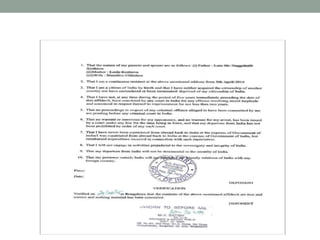
the other party. An affidavit contains plain facts listed one
after the other and a verification clause which is to be
attested by the prescribed officer with authority.
Circumstances For Creating An Affidavit
• Affidavits are used whenever there is a reason to swear an
oath of any nature, for instance- in passport requirements,
divorce proceedings, property disputes, debt cases among
others. It is also used in the event of loss of certificates or
original documents of any nature, for purposes of changing
names of individuals and for a number of different reasons.
• According to the Indian Laws, an affidavit can be used to prove
a fact in a court of law provided the court orders it. Since
affidavits are not included in the definition of ‘Evidence’ in the
Indian Evidence Act, they can be used as evidence only when
the court finds it reasonable to invoke the provisions of order
19 of the Civil Procedure Code. This provision is however
subject to the right of the opposite party to produce the
deponent for cross verification
Examples of Affidavit
• Name Change Affidavits
1. General Name Change Affidavit
2. Change of Name After Marriage Affidavit
3. Change of Name of Minor Affidavit
4. One and the Same Person Affidavit
• Change of Signature Affidavit
• Address Proof Affidavit
• Proof of Date of Birth Affidavit
• Income Proof Affidavit
• Joint Affidavit for Registration of Marriage
• Affidavit for No-criminal record
• Affidavit for Claim Settlement in Bank
• Affidavit for Issue of Duplicate Certificates/Documents/Mark lists
• First Child Affidavit
• Affidavit for Educational Loan
• Anti Ragging Affidavit
• Affidavit for gap in education/employment
• Passport Affidavits – also known as Annexures
Annexures are to be made strictly according to the formats issued by the Ministry of External
Affairs
• LPG Annexures
What Happens On Filing Of A False Affidavit?
• Swearing of a false affidavit can make a person liable to
be charged under the Indian Penal Code ( U/S 420) for
the offence of Perjury . It is a grave matter which warrants
strict. action.
Such provisions ensure that persons who swear untruths
in affidavits are aware of the consequences and to
prevent them from committing such offences.
How to Write An Affidavit
• Although affidavits are considered legal documents, anyone
can draft one.
• As long as it is signed, witnessed, and notarized correctly, the
affidavit will be valid. This means that you do not need to ask a
lawyer to create an affidavit. It is important to note, however,
that certain types of affidavits will need to contain specific
information in order to fulfill their purpose and meet legal
requirements. Nevertheless, the following basic elements
should be included in any type of affidavit.
• Start with a heading. The heading may be made of a case
heading if the affidavit is for an open case, or it may simply say
“Affidavit of [your name]” if you do not have an open case. The
case heading includes the court where your case is being
heard, the case number, and the names of the plaintiffs and
defendants. After the case heading or general title, the county
and state where you will sign the affidavit will be listed.
• The first section should contain your name in a
sentence that generally states that you, the affiant,
swear that the following account of events is true and
correct to the best of your knowledge. For example,
“Before me comes [your name], whose residence is
[address, including city, county, state and zip code], and
hereby swears to the following facts under penalty of
perjury.” Depending on who drafts the affidavit, this
sentence may vary in wording.
• The following paragraphs usually each contain one
fact. After each fact is detailed, the affidavit usually
contains the words, “Further Affiant Sayeth Naught.” This
means that the affiant has said all they have to say on the
matter.
•
• Lastly, you will need to include the signature lines and
notary section. Keep in mind that by signing the affidavit, you
are swearing that the facts in the document are true and
correct.
• GENERAL RULES
• An affidavit is not written in typical paragraphs. Each paragraph
should be numbered and usually each contains only one fact.
To ensure that the affidavit is easily understood, follow these
best practice tips:
• Keep legal language out of the affidavit as much as possible.
• Keep the affidavit as short as possible.
• Make sure your thoughts are organized and in the proper order
if you are relating your actions in an event.
CONTI…
• Do not use inflammatory language.
• Leave any drama out of it; just state the plain and simple facts.
• Proofread the affidavit for spelling and grammatical errors.
• Keep in mind that the affidavit may speak to your credibility, so
following these simple tips will make you look more
professional and will not negatively affect your credibility.
• Making any statement that is not true in an affidavit is
technically a violation of the law and you can be fined or even
imprisoned for committing perjury (the crime of being willfully
untruthful under oath). Being truthful to the court is vital,
whether communicating via an affidavit or in person on the
stand. Many affidavits assert that they are signed under penalty
of perjury, though this may not be a required statement.
•
THANK YOU

Affidavit

  • 1.
    AFFIDAVIT- GENERAL INTRODUCTION BY DR. VIJAYSRIVASTAVA ASSOCIATE PROFESSOR AMITY LAW SCHOOL AMITY UNIVERSITY
  • 2.
    Affidavit - Introduction •The term Affidavit refers to a sworn statement in written format made especially under an oath or affirmation before an authorized officer or Magistrate. • In other words, an Affidavit is a declaration of facts made in writing and sworn before a person having the authority to administer oath. All affidavits are verified statements and printed on Stamp papers of different denominations. • All affidavits need to be drawn up in the first person and should contain facts and not inferences. A person who makes an affidavit is called a Deponent or an Affiant. The person who has authority to attest a certificate may be a Magistrate who may in turn be either a Judicial or an Executive Magistrate, a Notary Public or a Commissioner of Oaths depending upon the affidavit which needs to be attested. Indians living abroad can swear affidavits before Consular officers posted in Indian missions.
  • 3.
    Who Can CreateAn Affidavit? • In order to create an affidavit, an individual should have attained majority and should be in a position to understand the nature of the contents sworn. In other words, the person should not be insane or incapacitated to the extent of not knowing the meaning of the statements mentioned in the affidavit.
  • 4.
    Essential features • AnAffidavit should be in writing Since an Affidavit is used as a record in court, it has to be in writing. This is to make the person who makes the affidavit accountable for the contents sworn in the affidavit. It also deters people from making false claims since they amount to punishable offences. • It must be a declaration made by an individual An Affidavit can be created only by an individual, and not by any artificial persons like Companies and other associations or Groups of individuals. • It must relate to facts alone An Affidavit should mention only the facts according to the best knowledge and belief of the deponent. It should not be based on mere inferences or assumptions
  • 5.
    • It mustbe made in the first person Affidavits cannot be created on behalf of other persons. The purpose is to prevent declaring of things beyond the reasonable knowledge of a person. It is the duty of the deponent to state facts which are known to him/her. However it is subject to the exception where affidavits are sworn on behalf of minor children or insane individuals. • It must be sworn before an officer or magistrate who is authorised to administer oath. An affidavit can be sworn only before a person having authority to attest it. For example, a name change affidavit may be attested either by a Notary Public or by an Executive or Judicial magistrate for documents created in India; while an affidavit for lost or damaged passport can be attested only by a Judicial or Executive Magistrate and it is beyond the authority of a Notary Public.
  • 6.
    Content of Affidavit •An affidavit should include only those facts that a deponent is able to prove to his personal knowledge. It should not contain assumptions and vague beliefs. The only exception to this rule is Interlocutory Applications submitted in civil proceedings which may be based on the belief of the deponent. However, it is subject to to the rule that the source of the information shall be specified and that the deponent shall be subject to cross verification by the other party. An affidavit contains plain facts listed one after the other and a verification clause which is to be attested by the prescribed officer with authority.
  • 9.
    Circumstances For CreatingAn Affidavit • Affidavits are used whenever there is a reason to swear an oath of any nature, for instance- in passport requirements, divorce proceedings, property disputes, debt cases among others. It is also used in the event of loss of certificates or original documents of any nature, for purposes of changing names of individuals and for a number of different reasons. • According to the Indian Laws, an affidavit can be used to prove a fact in a court of law provided the court orders it. Since affidavits are not included in the definition of ‘Evidence’ in the Indian Evidence Act, they can be used as evidence only when the court finds it reasonable to invoke the provisions of order 19 of the Civil Procedure Code. This provision is however subject to the right of the opposite party to produce the deponent for cross verification
  • 10.
    Examples of Affidavit •Name Change Affidavits 1. General Name Change Affidavit 2. Change of Name After Marriage Affidavit 3. Change of Name of Minor Affidavit 4. One and the Same Person Affidavit • Change of Signature Affidavit • Address Proof Affidavit • Proof of Date of Birth Affidavit • Income Proof Affidavit • Joint Affidavit for Registration of Marriage • Affidavit for No-criminal record • Affidavit for Claim Settlement in Bank • Affidavit for Issue of Duplicate Certificates/Documents/Mark lists • First Child Affidavit • Affidavit for Educational Loan • Anti Ragging Affidavit • Affidavit for gap in education/employment • Passport Affidavits – also known as Annexures Annexures are to be made strictly according to the formats issued by the Ministry of External Affairs • LPG Annexures
  • 11.
    What Happens OnFiling Of A False Affidavit? • Swearing of a false affidavit can make a person liable to be charged under the Indian Penal Code ( U/S 420) for the offence of Perjury . It is a grave matter which warrants strict. action. Such provisions ensure that persons who swear untruths in affidavits are aware of the consequences and to prevent them from committing such offences.
  • 12.
    How to WriteAn Affidavit • Although affidavits are considered legal documents, anyone can draft one. • As long as it is signed, witnessed, and notarized correctly, the affidavit will be valid. This means that you do not need to ask a lawyer to create an affidavit. It is important to note, however, that certain types of affidavits will need to contain specific information in order to fulfill their purpose and meet legal requirements. Nevertheless, the following basic elements should be included in any type of affidavit. • Start with a heading. The heading may be made of a case heading if the affidavit is for an open case, or it may simply say “Affidavit of [your name]” if you do not have an open case. The case heading includes the court where your case is being heard, the case number, and the names of the plaintiffs and defendants. After the case heading or general title, the county and state where you will sign the affidavit will be listed.
  • 13.
    • The firstsection should contain your name in a sentence that generally states that you, the affiant, swear that the following account of events is true and correct to the best of your knowledge. For example, “Before me comes [your name], whose residence is [address, including city, county, state and zip code], and hereby swears to the following facts under penalty of perjury.” Depending on who drafts the affidavit, this sentence may vary in wording. • The following paragraphs usually each contain one fact. After each fact is detailed, the affidavit usually contains the words, “Further Affiant Sayeth Naught.” This means that the affiant has said all they have to say on the matter. •
  • 14.
    • Lastly, youwill need to include the signature lines and notary section. Keep in mind that by signing the affidavit, you are swearing that the facts in the document are true and correct. • GENERAL RULES • An affidavit is not written in typical paragraphs. Each paragraph should be numbered and usually each contains only one fact. To ensure that the affidavit is easily understood, follow these best practice tips: • Keep legal language out of the affidavit as much as possible. • Keep the affidavit as short as possible. • Make sure your thoughts are organized and in the proper order if you are relating your actions in an event.
  • 15.
    CONTI… • Do notuse inflammatory language. • Leave any drama out of it; just state the plain and simple facts. • Proofread the affidavit for spelling and grammatical errors. • Keep in mind that the affidavit may speak to your credibility, so following these simple tips will make you look more professional and will not negatively affect your credibility. • Making any statement that is not true in an affidavit is technically a violation of the law and you can be fined or even imprisoned for committing perjury (the crime of being willfully untruthful under oath). Being truthful to the court is vital, whether communicating via an affidavit or in person on the stand. Many affidavits assert that they are signed under penalty of perjury, though this may not be a required statement. •
  • 16.