AGS Project Showcase: Advocacy Products
10th Grade World Studies Project
Presenter: Stacy Allen Webster, Academy for Global Studies
at Stephen F. Austin High School, Austin TX
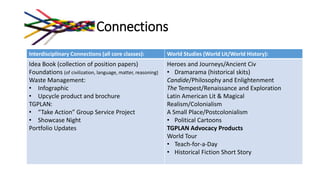
Connections
Interdisciplinary Connections (all core classes): World Studies (World Lit/World History):
Idea Book (collection of position papers)
Foundations (of civilization, language, matter, reasoning)
Waste Management:
• Infographic
• Upcycle product and brochure
TGPLAN:
• “Take Action” Group Service Project
• Showcase Night
Portfolio Updates
Heroes and Journeys/Ancient Civ
• Dramarama (historical skits)
Candide/Philosophy and Enlightenment
The Tempest/Renaissance and Exploration
Latin American Lit & Magical
Realism/Colonialism
A Small Place/Postcolonialism
• Political Cartoons
TGPLAN Advocacy Products
World Tour
• Teach-for-a-Day
• Historical Fiction Short Story
Our Interdisciplinary SPRING THING:
Think Globally, Problem-solve Locally, Act Neighborly
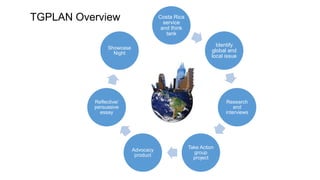
TGPLAN Overview Costa Rica
service
and think
tank
Identify
global and
local issue
Research
and
interviews
Take Action
group
project
Advocacy
product
Reflective/
persuasive
essay
Showcase
Night
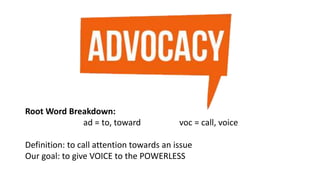
Root Word Breakdown:
ad = to, toward voc = call, voice
Definition: to call attention towards an issue
Our goal: to give VOICE to the POWERLESS
Persuasion: the art of getting what you want
logos
pathos
ethos
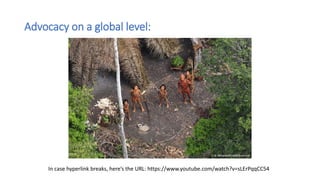
Advocacy on a global level:
In case hyperlink breaks, here’s the URL: https://www.youtube.com/watch?v=sLErPqqCC54
The Art of Persuasion
1) Where did you see evidence of logos, pathos, ethos in this video clip?
2) Which rhetorical appeal had the strongest effect on you?
3) What is the purpose of this video?
4) Who is the audience? How do you know?
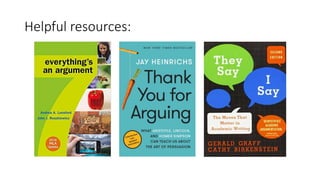
Helpful resources:
TGPLAN Table Talk
1) As a teenager attempting to enact change in the world, how will you
establish credibility?
2) Who counts as an expert on an issue? How will you work with your
group to ensure that multiple perspectives are represented in your end
product?
This leads to INTERVIEWING EXPERTS.
Step 1: FIND POSSIBLE INTERVIEWEES Research names of visionaries, problem-solvers, pot-
stirrers, and risk-takers who are attempting to address a global issue impacting Austin. You may
also list people who are impacted by the issue or who have a differing opinion, in order to
represent multiple perspectives.
Step 2: DRAFT A SCRIPT FOR YOUR INTERVIEW REQUEST CALL Acronyms and project details are
very difficult to understand out of context. How will you succinctly introduce yourself, explain the
project and your need for an interview, and professionally set up an appointment time? Role play
the conversation you will have when you initially contact your expert.
Step 3: WRITE QUESTIONS Brainstorm 20 interview questions. At least 10 of the questions
should be open-ended questions that lead to responses in complete sentences. Do not include
obvious questions like “What’s your name?” “How do you spell that?” “What’s your job title?”
“How long have you worked here?”…but be sure to ask those questions during the interview!
Step 4: BOOK AN INTERVIEW. Suggest options to your expert. Consider transportation issues
(will you need to get a ride or take the city bus to the interview?). Will you take a group member
with you in order to record the interview? What times will work for all parties involved?
Step 5: CONDUCT THE INTERVIEW Set up the appointment and then conduct the interview!
Keep in mind that footage of your interview is preferred. Be sure to go with a friend or parent.
Here’s your list of possible interview scenarios, ranked from best case to worse case:
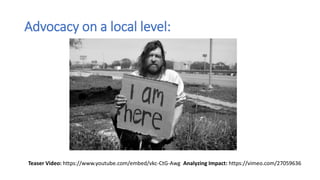
Advocacy on a local level:
Teaser Video: https://www.youtube.com/embed/vkc-CtG-Awg Analyzing Impact: https://vimeo.com/27059636
Student-created PSA:
In case hyperlink breaks: https://www.youtube.com/watch?v=47aItSh2Z1c
Student-created PSA:
In case hyperlink breaks: https://www.youtube.com/watch?v=cX_yMDS6YIw&feature=youtu.be
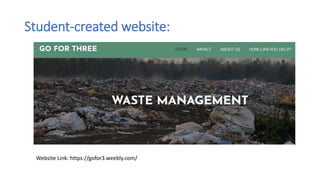
Student-created website:
Website Link: https://gofor3.weebly.com/
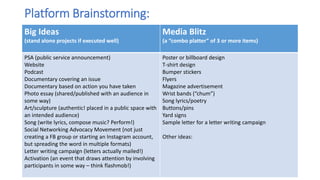
Platform Brainstorming:
Big Ideas
(stand alone projects if executed well)
Media Blitz
(a “combo platter” of 3 or more items)
PSA (public service announcement)
Website
Podcast
Documentary covering an issue
Documentary based on action you have taken
Photo essay (shared/published with an audience in
some way)
Art/sculpture (authentic! placed in a public space with
an intended audience)
Song (write lyrics, compose music? Perform!)
Social Networking Advocacy Movement (not just
creating a FB group or starting an Instagram account,
but spreading the word in multiple formats)
Letter writing campaign (letters actually mailed!)
Activation (an event that draws attention by involving
participants in some way – think flashmob!)
Poster or billboard design
T-shirt design
Bumper stickers
Flyers
Magazine advertisement
Wrist bands (“chum”)
Song lyrics/poetry
Buttons/pins
Yard signs
Sample letter for a letter writing campaign
Other ideas:
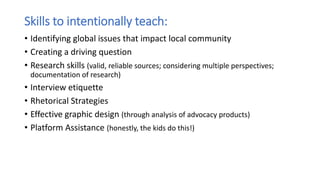
Skills to intentionally teach:
• Identifying global issues that impact local community
• Creating a driving question
• Research skills (valid, reliable sources; considering multiple perspectives;
documentation of research)
• Interview etiquette
• Rhetorical Strategies
• Effective graphic design (through analysis of advocacy products)
• Platform Assistance (honestly, the kids do this!)
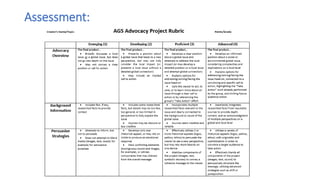
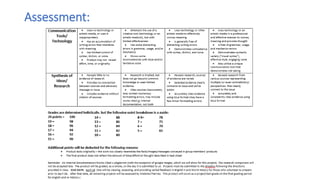
Assessment:
Assessment:
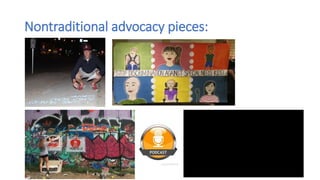
Nontraditional advocacy pieces:

Advocacy ISSN 2018

  • 1.
    AGS Project Showcase:Advocacy Products 10th Grade World Studies Project Presenter: Stacy Allen Webster, Academy for Global Studies at Stephen F. Austin High School, Austin TX
  • 2.
    Connections Interdisciplinary Connections (allcore classes): World Studies (World Lit/World History): Idea Book (collection of position papers) Foundations (of civilization, language, matter, reasoning) Waste Management: • Infographic • Upcycle product and brochure TGPLAN: • “Take Action” Group Service Project • Showcase Night Portfolio Updates Heroes and Journeys/Ancient Civ • Dramarama (historical skits) Candide/Philosophy and Enlightenment The Tempest/Renaissance and Exploration Latin American Lit & Magical Realism/Colonialism A Small Place/Postcolonialism • Political Cartoons TGPLAN Advocacy Products World Tour • Teach-for-a-Day • Historical Fiction Short Story
  • 3.
    Our Interdisciplinary SPRINGTHING: Think Globally, Problem-solve Locally, Act Neighborly
  • 4.
    TGPLAN Overview CostaRica service and think tank Identify global and local issue Research and interviews Take Action group project Advocacy product Reflective/ persuasive essay Showcase Night
  • 5.
    Root Word Breakdown: ad= to, toward voc = call, voice Definition: to call attention towards an issue Our goal: to give VOICE to the POWERLESS
  • 6.
    Persuasion: the artof getting what you want logos pathos ethos
  • 7.
    Advocacy on aglobal level: In case hyperlink breaks, here’s the URL: https://www.youtube.com/watch?v=sLErPqqCC54
  • 8.
    The Art ofPersuasion 1) Where did you see evidence of logos, pathos, ethos in this video clip? 2) Which rhetorical appeal had the strongest effect on you? 3) What is the purpose of this video? 4) Who is the audience? How do you know?
  • 9.
  • 10.
    TGPLAN Table Talk 1)As a teenager attempting to enact change in the world, how will you establish credibility? 2) Who counts as an expert on an issue? How will you work with your group to ensure that multiple perspectives are represented in your end product? This leads to INTERVIEWING EXPERTS.
  • 11.
    Step 1: FINDPOSSIBLE INTERVIEWEES Research names of visionaries, problem-solvers, pot- stirrers, and risk-takers who are attempting to address a global issue impacting Austin. You may also list people who are impacted by the issue or who have a differing opinion, in order to represent multiple perspectives. Step 2: DRAFT A SCRIPT FOR YOUR INTERVIEW REQUEST CALL Acronyms and project details are very difficult to understand out of context. How will you succinctly introduce yourself, explain the project and your need for an interview, and professionally set up an appointment time? Role play the conversation you will have when you initially contact your expert. Step 3: WRITE QUESTIONS Brainstorm 20 interview questions. At least 10 of the questions should be open-ended questions that lead to responses in complete sentences. Do not include obvious questions like “What’s your name?” “How do you spell that?” “What’s your job title?” “How long have you worked here?”…but be sure to ask those questions during the interview! Step 4: BOOK AN INTERVIEW. Suggest options to your expert. Consider transportation issues (will you need to get a ride or take the city bus to the interview?). Will you take a group member with you in order to record the interview? What times will work for all parties involved? Step 5: CONDUCT THE INTERVIEW Set up the appointment and then conduct the interview! Keep in mind that footage of your interview is preferred. Be sure to go with a friend or parent. Here’s your list of possible interview scenarios, ranked from best case to worse case:
  • 12.
    Advocacy on alocal level: Teaser Video: https://www.youtube.com/embed/vkc-CtG-Awg Analyzing Impact: https://vimeo.com/27059636
  • 13.
    Student-created PSA: In casehyperlink breaks: https://www.youtube.com/watch?v=47aItSh2Z1c
  • 14.
    Student-created PSA: In casehyperlink breaks: https://www.youtube.com/watch?v=cX_yMDS6YIw&feature=youtu.be
  • 15.
    Student-created website: Website Link:https://gofor3.weebly.com/
  • 16.
    Platform Brainstorming: Big Ideas (standalone projects if executed well) Media Blitz (a “combo platter” of 3 or more items) PSA (public service announcement) Website Podcast Documentary covering an issue Documentary based on action you have taken Photo essay (shared/published with an audience in some way) Art/sculpture (authentic! placed in a public space with an intended audience) Song (write lyrics, compose music? Perform!) Social Networking Advocacy Movement (not just creating a FB group or starting an Instagram account, but spreading the word in multiple formats) Letter writing campaign (letters actually mailed!) Activation (an event that draws attention by involving participants in some way – think flashmob!) Poster or billboard design T-shirt design Bumper stickers Flyers Magazine advertisement Wrist bands (“chum”) Song lyrics/poetry Buttons/pins Yard signs Sample letter for a letter writing campaign Other ideas:
  • 17.
    Skills to intentionallyteach: • Identifying global issues that impact local community • Creating a driving question • Research skills (valid, reliable sources; considering multiple perspectives; documentation of research) • Interview etiquette • Rhetorical Strategies • Effective graphic design (through analysis of advocacy products) • Platform Assistance (honestly, the kids do this!)
  • 18.
  • 19.
  • 20.