1
WELCOME
2
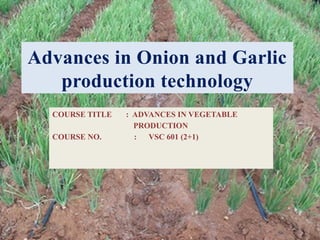
Advances in Onion and Garlic
production technology
COURSE TITLE : ADVANCES IN VEGETABLE
PRODUCTION
COURSE NO. : VSC 601 (2+1)
3
Onion :Allium cepa Garlic : Allium sativus
• Family :Liliaceae> Amaryllidaceae>Alliaceae
• Chromosome No. : 2n= 2x= 16
• Origin : Central asia.
• Long day plant
• Modified stem known as Bulb.
4
Nutritive value:
• Pungency and flavour- Allyl propyl disulphide
• Antioxidant – quercetin (flavonoid)
• Phytochemicals – disulfides, trisulphides, cepaene and
vinyldithins – prevents cancer, heart diseases and digestive
diseases.
• Raw onion has a antiseptic value throughout the alimentary
canal.
• Improves bone density in women
• Sulphur …..reduces blood sugar content
• Onion very useful to prevent sunstroke in summer.
5
Soil requirements
• Successful onion cultivation : deep, loamy with good
drainage, moisture holding capacity and sufficient
organic matter.
• pH- 6.0-7.5.
• Heavy soils
• More sensitive to highly acidic, alkali and saline soils
and water logging condition.
6
Climate
• Vegetative growth – Low temperature (13-24°C) + Short days
• Bulb growth – High temperature (16-25°C) + Long days
• In India mainly short day (10-12 hours) onions grown in
plains. In hills long day (13-14 hours) onions are grown.
1. Temperature
2. Day length
3. Relative Humidity
4. Rain fall
7
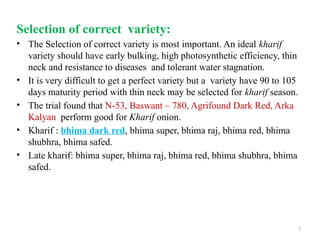
Selection of correct variety:
• The Selection of correct variety is most important. An ideal kharif
variety should have early bulking, high photosynthetic efficiency, thin
neck and resistance to diseases and tolerant water stagnation.
• It is very difficult to get a perfect variety but a variety have 90 to 105
days maturity period with thin neck may be selected for kharif season.
• The trial found that N-53, Baswant – 780, Agrifound Dark Red, Arka
Kalyan perform good for Kharif onion.
• Kharif : bhima dark red, bhima super, bhima raj, bhima red, bhima
shubhra, bhima safed.
• Late kharif: bhima super, bhima raj, bhima red, bhima shubhra, bhima
safed.
8
Varieties suitable for Rabi
• Bhima shakti, bhima kiran, bhima light red-
good for storage.
9
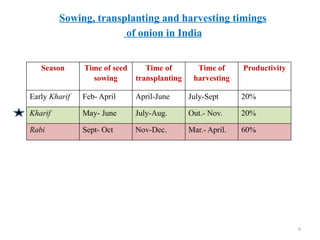
Sowing, transplanting and harvesting timings
of onion in India
Season Time of seed
sowing
Time of
transplanting
Time of
harvesting
Productivity
Early Kharif Feb- April April-June July-Sept 20%
Kharif May- June July-Aug. Out.- Nov. 20%
Rabi Sept- Oct Nov-Dec. Mar.- April. 60%
10
The production and productivity of kharif
onion is very low compared to other seasons
The main reasons of low productivity of kharif onions are
 Unavailability of right type of seed in time
 Shortage of water for production nursery in summer
 High seedling mortality due to scorching heat in May
 Ineffective drainage, water satganation
 Severe weed problem
 Heavy incidence of diseases during rainy seasons
 Less efficacy of prophylactic sprays in controlling diseases due to
constant drizzling
 Problems in curing and drying of onions after harvest
 Poor crop stand in direct seed sown crop
11
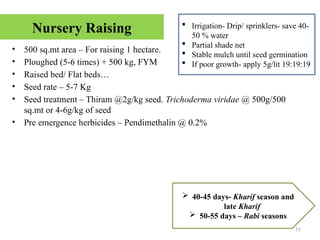
Nursery Raising
• 500 sq.mt area – For raising 1 hectare.
• Ploughed (5-6 times) + 500 kg, FYM
• Raised bed/ Flat beds…
• Seed rate – 5-7 Kg
• Seed treatment – Thiram @2g/kg seed. Trichoderma viridae @ 500g/500
sq.mt or 4-6g/kg of seed
• Pre emergence herbicides – Pendimethalin @ 0.2%
 40-45 days- Kharif season and
late Kharif
 50-55 days – Rabi seasons
 Irrigation- Drip/ sprinklers- save 40-
50 % water
 Partial shade net
 Stable mulch until seed germination
 If poor growth- apply 5g/lit 19:19:19
12
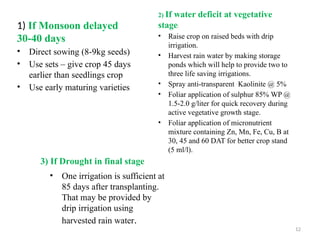
2) If water deficit at vegetative
stage:
• Raise crop on raised beds with drip
irrigation.
• Harvest rain water by making storage
ponds which will help to provide two to
three life saving irrigations.
• Spray anti-transparent Kaolinite @ 5%
• Foliar application of sulphur 85% WP @
1.5-2.0 g/liter for quick recovery during
active vegetative growth stage.
• Foliar application of micronutrient
mixture containing Zn, Mn, Fe, Cu, B at
30, 45 and 60 DAT for better crop stand
(5 ml/l).
3) If Drought in final stage
• One irrigation is sufficient at
85 days after transplanting.
That may be provided by
drip irrigation using
harvested rain water.
1) If Monsoon delayed
30-40 days
• Direct sowing (8-9kg seeds)
• Use sets – give crop 45 days
earlier than seedlings crop
• Use early maturing varieties
13
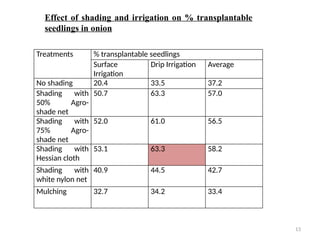
Treatments % transplantable seedlings
Surface
Irrigation
Drip Irrigation Average
No shading 20.4 33.5 37.2
Shading with
50% Agro-
shade net
50.7 63.3 57.0
Shading with
75% Agro-
shade net
52.0 61.0 56.5
Shading with
Hessian cloth
53.1 63.3 58.2
Shading with
white nylon net
40.9 44.5 42.7
Mulching 32.7 34.2 33.4
Effect of shading and irrigation on % transplantable
seedlings in onion
14
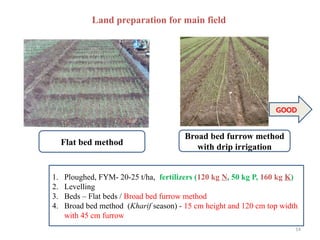
Land preparation for main field
Flat bed method
Broad bed furrow method
with drip irrigation
1. Ploughed, FYM- 20-25 t/ha, fertilizers (120 kg N, 50 kg P, 160 kg K)
2. Levelling
3. Beds – Flat beds / Broad bed furrow method
4. Broad bed method (Kharif season) - 15 cm height and 120 cm top width
with 45 cm furrow
GOOD
15
• Two inline drip laterals on each bed. Distance between two laterals is
60cm. Distance between two emitters is 30-50cm. Discharge from each
dripper is 4lit/hour.
16
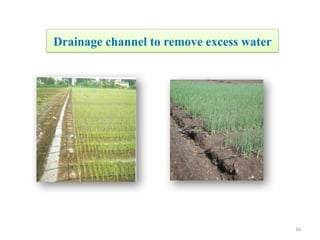
Drainage channel to remove excess water
17
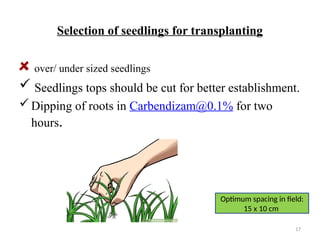
Selection of seedlings for transplanting
over/ under sized seedlings
 Seedlings tops should be cut for better establishment.
Dipping of roots in Carbendizam@0.1% for two
hours.
Optimum spacing in field:
15 x 10 cm
18
Methods of planting
Depending upon soil, topography, climatic conditions and
economic aspects………
1. Raising seedlings and transplanting
2. Planting bulbs directly in the field
3. Broad casting or drilling of seeds directly in the field.
19
Transplanting method Planting of bulbs Broad casting or
drilling method
 Most common for
irrigated crop
 Seed rate – 8-10 kg
/ha
 Nursery : 120cm
width, 10 cm height
and convenient length
 15c m height, 0.8 cm
neck diameter (8
weeks)
 Spacing : 10 x 15 cm.
 Hill slope / terrace
 Medium sized bulbs
from June crop are
used to plant sep-oct
season
 45 cm wide ridges,
plant bulbs at 25 cm
apart on both side a
ridge
 Seed rate – 10-12 q/ha
 To save labour charges
 Seed rate : 25 kg/ha
 Care – weeds at initial
stages
 6-8 weeks after- go for
transplanting
20
Weed competition is very high in onion
compared to all other crops
 30-40% losses.
 Slow growth at initial stages
 Short stature, non-branching, sparse foliage and shallow root
system.
 Application of Oxyflurofen @ 23.5% EC (1.5 -2.0 ml/L)/
Pendimethalin @ 30% EC (3.5-4ml/L) before transplanting or
at the time of transplanting followed by one hand weeding at
40-60 days after transplanting is recommended for efficient
weed control.
21
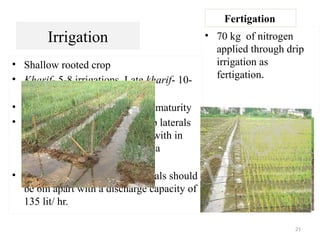
Irrigation
• Shallow rooted crop
• Kharif- 5-8 irrigations, Late kharif- 10-
12, Rabi-12-15.
• Stopped when the crop attains maturity
• Drip irrigation – BBF, two drip laterals
at a spacing of 60cm distance with in
built emitters. (30-50cm) with a
discharge flow rate - 4lit/hr
• Sprinkler irrigation – two laterals should
be 6m apart with a discharge capacity of
135 lit/ hr.
• 70 kg of nitrogen
applied through drip
irrigation as
fertigation.
Fertigation
22
Fertilizers
• Kharif: 75:40:40kg NPK
• Late kharif and rabi: 110:40:40kg NPK
• 15 t/ha- FYM
• 7.5t/ha- poultry manure
• 7.5t/ha- vermicompost
• sulphur is essential to improve pungency in onion- 40kg S/ha.
23
Mulching
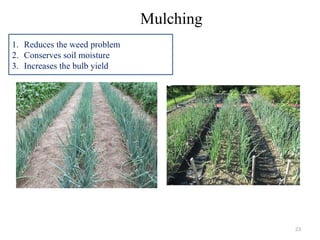
1. Reduces the weed problem
2. Conserves soil moisture
3. Increases the bulb yield
24
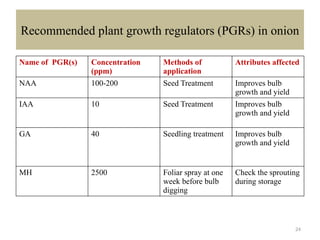
Recommended plant growth regulators (PGRs) in onion
Name of PGR(s) Concentration
(ppm)
Methods of
application
Attributes affected
NAA 100-200 Seed Treatment Improves bulb
growth and yield
IAA 10 Seed Treatment Improves bulb
growth and yield
GA 40 Seedling treatment Improves bulb
growth and yield
MH 2500 Foliar spray at one
week before bulb
digging
Check the sprouting
during storage
25
Cropping systems
• Legume followed by onion sequence is recommended for higher yield, better
utilization of nutrients and for improving soil health.
• Heavily manured crop – may not utilize all nutrients – so, next crop should be
of high nutrient obsorving capacity.
• Eg…. Onion > Fodder crops.
• Cropping sequence:
Soyabean in kharif season followed by onion in Rabi season is the best crop
rotation which improves soil fertility as well as monetary returns
INTERCROPPING
• Onion crop is best suited for intercrop with paired row planting of sugar cane
(Nov.-Dec. Planting) under drip irrigation system.
• Sugar cane(60 x 30cm), after every two rows of sugarcane, onion bed of 180
cm was prepared.
• Sugarcane-onion intercropping system with drip irrigation saves 25-30%
water
26
Harvesting of Rabi onion :
 30-50% neck fall
 Premature harvesting : thick
neck bulb (not store well)
 Late harvest : increase
respiration, susceptibility to
diseases
YIELD : 30-40 t/ha
Harvesting of kharif onion
 Pigments and size and shape taken as index
for kharif onion maturity: Colour of leaves
changes to slightly yellow and tops start
drying, red pigmentation on bulbs, true shape
and size of bulbs.
 Top fall induce mechanically 2/3 days prior to
harvest. After 3 days top of bulbs shld be
removed leaving 2-2.5cm stalk.
 Curing for 10-12 days.
 Premature harvesting: sprouting of bulbs
 Late harvest: doubles and bolting
 Bulbs mature in 90-110 days.
YIELD: 20-25 t/ha
Late kharif 30-35 t/ha
27
Curing
• Removal of excess moisture from the outer skin and neck
of onion which helps in reducing the infection of diseases.
• Prevents shrinkage
• Development of skin colour
• Bulbs are cured either in field or in open shade.
• Shade curing (10days) – detachment of soil, shedding of dried
roots. so, elimination of microbial infection
• Windrowing : In traditional small-scale operations, onion
drying is carried out in the field (1-2 weeks)
• Bulbs stored 10-14 days before storage.
28
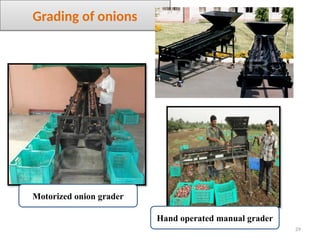
Grading
• The onion bulbs are classified into three grades based on bulb size i.e. A (>
80 mm), B (50-80 mm) and C (30-50 mm) grades.
• The grading with machine reduces labour charges and also increases
precision.
• The efficiency of manual operated grading machine is 5 times and the
efficiency is almost 20 times with motorized grading machine.
• The accuracy of grading of onion with grading machine is around 90% as
against 70% with manual grading.
29
Grading of onions
Motorized onion grader
Hand operated manual grader
30
Storage of onion bulbs
• The bulbs harvested from Rabi season have better storage life than Kharif
and late Kharif onion. The storage life of onion depends on various
parameters like season, variety, bulb dormancy, nutrient and irrigation
management, pest and disease incidence, pre-and post-harvest management
practices and storage environment.
• Field curing should be done before storage
31
• Bulbs need to be stored in 40-50 kg jute bags, gunny bags,
plastic netted bags or plastic and wooden baskets for better
storage.
• The optimum conditions for storage are 30-35˚C and 65-70%
relative humidity under ambient condition.
• Cold storage- 0°C + 65-70% relative humidity----6months
storage with only 5% losses…….>>>
• The use of gamma irradiation (cobalt 60) at 60 Gr. controls the
sprouting completely
32
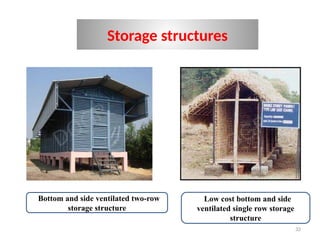
Storage structures
Bottom and side ventilated two-row
storage structure
Low cost bottom and side
ventilated single row storage
structure
33
Bulbs for dehydration should have the
following characters
• Globe shape with small neck
• Large bulbs
• Devoid of green patches – white onions preferred, over yellow
and red.
• TSS : 15-20 Brix
• Pungency should high
• Minimum shrinkage loss and rotting
34
Garlic- (Primarily used as a spice or condiment)
CLIMATE
• Exposure of young plants to
20°C or lower temperature for
1-2 months
• However, longer exposure to
low temperature may produce
bulbils in the axils of the leaves,
which reduce the bulb yield.
• The critical day length for
bulbing is 10-12 h for short day
garlic and 13-14 h for long day
garlic
SOILS
• Soils with high organic matter are
preferred, due to their increased
moisture and nutrient holding
capacity.
• In heavy soils, the bulbs produced
may be deformed. Bulbs become
discoloured in poorly drained soils.
• pH of 6-8 is desirable
• Like onion, garlic is sensitive to
highly acidic, alkali and saline
soils and water logging
conditions.
35
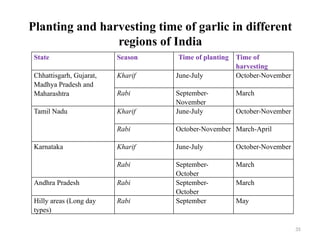
Planting and harvesting time of garlic in different
regions of India
State Season Time of planting Time of
harvesting
Chhattisgarh, Gujarat,
Madhya Pradesh and
Maharashtra
Kharif June-July October-November
Rabi September-
November
March
Tamil Nadu Kharif June-July October-November
Rabi October-November March-April
Karnataka Kharif June-July October-November
Rabi September-
October
March
Andhra Pradesh Rabi September-
October
March
Hilly areas (Long day
types)
Rabi September May
36
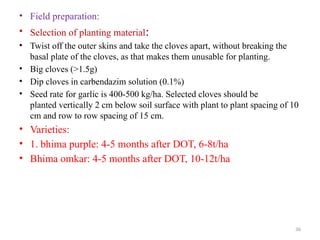
• Field preparation:
• Selection of planting material:
• Twist off the outer skins and take the cloves apart, without breaking the
basal plate of the cloves, as that makes them unusable for planting.
• Big cloves (>1.5g)
• Dip cloves in carbendazim solution (0.1%)
• Seed rate for garlic is 400-500 kg/ha. Selected cloves should be
planted vertically 2 cm below soil surface with plant to plant spacing of 10
cm and row to row spacing of 15 cm.
• Varieties:
• 1. bhima purple: 4-5 months after DOT, 6-8t/ha
• Bhima omkar: 4-5 months after DOT, 10-12t/ha
37
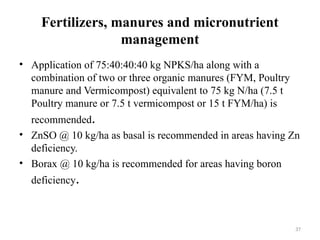
Fertilizers, manures and micronutrient
management
• Application of 75:40:40:40 kg NPKS/ha along with a
combination of two or three organic manures (FYM, Poultry
manure and Vermicompost) equivalent to 75 kg N/ha (7.5 t
Poultry manure or 7.5 t vermicompost or 15 t FYM/ha) is
recommended.
• ZnSO @ 10 kg/ha as basal is recommended in areas having Zn
deficiency.
• Borax @ 10 kg/ha is recommended for areas having boron
deficiency.
38
Irrigation
Garlic grown on flat bed
with flood irrigation
Garlic grown on raised bed with
drip irrigation
Garlic grown on flat bed with
sprinkler irrigation
39
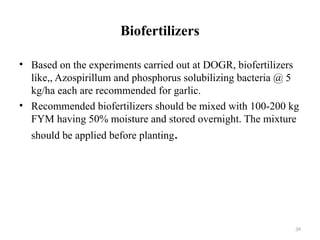
Biofertilizers
• Based on the experiments carried out at DOGR, biofertilizers
like,, Azospirillum and phosphorus solubilizing bacteria @ 5
kg/ha each are recommended for garlic.
• Recommended biofertilizers should be mixed with 100-200 kg
FYM having 50% moisture and stored overnight. The mixture
should be applied before planting.
40
Diseases
• Onion smut (Urocystis cepulae)
• Purple blotch (Alternaria porri)
• Stemphylum blight (Stemphylium vesicarium)
• Downy mildew (Perenospora destructor)
• Pink root of onion (Pyrenochjaeta terrestris)
• Black mould of onion (Aspergillus sp)
• Bulb rot (Fusarium oxysporum f.sp. cepae)
• White rot (Sclerotium cepivorum)
• Bacterial stalk rot of onion (Pseudomaonas gladioli pv. allicola)
• Soft rot of onion (Pseudomaonas marginalis pv. marginalis)
• Seedling blight of onion (Pseudomonas siccata)
• Onion yellow dwarf virus
41
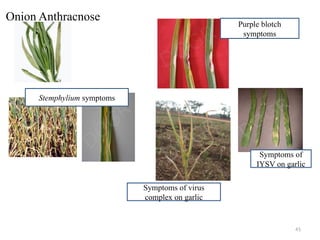
Onion Anthracnose
Stemphylium symptoms
Purple blotch
symptoms
Symptoms of virus
complex on garlic
Symptoms of
IYSV on garlic
42
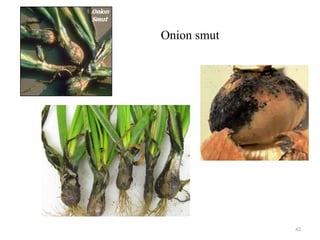
Onion smut
43
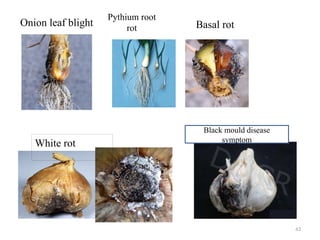
Pythium root
rot
Onion leaf blight Basal rot
White rot
Black mould disease
symptom
44
• Anthracnose, puple blotch and sclerotial rot- kharif season
• Stemphylium blight in rabi season.
• Dip seedlings in 0.1% carbendazim solution for two hours.
Foliar spray of mancozeb0.25% at 30 DOT and hexaconzole
(0.1%) and profenophos (1ml/lit) at 60 DOT, plant 2 rows of
maize.
• The spreader 0.5 to 1% should be always to added to spray
solution.
45
ONION PESTS
• Onion thrips
• Onion maggot
• Mites
• Borer
• Bloat or Nematode rot
46
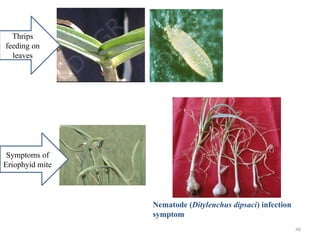
Thrips
feeding on
leaves
Symptoms of
Eriophyid mite
Nematode (Ditylenchus dipsaci) infection
symptom
47
Integrated pest and disease management
• Follow crop rotation by non host crops (corn and millets) and
clean cultivation by destroying plant debris of previous season.
• Use of drip irrigation over conventional irrigation to avoid disease
outbreaks.
• Provide good drainage through raised beds in Kharif to minimize
soil borne diseases
• Seed treatment with Thiram + Carbendazim (2:1) @ 3g/kg seed
or Trichoderma spp. @ 4-6 g/kg seed
• Multiply 2 kg of Trichoderma spp. in 1 quintal of FYM and apply
in one hectare.
• Dip the seedlings in 0.025% carbosulfan + 0.1% carbendazim
solution for 2h before transplanting in the main field
48
• Plant 2 rows of maize or outer row of maize and inner row of
wheat surrounding onion crop (250sq.m) at least 30 days
prior to transplanting to block adult thrips
• Foliar sprays of pesticides from 30 days after transplanting or
as soon as the pest/disease appears in the field
• Spray insecticides when thrips population crosses economic
threshold level (ETL) i.e. 30/plant
• Spray fungicides and pesticide in combination for effective
management of pest and diseases.
• Spray Schedule includes Mancozeb @ 0.25% with
Methomyl @ 0.8 g/l at 30 days after
transplanting, Tricyclazole @ 0.1% with Carbosulphan @ 2
ml/l at 45 days after transplanting, Hexaconazole @ 0.1%
with profenofos @ 1 ml/l at 60 days after transplanting
49
Hybrid seed production in onion
• Hand emasculation and pollination: not economical bcz
difficulty in emasculation, labour intensive, time consuming
• Discovery of cytoplasmic genic male sterility (CGMS) by
Jones and Clarke (1925), the phenomenon of heterosis
breeding in onion is being exploited
• Possible in long day as well as short day onions.
• Qualitative genes in onion cause male sterility.
• Male sterility in onion was first exploited by Jones and Clarke
using a male sterile genetic stock of cultivar ‘Italian Red’
found in breeding plots at Davis, California in 1925.
50
• How they identified in italian red:
Unfortunately grown in isolation. They produced
bulbils, but no pollination
51
CGMS interaction between cytoplasmic factor and nuclear
gene
Cytoplasmic factor:
• N- normal fertile cytoplasm
• S- sterile cytoplasm
Nuclear gene:
• Ms- for the normal fertile
• msms for the sterile form.
52
• Hence, genetic constitution of male sterile: S msms
• male fertile plants:
1. Nmsms,
2. N Msms,
3. N MsMs,
4. S Msms and
5. S MsMs
• Male sterility could only be maintained completely by crossing
it with fertile plant with N msms genetic
composition(maintainer line)
53
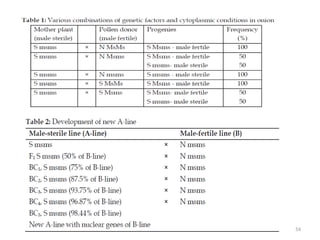
• The frequency of plants with sterile cytoplasm (S msms) in
population has been found to be very low, while there is 5%
chance to get N msms type of plants in a population (Pike
1986).
• Once a maintainer line has been identified in a locally adapted
inbred population, a new male-sterile line must be developed
by repeated backcrossing the male-sterile plants with the
desired N msms maintainer line. After 5 backcrosses, the
nuclear genotype of new male sterile line (A-line) would be
almost identical to that of the B-line
54
55
• A line is maintained by crosses with B line. Once a maintainer
line(B) is identified in local population, New A line is
produced by repeated backcrosses between A line (already
known male sterile) with B line. New A line is then having
sterile cytoplasm with all nuclear genes of B line
• B line is maintained by…..
• C /R line maintained by selfing (with using honeybees, sugar
solution).
• Then hear the question is we can develop these lines, but why
hybrids are not popular in onion..??
56
• Reasons:
1. Male sterile lines developed in India, but Male sterility is not
stable. (bcz of crossing).
2. Inbreds : difficult in production, not pure (inbreeding
depression).
3. Long breeding cycle (8months)
4. Less storage life of seed (viability is less than 1 year).
5. Very few seeds is possible in manual crossing. Which is
commercially not possible.
57
• At IARI, male sterility is isolated in a commercial variety,
pusa red.
• At IIHR (Arka Kirtiman and Arka Lalima)
58
• Production of hybrid seeds;
Hybrid seeds are produced in the open isolated field, where
pollination is carried out mainly by bees. The bulbs of male
sterile line (Aline) and pollen parent (C/R) are planted
alternatively in the ratio of 4:1 or 8:2.
Necessary Steps:
1. Synchronize flowering time, by storage of parental bulbs(9-
14C) or planting dates.
2. 3-5 bee colonies per acre
3. Uniform stalk emergence by GA3 50ppm
59
• Daily roguing in Aline
• Harvest seed separately
• Spray anti shattering chemicals like poly vinyl acetate
• Seed yield: 400-600kg/ha
60
• Jones and clarke, maintained their male sterile
lines vegetatively using bulbils produced in the
flower heads, bur these are difficult to store,
and accumulate viruses.
61
• Jones and clarke, maintained their male sterile lines vegetatively using
bulbils produced in the flower heads, bur these are difficult to store, and
accumulate viruses.
• And other method is……
• A line (Smsms) x B line (Nmsms)
Hybrid (Smsms) male sterile
62
Thank you for listening

Advances in onion production technology.pptx

  • 1.
  • 2.
    2 Advances in Onionand Garlic production technology COURSE TITLE : ADVANCES IN VEGETABLE PRODUCTION COURSE NO. : VSC 601 (2+1)
  • 3.
    3 Onion :Allium cepaGarlic : Allium sativus • Family :Liliaceae> Amaryllidaceae>Alliaceae • Chromosome No. : 2n= 2x= 16 • Origin : Central asia. • Long day plant • Modified stem known as Bulb.
  • 4.
    4 Nutritive value: • Pungencyand flavour- Allyl propyl disulphide • Antioxidant – quercetin (flavonoid) • Phytochemicals – disulfides, trisulphides, cepaene and vinyldithins – prevents cancer, heart diseases and digestive diseases. • Raw onion has a antiseptic value throughout the alimentary canal. • Improves bone density in women • Sulphur …..reduces blood sugar content • Onion very useful to prevent sunstroke in summer.
  • 5.
    5 Soil requirements • Successfulonion cultivation : deep, loamy with good drainage, moisture holding capacity and sufficient organic matter. • pH- 6.0-7.5. • Heavy soils • More sensitive to highly acidic, alkali and saline soils and water logging condition.
  • 6.
    6 Climate • Vegetative growth– Low temperature (13-24°C) + Short days • Bulb growth – High temperature (16-25°C) + Long days • In India mainly short day (10-12 hours) onions grown in plains. In hills long day (13-14 hours) onions are grown. 1. Temperature 2. Day length 3. Relative Humidity 4. Rain fall
  • 7.
    7 Selection of correctvariety: • The Selection of correct variety is most important. An ideal kharif variety should have early bulking, high photosynthetic efficiency, thin neck and resistance to diseases and tolerant water stagnation. • It is very difficult to get a perfect variety but a variety have 90 to 105 days maturity period with thin neck may be selected for kharif season. • The trial found that N-53, Baswant – 780, Agrifound Dark Red, Arka Kalyan perform good for Kharif onion. • Kharif : bhima dark red, bhima super, bhima raj, bhima red, bhima shubhra, bhima safed. • Late kharif: bhima super, bhima raj, bhima red, bhima shubhra, bhima safed.
  • 8.
    8 Varieties suitable forRabi • Bhima shakti, bhima kiran, bhima light red- good for storage.
  • 9.
    9 Sowing, transplanting andharvesting timings of onion in India Season Time of seed sowing Time of transplanting Time of harvesting Productivity Early Kharif Feb- April April-June July-Sept 20% Kharif May- June July-Aug. Out.- Nov. 20% Rabi Sept- Oct Nov-Dec. Mar.- April. 60%
  • 10.
    10 The production andproductivity of kharif onion is very low compared to other seasons The main reasons of low productivity of kharif onions are  Unavailability of right type of seed in time  Shortage of water for production nursery in summer  High seedling mortality due to scorching heat in May  Ineffective drainage, water satganation  Severe weed problem  Heavy incidence of diseases during rainy seasons  Less efficacy of prophylactic sprays in controlling diseases due to constant drizzling  Problems in curing and drying of onions after harvest  Poor crop stand in direct seed sown crop
  • 11.
    11 Nursery Raising • 500sq.mt area – For raising 1 hectare. • Ploughed (5-6 times) + 500 kg, FYM • Raised bed/ Flat beds… • Seed rate – 5-7 Kg • Seed treatment – Thiram @2g/kg seed. Trichoderma viridae @ 500g/500 sq.mt or 4-6g/kg of seed • Pre emergence herbicides – Pendimethalin @ 0.2%  40-45 days- Kharif season and late Kharif  50-55 days – Rabi seasons  Irrigation- Drip/ sprinklers- save 40- 50 % water  Partial shade net  Stable mulch until seed germination  If poor growth- apply 5g/lit 19:19:19
  • 12.
    12 2) If waterdeficit at vegetative stage: • Raise crop on raised beds with drip irrigation. • Harvest rain water by making storage ponds which will help to provide two to three life saving irrigations. • Spray anti-transparent Kaolinite @ 5% • Foliar application of sulphur 85% WP @ 1.5-2.0 g/liter for quick recovery during active vegetative growth stage. • Foliar application of micronutrient mixture containing Zn, Mn, Fe, Cu, B at 30, 45 and 60 DAT for better crop stand (5 ml/l). 3) If Drought in final stage • One irrigation is sufficient at 85 days after transplanting. That may be provided by drip irrigation using harvested rain water. 1) If Monsoon delayed 30-40 days • Direct sowing (8-9kg seeds) • Use sets – give crop 45 days earlier than seedlings crop • Use early maturing varieties
  • 13.
    13 Treatments % transplantableseedlings Surface Irrigation Drip Irrigation Average No shading 20.4 33.5 37.2 Shading with 50% Agro- shade net 50.7 63.3 57.0 Shading with 75% Agro- shade net 52.0 61.0 56.5 Shading with Hessian cloth 53.1 63.3 58.2 Shading with white nylon net 40.9 44.5 42.7 Mulching 32.7 34.2 33.4 Effect of shading and irrigation on % transplantable seedlings in onion
  • 14.
    14 Land preparation formain field Flat bed method Broad bed furrow method with drip irrigation 1. Ploughed, FYM- 20-25 t/ha, fertilizers (120 kg N, 50 kg P, 160 kg K) 2. Levelling 3. Beds – Flat beds / Broad bed furrow method 4. Broad bed method (Kharif season) - 15 cm height and 120 cm top width with 45 cm furrow GOOD
  • 15.
    15 • Two inlinedrip laterals on each bed. Distance between two laterals is 60cm. Distance between two emitters is 30-50cm. Discharge from each dripper is 4lit/hour.
  • 16.
    16 Drainage channel toremove excess water
  • 17.
    17 Selection of seedlingsfor transplanting over/ under sized seedlings  Seedlings tops should be cut for better establishment. Dipping of roots in Carbendizam@0.1% for two hours. Optimum spacing in field: 15 x 10 cm
  • 18.
    18 Methods of planting Dependingupon soil, topography, climatic conditions and economic aspects……… 1. Raising seedlings and transplanting 2. Planting bulbs directly in the field 3. Broad casting or drilling of seeds directly in the field.
  • 19.
    19 Transplanting method Plantingof bulbs Broad casting or drilling method  Most common for irrigated crop  Seed rate – 8-10 kg /ha  Nursery : 120cm width, 10 cm height and convenient length  15c m height, 0.8 cm neck diameter (8 weeks)  Spacing : 10 x 15 cm.  Hill slope / terrace  Medium sized bulbs from June crop are used to plant sep-oct season  45 cm wide ridges, plant bulbs at 25 cm apart on both side a ridge  Seed rate – 10-12 q/ha  To save labour charges  Seed rate : 25 kg/ha  Care – weeds at initial stages  6-8 weeks after- go for transplanting
  • 20.
    20 Weed competition isvery high in onion compared to all other crops  30-40% losses.  Slow growth at initial stages  Short stature, non-branching, sparse foliage and shallow root system.  Application of Oxyflurofen @ 23.5% EC (1.5 -2.0 ml/L)/ Pendimethalin @ 30% EC (3.5-4ml/L) before transplanting or at the time of transplanting followed by one hand weeding at 40-60 days after transplanting is recommended for efficient weed control.
  • 21.
    21 Irrigation • Shallow rootedcrop • Kharif- 5-8 irrigations, Late kharif- 10- 12, Rabi-12-15. • Stopped when the crop attains maturity • Drip irrigation – BBF, two drip laterals at a spacing of 60cm distance with in built emitters. (30-50cm) with a discharge flow rate - 4lit/hr • Sprinkler irrigation – two laterals should be 6m apart with a discharge capacity of 135 lit/ hr. • 70 kg of nitrogen applied through drip irrigation as fertigation. Fertigation
  • 22.
    22 Fertilizers • Kharif: 75:40:40kgNPK • Late kharif and rabi: 110:40:40kg NPK • 15 t/ha- FYM • 7.5t/ha- poultry manure • 7.5t/ha- vermicompost • sulphur is essential to improve pungency in onion- 40kg S/ha.
  • 23.
    23 Mulching 1. Reduces theweed problem 2. Conserves soil moisture 3. Increases the bulb yield
  • 24.
    24 Recommended plant growthregulators (PGRs) in onion Name of PGR(s) Concentration (ppm) Methods of application Attributes affected NAA 100-200 Seed Treatment Improves bulb growth and yield IAA 10 Seed Treatment Improves bulb growth and yield GA 40 Seedling treatment Improves bulb growth and yield MH 2500 Foliar spray at one week before bulb digging Check the sprouting during storage
  • 25.
    25 Cropping systems • Legumefollowed by onion sequence is recommended for higher yield, better utilization of nutrients and for improving soil health. • Heavily manured crop – may not utilize all nutrients – so, next crop should be of high nutrient obsorving capacity. • Eg…. Onion > Fodder crops. • Cropping sequence: Soyabean in kharif season followed by onion in Rabi season is the best crop rotation which improves soil fertility as well as monetary returns INTERCROPPING • Onion crop is best suited for intercrop with paired row planting of sugar cane (Nov.-Dec. Planting) under drip irrigation system. • Sugar cane(60 x 30cm), after every two rows of sugarcane, onion bed of 180 cm was prepared. • Sugarcane-onion intercropping system with drip irrigation saves 25-30% water
  • 26.
    26 Harvesting of Rabionion :  30-50% neck fall  Premature harvesting : thick neck bulb (not store well)  Late harvest : increase respiration, susceptibility to diseases YIELD : 30-40 t/ha Harvesting of kharif onion  Pigments and size and shape taken as index for kharif onion maturity: Colour of leaves changes to slightly yellow and tops start drying, red pigmentation on bulbs, true shape and size of bulbs.  Top fall induce mechanically 2/3 days prior to harvest. After 3 days top of bulbs shld be removed leaving 2-2.5cm stalk.  Curing for 10-12 days.  Premature harvesting: sprouting of bulbs  Late harvest: doubles and bolting  Bulbs mature in 90-110 days. YIELD: 20-25 t/ha Late kharif 30-35 t/ha
  • 27.
    27 Curing • Removal ofexcess moisture from the outer skin and neck of onion which helps in reducing the infection of diseases. • Prevents shrinkage • Development of skin colour • Bulbs are cured either in field or in open shade. • Shade curing (10days) – detachment of soil, shedding of dried roots. so, elimination of microbial infection • Windrowing : In traditional small-scale operations, onion drying is carried out in the field (1-2 weeks) • Bulbs stored 10-14 days before storage.
  • 28.
    28 Grading • The onionbulbs are classified into three grades based on bulb size i.e. A (> 80 mm), B (50-80 mm) and C (30-50 mm) grades. • The grading with machine reduces labour charges and also increases precision. • The efficiency of manual operated grading machine is 5 times and the efficiency is almost 20 times with motorized grading machine. • The accuracy of grading of onion with grading machine is around 90% as against 70% with manual grading.
  • 29.
    29 Grading of onions Motorizedonion grader Hand operated manual grader
  • 30.
    30 Storage of onionbulbs • The bulbs harvested from Rabi season have better storage life than Kharif and late Kharif onion. The storage life of onion depends on various parameters like season, variety, bulb dormancy, nutrient and irrigation management, pest and disease incidence, pre-and post-harvest management practices and storage environment. • Field curing should be done before storage
  • 31.
    31 • Bulbs needto be stored in 40-50 kg jute bags, gunny bags, plastic netted bags or plastic and wooden baskets for better storage. • The optimum conditions for storage are 30-35˚C and 65-70% relative humidity under ambient condition. • Cold storage- 0°C + 65-70% relative humidity----6months storage with only 5% losses…….>>> • The use of gamma irradiation (cobalt 60) at 60 Gr. controls the sprouting completely
  • 32.
    32 Storage structures Bottom andside ventilated two-row storage structure Low cost bottom and side ventilated single row storage structure
  • 33.
    33 Bulbs for dehydrationshould have the following characters • Globe shape with small neck • Large bulbs • Devoid of green patches – white onions preferred, over yellow and red. • TSS : 15-20 Brix • Pungency should high • Minimum shrinkage loss and rotting
  • 34.
    34 Garlic- (Primarily usedas a spice or condiment) CLIMATE • Exposure of young plants to 20°C or lower temperature for 1-2 months • However, longer exposure to low temperature may produce bulbils in the axils of the leaves, which reduce the bulb yield. • The critical day length for bulbing is 10-12 h for short day garlic and 13-14 h for long day garlic SOILS • Soils with high organic matter are preferred, due to their increased moisture and nutrient holding capacity. • In heavy soils, the bulbs produced may be deformed. Bulbs become discoloured in poorly drained soils. • pH of 6-8 is desirable • Like onion, garlic is sensitive to highly acidic, alkali and saline soils and water logging conditions.
  • 35.
    35 Planting and harvestingtime of garlic in different regions of India State Season Time of planting Time of harvesting Chhattisgarh, Gujarat, Madhya Pradesh and Maharashtra Kharif June-July October-November Rabi September- November March Tamil Nadu Kharif June-July October-November Rabi October-November March-April Karnataka Kharif June-July October-November Rabi September- October March Andhra Pradesh Rabi September- October March Hilly areas (Long day types) Rabi September May
  • 36.
    36 • Field preparation: •Selection of planting material: • Twist off the outer skins and take the cloves apart, without breaking the basal plate of the cloves, as that makes them unusable for planting. • Big cloves (>1.5g) • Dip cloves in carbendazim solution (0.1%) • Seed rate for garlic is 400-500 kg/ha. Selected cloves should be planted vertically 2 cm below soil surface with plant to plant spacing of 10 cm and row to row spacing of 15 cm. • Varieties: • 1. bhima purple: 4-5 months after DOT, 6-8t/ha • Bhima omkar: 4-5 months after DOT, 10-12t/ha
  • 37.
    37 Fertilizers, manures andmicronutrient management • Application of 75:40:40:40 kg NPKS/ha along with a combination of two or three organic manures (FYM, Poultry manure and Vermicompost) equivalent to 75 kg N/ha (7.5 t Poultry manure or 7.5 t vermicompost or 15 t FYM/ha) is recommended. • ZnSO @ 10 kg/ha as basal is recommended in areas having Zn deficiency. • Borax @ 10 kg/ha is recommended for areas having boron deficiency.
  • 38.
    38 Irrigation Garlic grown onflat bed with flood irrigation Garlic grown on raised bed with drip irrigation Garlic grown on flat bed with sprinkler irrigation
  • 39.
    39 Biofertilizers • Based onthe experiments carried out at DOGR, biofertilizers like,, Azospirillum and phosphorus solubilizing bacteria @ 5 kg/ha each are recommended for garlic. • Recommended biofertilizers should be mixed with 100-200 kg FYM having 50% moisture and stored overnight. The mixture should be applied before planting.
  • 40.
    40 Diseases • Onion smut(Urocystis cepulae) • Purple blotch (Alternaria porri) • Stemphylum blight (Stemphylium vesicarium) • Downy mildew (Perenospora destructor) • Pink root of onion (Pyrenochjaeta terrestris) • Black mould of onion (Aspergillus sp) • Bulb rot (Fusarium oxysporum f.sp. cepae) • White rot (Sclerotium cepivorum) • Bacterial stalk rot of onion (Pseudomaonas gladioli pv. allicola) • Soft rot of onion (Pseudomaonas marginalis pv. marginalis) • Seedling blight of onion (Pseudomonas siccata) • Onion yellow dwarf virus
  • 41.
    41 Onion Anthracnose Stemphylium symptoms Purpleblotch symptoms Symptoms of virus complex on garlic Symptoms of IYSV on garlic
  • 42.
  • 43.
    43 Pythium root rot Onion leafblight Basal rot White rot Black mould disease symptom
  • 44.
    44 • Anthracnose, pupleblotch and sclerotial rot- kharif season • Stemphylium blight in rabi season. • Dip seedlings in 0.1% carbendazim solution for two hours. Foliar spray of mancozeb0.25% at 30 DOT and hexaconzole (0.1%) and profenophos (1ml/lit) at 60 DOT, plant 2 rows of maize. • The spreader 0.5 to 1% should be always to added to spray solution.
  • 45.
    45 ONION PESTS • Onionthrips • Onion maggot • Mites • Borer • Bloat or Nematode rot
  • 46.
    46 Thrips feeding on leaves Symptoms of Eriophyidmite Nematode (Ditylenchus dipsaci) infection symptom
  • 47.
    47 Integrated pest anddisease management • Follow crop rotation by non host crops (corn and millets) and clean cultivation by destroying plant debris of previous season. • Use of drip irrigation over conventional irrigation to avoid disease outbreaks. • Provide good drainage through raised beds in Kharif to minimize soil borne diseases • Seed treatment with Thiram + Carbendazim (2:1) @ 3g/kg seed or Trichoderma spp. @ 4-6 g/kg seed • Multiply 2 kg of Trichoderma spp. in 1 quintal of FYM and apply in one hectare. • Dip the seedlings in 0.025% carbosulfan + 0.1% carbendazim solution for 2h before transplanting in the main field
  • 48.
    48 • Plant 2rows of maize or outer row of maize and inner row of wheat surrounding onion crop (250sq.m) at least 30 days prior to transplanting to block adult thrips • Foliar sprays of pesticides from 30 days after transplanting or as soon as the pest/disease appears in the field • Spray insecticides when thrips population crosses economic threshold level (ETL) i.e. 30/plant • Spray fungicides and pesticide in combination for effective management of pest and diseases. • Spray Schedule includes Mancozeb @ 0.25% with Methomyl @ 0.8 g/l at 30 days after transplanting, Tricyclazole @ 0.1% with Carbosulphan @ 2 ml/l at 45 days after transplanting, Hexaconazole @ 0.1% with profenofos @ 1 ml/l at 60 days after transplanting
  • 49.
    49 Hybrid seed productionin onion • Hand emasculation and pollination: not economical bcz difficulty in emasculation, labour intensive, time consuming • Discovery of cytoplasmic genic male sterility (CGMS) by Jones and Clarke (1925), the phenomenon of heterosis breeding in onion is being exploited • Possible in long day as well as short day onions. • Qualitative genes in onion cause male sterility. • Male sterility in onion was first exploited by Jones and Clarke using a male sterile genetic stock of cultivar ‘Italian Red’ found in breeding plots at Davis, California in 1925.
  • 50.
    50 • How theyidentified in italian red: Unfortunately grown in isolation. They produced bulbils, but no pollination
  • 51.
    51 CGMS interaction betweencytoplasmic factor and nuclear gene Cytoplasmic factor: • N- normal fertile cytoplasm • S- sterile cytoplasm Nuclear gene: • Ms- for the normal fertile • msms for the sterile form.
  • 52.
    52 • Hence, geneticconstitution of male sterile: S msms • male fertile plants: 1. Nmsms, 2. N Msms, 3. N MsMs, 4. S Msms and 5. S MsMs • Male sterility could only be maintained completely by crossing it with fertile plant with N msms genetic composition(maintainer line)
  • 53.
    53 • The frequencyof plants with sterile cytoplasm (S msms) in population has been found to be very low, while there is 5% chance to get N msms type of plants in a population (Pike 1986). • Once a maintainer line has been identified in a locally adapted inbred population, a new male-sterile line must be developed by repeated backcrossing the male-sterile plants with the desired N msms maintainer line. After 5 backcrosses, the nuclear genotype of new male sterile line (A-line) would be almost identical to that of the B-line
  • 54.
  • 55.
    55 • A lineis maintained by crosses with B line. Once a maintainer line(B) is identified in local population, New A line is produced by repeated backcrosses between A line (already known male sterile) with B line. New A line is then having sterile cytoplasm with all nuclear genes of B line • B line is maintained by….. • C /R line maintained by selfing (with using honeybees, sugar solution). • Then hear the question is we can develop these lines, but why hybrids are not popular in onion..??
  • 56.
    56 • Reasons: 1. Malesterile lines developed in India, but Male sterility is not stable. (bcz of crossing). 2. Inbreds : difficult in production, not pure (inbreeding depression). 3. Long breeding cycle (8months) 4. Less storage life of seed (viability is less than 1 year). 5. Very few seeds is possible in manual crossing. Which is commercially not possible.
  • 57.
    57 • At IARI,male sterility is isolated in a commercial variety, pusa red. • At IIHR (Arka Kirtiman and Arka Lalima)
  • 58.
    58 • Production ofhybrid seeds; Hybrid seeds are produced in the open isolated field, where pollination is carried out mainly by bees. The bulbs of male sterile line (Aline) and pollen parent (C/R) are planted alternatively in the ratio of 4:1 or 8:2. Necessary Steps: 1. Synchronize flowering time, by storage of parental bulbs(9- 14C) or planting dates. 2. 3-5 bee colonies per acre 3. Uniform stalk emergence by GA3 50ppm
  • 59.
    59 • Daily roguingin Aline • Harvest seed separately • Spray anti shattering chemicals like poly vinyl acetate • Seed yield: 400-600kg/ha
  • 60.
    60 • Jones andclarke, maintained their male sterile lines vegetatively using bulbils produced in the flower heads, bur these are difficult to store, and accumulate viruses.
  • 61.
    61 • Jones andclarke, maintained their male sterile lines vegetatively using bulbils produced in the flower heads, bur these are difficult to store, and accumulate viruses. • And other method is…… • A line (Smsms) x B line (Nmsms) Hybrid (Smsms) male sterile

  • 62.