Improving Collaborative Filtering Recommendation
via
Graph Learning
• A Deep Dive into Graph Learning
• Paper by Yongyu Wang, JD Logistics
• https://arxiv.org/abs/2311.03316
Neeharika Singh
Introduction
• Recommendation systems in e-commerce.
• Predicts preferences using historical data.
• Navigates vast product selections efficiently.
• Importance of personalized user experience.
• Enhances customer satisfaction
• Purchase decision
• Role of Collaborative Filtering (CF) in recommendations.
• Predicts based on user similarities.
• Enhances accuracy through shared preferences.
Understanding Collaborative Filtering
• Basic principle: Users with similar past preferences likely have similar future preferences.
• CF can be classified in two categories
• User Based CF
• Item Based DF
• Traditional method
• k-nearest neighbor (k-NN) graph approach.
Limitations of Traditional k-NN in CF
• Fixed-Size Neighborhood
• Limits considering a broader pattern in data.
• Local Relationships
• Focuses mainly on local preferences, missing global context.
Graph Learning in Collaborative Filtering
• Innovative integration of Graph Learning into CF.
• Aims to enhance recommendation accuracy and efficiency.
• Addresses limitations of traditional k-NN approach.
Graph Learning in Collaborative Filtering
• Graph Learning Concept
• Users and items as graph nodes, with edges symbolizing their interactions.
• Graphs' Role in CF
• Provide intricate visualization and understanding of complex user-item relationships.
• Learning Graph Dynamics
• Involves sophisticated data-driven optimization to define meaningful connections.
Enhancing Graph Construction in Collaborative Filtering
• Initial Base Graph Construction
• Start with a simple k-NN graph using a minimal 'k' (e.g., k = 2) to limit redundant connections.
• Graph Learning Optimization
• Employ an optimization model to refine the graph, ensuring smooth signals and controlled sparsity.
• Topology-Based Prediction Method
• Use the refined graph for prediction in user-based and item-based CF, focusing on weighted sums from
connected nodes or items.
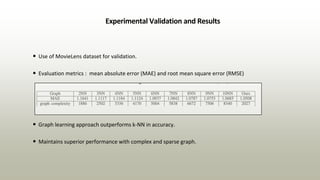
Experimental Validation and Results
• Use of MovieLens dataset for validation.
• Evaluation metrics : mean absolute error (MAE) and root mean square error (RMSE)
• Graph learning approach outperforms k-NN in accuracy.
• Maintains superior performance with complex and sparse graph.
Conclusion
• Impact on online shopping experience.
• Significance in the field of machine learning and AI.
• Future potential of graph learning in e-commerce.

Advanced_Recommendation_Systems_Presentation.pptx

  • 1.
    Improving Collaborative FilteringRecommendation via Graph Learning • A Deep Dive into Graph Learning • Paper by Yongyu Wang, JD Logistics • https://arxiv.org/abs/2311.03316 Neeharika Singh
  • 2.
    Introduction • Recommendation systemsin e-commerce. • Predicts preferences using historical data. • Navigates vast product selections efficiently. • Importance of personalized user experience. • Enhances customer satisfaction • Purchase decision • Role of Collaborative Filtering (CF) in recommendations. • Predicts based on user similarities. • Enhances accuracy through shared preferences.
  • 3.
    Understanding Collaborative Filtering •Basic principle: Users with similar past preferences likely have similar future preferences. • CF can be classified in two categories • User Based CF • Item Based DF • Traditional method • k-nearest neighbor (k-NN) graph approach.
  • 4.
    Limitations of Traditionalk-NN in CF • Fixed-Size Neighborhood • Limits considering a broader pattern in data. • Local Relationships • Focuses mainly on local preferences, missing global context.
  • 5.
    Graph Learning inCollaborative Filtering • Innovative integration of Graph Learning into CF. • Aims to enhance recommendation accuracy and efficiency. • Addresses limitations of traditional k-NN approach.
  • 6.
    Graph Learning inCollaborative Filtering • Graph Learning Concept • Users and items as graph nodes, with edges symbolizing their interactions. • Graphs' Role in CF • Provide intricate visualization and understanding of complex user-item relationships. • Learning Graph Dynamics • Involves sophisticated data-driven optimization to define meaningful connections.
  • 7.
    Enhancing Graph Constructionin Collaborative Filtering • Initial Base Graph Construction • Start with a simple k-NN graph using a minimal 'k' (e.g., k = 2) to limit redundant connections. • Graph Learning Optimization • Employ an optimization model to refine the graph, ensuring smooth signals and controlled sparsity. • Topology-Based Prediction Method • Use the refined graph for prediction in user-based and item-based CF, focusing on weighted sums from connected nodes or items.
  • 8.
    Experimental Validation andResults • Use of MovieLens dataset for validation. • Evaluation metrics : mean absolute error (MAE) and root mean square error (RMSE) • Graph learning approach outperforms k-NN in accuracy. • Maintains superior performance with complex and sparse graph.
  • 9.
    Conclusion • Impact ononline shopping experience. • Significance in the field of machine learning and AI. • Future potential of graph learning in e-commerce.