Advanced Injectors Lecture BACD Regional Meeting London June 2008
MEDICAL DISCLOSURE: Dr. Patrick J. Treacy is a Cosmetic Doctor presently on the Specialist Register in Ireland He holds a Dip Cos. Med Dip Dermatology, U.K. BTEC Laser Technology Previously worked in the U. K. U.S. Australia,  New Zealand, South Africa. No financial interest or stock in Bioform nor do I  receive any additional remuneration for giving this Advanced Training lecture.
1. Radiesse XL 2. Hand Volumisation
Product Information Injection Techniques What is Beauty? The Aging Face  Upper and Mid Face Lower Face 7. HIV Lipodystrophy  Presentation Content
Key Characteristics Safe Bio-compatible Bio-degradable Effect 18-24 months No migration No pre-testing No special handling
CaHA Injectable Implant Key Components Structural component ( ~30%) calcium and phosphate ions  (Ca10(PO4)6(OH)2) natural mineral  (identical to human teeth & bone) Gel carrier ( ~70%) sodium carboxymethylcellulose glycerine sterile water Biocompatible and ‘GRAS’ G enerally  R ecognized  A s  S afe by FDA
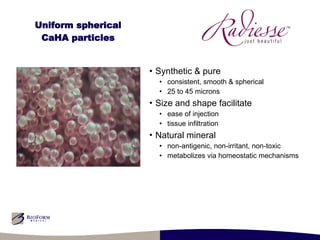
Uniform spherical CaHA particles Synthetic & pure consistent, smooth & spherical 25 to 45 microns Size and shape facilitate   ease of injection  tissue infiltration Natural mineral   non-antigenic, non-irritant, non-toxic metabolizes via homeostatic mechanisms
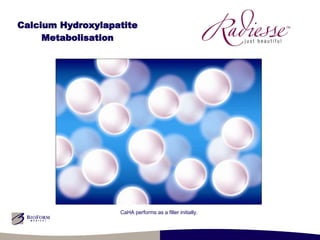
Calcium Hydroxylapatite Metabolisation CaHA performs as a filler initially.
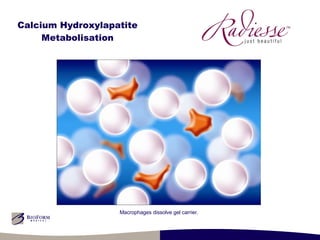
Calcium Hydroxylapatite Metabolisation Macrophages dissolve gel carrier.
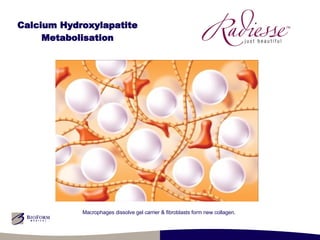
Calcium Hydroxylapatite Metabolisation Macrophages dissolve gel carrier & fibroblasts form new collagen.
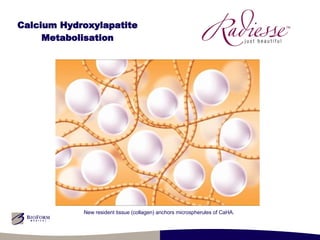
Calcium Hydroxylapatite Metabolisation New resident tissue (collagen) anchors microspherules of CaHA.
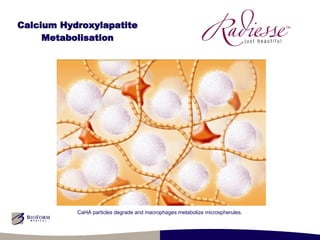
Calcium Hydroxylapatite Metabolisation CaHA particles degrade and macrophages metabolize microspherules.
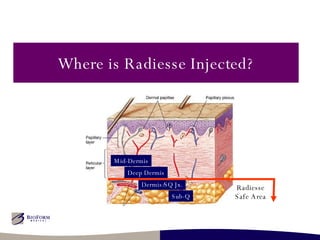
Where is Radiesse Injected? Mid-Dermis Deep Dermis Dermis/SQ Jx. Sub-Q Radiesse Safe Area
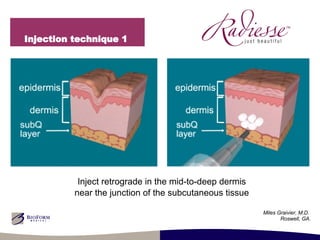
Injection technique 1  Inject retrograde in the mid-to-deep dermis near the junction of the subcutaneous tissue Miles Graivier, M.D.  Roswell, GA.
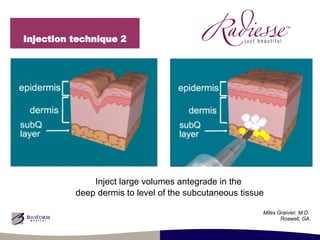
Injection technique 2 Inject large volumes antegrade in the  deep dermis to level of the subcutaneous tissue Miles Graivier, M.D.  Roswell, GA.
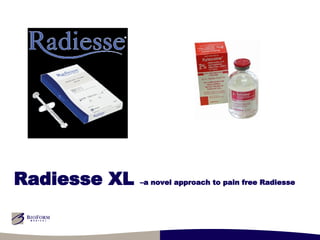
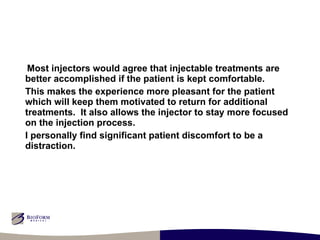
Radiesse XL  –a novel approach to pain free Radiesse
Most injectors would agree that injectable treatments are better accomplished if the patient is kept comfortable. This makes the experience more pleasant for the patient which will keep them motivated to return for additional treatments.  It also allows the injector to stay more focused on the injection process. I personally find significant patient discomfort to be a distraction.
Traditional Anesthesia for Radiesse Most practitioners have typically utilized some form of local anesthesia: Topical Infraorbital, mental, supratrochlear, or supraorbital nerve blocks Local infiltration Depending upon the physician’s preference, usually 1% to 2% lidocaine with or without adrenaline is used.
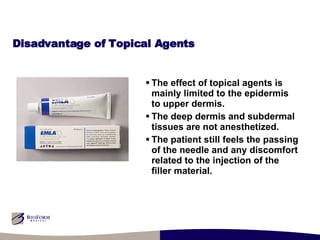
Disadvantage of Topical Agents The effect of topical agents is mainly limited to the epidermis to upper dermis. The deep dermis and subdermal tissues are not anesthetized. The patient still feels the passing of the needle and any discomfort related to the injection of the filler material.
Disadvantages of nerve blocks  May be quite uncomfortable. May cause additional bruising.  Depending upon the treatment site, the nerve block may distort the area to be injected (e.g. the cheek and tear trough with an infraorbital nerve block). Require some knowledge of the location of key facial foramina to be successful.  Therefore, the efficacy of the block may be dependent on the expertise of the injector.
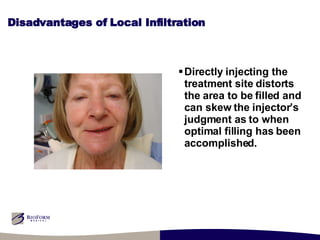
Disadvantages of Local Infiltration Directly injecting the treatment site distorts the area to be filled and can skew the injector’s judgment as to when optimal filling has been accomplished.
Mixing Lidocaine with Radiesse Anesthetizes the treatment site as the injection process progresses. In most cases, the mixing of lidocaine with Radiesse obviates the need for nerve blocks or local infiltration. Most patients prefer injecting the mixed product to having nerve blocks. Some patients still will require or desire nerve blocks (sensitive patient, lip injections, etc.) The needle entry point (at least on the face) should still be anesthetized with a topical or local anaesthetic.
Mixing Lidocaine with Radiesse Eliminates distortion of the treatment site from the local anesthetic. I find that most of my midface injections can be done just with a topical anesthetic on the oral mucosa. I now mix lidocaine with Radiesse for basically all of my injections. Eliminates the immediately post injection ”burning” that some patients used to complain of.
Radiesse Mixing with Lidocaine Why mix Radiesse with lidocaine? Provide a less-painful alternative by eliminating the pain of a block and reducing discomfort for areas that are not easily blocked Prevent tissue distortion that may be caused by injecting local anesthetics Adjust the cohesiveness of Radiesse to use it as a layering rather than a bulking filler
Mixing Lidocaine with Radiesse 0.15- 0.2 cc of 1 - 2% lidocaine with or without epinephrine is placed into an empty Radiesse 1.3cc syringe (A). Syringe A is connected to a 1.3 cc syringe (B) of Radiesse using a 3 Way tap (or Luer lock to Luer lock connector). The Radiesse contents are injected into syringe A and the mixture is then “swished” back and forth several times. 10 back and forth “swishes” are needed to obtain a homogeneous product. The mixture of Radiesse and lidocaine is then advanced back into the 1.3 cc syringe.
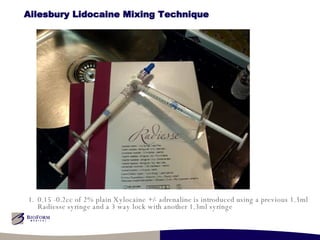
Ailesbury Lidocaine Mixing Technique 0.15 -0.2cc of 2% plain Xylocaine +/- adrenaline is introduced using a previous 1.3ml Radiesse syringe and a 3 way lock with another 1.3ml syringe
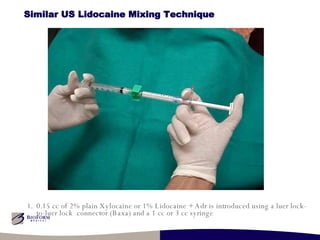
Similar US Lidocaine Mixing Technique 0.15 cc of 2% plain Xylocaine or 1% Lidocaine + Adr is introduced using a luer lock-to-luer lock  connector (Baxa) and a 1 cc or 3 cc syringe
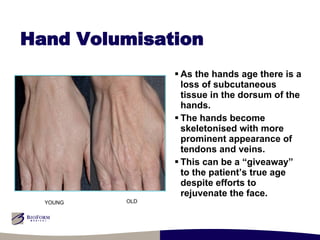
Hand Volumisation As the hands age there is a loss of subcutaneous tissue in the dorsum of the hands. The hands become skeletonised with more prominent appearance of tendons and veins. This can be a “giveaway” to the patient’s true age despite efforts to rejuvenate the face. YOUNG OLD
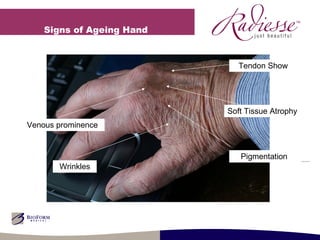
Signs of Ageing Hand  Soft Tissue Atrophy Pigmentation  Venous prominence Tendon Show  Wrinkles
Radiesse for Hand Volumisation Radiesse probably represents the best filler we currently have available for the dorsum of the hands. Simpler, less invasive, and more natural results than fat transfer. 5 – 10 minute procedure with no anesthesia needed other than mixing lidocaine (without adrenaline). Bolus injection into the subdermal areolar space. Massage Radiesse to distribute it evenly. Total Volume – 1.3 to 1.95 cc per hand
Presentation Content
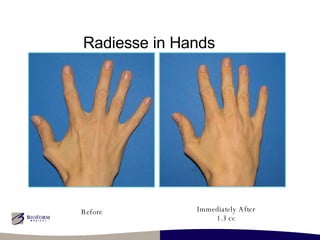
Radiesse in Hands Before Immediately After 1.3 cc
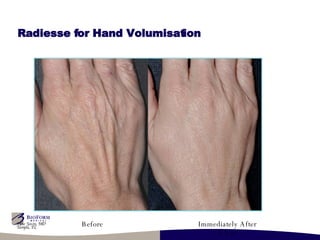
Radiesse for Hand Volumisation Before Immediately After 1.3 cc Mike Jasin, MD  Tampa, FL
Presentation Content

Advanced Radiesse Hand Lecture Final

  • 1.
    Advanced Injectors LectureBACD Regional Meeting London June 2008
  • 2.
    MEDICAL DISCLOSURE: Dr.Patrick J. Treacy is a Cosmetic Doctor presently on the Specialist Register in Ireland He holds a Dip Cos. Med Dip Dermatology, U.K. BTEC Laser Technology Previously worked in the U. K. U.S. Australia, New Zealand, South Africa. No financial interest or stock in Bioform nor do I receive any additional remuneration for giving this Advanced Training lecture.
  • 3.
    1. Radiesse XL2. Hand Volumisation
  • 4.
    Product Information InjectionTechniques What is Beauty? The Aging Face Upper and Mid Face Lower Face 7. HIV Lipodystrophy Presentation Content
  • 5.
    Key Characteristics SafeBio-compatible Bio-degradable Effect 18-24 months No migration No pre-testing No special handling
  • 6.
    CaHA Injectable ImplantKey Components Structural component ( ~30%) calcium and phosphate ions (Ca10(PO4)6(OH)2) natural mineral (identical to human teeth & bone) Gel carrier ( ~70%) sodium carboxymethylcellulose glycerine sterile water Biocompatible and ‘GRAS’ G enerally R ecognized A s S afe by FDA
  • 7.
    Uniform spherical CaHAparticles Synthetic & pure consistent, smooth & spherical 25 to 45 microns Size and shape facilitate ease of injection tissue infiltration Natural mineral non-antigenic, non-irritant, non-toxic metabolizes via homeostatic mechanisms
  • 8.
    Calcium Hydroxylapatite MetabolisationCaHA performs as a filler initially.
  • 9.
    Calcium Hydroxylapatite MetabolisationMacrophages dissolve gel carrier.
  • 10.
    Calcium Hydroxylapatite MetabolisationMacrophages dissolve gel carrier & fibroblasts form new collagen.
  • 11.
    Calcium Hydroxylapatite MetabolisationNew resident tissue (collagen) anchors microspherules of CaHA.
  • 12.
    Calcium Hydroxylapatite MetabolisationCaHA particles degrade and macrophages metabolize microspherules.
  • 13.
    Where is RadiesseInjected? Mid-Dermis Deep Dermis Dermis/SQ Jx. Sub-Q Radiesse Safe Area
  • 14.
    Injection technique 1 Inject retrograde in the mid-to-deep dermis near the junction of the subcutaneous tissue Miles Graivier, M.D. Roswell, GA.
  • 15.
    Injection technique 2Inject large volumes antegrade in the deep dermis to level of the subcutaneous tissue Miles Graivier, M.D. Roswell, GA.
  • 16.
    Radiesse XL –a novel approach to pain free Radiesse
  • 17.
    Most injectors wouldagree that injectable treatments are better accomplished if the patient is kept comfortable. This makes the experience more pleasant for the patient which will keep them motivated to return for additional treatments. It also allows the injector to stay more focused on the injection process. I personally find significant patient discomfort to be a distraction.
  • 18.
    Traditional Anesthesia forRadiesse Most practitioners have typically utilized some form of local anesthesia: Topical Infraorbital, mental, supratrochlear, or supraorbital nerve blocks Local infiltration Depending upon the physician’s preference, usually 1% to 2% lidocaine with or without adrenaline is used.
  • 19.
    Disadvantage of TopicalAgents The effect of topical agents is mainly limited to the epidermis to upper dermis. The deep dermis and subdermal tissues are not anesthetized. The patient still feels the passing of the needle and any discomfort related to the injection of the filler material.
  • 20.
    Disadvantages of nerveblocks May be quite uncomfortable. May cause additional bruising. Depending upon the treatment site, the nerve block may distort the area to be injected (e.g. the cheek and tear trough with an infraorbital nerve block). Require some knowledge of the location of key facial foramina to be successful. Therefore, the efficacy of the block may be dependent on the expertise of the injector.
  • 21.
    Disadvantages of LocalInfiltration Directly injecting the treatment site distorts the area to be filled and can skew the injector’s judgment as to when optimal filling has been accomplished.
  • 22.
    Mixing Lidocaine withRadiesse Anesthetizes the treatment site as the injection process progresses. In most cases, the mixing of lidocaine with Radiesse obviates the need for nerve blocks or local infiltration. Most patients prefer injecting the mixed product to having nerve blocks. Some patients still will require or desire nerve blocks (sensitive patient, lip injections, etc.) The needle entry point (at least on the face) should still be anesthetized with a topical or local anaesthetic.
  • 23.
    Mixing Lidocaine withRadiesse Eliminates distortion of the treatment site from the local anesthetic. I find that most of my midface injections can be done just with a topical anesthetic on the oral mucosa. I now mix lidocaine with Radiesse for basically all of my injections. Eliminates the immediately post injection ”burning” that some patients used to complain of.
  • 24.
    Radiesse Mixing withLidocaine Why mix Radiesse with lidocaine? Provide a less-painful alternative by eliminating the pain of a block and reducing discomfort for areas that are not easily blocked Prevent tissue distortion that may be caused by injecting local anesthetics Adjust the cohesiveness of Radiesse to use it as a layering rather than a bulking filler
  • 25.
    Mixing Lidocaine withRadiesse 0.15- 0.2 cc of 1 - 2% lidocaine with or without epinephrine is placed into an empty Radiesse 1.3cc syringe (A). Syringe A is connected to a 1.3 cc syringe (B) of Radiesse using a 3 Way tap (or Luer lock to Luer lock connector). The Radiesse contents are injected into syringe A and the mixture is then “swished” back and forth several times. 10 back and forth “swishes” are needed to obtain a homogeneous product. The mixture of Radiesse and lidocaine is then advanced back into the 1.3 cc syringe.
  • 26.
    Ailesbury Lidocaine MixingTechnique 0.15 -0.2cc of 2% plain Xylocaine +/- adrenaline is introduced using a previous 1.3ml Radiesse syringe and a 3 way lock with another 1.3ml syringe
  • 27.
    Similar US LidocaineMixing Technique 0.15 cc of 2% plain Xylocaine or 1% Lidocaine + Adr is introduced using a luer lock-to-luer lock connector (Baxa) and a 1 cc or 3 cc syringe
  • 28.
    Hand Volumisation Asthe hands age there is a loss of subcutaneous tissue in the dorsum of the hands. The hands become skeletonised with more prominent appearance of tendons and veins. This can be a “giveaway” to the patient’s true age despite efforts to rejuvenate the face. YOUNG OLD
  • 29.
    Signs of AgeingHand Soft Tissue Atrophy Pigmentation Venous prominence Tendon Show Wrinkles
  • 30.
    Radiesse for HandVolumisation Radiesse probably represents the best filler we currently have available for the dorsum of the hands. Simpler, less invasive, and more natural results than fat transfer. 5 – 10 minute procedure with no anesthesia needed other than mixing lidocaine (without adrenaline). Bolus injection into the subdermal areolar space. Massage Radiesse to distribute it evenly. Total Volume – 1.3 to 1.95 cc per hand
  • 31.
  • 32.
    Radiesse in HandsBefore Immediately After 1.3 cc
  • 33.
    Radiesse for HandVolumisation Before Immediately After 1.3 cc Mike Jasin, MD Tampa, FL
  • 34.