Read Anytime Anywhere Easy Ebook Downloads at ebookmeta.com
Advanced Methods and Deep Learning in Computer
Vision (Computer Vision and Pattern Recognition)
1st Edition E. R. Davies
https://ebookmeta.com/product/advanced-methods-and-deep-
learning-in-computer-vision-computer-vision-and-pattern-
recognition-1st-edition-e-r-davies/
OR CLICK HERE
DOWLOAD EBOOK
Visit and Get More Ebook Downloads Instantly at https://ebookmeta.com
ADVANCED METHODS AND DEEP
LEARNING IN COMPUTER VISION
This page intentionally left blank
Computer Vision and Pattern Recognition
ADVANCED
METHODS AND
DEEP LEARNING
IN
COMPUTER
VISION
Edited by
E.R. Davies
Matthew A. Turk
Academic Press is an imprint of Elsevier
125 London Wall, London EC2Y 5AS, United Kingdom
525 B Street, Suite 1650, San Diego, CA 92101, United States
50 Hampshire Street, 5th Floor, Cambridge, MA 02139, United States
The Boulevard, Langford Lane, Kidlington, Oxford OX5 1GB, United Kingdom
Copyright © 2022 Elsevier Inc. All rights reserved.
No part of this publication may be reproduced or transmitted in any form or by any means, electronic or mechanical,
including photocopying, recording, or any information storage and retrieval system, without permission in writing from the
publisher. Details on how to seek permission, further information about the Publisher’s permissions policies and our
arrangements with organizations such as the Copyright Clearance Center and the Copyright Licensing Agency, can be found
at our website: www.elsevier.com/permissions.
This book and the individual contributions contained in it are protected under copyright by the Publisher (other than as may
be noted herein).
Notices
Knowledge and best practice in this field are constantly changing. As new research and experience broaden our
understanding, changes in research methods, professional practices, or medical treatment may become necessary.
Practitioners and researchers must always rely on their own experience and knowledge in evaluating and using any
information, methods, compounds, or experiments described herein. In using such information or methods they should be
mindful of their own safety and the safety of others, including parties for whom they have a professional responsibility.
To the fullest extent of the law, neither the Publisher nor the authors, contributors, or editors, assume any liability for any
injury and/or damage to persons or property as a matter of products liability, negligence or otherwise, or from any use or
operation of any methods, products, instructions, or ideas contained in the material herein.
Library of Congress Cataloging-in-Publication Data
A catalog record for this book is available from the Library of Congress
British Library Cataloguing-in-Publication Data
A catalogue record for this book is available from the British Library
ISBN: 978-0-12-822109-9
For information on all Academic Press publications
visit our website at https://www.elsevier.com/books-and-journals
Publisher: Mara Conner
Acquisitions Editor: Tim Pitts
Editorial Project Manager: Isabella C. Silva
Production Project Manager: Sojan P. Pazhayattil
Designer: Greg Harris
Typeset by VTeX
This book is dedicated to my family.
To cherished memories of my parents, Arthur and Mary Davies.
To my wife, Joan, for love, patience, support and inspiration.
To my children, Elizabeth, Sarah and Marion, and grandchildren, Jasper, Jerome, Eva, Tara and Pia,
for bringing endless joy into my life!
Roy Davies
This book is dedicated to the students, colleagues, friends, and family who have motivated, guided,
and supported me in ways too numerous to mention.
To my wife, Kelly, and my children, Hannah and Matt – special thanks and appreciation for your love
and inspiration.
Matthew Turk
This page intentionally left blank
Contents
List of contributors xi
About the editors xiii
Preface xv
1. The dramatically changing face of
computer vision
E.R. DAVIES
1.1 Introduction – computer vision and its
origins 1
1.2 Part A – Understanding low-level image
processing operators 4
1.3 Part B – 2-D object location and
recognition 15
1.4 Part C – 3-D object location and the
importance of invariance 29
1.5 Part D – Tracking moving objects 55
1.6 Part E – Texture analysis 61
1.7 Part F – From artificial neural networks to
deep learning methods 68
1.8 Part G – Summary 86
References 87
2. Advanced methods for robust object
detection
ZHAOWEI CAI AND NUNO VASCONCELOS
2.1 Introduction 93
2.2 Preliminaries 95
2.3 R-CNN 96
2.4 SPP-Net 97
2.5 Fast R-CNN 98
2.6 Faster R-CNN 101
2.7 Cascade R-CNN 103
2.8 Multiscale feature representation 106
2.9 YOLO 110
2.10 SSD 112
2.11 RetinaNet 113
2.12 Detection performances 115
2.13 Conclusion 115
References 116
3. Learning with limited supervision
SUJOY PAUL AND AMIT K. ROY-CHOWDHURY
3.1 Introduction 119
3.2 Context-aware active learning 120
3.3 Weakly supervised event
localization 129
3.4 Domain adaptation of semantic
segmentation using weak labels 137
3.5 Weakly-supervised reinforcement learning
for dynamical tasks 144
3.6 Conclusions 151
References 153
4. Efficient methods for deep learning
HAN CAI, JI LIN, AND SONG HAN
4.1 Model compression 159
4.2 Efficient neural network
architectures 170
4.3 Conclusion 185
References 185
5. Deep conditional image generation
GANG HUA AND DONGDONG CHEN
5.1 Introduction 191
5.2 Visual pattern learning: a brief
review 194
5.3 Classical generative models 195
5.4 Deep generative models 197
5.5 Deep conditional image generation 200
5.6 Disentanglement for controllable
synthesis 201
5.7 Conclusion and discussions 216
References 216
vii
viii Contents
6. Deep face recognition using full and
partial face images
HASSAN UGAIL
6.1 Introduction 221
6.2 Components of deep face
recognition 227
6.3 Face recognition using full face
images 231
6.4 Deep face recognition using partial face
data 233
6.5 Specific model training for full and partial
faces 237
6.6 Discussion and conclusions 239
References 240
7. Unsupervised domain adaptation using
shallow and deep representations
YOGESH BALAJI, HIEN NGUYEN, AND RAMA CHELLAPPA
7.1 Introduction 243
7.2 Unsupervised domain adaptation using
manifolds 244
7.3 Unsupervised domain adaptation using
dictionaries 247
7.4 Unsupervised domain adaptation using deep
networks 258
7.5 Summary 270
References 270
8. Domain adaptation and continual
learning in semantic segmentation
UMBERTO MICHIELI, MARCO TOLDO, AND
PIETRO ZANUTTIGH
8.1 Introduction 275
8.2 Unsupervised domain adaptation 277
8.3 Continual learning 291
8.4 Conclusion 298
References 299
9. Visual tracking
MICHAEL FELSBERG
9.1 Introduction 305
9.2 Template-based methods 308
9.3 Online-learning-based methods 314
9.4 Deep learning-based methods 323
9.5 The transition from tracking to
segmentation 327
9.6 Conclusions 331
References 332
10. Long-term deep object tracking
EFSTRATIOS GAVVES AND DEEPAK GUPTA
10.1 Introduction 337
10.2 Short-term visual object tracking 341
10.3 Long-term visual object tracking 345
10.4 Discussion 367
References 368
11. Learning for action-based scene
understanding
CORNELIA FERMÜLLER AND MICHAEL MAYNORD
11.1 Introduction 373
11.2 Affordances of objects 375
11.3 Functional parsing of manipulation
actions 383
11.4 Functional scene understanding through
deep learning with language and
vision 390
11.5 Future directions 397
11.6 Conclusions 399
References 399
12. Self-supervised temporal event
segmentation inspired by cognitive theories
RAMY MOUNIR, SATHYANARAYANAN AAKUR, AND
SUDEEP SARKAR
12.1 Introduction 406
12.2 The event segmentation theory from
cognitive science 408
12.3 Version 1: single-pass temporal segmentation
using prediction 410
12.4 Version 2: segmentation using
attention-based event models 421
12.5 Version 3: spatio-temporal localization using
prediction loss map 428
12.6 Other event segmentation approaches in
computer vision 440
Contents ix
12.7 Conclusions 443
References 444
13. Probabilistic anomaly detection
methods using learned models from
time-series data for multimedia self-aware
systems
CARLO REGAZZONI, ALI KRAYANI, GIULIA SLAVIC, AND
LUCIO MARCENARO
13.1 Introduction 450
13.2 Base concepts and state of the art 451
13.3 Framework for computing anomaly in
self-aware systems 458
13.4 Case study results: anomaly detection on
multisensory data from a self-aware
vehicle 467
13.5 Conclusions 476
References 477
14. Deep plug-and-play and deep unfolding
methods for image restoration
KAI ZHANG AND RADU TIMOFTE
14.1 Introduction 481
14.2 Half quadratic splitting (HQS)
algorithm 484
14.3 Deep plug-and-play image
restoration 485
14.4 Deep unfolding image restoration 492
14.5 Experiments 495
14.6 Discussion and conclusions 504
References 505
15. Visual adversarial attacks and defenses
CHANGJAE OH, ALESSIO XOMPERO, AND
ANDREA CAVALLARO
15.1 Introduction 511
15.2 Problem definition 512
15.3 Properties of an adversarial attack 514
15.4 Types of perturbations 515
15.5 Attack scenarios 515
15.6 Image processing 522
15.7 Image classification 523
15.8 Semantic segmentation and object
detection 529
15.9 Object tracking 529
15.10 Video classification 531
15.11 Defenses against adversarial attacks 533
15.12 Conclusions 537
References 538
Index 545
This page intentionally left blank
List of contributors
Sathyanarayanan Aakur Computer Science, Ok-
lahoma State University, Stillwater, OK, United
States
Yogesh Balaji Department of Computer Science
and UMACS, University of Maryland, College
Park, MD, United States
Han Cai Massachusetts Institute of Technology,
Cambridge, MA, United States
Zhaowei Cai Amazon Web Services, Pasadena, CA,
United States
Andrea Cavallaro Centre for Intelligent Sens-
ing, Queen Mary University of London, London,
United Kingdom
Rama Chellappa Departments of Electrical and
Computer Engineering and Biomedical Engineer-
ing, Johns Hopkins University, Baltimore, MD,
United States
Dongdong Chen Microsoft Cloud & AI, Redmond,
WA, United States
E.R. Davies Royal Holloway, University of London,
Egham, Surrey, United Kingdom
Michael Felsberg Computer Vision Laboratory, De-
partment of Electrical Engineering, Linköping Uni-
versity, Linköping, Sweden
School of Engineering, University of KwaZulu-
Natal, Durban, South Africa
Cornelia Fermüller University of Maryland, Insti-
tute for Advanced Computer Studies, Iribe Cen-
ter for Computer Science and Engineering, College
Park, MD, United States
Efstratios Gavves Informatics Institute, University
of Amsterdam, Amsterdam, Netherlands
Deepak Gupta Informatics Institute, University of
Amsterdam, Amsterdam, Netherlands
Song Han Massachusetts Institute of Technology,
Cambridge, MA, United States
Gang Hua Wormpex AI Research, Bellevue, WA,
United States
Ali Krayani DITEN, University of Genoa, Genoa,
Italy
Ji Lin Massachusetts Institute of Technology, Cam-
bridge, MA, United States
Lucio Marcenaro DITEN, University of Genoa,
Genoa, Italy
Michael Maynord University of Maryland, Com-
puter Science Department, Iribe Center for Com-
puter Science and Engineering, College Park, MD,
United States
Umberto Michieli Department of Information En-
gineering, University of Padova, Padova, Italy
Ramy Mounir Computer Science and Engineering,
University of South Florida, Tampa, FL, United
States
Hien Nguyen Department of Electrical and Com-
puter Engineering, University of Houston, Hous-
ton, TX, United States
Changjae Oh Centre for Intelligent Sensing, Queen
Mary University of London, London, United King-
dom
Sujoy Paul Google Research, Bangalore, India
Carlo Regazzoni DITEN, University of Genoa,
Genoa, Italy
Amit K. Roy-Chowdhury University of California,
Riverside, Electrical and Computer Engineering,
Riverside, CA, United States
Sudeep Sarkar Computer Science and Engineering,
University of South Florida, Tampa, FL, United
States
Giulia Slavic DITEN, University of Genoa, Genoa,
Italy
Radu Timofte Computer Vision Lab, ETH Zürich,
Zürich, Switzerland
Marco Toldo Department of Information Engineer-
ing, University of Padova, Padova, Italy
Hassan Ugail Centre for Visual Computing, Uni-
versity of Bradford, Bradford, United Kingdom
xi
xii List of contributors
Nuno Vasconcelos University of California San
Diego, Department of Electrical and Computer En-
gineering, San Diego, CA, United States
Alessio Xompero Centre for Intelligent Sens-
ing, Queen Mary University of London, London,
United Kingdom
Pietro Zanuttigh Department of Information Engi-
neering, University of Padova, Padova, Italy
Kai Zhang Computer Vision Lab, ETH Zürich,
Zürich, Switzerland
About the editors
Roy Davies is Emeritus Professor of Ma-
chine Vision at Royal Holloway, University
of London. He has worked on many aspects
of vision, from feature detection and noise
suppression to robust pattern matching and
real-time implementations of practical vision
tasks. His interests include automated vi-
sual inspection, surveillance, vehicle guid-
ance, and crime detection. He has published
more than 200 papers and three books – Ma-
chine Vision: Theory, Algorithms, Practicalities
(1990), Electronics, Noise and Signal Recovery
(1993), and Image Processing for the Food Indus-
try (2000); the first of these has been widely
used internationally for more than 25 years
and in 2017 came out in a much enhanced
fifth edition entitled Computer Vision: Prin-
ciples, Algorithms, Applications, Learning. Roy
is a Fellow of the IoP and the IET, and a
Senior Member of the IEEE. He is on the
Editorial Boards of Pattern Recognition Let-
ters, Real-Time Image Processing, Imaging Sci-
ence and IET Image Processing. He holds a DSc
at the University of London: he was awarded
BMV
A Distinguished Fellow in 2005 and Fellow
of the International Association of Pattern Recog-
nition in 2008.
Matthew Turk is the President of the Toy-
ota Technological Institute at Chicago (TTIC)
and an Emeritus Professor at the Univer-
sity of California, Santa Barbara. His research
interests span computer vision and human-
computer interaction, including topics such
as autonomous vehicles, face and gesture
recognition, multimodal interaction, compu-
tational photography, augmented and vir-
tual reality, and AI ethics. He has served as
General or Program Chair of several major
conferences, including the IEEE Conference
on Computer Vision and Pattern Recogni-
tion, the ACM Multimedia Conference, the
IEEE Conference on Automatic Face and
Gesture Recognition, the ACM International
Conference on Multimodal Interaction, and
the IEEE Winter Conference on Applications
of Computer Vision. He has received sev-
eral best paper awards, and he is an ACM
Fellow, an IEEE Fellow, an IAPR Fellow,
and the recipient of the 2011–2012 Fulbright-
Nokia Distinguished Chair in Information
and Communications Technologies.
xiii
This page intentionally left blank
Preface
It is now close to a decade since the ex-
plosive growth in the development and ap-
plication of deep neural networks (DNNs)
came about, and their subsequent progress
has been little short of remarkable. True, this
progress has been helped considerably by
the deployment of special hardware in the
form of powerful GPUs; and their progress
followed from the realization that CNNs
constituted a crucial architectural base, to
which features such as ReLUs, pooling, fully
connected layers, unpooling and deconvolu-
tion could also be included. In fact, all these
techniques helped to breathe life into DNNs
and to extend their use dramatically, so
the initial near-exponential growth in their
use has been maintained without break for
the whole subsequent period. Not only has
the power of the approach been impressive
but its application has widened considerably
from the initial emphasis on rapid object lo-
cation and image segmentation—and even
semantic segmentation—to aspects pertain-
ing to video rather than mere image analysis.
It would be idle to assert that the whole
of the development of computer vision since
2012 has been due solely to the advent
of DNNs. Other important techniques such
as reinforcement learning, transfer learning,
self-supervision, linguistic description of im-
ages, label propagation, and applications
such as novelty and anomaly detection, im-
age inpainting and tracking have all played
a part and contributed to the widening and
maturing of computer vision. Nevertheless,
many such techniques and application ar-
eas have been stimulated, challenged, and
enhanced by the extremely rapid take-up of
DNNs.
It is the purpose of this volume to explore
the way computer vision has advanced since
these dramatic changes were instigated. In-
deed, we can validly ask where we are now,
and how solid is the deep neural and ma-
chine learning base on which computer vi-
sion has recently embarked. Has this been a
coherent movement or a blind opportunistic
rush forward in which workers have ignored
important possibilities, and can we see fur-
ther into the future and be sure that we are
advancing in the right direction? Or is this
a case where each worker can take his or her
own viewpoint and for any given application
merely attend to what appears to be neces-
sary, and if so, is anything lost by employing
a limited approach of this sort?
In fact, there are other highly pertinent
questions to be answered, such as the thorny
one of the extent to which a deep network
can only be as powerful as the dataset it
is trained on; this question will presum-
ably apply to any alternative learning-based
approach, whether describable as a DNN
or not. Employing reinforcement learning
or self-supervision or other approaches will
surely not affect this likely limitation. And
note that human beings are hardly examples
of how extensive training can in any way
be avoided; their transfer learning capabili-
ties will be a vital aspect of how efficient the
learning process can be made.
It is the aim of this volume not only to
present advanced vision methodologies but
also to elucidate the principles involved: i.e.,
it aims to be pedagogic, concentrating as
xv
xvi Preface
much on helping the reader to understand
as on presenting the latest research. With this
in mind, Chapter 1 sets the scene for the re-
mainder of this volume. It starts by looking
closely at the legacy of earlier vision work,
covering in turn feature detection, object de-
tection, 3D vision and the advent of DNNs;
finally, tracking is taken as an important ap-
plication area which builds on the material
of the earlier sections and shows clearly how
deep networks can play a crucial role. This
chapter is necessarily quite long, as it has to
get from ground zero to a formidable attain-
ment level in relatively few pages; in addi-
tion, it has to set the scene for the important
developments and methodologies described
by eminent experts in the remaining chap-
ters.
As is made clear in Chapter 1, object de-
tection is one of the most challenging tasks in
computer vision. In particular, it has to over-
come problems such as scale-variance, occlu-
sion, variable lighting, complex backgrounds
and all the factors of variability associated
with the natural world. Chapter 2 describes
the various methods and approaches that
have been used in recent advances. These
include region-of-interest pooling, multitask
losses, region proposal networks, anchors,
cascaded detection and regression, multi-
scale feature representations, data augmen-
tation techniques, loss functions, and more.
Chapter 3 emphasizes that the recent suc-
cesses in computer vision have largely cen-
tered around the huge corpus of intricately
labeled data needed for training models. It
examines the methods that can be used to
learn recognition models from such data,
while requiring limited manual supervision.
Apart from reducing the amount of man-
ually labeled data required to learn recog-
nition models, it is necessary to reduce the
level of supervision from strong to weak—
at the same time permitting relevant queries
from an oracle. An overview is given of theo-
retical frameworks and experimental results
that help to achieve this.
Chapter 4 tackles the computational prob-
lems of deep neural networks, which make
it difficult to deploy them on resource-
constrained hardware devices. It dis-
cusses model compression techniques and
hardware-aware neural architecture search
techniques with the aim of making deep
learning more efficient and making neural
networks smaller and faster. To achieve all
this, the chapter shows how to use param-
eter pruning to remove redundant weights,
low-rank factorization to reduce complex-
ity, weight quantization to reduce weight
precision and model size, and knowledge
distillation to transfer dark knowledge from
large models to smaller ones.
Chapter 5 discusses how deep generative
models attempt to recover the lower dimen-
sional structure of the target visual mod-
els. It shows how to leverage deep gener-
ative models to achieve more controllable
visual pattern synthesis via conditional im-
age generation. The key to achieving this
is “disentanglement” of the visual represen-
tation, where attempts are made to sepa-
rate different controlling factors in the hid-
den embedding space. Three case studies,
in style transfer, vision-language generation,
and face synthesis, are presented to illus-
trate how to achieve this in unsupervised or
weakly supervised settings.
Chapter 6 concentrates on a topical real-
world problem—that of face recognition.
It discusses state-of-the-art deep learning-
based methods that can be used even with
partial facial images. It shows (a) how the
necessary deep learning architectures are put
together; (b) how such models can be trained
and tested; (c) how fine tuning of pretrained
networks can be utilized for identifying ef-
ficient recognition cues with full and partial
facial data; (d) the degree of success achieved
by the recent developments in deep learning;
Preface xvii
(e) the current limitations of deep learning-
based techniques used in face recognition.
The chapter also presents some of the re-
maining challenges in this area.
Chapter 7 discusses the crucial ques-
tion of how to transfer learning from
one data domain to another. This involves
approaches based on differential geome-
try, sparse representation and deep neu-
ral networks. These fall into the two broad
classes—discriminative and generative ap-
proaches. The former involve training a
classifier model while employing additional
losses to make the source and target fea-
ture distributions similar. The latter utilize a
generative model to perform domain adap-
tation: typically, a cross-domain generative
adversarial network is trained for mapping
samples from source domain to target, and a
classifier model is trained on the transformed
target images. Such approaches are validated
on cross-domain recognition and semantic
segmentation tasks.
Chapter 8 returns to the domain adapta-
tion task, in the context of semantic segmen-
tation, where deep networks are plagued by
the need for huge amounts of labeled data
for training. The chapter starts by discussing
the different levels at which the adapta-
tion can be performed and the strategies for
achieving them. It then moves on to dis-
cuss the task of continual learning in se-
mantic segmentation. Although the latter is
a relatively new research field, interest in it
is rapidly growing, and many different sce-
narios have been introduced. These are de-
scribed in detail along with the approaches
needed to tackle them.
Following on from Chapter 1, Chapter 9
reemphasizes the importance of visual track-
ing as one of the prime, classical problems in
computer vision. The purpose of this chap-
ter is to give an overview of the development
of the field, starting from the Lucas-Kanade
and matched filter approaches and conclud-
ing with deep learning-based approaches as
well as the transition to video segmentation.
The overview is limited to holistic models
for generic tracking in the image plane, and
a particular focus is given to discriminative
models, the MOSSE (minimum output sum
of squared errors) tracker, and DCFs (dis-
criminative correlation filters).
Chapter 10 takes the concept of visual ob-
ject tracking one stage further and concen-
trates on long-term tracking. To be success-
ful at this task, object tracking must address
significant challenges that relate to model
decay—that is, the worsening of the model
due to added bias, and target disappearance
and reappearance. The success of deep learn-
ing has strongly influenced visual object
tracking, as offline learning of Siamese track-
ers helps to eliminate model decay. How-
ever, to avoid the possibility of losing track
in cases where the appearance of the target
changes significantly, Siamese trackers can
benefit from built-in invariances and equiv-
ariances, allowing for appearance variations
without exacerbating model decay.
If computer vision is to be successful in
the dynamic world of videos and action, it
seems vital that human cognitive concepts
will be required, a message that is amply
confirmed by the following two chapters.
Chapter 11 outlines an action-centric frame-
work which spans multiple time scales and
levels of abstraction. The lower level de-
tails object characteristics which afford them-
selves to different actions; the mid-level
models individual actions, and higher levels
model activities. By emphasizing the use of
grasp characteristics, geometry, ontologies,
and physics-based constraints, over-training
on appearance characteristics is avoided. To
integrate signal-based perception with sym-
bolic knowledge, vectorized knowledge is
aligned with visual features. The chapter also
includes a discussion on action and activity
understanding.
xviii Preface
Chapter 12 considers the temporal event
segmentation problem. Cognitive science
research indicates how to design highly
effective computer vision algorithms for
spatio-temporal segmentation of events in
videos without the need for any annotated
data. First, an event segmentation theory
model permits event boundaries to be com-
puted: then, temporal segmentation using
a perceptual prediction framework, tempo-
ral segmentation along with event work-
ing models based on attention maps, and
spatio-temporal localization of events follow.
This approach gives state-of-the-art perfor-
mance in unsupervised temporal segmen-
tation and spatial-temporal action localiza-
tion with competitive performance on fully
supervised baselines that require extensive
amounts of annotation.
Anomaly detection techniques constitute
a fundamental resource in many applica-
tions such as medical image analysis, fraud
detection or video surveillance. These tech-
niques also represent an essential step for
artificial self-aware systems that can con-
tinually learn from new situations. Chapter
13 presents a semi-supervised method for
the detection of anomalies for this type of
self-aware agent. It leverages the message-
passing capability of generalized dynamic
Bayesian networks to provide anomalies at
different abstraction levels for diverse types
of time-series data. Consequently, detected
anomalies could be employed to enable the
system to evolve by integrating the new ac-
quired knowledge. A case study is proposed
for the description of the anomaly detection
method, which will use multisensory data
from a semi-autonomous vehicle performing
different tasks in a closed environment.
Model- and learning-based methods have
been the two dominant strategies for solv-
ing various image restoration problems in
low-level vision. Typically, those two kinds
of method have their respective merits
and drawbacks; e.g., model-based methods
are flexible for handling different image
restoration problems but are usually time-
consuming with sophisticated priors for the
purpose of good performance; meanwhile,
learning-based methods show superior ef-
fectiveness and efficiency over traditional
model-based methods, largely due to the
end-to-end training, but generally lack the
flexibility to handle different image restora-
tion tasks. Chapter 14 introduces deep plug-
and-play methods and deep unfolding meth-
ods, which have shown great promise by
leveraging both learning-based and model-
based methods: the main idea of deep plug-
and-play methods is that a learning-based
denoiser can implicitly serve as the im-
age prior for model-based image restoration
methods, while the main idea of deep un-
folding methods is that, by unfolding the
model-based methods via variable splitting
algorithms, an end-to-end trainable, itera-
tive network can be obtained by replacing
the corresponding subproblems with neural
modules. Hence, deep plug-and-play meth-
ods and deep unfolding methods can in-
herit the flexibility of model-based meth-
ods, while maintaining the advantages of
learning-based methods.
Visual adversarial examples are images
and videos purposefully perturbed to mis-
lead machine learning models. Chapter 15
presents an overview of methods that craft
adversarial perturbations to generate visual
adversarial examples for image classifica-
tion, object detection, motion estimation and
video recognition tasks. The key properties
of an adversarial attack and the types of per-
turbation that an attack generates are first de-
fined; then the main design choices for meth-
ods that craft adversarial attacks for images
and videos are analyzed and the knowledge
they use of the target model is examined. Fi-
nally, defense mechanisms that increase the
robustness of machine learning models to
Preface xix
adversarial attacks or to detect manipulated
input data are reviewed.
Together, these chapters provide the inter-
ested reader—whether student, researcher,
or practitioner—with both breadth and
depth with respect to advanced computer
vision methodology and state-of-the-art ap-
proaches.
Finally, we would like to extend our
thanks to all the authors for the huge degree
of commitment and dedication they have de-
voted to producing their chapters, thereby
contributing in no small way to making this
volume a successful venture for advancing
the subject in what is after all a rapidly
changing era. Lastly, we are especially in-
debted to Tim Pitts of Elsevier Science for
his constant advice and encouragement, not
only from the outset but also while we were
in the throes of putting together this volume.
Roy Davies
Royal Holloway, University of London,
London, United Kingdom
Matthew Turk
Toyota Technological Institute at Chicago,
Chicago, IL, United States
May 2021
This page intentionally left blank
C H A P T E R
1
The dramatically changing face of
computer vision
E.R. Davies
Royal Holloway, University of London, Egham, Surrey, United Kingdom
CHAPTER POINTS
• Studies of legacy methods in computer
vision, including low-level image
processing operators, 2-D and 3-D object
detection, location and recognition,
tracking and segmentation.
• Examination of the development of deep
learning methods from artificial neural
networks, including the deep learning
explosion.
• Studies of the application of deep learning
methods to feature detection, object
detection, location and recognition, object
tracking, texture classification, and
semantic segmentation of images.
• The impact of deep learning methods on
preexisting computer vision methodology.
1.1 Introduction – computer vision and its origins
During the last three or four decades, computer vision has gradually emerged as a fully-
fledged subject with its own methodology and area of application. Indeed, it has so many
areas of application that it would be difficult to list them all. Amongst the most prominent
are object recognition, surveillance (including people counting and numberplate recognition),
robotic control (including automatic vehicle guidance), segmentation and interpretation of
medical images, automatic inspection and assembly in factory situations, fingerprint and
face recognition, interpretation of hand signals, and many more. To achieve all this, mea-
surements have to be made from a variety of image sources, including visible and infrared
channels, 3-D sensors, and a number of vital medical imaging devices such as CT and MRI
scanners. And the measurements have to include position, pose, distances between objects,
Advanced Methods and Deep Learning in Computer Vision
https://doi.org/10.1016/B978-0-12-822109-9.00010-2 Copyright © 2022 Elsevier Inc. All rights reserved.
1
2 1. The dramatically changing face of computer vision
movement, shape, texture, color, and many more aspects. With this plethora of activities and
of the methods used to achieve them, it will be difficult to encapsulate the overall situation
within the scope of a single chapter: hence the selection of material will necessarily be re-
stricted; nevertheless, we will aim to provide a sound base and a didactic approach to the
subject matter.
In the 2020s one can hardly introduce computer vision without acknowledging the enor-
mous advances made during the 2010s, and specifically the ‘deep learning explosion’, which
took place around 2012. This dramatically changed the shape of the subject and resulted in
advances and applications that are not only impressive but are also in many cases well be-
yond what people dreamed about even in 2010. As a result, this volume is aimed particularly
at these modern advanced developments: it is the role of this chapter to outline the legacy
methodology, to explore the new deep learning methods, and to show how the latter have
impacted and improved upon the earlier (legacy) approaches.
At this point it will be useful to consider the origins of computer vision, which can be
considered to have started life during the 1960s and 1970s, largely as an offshoot of image
processing. At that time it became practical to capture whole images and to store and process
them conveniently on digital computers. Initially, images tended to be captured in binary or
grey-scale form, though later it became possible to capture them in color. Early on, workers
dreamed of emulating the human eye by recognizing objects and interpreting scenes, but
with the less powerful computers then available, such dreams were restricted. In practice,
image processing was used to ‘tidy up’ images and to locate object features, while image
recognition was carried out using statistical pattern recognition techniques such as the nearest
neighbor algorithm. Another of the motivations underlying the development of computer
vision was AI and yet another was biological vision. Space will prevent further discussion of
these aspects here, except to remark that they sowed the seeds for artificial neural networks
and deep learning (for details, see Part F below).
Tidying up images is probably better described as preprocessing: this can include a num-
ber of functions, noise elimination being amongst the most important. It was soon discovered
that the use of smoothing algorithms, in which the mean value of the intensities in a window
around each input pixel is calculated and used to form a separate smoothed image, not only
results in reduced levels of noise but also affects the signals themselves (this process can
also be imagined as reducing the input bandwidth to exclude much of the noise, with the
additional effect of eliminating high spatial frequency components of the input signal). How-
ever, by applying median rather than mean filtering, this problem was largely overcome, as it
worked by eliminating the outliers at each end of the local intensity distribution—the median
being the value least influenced by noise.
Typical mean filtering kernels include the following, the second approximating more
closely to the ideal Gaussian form:
1
9
⎡
⎣
1 1 1
1 1 1
1 1 1
⎤
⎦ 1
16
⎡
⎣
1 2 1
2 4 2
1 2 1
⎤
⎦ (1.1)
1.1. Introduction – computer vision and its origins 3
Both of these are linear convolution kernels, which by definition are spatially invariant
over the image space. A general 3 × 3 convolution mask is given by
⎡
⎣
c4 c3 c2
c5 c0 c1
c6 c7 c8
⎤
⎦ (1.2)
where the local pixels are assigned labels 0–8. Next, we take the intensity values in a local
3 × 3 image neighborhood as
P4 P3 P2
P5 P0 P1
P6 P7 P8
(1.3)
If we now use a notation based approximately on C ++, we can write the complete con-
volution procedure in the form:
for all pixels in image do {
Q0 = P0 ∗ c0 + P1 ∗ c1 + P2 ∗ c2 + P3 ∗ c3 + P4 ∗ c4
+ P5 ∗ c5 + P6 ∗ c6 + P7 ∗ c7 + P8 ∗ c8;
} (1.4)
So far we have concentrated on convolution masks, which are linear combinations of input
intensities: these contrast with nonlinear procedures such as thresholding, which cannot be
expressed as convolutions. In fact, thresholding is a very widely used technique, and can be
written in the form:
for all pixels in image do {
if (P0 < thresh)A0 = 1; else A0 = 0;
} (1.5)
This procedure converts a grey scale image in P-space into a binary image in A-space. Here it
is used to identify dark objects by expressing them as 1s on a background of 0s.
We end this section by presenting a complete procedure for median filtering within a 3 × 3
neighborhood:
for (i = 0; i <= 255; i + +) hist[i] = 0;
for all pixels in image do {
for (m = 0;m <= 8;m + +) hist[P[m]] + +;
i = 0; sum = 0;
while (sum < 5){
sum = sum + hist[i];
i = i + l;
}
4 1. The dramatically changing face of computer vision
Q0 = i − 1;
for (m = 0;m <= 8;m + +) hist[P[m]] = 0;
} (1.6)
The notation P[0] is intended to denote P0, and so on for P[1] to P[8]. Note that the me-
dian operation is computation intensive, so time is saved by only reinitializing the particular
histogram elements that have actually been used.
An important point about the procedures covered by Eqs. (1.4)–(1.6) is that they take their
input from one image space and output it to another image space—a process often described
as parallel processing—thereby eliminating problems relating to the order in which the indi-
vidual pixel computations are carried out.
Finally, the image smoothing algorithms given by Eqs. (1.1)–(1.4) all use 3 × 3 convolution
kernels, though much larger kernels can obviously be used: indeed, they can alternatively
be implemented by first converting to the spatial frequency domain and then systematically
eliminating high spatial frequencies, albeit with an additional computational burden. On the
other hand, nonlinear operations such as median filtering cannot be tackled in this way.
For convenience, the remainder of this chapter has been split into a number of parts, as
follows:
Part A – Understanding low-level image processing perators
Part B – 2-D object location and recognition
Part C – 3-D object location and the importance of invariance
Part D – Tracking moving objects
Part E – Texture analysis
Part F – From artificial neural networks to deep learning methods
Part G – Summary.
Overall, the purpose of this chapter is to summarize vital parts of the early—or ‘legacy’—work
on computer vision, and to remind readers of their significance, so that they can more confi-
dently get to grips with recent advanced developments in the subject. However, the need to
make this sort of selection means that many other important topics have had to be excluded.
1.2 Part A – Understanding low-level image processing operators
1.2.1 The basics of edge detection
No imaging operation is more important or more widely used than edge detection. There
are important reasons for this, but ultimately, describing object shapes by their boundaries
and internal contours reduces the amount of data required to hold an N × N image from
O(N2) to O(N), thereby making subsequent storage and processing more efficient. Further-
more, there is much evidence that humans can recognize objects highly effectively, or even
with increased efficiency, from their boundaries: the quick responses humans can make from
2-D sketches and cartoons support this idea.
In the 1960s and 1970s, a considerable number of edge detection operators were developed,
many of them intuitively, which meant that their optimality was in question. A number of the
1.2. Part A – Understanding low-level image processing operators 5
operators applied 8 or 12 template masks to ensure that edges of different orientations could
be detected. Oddly, it was some time before it was fully realized that as edges are vectors, just
two masks should be sufficient to detect them. However, this did not immediately eliminate
the problem of deciding what mask coefficients should be used in edge detectors—even in
the case of 3 × 3 neighborhoods—and we next proceed to explore this further.
In what follows we initially assume that 8 masks are to be used, with angles differing by
45°. However, 4 of the masks differ from the others only in sign, which makes it unnecessary
to apply them separately. At this point, symmetry arguments lead to the following respective
masks for 0° and 45°:
⎡
⎣
−A 0 A
−B 0 B
−A 0 A
⎤
⎦
⎡
⎣
0 C D
−C 0 C
−D −C 0
⎤
⎦ (1.7)
It is clearly of great importance to design masks so that they give consistent responses in
different directions. To find how this affects the mask coefficients, we make use of the fact
that intensity gradients must follow the rules of vector addition. If the pixel intensity values
within a 3 × 3 neighborhood are
a b c
d e f
g h i
(1.8)
the above masks will lead to the following estimates of gradient in the 0°, 90° and 45° direc-
tions:
g0 = A(c + i − a − g) + B(f − d)
g90 = A(a + c − g − i) + B(b − h)
g45 = C(b + f − d − h) + D(c − g)
(1.9)
If vector addition is to be valid, we also have:
g45 = (g0 + g90)/
√
2 (1.10)
Equating coefficients of a, b, ..., i leads to the self-consistent pair of conditions:
C = B/
√
2
D = A
√
2
(1.11)
Next, notice the further requirement—that the 0° and 45° masks should give equal re-
sponses at 22.5°. In fact, a rather tedious algebraic manipulation (Davies, 1986) shows that
B/A =

13
√
2 − 4

/7 = 2.055 (1.12)
If we approximate this value as 2 we immediately arrive at the Sobel operator masks
Sx =
⎡
⎣
−1 0 1
−2 0 2
−1 0 1
⎤
⎦ Sy =
⎡
⎣
1 2 1
0 0 0
−1 −2 −1
⎤
⎦ (1.13)
6 1. The dramatically changing face of computer vision
application of which yields maps of the gx, gy components of intensity gradient. As edges
are vectors, we can compute the local edge magnitude g and direction θ using the standard
vector-based formulae:
g =

g2
x + g2
y
1/2
θ = arctan gy/gx
(1.14)
Notice that whole-image calculations of g and θ will not be convolutions as they involve
nonlinear operations.
In summary, in Sections 1.1 and 1.2.1 we have described various categories of image pro-
cessing operator, including linear, nonlinear and convolution operators. Examples of (linear)
convolutions are mean and Gaussian smoothing and edge gradient component estimation.
Examples of nonlinear operations are thresholding, edge gradient and edge orientation com-
putations. Above all, it should be noted that the Sobel mask coefficients have been arrived at
in a principled (non ad hoc) way. In fact, they were designed to optimize accuracy of edge ori-
entation. Note also that, as we shall see later, orientation accuracy is of paramount importance
when edge information is passed to object location schemes such as the Hough transform.
1.2.2 The Canny operator
The aim of the Canny edge detector was to be far more accurate than basic edge detectors
such as the Sobel, and it caused quite a stir when it was published in 1986 (Canny, 1986). To
achieve such increases in accuracy, a number of processes are applied in turn:
1. The image is smoothed using a 2-D Gaussian to ensure that the intensity field is a mathe-
matically well-behaved function.
2. The image is differentiated using two 1-D derivative functions, such as those of the Sobel,
and the gradient magnitude field is computed.
3. Nonmaximum suppression is employed along the local edge normal direction to thin the
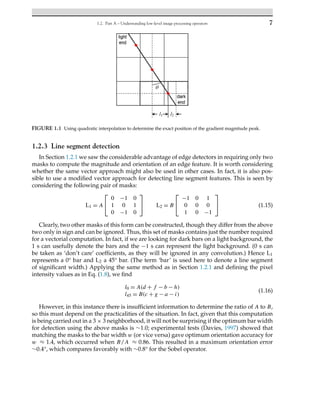
edges: this takes place in two stages (1) finding the two noncentral red points shown in
Fig. 1.1, which involves gradient magnitude interpolation between two pairs of pixels;
(2) performing quadratic interpolation between the intensity gradients at the three red
points to determine the position of the peak edge signal to subpixel precision.
4. ‘Hysteresis’ thresholding is performed: this involves applying two thresholds t1 and t2
(t2  t1) to the intensity gradient field; the result is ‘nonedge’ if g  t1, ‘edge’ if g  t2, and
otherwise is only ‘edge’ if next to ‘edge’. (Note that the ‘edge’ property can be propagated
from pixel to pixel under the above rules.)
As noted in item 3, quadratic interpolation can be used to locate the position of the gra-
dient magnitude peak. A few lines of algebra shows that, for the g-values g1, g2, g3 of
the three red points, the displacement of the peak from the central red point is equal to
(g3 − g1)secθ/[2(2g2 − g1 − g3)]: here, sec θ is the factor by which θ increases the distance
between the outermost red points.
1.2. Part A – Understanding low-level image processing operators 7
FIGURE 1.1 Using quadratic interpolation to determine the exact position of the gradient magnitude peak.
1.2.3 Line segment detection
In Section 1.2.1 we saw the considerable advantage of edge detectors in requiring only two
masks to compute the magnitude and orientation of an edge feature. It is worth considering
whether the same vector approach might also be used in other cases. In fact, it is also pos-
sible to use a modified vector approach for detecting line segment features. This is seen by
considering the following pair of masks:
L1 = A
⎡
⎣
0 −1 0
1 0 1
0 −1 0
⎤
⎦ L2 = B
⎡
⎣
−1 0 1
0 0 0
1 0 −1
⎤
⎦ (1.15)
Clearly, two other masks of this form can be constructed, though they differ from the above
two only in sign and can be ignored. Thus, this set of masks contains just the number required
for a vectorial computation. In fact, if we are looking for dark bars on a light background, the
1 s can usefully denote the bars and the −1 s can represent the light background. (0 s can
be taken as ‘don’t care’ coefficients, as they will be ignored in any convolution.) Hence L1
represents a 0° bar and L2 a 45° bar. (The term ‘bar’ is used here to denote a line segment
of significant width.) Applying the same method as in Section 1.2.1 and defining the pixel
intensity values as in Eq. (1.8), we find
l0 = A(d + f − b − h)
l45 = B(c + g − a − i)
(1.16)
However, in this instance there is insufficient information to determine the ratio of A to B,
so this must depend on the practicalities of the situation. In fact, given that this computation
is being carried out in a 3 × 3 neighborhood, it will not be surprising if the optimum bar width
for detection using the above masks is ∼1.0; experimental tests (Davies, 1997) showed that
matching the masks to the bar width w (or vice versa) gave optimum orientation accuracy for
w ≈ 1.4, which occurred when B/A ≈ 0.86. This resulted in a maximum orientation error
∼0.4°, which compares favorably with ∼0.8° for the Sobel operator.
8 1. The dramatically changing face of computer vision
We now proceed to use formulae similar to those in Section 1.2.1 for pseudo-vectorial com-
putation of the line strength coefficient l and line segment orientation θ:
l =

l2
0 + l2
45
1/2
θ =
1
2
arctan(l45/l0)
(1.17)
Here we have been forced to include a factor of one half in front of the arctan: this is because
a line segment exhibits 180° rotation symmetry compared with the usual 360° for ordinary
angles.
Note that this is again a case in which optimization is aimed at achieving high orientation
accuracy rather than, for example, sensitivity of detection.
It is worth remarking here on two applications of line segment detection. One is the in-
spection of bulk wheat grains to locate small dark insects which approximate to dark bar-like
features: 7 × 7 masks devised on the above model have been used to achieve this (Davies
et al., 2003). Another is the location of artefacts such as telegraph wires in the sky, or wires
supporting film actors which can then be removed systematically.
1.2.4 Optimizing detection sensitivity
Optimization of detection sensitivity is a task that is well known in radar applications and
has been very effectively applied for this purpose since World War II. Essentially, efficient
detection of aircraft by radar systems involves optimization of the signal-to-noise-ratio (SNR).
Of course, in radar, detection is a 1-D problem whereas in imaging we need to optimally
detect 2-D objects against a background of noise. However, image noise is not necessarily
Gaussian white noise, as can normally be assumed in radar, though it is convenient to start
with that assumption.
In radar the signals can be regarded as positive peaks (or ‘bleeps’) against a background of
noise which is normally close to zero. Under these conditions there is a well-known theorem
that says that the optimum detection of a bleep of given shape is obtained using a ‘matched
filter’ which has the same shape as the idealized input signal. The same applies in imaging,
and in that case the spatial matched filter has to have the same intensity profile as that of an
ideal form of the 2-D object to be detected.
We shall now outline the mathematical basis of this approach. First, we assume a set of
pixels at which signals are sampled, giving values Si. Next, we express the desired filter as an
n-element weighting template with coefficients wi. Finally, we assume that the noise levels at
each pixel are independent and are subject to local distributions with standard deviations Ni.
Clearly, the total signal received from the weighting template will be
S =
n
i=1
wiSi (1.18)
1.2. Part A – Understanding low-level image processing operators 9
whereas the total noise received from the weighting template will be characterized by its
variance:
N2
=
n
i=1
w2
i N2
i (1.19)
Hence the (power) SNR is
ρ2
= S2
/N2
=
n
i=1
wiSi
2
/
n
i=1
w2
i N2
i (1.20)
For optimum SNR, we compute the derivative
∂ρ2
/∂wi =

1/N4

N2
(2SSi) − S2

2wiN2
i

=

2S/N4

N2
Si − S

wiN2
i

(1.21)
and then set ∂ρ2/∂wi = 0. This immediately gives:
wi =
Si
N2
i
×
N2
S
(1.22)
which can more simply be expressed as:
wi ∝
Si
N2
i
(1.23)
though with no loss of generality, we can replace the proportionality sign by an equality.
Note that if Ni is independent of i (i.e., the noise level does not vary over the image),
wi = Si: this proves the theorem mentioned above—that the spatial matched filter needs to
have the same intensity profile as that of the 2-D object to be detected.
1.2.5 Dealing with variations in the background intensity
Apart from the obvious difference in dimensionality, there is a further important way in
which vision differs from radar: for the latter, in the absence of a signal, the system output
hovers around, and averages to, zero. However, in vision, the background level will typically
vary with the ambient illumination and will also vary over the input image. Basically, the
solution to this problem is to employ zero-sum (or zero-mean) masks. Thus, for a mask such
as that in Eq. (1.2), we merely subtract the mean value c̄ of all the mask components from
each component to ensure that the overall mask is zero-mean.
To confirm that using the zero-mean strategy works, imagine applying an unmodified
mask to the image neighborhood shown in Eq. (1.3): let us assume we obtain a value K. Now
add B to the intensity of each pixel in the neighborhood: this will add

n Bci = B

n ci = Bnc̄
to the value K; but if we make c̄ = 0, we end up with the original mask output K.
10 1. The dramatically changing face of computer vision
Overall, we should note that the zero-mean strategy is only an approximation, as there
will be places in an image where the background varies between high and low level, so that
zero-mean cancellation cannot occur exactly (i.e., B cannot be regarded as constant over the
region of the mask). Nevertheless, assuming that the background variation occurs on a scale
significantly larger than that of the mask size, this should work adequately.
It should be remarked that the zero-mean approximation is already widely used—as in-
deed we have already seen from the edge and line-segment masks in Eqs. (1.7) and (1.15). It
must also apply for other detectors we could devise, such as corner and hole detectors.
1.2.6 A theory combining the matched filter and zero-mean constructs
At first sight, the zero-mean construct is so simple that it might appear to integrate easily
with the matched filter formalism of Section 1.2.4. However, applying it reduces the number
of degrees of freedom of the matched filter by one, so a change is needed to the matched filter
formalism to ensure that the latter continues to be an ideal detector. To proceed, we represent
the zero-mean and matched filter cases as follows:
(wi)z-m = Si − S̄
(wi)m-f = Si/N2
i
(1.24)
Next, we combine these into the form
wi =

Si − S̃

/N2
i (1.25)
where we have avoided an impasse by trying a hypothetical (i.e., as yet unknown) type of
mean for S, which we call S̃. [Of course, if this hypothesis in the end results in a contradiction,
a fresh approach will naturally be required.] Applying the zero-mean condition

i wi = 0
now yields the following:
i
wi =
i
Si/N2
i −
i
S̃/N2
i = 0 (1.26)
∴ S̃
i

1/N2
i

=
i
Si/N2
i (1.27)
∴ S̃ =
i

Si/N2
i

/
i

1/N2
i

(1.28)
From this, we deduce that S̃ has to be a weighted mean, and in particular the noise-weighted
mean S̃. On the other hand, if the noise is uniform, S̃ will revert to the usual unweighted
mean S̄. Also, if we do not apply the zero-mean condition (which we can achieve by setting
S̃ = 0), Eq. (1.25) reverts immediately to the standard matched filter condition.
The formula for S̃ may seem to be unduly general, in that Ni should normally be almost
independent of i. However, if an ideal profile were to be derived by averaging real object
profiles, then away from its center, the noise variance could be more substantial. Indeed, for
1.2. Part A – Understanding low-level image processing operators 11
large objects this would be a distinct limiting factor on such an approach. But for fairly small
objects and features, noise variance should not vary excessively and useful matched filter
profiles should be obtainable.
On a personal note, the main result proven in this section (cf. Eqs. (1.25) and (1.28)) took
me so much time and effort to resolve the various issues that I was never convinced I would
solve it. Hence I came to think of it as ‘Davies’s last theorem’.
1.2.7 Mask design—other considerations
Although the matched filter formalism and the now fully integrated zero-mean condition
might seem to be sufficiently general to provide for unambiguous mask design, there are a
number of aspects that remain to be considered. For example, how large should the masks
be made? And how should they be optimally placed around any notable objects or features?
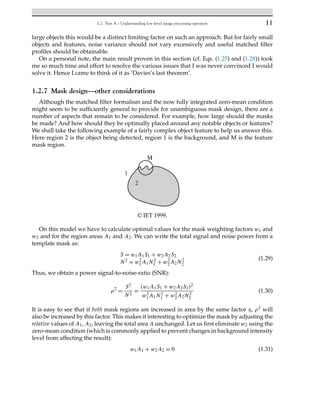
We shall take the following example of a fairly complex object feature to help us answer this.
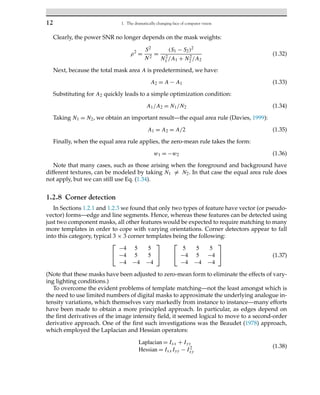
Here region 2 is the object being detected, region 1 is the background, and M is the feature
mask region.
© IET 1999.
On this model we have to calculate optimal values for the mask weighting factors w1 and
w2 and for the region areas A1 and A2. We can write the total signal and noise power from a
template mask as:
S = w1A1S1 + w2A2S2
N2 = w2
1A1N2
1 + w2
2A2N2
2
(1.29)
Thus, we obtain a power signal-to-noise-ratio (SNR):
ρ2
=
S2
N2
=
(w1A1S1 + w2A2S2)2
w2
1A1N2
1 + w2
2A2N2
2
(1.30)
It is easy to see that if both mask regions are increased in area by the same factor η, ρ2 will
also be increased by this factor. This makes it interesting to optimize the mask by adjusting the
relative values of A1, A2, leaving the total area A unchanged. Let us first eliminate w2 using the
zero-mean condition (which is commonly applied to prevent changes in background intensity
level from affecting the result):
w1A1 + w2A2 = 0 (1.31)
12 1. The dramatically changing face of computer vision
Clearly, the power SNR no longer depends on the mask weights:
ρ2
=
S2
N2
=
(S1 − S2)2
N2
1 /A1 + N2
2 /A2
(1.32)
Next, because the total mask area A is predetermined, we have:
A2 = A − A1 (1.33)
Substituting for A2 quickly leads to a simple optimization condition:
A1/A2 = N1/N2 (1.34)
Taking N1 = N2, we obtain an important result—the equal area rule (Davies, 1999):
A1 = A2 = A/2 (1.35)
Finally, when the equal area rule applies, the zero-mean rule takes the form:
w1 = −w2 (1.36)
Note that many cases, such as those arising when the foreground and background have
different textures, can be modeled by taking N1 = N2. In that case the equal area rule does
not apply, but we can still use Eq. (1.34).
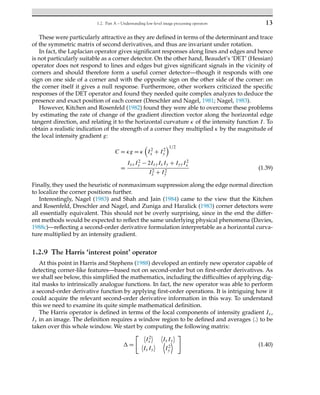
1.2.8 Corner detection
In Sections 1.2.1 and 1.2.3 we found that only two types of feature have vector (or pseudo-
vector) forms—edge and line segments. Hence, whereas these features can be detected using
just two component masks, all other features would be expected to require matching to many
more templates in order to cope with varying orientations. Corner detectors appear to fall
into this category, typical 3 × 3 corner templates being the following:
⎡
⎣
−4 5 5
−4 5 5
−4 −4 −4
⎤
⎦
⎡
⎣
5 5 5
−4 5 −4
−4 −4 −4
⎤
⎦ (1.37)
(Note that these masks have been adjusted to zero-mean form to eliminate the effects of vary-
ing lighting conditions.)
To overcome the evident problems of template matching—not the least amongst which is
the need to use limited numbers of digital masks to approximate the underlying analogue in-
tensity variations, which themselves vary markedly from instance to instance—many efforts
have been made to obtain a more principled approach. In particular, as edges depend on
the first derivatives of the image intensity field, it seemed logical to move to a second-order
derivative approach. One of the first such investigations was the Beaudet (1978) approach,
which employed the Laplacian and Hessian operators:
Laplacian = Ixx + Iyy
Hessian = IxxIyy − I2
xy
(1.38)
1.2. Part A – Understanding low-level image processing operators 13
These were particularly attractive as they are defined in terms of the determinant and trace
of the symmetric matrix of second derivatives, and thus are invariant under rotation.
In fact, the Laplacian operator gives significant responses along lines and edges and hence
is not particularly suitable as a corner detector. On the other hand, Beaudet’s ‘DET’ (Hessian)
operator does not respond to lines and edges but gives significant signals in the vicinity of
corners and should therefore form a useful corner detector—though it responds with one
sign on one side of a corner and with the opposite sign on the other side of the corner: on
the corner itself it gives a null response. Furthermore, other workers criticized the specific
responses of the DET operator and found they needed quite complex analyzes to deduce the
presence and exact position of each corner (Dreschler and Nagel, 1981; Nagel, 1983).
However, Kitchen and Rosenfeld (1982) found they were able to overcome these problems
by estimating the rate of change of the gradient direction vector along the horizontal edge
tangent direction, and relating it to the horizontal curvature κ of the intensity function I. To
obtain a realistic indication of the strength of a corner they multiplied κ by the magnitude of
the local intensity gradient g:
C = κg = κ

I2
x + I2
y
1/2
=
IxxI2
y − 2IxyIxIy + IyyI2
x
I2
x + I2
y
(1.39)
Finally, they used the heuristic of nonmaximum suppression along the edge normal direction
to localize the corner positions further.
Interestingly, Nagel (1983) and Shah and Jain (1984) came to the view that the Kitchen
and Rosenfeld, Dreschler and Nagel, and Zuniga and Haralick (1983) corner detectors were
all essentially equivalent. This should not be overly surprising, since in the end the differ-
ent methods would be expected to reflect the same underlying physical phenomena (Davies,
1988c)—reflecting a second-order derivative formulation interpretable as a horizontal curva-
ture multiplied by an intensity gradient.
1.2.9 The Harris ‘interest point’ operator
At this point in Harris and Stephens (1988) developed an entirely new operator capable of
detecting corner-like features—based not on second-order but on first-order derivatives. As
we shall see below, this simplified the mathematics, including the difficulties of applying dig-
ital masks to intrinsically analogue functions. In fact, the new operator was able to perform
a second-order derivative function by applying first-order operations. It is intriguing how it
could acquire the relevant second-order derivative information in this way. To understand
this we need to examine its quite simple mathematical definition.
The Harris operator is defined in terms of the local components of intensity gradient Ix,
Iy in an image. The definition requires a window region to be defined and averages . to be
taken over this whole window. We start by computing the following matrix:
 =
 
I2
x
 
IxIy


IxIy
 
I2
y


(1.40)
14 1. The dramatically changing face of computer vision
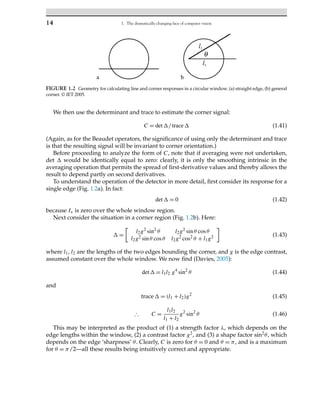
FIGURE 1.2 Geometry for calculating line and corner responses in a circular window. (a) straight edge, (b) general
corner. © IET 2005.
We then use the determinant and trace to estimate the corner signal:
C = det/trace (1.41)
(Again, as for the Beaudet operators, the significance of using only the determinant and trace
is that the resulting signal will be invariant to corner orientation.)
Before proceeding to analyze the form of C, note that if averaging were not undertaken,
det  would be identically equal to zero: clearly, it is only the smoothing intrinsic in the
averaging operation that permits the spread of first-derivative values and thereby allows the
result to depend partly on second derivatives.
To understand the operation of the detector in more detail, first consider its response for a
single edge (Fig. 1.2a). In fact:
det = 0 (1.42)
because Ix is zero over the whole window region.
Next consider the situation in a corner region (Fig. 1.2b). Here:
 =

l2g2 sin2
θ l2g2 sinθ cosθ
l2g2 sinθ cosθ l2g2 cos2 θ + l1g2

(1.43)
where l1, l2 are the lengths of the two edges bounding the corner, and g is the edge contrast,
assumed constant over the whole window. We now find (Davies, 2005):
det = l1l2 g4
sin2
θ (1.44)
and
trace = (l1 + l2)g2
(1.45)
∴ C =
l1l2
l1 + l2
g2
sin2
θ (1.46)
This may be interpreted as the product of (1) a strength factor λ, which depends on the
edge lengths within the window, (2) a contrast factor g2, and (3) a shape factor sin2θ, which
depends on the edge ‘sharpness’ θ. Clearly, C is zero for θ = 0 and θ = π, and is a maximum
for θ = π/2—all these results being intuitively correct and appropriate.
1.3. Part B – 2-D object location and recognition 15
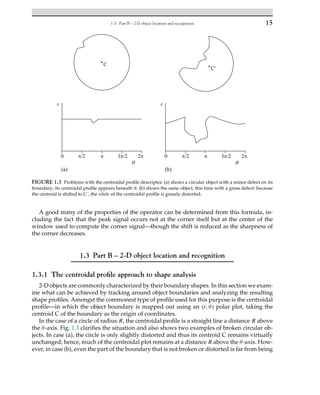
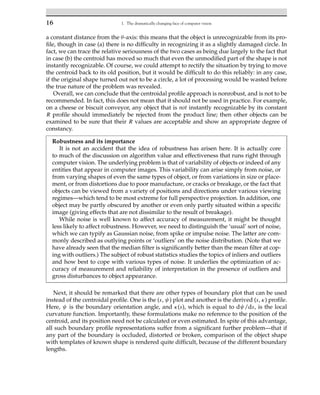
FIGURE 1.3 Problems with the centroidal profile descriptor. (a) shows a circular object with a minor defect on its
boundary; its centroidal profile appears beneath it. (b) shows the same object, this time with a gross defect: because
the centroid is shifted to C´, the whole of the centroidal profile is grossly distorted.
A good many of the properties of the operator can be determined from this formula, in-
cluding the fact that the peak signal occurs not at the corner itself but at the center of the
window used to compute the corner signal—though the shift is reduced as the sharpness of
the corner decreases.
1.3 Part B – 2-D object location and recognition
1.3.1 The centroidal profile approach to shape analysis
2-D objects are commonly characterized by their boundary shapes. In this section we exam-
ine what can be achieved by tracking around object boundaries and analyzing the resulting
shape profiles. Amongst the commonest type of profile used for this purpose is the centroidal
profile—in which the object boundary is mapped out using an (r,θ) polar plot, taking the
centroid C of the boundary as the origin of coordinates.
In the case of a circle of radius R, the centroidal profile is a straight line a distance R above
the θ-axis. Fig. 1.3 clarifies the situation and also shows two examples of broken circular ob-
jects. In case (a), the circle is only slightly distorted and thus its centroid C remains virtually
unchanged; hence, much of the centroidal plot remains at a distance R above the θ-axis. How-
ever, in case (b), even the part of the boundary that is not broken or distorted is far from being
16 1. The dramatically changing face of computer vision
a constant distance from the θ-axis: this means that the object is unrecognizable from its pro-
file, though in case (a) there is no difficulty in recognizing it as a slightly damaged circle. In
fact, we can trace the relative seriousness of the two cases as being due largely to the fact that
in case (b) the centroid has moved so much that even the unmodified part of the shape is not
instantly recognizable. Of course, we could attempt to rectify the situation by trying to move
the centroid back to its old position, but it would be difficult to do this reliably: in any case,
if the original shape turned out not to be a circle, a lot of processing would be wasted before
the true nature of the problem was revealed.
Overall, we can conclude that the centroidal profile approach is nonrobust, and is not to be
recommended. In fact, this does not mean that it should not be used in practice. For example,
on a cheese or biscuit conveyor, any object that is not instantly recognizable by its constant
R profile should immediately be rejected from the product line; then other objects can be
examined to be sure that their R values are acceptable and show an appropriate degree of
constancy.
Robustness and its importance
It is not an accident that the idea of robustness has arisen here. It is actually core
to much of the discussion on algorithm value and effectiveness that runs right through
computer vision. The underlying problem is that of variability of objects or indeed of any
entities that appear in computer images. This variability can arise simply from noise, or
from varying shapes of even the same types of object, or from variations in size or place-
ment, or from distortions due to poor manufacture, or cracks or breakage, or the fact that
objects can be viewed from a variety of positions and directions under various viewing
regimes—which tend to be most extreme for full perspective projection. In addition, one
object may be partly obscured by another or even only partly situated within a specific
image (giving effects that are not dissimilar to the result of breakage).
While noise is well known to affect accuracy of measurement, it might be thought
less likely to affect robustness. However, we need to distinguish the ‘usual’ sort of noise,
which we can typify as Gaussian noise, from spike or impulse noise. The latter are com-
monly described as outlying points or ‘outliers’ on the noise distribution. (Note that we
have already seen that the median filter is significantly better than the mean filter at cop-
ing with outliers.) The subject of robust statistics studies the topics of inliers and outliers
and how best to cope with various types of noise. It underlies the optimization of ac-
curacy of measurement and reliability of interpretation in the presence of outliers and
gross disturbances to object appearance.
Next, it should be remarked that there are other types of boundary plot that can be used
instead of the centroidal profile. One is the (s, ψ) plot and another is the derived (s, κ) profile.
Here, ψ is the boundary orientation angle, and κ(s), which is equal to dψ/ds, is the local
curvature function. Importantly, these formulations make no reference to the position of the
centroid, and its position need not be calculated or even estimated. In spite of this advantage,
all such boundary profile representations suffer from a significant further problem—that if
any part of the boundary is occluded, distorted or broken, comparison of the object shape
with templates of known shape is rendered quite difficult, because of the different boundary
lengths.
1.3. Part B – 2-D object location and recognition 17
In spite of these problems, when it can be employed, the centroidal profile method has
certain advantages, in that it contributes ease of measurement of circular radii, ease of identi-
fication of squares and other shapes with prominent corners, and straightforward orientation
measurement—particularly for shapes with prominent corners.
It now remains to find a method that can replace the centroidal profile method in instances
where gross distortions or occlusions can occur. For such a method we need to move on to
the following section which introduces the Hough transform approach.
1.3.2 Hough-based schemes for object detection
In Section 1.3.1 we explored how circular objects might be identified from their boundaries
using the centroidal profile approach to shape analysis. The approach was found to be non-
robust because of its incapability for coping with gross shape distortions and occlusions. In
this section we show that the Hough transform provides a simple but neat way of solving
this problem. The method used is to take each edge point in the image, move a distance R
inwards along the local edge normal, and accumulate a point in a separate image called the
parameter space: R is taken to be the expected radius of the circles to be located. The result
of this will be a preponderance of points (often called ‘votes’) around the locations of circle
centers. Indeed, to obtain accurate estimates of center locations, it is only necessary to find
significant peaks in parameter space.
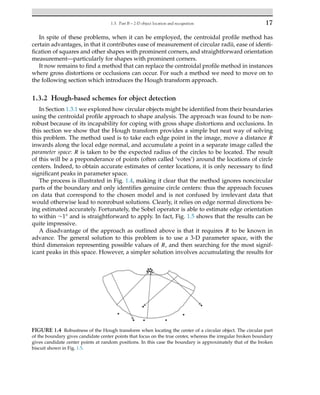
The process is illustrated in Fig. 1.4, making it clear that the method ignores noncircular
parts of the boundary and only identifies genuine circle centers: thus the approach focuses
on data that correspond to the chosen model and is not confused by irrelevant data that
would otherwise lead to nonrobust solutions. Clearly, it relies on edge normal directions be-
ing estimated accurately. Fortunately, the Sobel operator is able to estimate edge orientation
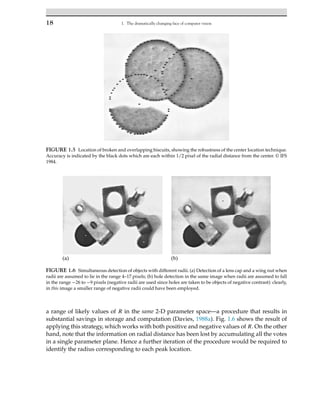
to within ∼1° and is straightforward to apply. In fact, Fig. 1.5 shows that the results can be
quite impressive.
A disadvantage of the approach as outlined above is that it requires R to be known in
advance. The general solution to this problem is to use a 3-D parameter space, with the
third dimension representing possible values of R, and then searching for the most signif-
icant peaks in this space. However, a simpler solution involves accumulating the results for
FIGURE 1.4 Robustness of the Hough transform when locating the center of a circular object. The circular part
of the boundary gives candidate center points that focus on the true center, whereas the irregular broken boundary
gives candidate center points at random positions. In this case the boundary is approximately that of the broken
biscuit shown in Fig. 1.5.
18 1. The dramatically changing face of computer vision
FIGURE 1.5 Location of broken and overlapping biscuits, showing the robustness of the center location technique.
Accuracy is indicated by the black dots which are each within 1/2 pixel of the radial distance from the center. © IFS
1984.
FIGURE 1.6 Simultaneous detection of objects with different radii. (a) Detection of a lens cap and a wing nut when
radii are assumed to lie in the range 4–17 pixels; (b) hole detection in the same image when radii are assumed to fall
in the range −26 to −9 pixels (negative radii are used since holes are taken to be objects of negative contrast): clearly,
in this image a smaller range of negative radii could have been employed.
a range of likely values of R in the same 2-D parameter space—a procedure that results in
substantial savings in storage and computation (Davies, 1988a). Fig. 1.6 shows the result of
applying this strategy, which works with both positive and negative values of R. On the other
hand, note that the information on radial distance has been lost by accumulating all the votes
in a single parameter plane. Hence a further iteration of the procedure would be required to
identify the radius corresponding to each peak location.
1.3. Part B – 2-D object location and recognition 19
FIGURE 1.7 The geometry of two ellipse detection methods. (a) In the diameter-bisection method, a pair of points
is located for which the edge orientations are antiparallel. The midpoints of such pairs are accumulated and the
resulting peaks are taken to correspond to ellipse centers. (b) In the chord–tangent method, the tangents at P1 and
P2 meet at T and the midpoint of P1P2 is M. The center C of the ellipse lies on the line TM produced.
The Hough transform approach can also be used for ellipse detection: two simple meth-
ods for achieving this are presented in Fig. 1.7. Both of these embody an indirect approach in
which pairs of edge points are employed. Whereas the diameter-bisection method involves
considerably less computation than the chord–tangent method, it is more prone to false
detections—for example, when two ellipses lie near to each other in an image.
To prove the validity of the chord–tangent method, note that symmetry ensures that the
method works for circles: projective properties then ensure that it also works for ellipses, be-
cause under orthographic projection, straight lines project into straight lines, midpoints into
midpoints, tangents into tangents, and circles into ellipses; in addition, it is always possible
to find a viewpoint such that a circle can be projected into a given ellipse.
We now move on to the so-called generalized Hough transform (GHT), which employs a
more direct procedure for performing ellipse detection than the other two methods outlined
above.
To understand how the standard Hough technique is generalized so that it can detect ar-
bitrary shapes, we first need to select a localization point L within a template of the idealized
shape. Then, we need to arrange so that, instead of moving from an edge point a fixed dis-
tance R directly along the local edge normal to arrive at the center, as for circles, we move an
appropriate variable distance R in a variable direction ϕ so as to arrive at L: R and ϕ are now
functions of the local edge normal direction θ (Fig. 1.8). Under these circumstances votes will
peak at the preselected object localization point L. The functions R (θ) andφ (θ) can be stored
analytically in the computer algorithm, or for completely arbitrary shapes they may be stored
as lookup tables. In either case the scheme is beautifully simple in principle but an important
complication arises because we are going from an isotropic shape (a circle) to an anisotropic
shape which may be in a completely arbitrary orientation.
This means adding an extra dimension in parameter space (Ballard, 1981). Each edge point
then contributes a set of votes in each orientation plane in parameter space. Finally, the whole
Other documents randomly have
different content
“Yet a moment I’m allotted
To transmit to you my will;
High here on the Smoky Mountains
Near the bright translucent rill,
Let me tell you while life lingers
In the archives of my breast,
Where you’ll find sweet Occoneechee
When my soul has flown to rest:
“She still lingers in the forest,
Near the sweet enchanted lake,
Near the spirit land she lingers,
Underneath the tangled brake.
She holds all our myths and legends,
Tales as told long years ago.
Now I bid you leave me lonely
To my fate of weal or woe.
“Leave me quick, the spirits call me,
Linger not within my sight,
Hie thee quickly through the shadows
Of this crisp autumnal night.
Tell our friend, sweet Occoneechee,
That I’ve gone to join the band
Of the braves who have departed
For the happy hunting land.”
Then a shadow passed between them,
Like a cloud upon the sky,
And the chief was separated
There upon the mountain high,
From his guide and friend forever,
So his eye could never see.
Whence he traveled, none returneth
To explain the mystery.
Thus bereft of friend and neighbor,
Whippoorwill began to wail,
For some mystic hand to guide him
Back into the trodden trail,
Where some chief had gone before him
In the years that long had flown,
Out upon the mystic ages,
Now forgotten and unknown.
But no spirit, sign or token
Came from out the vista fair,
Nothing saw, nor nothing heard he,
Save the earth and scenery fair.
As he stood and gazed in silence,
Motionless and calm as death,
Stillness reigned on hill and valley
And the chieftain held his breath,
While he strained his ears and vision,
Listening, looking here and there,
Waiting, watching, simply trusting
For an answer to his prayer.
Suddenly he heard the calling
Of a voice so sweet and clear,
That he answered, quickly answered,
Though his heart was filled with fear.
And the voice from out the forest,
Called as calls the mating bird,
In the bower in the springtime,
Sweetest call that e’er was heard,
Resonant comes, softly trilling,
Sweetly to its lingering mate,
In the silence of the forest,
As they for each other wait.
Then the chieftain bounded forward,
Like a hound upon the trail,
Thru the forest land primeval
Over mound and hill and dale;
Over ridge and rock and river,
Thru the heath and brush and grass,
Thru the land of the Uktena,
Thru it all he had to pass.
Till he reached the mystic region,
Far back in the darkest glen,
Near the lake of the enchanted
Only known to bravest men.
Here the bear and owl and panther,
Find a cure for every ill,
Find life’s sweetest panacea,
Near the sparkling crystal rill,
High upon the Smoky Mountains
Resonant with Nature wild,
For the wanderer from the distance,
And the tawny Indian child.
This the forest land primeval,
Full of awe and dread and dreams,
Full of ghouls and ghosts and goblins,
Full of rippling crystal streams.
From the stream down in the ravine,
Came another gentle call,
Like the chirping of the robin,
In the hemlocks straight and tall.
Once again the call repeated,
Then a sudden little trill
Floated out upon the breezes,
From beside the crystal rill.
Then the chieftain whistled keenly
Like a hawk upon the wing,
When it soars above the mountain,
On the balmy air of spring.
Then another chirping, chirping,
Came from deep down in the vale,
And it floated up the mountain
Like a leaf upon the gale.
Now the chieftain, moved by caution,
Watched and moved with greatest care,
Down and thru the deepest gulches,
Looking here, observing there,
For the bird or beast or human,
That could send out such a call,
From the laurel near the fountain
And a splendid waterfall.
Suddenly his heart beat faster,
At the sight which came to view,
Through the opening in the laurel
As it parts to let him thru.
She was bathing feet and ankles,
Arms and hands she did refresh
In the iridescent splendor,
Of the fountain cool and fresh.
Then he bounds forth quick to greet her,
E’er she sees him by her side,
She the maiden true and holy,
Who was soon to be his bride.
“O, I see you, Occoneechee!”
“And I see you, Whippoorwill!”
Were the greetings that they whispered
As they met there near the rill.
They were married in the morning,
He the groom and she the bride,
And they lived in bliss together,
Many years before they died;
Now their spirits dwell together,
Near the hidden mystic shore,
Of the lake back in the shadows
Since their wanderings are o’er.
1
And at night the legends tell us,
You can hear a man and bride
Hold converse of trail and travel,
High upon the mountainside;
And the soul of Occoneechee,
Lingers near the rippling rill,
High upon the Smoky Mountains,
With her lover Whippoorwill.
Colonel Thomas. ↑
PART III
MYTHS OF THE CHEROKEE
“I know not how the truth may be,
I tell the tale as ’twas told me.”
The myths related here are from the great story tellers like Ayunini, or “Swimmer,”
who was the greatest of all, but while he ranked first and lived during the time that
tried men’s hearts, having been born about 1835, and died in March, 1899, his
stories can only be perpetuated by putting them in print, and we are indebted to
him for many of these beautiful stories, which should be perpetuated at least so
long as one of the Cherokee tribe shall live.
Sequoya.
Inventor of the Cherokee Alphabet.
John Ax (Itagu-nuhi).
The great story teller.
Everglades of Florida.
Home of the Seminoles.
Next in rank of importance comes Itagunahi, better known among the English-
speaking people as John Axe, who was born in the year 1800, saw the battle of
Horseshoe Bend, witnessed the removal of the Cherokee tribe in 1838. He knew its
history and almost all of the myths, legends and stories, transmitted many of them
to the white man for record, and while he never spoke English, he was a very
versatile and interesting man of the old type of Indians, and strong to the last days;
he lived to near 100 years, then passed to the Happy Hunting Grounds.
To John D. Wofford, of the Western Reservation or tribe, we are indebted for much
information, which would have been lost except for his wonderful knowledge.
All the story-tellers prefaced their remarks by saying, “This is what the old folks
used to tell us when we were boys.”
Cherokee myths may be classified as sacred myths, animal stories, local legends,
and historical traditions. The sacred myths were not for every one, but only those
might hear who observed the proper form and ceremony.
In the old times the myth-keepers and priests were accustomed to meet together at
night in the asi, or low-built log sleeping house, to recite the traditions and discuss
their secret knowledge. At times those who desired instruction from an adept in the
sacred lore of the tribe would meet the priest by appointment in the asi, where they
sat up all night talking, with only the light of a small fire burning in the middle of
the floor. At daybreak the whole party went down to the running stream, where the
pupils or hearers of the myths stripped themselves and were scratched upon the
naked skin with a bone tooth comb in the hands of the priest, after which they
waded out, facing the rising sun, and dipped seven times under the water, while the
priest recited prayers upon the bank. The purificatory rite, which was observed
more than a century ago by Adair, is also a part of the ceremonial of the ball play,
the green-corn dance, and, in fact, every important ritual performance. Before
beginning one of the stories of the sacred class the informant would sometimes
suggest jokingly that the author first submit to being scratched and, “Go to water.”
MYTH ONE.
How the World Was Made.
The earth is a great island floating in a sea of water, and suspended at each of the
four cardinal points by a cord hanging down from the sky vault, which is of solid
rock. When the world grows old and worn out, the people will die and the cords
will break, and let the earth sink down into the ocean, and all will be water again.
The Indians are afraid of this.
When all was water, the animals were above the Galunlati, beyond the arch; but it
was very much crowded, and they were wanting more room. They wondered what
was below the water, and at last Dayunisi, “Beaver’s Grandchild,” the little Water-
beetle, offered to go and see if it could learn. It darted in every direction over the
surface of the water, but could find no firm place to rest.
Then it dived to the bottom and came up with some soft mud, which began to grow
and spread in every direction until it became an island which we call the earth. It
was afterwards fastened to the sky, but no one remembers who did it.
At first the earth was flat, and very soft and wet. The animals were anxious to get
down, and sent out different birds to see if it was yet dry, but they found no place to
alight and came back again to Galunlati. At last it seemed to be time, and they sent
out the Buzzard and told him to go and make ready for them.
This was the Great Buzzard, the father of all the buzzards we see now. He flew all
over the earth, low down, near the ground, and it was still soft. When he reached
the Cherokee country, he was very tired, and his wings began to flap and strike the
ground, and wherever they struck the earth there was a valley, and where they
turned up again, there was a mountain. When the animals above saw this, they
were afraid the whole earth would be mountains, so they called him back, but the
Cherokee country remains full of mountains to this day.
When the earth was dry and the animals came down, it was still dark, so they got
the sun and set it in a track to go every day across the island from east to west, just
overhead. It was too hot this way, and Tsiskagili, the Red Crawfish, had his shell
scorched red, so that his meat was spoiled; and the Cherokee do not eat it. The
conjurers put the sun another hand-breadth higher in the air, but it was still too hot.
They raised it another time, and another, until it was seven hand-breadths high, and
just under the sky arch. Then it was right, and they left it so. This is why the
conjurers call the highest place “Gulkwagine Digalunlatiyun,” “the seven height,”
because it is seven hand-breadths above the earth. Every day the sun goes along
under this arch, and returns at night on the upper side to the starting place.
There is another world under this, and it is like ours in everything—animals,
plants, and people—save that the seasons are different. The streams that come
down from the mountains are the trails by which the people reach the underworld,
and the springs at their heads are the doorways by which they enter it, but to do this
one must fast and go to water and have one of the underground people for a guide.
We know that the seasons in the underground are different from ours, because the
water in the springs is warmer in the winter and cooler in the summer than the
outer air.
When the animals and the plants were first made—we do not know by whom—
they were told to watch and keep awake for seven nights, just as young men now
fast and keep awake when they pray to their medicine. They tried to do this, and
nearly all were awake through the first night, but the next night several dropped off
to sleep, and the third night others were asleep, and then others, until, on the
seventh night, of all the animals, only the owl, the panther and one or two more
were still awake.
To these were given the power to see and to go about in the dark, and to make prey
of the birds and animals which must sleep at night. Of the trees, only the cedar, the
pine, the spruce, the holly and the laurel were awake to the end, and to them it was
given to be always green and to be greatest for medicine, but to the others it was
said: “Because you have not endured to the end you shall lose your hair every
winter.”
Men came after the animals and plants. At first there were only a brother and sister
until he struck her with a fish and told her to multiply, and so it was. In seven days
a child was born to her, and thereafter every seven days another, and they increased
very fast until there was danger that the world could not keep them. Then it was
made that a woman should have only one child in a year, and it has been so ever
since.
MYTH TWO.
The First Fire.
In the beginning there was no fire, and the world was cold, until the Thunders
(Ani-Hyuntikwalaski) who lived up in Galunlati, sent their lightning and put fire
into the bottom of a hollow sycamore tree, which grew on an island. The animals
knew it was there, because they could see the smoke coming out at the top, but
they could not get to it on account of the water, so they held a council to decide
what to do. This was a long time ago.
Every animal that could fly or swim was anxious to go after the fire. The Raven
offered, and because he was so large and strong they thought he could surely do the
work, so he was sent first. He flew high and far across the water and alighted on
the sycamore tree, but while he was wondering what to do next, the heat had
scorched all his feathers black, and he was frightened and came back without the
fire.
The little Screech-owl (Wahuhu) volunteered to go, and reached the place safely,
but while he was looking down in the hollow tree a blast of hot air came up and
nearly burned out his eyes. He managed to fly home as best he could, but it was a
long time before he could see well, and his eyes are red to this day.
Then the Hooting Owl (Uguku) and the Horned Owl (Tskili) went, but by the time
they got to the hollow tree the fire was burning so fiercely that the smoke nearly
blinded them, and the ashes carried up by the wind made white rings about their
eyes. They had to come home again without the fire, but with all of their rubbing
they were never able to get rid of the white rings.
Now, no more of the birds would venture, and so the little Uksuhi snake, the Black
Racer, said he would go through the water and bring back some fire. He swam
across to the island and crawled through the grass to the tree, and went in by a
small hole at the bottom. The heat and smoke were too much for him, too, and after
dodging about blindly over the hot ashes until he was almost on fire himself he
managed by good luck to get out again at the same hole, but his body had scorched
black, and he has ever since had the habit of darting and doubling on his track as if
trying to escape from close quarters.
He came back, and the great Blacksnake, Gulegi, “The Climber,” offered to go for
the fire. He swam over to the island and climbed up the tree on the outside, as the
blacksnake always does, but when he put his head down into the hole the smoke
choked him so that he fell into the burning stump, and before he could climb out
again he was as black as the Uksuhi.
Now, they held another council, for still there was no fire, and the world was cold,
but the birds, snakes and four-footed animals all had some excuse for not going,
because they were all afraid to venture near the burning sycamore, until at last
Kananeski Amaiyehi (the Water Spider) said she would go. This is not the water
spider that looks like a mosquito, but the other one, with black downy hair and red
stripes on her body. She can run on the water or dive to the bottom, so there would
be no trouble to get over to the island, but the question was, how could she bring
back the fire?
“I’ll manage that,” said the spider, so she spun a thread from her body and wove it
into a tusti bowl, which she fastened on her back. Then she crossed over to the
island and through the grass to where the fire was still burning. She put one little
coal of fire into her bowl, and came back with it, and ever since we have had fire,
and the spider still keeps her tusti bowl.
MYTH THREE.
Origin of the Pleiades and the Pine.
Long ago, when the world was new, there were seven boys who used to spend all
their time down by the town-house, playing the gatayusti game, rolling a stone
wheel along the ground and sliding a curved stick after it to strike it. Their mothers
scolded but it did no good, so one day they collected some gatayusti stones and
boiled them in the pot with the corn for dinner.
When the boys came home hungry their mothers dipped out the stones and said,
“Since you like the gatayusti better than the cornfield, take the stones now for your
dinner.”
The boys were very angry, and went down to the town-house, saying, “As our
mothers treat us this way, let us go where we shall never trouble them any more.”
They began a dance—some say it was the feather dance—and went round and
round the town-house, praying to the spirits to help them. At last their mothers
were afraid something was wrong and went out to look for them.
They saw the boys still dancing around the town-house, and as they watched they
noticed that their feet were off the earth, and that with every round they rose higher
and higher in the air.
They ran to get their children, but it was too late, for they were already above the
roof of the town-house—all but one, whose mother managed to pull him down
with the gatayusti pole, but he struck the ground with such force that he sank into it
and the earth closed over him. The other six children circled higher and higher until
they went up to the sky, where we see them now as the pleiades, which the
Cherokee still calls “Anitsutsa” (the Boys).
The people grieved long after them, but the mother whose boy had gone into the
ground came every morning and evening to cry over the spot, until the earth was
damp with her tears.
At last a little green shoot sprouted up and grew day by day until it became the tall
tree that we now call the pine, and the pine is still of the same nature as the stars
and holds in itself the same bright light.
MYTH FOUR.
The Milky Way.
Some people in the South had a corn mill, in which they pounded the corn into
meal, and several mornings when they came to fill it they noticed that some of the
meal had been stolen during the night.
They examined the ground, and found the tracks of a dog; so the next night they
watched, and when the dog came from the North, and began to eat the meal out of
the bowl, they sprang out and whipped him. He ran off howling to his home in the
North, with the meal dropping from his mouth as he ran, and leaving behind a
white trail where now we see the Milky Way, which the Cherokee calls to this day
Gili-utsunstanunyi, “Where the dog ran.”
MYTH FIVE.
The Deluge.
A long time ago a man had a dog, which began to go down to the river every day
and look at the water and howl. At last the man was very angry and scolded the
dog, which then spoke to him and said: “Very soon there is going to be a great
freshet and the water will come so high that everybody will be drowned; but if you
will make a raft to get upon when the rain comes, you can be saved, but you must
first throw me into the water.” The man did not believe it, and the dog said, “If you
want a sign that I speak the truth, look at the back of my neck.” He looked and saw
that the dog’s neck had the skin worked off so that the bones stuck out.
Then he believed the dog, and began to build a raft. Soon the rain came and he took
his family, with plenty of provisions, and they all got upon it. It rained for a long
time, and the water rose until the mountains were covered and all the people in the
world were drowned. Then the rain stopped and the water went down again, until at
last it was safe to come off the raft.
Now, there was no one alive but the man and his family, but one day they heard a
sound of dancing and shouting on the other side of the ridge. The man climbed to
the top and looked over; everything was still, but all along the valley he saw great
piles of bones of the people who had been drowned, and then he knew that the
Ghosts had been dancing.
MYTH SIX.
How the Terrapin Beat the Rabbit.
The Rabbit was a great runner and a great boaster of what she could do. No one
thought that a Terrapin was anything but a slow traveler, but he was a great warrior
and very boastful, and the two were always disputing about their speed. At last they
agreed to decide the matter by a race.
Tuckaseigee River.
“There the Tuckaseigee River
Dashes down its rocky bed.”
They fixed the day and the starting place, and arranged to run across four mountain
ridges, and the one who came in first at the end of the race was to be the winner.
The Rabbit felt so sure of it that he said to the Terrapin, “You know you can’t run.
You know you can never win the race, so I’ll give you the first ridge and then
you’ll have three to cross while I go over four.” The Terrapin said that would be all
right, but that night when he went home to his family he sent for his Terrapin
friends and told them he wanted their help. He said he knew he could not outrun
the Rabbit, but he wanted to stop the Rabbit’s boasting. He explained his plan to
his friends and they agreed to help him. When the day came all the animals were
there to see the race. The Rabbit was there with them, but the Terrapin was gone
ahead toward the first ridge, as they had arranged, and they could hardly see him
on account of the tall grass.
The word was given and the Rabbit ran off with long jumps up the mountain,
expecting to win the race before the Terrapin could get down on the other side. But
before he got up the mountain he saw the Terrapin go over the ridge ahead of him.
He ran on, and when he reached the top he looked all around, but could not see the
Terrapin on account of the long grass. He kept on down the mountain and began to
climb the second ridge, but when he looked up again there was the Terrapin just
going over the top.
Now he was very much surprised, and made his longest jumps to catch up, but
when he got to the top there was the Terrapin away in front going over the third
ridge. The Rabbit was getting tired now and nearly out of breath, but he kept on
down the mountain and up the other ridge until he got to the top just in time to see
the Terrapin cross the fourth ridge and thus win the race. The Rabbit could not
make another jump, but fell over on the ground, crying, “mi, mi, mi, mi,” as the
Rabbit does ever since when he is too tired to run any more.
The race was given to the Terrapin, and all the animals wondered how he could win
against the Rabbit, but he kept still and never told. It was easy enough, however,
because all the Terrapin’s friends look just alike, and he had simply posted one near
the top of each ridge to wait until the Rabbit came in sight and then climb over and
hide in the long grass.
When the Rabbit came on he could not find the Terrapin and so thought the
Terrapin was ahead, and if he had met one of the other Terrapins he would have
thought it the same one, because they look so much alike. The real Terrapin had
posted himself on the fourth ridge, so as to come in at the end of the race and be
ready to answer questions if the animals suspected anything.
Because the Rabbit had to lie down and lose the race the conjurer now, when
preparing his young men for the ball play, boils a lot of rabbit hamstrings into soup,
and sends some one to pour it across the path along which the other players have to
come in the morning, so that they may become tired in the same way and lose the
game. It is not always easy to do this, because the other party is expecting it and
has watchers ahead to prevent it.
MYTH SEVEN.
The Rabbit and the Tar Wolf.
Once there was such a long spell of dry weather that there was no more water in
the creeks and springs, and the animals held a council to see what to do about it.
They decided to dig a well, and all agreed to help except the Rabbit, who was a
lazy fellow, and said, “I don’t need to dig for water. The dew on the grass is enough
for me.” The others did not like this, but they went to work together and dug the
well.
They noticed by and by that the Rabbit kept sleek and lively, although it was still
dry weather and the water was getting low in the well. They said, “That tricky
Rabbit steals our water at night,” so they made a wolf of pine gum and tar and set it
up by the well to scare the thief. That night the Rabbit came, as he had been
coming every night, to drink enough to last him all next day. He saw the queer
black thing by the well and said, “Who’s there?” but the tar wolf said nothing.
He came nearer, but the wolf never moved, so he grew braver and said, “Get out of
my way or I will kick you.” Still the wolf never moved and the Rabbit came up and
struck it with its front foot, but the tar held it fast. Now he was angry and said:
“Turn my foot loose, or I will strike you with my other front foot”; still the wolf
said nothing. Then the Rabbit struck the wolf with his other foot, and it stuck, and
the Rabbit said, “Turn my foot loose or I will kick you,” and still the wolf was
silent, and then the rabbit kicked with his right hind foot so hard that it stuck, and
still the wolf said nothing; and the Rabbit said, “If you don’t turn my foot loose, I
will kick you with my left hind foot, which never fails to accomplish what I want it
to do”; yet the wolf was silent, and the Rabbit made his last kick and the foot stuck,
just as the others had done.
The Rabbit plead with the wolf to let him go, and yet no response came, and, at
last, when he found he was stuck fast with his feet, he said: “If you don’t turn me
loose I will butt you with all my might,” and in his desperation, he struck with all
his force, and his head stuck fast to the wolf.
In the morning all the animals came down to the well to drink as usual, and found
the Rabbit stuck fast to the wolf of tar, and they began to discuss what disposition
to make of him, so one suggested that they cut his head off, to which the Rabbit
replied, “Please do cut my head off, for it is such an easy death to die,” but this
aroused the suspicion of the animals, so that the fox said, “No, we will not do this
for he deserves a harsher death than this,” whereupon they all agreed. Then the
Wolf suggested that they burn him alive, to which the Rabbit said, “Please Mr.
Wolf, have me burned, for that will be so easy,” but this did not please the
audience, and another suggested that they take him to the briar patch, and throw
him into the thickest part of the sharp briars to scratch him to pieces, to which the
Rabbit said, “Oh, Mr. Fox, please do not allow me to be thrown into the briars for
they stick and scratch me so much that I could never stand the pain”; and they all
with one accord exclaimed, “Throw him in,” and they threw him into the briars,
and the Rabbit sped away as fast as he could, saying, “This is where I was reared,
this is my home, and this is all that I could desire.”
MYTH EIGHT.
The Rabbit and the Possum After a Wife.
The Rabbit and the Possum each wanted a wife, but no one would marry either of
them. They talked the matter over and the Rabbit said, “We can’t get wives here;
let’s go to the next settlement. I’m the messenger for the council, and I’ll tell the
people that I bring an order that everybody must take a mate at once, and then we’ll
be sure to get wives.”
The Possum thought this a fine plan, so they started off together to the next town.
As the Rabbit traveled faster he got there first and waited outside until the people
noticed him and took him into the town-house. When the chief came to ask him his
business the Rabbit said he brought an important message from the council that
everybody must get married without delay. So the chief called the people together

Advanced Methods and Deep Learning in Computer Vision (Computer Vision and Pattern Recognition) 1st Edition E. R. Davies


  • 1.
    Read Anytime AnywhereEasy Ebook Downloads at ebookmeta.com Advanced Methods and Deep Learning in Computer Vision (Computer Vision and Pattern Recognition) 1st Edition E. R. Davies https://ebookmeta.com/product/advanced-methods-and-deep- learning-in-computer-vision-computer-vision-and-pattern- recognition-1st-edition-e-r-davies/ OR CLICK HERE DOWLOAD EBOOK Visit and Get More Ebook Downloads Instantly at https://ebookmeta.com
  • 3.
    ADVANCED METHODS ANDDEEP LEARNING IN COMPUTER VISION
  • 4.
  • 5.
    Computer Vision andPattern Recognition ADVANCED METHODS AND DEEP LEARNING IN COMPUTER VISION Edited by E.R. Davies Matthew A. Turk
  • 6.
    Academic Press isan imprint of Elsevier 125 London Wall, London EC2Y 5AS, United Kingdom 525 B Street, Suite 1650, San Diego, CA 92101, United States 50 Hampshire Street, 5th Floor, Cambridge, MA 02139, United States The Boulevard, Langford Lane, Kidlington, Oxford OX5 1GB, United Kingdom Copyright © 2022 Elsevier Inc. All rights reserved. No part of this publication may be reproduced or transmitted in any form or by any means, electronic or mechanical, including photocopying, recording, or any information storage and retrieval system, without permission in writing from the publisher. Details on how to seek permission, further information about the Publisher’s permissions policies and our arrangements with organizations such as the Copyright Clearance Center and the Copyright Licensing Agency, can be found at our website: www.elsevier.com/permissions. This book and the individual contributions contained in it are protected under copyright by the Publisher (other than as may be noted herein). Notices Knowledge and best practice in this field are constantly changing. As new research and experience broaden our understanding, changes in research methods, professional practices, or medical treatment may become necessary. Practitioners and researchers must always rely on their own experience and knowledge in evaluating and using any information, methods, compounds, or experiments described herein. In using such information or methods they should be mindful of their own safety and the safety of others, including parties for whom they have a professional responsibility. To the fullest extent of the law, neither the Publisher nor the authors, contributors, or editors, assume any liability for any injury and/or damage to persons or property as a matter of products liability, negligence or otherwise, or from any use or operation of any methods, products, instructions, or ideas contained in the material herein. Library of Congress Cataloging-in-Publication Data A catalog record for this book is available from the Library of Congress British Library Cataloguing-in-Publication Data A catalogue record for this book is available from the British Library ISBN: 978-0-12-822109-9 For information on all Academic Press publications visit our website at https://www.elsevier.com/books-and-journals Publisher: Mara Conner Acquisitions Editor: Tim Pitts Editorial Project Manager: Isabella C. Silva Production Project Manager: Sojan P. Pazhayattil Designer: Greg Harris Typeset by VTeX
  • 7.
    This book isdedicated to my family. To cherished memories of my parents, Arthur and Mary Davies. To my wife, Joan, for love, patience, support and inspiration. To my children, Elizabeth, Sarah and Marion, and grandchildren, Jasper, Jerome, Eva, Tara and Pia, for bringing endless joy into my life! Roy Davies This book is dedicated to the students, colleagues, friends, and family who have motivated, guided, and supported me in ways too numerous to mention. To my wife, Kelly, and my children, Hannah and Matt – special thanks and appreciation for your love and inspiration. Matthew Turk
  • 8.
  • 9.
    Contents List of contributorsxi About the editors xiii Preface xv 1. The dramatically changing face of computer vision E.R. DAVIES 1.1 Introduction – computer vision and its origins 1 1.2 Part A – Understanding low-level image processing operators 4 1.3 Part B – 2-D object location and recognition 15 1.4 Part C – 3-D object location and the importance of invariance 29 1.5 Part D – Tracking moving objects 55 1.6 Part E – Texture analysis 61 1.7 Part F – From artificial neural networks to deep learning methods 68 1.8 Part G – Summary 86 References 87 2. Advanced methods for robust object detection ZHAOWEI CAI AND NUNO VASCONCELOS 2.1 Introduction 93 2.2 Preliminaries 95 2.3 R-CNN 96 2.4 SPP-Net 97 2.5 Fast R-CNN 98 2.6 Faster R-CNN 101 2.7 Cascade R-CNN 103 2.8 Multiscale feature representation 106 2.9 YOLO 110 2.10 SSD 112 2.11 RetinaNet 113 2.12 Detection performances 115 2.13 Conclusion 115 References 116 3. Learning with limited supervision SUJOY PAUL AND AMIT K. ROY-CHOWDHURY 3.1 Introduction 119 3.2 Context-aware active learning 120 3.3 Weakly supervised event localization 129 3.4 Domain adaptation of semantic segmentation using weak labels 137 3.5 Weakly-supervised reinforcement learning for dynamical tasks 144 3.6 Conclusions 151 References 153 4. Efficient methods for deep learning HAN CAI, JI LIN, AND SONG HAN 4.1 Model compression 159 4.2 Efficient neural network architectures 170 4.3 Conclusion 185 References 185 5. Deep conditional image generation GANG HUA AND DONGDONG CHEN 5.1 Introduction 191 5.2 Visual pattern learning: a brief review 194 5.3 Classical generative models 195 5.4 Deep generative models 197 5.5 Deep conditional image generation 200 5.6 Disentanglement for controllable synthesis 201 5.7 Conclusion and discussions 216 References 216 vii
  • 10.
    viii Contents 6. Deepface recognition using full and partial face images HASSAN UGAIL 6.1 Introduction 221 6.2 Components of deep face recognition 227 6.3 Face recognition using full face images 231 6.4 Deep face recognition using partial face data 233 6.5 Specific model training for full and partial faces 237 6.6 Discussion and conclusions 239 References 240 7. Unsupervised domain adaptation using shallow and deep representations YOGESH BALAJI, HIEN NGUYEN, AND RAMA CHELLAPPA 7.1 Introduction 243 7.2 Unsupervised domain adaptation using manifolds 244 7.3 Unsupervised domain adaptation using dictionaries 247 7.4 Unsupervised domain adaptation using deep networks 258 7.5 Summary 270 References 270 8. Domain adaptation and continual learning in semantic segmentation UMBERTO MICHIELI, MARCO TOLDO, AND PIETRO ZANUTTIGH 8.1 Introduction 275 8.2 Unsupervised domain adaptation 277 8.3 Continual learning 291 8.4 Conclusion 298 References 299 9. Visual tracking MICHAEL FELSBERG 9.1 Introduction 305 9.2 Template-based methods 308 9.3 Online-learning-based methods 314 9.4 Deep learning-based methods 323 9.5 The transition from tracking to segmentation 327 9.6 Conclusions 331 References 332 10. Long-term deep object tracking EFSTRATIOS GAVVES AND DEEPAK GUPTA 10.1 Introduction 337 10.2 Short-term visual object tracking 341 10.3 Long-term visual object tracking 345 10.4 Discussion 367 References 368 11. Learning for action-based scene understanding CORNELIA FERMÜLLER AND MICHAEL MAYNORD 11.1 Introduction 373 11.2 Affordances of objects 375 11.3 Functional parsing of manipulation actions 383 11.4 Functional scene understanding through deep learning with language and vision 390 11.5 Future directions 397 11.6 Conclusions 399 References 399 12. Self-supervised temporal event segmentation inspired by cognitive theories RAMY MOUNIR, SATHYANARAYANAN AAKUR, AND SUDEEP SARKAR 12.1 Introduction 406 12.2 The event segmentation theory from cognitive science 408 12.3 Version 1: single-pass temporal segmentation using prediction 410 12.4 Version 2: segmentation using attention-based event models 421 12.5 Version 3: spatio-temporal localization using prediction loss map 428 12.6 Other event segmentation approaches in computer vision 440
  • 11.
    Contents ix 12.7 Conclusions443 References 444 13. Probabilistic anomaly detection methods using learned models from time-series data for multimedia self-aware systems CARLO REGAZZONI, ALI KRAYANI, GIULIA SLAVIC, AND LUCIO MARCENARO 13.1 Introduction 450 13.2 Base concepts and state of the art 451 13.3 Framework for computing anomaly in self-aware systems 458 13.4 Case study results: anomaly detection on multisensory data from a self-aware vehicle 467 13.5 Conclusions 476 References 477 14. Deep plug-and-play and deep unfolding methods for image restoration KAI ZHANG AND RADU TIMOFTE 14.1 Introduction 481 14.2 Half quadratic splitting (HQS) algorithm 484 14.3 Deep plug-and-play image restoration 485 14.4 Deep unfolding image restoration 492 14.5 Experiments 495 14.6 Discussion and conclusions 504 References 505 15. Visual adversarial attacks and defenses CHANGJAE OH, ALESSIO XOMPERO, AND ANDREA CAVALLARO 15.1 Introduction 511 15.2 Problem definition 512 15.3 Properties of an adversarial attack 514 15.4 Types of perturbations 515 15.5 Attack scenarios 515 15.6 Image processing 522 15.7 Image classification 523 15.8 Semantic segmentation and object detection 529 15.9 Object tracking 529 15.10 Video classification 531 15.11 Defenses against adversarial attacks 533 15.12 Conclusions 537 References 538 Index 545
  • 12.
  • 13.
    List of contributors SathyanarayananAakur Computer Science, Ok- lahoma State University, Stillwater, OK, United States Yogesh Balaji Department of Computer Science and UMACS, University of Maryland, College Park, MD, United States Han Cai Massachusetts Institute of Technology, Cambridge, MA, United States Zhaowei Cai Amazon Web Services, Pasadena, CA, United States Andrea Cavallaro Centre for Intelligent Sens- ing, Queen Mary University of London, London, United Kingdom Rama Chellappa Departments of Electrical and Computer Engineering and Biomedical Engineer- ing, Johns Hopkins University, Baltimore, MD, United States Dongdong Chen Microsoft Cloud & AI, Redmond, WA, United States E.R. Davies Royal Holloway, University of London, Egham, Surrey, United Kingdom Michael Felsberg Computer Vision Laboratory, De- partment of Electrical Engineering, Linköping Uni- versity, Linköping, Sweden School of Engineering, University of KwaZulu- Natal, Durban, South Africa Cornelia Fermüller University of Maryland, Insti- tute for Advanced Computer Studies, Iribe Cen- ter for Computer Science and Engineering, College Park, MD, United States Efstratios Gavves Informatics Institute, University of Amsterdam, Amsterdam, Netherlands Deepak Gupta Informatics Institute, University of Amsterdam, Amsterdam, Netherlands Song Han Massachusetts Institute of Technology, Cambridge, MA, United States Gang Hua Wormpex AI Research, Bellevue, WA, United States Ali Krayani DITEN, University of Genoa, Genoa, Italy Ji Lin Massachusetts Institute of Technology, Cam- bridge, MA, United States Lucio Marcenaro DITEN, University of Genoa, Genoa, Italy Michael Maynord University of Maryland, Com- puter Science Department, Iribe Center for Com- puter Science and Engineering, College Park, MD, United States Umberto Michieli Department of Information En- gineering, University of Padova, Padova, Italy Ramy Mounir Computer Science and Engineering, University of South Florida, Tampa, FL, United States Hien Nguyen Department of Electrical and Com- puter Engineering, University of Houston, Hous- ton, TX, United States Changjae Oh Centre for Intelligent Sensing, Queen Mary University of London, London, United King- dom Sujoy Paul Google Research, Bangalore, India Carlo Regazzoni DITEN, University of Genoa, Genoa, Italy Amit K. Roy-Chowdhury University of California, Riverside, Electrical and Computer Engineering, Riverside, CA, United States Sudeep Sarkar Computer Science and Engineering, University of South Florida, Tampa, FL, United States Giulia Slavic DITEN, University of Genoa, Genoa, Italy Radu Timofte Computer Vision Lab, ETH Zürich, Zürich, Switzerland Marco Toldo Department of Information Engineer- ing, University of Padova, Padova, Italy Hassan Ugail Centre for Visual Computing, Uni- versity of Bradford, Bradford, United Kingdom xi
  • 14.
    xii List ofcontributors Nuno Vasconcelos University of California San Diego, Department of Electrical and Computer En- gineering, San Diego, CA, United States Alessio Xompero Centre for Intelligent Sens- ing, Queen Mary University of London, London, United Kingdom Pietro Zanuttigh Department of Information Engi- neering, University of Padova, Padova, Italy Kai Zhang Computer Vision Lab, ETH Zürich, Zürich, Switzerland
  • 15.
    About the editors RoyDavies is Emeritus Professor of Ma- chine Vision at Royal Holloway, University of London. He has worked on many aspects of vision, from feature detection and noise suppression to robust pattern matching and real-time implementations of practical vision tasks. His interests include automated vi- sual inspection, surveillance, vehicle guid- ance, and crime detection. He has published more than 200 papers and three books – Ma- chine Vision: Theory, Algorithms, Practicalities (1990), Electronics, Noise and Signal Recovery (1993), and Image Processing for the Food Indus- try (2000); the first of these has been widely used internationally for more than 25 years and in 2017 came out in a much enhanced fifth edition entitled Computer Vision: Prin- ciples, Algorithms, Applications, Learning. Roy is a Fellow of the IoP and the IET, and a Senior Member of the IEEE. He is on the Editorial Boards of Pattern Recognition Let- ters, Real-Time Image Processing, Imaging Sci- ence and IET Image Processing. He holds a DSc at the University of London: he was awarded BMV A Distinguished Fellow in 2005 and Fellow of the International Association of Pattern Recog- nition in 2008. Matthew Turk is the President of the Toy- ota Technological Institute at Chicago (TTIC) and an Emeritus Professor at the Univer- sity of California, Santa Barbara. His research interests span computer vision and human- computer interaction, including topics such as autonomous vehicles, face and gesture recognition, multimodal interaction, compu- tational photography, augmented and vir- tual reality, and AI ethics. He has served as General or Program Chair of several major conferences, including the IEEE Conference on Computer Vision and Pattern Recogni- tion, the ACM Multimedia Conference, the IEEE Conference on Automatic Face and Gesture Recognition, the ACM International Conference on Multimodal Interaction, and the IEEE Winter Conference on Applications of Computer Vision. He has received sev- eral best paper awards, and he is an ACM Fellow, an IEEE Fellow, an IAPR Fellow, and the recipient of the 2011–2012 Fulbright- Nokia Distinguished Chair in Information and Communications Technologies. xiii
  • 16.
  • 17.
    Preface It is nowclose to a decade since the ex- plosive growth in the development and ap- plication of deep neural networks (DNNs) came about, and their subsequent progress has been little short of remarkable. True, this progress has been helped considerably by the deployment of special hardware in the form of powerful GPUs; and their progress followed from the realization that CNNs constituted a crucial architectural base, to which features such as ReLUs, pooling, fully connected layers, unpooling and deconvolu- tion could also be included. In fact, all these techniques helped to breathe life into DNNs and to extend their use dramatically, so the initial near-exponential growth in their use has been maintained without break for the whole subsequent period. Not only has the power of the approach been impressive but its application has widened considerably from the initial emphasis on rapid object lo- cation and image segmentation—and even semantic segmentation—to aspects pertain- ing to video rather than mere image analysis. It would be idle to assert that the whole of the development of computer vision since 2012 has been due solely to the advent of DNNs. Other important techniques such as reinforcement learning, transfer learning, self-supervision, linguistic description of im- ages, label propagation, and applications such as novelty and anomaly detection, im- age inpainting and tracking have all played a part and contributed to the widening and maturing of computer vision. Nevertheless, many such techniques and application ar- eas have been stimulated, challenged, and enhanced by the extremely rapid take-up of DNNs. It is the purpose of this volume to explore the way computer vision has advanced since these dramatic changes were instigated. In- deed, we can validly ask where we are now, and how solid is the deep neural and ma- chine learning base on which computer vi- sion has recently embarked. Has this been a coherent movement or a blind opportunistic rush forward in which workers have ignored important possibilities, and can we see fur- ther into the future and be sure that we are advancing in the right direction? Or is this a case where each worker can take his or her own viewpoint and for any given application merely attend to what appears to be neces- sary, and if so, is anything lost by employing a limited approach of this sort? In fact, there are other highly pertinent questions to be answered, such as the thorny one of the extent to which a deep network can only be as powerful as the dataset it is trained on; this question will presum- ably apply to any alternative learning-based approach, whether describable as a DNN or not. Employing reinforcement learning or self-supervision or other approaches will surely not affect this likely limitation. And note that human beings are hardly examples of how extensive training can in any way be avoided; their transfer learning capabili- ties will be a vital aspect of how efficient the learning process can be made. It is the aim of this volume not only to present advanced vision methodologies but also to elucidate the principles involved: i.e., it aims to be pedagogic, concentrating as xv
  • 18.
    xvi Preface much onhelping the reader to understand as on presenting the latest research. With this in mind, Chapter 1 sets the scene for the re- mainder of this volume. It starts by looking closely at the legacy of earlier vision work, covering in turn feature detection, object de- tection, 3D vision and the advent of DNNs; finally, tracking is taken as an important ap- plication area which builds on the material of the earlier sections and shows clearly how deep networks can play a crucial role. This chapter is necessarily quite long, as it has to get from ground zero to a formidable attain- ment level in relatively few pages; in addi- tion, it has to set the scene for the important developments and methodologies described by eminent experts in the remaining chap- ters. As is made clear in Chapter 1, object de- tection is one of the most challenging tasks in computer vision. In particular, it has to over- come problems such as scale-variance, occlu- sion, variable lighting, complex backgrounds and all the factors of variability associated with the natural world. Chapter 2 describes the various methods and approaches that have been used in recent advances. These include region-of-interest pooling, multitask losses, region proposal networks, anchors, cascaded detection and regression, multi- scale feature representations, data augmen- tation techniques, loss functions, and more. Chapter 3 emphasizes that the recent suc- cesses in computer vision have largely cen- tered around the huge corpus of intricately labeled data needed for training models. It examines the methods that can be used to learn recognition models from such data, while requiring limited manual supervision. Apart from reducing the amount of man- ually labeled data required to learn recog- nition models, it is necessary to reduce the level of supervision from strong to weak— at the same time permitting relevant queries from an oracle. An overview is given of theo- retical frameworks and experimental results that help to achieve this. Chapter 4 tackles the computational prob- lems of deep neural networks, which make it difficult to deploy them on resource- constrained hardware devices. It dis- cusses model compression techniques and hardware-aware neural architecture search techniques with the aim of making deep learning more efficient and making neural networks smaller and faster. To achieve all this, the chapter shows how to use param- eter pruning to remove redundant weights, low-rank factorization to reduce complex- ity, weight quantization to reduce weight precision and model size, and knowledge distillation to transfer dark knowledge from large models to smaller ones. Chapter 5 discusses how deep generative models attempt to recover the lower dimen- sional structure of the target visual mod- els. It shows how to leverage deep gener- ative models to achieve more controllable visual pattern synthesis via conditional im- age generation. The key to achieving this is “disentanglement” of the visual represen- tation, where attempts are made to sepa- rate different controlling factors in the hid- den embedding space. Three case studies, in style transfer, vision-language generation, and face synthesis, are presented to illus- trate how to achieve this in unsupervised or weakly supervised settings. Chapter 6 concentrates on a topical real- world problem—that of face recognition. It discusses state-of-the-art deep learning- based methods that can be used even with partial facial images. It shows (a) how the necessary deep learning architectures are put together; (b) how such models can be trained and tested; (c) how fine tuning of pretrained networks can be utilized for identifying ef- ficient recognition cues with full and partial facial data; (d) the degree of success achieved by the recent developments in deep learning;
  • 19.
    Preface xvii (e) thecurrent limitations of deep learning- based techniques used in face recognition. The chapter also presents some of the re- maining challenges in this area. Chapter 7 discusses the crucial ques- tion of how to transfer learning from one data domain to another. This involves approaches based on differential geome- try, sparse representation and deep neu- ral networks. These fall into the two broad classes—discriminative and generative ap- proaches. The former involve training a classifier model while employing additional losses to make the source and target fea- ture distributions similar. The latter utilize a generative model to perform domain adap- tation: typically, a cross-domain generative adversarial network is trained for mapping samples from source domain to target, and a classifier model is trained on the transformed target images. Such approaches are validated on cross-domain recognition and semantic segmentation tasks. Chapter 8 returns to the domain adapta- tion task, in the context of semantic segmen- tation, where deep networks are plagued by the need for huge amounts of labeled data for training. The chapter starts by discussing the different levels at which the adapta- tion can be performed and the strategies for achieving them. It then moves on to dis- cuss the task of continual learning in se- mantic segmentation. Although the latter is a relatively new research field, interest in it is rapidly growing, and many different sce- narios have been introduced. These are de- scribed in detail along with the approaches needed to tackle them. Following on from Chapter 1, Chapter 9 reemphasizes the importance of visual track- ing as one of the prime, classical problems in computer vision. The purpose of this chap- ter is to give an overview of the development of the field, starting from the Lucas-Kanade and matched filter approaches and conclud- ing with deep learning-based approaches as well as the transition to video segmentation. The overview is limited to holistic models for generic tracking in the image plane, and a particular focus is given to discriminative models, the MOSSE (minimum output sum of squared errors) tracker, and DCFs (dis- criminative correlation filters). Chapter 10 takes the concept of visual ob- ject tracking one stage further and concen- trates on long-term tracking. To be success- ful at this task, object tracking must address significant challenges that relate to model decay—that is, the worsening of the model due to added bias, and target disappearance and reappearance. The success of deep learn- ing has strongly influenced visual object tracking, as offline learning of Siamese track- ers helps to eliminate model decay. How- ever, to avoid the possibility of losing track in cases where the appearance of the target changes significantly, Siamese trackers can benefit from built-in invariances and equiv- ariances, allowing for appearance variations without exacerbating model decay. If computer vision is to be successful in the dynamic world of videos and action, it seems vital that human cognitive concepts will be required, a message that is amply confirmed by the following two chapters. Chapter 11 outlines an action-centric frame- work which spans multiple time scales and levels of abstraction. The lower level de- tails object characteristics which afford them- selves to different actions; the mid-level models individual actions, and higher levels model activities. By emphasizing the use of grasp characteristics, geometry, ontologies, and physics-based constraints, over-training on appearance characteristics is avoided. To integrate signal-based perception with sym- bolic knowledge, vectorized knowledge is aligned with visual features. The chapter also includes a discussion on action and activity understanding.
  • 20.
    xviii Preface Chapter 12considers the temporal event segmentation problem. Cognitive science research indicates how to design highly effective computer vision algorithms for spatio-temporal segmentation of events in videos without the need for any annotated data. First, an event segmentation theory model permits event boundaries to be com- puted: then, temporal segmentation using a perceptual prediction framework, tempo- ral segmentation along with event work- ing models based on attention maps, and spatio-temporal localization of events follow. This approach gives state-of-the-art perfor- mance in unsupervised temporal segmen- tation and spatial-temporal action localiza- tion with competitive performance on fully supervised baselines that require extensive amounts of annotation. Anomaly detection techniques constitute a fundamental resource in many applica- tions such as medical image analysis, fraud detection or video surveillance. These tech- niques also represent an essential step for artificial self-aware systems that can con- tinually learn from new situations. Chapter 13 presents a semi-supervised method for the detection of anomalies for this type of self-aware agent. It leverages the message- passing capability of generalized dynamic Bayesian networks to provide anomalies at different abstraction levels for diverse types of time-series data. Consequently, detected anomalies could be employed to enable the system to evolve by integrating the new ac- quired knowledge. A case study is proposed for the description of the anomaly detection method, which will use multisensory data from a semi-autonomous vehicle performing different tasks in a closed environment. Model- and learning-based methods have been the two dominant strategies for solv- ing various image restoration problems in low-level vision. Typically, those two kinds of method have their respective merits and drawbacks; e.g., model-based methods are flexible for handling different image restoration problems but are usually time- consuming with sophisticated priors for the purpose of good performance; meanwhile, learning-based methods show superior ef- fectiveness and efficiency over traditional model-based methods, largely due to the end-to-end training, but generally lack the flexibility to handle different image restora- tion tasks. Chapter 14 introduces deep plug- and-play methods and deep unfolding meth- ods, which have shown great promise by leveraging both learning-based and model- based methods: the main idea of deep plug- and-play methods is that a learning-based denoiser can implicitly serve as the im- age prior for model-based image restoration methods, while the main idea of deep un- folding methods is that, by unfolding the model-based methods via variable splitting algorithms, an end-to-end trainable, itera- tive network can be obtained by replacing the corresponding subproblems with neural modules. Hence, deep plug-and-play meth- ods and deep unfolding methods can in- herit the flexibility of model-based meth- ods, while maintaining the advantages of learning-based methods. Visual adversarial examples are images and videos purposefully perturbed to mis- lead machine learning models. Chapter 15 presents an overview of methods that craft adversarial perturbations to generate visual adversarial examples for image classifica- tion, object detection, motion estimation and video recognition tasks. The key properties of an adversarial attack and the types of per- turbation that an attack generates are first de- fined; then the main design choices for meth- ods that craft adversarial attacks for images and videos are analyzed and the knowledge they use of the target model is examined. Fi- nally, defense mechanisms that increase the robustness of machine learning models to
  • 21.
    Preface xix adversarial attacksor to detect manipulated input data are reviewed. Together, these chapters provide the inter- ested reader—whether student, researcher, or practitioner—with both breadth and depth with respect to advanced computer vision methodology and state-of-the-art ap- proaches. Finally, we would like to extend our thanks to all the authors for the huge degree of commitment and dedication they have de- voted to producing their chapters, thereby contributing in no small way to making this volume a successful venture for advancing the subject in what is after all a rapidly changing era. Lastly, we are especially in- debted to Tim Pitts of Elsevier Science for his constant advice and encouragement, not only from the outset but also while we were in the throes of putting together this volume. Roy Davies Royal Holloway, University of London, London, United Kingdom Matthew Turk Toyota Technological Institute at Chicago, Chicago, IL, United States May 2021
  • 22.
  • 23.
    C H AP T E R 1 The dramatically changing face of computer vision E.R. Davies Royal Holloway, University of London, Egham, Surrey, United Kingdom CHAPTER POINTS • Studies of legacy methods in computer vision, including low-level image processing operators, 2-D and 3-D object detection, location and recognition, tracking and segmentation. • Examination of the development of deep learning methods from artificial neural networks, including the deep learning explosion. • Studies of the application of deep learning methods to feature detection, object detection, location and recognition, object tracking, texture classification, and semantic segmentation of images. • The impact of deep learning methods on preexisting computer vision methodology. 1.1 Introduction – computer vision and its origins During the last three or four decades, computer vision has gradually emerged as a fully- fledged subject with its own methodology and area of application. Indeed, it has so many areas of application that it would be difficult to list them all. Amongst the most prominent are object recognition, surveillance (including people counting and numberplate recognition), robotic control (including automatic vehicle guidance), segmentation and interpretation of medical images, automatic inspection and assembly in factory situations, fingerprint and face recognition, interpretation of hand signals, and many more. To achieve all this, mea- surements have to be made from a variety of image sources, including visible and infrared channels, 3-D sensors, and a number of vital medical imaging devices such as CT and MRI scanners. And the measurements have to include position, pose, distances between objects, Advanced Methods and Deep Learning in Computer Vision https://doi.org/10.1016/B978-0-12-822109-9.00010-2 Copyright © 2022 Elsevier Inc. All rights reserved. 1
  • 24.
    2 1. Thedramatically changing face of computer vision movement, shape, texture, color, and many more aspects. With this plethora of activities and of the methods used to achieve them, it will be difficult to encapsulate the overall situation within the scope of a single chapter: hence the selection of material will necessarily be re- stricted; nevertheless, we will aim to provide a sound base and a didactic approach to the subject matter. In the 2020s one can hardly introduce computer vision without acknowledging the enor- mous advances made during the 2010s, and specifically the ‘deep learning explosion’, which took place around 2012. This dramatically changed the shape of the subject and resulted in advances and applications that are not only impressive but are also in many cases well be- yond what people dreamed about even in 2010. As a result, this volume is aimed particularly at these modern advanced developments: it is the role of this chapter to outline the legacy methodology, to explore the new deep learning methods, and to show how the latter have impacted and improved upon the earlier (legacy) approaches. At this point it will be useful to consider the origins of computer vision, which can be considered to have started life during the 1960s and 1970s, largely as an offshoot of image processing. At that time it became practical to capture whole images and to store and process them conveniently on digital computers. Initially, images tended to be captured in binary or grey-scale form, though later it became possible to capture them in color. Early on, workers dreamed of emulating the human eye by recognizing objects and interpreting scenes, but with the less powerful computers then available, such dreams were restricted. In practice, image processing was used to ‘tidy up’ images and to locate object features, while image recognition was carried out using statistical pattern recognition techniques such as the nearest neighbor algorithm. Another of the motivations underlying the development of computer vision was AI and yet another was biological vision. Space will prevent further discussion of these aspects here, except to remark that they sowed the seeds for artificial neural networks and deep learning (for details, see Part F below). Tidying up images is probably better described as preprocessing: this can include a num- ber of functions, noise elimination being amongst the most important. It was soon discovered that the use of smoothing algorithms, in which the mean value of the intensities in a window around each input pixel is calculated and used to form a separate smoothed image, not only results in reduced levels of noise but also affects the signals themselves (this process can also be imagined as reducing the input bandwidth to exclude much of the noise, with the additional effect of eliminating high spatial frequency components of the input signal). How- ever, by applying median rather than mean filtering, this problem was largely overcome, as it worked by eliminating the outliers at each end of the local intensity distribution—the median being the value least influenced by noise. Typical mean filtering kernels include the following, the second approximating more closely to the ideal Gaussian form: 1 9 ⎡ ⎣ 1 1 1 1 1 1 1 1 1 ⎤ ⎦ 1 16 ⎡ ⎣ 1 2 1 2 4 2 1 2 1 ⎤ ⎦ (1.1)
  • 25.
    1.1. Introduction –computer vision and its origins 3 Both of these are linear convolution kernels, which by definition are spatially invariant over the image space. A general 3 × 3 convolution mask is given by ⎡ ⎣ c4 c3 c2 c5 c0 c1 c6 c7 c8 ⎤ ⎦ (1.2) where the local pixels are assigned labels 0–8. Next, we take the intensity values in a local 3 × 3 image neighborhood as P4 P3 P2 P5 P0 P1 P6 P7 P8 (1.3) If we now use a notation based approximately on C ++, we can write the complete con- volution procedure in the form: for all pixels in image do { Q0 = P0 ∗ c0 + P1 ∗ c1 + P2 ∗ c2 + P3 ∗ c3 + P4 ∗ c4 + P5 ∗ c5 + P6 ∗ c6 + P7 ∗ c7 + P8 ∗ c8; } (1.4) So far we have concentrated on convolution masks, which are linear combinations of input intensities: these contrast with nonlinear procedures such as thresholding, which cannot be expressed as convolutions. In fact, thresholding is a very widely used technique, and can be written in the form: for all pixels in image do { if (P0 < thresh)A0 = 1; else A0 = 0; } (1.5) This procedure converts a grey scale image in P-space into a binary image in A-space. Here it is used to identify dark objects by expressing them as 1s on a background of 0s. We end this section by presenting a complete procedure for median filtering within a 3 × 3 neighborhood: for (i = 0; i <= 255; i + +) hist[i] = 0; for all pixels in image do { for (m = 0;m <= 8;m + +) hist[P[m]] + +; i = 0; sum = 0; while (sum < 5){ sum = sum + hist[i]; i = i + l; }
  • 26.
    4 1. Thedramatically changing face of computer vision Q0 = i − 1; for (m = 0;m <= 8;m + +) hist[P[m]] = 0; } (1.6) The notation P[0] is intended to denote P0, and so on for P[1] to P[8]. Note that the me- dian operation is computation intensive, so time is saved by only reinitializing the particular histogram elements that have actually been used. An important point about the procedures covered by Eqs. (1.4)–(1.6) is that they take their input from one image space and output it to another image space—a process often described as parallel processing—thereby eliminating problems relating to the order in which the indi- vidual pixel computations are carried out. Finally, the image smoothing algorithms given by Eqs. (1.1)–(1.4) all use 3 × 3 convolution kernels, though much larger kernels can obviously be used: indeed, they can alternatively be implemented by first converting to the spatial frequency domain and then systematically eliminating high spatial frequencies, albeit with an additional computational burden. On the other hand, nonlinear operations such as median filtering cannot be tackled in this way. For convenience, the remainder of this chapter has been split into a number of parts, as follows: Part A – Understanding low-level image processing perators Part B – 2-D object location and recognition Part C – 3-D object location and the importance of invariance Part D – Tracking moving objects Part E – Texture analysis Part F – From artificial neural networks to deep learning methods Part G – Summary. Overall, the purpose of this chapter is to summarize vital parts of the early—or ‘legacy’—work on computer vision, and to remind readers of their significance, so that they can more confi- dently get to grips with recent advanced developments in the subject. However, the need to make this sort of selection means that many other important topics have had to be excluded. 1.2 Part A – Understanding low-level image processing operators 1.2.1 The basics of edge detection No imaging operation is more important or more widely used than edge detection. There are important reasons for this, but ultimately, describing object shapes by their boundaries and internal contours reduces the amount of data required to hold an N × N image from O(N2) to O(N), thereby making subsequent storage and processing more efficient. Further- more, there is much evidence that humans can recognize objects highly effectively, or even with increased efficiency, from their boundaries: the quick responses humans can make from 2-D sketches and cartoons support this idea. In the 1960s and 1970s, a considerable number of edge detection operators were developed, many of them intuitively, which meant that their optimality was in question. A number of the
  • 27.
    1.2. Part A– Understanding low-level image processing operators 5 operators applied 8 or 12 template masks to ensure that edges of different orientations could be detected. Oddly, it was some time before it was fully realized that as edges are vectors, just two masks should be sufficient to detect them. However, this did not immediately eliminate the problem of deciding what mask coefficients should be used in edge detectors—even in the case of 3 × 3 neighborhoods—and we next proceed to explore this further. In what follows we initially assume that 8 masks are to be used, with angles differing by 45°. However, 4 of the masks differ from the others only in sign, which makes it unnecessary to apply them separately. At this point, symmetry arguments lead to the following respective masks for 0° and 45°: ⎡ ⎣ −A 0 A −B 0 B −A 0 A ⎤ ⎦ ⎡ ⎣ 0 C D −C 0 C −D −C 0 ⎤ ⎦ (1.7) It is clearly of great importance to design masks so that they give consistent responses in different directions. To find how this affects the mask coefficients, we make use of the fact that intensity gradients must follow the rules of vector addition. If the pixel intensity values within a 3 × 3 neighborhood are a b c d e f g h i (1.8) the above masks will lead to the following estimates of gradient in the 0°, 90° and 45° direc- tions: g0 = A(c + i − a − g) + B(f − d) g90 = A(a + c − g − i) + B(b − h) g45 = C(b + f − d − h) + D(c − g) (1.9) If vector addition is to be valid, we also have: g45 = (g0 + g90)/ √ 2 (1.10) Equating coefficients of a, b, ..., i leads to the self-consistent pair of conditions: C = B/ √ 2 D = A √ 2 (1.11) Next, notice the further requirement—that the 0° and 45° masks should give equal re- sponses at 22.5°. In fact, a rather tedious algebraic manipulation (Davies, 1986) shows that B/A = 13 √ 2 − 4 /7 = 2.055 (1.12) If we approximate this value as 2 we immediately arrive at the Sobel operator masks Sx = ⎡ ⎣ −1 0 1 −2 0 2 −1 0 1 ⎤ ⎦ Sy = ⎡ ⎣ 1 2 1 0 0 0 −1 −2 −1 ⎤ ⎦ (1.13)
  • 28.
    6 1. Thedramatically changing face of computer vision application of which yields maps of the gx, gy components of intensity gradient. As edges are vectors, we can compute the local edge magnitude g and direction θ using the standard vector-based formulae: g = g2 x + g2 y 1/2 θ = arctan gy/gx (1.14) Notice that whole-image calculations of g and θ will not be convolutions as they involve nonlinear operations. In summary, in Sections 1.1 and 1.2.1 we have described various categories of image pro- cessing operator, including linear, nonlinear and convolution operators. Examples of (linear) convolutions are mean and Gaussian smoothing and edge gradient component estimation. Examples of nonlinear operations are thresholding, edge gradient and edge orientation com- putations. Above all, it should be noted that the Sobel mask coefficients have been arrived at in a principled (non ad hoc) way. In fact, they were designed to optimize accuracy of edge ori- entation. Note also that, as we shall see later, orientation accuracy is of paramount importance when edge information is passed to object location schemes such as the Hough transform. 1.2.2 The Canny operator The aim of the Canny edge detector was to be far more accurate than basic edge detectors such as the Sobel, and it caused quite a stir when it was published in 1986 (Canny, 1986). To achieve such increases in accuracy, a number of processes are applied in turn: 1. The image is smoothed using a 2-D Gaussian to ensure that the intensity field is a mathe- matically well-behaved function. 2. The image is differentiated using two 1-D derivative functions, such as those of the Sobel, and the gradient magnitude field is computed. 3. Nonmaximum suppression is employed along the local edge normal direction to thin the edges: this takes place in two stages (1) finding the two noncentral red points shown in Fig. 1.1, which involves gradient magnitude interpolation between two pairs of pixels; (2) performing quadratic interpolation between the intensity gradients at the three red points to determine the position of the peak edge signal to subpixel precision. 4. ‘Hysteresis’ thresholding is performed: this involves applying two thresholds t1 and t2 (t2 t1) to the intensity gradient field; the result is ‘nonedge’ if g t1, ‘edge’ if g t2, and otherwise is only ‘edge’ if next to ‘edge’. (Note that the ‘edge’ property can be propagated from pixel to pixel under the above rules.) As noted in item 3, quadratic interpolation can be used to locate the position of the gra- dient magnitude peak. A few lines of algebra shows that, for the g-values g1, g2, g3 of the three red points, the displacement of the peak from the central red point is equal to (g3 − g1)secθ/[2(2g2 − g1 − g3)]: here, sec θ is the factor by which θ increases the distance between the outermost red points.
  • 29.
    1.2. Part A– Understanding low-level image processing operators 7 FIGURE 1.1 Using quadratic interpolation to determine the exact position of the gradient magnitude peak. 1.2.3 Line segment detection In Section 1.2.1 we saw the considerable advantage of edge detectors in requiring only two masks to compute the magnitude and orientation of an edge feature. It is worth considering whether the same vector approach might also be used in other cases. In fact, it is also pos- sible to use a modified vector approach for detecting line segment features. This is seen by considering the following pair of masks: L1 = A ⎡ ⎣ 0 −1 0 1 0 1 0 −1 0 ⎤ ⎦ L2 = B ⎡ ⎣ −1 0 1 0 0 0 1 0 −1 ⎤ ⎦ (1.15) Clearly, two other masks of this form can be constructed, though they differ from the above two only in sign and can be ignored. Thus, this set of masks contains just the number required for a vectorial computation. In fact, if we are looking for dark bars on a light background, the 1 s can usefully denote the bars and the −1 s can represent the light background. (0 s can be taken as ‘don’t care’ coefficients, as they will be ignored in any convolution.) Hence L1 represents a 0° bar and L2 a 45° bar. (The term ‘bar’ is used here to denote a line segment of significant width.) Applying the same method as in Section 1.2.1 and defining the pixel intensity values as in Eq. (1.8), we find l0 = A(d + f − b − h) l45 = B(c + g − a − i) (1.16) However, in this instance there is insufficient information to determine the ratio of A to B, so this must depend on the practicalities of the situation. In fact, given that this computation is being carried out in a 3 × 3 neighborhood, it will not be surprising if the optimum bar width for detection using the above masks is ∼1.0; experimental tests (Davies, 1997) showed that matching the masks to the bar width w (or vice versa) gave optimum orientation accuracy for w ≈ 1.4, which occurred when B/A ≈ 0.86. This resulted in a maximum orientation error ∼0.4°, which compares favorably with ∼0.8° for the Sobel operator.
  • 30.
    8 1. Thedramatically changing face of computer vision We now proceed to use formulae similar to those in Section 1.2.1 for pseudo-vectorial com- putation of the line strength coefficient l and line segment orientation θ: l = l2 0 + l2 45 1/2 θ = 1 2 arctan(l45/l0) (1.17) Here we have been forced to include a factor of one half in front of the arctan: this is because a line segment exhibits 180° rotation symmetry compared with the usual 360° for ordinary angles. Note that this is again a case in which optimization is aimed at achieving high orientation accuracy rather than, for example, sensitivity of detection. It is worth remarking here on two applications of line segment detection. One is the in- spection of bulk wheat grains to locate small dark insects which approximate to dark bar-like features: 7 × 7 masks devised on the above model have been used to achieve this (Davies et al., 2003). Another is the location of artefacts such as telegraph wires in the sky, or wires supporting film actors which can then be removed systematically. 1.2.4 Optimizing detection sensitivity Optimization of detection sensitivity is a task that is well known in radar applications and has been very effectively applied for this purpose since World War II. Essentially, efficient detection of aircraft by radar systems involves optimization of the signal-to-noise-ratio (SNR). Of course, in radar, detection is a 1-D problem whereas in imaging we need to optimally detect 2-D objects against a background of noise. However, image noise is not necessarily Gaussian white noise, as can normally be assumed in radar, though it is convenient to start with that assumption. In radar the signals can be regarded as positive peaks (or ‘bleeps’) against a background of noise which is normally close to zero. Under these conditions there is a well-known theorem that says that the optimum detection of a bleep of given shape is obtained using a ‘matched filter’ which has the same shape as the idealized input signal. The same applies in imaging, and in that case the spatial matched filter has to have the same intensity profile as that of an ideal form of the 2-D object to be detected. We shall now outline the mathematical basis of this approach. First, we assume a set of pixels at which signals are sampled, giving values Si. Next, we express the desired filter as an n-element weighting template with coefficients wi. Finally, we assume that the noise levels at each pixel are independent and are subject to local distributions with standard deviations Ni. Clearly, the total signal received from the weighting template will be S = n i=1 wiSi (1.18)
  • 31.
    1.2. Part A– Understanding low-level image processing operators 9 whereas the total noise received from the weighting template will be characterized by its variance: N2 = n i=1 w2 i N2 i (1.19) Hence the (power) SNR is ρ2 = S2 /N2 = n i=1 wiSi 2 / n i=1 w2 i N2 i (1.20) For optimum SNR, we compute the derivative ∂ρ2 /∂wi = 1/N4 N2 (2SSi) − S2 2wiN2 i = 2S/N4 N2 Si − S wiN2 i (1.21) and then set ∂ρ2/∂wi = 0. This immediately gives: wi = Si N2 i × N2 S (1.22) which can more simply be expressed as: wi ∝ Si N2 i (1.23) though with no loss of generality, we can replace the proportionality sign by an equality. Note that if Ni is independent of i (i.e., the noise level does not vary over the image), wi = Si: this proves the theorem mentioned above—that the spatial matched filter needs to have the same intensity profile as that of the 2-D object to be detected. 1.2.5 Dealing with variations in the background intensity Apart from the obvious difference in dimensionality, there is a further important way in which vision differs from radar: for the latter, in the absence of a signal, the system output hovers around, and averages to, zero. However, in vision, the background level will typically vary with the ambient illumination and will also vary over the input image. Basically, the solution to this problem is to employ zero-sum (or zero-mean) masks. Thus, for a mask such as that in Eq. (1.2), we merely subtract the mean value c̄ of all the mask components from each component to ensure that the overall mask is zero-mean. To confirm that using the zero-mean strategy works, imagine applying an unmodified mask to the image neighborhood shown in Eq. (1.3): let us assume we obtain a value K. Now add B to the intensity of each pixel in the neighborhood: this will add n Bci = B n ci = Bnc̄ to the value K; but if we make c̄ = 0, we end up with the original mask output K.
  • 32.
    10 1. Thedramatically changing face of computer vision Overall, we should note that the zero-mean strategy is only an approximation, as there will be places in an image where the background varies between high and low level, so that zero-mean cancellation cannot occur exactly (i.e., B cannot be regarded as constant over the region of the mask). Nevertheless, assuming that the background variation occurs on a scale significantly larger than that of the mask size, this should work adequately. It should be remarked that the zero-mean approximation is already widely used—as in- deed we have already seen from the edge and line-segment masks in Eqs. (1.7) and (1.15). It must also apply for other detectors we could devise, such as corner and hole detectors. 1.2.6 A theory combining the matched filter and zero-mean constructs At first sight, the zero-mean construct is so simple that it might appear to integrate easily with the matched filter formalism of Section 1.2.4. However, applying it reduces the number of degrees of freedom of the matched filter by one, so a change is needed to the matched filter formalism to ensure that the latter continues to be an ideal detector. To proceed, we represent the zero-mean and matched filter cases as follows: (wi)z-m = Si − S̄ (wi)m-f = Si/N2 i (1.24) Next, we combine these into the form wi = Si − S̃ /N2 i (1.25) where we have avoided an impasse by trying a hypothetical (i.e., as yet unknown) type of mean for S, which we call S̃. [Of course, if this hypothesis in the end results in a contradiction, a fresh approach will naturally be required.] Applying the zero-mean condition i wi = 0 now yields the following: i wi = i Si/N2 i − i S̃/N2 i = 0 (1.26) ∴ S̃ i 1/N2 i = i Si/N2 i (1.27) ∴ S̃ = i Si/N2 i / i 1/N2 i (1.28) From this, we deduce that S̃ has to be a weighted mean, and in particular the noise-weighted mean S̃. On the other hand, if the noise is uniform, S̃ will revert to the usual unweighted mean S̄. Also, if we do not apply the zero-mean condition (which we can achieve by setting S̃ = 0), Eq. (1.25) reverts immediately to the standard matched filter condition. The formula for S̃ may seem to be unduly general, in that Ni should normally be almost independent of i. However, if an ideal profile were to be derived by averaging real object profiles, then away from its center, the noise variance could be more substantial. Indeed, for
  • 33.
    1.2. Part A– Understanding low-level image processing operators 11 large objects this would be a distinct limiting factor on such an approach. But for fairly small objects and features, noise variance should not vary excessively and useful matched filter profiles should be obtainable. On a personal note, the main result proven in this section (cf. Eqs. (1.25) and (1.28)) took me so much time and effort to resolve the various issues that I was never convinced I would solve it. Hence I came to think of it as ‘Davies’s last theorem’. 1.2.7 Mask design—other considerations Although the matched filter formalism and the now fully integrated zero-mean condition might seem to be sufficiently general to provide for unambiguous mask design, there are a number of aspects that remain to be considered. For example, how large should the masks be made? And how should they be optimally placed around any notable objects or features? We shall take the following example of a fairly complex object feature to help us answer this. Here region 2 is the object being detected, region 1 is the background, and M is the feature mask region. © IET 1999. On this model we have to calculate optimal values for the mask weighting factors w1 and w2 and for the region areas A1 and A2. We can write the total signal and noise power from a template mask as: S = w1A1S1 + w2A2S2 N2 = w2 1A1N2 1 + w2 2A2N2 2 (1.29) Thus, we obtain a power signal-to-noise-ratio (SNR): ρ2 = S2 N2 = (w1A1S1 + w2A2S2)2 w2 1A1N2 1 + w2 2A2N2 2 (1.30) It is easy to see that if both mask regions are increased in area by the same factor η, ρ2 will also be increased by this factor. This makes it interesting to optimize the mask by adjusting the relative values of A1, A2, leaving the total area A unchanged. Let us first eliminate w2 using the zero-mean condition (which is commonly applied to prevent changes in background intensity level from affecting the result): w1A1 + w2A2 = 0 (1.31)
  • 34.
    12 1. Thedramatically changing face of computer vision Clearly, the power SNR no longer depends on the mask weights: ρ2 = S2 N2 = (S1 − S2)2 N2 1 /A1 + N2 2 /A2 (1.32) Next, because the total mask area A is predetermined, we have: A2 = A − A1 (1.33) Substituting for A2 quickly leads to a simple optimization condition: A1/A2 = N1/N2 (1.34) Taking N1 = N2, we obtain an important result—the equal area rule (Davies, 1999): A1 = A2 = A/2 (1.35) Finally, when the equal area rule applies, the zero-mean rule takes the form: w1 = −w2 (1.36) Note that many cases, such as those arising when the foreground and background have different textures, can be modeled by taking N1 = N2. In that case the equal area rule does not apply, but we can still use Eq. (1.34). 1.2.8 Corner detection In Sections 1.2.1 and 1.2.3 we found that only two types of feature have vector (or pseudo- vector) forms—edge and line segments. Hence, whereas these features can be detected using just two component masks, all other features would be expected to require matching to many more templates in order to cope with varying orientations. Corner detectors appear to fall into this category, typical 3 × 3 corner templates being the following: ⎡ ⎣ −4 5 5 −4 5 5 −4 −4 −4 ⎤ ⎦ ⎡ ⎣ 5 5 5 −4 5 −4 −4 −4 −4 ⎤ ⎦ (1.37) (Note that these masks have been adjusted to zero-mean form to eliminate the effects of vary- ing lighting conditions.) To overcome the evident problems of template matching—not the least amongst which is the need to use limited numbers of digital masks to approximate the underlying analogue in- tensity variations, which themselves vary markedly from instance to instance—many efforts have been made to obtain a more principled approach. In particular, as edges depend on the first derivatives of the image intensity field, it seemed logical to move to a second-order derivative approach. One of the first such investigations was the Beaudet (1978) approach, which employed the Laplacian and Hessian operators: Laplacian = Ixx + Iyy Hessian = IxxIyy − I2 xy (1.38)
  • 35.
    1.2. Part A– Understanding low-level image processing operators 13 These were particularly attractive as they are defined in terms of the determinant and trace of the symmetric matrix of second derivatives, and thus are invariant under rotation. In fact, the Laplacian operator gives significant responses along lines and edges and hence is not particularly suitable as a corner detector. On the other hand, Beaudet’s ‘DET’ (Hessian) operator does not respond to lines and edges but gives significant signals in the vicinity of corners and should therefore form a useful corner detector—though it responds with one sign on one side of a corner and with the opposite sign on the other side of the corner: on the corner itself it gives a null response. Furthermore, other workers criticized the specific responses of the DET operator and found they needed quite complex analyzes to deduce the presence and exact position of each corner (Dreschler and Nagel, 1981; Nagel, 1983). However, Kitchen and Rosenfeld (1982) found they were able to overcome these problems by estimating the rate of change of the gradient direction vector along the horizontal edge tangent direction, and relating it to the horizontal curvature κ of the intensity function I. To obtain a realistic indication of the strength of a corner they multiplied κ by the magnitude of the local intensity gradient g: C = κg = κ I2 x + I2 y 1/2 = IxxI2 y − 2IxyIxIy + IyyI2 x I2 x + I2 y (1.39) Finally, they used the heuristic of nonmaximum suppression along the edge normal direction to localize the corner positions further. Interestingly, Nagel (1983) and Shah and Jain (1984) came to the view that the Kitchen and Rosenfeld, Dreschler and Nagel, and Zuniga and Haralick (1983) corner detectors were all essentially equivalent. This should not be overly surprising, since in the end the differ- ent methods would be expected to reflect the same underlying physical phenomena (Davies, 1988c)—reflecting a second-order derivative formulation interpretable as a horizontal curva- ture multiplied by an intensity gradient. 1.2.9 The Harris ‘interest point’ operator At this point in Harris and Stephens (1988) developed an entirely new operator capable of detecting corner-like features—based not on second-order but on first-order derivatives. As we shall see below, this simplified the mathematics, including the difficulties of applying dig- ital masks to intrinsically analogue functions. In fact, the new operator was able to perform a second-order derivative function by applying first-order operations. It is intriguing how it could acquire the relevant second-order derivative information in this way. To understand this we need to examine its quite simple mathematical definition. The Harris operator is defined in terms of the local components of intensity gradient Ix, Iy in an image. The definition requires a window region to be defined and averages . to be taken over this whole window. We start by computing the following matrix: = I2 x IxIy IxIy I2 y (1.40)
  • 36.
    14 1. Thedramatically changing face of computer vision FIGURE 1.2 Geometry for calculating line and corner responses in a circular window. (a) straight edge, (b) general corner. © IET 2005. We then use the determinant and trace to estimate the corner signal: C = det/trace (1.41) (Again, as for the Beaudet operators, the significance of using only the determinant and trace is that the resulting signal will be invariant to corner orientation.) Before proceeding to analyze the form of C, note that if averaging were not undertaken, det would be identically equal to zero: clearly, it is only the smoothing intrinsic in the averaging operation that permits the spread of first-derivative values and thereby allows the result to depend partly on second derivatives. To understand the operation of the detector in more detail, first consider its response for a single edge (Fig. 1.2a). In fact: det = 0 (1.42) because Ix is zero over the whole window region. Next consider the situation in a corner region (Fig. 1.2b). Here: = l2g2 sin2 θ l2g2 sinθ cosθ l2g2 sinθ cosθ l2g2 cos2 θ + l1g2 (1.43) where l1, l2 are the lengths of the two edges bounding the corner, and g is the edge contrast, assumed constant over the whole window. We now find (Davies, 2005): det = l1l2 g4 sin2 θ (1.44) and trace = (l1 + l2)g2 (1.45) ∴ C = l1l2 l1 + l2 g2 sin2 θ (1.46) This may be interpreted as the product of (1) a strength factor λ, which depends on the edge lengths within the window, (2) a contrast factor g2, and (3) a shape factor sin2θ, which depends on the edge ‘sharpness’ θ. Clearly, C is zero for θ = 0 and θ = π, and is a maximum for θ = π/2—all these results being intuitively correct and appropriate.
  • 37.
    1.3. Part B– 2-D object location and recognition 15 FIGURE 1.3 Problems with the centroidal profile descriptor. (a) shows a circular object with a minor defect on its boundary; its centroidal profile appears beneath it. (b) shows the same object, this time with a gross defect: because the centroid is shifted to C´, the whole of the centroidal profile is grossly distorted. A good many of the properties of the operator can be determined from this formula, in- cluding the fact that the peak signal occurs not at the corner itself but at the center of the window used to compute the corner signal—though the shift is reduced as the sharpness of the corner decreases. 1.3 Part B – 2-D object location and recognition 1.3.1 The centroidal profile approach to shape analysis 2-D objects are commonly characterized by their boundary shapes. In this section we exam- ine what can be achieved by tracking around object boundaries and analyzing the resulting shape profiles. Amongst the commonest type of profile used for this purpose is the centroidal profile—in which the object boundary is mapped out using an (r,θ) polar plot, taking the centroid C of the boundary as the origin of coordinates. In the case of a circle of radius R, the centroidal profile is a straight line a distance R above the θ-axis. Fig. 1.3 clarifies the situation and also shows two examples of broken circular ob- jects. In case (a), the circle is only slightly distorted and thus its centroid C remains virtually unchanged; hence, much of the centroidal plot remains at a distance R above the θ-axis. How- ever, in case (b), even the part of the boundary that is not broken or distorted is far from being
  • 38.
    16 1. Thedramatically changing face of computer vision a constant distance from the θ-axis: this means that the object is unrecognizable from its pro- file, though in case (a) there is no difficulty in recognizing it as a slightly damaged circle. In fact, we can trace the relative seriousness of the two cases as being due largely to the fact that in case (b) the centroid has moved so much that even the unmodified part of the shape is not instantly recognizable. Of course, we could attempt to rectify the situation by trying to move the centroid back to its old position, but it would be difficult to do this reliably: in any case, if the original shape turned out not to be a circle, a lot of processing would be wasted before the true nature of the problem was revealed. Overall, we can conclude that the centroidal profile approach is nonrobust, and is not to be recommended. In fact, this does not mean that it should not be used in practice. For example, on a cheese or biscuit conveyor, any object that is not instantly recognizable by its constant R profile should immediately be rejected from the product line; then other objects can be examined to be sure that their R values are acceptable and show an appropriate degree of constancy. Robustness and its importance It is not an accident that the idea of robustness has arisen here. It is actually core to much of the discussion on algorithm value and effectiveness that runs right through computer vision. The underlying problem is that of variability of objects or indeed of any entities that appear in computer images. This variability can arise simply from noise, or from varying shapes of even the same types of object, or from variations in size or place- ment, or from distortions due to poor manufacture, or cracks or breakage, or the fact that objects can be viewed from a variety of positions and directions under various viewing regimes—which tend to be most extreme for full perspective projection. In addition, one object may be partly obscured by another or even only partly situated within a specific image (giving effects that are not dissimilar to the result of breakage). While noise is well known to affect accuracy of measurement, it might be thought less likely to affect robustness. However, we need to distinguish the ‘usual’ sort of noise, which we can typify as Gaussian noise, from spike or impulse noise. The latter are com- monly described as outlying points or ‘outliers’ on the noise distribution. (Note that we have already seen that the median filter is significantly better than the mean filter at cop- ing with outliers.) The subject of robust statistics studies the topics of inliers and outliers and how best to cope with various types of noise. It underlies the optimization of ac- curacy of measurement and reliability of interpretation in the presence of outliers and gross disturbances to object appearance. Next, it should be remarked that there are other types of boundary plot that can be used instead of the centroidal profile. One is the (s, ψ) plot and another is the derived (s, κ) profile. Here, ψ is the boundary orientation angle, and κ(s), which is equal to dψ/ds, is the local curvature function. Importantly, these formulations make no reference to the position of the centroid, and its position need not be calculated or even estimated. In spite of this advantage, all such boundary profile representations suffer from a significant further problem—that if any part of the boundary is occluded, distorted or broken, comparison of the object shape with templates of known shape is rendered quite difficult, because of the different boundary lengths.
  • 39.
    1.3. Part B– 2-D object location and recognition 17 In spite of these problems, when it can be employed, the centroidal profile method has certain advantages, in that it contributes ease of measurement of circular radii, ease of identi- fication of squares and other shapes with prominent corners, and straightforward orientation measurement—particularly for shapes with prominent corners. It now remains to find a method that can replace the centroidal profile method in instances where gross distortions or occlusions can occur. For such a method we need to move on to the following section which introduces the Hough transform approach. 1.3.2 Hough-based schemes for object detection In Section 1.3.1 we explored how circular objects might be identified from their boundaries using the centroidal profile approach to shape analysis. The approach was found to be non- robust because of its incapability for coping with gross shape distortions and occlusions. In this section we show that the Hough transform provides a simple but neat way of solving this problem. The method used is to take each edge point in the image, move a distance R inwards along the local edge normal, and accumulate a point in a separate image called the parameter space: R is taken to be the expected radius of the circles to be located. The result of this will be a preponderance of points (often called ‘votes’) around the locations of circle centers. Indeed, to obtain accurate estimates of center locations, it is only necessary to find significant peaks in parameter space. The process is illustrated in Fig. 1.4, making it clear that the method ignores noncircular parts of the boundary and only identifies genuine circle centers: thus the approach focuses on data that correspond to the chosen model and is not confused by irrelevant data that would otherwise lead to nonrobust solutions. Clearly, it relies on edge normal directions be- ing estimated accurately. Fortunately, the Sobel operator is able to estimate edge orientation to within ∼1° and is straightforward to apply. In fact, Fig. 1.5 shows that the results can be quite impressive. A disadvantage of the approach as outlined above is that it requires R to be known in advance. The general solution to this problem is to use a 3-D parameter space, with the third dimension representing possible values of R, and then searching for the most signif- icant peaks in this space. However, a simpler solution involves accumulating the results for FIGURE 1.4 Robustness of the Hough transform when locating the center of a circular object. The circular part of the boundary gives candidate center points that focus on the true center, whereas the irregular broken boundary gives candidate center points at random positions. In this case the boundary is approximately that of the broken biscuit shown in Fig. 1.5.
  • 40.
    18 1. Thedramatically changing face of computer vision FIGURE 1.5 Location of broken and overlapping biscuits, showing the robustness of the center location technique. Accuracy is indicated by the black dots which are each within 1/2 pixel of the radial distance from the center. © IFS 1984. FIGURE 1.6 Simultaneous detection of objects with different radii. (a) Detection of a lens cap and a wing nut when radii are assumed to lie in the range 4–17 pixels; (b) hole detection in the same image when radii are assumed to fall in the range −26 to −9 pixels (negative radii are used since holes are taken to be objects of negative contrast): clearly, in this image a smaller range of negative radii could have been employed. a range of likely values of R in the same 2-D parameter space—a procedure that results in substantial savings in storage and computation (Davies, 1988a). Fig. 1.6 shows the result of applying this strategy, which works with both positive and negative values of R. On the other hand, note that the information on radial distance has been lost by accumulating all the votes in a single parameter plane. Hence a further iteration of the procedure would be required to identify the radius corresponding to each peak location.
  • 41.
    1.3. Part B– 2-D object location and recognition 19 FIGURE 1.7 The geometry of two ellipse detection methods. (a) In the diameter-bisection method, a pair of points is located for which the edge orientations are antiparallel. The midpoints of such pairs are accumulated and the resulting peaks are taken to correspond to ellipse centers. (b) In the chord–tangent method, the tangents at P1 and P2 meet at T and the midpoint of P1P2 is M. The center C of the ellipse lies on the line TM produced. The Hough transform approach can also be used for ellipse detection: two simple meth- ods for achieving this are presented in Fig. 1.7. Both of these embody an indirect approach in which pairs of edge points are employed. Whereas the diameter-bisection method involves considerably less computation than the chord–tangent method, it is more prone to false detections—for example, when two ellipses lie near to each other in an image. To prove the validity of the chord–tangent method, note that symmetry ensures that the method works for circles: projective properties then ensure that it also works for ellipses, be- cause under orthographic projection, straight lines project into straight lines, midpoints into midpoints, tangents into tangents, and circles into ellipses; in addition, it is always possible to find a viewpoint such that a circle can be projected into a given ellipse. We now move on to the so-called generalized Hough transform (GHT), which employs a more direct procedure for performing ellipse detection than the other two methods outlined above. To understand how the standard Hough technique is generalized so that it can detect ar- bitrary shapes, we first need to select a localization point L within a template of the idealized shape. Then, we need to arrange so that, instead of moving from an edge point a fixed dis- tance R directly along the local edge normal to arrive at the center, as for circles, we move an appropriate variable distance R in a variable direction ϕ so as to arrive at L: R and ϕ are now functions of the local edge normal direction θ (Fig. 1.8). Under these circumstances votes will peak at the preselected object localization point L. The functions R (θ) andφ (θ) can be stored analytically in the computer algorithm, or for completely arbitrary shapes they may be stored as lookup tables. In either case the scheme is beautifully simple in principle but an important complication arises because we are going from an isotropic shape (a circle) to an anisotropic shape which may be in a completely arbitrary orientation. This means adding an extra dimension in parameter space (Ballard, 1981). Each edge point then contributes a set of votes in each orientation plane in parameter space. Finally, the whole
  • 42.
    Other documents randomlyhave different content
  • 43.
    “Yet a momentI’m allotted To transmit to you my will; High here on the Smoky Mountains Near the bright translucent rill, Let me tell you while life lingers In the archives of my breast, Where you’ll find sweet Occoneechee When my soul has flown to rest: “She still lingers in the forest, Near the sweet enchanted lake, Near the spirit land she lingers, Underneath the tangled brake. She holds all our myths and legends, Tales as told long years ago. Now I bid you leave me lonely To my fate of weal or woe. “Leave me quick, the spirits call me, Linger not within my sight, Hie thee quickly through the shadows Of this crisp autumnal night. Tell our friend, sweet Occoneechee, That I’ve gone to join the band Of the braves who have departed For the happy hunting land.” Then a shadow passed between them, Like a cloud upon the sky, And the chief was separated There upon the mountain high, From his guide and friend forever, So his eye could never see. Whence he traveled, none returneth To explain the mystery. Thus bereft of friend and neighbor, Whippoorwill began to wail,
  • 44.
    For some mystichand to guide him Back into the trodden trail, Where some chief had gone before him In the years that long had flown, Out upon the mystic ages, Now forgotten and unknown. But no spirit, sign or token Came from out the vista fair, Nothing saw, nor nothing heard he, Save the earth and scenery fair. As he stood and gazed in silence, Motionless and calm as death, Stillness reigned on hill and valley And the chieftain held his breath, While he strained his ears and vision, Listening, looking here and there, Waiting, watching, simply trusting For an answer to his prayer. Suddenly he heard the calling Of a voice so sweet and clear, That he answered, quickly answered, Though his heart was filled with fear. And the voice from out the forest, Called as calls the mating bird, In the bower in the springtime, Sweetest call that e’er was heard, Resonant comes, softly trilling, Sweetly to its lingering mate, In the silence of the forest, As they for each other wait. Then the chieftain bounded forward, Like a hound upon the trail, Thru the forest land primeval Over mound and hill and dale;
  • 45.
    Over ridge androck and river, Thru the heath and brush and grass, Thru the land of the Uktena, Thru it all he had to pass. Till he reached the mystic region, Far back in the darkest glen, Near the lake of the enchanted Only known to bravest men. Here the bear and owl and panther, Find a cure for every ill, Find life’s sweetest panacea, Near the sparkling crystal rill, High upon the Smoky Mountains Resonant with Nature wild, For the wanderer from the distance, And the tawny Indian child. This the forest land primeval, Full of awe and dread and dreams, Full of ghouls and ghosts and goblins, Full of rippling crystal streams. From the stream down in the ravine, Came another gentle call, Like the chirping of the robin, In the hemlocks straight and tall. Once again the call repeated, Then a sudden little trill Floated out upon the breezes, From beside the crystal rill. Then the chieftain whistled keenly Like a hawk upon the wing, When it soars above the mountain, On the balmy air of spring. Then another chirping, chirping, Came from deep down in the vale, And it floated up the mountain
  • 46.
    Like a leafupon the gale. Now the chieftain, moved by caution, Watched and moved with greatest care, Down and thru the deepest gulches, Looking here, observing there, For the bird or beast or human, That could send out such a call, From the laurel near the fountain And a splendid waterfall. Suddenly his heart beat faster, At the sight which came to view, Through the opening in the laurel As it parts to let him thru. She was bathing feet and ankles, Arms and hands she did refresh In the iridescent splendor, Of the fountain cool and fresh. Then he bounds forth quick to greet her, E’er she sees him by her side, She the maiden true and holy, Who was soon to be his bride. “O, I see you, Occoneechee!” “And I see you, Whippoorwill!” Were the greetings that they whispered As they met there near the rill. They were married in the morning, He the groom and she the bride, And they lived in bliss together, Many years before they died; Now their spirits dwell together, Near the hidden mystic shore, Of the lake back in the shadows Since their wanderings are o’er.
  • 47.
    1 And at nightthe legends tell us, You can hear a man and bride Hold converse of trail and travel, High upon the mountainside; And the soul of Occoneechee, Lingers near the rippling rill, High upon the Smoky Mountains, With her lover Whippoorwill. Colonel Thomas. ↑
  • 48.
  • 49.
    MYTHS OF THECHEROKEE
  • 50.
    MYTHS OF THECHEROKEE “I know not how the truth may be, I tell the tale as ’twas told me.” The myths related here are from the great story tellers like Ayunini, or “Swimmer,” who was the greatest of all, but while he ranked first and lived during the time that tried men’s hearts, having been born about 1835, and died in March, 1899, his stories can only be perpetuated by putting them in print, and we are indebted to him for many of these beautiful stories, which should be perpetuated at least so long as one of the Cherokee tribe shall live.
  • 51.
    Sequoya. Inventor of theCherokee Alphabet. John Ax (Itagu-nuhi). The great story teller.
  • 52.
    Everglades of Florida. Homeof the Seminoles. Next in rank of importance comes Itagunahi, better known among the English- speaking people as John Axe, who was born in the year 1800, saw the battle of Horseshoe Bend, witnessed the removal of the Cherokee tribe in 1838. He knew its history and almost all of the myths, legends and stories, transmitted many of them to the white man for record, and while he never spoke English, he was a very versatile and interesting man of the old type of Indians, and strong to the last days; he lived to near 100 years, then passed to the Happy Hunting Grounds. To John D. Wofford, of the Western Reservation or tribe, we are indebted for much information, which would have been lost except for his wonderful knowledge. All the story-tellers prefaced their remarks by saying, “This is what the old folks used to tell us when we were boys.” Cherokee myths may be classified as sacred myths, animal stories, local legends, and historical traditions. The sacred myths were not for every one, but only those might hear who observed the proper form and ceremony.
  • 53.
    In the oldtimes the myth-keepers and priests were accustomed to meet together at night in the asi, or low-built log sleeping house, to recite the traditions and discuss their secret knowledge. At times those who desired instruction from an adept in the sacred lore of the tribe would meet the priest by appointment in the asi, where they sat up all night talking, with only the light of a small fire burning in the middle of the floor. At daybreak the whole party went down to the running stream, where the pupils or hearers of the myths stripped themselves and were scratched upon the naked skin with a bone tooth comb in the hands of the priest, after which they waded out, facing the rising sun, and dipped seven times under the water, while the priest recited prayers upon the bank. The purificatory rite, which was observed more than a century ago by Adair, is also a part of the ceremonial of the ball play, the green-corn dance, and, in fact, every important ritual performance. Before beginning one of the stories of the sacred class the informant would sometimes suggest jokingly that the author first submit to being scratched and, “Go to water.” MYTH ONE. How the World Was Made. The earth is a great island floating in a sea of water, and suspended at each of the four cardinal points by a cord hanging down from the sky vault, which is of solid rock. When the world grows old and worn out, the people will die and the cords will break, and let the earth sink down into the ocean, and all will be water again. The Indians are afraid of this. When all was water, the animals were above the Galunlati, beyond the arch; but it was very much crowded, and they were wanting more room. They wondered what was below the water, and at last Dayunisi, “Beaver’s Grandchild,” the little Water- beetle, offered to go and see if it could learn. It darted in every direction over the surface of the water, but could find no firm place to rest. Then it dived to the bottom and came up with some soft mud, which began to grow and spread in every direction until it became an island which we call the earth. It was afterwards fastened to the sky, but no one remembers who did it.
  • 54.
    At first theearth was flat, and very soft and wet. The animals were anxious to get down, and sent out different birds to see if it was yet dry, but they found no place to alight and came back again to Galunlati. At last it seemed to be time, and they sent out the Buzzard and told him to go and make ready for them. This was the Great Buzzard, the father of all the buzzards we see now. He flew all over the earth, low down, near the ground, and it was still soft. When he reached the Cherokee country, he was very tired, and his wings began to flap and strike the ground, and wherever they struck the earth there was a valley, and where they turned up again, there was a mountain. When the animals above saw this, they were afraid the whole earth would be mountains, so they called him back, but the Cherokee country remains full of mountains to this day. When the earth was dry and the animals came down, it was still dark, so they got the sun and set it in a track to go every day across the island from east to west, just overhead. It was too hot this way, and Tsiskagili, the Red Crawfish, had his shell scorched red, so that his meat was spoiled; and the Cherokee do not eat it. The conjurers put the sun another hand-breadth higher in the air, but it was still too hot. They raised it another time, and another, until it was seven hand-breadths high, and just under the sky arch. Then it was right, and they left it so. This is why the conjurers call the highest place “Gulkwagine Digalunlatiyun,” “the seven height,” because it is seven hand-breadths above the earth. Every day the sun goes along under this arch, and returns at night on the upper side to the starting place. There is another world under this, and it is like ours in everything—animals, plants, and people—save that the seasons are different. The streams that come down from the mountains are the trails by which the people reach the underworld, and the springs at their heads are the doorways by which they enter it, but to do this one must fast and go to water and have one of the underground people for a guide. We know that the seasons in the underground are different from ours, because the water in the springs is warmer in the winter and cooler in the summer than the outer air. When the animals and the plants were first made—we do not know by whom— they were told to watch and keep awake for seven nights, just as young men now fast and keep awake when they pray to their medicine. They tried to do this, and nearly all were awake through the first night, but the next night several dropped off to sleep, and the third night others were asleep, and then others, until, on the
  • 55.
    seventh night, ofall the animals, only the owl, the panther and one or two more were still awake. To these were given the power to see and to go about in the dark, and to make prey of the birds and animals which must sleep at night. Of the trees, only the cedar, the pine, the spruce, the holly and the laurel were awake to the end, and to them it was given to be always green and to be greatest for medicine, but to the others it was said: “Because you have not endured to the end you shall lose your hair every winter.” Men came after the animals and plants. At first there were only a brother and sister until he struck her with a fish and told her to multiply, and so it was. In seven days a child was born to her, and thereafter every seven days another, and they increased very fast until there was danger that the world could not keep them. Then it was made that a woman should have only one child in a year, and it has been so ever since. MYTH TWO. The First Fire. In the beginning there was no fire, and the world was cold, until the Thunders (Ani-Hyuntikwalaski) who lived up in Galunlati, sent their lightning and put fire into the bottom of a hollow sycamore tree, which grew on an island. The animals knew it was there, because they could see the smoke coming out at the top, but they could not get to it on account of the water, so they held a council to decide what to do. This was a long time ago. Every animal that could fly or swim was anxious to go after the fire. The Raven offered, and because he was so large and strong they thought he could surely do the work, so he was sent first. He flew high and far across the water and alighted on the sycamore tree, but while he was wondering what to do next, the heat had scorched all his feathers black, and he was frightened and came back without the fire.
  • 56.
    The little Screech-owl(Wahuhu) volunteered to go, and reached the place safely, but while he was looking down in the hollow tree a blast of hot air came up and nearly burned out his eyes. He managed to fly home as best he could, but it was a long time before he could see well, and his eyes are red to this day. Then the Hooting Owl (Uguku) and the Horned Owl (Tskili) went, but by the time they got to the hollow tree the fire was burning so fiercely that the smoke nearly blinded them, and the ashes carried up by the wind made white rings about their eyes. They had to come home again without the fire, but with all of their rubbing they were never able to get rid of the white rings. Now, no more of the birds would venture, and so the little Uksuhi snake, the Black Racer, said he would go through the water and bring back some fire. He swam across to the island and crawled through the grass to the tree, and went in by a small hole at the bottom. The heat and smoke were too much for him, too, and after dodging about blindly over the hot ashes until he was almost on fire himself he managed by good luck to get out again at the same hole, but his body had scorched black, and he has ever since had the habit of darting and doubling on his track as if trying to escape from close quarters. He came back, and the great Blacksnake, Gulegi, “The Climber,” offered to go for the fire. He swam over to the island and climbed up the tree on the outside, as the blacksnake always does, but when he put his head down into the hole the smoke choked him so that he fell into the burning stump, and before he could climb out again he was as black as the Uksuhi. Now, they held another council, for still there was no fire, and the world was cold, but the birds, snakes and four-footed animals all had some excuse for not going, because they were all afraid to venture near the burning sycamore, until at last Kananeski Amaiyehi (the Water Spider) said she would go. This is not the water spider that looks like a mosquito, but the other one, with black downy hair and red stripes on her body. She can run on the water or dive to the bottom, so there would be no trouble to get over to the island, but the question was, how could she bring back the fire? “I’ll manage that,” said the spider, so she spun a thread from her body and wove it into a tusti bowl, which she fastened on her back. Then she crossed over to the island and through the grass to where the fire was still burning. She put one little coal of fire into her bowl, and came back with it, and ever since we have had fire, and the spider still keeps her tusti bowl.
  • 57.
    MYTH THREE. Origin ofthe Pleiades and the Pine. Long ago, when the world was new, there were seven boys who used to spend all their time down by the town-house, playing the gatayusti game, rolling a stone wheel along the ground and sliding a curved stick after it to strike it. Their mothers scolded but it did no good, so one day they collected some gatayusti stones and boiled them in the pot with the corn for dinner. When the boys came home hungry their mothers dipped out the stones and said, “Since you like the gatayusti better than the cornfield, take the stones now for your dinner.” The boys were very angry, and went down to the town-house, saying, “As our mothers treat us this way, let us go where we shall never trouble them any more.” They began a dance—some say it was the feather dance—and went round and round the town-house, praying to the spirits to help them. At last their mothers were afraid something was wrong and went out to look for them. They saw the boys still dancing around the town-house, and as they watched they noticed that their feet were off the earth, and that with every round they rose higher and higher in the air. They ran to get their children, but it was too late, for they were already above the roof of the town-house—all but one, whose mother managed to pull him down with the gatayusti pole, but he struck the ground with such force that he sank into it and the earth closed over him. The other six children circled higher and higher until they went up to the sky, where we see them now as the pleiades, which the Cherokee still calls “Anitsutsa” (the Boys). The people grieved long after them, but the mother whose boy had gone into the ground came every morning and evening to cry over the spot, until the earth was damp with her tears.
  • 58.
    At last alittle green shoot sprouted up and grew day by day until it became the tall tree that we now call the pine, and the pine is still of the same nature as the stars and holds in itself the same bright light. MYTH FOUR. The Milky Way. Some people in the South had a corn mill, in which they pounded the corn into meal, and several mornings when they came to fill it they noticed that some of the meal had been stolen during the night. They examined the ground, and found the tracks of a dog; so the next night they watched, and when the dog came from the North, and began to eat the meal out of the bowl, they sprang out and whipped him. He ran off howling to his home in the North, with the meal dropping from his mouth as he ran, and leaving behind a white trail where now we see the Milky Way, which the Cherokee calls to this day Gili-utsunstanunyi, “Where the dog ran.” MYTH FIVE. The Deluge. A long time ago a man had a dog, which began to go down to the river every day and look at the water and howl. At last the man was very angry and scolded the dog, which then spoke to him and said: “Very soon there is going to be a great freshet and the water will come so high that everybody will be drowned; but if you will make a raft to get upon when the rain comes, you can be saved, but you must first throw me into the water.” The man did not believe it, and the dog said, “If you want a sign that I speak the truth, look at the back of my neck.” He looked and saw that the dog’s neck had the skin worked off so that the bones stuck out.
  • 59.
    Then he believedthe dog, and began to build a raft. Soon the rain came and he took his family, with plenty of provisions, and they all got upon it. It rained for a long time, and the water rose until the mountains were covered and all the people in the world were drowned. Then the rain stopped and the water went down again, until at last it was safe to come off the raft. Now, there was no one alive but the man and his family, but one day they heard a sound of dancing and shouting on the other side of the ridge. The man climbed to the top and looked over; everything was still, but all along the valley he saw great piles of bones of the people who had been drowned, and then he knew that the Ghosts had been dancing. MYTH SIX. How the Terrapin Beat the Rabbit. The Rabbit was a great runner and a great boaster of what she could do. No one thought that a Terrapin was anything but a slow traveler, but he was a great warrior and very boastful, and the two were always disputing about their speed. At last they agreed to decide the matter by a race.
  • 60.
    Tuckaseigee River. “There theTuckaseigee River Dashes down its rocky bed.” They fixed the day and the starting place, and arranged to run across four mountain ridges, and the one who came in first at the end of the race was to be the winner.
  • 61.
    The Rabbit feltso sure of it that he said to the Terrapin, “You know you can’t run. You know you can never win the race, so I’ll give you the first ridge and then you’ll have three to cross while I go over four.” The Terrapin said that would be all right, but that night when he went home to his family he sent for his Terrapin friends and told them he wanted their help. He said he knew he could not outrun the Rabbit, but he wanted to stop the Rabbit’s boasting. He explained his plan to his friends and they agreed to help him. When the day came all the animals were there to see the race. The Rabbit was there with them, but the Terrapin was gone ahead toward the first ridge, as they had arranged, and they could hardly see him on account of the tall grass. The word was given and the Rabbit ran off with long jumps up the mountain, expecting to win the race before the Terrapin could get down on the other side. But before he got up the mountain he saw the Terrapin go over the ridge ahead of him. He ran on, and when he reached the top he looked all around, but could not see the Terrapin on account of the long grass. He kept on down the mountain and began to climb the second ridge, but when he looked up again there was the Terrapin just going over the top. Now he was very much surprised, and made his longest jumps to catch up, but when he got to the top there was the Terrapin away in front going over the third ridge. The Rabbit was getting tired now and nearly out of breath, but he kept on down the mountain and up the other ridge until he got to the top just in time to see the Terrapin cross the fourth ridge and thus win the race. The Rabbit could not make another jump, but fell over on the ground, crying, “mi, mi, mi, mi,” as the Rabbit does ever since when he is too tired to run any more. The race was given to the Terrapin, and all the animals wondered how he could win against the Rabbit, but he kept still and never told. It was easy enough, however, because all the Terrapin’s friends look just alike, and he had simply posted one near the top of each ridge to wait until the Rabbit came in sight and then climb over and hide in the long grass. When the Rabbit came on he could not find the Terrapin and so thought the Terrapin was ahead, and if he had met one of the other Terrapins he would have thought it the same one, because they look so much alike. The real Terrapin had posted himself on the fourth ridge, so as to come in at the end of the race and be ready to answer questions if the animals suspected anything.
  • 62.
    Because the Rabbithad to lie down and lose the race the conjurer now, when preparing his young men for the ball play, boils a lot of rabbit hamstrings into soup, and sends some one to pour it across the path along which the other players have to come in the morning, so that they may become tired in the same way and lose the game. It is not always easy to do this, because the other party is expecting it and has watchers ahead to prevent it. MYTH SEVEN. The Rabbit and the Tar Wolf. Once there was such a long spell of dry weather that there was no more water in the creeks and springs, and the animals held a council to see what to do about it. They decided to dig a well, and all agreed to help except the Rabbit, who was a lazy fellow, and said, “I don’t need to dig for water. The dew on the grass is enough for me.” The others did not like this, but they went to work together and dug the well. They noticed by and by that the Rabbit kept sleek and lively, although it was still dry weather and the water was getting low in the well. They said, “That tricky Rabbit steals our water at night,” so they made a wolf of pine gum and tar and set it up by the well to scare the thief. That night the Rabbit came, as he had been coming every night, to drink enough to last him all next day. He saw the queer black thing by the well and said, “Who’s there?” but the tar wolf said nothing. He came nearer, but the wolf never moved, so he grew braver and said, “Get out of my way or I will kick you.” Still the wolf never moved and the Rabbit came up and struck it with its front foot, but the tar held it fast. Now he was angry and said: “Turn my foot loose, or I will strike you with my other front foot”; still the wolf said nothing. Then the Rabbit struck the wolf with his other foot, and it stuck, and the Rabbit said, “Turn my foot loose or I will kick you,” and still the wolf was silent, and then the rabbit kicked with his right hind foot so hard that it stuck, and still the wolf said nothing; and the Rabbit said, “If you don’t turn my foot loose, I will kick you with my left hind foot, which never fails to accomplish what I want it to do”; yet the wolf was silent, and the Rabbit made his last kick and the foot stuck, just as the others had done.
  • 63.
    The Rabbit pleadwith the wolf to let him go, and yet no response came, and, at last, when he found he was stuck fast with his feet, he said: “If you don’t turn me loose I will butt you with all my might,” and in his desperation, he struck with all his force, and his head stuck fast to the wolf. In the morning all the animals came down to the well to drink as usual, and found the Rabbit stuck fast to the wolf of tar, and they began to discuss what disposition to make of him, so one suggested that they cut his head off, to which the Rabbit replied, “Please do cut my head off, for it is such an easy death to die,” but this aroused the suspicion of the animals, so that the fox said, “No, we will not do this for he deserves a harsher death than this,” whereupon they all agreed. Then the Wolf suggested that they burn him alive, to which the Rabbit said, “Please Mr. Wolf, have me burned, for that will be so easy,” but this did not please the audience, and another suggested that they take him to the briar patch, and throw him into the thickest part of the sharp briars to scratch him to pieces, to which the Rabbit said, “Oh, Mr. Fox, please do not allow me to be thrown into the briars for they stick and scratch me so much that I could never stand the pain”; and they all with one accord exclaimed, “Throw him in,” and they threw him into the briars, and the Rabbit sped away as fast as he could, saying, “This is where I was reared, this is my home, and this is all that I could desire.” MYTH EIGHT. The Rabbit and the Possum After a Wife. The Rabbit and the Possum each wanted a wife, but no one would marry either of them. They talked the matter over and the Rabbit said, “We can’t get wives here; let’s go to the next settlement. I’m the messenger for the council, and I’ll tell the people that I bring an order that everybody must take a mate at once, and then we’ll be sure to get wives.” The Possum thought this a fine plan, so they started off together to the next town. As the Rabbit traveled faster he got there first and waited outside until the people noticed him and took him into the town-house. When the chief came to ask him his business the Rabbit said he brought an important message from the council that everybody must get married without delay. So the chief called the people together