IAS 12 - Accounting
for Income Taxes
International Accounting Standard 12
PRESENTED BY ABINRADH R
OBJECTIVE
OF IAS 12
• The objective of this Standard is to prescribe the
accounting treatment for income taxes. For the
purposes of this Standard, income taxes include all
domestic and foreign taxes which are based on taxable
profits.
• IAS 12 seeks to provide a structured framework for
recognizing and measuring income taxes, ensuring
that financial statements accurately reflect an entity's
tax obligations and the associated impacts on its
financial performance and position.
DEFINITIONS
• The following terms are used in this Standard
A) Accounting profit is profit or loss for a period before
deducting tax expense.
B) Taxable profit is the profit for a period, determined in
accordance with the rules established by the taxation
authorities, upon which income taxes are payable
C) Tax expense is the aggregate amount included in the
determination of profit or loss for the period in respect
of current tax and deferred tax.
D) Current tax is the amount of income taxes payable in
respect of the taxable profit for a period.
E) Deferred tax liabilities are the amounts of income
taxes payable in future periods in respect of taxable
temporary differences.
F) Deferred tax assets are the amounts of income taxes
recoverable in future periods
TAX BASE
• The tax base of an asset is the amount that will be deductible
for tax purposes against any taxable economic benefits that will
flow to an entity when it recovers the carrying amount of the
asset.
• Eg : A machine cost 100. For tax purposes, depreciation of 30
has already been deducted d in the current and prior periods
and the remaining cost will be deductible in future periods.
• The tax base of a liability is its carrying amount, less any
amount that will be deductible for tax purposes in respect of
that liability in future periods.
• Eg : Current liabilities include accrued fines and penalties with
a carrying amount of 100. Fines and penalties are not deductible
for tax purposes.
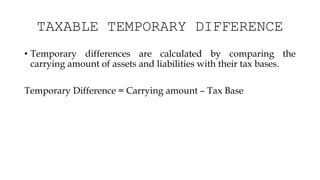
TAXABLE TEMPORARY DIFFERENCE
• Temporary differences are calculated by comparing the
carrying amount of assets and liabilities with their tax bases.
Temporary Difference = Carrying amount – Tax Base
Deferred tax asset & Liabilities
• Deferred Tax Asset
The amounts of income taxes recoverable in future periods in
respect of:
 deductible temporary differences;
 the carry-forward of unused tax losses; and
the carry-forward of unused tax credits.
• Deferred Tax Liability
The amounts of income taxes payable in future periods in respect
of taxable temporary differences
FORMULAE

IAS 12 - Copy.pptx ffffffffffffffffffffff

  • 1.
    IAS 12 -Accounting for Income Taxes International Accounting Standard 12 PRESENTED BY ABINRADH R
  • 2.
    OBJECTIVE OF IAS 12 •The objective of this Standard is to prescribe the accounting treatment for income taxes. For the purposes of this Standard, income taxes include all domestic and foreign taxes which are based on taxable profits. • IAS 12 seeks to provide a structured framework for recognizing and measuring income taxes, ensuring that financial statements accurately reflect an entity's tax obligations and the associated impacts on its financial performance and position.
  • 3.
    DEFINITIONS • The followingterms are used in this Standard A) Accounting profit is profit or loss for a period before deducting tax expense. B) Taxable profit is the profit for a period, determined in accordance with the rules established by the taxation authorities, upon which income taxes are payable C) Tax expense is the aggregate amount included in the determination of profit or loss for the period in respect of current tax and deferred tax. D) Current tax is the amount of income taxes payable in respect of the taxable profit for a period. E) Deferred tax liabilities are the amounts of income taxes payable in future periods in respect of taxable temporary differences. F) Deferred tax assets are the amounts of income taxes recoverable in future periods
  • 4.
    TAX BASE • Thetax base of an asset is the amount that will be deductible for tax purposes against any taxable economic benefits that will flow to an entity when it recovers the carrying amount of the asset. • Eg : A machine cost 100. For tax purposes, depreciation of 30 has already been deducted d in the current and prior periods and the remaining cost will be deductible in future periods.
  • 5.
    • The taxbase of a liability is its carrying amount, less any amount that will be deductible for tax purposes in respect of that liability in future periods. • Eg : Current liabilities include accrued fines and penalties with a carrying amount of 100. Fines and penalties are not deductible for tax purposes.
  • 6.
    TAXABLE TEMPORARY DIFFERENCE •Temporary differences are calculated by comparing the carrying amount of assets and liabilities with their tax bases. Temporary Difference = Carrying amount – Tax Base
  • 7.
    Deferred tax asset& Liabilities • Deferred Tax Asset The amounts of income taxes recoverable in future periods in respect of:  deductible temporary differences;  the carry-forward of unused tax losses; and the carry-forward of unused tax credits.
  • 8.
    • Deferred TaxLiability The amounts of income taxes payable in future periods in respect of taxable temporary differences
  • 9.