Advance
Encryption
Standard
Security of cloud computing
Click icon to add picture
2
What is AES?
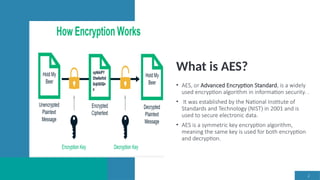
• AES, or Advanced Encryption Standard, is a widely
used encryption algorithm in information security. .
• It was established by the National Institute of
Standards and Technology (NIST) in 2001 and is
used to secure electronic data.
• AES is a symmetric key encryption algorithm,
meaning the same key is used for both encryption
and decryption.
Click icon to add picture
3
Enhancement of Cloud Computing Security with
Secure Data Storage using AES
(Vishal R. Pancholi , Dr. Bhadresh P. Patel )
Click icon to add picture
4
Introduction
• Cloud computing makes it
easy for organizations to
access resources and achieve
their goals.
• However, storing data in the
cloud poses security risks.- To
secure data, cryptography is
used.-
• AES is a type of cryptography
algorithm that scrambles
data to keep it safe.
• . It is based on several
substitutions, permutation
and transformation.
• On the other hand security of
the data in the cloud database
server is the key area of concern.
• It requires a very high degree of
privacy and authentication. To
protect the data in cloud
database
• server cryptography is one of the
important methods.
Cryptography provides various
symmetric and asymmetric
algorithms to secure the data.
• This paper presents the
symmetric cryptographic
algorithm named as AES
(Advanced Encryption Standard).
Click icon to add picture
6
Methodology
3)Algorithm Selection
• They selected the AES algorithm as the solution due to
its speed, efficiency, and security features.
4)Description of AES Algorithm
• They explained how the AES algorithm works, including
the substitution, permutation, and transformation
processes.
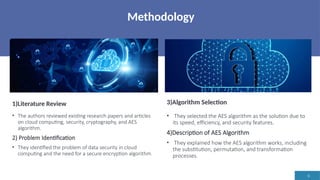
1)Literature Review
• The authors reviewed existing research papers and articles
on cloud computing, security, cryptography, and AES
algorithm.
2) Problem Identification
• They identified the problem of data security in cloud
computing and the need for a secure encryption algorithm.
7
Methodology
6)Conclusion
• They concluded that AES algorithm is a highly secure
encryption method for data storage in cloud computing.
• Selected the AES algorithm as the solution, explained
how it works, analyzed its benefits, and concluded that it
is a highly secure encryption method.
5)Analysis
• They analyzed the benefits of using AES algorithm for
data security in cloud computing, including its resistance
to various attacks and high security level.
8
An Ultra-High Throughput and Efficient
Implementation of Advanced Encryption Standard
(Sarita Sanap and Vijayshree More )
Click icon to add picture
9
Methodology
• Implementation of efficient AES is
proposed in this work.
• High throughput is achieved
through:
• Parallel pipeline architecture
• Optimization of S-box
• Simulation, synthesis, and
implementation are done using:
• Vivado 2017.4
• Active Aldec-HDL
• FPGA Virtex 5 and Virtex 7 are used
for implementation.
• Comparative analysis of previous
work and proposed work is
conducted considering various
constraints.
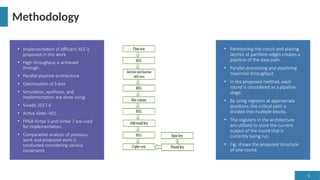
• Partitioning the circuit and placing
latches at partition edges creates a
pipeline of the data path.
• Parallel processing and pipelining
maximize throughput.
• In the proposed method, each
round is considered as a pipeline
stage.
• By using registers at appropriate
positions, the critical path is
divided into multiple blocks.
• The registers in the architecture
are utilized to store the current
output of the round that is
currently being run.
• Fig. shows the proposed structure
of one round.
10
Results
•Significant improvements in throughput and
efficiency.
•Comprehensive comparative analysis.
•NIST validation tests confirm randomness.
•Detailed resource utilization metrics.
•More information on performance metrics and
limitations could be helpful.
11
Conclusion
•AES Implementation: Based on pipeline structure and optimized S-box.
•Throughput & Efficiency: Provides high throughput and efficient encryption.
•FPGA Implementation:
 Uses less area.
 Significantly reduces delay.
 Suitable for constrained nodes.
•Design Evaluation:
 Effectiveness assessed using avalanche effect and strict avalanche criterion (SAC).
 Achieved a significant increase in avalanche effect.
 Strict avalanche criterion effectively met.
•Validation:
 Design validated using NIST tests.
 Proved achievement of the randomness factor.
•Resource Utilization: For 7vx330ffg1157, only 1% of available slices used.
•Future Work: Plans to extend the work for ASIC synthesis flow with cryptanalysis performance.
12
A MODIFIED ADVANCED ENCRYPTION STANDARD
ALGORITHM
(M. Indrasena Reddy, A.P Siva Kumar )
Click icon to add picture
13
Methodology
• The proposed work deals with the
transmission of data from the
sender to the receiver in a
computer network in a secure
manner.
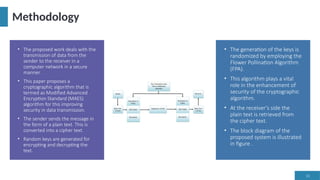
• This paper proposes a
cryptographic algorithm that is
termed as Modified Advanced
Encryption Standard (MAES)
algorithm for this improving
security in data transmission.
• The sender sends the message in
the form of a plain text. This is
converted into a cipher text.
• Random keys are generated for
encrypting and decrypting the
text.
• The generation of the keys is
randomized by employing the
Flower Pollination Algorithm
(FPA).
• This algorithm plays a vital
role in the enhancement of
security of the cryptographic
algorithm.
• At the receiver’s side the
plain text is retrieved from
the cipher text.
• The block diagram of the
proposed system is illustrated
in figure .
14
Results
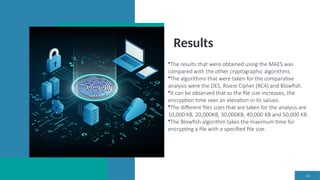
•The results that were obtained using the MAES was
compared with the other cryptographic algorithms.
•The algorithms that were taken for the comparative
analysis were the DES, Rivest Cipher (RC4) and Blowfish.
•It can be observed that as the file size increases, the
encryption time sees an elevation in its values.
•The different files sizes that are taken for the analysis are
10,000 KB, 20,000KB, 30,000KB, 40,000 KB and 50,000 KB.
•The Blowfish algorithm takes the maximum time for
encrypting a file with a specified file size.
15
Conclusion
•This paper has dealt with the development of a secure approach for data transmission over computer networks.
•The MAES algorithm was developed as an enhancement to the traditional AES.
•The generation of the key in the MAES algorithm was done using the FPA.
•This improved the randomness of the process of generating the key for encryption and decryption.
•The MAES algorithm has outstanding results when compared to the other existing algorithms.
•From the experimental results, it is evident that the encryption time, decryption time, memory usage and security level
have yielded promising results.
•This justifies the performance of the MAES algorithm.
•This work can be further extended for diverse applications.
16
Advanced Encryption Standard (AES) Algorithm to
Encrypt and Decrypt Data
(Ako Muhamad Abdullah)
Click icon to add picture
17
Methodology
• Selective encryption is a technique
for encrypting only parts of a
compressed video stream to reduce
computational complexity Selective
encryption is not a new idea.
• It has been proposed in several
applications, especially in
multimedia system.
• Selective encryption can be used to
reduce the power consumed by the
encryption function for digital
content.
• Since particular parts of the bit
stream are encrypted, selective
encryption can also enable new
system functionality such allowing
previewing of content.
• For selective encryption to work,
we need to rely on a
characteristic of the compression
algorithm to concentrate
important data relative to the
original signal in a relatively small
fraction of the compressed
bitstream.
• In our selective encryption, an I-
Frame bit stream of H.264/AVC,
bitstream is encrypted to
minimize computational
complexity or provide new
functionalities for uses of the
encrypted bit stream while at the
same time providing reasonable
security of the bit stream.
18
Results
•AES may, as all algorithms, be used in different ways to
perform encryption.
•Different methods are suitable for different situations.
•It is vital that the correct method is applied in the correct
manner to each and every situation, or the result may well
be insecure even if AES as such is secure.
•It is very easy to implement a system using AES as its
encryption algorithm, but much more skill and experience
are required to do it in the right way for a given situation.
•To describe exactly how to apply AES for varying purposes
is very much out of scope for this paper.
19
Conclusion
•This paper a proposed system to study video data security by a review and investigation on multimedia security
technologies and successful to achievement main above goals, which enhancing the Selective Video Encryption Using
Computation between H.264/AVC and AES Encryption Algorithm H.264/AVC bit-stream was able to be consumed in a form
of the partial bit-stream converted by extraction process.
• At this time, each bitsrtream of the H.264/AVC bitstream should be consumed by a trusted user who has the rights for
accessibility. The requirements for H.264/AVC encryption and decryption are as follow.
•The encryption considers the security, time efficiency, format compliance and error robustness, basically. The I Frame
encryption being the basis of P-frame and B-Frame in H.264/AVC bit-streams should be more securely protected than the
enhancement layers.

Advance Encryption Standard and its better performance

  • 1.
    Advance Encryption Standard Security of cloudcomputing Click icon to add picture
  • 2.
    2 What is AES? •AES, or Advanced Encryption Standard, is a widely used encryption algorithm in information security. . • It was established by the National Institute of Standards and Technology (NIST) in 2001 and is used to secure electronic data. • AES is a symmetric key encryption algorithm, meaning the same key is used for both encryption and decryption. Click icon to add picture
  • 3.
    3 Enhancement of CloudComputing Security with Secure Data Storage using AES (Vishal R. Pancholi , Dr. Bhadresh P. Patel ) Click icon to add picture
  • 4.
    4 Introduction • Cloud computingmakes it easy for organizations to access resources and achieve their goals. • However, storing data in the cloud poses security risks.- To secure data, cryptography is used.- • AES is a type of cryptography algorithm that scrambles data to keep it safe. • . It is based on several substitutions, permutation and transformation. • On the other hand security of the data in the cloud database server is the key area of concern. • It requires a very high degree of privacy and authentication. To protect the data in cloud database • server cryptography is one of the important methods. Cryptography provides various symmetric and asymmetric algorithms to secure the data. • This paper presents the symmetric cryptographic algorithm named as AES (Advanced Encryption Standard).
  • 5.
    Click icon toadd picture
  • 6.
    6 Methodology 3)Algorithm Selection • Theyselected the AES algorithm as the solution due to its speed, efficiency, and security features. 4)Description of AES Algorithm • They explained how the AES algorithm works, including the substitution, permutation, and transformation processes. 1)Literature Review • The authors reviewed existing research papers and articles on cloud computing, security, cryptography, and AES algorithm. 2) Problem Identification • They identified the problem of data security in cloud computing and the need for a secure encryption algorithm.
  • 7.
    7 Methodology 6)Conclusion • They concludedthat AES algorithm is a highly secure encryption method for data storage in cloud computing. • Selected the AES algorithm as the solution, explained how it works, analyzed its benefits, and concluded that it is a highly secure encryption method. 5)Analysis • They analyzed the benefits of using AES algorithm for data security in cloud computing, including its resistance to various attacks and high security level.
  • 8.
    8 An Ultra-High Throughputand Efficient Implementation of Advanced Encryption Standard (Sarita Sanap and Vijayshree More ) Click icon to add picture
  • 9.
    9 Methodology • Implementation ofefficient AES is proposed in this work. • High throughput is achieved through: • Parallel pipeline architecture • Optimization of S-box • Simulation, synthesis, and implementation are done using: • Vivado 2017.4 • Active Aldec-HDL • FPGA Virtex 5 and Virtex 7 are used for implementation. • Comparative analysis of previous work and proposed work is conducted considering various constraints. • Partitioning the circuit and placing latches at partition edges creates a pipeline of the data path. • Parallel processing and pipelining maximize throughput. • In the proposed method, each round is considered as a pipeline stage. • By using registers at appropriate positions, the critical path is divided into multiple blocks. • The registers in the architecture are utilized to store the current output of the round that is currently being run. • Fig. shows the proposed structure of one round.
  • 10.
    10 Results •Significant improvements inthroughput and efficiency. •Comprehensive comparative analysis. •NIST validation tests confirm randomness. •Detailed resource utilization metrics. •More information on performance metrics and limitations could be helpful.
  • 11.
    11 Conclusion •AES Implementation: Basedon pipeline structure and optimized S-box. •Throughput & Efficiency: Provides high throughput and efficient encryption. •FPGA Implementation:  Uses less area.  Significantly reduces delay.  Suitable for constrained nodes. •Design Evaluation:  Effectiveness assessed using avalanche effect and strict avalanche criterion (SAC).  Achieved a significant increase in avalanche effect.  Strict avalanche criterion effectively met. •Validation:  Design validated using NIST tests.  Proved achievement of the randomness factor. •Resource Utilization: For 7vx330ffg1157, only 1% of available slices used. •Future Work: Plans to extend the work for ASIC synthesis flow with cryptanalysis performance.
  • 12.
    12 A MODIFIED ADVANCEDENCRYPTION STANDARD ALGORITHM (M. Indrasena Reddy, A.P Siva Kumar ) Click icon to add picture
  • 13.
    13 Methodology • The proposedwork deals with the transmission of data from the sender to the receiver in a computer network in a secure manner. • This paper proposes a cryptographic algorithm that is termed as Modified Advanced Encryption Standard (MAES) algorithm for this improving security in data transmission. • The sender sends the message in the form of a plain text. This is converted into a cipher text. • Random keys are generated for encrypting and decrypting the text. • The generation of the keys is randomized by employing the Flower Pollination Algorithm (FPA). • This algorithm plays a vital role in the enhancement of security of the cryptographic algorithm. • At the receiver’s side the plain text is retrieved from the cipher text. • The block diagram of the proposed system is illustrated in figure .
  • 14.
    14 Results •The results thatwere obtained using the MAES was compared with the other cryptographic algorithms. •The algorithms that were taken for the comparative analysis were the DES, Rivest Cipher (RC4) and Blowfish. •It can be observed that as the file size increases, the encryption time sees an elevation in its values. •The different files sizes that are taken for the analysis are 10,000 KB, 20,000KB, 30,000KB, 40,000 KB and 50,000 KB. •The Blowfish algorithm takes the maximum time for encrypting a file with a specified file size.
  • 15.
    15 Conclusion •This paper hasdealt with the development of a secure approach for data transmission over computer networks. •The MAES algorithm was developed as an enhancement to the traditional AES. •The generation of the key in the MAES algorithm was done using the FPA. •This improved the randomness of the process of generating the key for encryption and decryption. •The MAES algorithm has outstanding results when compared to the other existing algorithms. •From the experimental results, it is evident that the encryption time, decryption time, memory usage and security level have yielded promising results. •This justifies the performance of the MAES algorithm. •This work can be further extended for diverse applications.
  • 16.
    16 Advanced Encryption Standard(AES) Algorithm to Encrypt and Decrypt Data (Ako Muhamad Abdullah) Click icon to add picture
  • 17.
    17 Methodology • Selective encryptionis a technique for encrypting only parts of a compressed video stream to reduce computational complexity Selective encryption is not a new idea. • It has been proposed in several applications, especially in multimedia system. • Selective encryption can be used to reduce the power consumed by the encryption function for digital content. • Since particular parts of the bit stream are encrypted, selective encryption can also enable new system functionality such allowing previewing of content. • For selective encryption to work, we need to rely on a characteristic of the compression algorithm to concentrate important data relative to the original signal in a relatively small fraction of the compressed bitstream. • In our selective encryption, an I- Frame bit stream of H.264/AVC, bitstream is encrypted to minimize computational complexity or provide new functionalities for uses of the encrypted bit stream while at the same time providing reasonable security of the bit stream.
  • 18.
    18 Results •AES may, asall algorithms, be used in different ways to perform encryption. •Different methods are suitable for different situations. •It is vital that the correct method is applied in the correct manner to each and every situation, or the result may well be insecure even if AES as such is secure. •It is very easy to implement a system using AES as its encryption algorithm, but much more skill and experience are required to do it in the right way for a given situation. •To describe exactly how to apply AES for varying purposes is very much out of scope for this paper.
  • 19.
    19 Conclusion •This paper aproposed system to study video data security by a review and investigation on multimedia security technologies and successful to achievement main above goals, which enhancing the Selective Video Encryption Using Computation between H.264/AVC and AES Encryption Algorithm H.264/AVC bit-stream was able to be consumed in a form of the partial bit-stream converted by extraction process. • At this time, each bitsrtream of the H.264/AVC bitstream should be consumed by a trusted user who has the rights for accessibility. The requirements for H.264/AVC encryption and decryption are as follow. •The encryption considers the security, time efficiency, format compliance and error robustness, basically. The I Frame encryption being the basis of P-frame and B-Frame in H.264/AVC bit-streams should be more securely protected than the enhancement layers.