KINDS OF BREAD
Prepared by: Maria Merllan Estrellante Mier
Types of Bread
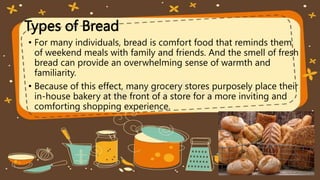
• For many individuals, bread is comfort food that reminds them
of weekend meals with family and friends. And the smell of fresh
bread can provide an overwhelming sense of warmth and
familiarity.
• Because of this effect, many grocery stores purposely place their
in-house bakery at the front of a store for a more inviting and
comforting shopping experience.
Types of Bread
• There are dozens of types of bread other than traditional
white or brown varieties to choose from when creating a
delicious meal or snack. Each selection has its benefits and
what circumstances are best for pairing.
• Some varieties are leavened while others are unleavened.
The difference here is how the bread rises and the shape of
the end product.
Types of Bread
•Here, we take a look at the most popular types
and break down why they are different and
when they are best suited. If you need more
options for your next meal, one of these choices
could be perfect.
SOURDOUGH
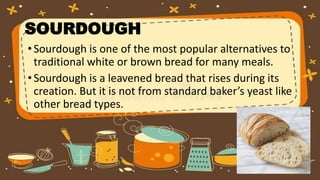
•Sourdough is one of the most popular alternatives to
traditional white or brown bread for many meals.
•Sourdough is a leavened bread that rises during its
creation. But it is not from standard baker’s yeast like
other bread types.
SOURDOUGH
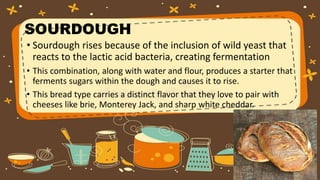
• Sourdough rises because of the inclusion of wild yeast that
reacts to the lactic acid bacteria, creating fermentation
• This combination, along with water and flour, produces a starter that
ferments sugars within the dough and causes it to rise.
• This bread type carries a distinct flavor that they love to pair with
cheeses like brie, Monterey Jack, and sharp white cheddar.
BAGUETTE
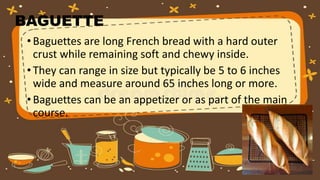
•Baguettes are long French bread with a hard outer
crust while remaining soft and chewy inside.
•They can range in size but typically be 5 to 6 inches
wide and measure around 65 inches long or more.
•Baguettes can be an appetizer or as part of the main
course.
BAGUETTE
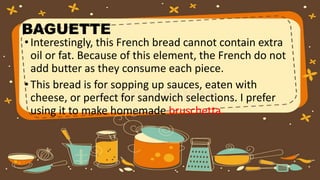
•Interestingly, this French bread cannot contain extra
oil or fat. Because of this element, the French do not
add butter as they consume each piece.
•This bread is for sopping up sauces, eaten with
cheese, or perfect for sandwich selections. I prefer
using it to make homemade bruschetta.
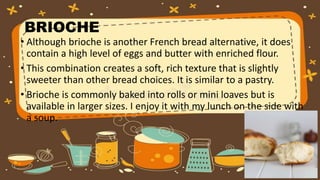
BRIOCHE
• Although brioche is another French bread alternative, it does
contain a high level of eggs and butter with enriched flour.
• This combination creates a soft, rich texture that is slightly
sweeter than other bread choices. It is similar to a pastry.
• Brioche is commonly baked into rolls or mini loaves but is
available in larger sizes. I enjoy it with my lunch on the side with
a soup.
BRIOCHE
• This type of bread is perfect for making French toast,
bread puddings, and sandwiches. It’s also great for
snacks or desserts where a dense, sweeter bread
alternative pairs well.
• Try a brioche bun with your best-loved soup, and you
will have your next favorite meal option.
FOCACCIA
• Focaccia is an Italian flat oven-baked leavened bread, similar to
pizza dough. But, it contains more yeast, making it rise and
produce a fluffy appearance.
• Typically, it will rise between one-half to one-inch thick.
• One characteristic of this bread is the punctures before baking.
Which helps retain moisture and gives it a perforated exterior.
These indents are also ideal for holding oil when dipping.
FOCACCIA
•It is typically a side dish item rather than an appetizer
or as part of the main course.
•Focaccia goes well with a soup or salad, hummus, or
braised greens. Although I am partial to using it for
hummus or other artichoke-style dips.
CIABATTA
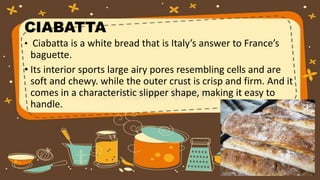
• Ciabatta is a white bread that is Italy’s answer to France’s
baguette.
• Its interior sports large airy pores resembling cells and are
soft and chewy. while the outer crust is crisp and firm. And it
comes in a characteristic slipper shape, making it easy to
handle.
CIABATTA
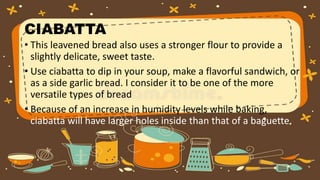
• This leavened bread also uses a stronger flour to provide a
slightly delicate, sweet taste.
• Use ciabatta to dip in your soup, make a flavorful sandwich, or
as a side garlic bread. I consider it to be one of the more
versatile types of bread
• Because of an increase in humidity levels while baking,
ciabatta will have larger holes inside than that of a baguette.
RYE BREAD
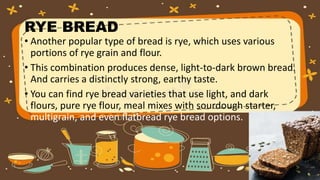
• Another popular type of bread is rye, which uses various
portions of rye grain and flour.
• This combination produces dense, light-to-dark brown bread.
And carries a distinctly strong, earthy taste.
• You can find rye bread varieties that use light, and dark
flours, pure rye flour, meal mixes with sourdough starter,
multigrain, and even flatbread rye bread options.
RYE BREAD
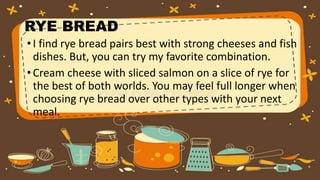
•I find rye bread pairs best with strong cheeses and fish
dishes. But, you can try my favorite combination.
•Cream cheese with sliced salmon on a slice of rye for
the best of both worlds. You may feel full longer when
choosing rye bread over other types with your next
meal.
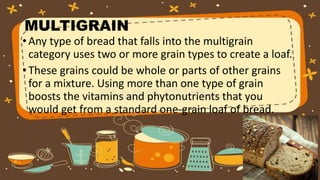
MULTIGRAIN
•Any type of bread that falls into the multigrain
category uses two or more grain types to create a loaf.
•These grains could be whole or parts of other grains
for a mixture. Using more than one type of grain
boosts the vitamins and phytonutrients that you
would get from a standard one-grain loaf of bread.
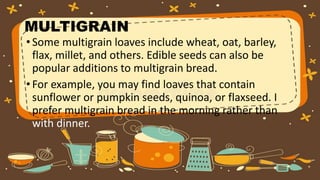
MULTIGRAIN
•Some multigrain loaves include wheat, oat, barley,
flax, millet, and others. Edible seeds can also be
popular additions to multigrain bread.
•For example, you may find loaves that contain
sunflower or pumpkin seeds, quinoa, or flaxseed. I
prefer multigrain bread in the morning rather than
with dinner.
PITA
•A pita is a Greek round-leavened flatbread that is
highly versatile for various meal options.
•It comes from wheat flour and does not contain as
much sodium as other types of bread. This feature
makes pitas a better choice for individuals on a low-
sodium diet.
PITA
•Although you can use pitas for virtually anything you
would use traditional bread for, they are familiar
staples for wraps, falafels, hummus, and baba ganoush.
•So, whether you use it as a meal option, snack, or side,
pitas can be perfect for virtually any menu choice.
WHOLE-GRAIN
• If you select whole-grain bread at the store, your loaf will contain
completely intact grain.
• Along with other grains, such as barley, oats, brown rice, and others.
As a result, this variety will be full of vitamins and nutrients not found
in non-whole grain.
• Whole grain bread is healthier than other types and is suitable for any
time of the day or night. But, this type of bread is best for sandwich
meals, toast, or snacks.
• This variety is ideal for anyone who is eating better and avoiding
processed grains.
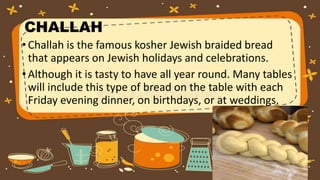
CHALLAH
•Challah is the famous kosher Jewish braided bread
that appears on Jewish holidays and celebrations.
•Although it is tasty to have all year round. Many tables
will include this type of bread on the table with each
Friday evening dinner, on birthdays, or at weddings.
CHALLAH
• It does have a large concentration of eggs, giving it a yellow
hue, and is rich in taste. Some challah recipes include raisins,
seeds, or honey for delicious alternatives.
• The braided structure symbolizes the Jewish community. But,
anyone can enjoy this delicious bread.
• Although I am not Jewish, I look forward to visiting friends who
include this bread at gatherings so I can partake in their
traditions.
NAAN
•Naan bread is a Persian flatbread that is versatile and
delicious in many ways.
•Some individuals may confuse naan bread with pitas. But
there are clear differences between these types of bread.
•Naan bread uses milk, yogurt, butter, and eggs, while
pitas do not.
NAAN
•These ingredients make it softer and more pliable to
work with before baking in an oven in round shapes.
•You can use naan bread for soups, and sauces, as a
wrap, or as a side to the main rice dish. I prefer to pair
naan bread with a plate of Cilantro Lime Chicken.
SODA BREAD
• Soda bread is an Irish variety that uses sodium
bicarbonate rather than traditional yeast to help the
bread rise.
• Using only four ingredients, including salt, soft flour,
baking soda, and milk, this type of bread is a staple in
Irish traditions.
SODA BREAD
•The baking soda reacts with sour milk or buttermilk to
replicate leavening without yeast.
•This bread carries a mild flavor and pairs well with
soups, stews, or as part of a hearty sandwich. But, I
prefer to use soda bread anytime I have a big bowl of
Irish stew.
SPROUTED BREAD
•Sprouted bread, also known as Ezekiel bread, is a
popular choice for many individuals because of
its baking process.
•One of the main features of sprouted types of
bread is that it does not contain any sugars.
SPROUTED BREAD
•For anyone watching their sugar intake, this bread is a
terrific option.
•Individuals with sensitivities to gluten or wheat may
find sprouted bread easier to digest. You can use
sprouted bread for sandwiches, toast, or other snacks.
POTATO BREAD
•If you have never tried potato bread, you are missing
out. I enjoy how this variety has a mild flavor that
helps add to your plate.
•It has a soft yet springy texture that keeps fresh longer
than traditional white bread.
POTATO BREAD
• Potato bread is easy to make, and I am confident that it will
not last long once you try it for yourself.
• This type of bread with a mild potato flavor goes well with
your chicken or ham sandwich. Or if you are adventurous,
make potato bread rolls and include them with your roast
chicken or ham at your next meal.
PUMPERNICKEL
•is a German bread that relies on coarse rye flour.
And it can use yeast or a sourdough starter,
depending on the variety.
•It has an exceptionally dark color to its dense but
moist interior, and some types will include seeds.
PUMPERNICKEL
• Because pumpernickel is a variation of rye bread, it will also
have an earthy flavor. But it will taste nuttier because of the
concentration of coarse flour.
• This bolder flavor pairs perfectly with sharp cheeses and
strong-flavor meats. I prefer pumpernickel when I make a
sharp cheddar and ham sandwich for my lunch.
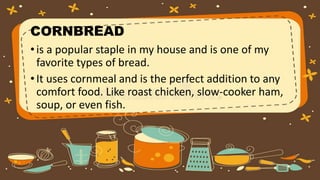
CORNBREAD
•is a popular staple in my house and is one of my
favorite types of bread.
•It uses cornmeal and is the perfect addition to any
comfort food. Like roast chicken, slow-cooker ham,
soup, or even fish.
•Corn does not include gluten, so it does not rise like
other types of bread. However, you can create a fluffy,
crumbly texture by using baking powder.
•Cornbread has a slightly sweet taste and is dense. It
does not keep well once baked, but there is no need
to worry because it is delicious and will not last.
CORNBREAD
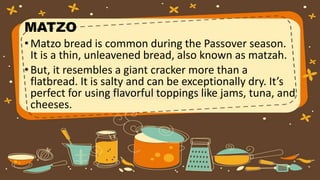
MATZO
• Matzo bread is common during the Passover season.
It is a thin, unleavened bread, also known as matzah.
• But, it resembles a giant cracker more than a
flatbread. It is salty and can be exceptionally dry. It’s
perfect for using flavorful toppings like jams, tuna, and
cheeses.
MATZO
•This type of bread is also available in many varieties.
As it can use different flours for alternative tastes.
•Matzo is ideal for virtually anything you want to put
on bread. From peanut butter and jelly to tuna salad
and egg and avocado, there are so many options that
it is hard for me to choose my favorite.
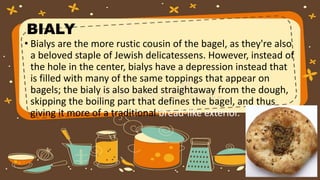
BIALY
• Bialys are the more rustic cousin of the bagel, as they're also
a beloved staple of Jewish delicatessens. However, instead of
the hole in the center, bialys have a depression instead that
is filled with many of the same toppings that appear on
bagels; the bialy is also baked straightaway from the dough,
skipping the boiling part that defines the bagel, and thus
giving it more of a traditional bread-like exterior.
BAGEL
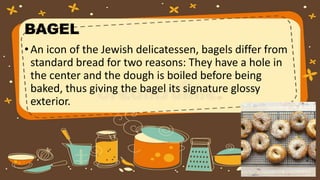
•An icon of the Jewish delicatessen, bagels differ from
standard bread for two reasons: They have a hole in
the center and the dough is boiled before being
baked, thus giving the bagel its signature glossy
exterior.
ENGLISH MUFFIN
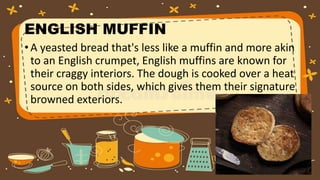
• A yeasted bread that's less like a muffin and more akin
to an English crumpet, English muffins are known for
their craggy interiors. The dough is cooked over a heat
source on both sides, which gives them their signature
browned exteriors.
FLATBREAD
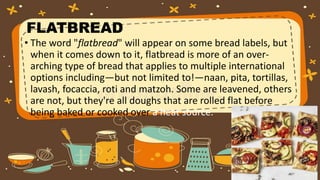
• The word "flatbread" will appear on some bread labels, but
when it comes down to it, flatbread is more of an over-
arching type of bread that applies to multiple international
options including—but not limited to!—naan, pita, tortillas,
lavash, focaccia, roti and matzoh. Some are leavened, others
are not, but they're all doughs that are rolled flat before
being baked or cooked over a heat source.
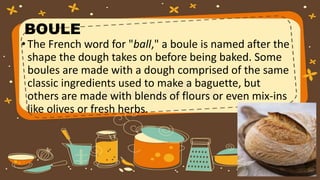
BOULE
•The French word for "ball," a boule is named after the
shape the dough takes on before being baked. Some
boules are made with a dough comprised of the same
classic ingredients used to make a baguette, but
others are made with blends of flours or even mix-ins
like olives or fresh herbs.
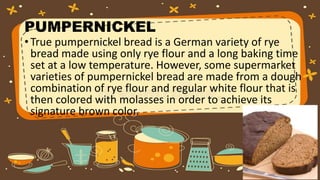
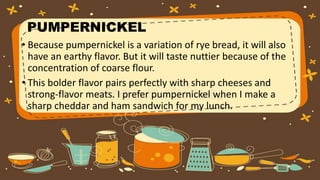
PUMPERNICKEL
•True pumpernickel bread is a German variety of rye
bread made using only rye flour and a long baking time
set at a low temperature. However, some supermarket
varieties of pumpernickel bread are made from a dough
combination of rye flour and regular white flour that is
then colored with molasses in order to achieve its
signature brown color.
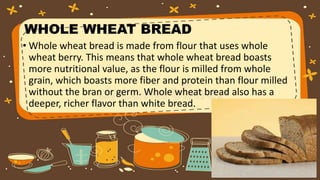
WHOLE WHEAT BREAD
• Whole wheat bread is made from flour that uses whole
wheat berry. This means that whole wheat bread boasts
more nutritional value, as the flour is milled from whole
grain, which boasts more fiber and protein than flour milled
without the bran or germ. Whole wheat bread also has a
deeper, richer flavor than white bread.
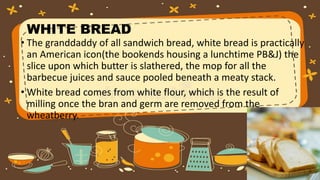
WHITE BREAD
• The granddaddy of all sandwich bread, white bread is practically
an American icon(the bookends housing a lunchtime PB&J) the
slice upon which butter is slathered, the mop for all the
barbecue juices and sauce pooled beneath a meaty stack.
• White bread comes from white flour, which is the result of
milling once the bran and germ are removed from the
wheatberry.
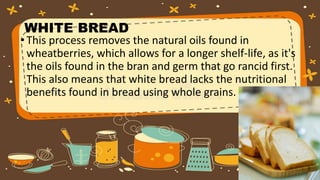
WHITE BREAD
• This process removes the natural oils found in
wheatberries, which allows for a longer shelf-life, as it's
the oils found in the bran and germ that go rancid first.
This also means that white bread lacks the nutritional
benefits found in bread using whole grains.
 THANK YOU 
- Ma’am Lyn

Advance Baking 10 (kinds bread).pptx

  • 1.
    KINDS OF BREAD Preparedby: Maria Merllan Estrellante Mier
  • 2.
    Types of Bread •For many individuals, bread is comfort food that reminds them of weekend meals with family and friends. And the smell of fresh bread can provide an overwhelming sense of warmth and familiarity. • Because of this effect, many grocery stores purposely place their in-house bakery at the front of a store for a more inviting and comforting shopping experience.
  • 3.
    Types of Bread •There are dozens of types of bread other than traditional white or brown varieties to choose from when creating a delicious meal or snack. Each selection has its benefits and what circumstances are best for pairing. • Some varieties are leavened while others are unleavened. The difference here is how the bread rises and the shape of the end product.
  • 4.
    Types of Bread •Here,we take a look at the most popular types and break down why they are different and when they are best suited. If you need more options for your next meal, one of these choices could be perfect.
  • 5.
    SOURDOUGH •Sourdough is oneof the most popular alternatives to traditional white or brown bread for many meals. •Sourdough is a leavened bread that rises during its creation. But it is not from standard baker’s yeast like other bread types.
  • 6.
    SOURDOUGH • Sourdough risesbecause of the inclusion of wild yeast that reacts to the lactic acid bacteria, creating fermentation • This combination, along with water and flour, produces a starter that ferments sugars within the dough and causes it to rise. • This bread type carries a distinct flavor that they love to pair with cheeses like brie, Monterey Jack, and sharp white cheddar.
  • 7.
    BAGUETTE •Baguettes are longFrench bread with a hard outer crust while remaining soft and chewy inside. •They can range in size but typically be 5 to 6 inches wide and measure around 65 inches long or more. •Baguettes can be an appetizer or as part of the main course.
  • 8.
    BAGUETTE •Interestingly, this Frenchbread cannot contain extra oil or fat. Because of this element, the French do not add butter as they consume each piece. •This bread is for sopping up sauces, eaten with cheese, or perfect for sandwich selections. I prefer using it to make homemade bruschetta.
  • 9.
    BRIOCHE • Although briocheis another French bread alternative, it does contain a high level of eggs and butter with enriched flour. • This combination creates a soft, rich texture that is slightly sweeter than other bread choices. It is similar to a pastry. • Brioche is commonly baked into rolls or mini loaves but is available in larger sizes. I enjoy it with my lunch on the side with a soup.
  • 10.
    BRIOCHE • This typeof bread is perfect for making French toast, bread puddings, and sandwiches. It’s also great for snacks or desserts where a dense, sweeter bread alternative pairs well. • Try a brioche bun with your best-loved soup, and you will have your next favorite meal option.
  • 11.
    FOCACCIA • Focaccia isan Italian flat oven-baked leavened bread, similar to pizza dough. But, it contains more yeast, making it rise and produce a fluffy appearance. • Typically, it will rise between one-half to one-inch thick. • One characteristic of this bread is the punctures before baking. Which helps retain moisture and gives it a perforated exterior. These indents are also ideal for holding oil when dipping.
  • 12.
    FOCACCIA •It is typicallya side dish item rather than an appetizer or as part of the main course. •Focaccia goes well with a soup or salad, hummus, or braised greens. Although I am partial to using it for hummus or other artichoke-style dips.
  • 13.
    CIABATTA • Ciabatta isa white bread that is Italy’s answer to France’s baguette. • Its interior sports large airy pores resembling cells and are soft and chewy. while the outer crust is crisp and firm. And it comes in a characteristic slipper shape, making it easy to handle.
  • 14.
    CIABATTA • This leavenedbread also uses a stronger flour to provide a slightly delicate, sweet taste. • Use ciabatta to dip in your soup, make a flavorful sandwich, or as a side garlic bread. I consider it to be one of the more versatile types of bread • Because of an increase in humidity levels while baking, ciabatta will have larger holes inside than that of a baguette.
  • 15.
    RYE BREAD • Anotherpopular type of bread is rye, which uses various portions of rye grain and flour. • This combination produces dense, light-to-dark brown bread. And carries a distinctly strong, earthy taste. • You can find rye bread varieties that use light, and dark flours, pure rye flour, meal mixes with sourdough starter, multigrain, and even flatbread rye bread options.
  • 16.
    RYE BREAD •I findrye bread pairs best with strong cheeses and fish dishes. But, you can try my favorite combination. •Cream cheese with sliced salmon on a slice of rye for the best of both worlds. You may feel full longer when choosing rye bread over other types with your next meal.
  • 17.
    MULTIGRAIN •Any type ofbread that falls into the multigrain category uses two or more grain types to create a loaf. •These grains could be whole or parts of other grains for a mixture. Using more than one type of grain boosts the vitamins and phytonutrients that you would get from a standard one-grain loaf of bread.
  • 18.
    MULTIGRAIN •Some multigrain loavesinclude wheat, oat, barley, flax, millet, and others. Edible seeds can also be popular additions to multigrain bread. •For example, you may find loaves that contain sunflower or pumpkin seeds, quinoa, or flaxseed. I prefer multigrain bread in the morning rather than with dinner.
  • 19.
    PITA •A pita isa Greek round-leavened flatbread that is highly versatile for various meal options. •It comes from wheat flour and does not contain as much sodium as other types of bread. This feature makes pitas a better choice for individuals on a low- sodium diet.
  • 20.
    PITA •Although you canuse pitas for virtually anything you would use traditional bread for, they are familiar staples for wraps, falafels, hummus, and baba ganoush. •So, whether you use it as a meal option, snack, or side, pitas can be perfect for virtually any menu choice.
  • 21.
    WHOLE-GRAIN • If youselect whole-grain bread at the store, your loaf will contain completely intact grain. • Along with other grains, such as barley, oats, brown rice, and others. As a result, this variety will be full of vitamins and nutrients not found in non-whole grain. • Whole grain bread is healthier than other types and is suitable for any time of the day or night. But, this type of bread is best for sandwich meals, toast, or snacks. • This variety is ideal for anyone who is eating better and avoiding processed grains.
  • 22.
    CHALLAH •Challah is thefamous kosher Jewish braided bread that appears on Jewish holidays and celebrations. •Although it is tasty to have all year round. Many tables will include this type of bread on the table with each Friday evening dinner, on birthdays, or at weddings.
  • 23.
    CHALLAH • It doeshave a large concentration of eggs, giving it a yellow hue, and is rich in taste. Some challah recipes include raisins, seeds, or honey for delicious alternatives. • The braided structure symbolizes the Jewish community. But, anyone can enjoy this delicious bread. • Although I am not Jewish, I look forward to visiting friends who include this bread at gatherings so I can partake in their traditions.
  • 24.
    NAAN •Naan bread isa Persian flatbread that is versatile and delicious in many ways. •Some individuals may confuse naan bread with pitas. But there are clear differences between these types of bread. •Naan bread uses milk, yogurt, butter, and eggs, while pitas do not.
  • 25.
    NAAN •These ingredients makeit softer and more pliable to work with before baking in an oven in round shapes. •You can use naan bread for soups, and sauces, as a wrap, or as a side to the main rice dish. I prefer to pair naan bread with a plate of Cilantro Lime Chicken.
  • 26.
    SODA BREAD • Sodabread is an Irish variety that uses sodium bicarbonate rather than traditional yeast to help the bread rise. • Using only four ingredients, including salt, soft flour, baking soda, and milk, this type of bread is a staple in Irish traditions.
  • 27.
    SODA BREAD •The bakingsoda reacts with sour milk or buttermilk to replicate leavening without yeast. •This bread carries a mild flavor and pairs well with soups, stews, or as part of a hearty sandwich. But, I prefer to use soda bread anytime I have a big bowl of Irish stew.
  • 28.
    SPROUTED BREAD •Sprouted bread,also known as Ezekiel bread, is a popular choice for many individuals because of its baking process. •One of the main features of sprouted types of bread is that it does not contain any sugars.
  • 29.
    SPROUTED BREAD •For anyonewatching their sugar intake, this bread is a terrific option. •Individuals with sensitivities to gluten or wheat may find sprouted bread easier to digest. You can use sprouted bread for sandwiches, toast, or other snacks.
  • 30.
    POTATO BREAD •If youhave never tried potato bread, you are missing out. I enjoy how this variety has a mild flavor that helps add to your plate. •It has a soft yet springy texture that keeps fresh longer than traditional white bread.
  • 31.
    POTATO BREAD • Potatobread is easy to make, and I am confident that it will not last long once you try it for yourself. • This type of bread with a mild potato flavor goes well with your chicken or ham sandwich. Or if you are adventurous, make potato bread rolls and include them with your roast chicken or ham at your next meal.
  • 32.
    PUMPERNICKEL •is a Germanbread that relies on coarse rye flour. And it can use yeast or a sourdough starter, depending on the variety. •It has an exceptionally dark color to its dense but moist interior, and some types will include seeds.
  • 33.
    PUMPERNICKEL • Because pumpernickelis a variation of rye bread, it will also have an earthy flavor. But it will taste nuttier because of the concentration of coarse flour. • This bolder flavor pairs perfectly with sharp cheeses and strong-flavor meats. I prefer pumpernickel when I make a sharp cheddar and ham sandwich for my lunch.
  • 34.
    CORNBREAD •is a popularstaple in my house and is one of my favorite types of bread. •It uses cornmeal and is the perfect addition to any comfort food. Like roast chicken, slow-cooker ham, soup, or even fish.
  • 35.
    •Corn does notinclude gluten, so it does not rise like other types of bread. However, you can create a fluffy, crumbly texture by using baking powder. •Cornbread has a slightly sweet taste and is dense. It does not keep well once baked, but there is no need to worry because it is delicious and will not last. CORNBREAD
  • 36.
    MATZO • Matzo breadis common during the Passover season. It is a thin, unleavened bread, also known as matzah. • But, it resembles a giant cracker more than a flatbread. It is salty and can be exceptionally dry. It’s perfect for using flavorful toppings like jams, tuna, and cheeses.
  • 37.
    MATZO •This type ofbread is also available in many varieties. As it can use different flours for alternative tastes. •Matzo is ideal for virtually anything you want to put on bread. From peanut butter and jelly to tuna salad and egg and avocado, there are so many options that it is hard for me to choose my favorite.
  • 38.
    BIALY • Bialys arethe more rustic cousin of the bagel, as they're also a beloved staple of Jewish delicatessens. However, instead of the hole in the center, bialys have a depression instead that is filled with many of the same toppings that appear on bagels; the bialy is also baked straightaway from the dough, skipping the boiling part that defines the bagel, and thus giving it more of a traditional bread-like exterior.
  • 39.
    BAGEL •An icon ofthe Jewish delicatessen, bagels differ from standard bread for two reasons: They have a hole in the center and the dough is boiled before being baked, thus giving the bagel its signature glossy exterior.
  • 40.
    ENGLISH MUFFIN • Ayeasted bread that's less like a muffin and more akin to an English crumpet, English muffins are known for their craggy interiors. The dough is cooked over a heat source on both sides, which gives them their signature browned exteriors.
  • 41.
    FLATBREAD • The word"flatbread" will appear on some bread labels, but when it comes down to it, flatbread is more of an over- arching type of bread that applies to multiple international options including—but not limited to!—naan, pita, tortillas, lavash, focaccia, roti and matzoh. Some are leavened, others are not, but they're all doughs that are rolled flat before being baked or cooked over a heat source.
  • 42.
    BOULE •The French wordfor "ball," a boule is named after the shape the dough takes on before being baked. Some boules are made with a dough comprised of the same classic ingredients used to make a baguette, but others are made with blends of flours or even mix-ins like olives or fresh herbs.
  • 43.
    PUMPERNICKEL •True pumpernickel breadis a German variety of rye bread made using only rye flour and a long baking time set at a low temperature. However, some supermarket varieties of pumpernickel bread are made from a dough combination of rye flour and regular white flour that is then colored with molasses in order to achieve its signature brown color.
  • 44.
    WHOLE WHEAT BREAD •Whole wheat bread is made from flour that uses whole wheat berry. This means that whole wheat bread boasts more nutritional value, as the flour is milled from whole grain, which boasts more fiber and protein than flour milled without the bran or germ. Whole wheat bread also has a deeper, richer flavor than white bread.
  • 45.
    WHITE BREAD • Thegranddaddy of all sandwich bread, white bread is practically an American icon(the bookends housing a lunchtime PB&J) the slice upon which butter is slathered, the mop for all the barbecue juices and sauce pooled beneath a meaty stack. • White bread comes from white flour, which is the result of milling once the bran and germ are removed from the wheatberry.
  • 46.
    WHITE BREAD • Thisprocess removes the natural oils found in wheatberries, which allows for a longer shelf-life, as it's the oils found in the bran and germ that go rancid first. This also means that white bread lacks the nutritional benefits found in bread using whole grains.
  • 47.
     THANK YOU - Ma’am Lyn