A P P P R E S E N T A T I O N P R E P A R E D B Y :
A L - M U H I M M . C A N D A O
Adjectives
adjectives
Are words that modify nouns and pronouns.
Adjectives answer the questions:
What kind? Yellow balls, endangered species, gigantic tower
Which one? His girlfriend, that sofa, whose music
How many/much? Both books, several hours, more time
Type of adjectives
Adjectives can take several forms:
articles
titles
possessives
Adjectives of Quality
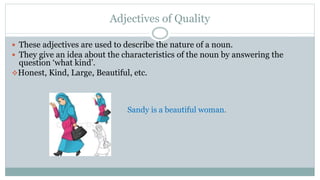
 These adjectives are used to describe the nature of a noun.
 They give an idea about the characteristics of the noun by answering the
question ‘what kind’.
Honest, Kind, Large, Beautiful, etc.
Sandy is a beautiful woman.
Adjectives of Quantity
 These adjectives help to show the amount of the noun or pronoun.
 These adjectives do not provide exact numbers; rather they tell us the
amount of the noun in relative or whole terms.
All, Half, Many, Few, Little, Enough, etc
Many people came to visit the fair.
Adjectives of Number
 Are used to show the number of nouns and their place in an order.
 There are three different sections within adjectives of number; they
are:
Definite Numerical Adjective
Those which clearly denote an exact number of nous or the order of the
noun.
One, Two, Twenty, Thirty-Three, etc.
First, Second, Third, Seventh etc.
 Those adjectives that do not give an exact numerical amount but just
give a general idea of the amount.
Some, Many, Few, Any, Several, All, etc.
There were many people present at the meeting.
Distributive Numerical Adjective
 Those adjectives that are used to refer to individual nouns within the
whole amount.
Either, Neither, Each, Another, Other, etc.
Taxes have to be paid by every employed citizen.
Indefinite Numerical Adjective
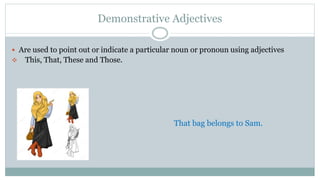
Demonstrative Adjectives
 Are used to point out or indicate a particular noun or pronoun using adjectives
 This, That, These and Those.
That bag belongs to Sam.
Interrogative Adjectives
 Are used to ask questions about nouns or in relation to nouns.
Where, What, Which, and Whose.
Where did she say she was going?
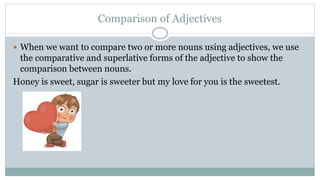
Comparison of Adjectives
 When we want to compare two or more nouns using adjectives, we use
the comparative and superlative forms of the adjective to show the
comparison between nouns.
Honey is sweet, sugar is sweeter but my love for you is the sweetest.
COMPARATIVE SUPERLATIVE
taller tallest
fatter fattest
bigger biggest
sadder saddest
ONE SYLLABLE ADJECTIVES
Add -er for the comparative and -est for the superlative. If the
adjective has a consonant + single vowel + consonant spelling, the
final consonant must be doubled before adding the ending.
POSTIVE FORM
tall
fat
big
sad
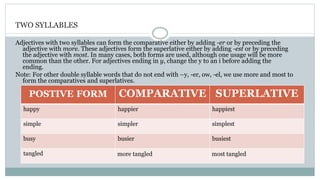
TWO SYLLABLES
Adjectives with two syllables can form the comparative either by adding -er or by preceding the
adjective with more. These adjectives form the superlative either by adding -est or by preceding
the adjective with most. In many cases, both forms are used, although one usage will be more
common than the other. For adjectives ending in y, change the y to an i before adding the
ending.
Note: For other double syllable words that do not end with –y, -er, ow, -el, we use more and most to
form the comparatives and superlatives.
POSTIVE FORM COMPARATIVE SUPERLATIVE
happy happier happiest
simple simpler simplest
busy busier busiest
tangled more tangled most tangled
THREE OR MORE SYLLABLES
Adjectives with three or more syllables form the comparative by
putting more in front of the adjective, and the superlative by
putting most in front.
POSTIVE FORM COMPARATIVE SUPERLATIVE
important more important most important
expensive more expensive most expensive
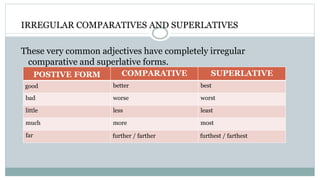
IRREGULAR COMPARATIVES AND SUPERLATIVES
These very common adjectives have completely irregular
comparative and superlative forms.
POSTIVE FORM COMPARATIVE SUPERLATIVE
good better best
bad worse worst
little less least
much more most
far further / farther furthest / farthest
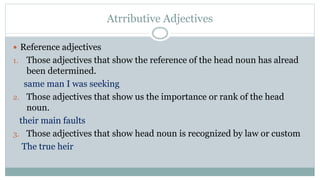
Atrributive Adjectives
 Reference adjectives
1. Those adjectives that show the reference of the head noun has alread
been determined.
same man I was seeking
2. Those adjectives that show us the importance or rank of the head
noun.
their main faults
3. Those adjectives that show head noun is recognized by law or custom
The true heir
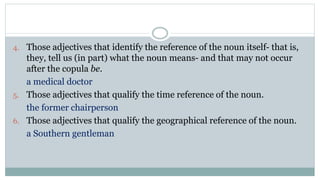
4. Those adjectives that identify the reference of the noun itself- that is,
they, tell us (in part) what the noun means- and that may not occur
after the copula be.
a medical doctor
5. Those adjectives that qualify the time reference of the noun.
the former chairperson
6. Those adjectives that qualify the geographical reference of the noun.
a Southern gentleman
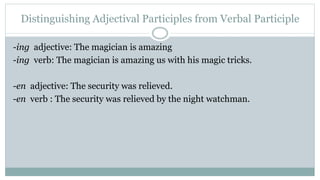
Distinguishing Adjectival Participles from Verbal Participle
-ing adjective: The magician is amazing
-ing verb: The magician is amazing us with his magic tricks.
-en adjective: The security was relieved.
-en verb : The security was relieved by the night watchman.
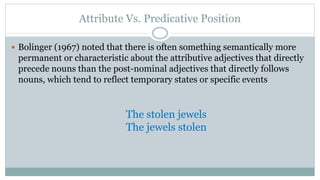
Attribute Vs. Predicative Position
 Bolinger (1967) noted that there is often something semantically more
permanent or characteristic about the attributive adjectives that directly
precede nouns than the post-nominal adjectives that directly follows
nouns, which tend to reflect temporary states or specific events
The stolen jewels
The jewels stolen
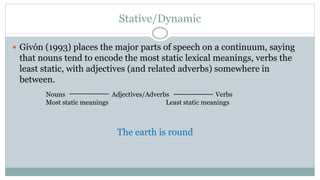
Stative/Dynamic
 Givón (1993) places the major parts of speech on a continuum, saying
that nouns tend to encode the most static lexical meanings, verbs the
least static, with adjectives (and related adverbs) somewhere in
between.
Nouns Adjectives/Adverbs Verbs
Most static meanings Least static meanings
The earth is round
Gradabilty
 The intensifier test could be used to see if a participle is acting as a verb
or adjective. In fact, may adjectives can be placed on a continuum of
intensity, with the intensity increasing or decreasing depending on the
intensifier chosen.
[less intense] [more intense]
somewhat rare, rare, quite rare, very rare, extremely rare
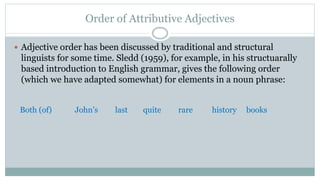
Order of Attributive Adjectives
 Adjective order has been discussed by traditional and structural
linguists for some time. Sledd (1959), for example, in his structuarally
based introduction to English grammar, gives the following order
(which we have adapted somewhat) for elements in a noun phrase:
Both (of) John’s last quite rare history books
 Kathleen Bailey (1975), in an empirical investigation of attributive
adjective ordering in English, points out that Sledd’s fifth category
(descriptive Adjectives) has several subcategories, some of which are:
a. Coloration
b. Measurement (tiny,short)
c. Shape (irregular, round)
d. Subjective evaluation (nice, sweet)
 Bailey’s data, which included (1) analysis of both transcribed speech
and written texts, (2) a card-sorting task, and (3) speech samples that
were elicited with visual prompts, show that most of these
subcategories have a relatively fixed ordering with respect to one
onather that is seldom violated.
The poor little pink plastic doll
 Svatko’s (1979) study of adjective ordering in English statrts with the
description given in Praninskas (1975;262), which Svatko selects as the
best one available.
An ugly big round chipped old blue French vase
Adjectives

Adjectives

  • 1.
    A P PP R E S E N T A T I O N P R E P A R E D B Y : A L - M U H I M M . C A N D A O Adjectives
  • 2.
    adjectives Are words thatmodify nouns and pronouns. Adjectives answer the questions: What kind? Yellow balls, endangered species, gigantic tower Which one? His girlfriend, that sofa, whose music How many/much? Both books, several hours, more time
  • 3.
    Type of adjectives Adjectivescan take several forms: articles titles possessives
  • 4.
    Adjectives of Quality These adjectives are used to describe the nature of a noun.  They give an idea about the characteristics of the noun by answering the question ‘what kind’. Honest, Kind, Large, Beautiful, etc. Sandy is a beautiful woman.
  • 5.
    Adjectives of Quantity These adjectives help to show the amount of the noun or pronoun.  These adjectives do not provide exact numbers; rather they tell us the amount of the noun in relative or whole terms. All, Half, Many, Few, Little, Enough, etc Many people came to visit the fair.
  • 6.
    Adjectives of Number Are used to show the number of nouns and their place in an order.  There are three different sections within adjectives of number; they are: Definite Numerical Adjective Those which clearly denote an exact number of nous or the order of the noun. One, Two, Twenty, Thirty-Three, etc. First, Second, Third, Seventh etc.
  • 7.
     Those adjectivesthat do not give an exact numerical amount but just give a general idea of the amount. Some, Many, Few, Any, Several, All, etc. There were many people present at the meeting. Distributive Numerical Adjective  Those adjectives that are used to refer to individual nouns within the whole amount. Either, Neither, Each, Another, Other, etc. Taxes have to be paid by every employed citizen. Indefinite Numerical Adjective
  • 8.
    Demonstrative Adjectives  Areused to point out or indicate a particular noun or pronoun using adjectives  This, That, These and Those. That bag belongs to Sam.
  • 9.
    Interrogative Adjectives  Areused to ask questions about nouns or in relation to nouns. Where, What, Which, and Whose. Where did she say she was going?
  • 10.
    Comparison of Adjectives When we want to compare two or more nouns using adjectives, we use the comparative and superlative forms of the adjective to show the comparison between nouns. Honey is sweet, sugar is sweeter but my love for you is the sweetest.
  • 11.
    COMPARATIVE SUPERLATIVE taller tallest fatterfattest bigger biggest sadder saddest ONE SYLLABLE ADJECTIVES Add -er for the comparative and -est for the superlative. If the adjective has a consonant + single vowel + consonant spelling, the final consonant must be doubled before adding the ending. POSTIVE FORM tall fat big sad
  • 12.
    TWO SYLLABLES Adjectives withtwo syllables can form the comparative either by adding -er or by preceding the adjective with more. These adjectives form the superlative either by adding -est or by preceding the adjective with most. In many cases, both forms are used, although one usage will be more common than the other. For adjectives ending in y, change the y to an i before adding the ending. Note: For other double syllable words that do not end with –y, -er, ow, -el, we use more and most to form the comparatives and superlatives. POSTIVE FORM COMPARATIVE SUPERLATIVE happy happier happiest simple simpler simplest busy busier busiest tangled more tangled most tangled
  • 13.
    THREE OR MORESYLLABLES Adjectives with three or more syllables form the comparative by putting more in front of the adjective, and the superlative by putting most in front. POSTIVE FORM COMPARATIVE SUPERLATIVE important more important most important expensive more expensive most expensive
  • 14.
    IRREGULAR COMPARATIVES ANDSUPERLATIVES These very common adjectives have completely irregular comparative and superlative forms. POSTIVE FORM COMPARATIVE SUPERLATIVE good better best bad worse worst little less least much more most far further / farther furthest / farthest
  • 15.
    Atrributive Adjectives  Referenceadjectives 1. Those adjectives that show the reference of the head noun has alread been determined. same man I was seeking 2. Those adjectives that show us the importance or rank of the head noun. their main faults 3. Those adjectives that show head noun is recognized by law or custom The true heir
  • 16.
    4. Those adjectivesthat identify the reference of the noun itself- that is, they, tell us (in part) what the noun means- and that may not occur after the copula be. a medical doctor 5. Those adjectives that qualify the time reference of the noun. the former chairperson 6. Those adjectives that qualify the geographical reference of the noun. a Southern gentleman
  • 17.
    Distinguishing Adjectival Participlesfrom Verbal Participle -ing adjective: The magician is amazing -ing verb: The magician is amazing us with his magic tricks. -en adjective: The security was relieved. -en verb : The security was relieved by the night watchman.
  • 18.
    Attribute Vs. PredicativePosition  Bolinger (1967) noted that there is often something semantically more permanent or characteristic about the attributive adjectives that directly precede nouns than the post-nominal adjectives that directly follows nouns, which tend to reflect temporary states or specific events The stolen jewels The jewels stolen
  • 19.
    Stative/Dynamic  Givón (1993)places the major parts of speech on a continuum, saying that nouns tend to encode the most static lexical meanings, verbs the least static, with adjectives (and related adverbs) somewhere in between. Nouns Adjectives/Adverbs Verbs Most static meanings Least static meanings The earth is round
  • 20.
    Gradabilty  The intensifiertest could be used to see if a participle is acting as a verb or adjective. In fact, may adjectives can be placed on a continuum of intensity, with the intensity increasing or decreasing depending on the intensifier chosen. [less intense] [more intense] somewhat rare, rare, quite rare, very rare, extremely rare
  • 21.
    Order of AttributiveAdjectives  Adjective order has been discussed by traditional and structural linguists for some time. Sledd (1959), for example, in his structuarally based introduction to English grammar, gives the following order (which we have adapted somewhat) for elements in a noun phrase: Both (of) John’s last quite rare history books
  • 22.
     Kathleen Bailey(1975), in an empirical investigation of attributive adjective ordering in English, points out that Sledd’s fifth category (descriptive Adjectives) has several subcategories, some of which are: a. Coloration b. Measurement (tiny,short) c. Shape (irregular, round) d. Subjective evaluation (nice, sweet)
  • 23.
     Bailey’s data,which included (1) analysis of both transcribed speech and written texts, (2) a card-sorting task, and (3) speech samples that were elicited with visual prompts, show that most of these subcategories have a relatively fixed ordering with respect to one onather that is seldom violated. The poor little pink plastic doll
  • 24.
     Svatko’s (1979)study of adjective ordering in English statrts with the description given in Praninskas (1975;262), which Svatko selects as the best one available. An ugly big round chipped old blue French vase