ADJECTIVES
DISCUSSANT: EVELYN S. DEL MUNDO
RIMBERIO CO
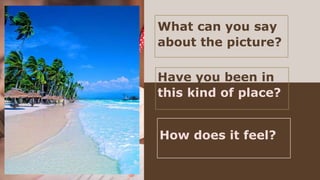
What can you say
about the picture?
Have you been in
this kind of place?
How does it feel?
RIMBERIO CO
What is adjectives?
• Adjective is one of the four major
word classes, along with nouns, verbs
and adverbs. They give us more
information about people, animals or
things represented by nouns and
pronouns:
• Adjectives give us more information.
They modify or describe features and
qualities of people, animals and
things.
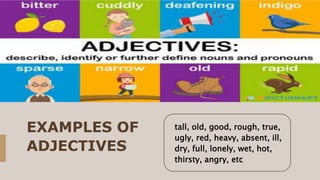
EXAMPLES OF
ADJECTIVES
tall, old, good, rough, true,
ugly, red, heavy, absent, ill,
dry, full, lonely, wet, hot,
thirsty, angry, etc
RIMBERIO CO
01 She wore a beautiful dress
Ben is an adorable baby.
The beautiful flower is wilting.
02
03
04 I gave her a big volleyball.
Distinguishing adjectives
PREDICATE
ADJECTIVE
• A predicate adjective is an
adjective that follows a linking
verb and modifies (i.e.,
describes) the subject of the
linking verb.
• A predicate adjective contrasts
with an attributive adjective,
which typically sits immediately
before the noun it modifies.
EXAMPLES:
•Lee seems drunk.
•Everything is funny a
s long as it is
happening to
somebody else.
•If you look good, you
don't need a purpose
in life.
PREPOSITIONAL
PHRASES ADJECTIVES
• An adjective prepositional phrase
describes a noun or pronoun. It
answers the questions which
one, what kind, how much, or
how many.
• Amy showed me a picture of her
new puppy.
EXAMPLES:
• Have you read the Shakespeare
play about a Scottish king?
• The tall girl from my English
class is on the basketball team.
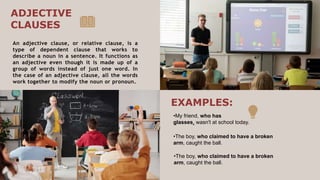
An adjective clause, or relative clause, is a
type of dependent clause that works to
describe a noun in a sentence. It functions as
an adjective even though it is made up of a
group of words instead of just one word. In
the case of an adjective clause, all the words
work together to modify the noun or pronoun.
•My friend, who has
glasses, wasn't at school today.
ADJECTIVE
CLAUSES
EXAMPLES:
•The boy, who claimed to have a broken
arm, caught the ball.
•The boy, who claimed to have a broken
arm, caught the ball.
RIMBERIO CO
RIMBERIO CO
THANK YOU

Adjectives (1).pptx

  • 1.
    ADJECTIVES DISCUSSANT: EVELYN S.DEL MUNDO RIMBERIO CO
  • 2.
    What can yousay about the picture? Have you been in this kind of place? How does it feel?
  • 3.
    RIMBERIO CO What isadjectives? • Adjective is one of the four major word classes, along with nouns, verbs and adverbs. They give us more information about people, animals or things represented by nouns and pronouns: • Adjectives give us more information. They modify or describe features and qualities of people, animals and things.
  • 4.
    EXAMPLES OF ADJECTIVES tall, old,good, rough, true, ugly, red, heavy, absent, ill, dry, full, lonely, wet, hot, thirsty, angry, etc
  • 5.
    RIMBERIO CO 01 Shewore a beautiful dress Ben is an adorable baby. The beautiful flower is wilting. 02 03 04 I gave her a big volleyball. Distinguishing adjectives
  • 6.
    PREDICATE ADJECTIVE • A predicateadjective is an adjective that follows a linking verb and modifies (i.e., describes) the subject of the linking verb. • A predicate adjective contrasts with an attributive adjective, which typically sits immediately before the noun it modifies.
  • 7.
    EXAMPLES: •Lee seems drunk. •Everythingis funny a s long as it is happening to somebody else. •If you look good, you don't need a purpose in life.
  • 8.
    PREPOSITIONAL PHRASES ADJECTIVES • Anadjective prepositional phrase describes a noun or pronoun. It answers the questions which one, what kind, how much, or how many. • Amy showed me a picture of her new puppy. EXAMPLES: • Have you read the Shakespeare play about a Scottish king? • The tall girl from my English class is on the basketball team.
  • 9.
    An adjective clause,or relative clause, is a type of dependent clause that works to describe a noun in a sentence. It functions as an adjective even though it is made up of a group of words instead of just one word. In the case of an adjective clause, all the words work together to modify the noun or pronoun. •My friend, who has glasses, wasn't at school today. ADJECTIVE CLAUSES EXAMPLES: •The boy, who claimed to have a broken arm, caught the ball. •The boy, who claimed to have a broken arm, caught the ball.
  • 10.
  • 11.