1
12-1 Adjective clauses: introduction
12-2 Using who and that in adjective ...
12-3 Using object pronouns in adjective ...
12-4 Using pronouns in adjective clauses…
12-5 Singular and plural verbs in adjective …
12-6 Using prepositions in adjective clauses
12-7 Using whose in adjective clauses
CONTENTS
2
12-1 ADJECTIVE CLAUSES: INTRODUCTION
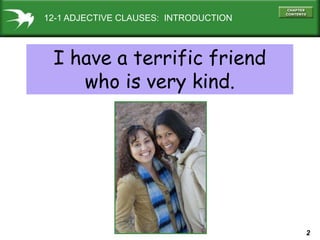
I have a terrific friend
who is very kind.
3
11-10 CPITALIZATION
12-1 ADJECTIVE CLAUSES: INTRODUCTION
(a) I have a terrific friend.
adjective + noun
(b) I have a thoughtful friend.
adjective + noun
adjective modifies noun
4
11-10 CPITALIZATION
12-1 ADJECTIVE CLAUSES: INTRODUCTION
(b) I have a thoughtful friend.
adjective + noun
adjective noun
(usually)
(a) I have a terrific friend.
adjective + noun
5
11-10 CPITALIZATION
12-1 ADJECTIVE CLAUSES: INTRODUCTION
(c) I have a friend who is always cheerful.
noun + adjective clause
adjective clause modifies noun
11-10 CPITALIZATION
(d) I have a friend who is a doctor.
noun + adjective clause
11-10 CPITALIZATION
(e) I have a friend who lives next door.
noun + adjective clause
6
11-10 CPITALIZATION
12-1 ADJECTIVE CLAUSES: INTRODUCTION
(c) I have a friend who is always cheerful.
noun + adjective clause
noun adjective clause
11-10 CPITALIZATION
(d) I have a friend who is a doctor.
noun + adjective clause
11-10 CPITALIZATION
(e) I have a friend who lives next door.
noun + adjective clause
7
12-2 USING WHO AND THAT IN ADJECTIVE CLAUSES
The boy who is dirty
is very happy.
8
12-2 USING WHO AND THAT IN ADJECTIVE CLAUSES
(a) The boy is dirty.
(b) The boy is very happy.
He is very happy.
= subject pronoun
he
= subject pronoun
who
who is dirty
he adjective clause
who
9
12-2 USING WHO AND THAT IN ADJECTIVE CLAUSES
(c) The child is messy.
(d) The child is very happy.
He is very happy.
that is messy
that = subject pronoun
Can replace who
10
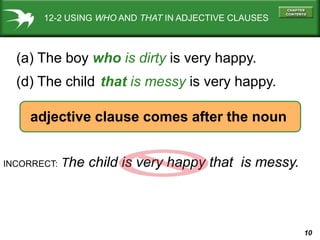
12-2 USING WHO AND THAT IN ADJECTIVE CLAUSES
(a) The boy who is dirty is very happy.
(d) The child is very happy.
that is messy
INCORRECT: The child is very happy that is messy.
adjective clause comes after the noun
11
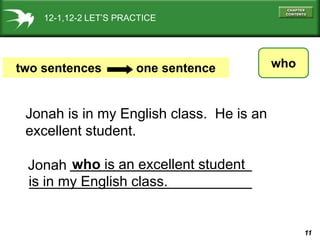
12-1,12-2 LET’S PRACTICE
who
two sentences one sentence
Jonah is in my English class. He is an
excellent student.
who is an excellent student
is in my English class.
Jonah
12
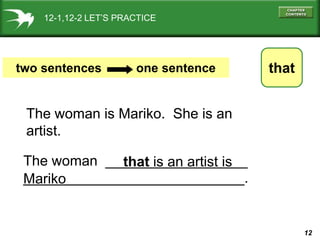
12-1,12-2 LET’S PRACTICE
that
two sentences one sentence
The woman is Mariko. She is an
artist.
that is an artist is
Mariko
The woman __________________
____________________________.
13
The woman that I spoke to
is a doctor.
12-3 USING OBJECT PRONOUNS IN ADJECTIVE
CLAUSES TO DESCRIBE PEOPLE
14
(a) The woman is a doctor. I spoke to her.
12-3 USING OBJECT PRONOUNS IN ADJECTIVE
CLAUSES TO DESCRIBE PEOPLE
S V O
that
(b) The woman that I spoke to is a doctor.
O S V
her = object pronoun
Change her to that
To make an
adjective
clause
Switch the order
15
(a) The woman is a doctor. I spoke to her.
12-3 USING OBJECT PRONOUNS IN ADJECTIVE
CLAUSES TO DESCRIBE PEOPLE
S V O
that
(b) The woman that I spoke to is a doctor.
O S V
(c) The woman Ø I spoke to is a doctor.
OK to delete object pronoun
16
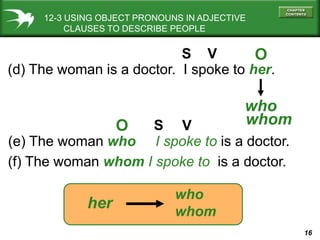
(d) The woman is a doctor. I spoke to her.
12-3 USING OBJECT PRONOUNS IN ADJECTIVE
CLAUSES TO DESCRIBE PEOPLE
S V O
who
(e) The woman who I spoke to is a doctor.
O S V whom
(f) The woman whom I spoke to is a doctor.
her
who
whom
17
12-3 USING OBJECT PRONOUNS IN ADJECTIVE
CLAUSES TO DESCRIBE PEOPLE
(e) The woman who I spoke to is a doctor.
(f) The woman whom I spoke to is a doctor.
that, Ø,
who
(b) The woman that I spoke to is a doctor.
(c) The woman Ø I spoke to is a doctor.
whom
common in speaking
and writing
very formal writing
ONLY
18
12-2, 12-3 LET’S PRACTICE
CORRECT INCORRECT ?
OR
The people that I met last night
were really funny.
19
12-2, 12-3 LET’S PRACTICE
CORRECT INCORRECT ?
OR
The man fixed my car was friendly.
20
12-2, 12-3 LET’S PRACTICE
CORRECT INCORRECT
OR ?
The woman that is reading is my sister.
21
12-4 USING PRONOUNS IN ADJECTIVE CLAUSES TO
DESCRIBE THINGS
The tools that
are in my pocket
are new.
22
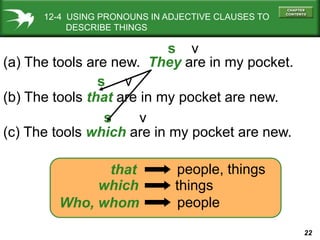
(a) The tools are new. They are in my pocket.
(c) The tools which are in my pocket are new.
(b) The tools that are in my pocket are new.
s v
s v
s v
12-4 USING PRONOUNS IN ADJECTIVE CLAUSES TO
DESCRIBE THINGS
that
which
Who, whom
people, things
things
people
23
INCORRECT:
The tools are in my pocket are new.
12-4 USING PRONOUNS IN ADJECTIVE CLAUSES TO
DESCRIBE THINGS
(a) The tools are new. They are in my pocket.
(b) The tools that are in my pocket are new.
(c) The tools which are in my pocket are new.
24
which, that object in adjective clause
(d) The old car needs work. I drive it.
(f) The old car that I drive needs work.
(e) The old car which I drive needs work.
s v o
o s v
o s v
(g) The old car Ø I drive needs work.
s v
12-4 USING PRONOUNS IN ADJECTIVE CLAUSES TO
DESCRIBE THINGS
25
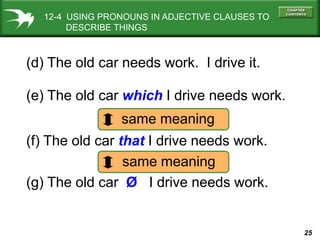
(d) The old car needs work. I drive it.
(f) The old car that I drive needs work.
(e) The old car which I drive needs work.
(g) The old car Ø I drive needs work.
same meaning
same meaning
12-4 USING PRONOUNS IN ADJECTIVE CLAUSES TO
DESCRIBE THINGS
26
which we played
12-4 LET’S PRACTICE
which
two sentences one sentence
We played a game. It was fun.
was fun.
The game
27
12-4 LET’S PRACTICE
that
two sentences one sentence
Where is the store? It sells great vegetables.
the store that sells great vegetables
Where is _____________________________?
28
12-5 SINGULAR AND PLURAL VERBS IN ADJECTIVE
CLAUSES
I have a friend who is a
wonderful gardener.
29
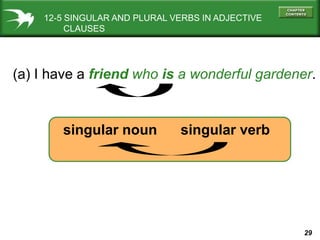
12-5 SINGULAR AND PLURAL VERBS IN ADJECTIVE
CLAUSES
(a) I have a friend who is a wonderful gardener.
singular noun singular verb
30
12-5 SINGULAR AND PLURAL VERBS IN ADJECTIVE
CLAUSES
(b) I have friends who are wonderful gardeners.
plural noun plural verb
31
12-5 LET’S PRACTICE
is
are
People who travel to other countries
___ required to have a passport.
are
32
12-5 LET’S PRACTICE
is
are
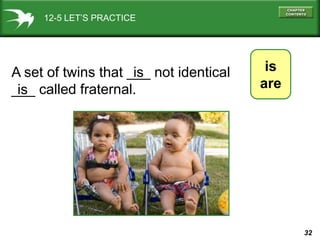
A set of twins that ___ not identical
___ called fraternal.
is
is
33
12-5 LET’S PRACTICE
speak
speaks
There are many people in
Europe who ______ more than
one language.
speak
34
12-6 USING PREPOSITIONS IN ADJECTIVE CLAUSES
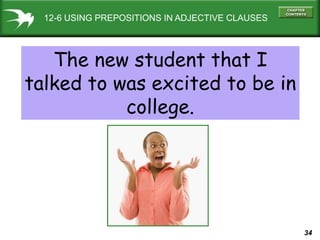
The new student that I
talked to was excited to be in
college.
35
12-6 USING PREPOSITIONS IN ADJECTIVE CLAUSES
(a) The teacher is friendly. I talked to her.
PREP OBJ
PREP
OBJ
(c) The teacher that I talked to is friendly.
(d) The teacher Ø I talked to is friendly.
(b) The teacher whom I talked to is friendly.
36
(e) The teacher to whom I talked is friendly.
PREP Obj.
FORMAL ENGLISH
preposition + whom + adjective clause
which
MUST have pronoun
12-6 USING PREPOSITIONS IN ADJECTIVE CLAUSES
37
12-6 USING PREPOSITIONS IN ADJECTIVE CLAUSES
(f) The paper is long. I am working on it.
PREP OBJ
PREP
OBJ
(h) The paper that I am working on is long.
(i) The paper Ø I am working on is long.
(g) The paper which I am working on is long.
38
(j) The paper on which I am working is long.
PREP OBJ
FORMAL ENGLISH
preposition + whom + adjective clause
which
MUST have pronoun
12-6 USING PREPOSITIONS IN ADJECTIVE CLAUSES
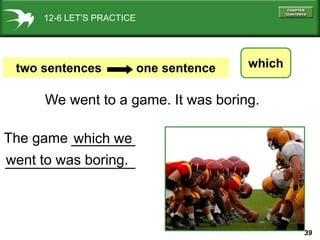
39
which we
which
two sentences one sentence
We went to a game. It was boring.
went to was boring.
The game
12-6 LET’S PRACTICE
40
Ø we
Ø
two sentences one sentence
went to was boring.
The game
12-6 LET’S PRACTICE
We went to a game. It was boring.
41
12-6 LET’S PRACTICE
The sculpture museum was
interesting. We went to it.
that
The sculpture museum that
we went to was interesting.
42
12-7 USING WHOSE IN ADJECTIVE CLAUSES
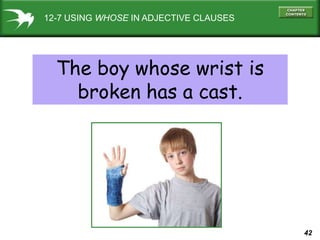
The boy whose wrist is
broken has a cast.
43
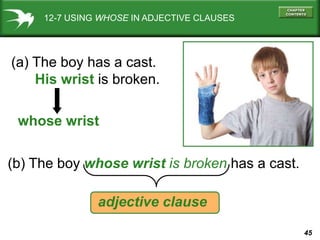
12-7 USING WHOSE IN ADJECTIVE CLAUSES
(a) The boy has a cast.
His wrist is broken.
44
12-7 USING WHOSE IN ADJECTIVE CLAUSES
(a) The boy has a cast.
His wrist is broken.
whose wrist
(b) The boy whose wrist is broken has a cast.
whose possession
45
12-7 USING WHOSE IN ADJECTIVE CLAUSES
(a) The boy has a cast.
His wrist is broken.
(b) The boy whose wrist is broken has a cast.
adjective clause
whose wrist
46
12-7 USING WHOSE IN ADJECTIVE CLAUSES
(c) I have a friend.
Her mother is a doctor.
whose mother
(d) I have a friend whose mother is a doctor.
47
12-7 USING WHOSE IN ADJECTIVE CLAUSES
(c) I have a friend.
Her mother is a doctor.
whose mother
(d) I have a friend whose mother is a doctor.
adjective clause
48
12-7 USING WHOSE IN ADJECTIVE CLAUSES
(e) The family was moving.
I bought their car.
49
12-7 USING WHOSE IN ADJECTIVE CLAUSES
(e) The family was moving.
I bought their car.
whose car
(f) The family whose car I bought was moving.
50
12-7 USING WHOSE IN ADJECTIVE CLAUSES
(c) The family is moving.
I bought their car.
whose car
(d) The family whose car I bought was moving.
adjective clause
51
12-7 LET’S PRACTICE
This is my friend Ichiro.
His sister is a famous
scientist.
who
whose
whose sister
is a famous scientist.
This is my friend Ichiro
52
12-7 LET’S PRACTICE
I go to a great doctor.
She is very busy.
who is very busy.
I go to a great doctor
who
whose
53
12-7 LET’S PRACTICE
I go to a busy doctor.
Her patients often have to wait
in line.
whose patients often
have to wait in line.
I go to a busy doctor
who
whose
54
54
PHOTO CREDITS
Images used under license from:
• Shutterstock, Inc.
• Clipart, Inc.
Copyright © 2008 Pearson Education and
its licensors. All rights reserved.

adjective clauses form and application.ppt

  • 1.
    1 12-1 Adjective clauses:introduction 12-2 Using who and that in adjective ... 12-3 Using object pronouns in adjective ... 12-4 Using pronouns in adjective clauses… 12-5 Singular and plural verbs in adjective … 12-6 Using prepositions in adjective clauses 12-7 Using whose in adjective clauses CONTENTS
  • 2.
    2 12-1 ADJECTIVE CLAUSES:INTRODUCTION I have a terrific friend who is very kind.
  • 3.
    3 11-10 CPITALIZATION 12-1 ADJECTIVECLAUSES: INTRODUCTION (a) I have a terrific friend. adjective + noun (b) I have a thoughtful friend. adjective + noun adjective modifies noun
  • 4.
    4 11-10 CPITALIZATION 12-1 ADJECTIVECLAUSES: INTRODUCTION (b) I have a thoughtful friend. adjective + noun adjective noun (usually) (a) I have a terrific friend. adjective + noun
  • 5.
    5 11-10 CPITALIZATION 12-1 ADJECTIVECLAUSES: INTRODUCTION (c) I have a friend who is always cheerful. noun + adjective clause adjective clause modifies noun 11-10 CPITALIZATION (d) I have a friend who is a doctor. noun + adjective clause 11-10 CPITALIZATION (e) I have a friend who lives next door. noun + adjective clause
  • 6.
    6 11-10 CPITALIZATION 12-1 ADJECTIVECLAUSES: INTRODUCTION (c) I have a friend who is always cheerful. noun + adjective clause noun adjective clause 11-10 CPITALIZATION (d) I have a friend who is a doctor. noun + adjective clause 11-10 CPITALIZATION (e) I have a friend who lives next door. noun + adjective clause
  • 7.
    7 12-2 USING WHOAND THAT IN ADJECTIVE CLAUSES The boy who is dirty is very happy.
  • 8.
    8 12-2 USING WHOAND THAT IN ADJECTIVE CLAUSES (a) The boy is dirty. (b) The boy is very happy. He is very happy. = subject pronoun he = subject pronoun who who is dirty he adjective clause who
  • 9.
    9 12-2 USING WHOAND THAT IN ADJECTIVE CLAUSES (c) The child is messy. (d) The child is very happy. He is very happy. that is messy that = subject pronoun Can replace who
  • 10.
    10 12-2 USING WHOAND THAT IN ADJECTIVE CLAUSES (a) The boy who is dirty is very happy. (d) The child is very happy. that is messy INCORRECT: The child is very happy that is messy. adjective clause comes after the noun
  • 11.
    11 12-1,12-2 LET’S PRACTICE who twosentences one sentence Jonah is in my English class. He is an excellent student. who is an excellent student is in my English class. Jonah
  • 12.
    12 12-1,12-2 LET’S PRACTICE that twosentences one sentence The woman is Mariko. She is an artist. that is an artist is Mariko The woman __________________ ____________________________.
  • 13.
    13 The woman thatI spoke to is a doctor. 12-3 USING OBJECT PRONOUNS IN ADJECTIVE CLAUSES TO DESCRIBE PEOPLE
  • 14.
    14 (a) The womanis a doctor. I spoke to her. 12-3 USING OBJECT PRONOUNS IN ADJECTIVE CLAUSES TO DESCRIBE PEOPLE S V O that (b) The woman that I spoke to is a doctor. O S V her = object pronoun Change her to that To make an adjective clause Switch the order
  • 15.
    15 (a) The womanis a doctor. I spoke to her. 12-3 USING OBJECT PRONOUNS IN ADJECTIVE CLAUSES TO DESCRIBE PEOPLE S V O that (b) The woman that I spoke to is a doctor. O S V (c) The woman Ø I spoke to is a doctor. OK to delete object pronoun
  • 16.
    16 (d) The womanis a doctor. I spoke to her. 12-3 USING OBJECT PRONOUNS IN ADJECTIVE CLAUSES TO DESCRIBE PEOPLE S V O who (e) The woman who I spoke to is a doctor. O S V whom (f) The woman whom I spoke to is a doctor. her who whom
  • 17.
    17 12-3 USING OBJECTPRONOUNS IN ADJECTIVE CLAUSES TO DESCRIBE PEOPLE (e) The woman who I spoke to is a doctor. (f) The woman whom I spoke to is a doctor. that, Ø, who (b) The woman that I spoke to is a doctor. (c) The woman Ø I spoke to is a doctor. whom common in speaking and writing very formal writing ONLY
  • 18.
    18 12-2, 12-3 LET’SPRACTICE CORRECT INCORRECT ? OR The people that I met last night were really funny.
  • 19.
    19 12-2, 12-3 LET’SPRACTICE CORRECT INCORRECT ? OR The man fixed my car was friendly.
  • 20.
    20 12-2, 12-3 LET’SPRACTICE CORRECT INCORRECT OR ? The woman that is reading is my sister.
  • 21.
    21 12-4 USING PRONOUNSIN ADJECTIVE CLAUSES TO DESCRIBE THINGS The tools that are in my pocket are new.
  • 22.
    22 (a) The toolsare new. They are in my pocket. (c) The tools which are in my pocket are new. (b) The tools that are in my pocket are new. s v s v s v 12-4 USING PRONOUNS IN ADJECTIVE CLAUSES TO DESCRIBE THINGS that which Who, whom people, things things people
  • 23.
    23 INCORRECT: The tools arein my pocket are new. 12-4 USING PRONOUNS IN ADJECTIVE CLAUSES TO DESCRIBE THINGS (a) The tools are new. They are in my pocket. (b) The tools that are in my pocket are new. (c) The tools which are in my pocket are new.
  • 24.
    24 which, that objectin adjective clause (d) The old car needs work. I drive it. (f) The old car that I drive needs work. (e) The old car which I drive needs work. s v o o s v o s v (g) The old car Ø I drive needs work. s v 12-4 USING PRONOUNS IN ADJECTIVE CLAUSES TO DESCRIBE THINGS
  • 25.
    25 (d) The oldcar needs work. I drive it. (f) The old car that I drive needs work. (e) The old car which I drive needs work. (g) The old car Ø I drive needs work. same meaning same meaning 12-4 USING PRONOUNS IN ADJECTIVE CLAUSES TO DESCRIBE THINGS
  • 26.
    26 which we played 12-4LET’S PRACTICE which two sentences one sentence We played a game. It was fun. was fun. The game
  • 27.
    27 12-4 LET’S PRACTICE that twosentences one sentence Where is the store? It sells great vegetables. the store that sells great vegetables Where is _____________________________?
  • 28.
    28 12-5 SINGULAR ANDPLURAL VERBS IN ADJECTIVE CLAUSES I have a friend who is a wonderful gardener.
  • 29.
    29 12-5 SINGULAR ANDPLURAL VERBS IN ADJECTIVE CLAUSES (a) I have a friend who is a wonderful gardener. singular noun singular verb
  • 30.
    30 12-5 SINGULAR ANDPLURAL VERBS IN ADJECTIVE CLAUSES (b) I have friends who are wonderful gardeners. plural noun plural verb
  • 31.
    31 12-5 LET’S PRACTICE is are Peoplewho travel to other countries ___ required to have a passport. are
  • 32.
    32 12-5 LET’S PRACTICE is are Aset of twins that ___ not identical ___ called fraternal. is is
  • 33.
    33 12-5 LET’S PRACTICE speak speaks Thereare many people in Europe who ______ more than one language. speak
  • 34.
    34 12-6 USING PREPOSITIONSIN ADJECTIVE CLAUSES The new student that I talked to was excited to be in college.
  • 35.
    35 12-6 USING PREPOSITIONSIN ADJECTIVE CLAUSES (a) The teacher is friendly. I talked to her. PREP OBJ PREP OBJ (c) The teacher that I talked to is friendly. (d) The teacher Ø I talked to is friendly. (b) The teacher whom I talked to is friendly.
  • 36.
    36 (e) The teacherto whom I talked is friendly. PREP Obj. FORMAL ENGLISH preposition + whom + adjective clause which MUST have pronoun 12-6 USING PREPOSITIONS IN ADJECTIVE CLAUSES
  • 37.
    37 12-6 USING PREPOSITIONSIN ADJECTIVE CLAUSES (f) The paper is long. I am working on it. PREP OBJ PREP OBJ (h) The paper that I am working on is long. (i) The paper Ø I am working on is long. (g) The paper which I am working on is long.
  • 38.
    38 (j) The paperon which I am working is long. PREP OBJ FORMAL ENGLISH preposition + whom + adjective clause which MUST have pronoun 12-6 USING PREPOSITIONS IN ADJECTIVE CLAUSES
  • 39.
    39 which we which two sentencesone sentence We went to a game. It was boring. went to was boring. The game 12-6 LET’S PRACTICE
  • 40.
    40 Ø we Ø two sentencesone sentence went to was boring. The game 12-6 LET’S PRACTICE We went to a game. It was boring.
  • 41.
    41 12-6 LET’S PRACTICE Thesculpture museum was interesting. We went to it. that The sculpture museum that we went to was interesting.
  • 42.
    42 12-7 USING WHOSEIN ADJECTIVE CLAUSES The boy whose wrist is broken has a cast.
  • 43.
    43 12-7 USING WHOSEIN ADJECTIVE CLAUSES (a) The boy has a cast. His wrist is broken.
  • 44.
    44 12-7 USING WHOSEIN ADJECTIVE CLAUSES (a) The boy has a cast. His wrist is broken. whose wrist (b) The boy whose wrist is broken has a cast. whose possession
  • 45.
    45 12-7 USING WHOSEIN ADJECTIVE CLAUSES (a) The boy has a cast. His wrist is broken. (b) The boy whose wrist is broken has a cast. adjective clause whose wrist
  • 46.
    46 12-7 USING WHOSEIN ADJECTIVE CLAUSES (c) I have a friend. Her mother is a doctor. whose mother (d) I have a friend whose mother is a doctor.
  • 47.
    47 12-7 USING WHOSEIN ADJECTIVE CLAUSES (c) I have a friend. Her mother is a doctor. whose mother (d) I have a friend whose mother is a doctor. adjective clause
  • 48.
    48 12-7 USING WHOSEIN ADJECTIVE CLAUSES (e) The family was moving. I bought their car.
  • 49.
    49 12-7 USING WHOSEIN ADJECTIVE CLAUSES (e) The family was moving. I bought their car. whose car (f) The family whose car I bought was moving.
  • 50.
    50 12-7 USING WHOSEIN ADJECTIVE CLAUSES (c) The family is moving. I bought their car. whose car (d) The family whose car I bought was moving. adjective clause
  • 51.
    51 12-7 LET’S PRACTICE Thisis my friend Ichiro. His sister is a famous scientist. who whose whose sister is a famous scientist. This is my friend Ichiro
  • 52.
    52 12-7 LET’S PRACTICE Igo to a great doctor. She is very busy. who is very busy. I go to a great doctor who whose
  • 53.
    53 12-7 LET’S PRACTICE Igo to a busy doctor. Her patients often have to wait in line. whose patients often have to wait in line. I go to a busy doctor who whose
  • 54.
    54 54 PHOTO CREDITS Images usedunder license from: • Shutterstock, Inc. • Clipart, Inc. Copyright © 2008 Pearson Education and its licensors. All rights reserved.