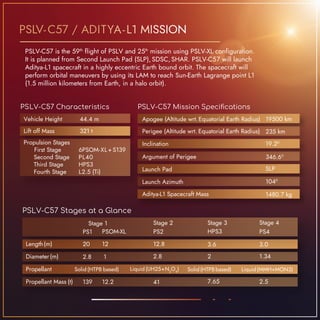
PSLV-C57 is the 59th
flight of PSLV and 25th
mission using PSLV-XL configuration.
It is planned from Second Launch Pad (SLP),SDSC,SHAR. PSLV-C57 will launch
Aditya-L1 spacecraft in a highly eccentric Earth bound orbit. The spacecraft will
perform orbital maneuvers by using its LAM to reach Sun-Earth Lagrange point L1
(1.5 million kilometers from Earth, in a halo orbit).
PSLV-C57 Stages at a Glance
Length(m)
Diameter(m)
Propellant
Propellant Mass (t)
20
2.8
Solid (HTPB based)
139
12
1
12.2
12.8
2.8
Liquid (UH25+N2
O4
)
41
3.6
2
Solid(HTPB based)
7.65
3.0
1.34
Liquid(MMH+MON3)
2.5
PSLV-C57 Mission Specifications
Apogee (Altitude wrt.Equatorial Earth Radius)
Perigee (Altitude wrt. Equatorial Earth Radius)
Inclination
19500 km
235 km
19.20
1040
SLP
1480.7 kg
346.60
Argument of Perigee
Launch Pad
Aditya-L1 Spacecraft Mass
Launch Azimuth
PSLV-C57 Characteristics
Vehicle Height 44.4 m
Lift off Mass 321 t
Propulsion Stages
First Stage
Second Stage
Third Stage
Fourth Stage
6PSOM-XL+ S139
PL40
HPS3
L2.5 (Ti)
Stage 1
PS1 PSOM-XL PS2 HPS3 PS4
Stage 2 Stage 3 Stage 4
ISRO ventures into the study of solar activities and its effect on space weather. The scientific
objectives of Aditya-L1 mission includes,study of coronal heating,solar wind acceleration,
Coronal Mass Ejections (CME),dynamics of solar atmosphere and temperature anisotropy.
Illustration of all five Lagrange points of Sun-Earth system. The spacecraft will be placed around Largrange point 1.
L4
L3
L5
L2
Sun
Earth
Moon
Aditya-L1
L4
L3
L5
L2
Sun
Earth
Moon
Aditya-L1
L1 1.5 million km
Halo orbit insertion in L1
Cruise phase
Earth SOI exit
Earth-centered orbit
transfer
Aditya-L1 in halo orbit
around L1 point
Aditya-L1 spacecraft - stowed view
L1
PS1 Ignition
Ignition of 4 ground-lit PSOMs
Separation of 4 ground-lit PSOMs
Separation of 2 air-lit PSOMs
PS1 Separation
Ignition of 2 air-lit PSOMs
PS2 Ignition
PS2 Separation
HPS3 Ignition
HPS3 Separation
1st
ignition of PS4
1st
cut-off of PS4
2nd
ignition of PS4
2nd
cut-off of PS4
Satellite Separation
Heatshield Separation
Payload Accommodation in PSLV-C57
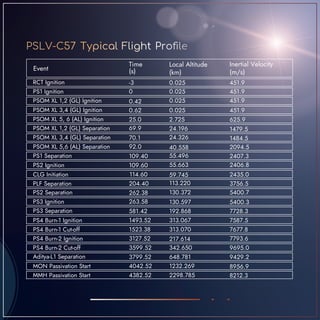
Event
RCT Ignition
PS1 Ignition
PSOM XL 1,2 (GL) Ignition
PSOM XL 3,4 (GL) Ignition
PSOM XL 5, 6 (AL) Ignition
PSOM XL 1,2 (GL) Separation
PSOM XL 3,4 (GL) Separation
PSOM XL 5,6 (AL) Separation
PS1 Separation
PS2 Ignition
CLG Initiation
PLF Separation
PS2 Separation
PS3 Ignition
PS3 Separation
PS4 Burn-1 Ignition
PS4 Burn-1 Cut-off
PS4 Burn-2 Ignition
PS4 Burn-2 Cut-off
Aditya-L1 Separation
MON Passivation Start
MMH Passivation Start
-3
0
0.42
0.62
25.0
69.9
70.1
92.0
109.40
109.60
114.60
204.40
262.38
263.58
581.42
1493.52
1523.38
3127.52
3599.52
3799.52
4042.52
4382.52
Time
(s)
0.025
0.025
0.025
0.025
2.725
24.196
24.326
40.558
55.496
55.663
59.745
113.220
130.372
130.597
192.868
313.067
313.070
217.614
342.650
648.781
1232.269
2298.785
Local Altitude
(km)
451.9
451.9
451.9
451.9
625.9
1479.5
1484.5
2094.5
2407.3
2406.8
2435.0
3756.5
5400.7
5400.3
7728.3
7587.5
7677.8
7793.6
9695.0
9429.2
8956.9
Inertial Velocity
(m/s)
8212.3
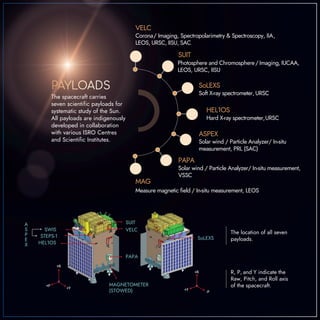
SWIS
SUIT
VELC
PAPA
STEPS-1
HEL1OS
SoLEXS
MAGNETOMETER
(STOWED)
+R
+P
+Y
+R
+Y
-P
R, P, and Y indicate the
Raw, Pitch, and Roll axis
of the spacecraft.
The location of all seven
payloads.
Corona/ Imaging, Spectropolarimetry & Spectroscopy, IIA,
LEOS, URSC, IISU, SAC
Photosphere and Chromosphere/ Imaging, IUCAA,
LEOS, URSC, IISU
Soft X-ray spectrometer, URSC
The spacecraft carries
seven scientific payloads for
systematic study of the Sun.
All payloads are indigenously
developed in collaboration
with various ISRO Centres
and Scientific Institutes.
VELC
SUIT
ASPEX
SoLEXS
HEL1OS
PAPA
MAG
Hard X-ray spectrometer,URSC
Solar wind / Particle Analyzer/ In-situ
measurement, PRL (SAC)
Solar wind / Particle Analyzer/ In-situ measurement,
VSSC
Measure magnetic field / In-situ measurement, LEOS
A
S
P
E
X
ASPEX payload comprises
2 Subsystems: SWIS and STEPS
VELC is the prime payload designed
as a reflective coronagraph with a
multi-slit spectrograph.
Suprathermal and Energetic
Particle Spectrometer is a
high-energy spectrometer
designed to measure
high-energy ions of the
solar wind.
SUIT is a UV telescope to image
the solar disk in the near ultra-violet
wavelength range.
Solar Wind Ion Spectrometer
is a low-energy spectrometer
designed to measure the proton
and alpha particles of the
solar wind.
HEL1OS is a hard X-ray spectrometer
designed to study solar flares in
the high energy X-rays.
SoLEXS is a soft X-ray spectrometer
designed to measure the solar soft
X-ray flux to study solar flares.
PAPA is designed to understand solar
winds and its composition and, do
mass analysis of solar wind ions.
Aditya Solar wind Particle
EXperiment
Solar Ultra-violet Imaging
Telescope
High Energy L1 Orbiting
X-ray Spectrometer
Plasma Analyser Package for Aditya
Visible Emission Line Coronagraph
Solar Low Energy X-ray Spectrometer
MAG will measure the low
intensity interplanetary magnetic
field in space.It has two sets of
Magnetic Sensors: one at the tip
of a 6 meter deployable boom,
and the other in the middle of
the boom,3 meters
away from the
spacecraft.
Magnetometer
Capacity Building and Public Outreach (CBPO)
Indian Space Research Organisation
Department of Space, Government of India
Antariksh Bhavan, New BEL Road
Bengaluru-560094, India
Telephone: +91 80 2217 2119
www.isro.gov.in
facebook.com/ISRO/
@isro
isro.dos

Aditya-L1

  • 2.
    PSLV-C57 is the59th flight of PSLV and 25th mission using PSLV-XL configuration. It is planned from Second Launch Pad (SLP),SDSC,SHAR. PSLV-C57 will launch Aditya-L1 spacecraft in a highly eccentric Earth bound orbit. The spacecraft will perform orbital maneuvers by using its LAM to reach Sun-Earth Lagrange point L1 (1.5 million kilometers from Earth, in a halo orbit). PSLV-C57 Stages at a Glance Length(m) Diameter(m) Propellant Propellant Mass (t) 20 2.8 Solid (HTPB based) 139 12 1 12.2 12.8 2.8 Liquid (UH25+N2 O4 ) 41 3.6 2 Solid(HTPB based) 7.65 3.0 1.34 Liquid(MMH+MON3) 2.5 PSLV-C57 Mission Specifications Apogee (Altitude wrt.Equatorial Earth Radius) Perigee (Altitude wrt. Equatorial Earth Radius) Inclination 19500 km 235 km 19.20 1040 SLP 1480.7 kg 346.60 Argument of Perigee Launch Pad Aditya-L1 Spacecraft Mass Launch Azimuth PSLV-C57 Characteristics Vehicle Height 44.4 m Lift off Mass 321 t Propulsion Stages First Stage Second Stage Third Stage Fourth Stage 6PSOM-XL+ S139 PL40 HPS3 L2.5 (Ti) Stage 1 PS1 PSOM-XL PS2 HPS3 PS4 Stage 2 Stage 3 Stage 4
  • 3.
    ISRO ventures intothe study of solar activities and its effect on space weather. The scientific objectives of Aditya-L1 mission includes,study of coronal heating,solar wind acceleration, Coronal Mass Ejections (CME),dynamics of solar atmosphere and temperature anisotropy. Illustration of all five Lagrange points of Sun-Earth system. The spacecraft will be placed around Largrange point 1. L4 L3 L5 L2 Sun Earth Moon Aditya-L1 L4 L3 L5 L2 Sun Earth Moon Aditya-L1 L1 1.5 million km Halo orbit insertion in L1 Cruise phase Earth SOI exit Earth-centered orbit transfer Aditya-L1 in halo orbit around L1 point Aditya-L1 spacecraft - stowed view L1
  • 4.
    PS1 Ignition Ignition of4 ground-lit PSOMs Separation of 4 ground-lit PSOMs Separation of 2 air-lit PSOMs PS1 Separation Ignition of 2 air-lit PSOMs PS2 Ignition PS2 Separation HPS3 Ignition HPS3 Separation 1st ignition of PS4 1st cut-off of PS4 2nd ignition of PS4 2nd cut-off of PS4 Satellite Separation Heatshield Separation Payload Accommodation in PSLV-C57
  • 5.
    Event RCT Ignition PS1 Ignition PSOMXL 1,2 (GL) Ignition PSOM XL 3,4 (GL) Ignition PSOM XL 5, 6 (AL) Ignition PSOM XL 1,2 (GL) Separation PSOM XL 3,4 (GL) Separation PSOM XL 5,6 (AL) Separation PS1 Separation PS2 Ignition CLG Initiation PLF Separation PS2 Separation PS3 Ignition PS3 Separation PS4 Burn-1 Ignition PS4 Burn-1 Cut-off PS4 Burn-2 Ignition PS4 Burn-2 Cut-off Aditya-L1 Separation MON Passivation Start MMH Passivation Start -3 0 0.42 0.62 25.0 69.9 70.1 92.0 109.40 109.60 114.60 204.40 262.38 263.58 581.42 1493.52 1523.38 3127.52 3599.52 3799.52 4042.52 4382.52 Time (s) 0.025 0.025 0.025 0.025 2.725 24.196 24.326 40.558 55.496 55.663 59.745 113.220 130.372 130.597 192.868 313.067 313.070 217.614 342.650 648.781 1232.269 2298.785 Local Altitude (km) 451.9 451.9 451.9 451.9 625.9 1479.5 1484.5 2094.5 2407.3 2406.8 2435.0 3756.5 5400.7 5400.3 7728.3 7587.5 7677.8 7793.6 9695.0 9429.2 8956.9 Inertial Velocity (m/s) 8212.3
  • 6.
    SWIS SUIT VELC PAPA STEPS-1 HEL1OS SoLEXS MAGNETOMETER (STOWED) +R +P +Y +R +Y -P R, P, andY indicate the Raw, Pitch, and Roll axis of the spacecraft. The location of all seven payloads. Corona/ Imaging, Spectropolarimetry & Spectroscopy, IIA, LEOS, URSC, IISU, SAC Photosphere and Chromosphere/ Imaging, IUCAA, LEOS, URSC, IISU Soft X-ray spectrometer, URSC The spacecraft carries seven scientific payloads for systematic study of the Sun. All payloads are indigenously developed in collaboration with various ISRO Centres and Scientific Institutes. VELC SUIT ASPEX SoLEXS HEL1OS PAPA MAG Hard X-ray spectrometer,URSC Solar wind / Particle Analyzer/ In-situ measurement, PRL (SAC) Solar wind / Particle Analyzer/ In-situ measurement, VSSC Measure magnetic field / In-situ measurement, LEOS A S P E X
  • 7.
    ASPEX payload comprises 2Subsystems: SWIS and STEPS VELC is the prime payload designed as a reflective coronagraph with a multi-slit spectrograph. Suprathermal and Energetic Particle Spectrometer is a high-energy spectrometer designed to measure high-energy ions of the solar wind. SUIT is a UV telescope to image the solar disk in the near ultra-violet wavelength range. Solar Wind Ion Spectrometer is a low-energy spectrometer designed to measure the proton and alpha particles of the solar wind. HEL1OS is a hard X-ray spectrometer designed to study solar flares in the high energy X-rays. SoLEXS is a soft X-ray spectrometer designed to measure the solar soft X-ray flux to study solar flares. PAPA is designed to understand solar winds and its composition and, do mass analysis of solar wind ions. Aditya Solar wind Particle EXperiment Solar Ultra-violet Imaging Telescope High Energy L1 Orbiting X-ray Spectrometer Plasma Analyser Package for Aditya Visible Emission Line Coronagraph Solar Low Energy X-ray Spectrometer MAG will measure the low intensity interplanetary magnetic field in space.It has two sets of Magnetic Sensors: one at the tip of a 6 meter deployable boom, and the other in the middle of the boom,3 meters away from the spacecraft. Magnetometer
  • 8.
    Capacity Building andPublic Outreach (CBPO) Indian Space Research Organisation Department of Space, Government of India Antariksh Bhavan, New BEL Road Bengaluru-560094, India Telephone: +91 80 2217 2119 www.isro.gov.in facebook.com/ISRO/ @isro isro.dos