https://onlinecourses-archive.nptel.ac.in/noc18_cs09/unit?unit=6&assessment=86 1/3
Courses » Wireless Adhoc And Sensor Networks
Unit 2 - Week 1:
reviewer2@nptel.iitm.ac.in ▼
Announcements Course Ask a Question Progress
Course
outline
How to access
the portal
Week 1:
Week 2
Week 3
Week 4
Week 5
Week 6
Lecture 1:
Introduction:
Wireless Ad
Hoc Networks-
Part- I
Lecture 2:
Introduction:
Wireless Ad
Hoc Networks-
Part- II
Lecture 3: Self-
organizing
Behaviour of
Wireless Ad
Hoc Networks
Lecture 4:
Cooperation in
Mobile Ad Hoc
Networks- Part-
I
Lecture 5:
Cooperation in
Mobile Ad Hoc
Networks- Part-
II
Week 1 Lecture
Material
Quiz :
Assignment
Week 1
Assignment
Solution Week 1
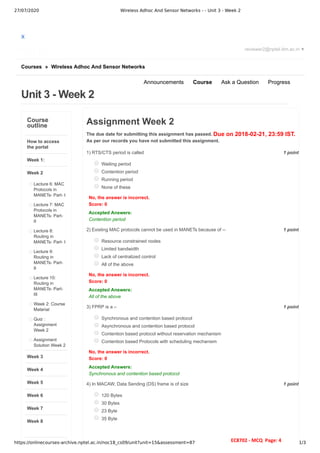
Due on 2018-02-21, 23:59 IST.
1 point
1)
1 point
2)
1 point
3)
1 point
4)
Assignment Week 1
The due date for submitting this assignment has passed.
As per our records you have not submitted this assignment.
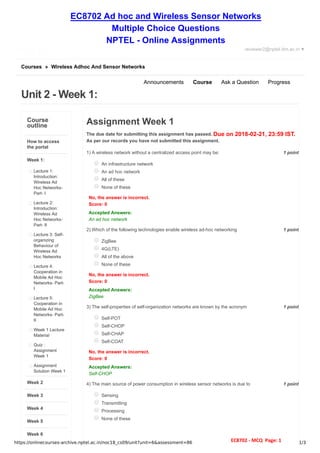
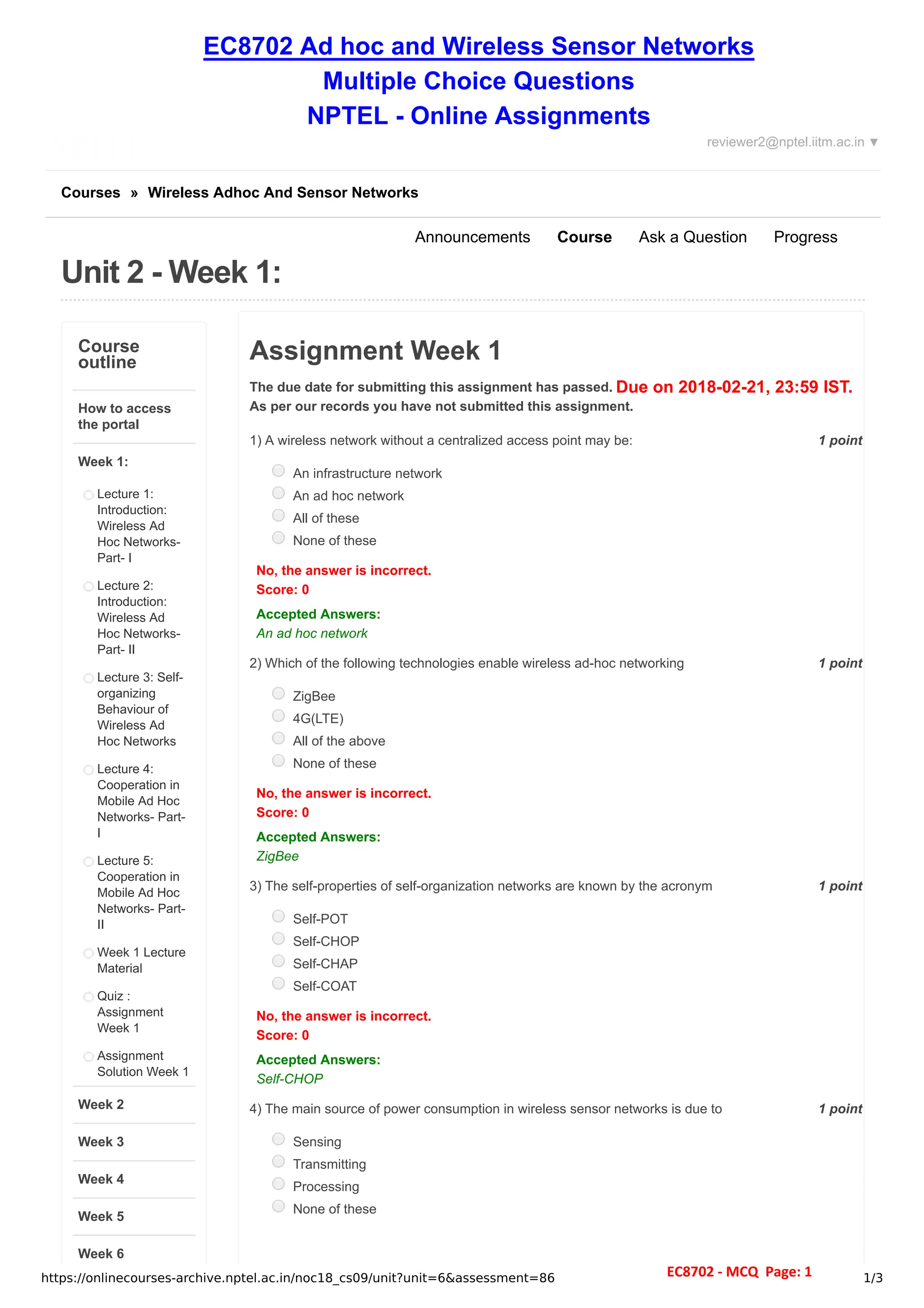
A wireless network without a centralized access point may be:
An infrastructure network
An ad hoc network
All of these
None of these
No, the answer is incorrect.
Score: 0
Accepted Answers:
An ad hoc network
Which of the following technologies enable wireless ad-hoc networking
ZigBee
4G(LTE)
All of the above
None of these
No, the answer is incorrect.
Score: 0
Accepted Answers:
ZigBee
The self-properties of self-organization networks are known by the acronym
Self-POT
Self-CHOP
Self-CHAP
Self-COAT
No, the answer is incorrect.
Score: 0
Accepted Answers:
Self-CHOP
The main source of power consumption in wireless sensor networks is due to
Sensing
Transmitting
Processing
None of these
EC8702 Ad hoc and Wireless Sensor Networks
Multiple Choice Questions
NPTEL - Online Assignments
EC8702 - MCQ Page: 1
27/07/2020 Wireless Adhoc And Sensor Networks - - Unit 2 - Week 1:
https://onlinecourses-archive.nptel.ac.in/noc18_cs09/unit?unit=6&assessment=86 2/3
Week 7
Week 8
DOWNLOAD
VIDEOS
1 point
5)
1 point
6)
1 point
7)
1 point
8)
1 point
9)
No, the answer is incorrect.
Score: 0
Accepted Answers:
Transmitting
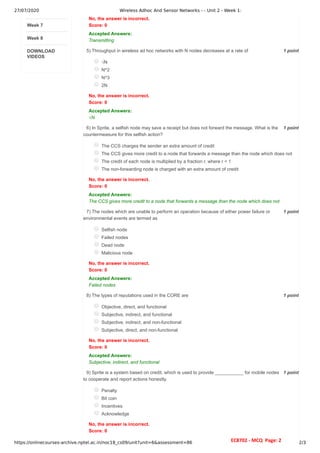
Throughput in wireless ad hoc networks with N nodes decreases at a rate of
√N
N^2
N^3
2N
No, the answer is incorrect.
Score: 0
Accepted Answers:
√N
In Sprite, a selfish node may save a receipt but does not forward the message. What is the
countermeasure for this selfish action?
The CCS charges the sender an extra amount of credit
The CCS gives more credit to a node that forwards a message than the node which does not
The credit of each node is multiplied by a fraction r, where r < 1
The non-forwarding node is charged with an extra amount of credit
No, the answer is incorrect.
Score: 0
Accepted Answers:
The CCS gives more credit to a node that forwards a message than the node which does not
The nodes which are unable to perform an operation because of either power failure or
environmental events are termed as
Selfish node
Failed nodes
Dead node
Malicious node
No, the answer is incorrect.
Score: 0
Accepted Answers:
Failed nodes
The types of reputations used in the CORE are
Objective, direct, and functional
Subjective, indirect, and functional
Subjective, indirect, and non-functional
Subjective, direct, and non-functional
No, the answer is incorrect.
Score: 0
Accepted Answers:
Subjective, indirect, and functional
Sprite is a system based on credit, which is used to provide ___________ for mobile nodes
to cooperate and report actions honestly.
Penalty
Bit coin
Incentives
Acknowledge
No, the answer is incorrect.
Score: 0
EC8702 - MCQ Page: 2
27/07/2020 Wireless Adhoc And Sensor Networks - - Unit 2 - Week 1:
https://onlinecourses-archive.nptel.ac.in/noc18_cs09/unit?unit=6&assessment=86 3/3
1 point
10)
Accepted Answers:
Incentives
Nodes which deliberately disrupt the correct operation of the routing protocol are known as:
Selfish nodes
Failed nodes
Badly failed nodes
Malicious nodes
No, the answer is incorrect.
Score: 0
Accepted Answers:
Malicious nodes
Previous Page End
A project of In association with
Funded by
Powered by
© 2014 NPTEL - Privacy & Terms - Honor Code - FAQs -
EC8702 - MCQ Page: 3
27/07/2020 Wireless Adhoc And Sensor Networks - - Unit 3 - Week 2
https://onlinecourses-archive.nptel.ac.in/noc18_cs09/unit?unit=15&assessment=87 1/3
X
Courses » Wireless Adhoc And Sensor Networks
Unit 3 - Week 2
reviewer2@nptel.iitm.ac.in ▼
Announcements Course Ask a Question Progress
Course
outline
How to access
the portal
Week 1:
Week 2
Week 3
Week 4
Week 5
Week 6
Week 7
Week 8
Lecture 6: MAC
Protocols in
MANETs- Part- I
Lecture 7: MAC
Protocols in
MANETs- Part-
II
Lecture 8:
Routing in
MANETs- Part- I
Lecture 9:
Routing in
MANETs- Part-
II
Lecture 10:
Routing in
MANETs- Part-
III
Week 2: Course
Material
Quiz :
Assignment
Week 2
Assignment
Solution Week 2
Due on 2018-02-21, 23:59 IST.
1 point
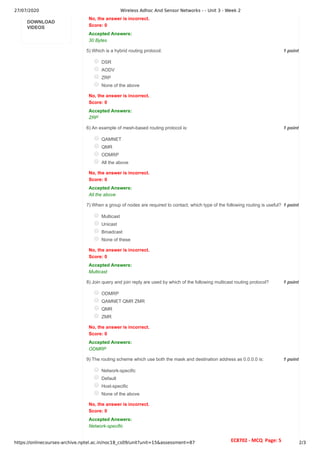
1)
1 point
2)
1 point
3)
1 point
4)
Assignment Week 2
The due date for submitting this assignment has passed.
As per our records you have not submitted this assignment.
RTS/CTS period is called
Waiting period
Contention period
Running period
None of these
No, the answer is incorrect.
Score: 0
Accepted Answers:
Contention period
Existing MAC protocols cannot be used in MANETs because of --
Resource constrained nodes
Limited bandwidth
Lack of centralized control
All of the above
No, the answer is incorrect.
Score: 0
Accepted Answers:
All of the above
FPRP is a –
Synchronous and contention based protocol
Asynchronous and contention based protocol
Contention based protocol without reservation mechanism
Contention based Protocols with scheduling mechanism
No, the answer is incorrect.
Score: 0
Accepted Answers:
Synchronous and contention based protocol
In MACAW, Data Sending (DS) frame is of size
120 Bytes
30 Bytes
23 Byte
35 Byte
EC8702 - MCQ Page: 4
27/07/2020 Wireless Adhoc And Sensor Networks - - Unit 3 - Week 2
https://onlinecourses-archive.nptel.ac.in/noc18_cs09/unit?unit=15&assessment=87 2/3
DOWNLOAD
VIDEOS
1 point
5)
1 point
6)
1 point
7)
1 point
8)
1 point
9)
No, the answer is incorrect.
Score: 0
Accepted Answers:
30 Bytes
Which is a hybrid routing protocol:
DSR
AODV
ZRP
None of the above
No, the answer is incorrect.
Score: 0
Accepted Answers:
ZRP
An example of mesh-based routing protocol is:
QAMNET
QMR
ODMRP
All the above
No, the answer is incorrect.
Score: 0
Accepted Answers:
All the above
When a group of nodes are required to contact, which type of the following routing is useful?
Multicast
Unicast
Broadcast
None of these
No, the answer is incorrect.
Score: 0
Accepted Answers:
Multicast
Join query and join reply are used by which of the following multicast routing protocol?
ODMRP
QAMNET QMR ZMR
QMR
ZMR
No, the answer is incorrect.
Score: 0
Accepted Answers:
ODMRP
The routing scheme which use both the mask and destination address as 0.0.0.0 is:
Network-specific
Default
Host-specific
None of the above
No, the answer is incorrect.
Score: 0
Accepted Answers:
Network-specific
EC8702 - MCQ Page: 5
27/07/2020 Wireless Adhoc And Sensor Networks - - Unit 3 - Week 2
https://onlinecourses-archive.nptel.ac.in/noc18_cs09/unit?unit=15&assessment=87 3/3
1 point
10)
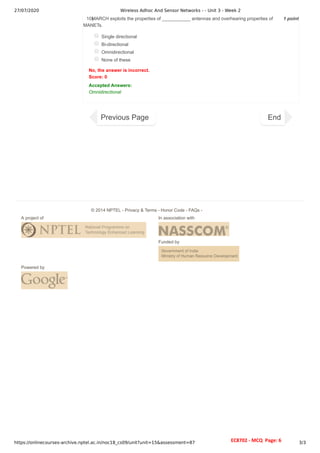
MARCH exploits the properties of ___________ antennas and overhearing properties of
MANETs.
Single directional
Bi-directional
Omnidirectional
None of these
No, the answer is incorrect.
Score: 0
Accepted Answers:
Omnidirectional
Previous Page End
A project of In association with
Funded by
Powered by
© 2014 NPTEL - Privacy & Terms - Honor Code - FAQs -
EC8702 - MCQ Page: 6
27/07/2020 Wireless Adhoc And Sensor Networks - - Unit 4 - Week 3
https://onlinecourses-archive.nptel.ac.in/noc18_cs09/unit?unit=24&assessment=93 1/3
X
Courses » Wireless Adhoc And Sensor Networks
Unit 4 - Week 3
reviewer2@nptel.iitm.ac.in ▼
Announcements Course Ask a Question Progress
Course
outline
How to access
the portal
Week 1:
Week 2
Week 3
Week 4
Week 5
Week 6
Lecture 11:
Multicasting in
MANETs
Lecture 12:
Mobility Models
for MANETs
Lecture 13:
Transport
Protocols for
MANETs- Part- I
Lecture 14 :
Transport
Protocols for
MANETs- Part-
II
Lecture 15:
Opportunistic
Mobile
Networks- Part-
I
Week 3 Lecture
Material
Feedback for
week 3
Quiz :
Assignment
Week 3
Assignment
Solution Week 3
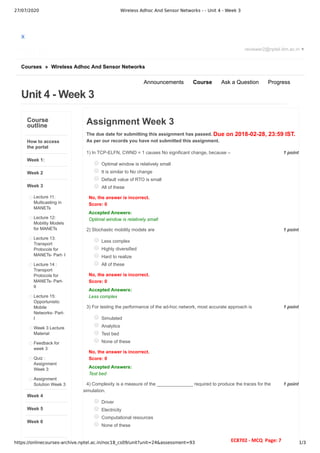
Due on 2018-02-28, 23:59 IST.
1 point
1)
1 point
2)
1 point
3)
1 point
4)
Assignment Week 3
The due date for submitting this assignment has passed.
As per our records you have not submitted this assignment.
In TCP-ELFN, CWND = 1 causes No significant change, because –
Optimal window is relatively small
It is similar to No change
Default value of RTO is small
All of these
No, the answer is incorrect.
Score: 0
Accepted Answers:
Optimal window is relatively small
Stochastic mobility models are
Less complex
Highly diversified
Hard to realize
All of these
No, the answer is incorrect.
Score: 0
Accepted Answers:
Less complex
For testing the performance of the ad-hoc network, most accurate approach is
Simulated
Analytics
Test bed
None of these
No, the answer is incorrect.
Score: 0
Accepted Answers:
Test bed
Complexity is a measure of the ______________ required to produce the traces for the
simulation.
Driver
Electricity
Computational resources
None of these
EC8702 - MCQ Page: 7
27/07/2020 Wireless Adhoc And Sensor Networks - - Unit 4 - Week 3
https://onlinecourses-archive.nptel.ac.in/noc18_cs09/unit?unit=24&assessment=93 2/3
Week 7
Week 8
DOWNLOAD
VIDEOS
1 point
5)
1 point
6)
1 point
7)
1 point
8)
1 point
9)
No, the answer is incorrect.
Score: 0
Accepted Answers:
Computational resources
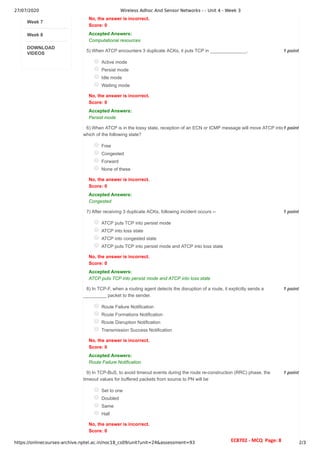
When ATCP encounters 3 duplicate ACKs, it puts TCP in ______________.
Active mode
Persist mode
Idle mode
Waiting mode
No, the answer is incorrect.
Score: 0
Accepted Answers:
Persist mode
When ATCP is in the lossy state, reception of an ECN or ICMP message will move ATCP into
which of the following state?
Free
Congested
Forward
None of these
No, the answer is incorrect.
Score: 0
Accepted Answers:
Congested
After receiving 3 duplicate ACKs, following incident occurs --
ATCP puts TCP into persist mode
ATCP into loss state
ATCP into congested state
ATCP puts TCP into persist mode and ATCP into loss state
No, the answer is incorrect.
Score: 0
Accepted Answers:
ATCP puts TCP into persist mode and ATCP into loss state
In TCP-F, when a routing agent detects the disruption of a route, it explicitly sends a
_________ packet to the sender.
Route Failure Notification
Route Formations Notification
Route Disruption Notification
Transmission Success Notification
No, the answer is incorrect.
Score: 0
Accepted Answers:
Route Failure Notification
In TCP-BuS, to avoid timeout events during the route re-construction (RRC) phase, the
timeout values for buffered packets from source to PN will be
Set to one
Doubled
Same
Half
No, the answer is incorrect.
Score: 0
EC8702 - MCQ Page: 8
27/07/2020 Wireless Adhoc And Sensor Networks - - Unit 4 - Week 3
https://onlinecourses-archive.nptel.ac.in/noc18_cs09/unit?unit=24&assessment=93 3/3
1 point
10)
Accepted Answers:
Doubled
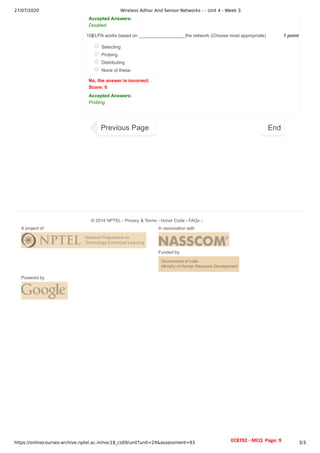
ELFN works based on __________________the network (Choose most appropriate)
Selecting
Probing
Distributing
None of these
No, the answer is incorrect.
Score: 0
Accepted Answers:
Probing
Previous Page End
A project of In association with
Funded by
Powered by
© 2014 NPTEL - Privacy & Terms - Honor Code - FAQs -
EC8702 - MCQ Page: 9
27/07/2020 Wireless Adhoc And Sensor Networks - - Unit 5 - Week 4
https://onlinecourses-archive.nptel.ac.in/noc18_cs09/unit?unit=33&assessment=92 1/3
X
Courses » Wireless Adhoc And Sensor Networks
Unit 5 - Week 4
reviewer2@nptel.iitm.ac.in ▼
Announcements Course Ask a Question Progress
Course
outline
How to access
the portal
Week 1:
Week 2
Week 3
Week 4
Week 5
Week 6
Week 7
Week 8
Lecture 16:
Opportunistic
Mobile
Networks- Part-
II
Lecture 17:
Opportunistic
Mobile
Networks- Part-
III
Lecture 18: UAV
Networks- Part-
I
Lecture 19: UAV
Networks- Part-
II
Lecture 20: UAV
Networks- Part-
III
Week 4: Lecture
Material
Quiz :
Assignment
Week 4
Assignment
Solution Week 4
Due on 2018-03-07, 23:59 IST.
1 point
1)
1 point
2)
1 point
3)
1 point
4)
Assignment Week 4
The due date for submitting this assignment has passed.
As per our records you have not submitted this assignment.
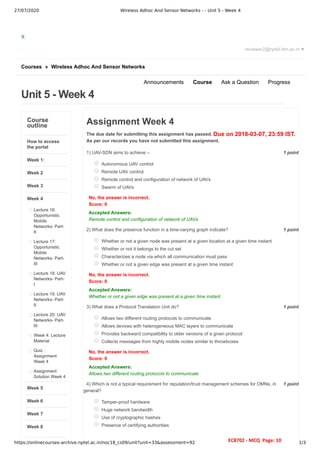
UAV-SDN aims to achieve –
Autonomous UAV control
Remote UAV control
Remote control and configuration of network of UAVs
Swarm of UAVs
No, the answer is incorrect.
Score: 0
Accepted Answers:
Remote control and configuration of network of UAVs
What does the presence function in a time-varying graph indicate?
Whether or not a given node was present at a given location at a given time instant
Whether or not it belongs to the cut set
Characterizes a node via which all communication must pass
Whether or not a given edge was present at a given time instant
No, the answer is incorrect.
Score: 0
Accepted Answers:
Whether or not a given edge was present at a given time instant
What does a Protocol Translation Unit do?
Allows two different routing protocols to communicate
Allows devices with heterogeneous MAC layers to communicate
Provides backward compatibility to older versions of a given protocol
Collects messages from highly mobile nodes similar to throwboxes
No, the answer is incorrect.
Score: 0
Accepted Answers:
Allows two different routing protocols to communicate
Which is not a typical requirement for reputation/trust management schemes for OMNs, in
general?
Tamper-proof hardware
Huge network bandwidth
Use of cryptographic hashes
Presence of certifying authorities
EC8702 - MCQ Page: 10
27/07/2020 Wireless Adhoc And Sensor Networks - - Unit 5 - Week 4
https://onlinecourses-archive.nptel.ac.in/noc18_cs09/unit?unit=33&assessment=92 2/3
DOWNLOAD
VIDEOS
1 point
5)
1 point
6)
1 point
7)
1 point
8)
1 point
9)
No, the answer is incorrect.
Score: 0
Accepted Answers:
Huge network bandwidth
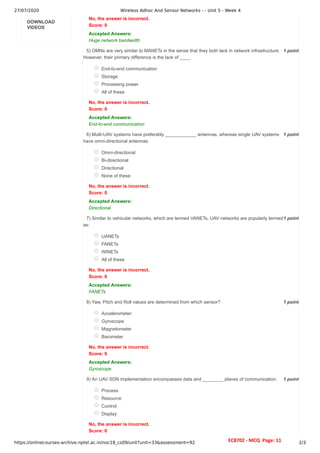
OMNs are very similar to MANETs in the sense that they both lack in network infrastructure.
However, their primary difference is the lack of ____
End-to-end communication
Storage
Processing power
All of these
No, the answer is incorrect.
Score: 0
Accepted Answers:
End-to-end communication
Multi-UAV systems have preferably ____________ antennas, whereas single UAV systems
have omni-directional antennas.
Omni-directional
Bi-directional
Directional
None of these
No, the answer is incorrect.
Score: 0
Accepted Answers:
Directional
Similar to vehicular networks, which are termed VANETs, UAV networks are popularly termed
as:
UANETs
FANETs
WINETs
All of these
No, the answer is incorrect.
Score: 0
Accepted Answers:
FANETs
Yaw, Pitch and Roll values are determined from which sensor?
Accelerometer
Gyroscope
Magnetometer
Barometer
No, the answer is incorrect.
Score: 0
Accepted Answers:
Gyroscope
An UAV SDN implementation encompasses data and ________ planes of communication.
Process
Resource
Control
Display
No, the answer is incorrect.
Score: 0
EC8702 - MCQ Page: 11
27/07/2020 Wireless Adhoc And Sensor Networks - - Unit 5 - Week 4
https://onlinecourses-archive.nptel.ac.in/noc18_cs09/unit?unit=33&assessment=92 3/3
1 point
10)
Accepted Answers:
Control
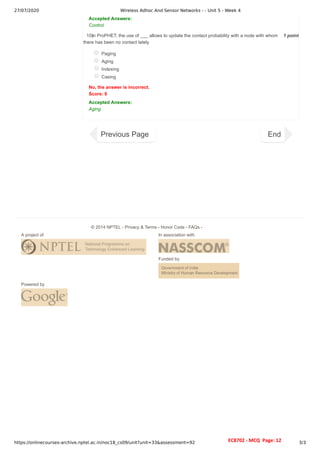
In ProPHET, the use of ___ allows to update the contact probability with a node with whom
there has been no contact lately
Paging
Aging
Indexing
Casing
No, the answer is incorrect.
Score: 0
Accepted Answers:
Aging
Previous Page End
A project of In association with
Funded by
Powered by
© 2014 NPTEL - Privacy & Terms - Honor Code - FAQs -
EC8702 - MCQ Page: 12
27/07/2020 Wireless Adhoc And Sensor Networks - - Unit 6 - Week 5
https://onlinecourses-archive.nptel.ac.in/noc18_cs09/unit?unit=42&assessment=99 1/3
X
Courses » Wireless Adhoc And Sensor Networks
Unit 6 - Week 5
reviewer2@nptel.iitm.ac.in ▼
Announcements Course Ask a Question Progress
Course
outline
How to access
the portal
Week 1:
Week 2
Week 3
Week 4
Week 5
Lecture 21:
Introducation:
Wireless Sensor
Networks- Part-
I
Lecture 22:
Introducation:
Wireless Sensor
Networks- Part-
II
Lecture 23:
WSN Coverage
& Placement-
Part-I
Lecture 24:
WSN Coverage
& Placement-
Part-II
Lecture 25:
Topology
Mangement in
Wireless Sensor
Networks
Week 5 Lecture
Material
Feedback for
week 5
Quiz :
Assignment
Week 5
Assignment
Solution Week 5
Due on 2018-03-14, 23:59 IST.
1 point
1)
1 point
2)
1 point
3)
1 point
4)
Assignment Week 5
The due date for submitting this assignment has passed.
As per our records you have not submitted this assignment.
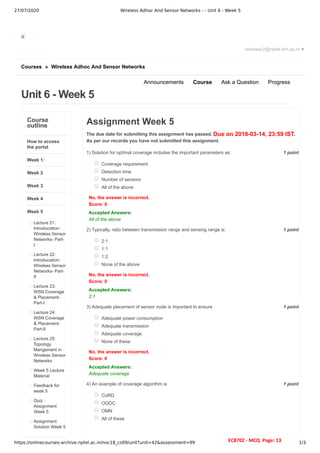
Solution for optimal coverage includes the important parameters as:
Coverage requirement
Detection time
Number of sensors
All of the above
No, the answer is incorrect.
Score: 0
Accepted Answers:
All of the above
Typically, ratio between transmission range and sensing range is:
2:1
1:1
1:2
None of the above
No, the answer is incorrect.
Score: 0
Accepted Answers:
2:1
Adequate placement of sensor node is important to ensure
Adequate power consumption
Adequate transmission
Adequate coverage
None of these
No, the answer is incorrect.
Score: 0
Accepted Answers:
Adequate coverage
An example of coverage algorithm is
CoRD
OGDC
OMN
All of these
EC8702 - MCQ Page: 13
27/07/2020 Wireless Adhoc And Sensor Networks - - Unit 6 - Week 5
https://onlinecourses-archive.nptel.ac.in/noc18_cs09/unit?unit=42&assessment=99 2/3
Week 6
Week 7
Week 8
DOWNLOAD
VIDEOS
1 point
5)
1 point
6)
1 point
7)
1 point
8)
1 point
9)
No, the answer is incorrect.
Score: 0
Accepted Answers:
OGDC
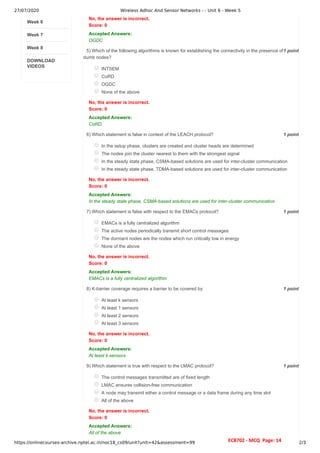
Which of the following algorithms is known for establishing the connectivity in the presence of
dumb nodes?
INTSEM
CoRD
OGDC
None of the above
No, the answer is incorrect.
Score: 0
Accepted Answers:
CoRD
Which statement is false in context of the LEACH protocol?
In the setup phase, clusters are created and cluster heads are determined
The nodes join the cluster nearest to them with the strongest signal
In the steady state phase, CSMA-based solutions are used for inter-cluster communication
In the steady state phase, TDMA-based solutions are used for inter-cluster communication
No, the answer is incorrect.
Score: 0
Accepted Answers:
In the steady state phase, CSMA-based solutions are used for inter-cluster communication
Which statement is false with respect to the EMACs protocol?
EMACs is a fully centralized algorithm
The active nodes periodically transmit short control messages
The dormant nodes are the nodes which run critically low in energy
None of the above
No, the answer is incorrect.
Score: 0
Accepted Answers:
EMACs is a fully centralized algorithm
K-barrier coverage requires a barrier to be covered by:
At least k sensors
At least 1 sensors
At least 2 sensors
At least 3 sensors
No, the answer is incorrect.
Score: 0
Accepted Answers:
At least k sensors
Which statement is true with respect to the LMAC protocol?
The control messages transmitted are of fixed length
LMAC ensures collision-free communication
A node may transmit either a control message or a data frame during any time slot
All of the above
No, the answer is incorrect.
Score: 0
Accepted Answers:
All of the above
EC8702 - MCQ Page: 14
27/07/2020 Wireless Adhoc And Sensor Networks - - Unit 6 - Week 5
https://onlinecourses-archive.nptel.ac.in/noc18_cs09/unit?unit=42&assessment=99 3/3
1 point
10)
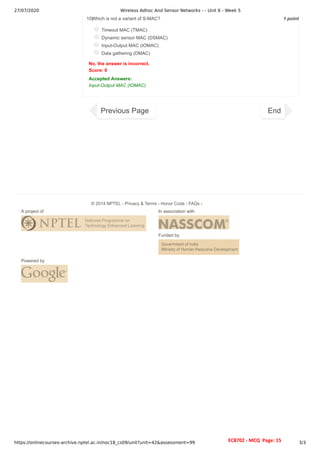
Which is not a variant of S-MAC?
Timeout MAC (TMAC)
Dynamic sensor MAC (DSMAC)
Input-Output MAC (IOMAC)
Data gathering (DMAC)
No, the answer is incorrect.
Score: 0
Accepted Answers:
Input-Output MAC (IOMAC)
Previous Page End
A project of In association with
Funded by
Powered by
© 2014 NPTEL - Privacy & Terms - Honor Code - FAQs -
EC8702 - MCQ Page: 15
27/07/2020 Wireless Adhoc And Sensor Networks - - Unit 7 - Week 6
https://onlinecourses-archive.nptel.ac.in/noc18_cs09/unit?unit=51&assessment=100 1/3
X
Courses » Wireless Adhoc And Sensor Networks
Unit 7 - Week 6
reviewer2@nptel.iitm.ac.in ▼
Announcements Course Ask a Question Progress
Course
outline
How to access
the portal
Week 1:
Week 2
Week 3
Week 4
Week 5
Week 6
Lecture 26:
Mobile Wireless
Sensor
Networks
Lecture 27:
Medium Access
Control in
Wireless
Networks- Part-I
Lecture 28:
Medium Access
Control in
Wireless
Networks- Part-
II
Lecture 29:
Routing in
Wireless Sensor
Networks- Part-
I
Lecture 30:
Routing in
Wireless Sensor
Networks- Part-
II
Week 6: Lecture
Material
Feedback for
week 6
Quiz :
Assignment
Due on 2018-03-21, 23:59 IST.
1 point
1)
1 point
2)
1 point
3)
1 point
4)
Assignment Week 6
The due date for submitting this assignment has passed.
As per our records you have not submitted this assignment.
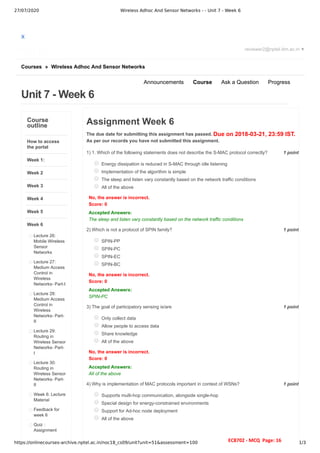
1. Which of the following statements does not describe the S-MAC protocol correctly?
Energy dissipation is reduced in S-MAC through idle listening
Implementation of the algorithm is simple
The sleep and listen vary constantly based on the network traffic conditions
All of the above
No, the answer is incorrect.
Score: 0
Accepted Answers:
The sleep and listen vary constantly based on the network traffic conditions
Which is not a protocol of SPIN family?
SPIN-PP
SPIN-PC
SPIN-EC
SPIN-BC
No, the answer is incorrect.
Score: 0
Accepted Answers:
SPIN-PC
The goal of participatory sensing is/are
Only collect data
Allow people to access data
Share knowledge
All of the above
No, the answer is incorrect.
Score: 0
Accepted Answers:
All of the above
Why is implementation of MAC protocols important in context of WSNs?
Supports multi-hop communication, alongside single-hop
Special design for energy-constrained environments
Support for Ad-hoc node deployment
All of the above
EC8702 - MCQ Page: 16
27/07/2020 Wireless Adhoc And Sensor Networks - - Unit 7 - Week 6
https://onlinecourses-archive.nptel.ac.in/noc18_cs09/unit?unit=51&assessment=100 2/3
Week 7
Week 8
DOWNLOAD
VIDEOS
Week 6
Assignment
Solution Week 6
1 point
5)
1 point
6)
1 point
7)
1 point
8)
1 point
9)
No, the answer is incorrect.
Score: 0
Accepted Answers:
All of the above
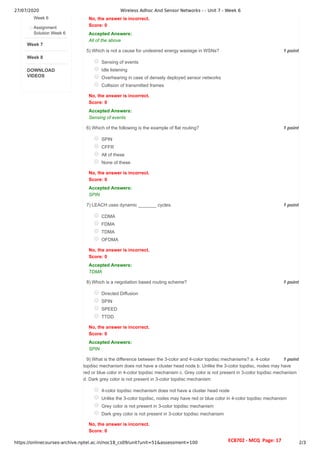
Which is not a cause for undesired energy wastage in WSNs?
Sensing of events
Idle listening
Overhearing in case of densely deployed sensor networks
Collision of transmitted frames
No, the answer is incorrect.
Score: 0
Accepted Answers:
Sensing of events
Which of the following is the example of flat routing?
SPIN
CFFR
All of these
None of these
No, the answer is incorrect.
Score: 0
Accepted Answers:
SPIN
LEACH uses dynamic _______ cycles.
CDMA
FDMA
TDMA
OFDMA
No, the answer is incorrect.
Score: 0
Accepted Answers:
TDMA
Which is a negotiation based routing scheme?
Directed Diffusion
SPIN
SPEED
TTDD
No, the answer is incorrect.
Score: 0
Accepted Answers:
SPIN
What is the difference between the 3-color and 4-color topdisc mechanisms? a. 4-color
topdisc mechanism does not have a cluster head node b. Unlike the 3-color topdisc, nodes may have
red or blue color in 4-color topdisc mechanism c. Grey color is not present in 3-color topdisc mechanism
d. Dark grey color is not present in 3-color topdisc mechanism
4-color topdisc mechanism does not have a cluster head node
Unlike the 3-color topdisc, nodes may have red or blue color in 4-color topdisc mechanism
Grey color is not present in 3-color topdisc mechanism
Dark grey color is not present in 3-color topdisc mechanism
No, the answer is incorrect.
Score: 0
EC8702 - MCQ Page: 17
27/07/2020 Wireless Adhoc And Sensor Networks - - Unit 7 - Week 6
https://onlinecourses-archive.nptel.ac.in/noc18_cs09/unit?unit=51&assessment=100 3/3
1 point
10)
Accepted Answers:
Dark grey color is not present in 3-color topdisc mechanism
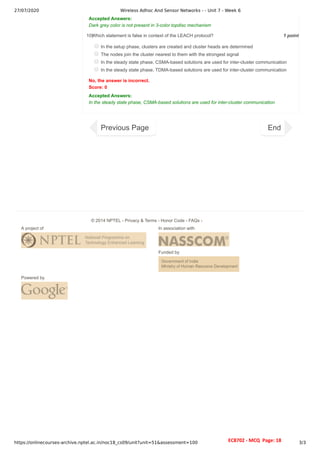
Which statement is false in context of the LEACH protocol?
In the setup phase, clusters are created and cluster heads are determined
The nodes join the cluster nearest to them with the strongest signal
In the steady state phase, CSMA-based solutions are used for inter-cluster communication
In the steady state phase, TDMA-based solutions are used for inter-cluster communication
No, the answer is incorrect.
Score: 0
Accepted Answers:
In the steady state phase, CSMA-based solutions are used for inter-cluster communication
Previous Page End
A project of In association with
Funded by
Powered by
© 2014 NPTEL - Privacy & Terms - Honor Code - FAQs -
EC8702 - MCQ Page: 18
27/07/2020 Wireless Adhoc And Sensor Networks - - Unit 8 - Week 7
https://onlinecourses-archive.nptel.ac.in/noc18_cs09/unit?unit=60&assessment=103 1/3
X
Courses » Wireless Adhoc And Sensor Networks
Unit 8 - Week 7
reviewer2@nptel.iitm.ac.in ▼
Announcements Course Ask a Question Progress
Course
outline
How to access
the portal
Week 1:
Week 2
Week 3
Week 4
Week 5
Week 6
Week 7
Lecture 31:
Congestion and
Flow Control-
Part- I
Lecture 32:
Congestion and
Flow Control-
Part- II
Lecture 33:
Underwater
Sensor
Networks- Part-
I
Lecture 34:
Underwater
Sensor
Networks- Part-
II
Lecture 35:
Underwater
Sensor
Networks- Part-
III
Week 7: Lecture
Material
Feedback for
week 7
Quiz :
Assignment
Due on 2018-03-28, 23:59 IST.
1 point
1)
1 point
2)
1 point
3)
1 point
4)
Assignment Week 7
The due date for submitting this assignment has passed.
As per our records you have not submitted this assignment.
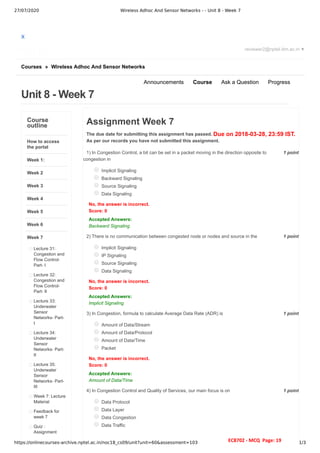
In Congestion Control, a bit can be set in a packet moving in the direction opposite to
congestion in
Implicit Signaling
Backward Signaling
Source Signaling
Data Signaling
No, the answer is incorrect.
Score: 0
Accepted Answers:
Backward Signaling
There is no communication between congested node or nodes and source in the
Implicit Signaling
IP Signaling
Source Signaling
Data Signaling
No, the answer is incorrect.
Score: 0
Accepted Answers:
Implicit Signaling
In Congestion, formula to calculate Average Data Rate (ADR) is
Amount of Data/Stream
Amount of Data/Protocol
Amount of Data/Time
Packet
No, the answer is incorrect.
Score: 0
Accepted Answers:
Amount of Data/Time
In Congestion Control and Quality of Services, our main focus is on
Data Protocol
Data Layer
Data Congestion
Data Traffic
EC8702 - MCQ Page: 19
27/07/2020 Wireless Adhoc And Sensor Networks - - Unit 8 - Week 7
https://onlinecourses-archive.nptel.ac.in/noc18_cs09/unit?unit=60&assessment=103 2/3
Week 8
DOWNLOAD
VIDEOS
Week 7
Assignment
Solution Week 7
1 point
5)
1 point
6)
1 point
7)
1 point
8)
1 point
9)
No, the answer is incorrect.
Score: 0
Accepted Answers:
Data Traffic
________________ is the best suitable ranging technique among these? (Consider no time-
synchronization among nodes.)
ToA (one-way message transfer)
Euclidean distance propagation technique
ToA (two-way message transfer)
All of the above
No, the answer is incorrect.
Score: 0
Accepted Answers:
ToA (two-way message transfer)
For achieving network-wide localization, which are the important parameters for evaluating
any localization algorithm?
Localization coverage
Average localization accuracy
Average energy consumption
All of these
No, the answer is incorrect.
Score: 0
Accepted Answers:
All of these
Underwater mobility affects
Topology
Link between nodes
Coverage
All of these
No, the answer is incorrect.
Score: 0
Accepted Answers:
All of these
Which statement is true for UWSN
High spatio-temporal variability of communication channel
Less transmission power required
No memory required for data caching
None of these
No, the answer is incorrect.
Score: 0
Accepted Answers:
High spatio-temporal variability of communication channel
The UWSN network could be
Star topology
Cluster topology
Mesh topology
All of these
No, the answer is incorrect.
Score: 0
Accepted Answers:
EC8702 - MCQ Page: 20
27/07/2020 Wireless Adhoc And Sensor Networks - - Unit 8 - Week 7
https://onlinecourses-archive.nptel.ac.in/noc18_cs09/unit?unit=60&assessment=103 3/3
1 point
10)
All of these
No. of reference points required for localizing a node in 3D coordinate systems is ______.
4
3
5
None of these
No, the answer is incorrect.
Score: 0
Accepted Answers:
4
Previous Page End
A project of In association with
Funded by
Powered by
© 2014 NPTEL - Privacy & Terms - Honor Code - FAQs -
EC8702 - MCQ Page: 21
27/07/2020 Wireless Adhoc And Sensor Networks - - Unit 9 - Week 8
https://onlinecourses-archive.nptel.ac.in/noc18_cs09/unit?unit=69&assessment=107 1/3
X
Courses » Wireless Adhoc And Sensor Networks
Unit 9 - Week 8
reviewer2@nptel.iitm.ac.in ▼
Announcements Course Ask a Question Progress
Course
outline
How to access
the portal
Week 1:
Week 2
Week 3
Week 4
Week 5
Week 6
Week 7
Week 8
Lecture 36:
Underwater
Sensor
Networks- Part-
IV
Lecture 37:
Security of
Wireless Sensor
Networks- Part-
I
Lecture 38:
Security of
Wireless Sensor
Networks- Part-
II
Lecture 39:
Hardware
Design of
Sensor Node
Lecture 40:
Real Life
Deployment of
WSN
Week 8: Lecture
Material
Feedback for
week 8
Due on 2018-04-04, 23:59 IST.
1 point
1)
1 point
2)
1 point
3)
1 point
4)
Assignment Week 8
The due date for submitting this assignment has passed.
As per our records you have not submitted this assignment.
Which of the following jamming attacks is time specific?
Constant jamming
Intermittent jamming
Deceptive jamming
Reactive jamming
No, the answer is incorrect.
Score: 0
Accepted Answers:
Intermittent jamming
The primary challenges of embedded operating system are
Small memory footprint
Efficient in power and computation
Lack hardware parallelism
All of these
No, the answer is incorrect.
Score: 0
Accepted Answers:
All of these
Advantages of Event-Driven Model operating system in WSN are
Concurrency with low resources
Complements the way networking protocols work
Inexpensive scheduling technique
All of these
No, the answer is incorrect.
Score: 0
Accepted Answers:
All of these
Example of Event-Driven Model operating system (OS) in WSN is
Mantis OS
RETOS
TinyOS
None of these
EC8702 - MCQ Page: 22
27/07/2020 Wireless Adhoc And Sensor Networks - - Unit 9 - Week 8
https://onlinecourses-archive.nptel.ac.in/noc18_cs09/unit?unit=69&assessment=107 2/3
DOWNLOAD
VIDEOS
Quiz :
Assignment
Week 8
Solution Week 8
1 point
5)
1 point
6)
1 point
7)
1 point
8)
1 point
9)
No, the answer is incorrect.
Score: 0
Accepted Answers:
TinyOS
A Bluetooth network consists of one primary device(s) and up to ____ secondary devices.
Five
Two
Seven
Nine
No, the answer is incorrect.
Score: 0
Accepted Answers:
Seven
Radar is one kind of ________ sensor
Passive
Active
Dead
None of these
No, the answer is incorrect.
Score: 0
Accepted Answers:
Active
One malicious node behaves like multiple nodes, this type of attack is known as
Byzantine attack
Sybil attack
DoS attack
Spoofing
No, the answer is incorrect.
Score: 0
Accepted Answers:
Sybil attack
The flash memory of microcontroller in a sensor node is used to
Hold a data base
Hold a data sheet only
Hold a program code
Hold program variables only
No, the answer is incorrect.
Score: 0
Accepted Answers:
Hold a program code
An example of Selective forwarding attack is:
Forwarding attack
Sinkhole attack
Selectivity attack
None of these
No, the answer is incorrect.
Score: 0
Accepted Answers:
Sinkhole attack
EC8702 - MCQ Page: 23
27/07/2020 Wireless Adhoc And Sensor Networks - - Unit 9 - Week 8
https://onlinecourses-archive.nptel.ac.in/noc18_cs09/unit?unit=69&assessment=107 3/3
1 point
10)
Traditional cryptographic algorithms cannot be used directly in WSN, because sensor nodes
are
Resource constrained.
Memory-less
Clock-less
Processor-less
No, the answer is incorrect.
Score: 0
Accepted Answers:
Resource constrained.
Previous Page End
A project of In association with
Funded by
Powered by
© 2014 NPTEL - Privacy & Terms - Honor Code - FAQs -
EC8702 - MCQ Page: 24

adhoc and wireless sensor network nptel assignment answers (1).pdf

  • 1.
    https://onlinecourses-archive.nptel.ac.in/noc18_cs09/unit?unit=6&assessment=86 1/3 Courses »Wireless Adhoc And Sensor Networks Unit 2 - Week 1: reviewer2@nptel.iitm.ac.in ▼ Announcements Course Ask a Question Progress Course outline How to access the portal Week 1: Week 2 Week 3 Week 4 Week 5 Week 6 Lecture 1: Introduction: Wireless Ad Hoc Networks- Part- I Lecture 2: Introduction: Wireless Ad Hoc Networks- Part- II Lecture 3: Self- organizing Behaviour of Wireless Ad Hoc Networks Lecture 4: Cooperation in Mobile Ad Hoc Networks- Part- I Lecture 5: Cooperation in Mobile Ad Hoc Networks- Part- II Week 1 Lecture Material Quiz : Assignment Week 1 Assignment Solution Week 1 Due on 2018-02-21, 23:59 IST. 1 point 1) 1 point 2) 1 point 3) 1 point 4) Assignment Week 1 The due date for submitting this assignment has passed. As per our records you have not submitted this assignment. A wireless network without a centralized access point may be: An infrastructure network An ad hoc network All of these None of these No, the answer is incorrect. Score: 0 Accepted Answers: An ad hoc network Which of the following technologies enable wireless ad-hoc networking ZigBee 4G(LTE) All of the above None of these No, the answer is incorrect. Score: 0 Accepted Answers: ZigBee The self-properties of self-organization networks are known by the acronym Self-POT Self-CHOP Self-CHAP Self-COAT No, the answer is incorrect. Score: 0 Accepted Answers: Self-CHOP The main source of power consumption in wireless sensor networks is due to Sensing Transmitting Processing None of these EC8702 Ad hoc and Wireless Sensor Networks Multiple Choice Questions NPTEL - Online Assignments EC8702 - MCQ Page: 1
  • 2.
    27/07/2020 Wireless AdhocAnd Sensor Networks - - Unit 2 - Week 1: https://onlinecourses-archive.nptel.ac.in/noc18_cs09/unit?unit=6&assessment=86 2/3 Week 7 Week 8 DOWNLOAD VIDEOS 1 point 5) 1 point 6) 1 point 7) 1 point 8) 1 point 9) No, the answer is incorrect. Score: 0 Accepted Answers: Transmitting Throughput in wireless ad hoc networks with N nodes decreases at a rate of √N N^2 N^3 2N No, the answer is incorrect. Score: 0 Accepted Answers: √N In Sprite, a selfish node may save a receipt but does not forward the message. What is the countermeasure for this selfish action? The CCS charges the sender an extra amount of credit The CCS gives more credit to a node that forwards a message than the node which does not The credit of each node is multiplied by a fraction r, where r < 1 The non-forwarding node is charged with an extra amount of credit No, the answer is incorrect. Score: 0 Accepted Answers: The CCS gives more credit to a node that forwards a message than the node which does not The nodes which are unable to perform an operation because of either power failure or environmental events are termed as Selfish node Failed nodes Dead node Malicious node No, the answer is incorrect. Score: 0 Accepted Answers: Failed nodes The types of reputations used in the CORE are Objective, direct, and functional Subjective, indirect, and functional Subjective, indirect, and non-functional Subjective, direct, and non-functional No, the answer is incorrect. Score: 0 Accepted Answers: Subjective, indirect, and functional Sprite is a system based on credit, which is used to provide ___________ for mobile nodes to cooperate and report actions honestly. Penalty Bit coin Incentives Acknowledge No, the answer is incorrect. Score: 0 EC8702 - MCQ Page: 2
  • 3.
    27/07/2020 Wireless AdhocAnd Sensor Networks - - Unit 2 - Week 1: https://onlinecourses-archive.nptel.ac.in/noc18_cs09/unit?unit=6&assessment=86 3/3 1 point 10) Accepted Answers: Incentives Nodes which deliberately disrupt the correct operation of the routing protocol are known as: Selfish nodes Failed nodes Badly failed nodes Malicious nodes No, the answer is incorrect. Score: 0 Accepted Answers: Malicious nodes Previous Page End A project of In association with Funded by Powered by © 2014 NPTEL - Privacy & Terms - Honor Code - FAQs - EC8702 - MCQ Page: 3
  • 4.
    27/07/2020 Wireless AdhocAnd Sensor Networks - - Unit 3 - Week 2 https://onlinecourses-archive.nptel.ac.in/noc18_cs09/unit?unit=15&assessment=87 1/3 X Courses » Wireless Adhoc And Sensor Networks Unit 3 - Week 2 reviewer2@nptel.iitm.ac.in ▼ Announcements Course Ask a Question Progress Course outline How to access the portal Week 1: Week 2 Week 3 Week 4 Week 5 Week 6 Week 7 Week 8 Lecture 6: MAC Protocols in MANETs- Part- I Lecture 7: MAC Protocols in MANETs- Part- II Lecture 8: Routing in MANETs- Part- I Lecture 9: Routing in MANETs- Part- II Lecture 10: Routing in MANETs- Part- III Week 2: Course Material Quiz : Assignment Week 2 Assignment Solution Week 2 Due on 2018-02-21, 23:59 IST. 1 point 1) 1 point 2) 1 point 3) 1 point 4) Assignment Week 2 The due date for submitting this assignment has passed. As per our records you have not submitted this assignment. RTS/CTS period is called Waiting period Contention period Running period None of these No, the answer is incorrect. Score: 0 Accepted Answers: Contention period Existing MAC protocols cannot be used in MANETs because of -- Resource constrained nodes Limited bandwidth Lack of centralized control All of the above No, the answer is incorrect. Score: 0 Accepted Answers: All of the above FPRP is a – Synchronous and contention based protocol Asynchronous and contention based protocol Contention based protocol without reservation mechanism Contention based Protocols with scheduling mechanism No, the answer is incorrect. Score: 0 Accepted Answers: Synchronous and contention based protocol In MACAW, Data Sending (DS) frame is of size 120 Bytes 30 Bytes 23 Byte 35 Byte EC8702 - MCQ Page: 4
  • 5.
    27/07/2020 Wireless AdhocAnd Sensor Networks - - Unit 3 - Week 2 https://onlinecourses-archive.nptel.ac.in/noc18_cs09/unit?unit=15&assessment=87 2/3 DOWNLOAD VIDEOS 1 point 5) 1 point 6) 1 point 7) 1 point 8) 1 point 9) No, the answer is incorrect. Score: 0 Accepted Answers: 30 Bytes Which is a hybrid routing protocol: DSR AODV ZRP None of the above No, the answer is incorrect. Score: 0 Accepted Answers: ZRP An example of mesh-based routing protocol is: QAMNET QMR ODMRP All the above No, the answer is incorrect. Score: 0 Accepted Answers: All the above When a group of nodes are required to contact, which type of the following routing is useful? Multicast Unicast Broadcast None of these No, the answer is incorrect. Score: 0 Accepted Answers: Multicast Join query and join reply are used by which of the following multicast routing protocol? ODMRP QAMNET QMR ZMR QMR ZMR No, the answer is incorrect. Score: 0 Accepted Answers: ODMRP The routing scheme which use both the mask and destination address as 0.0.0.0 is: Network-specific Default Host-specific None of the above No, the answer is incorrect. Score: 0 Accepted Answers: Network-specific EC8702 - MCQ Page: 5
  • 6.
    27/07/2020 Wireless AdhocAnd Sensor Networks - - Unit 3 - Week 2 https://onlinecourses-archive.nptel.ac.in/noc18_cs09/unit?unit=15&assessment=87 3/3 1 point 10) MARCH exploits the properties of ___________ antennas and overhearing properties of MANETs. Single directional Bi-directional Omnidirectional None of these No, the answer is incorrect. Score: 0 Accepted Answers: Omnidirectional Previous Page End A project of In association with Funded by Powered by © 2014 NPTEL - Privacy & Terms - Honor Code - FAQs - EC8702 - MCQ Page: 6
  • 7.
    27/07/2020 Wireless AdhocAnd Sensor Networks - - Unit 4 - Week 3 https://onlinecourses-archive.nptel.ac.in/noc18_cs09/unit?unit=24&assessment=93 1/3 X Courses » Wireless Adhoc And Sensor Networks Unit 4 - Week 3 reviewer2@nptel.iitm.ac.in ▼ Announcements Course Ask a Question Progress Course outline How to access the portal Week 1: Week 2 Week 3 Week 4 Week 5 Week 6 Lecture 11: Multicasting in MANETs Lecture 12: Mobility Models for MANETs Lecture 13: Transport Protocols for MANETs- Part- I Lecture 14 : Transport Protocols for MANETs- Part- II Lecture 15: Opportunistic Mobile Networks- Part- I Week 3 Lecture Material Feedback for week 3 Quiz : Assignment Week 3 Assignment Solution Week 3 Due on 2018-02-28, 23:59 IST. 1 point 1) 1 point 2) 1 point 3) 1 point 4) Assignment Week 3 The due date for submitting this assignment has passed. As per our records you have not submitted this assignment. In TCP-ELFN, CWND = 1 causes No significant change, because – Optimal window is relatively small It is similar to No change Default value of RTO is small All of these No, the answer is incorrect. Score: 0 Accepted Answers: Optimal window is relatively small Stochastic mobility models are Less complex Highly diversified Hard to realize All of these No, the answer is incorrect. Score: 0 Accepted Answers: Less complex For testing the performance of the ad-hoc network, most accurate approach is Simulated Analytics Test bed None of these No, the answer is incorrect. Score: 0 Accepted Answers: Test bed Complexity is a measure of the ______________ required to produce the traces for the simulation. Driver Electricity Computational resources None of these EC8702 - MCQ Page: 7
  • 8.
    27/07/2020 Wireless AdhocAnd Sensor Networks - - Unit 4 - Week 3 https://onlinecourses-archive.nptel.ac.in/noc18_cs09/unit?unit=24&assessment=93 2/3 Week 7 Week 8 DOWNLOAD VIDEOS 1 point 5) 1 point 6) 1 point 7) 1 point 8) 1 point 9) No, the answer is incorrect. Score: 0 Accepted Answers: Computational resources When ATCP encounters 3 duplicate ACKs, it puts TCP in ______________. Active mode Persist mode Idle mode Waiting mode No, the answer is incorrect. Score: 0 Accepted Answers: Persist mode When ATCP is in the lossy state, reception of an ECN or ICMP message will move ATCP into which of the following state? Free Congested Forward None of these No, the answer is incorrect. Score: 0 Accepted Answers: Congested After receiving 3 duplicate ACKs, following incident occurs -- ATCP puts TCP into persist mode ATCP into loss state ATCP into congested state ATCP puts TCP into persist mode and ATCP into loss state No, the answer is incorrect. Score: 0 Accepted Answers: ATCP puts TCP into persist mode and ATCP into loss state In TCP-F, when a routing agent detects the disruption of a route, it explicitly sends a _________ packet to the sender. Route Failure Notification Route Formations Notification Route Disruption Notification Transmission Success Notification No, the answer is incorrect. Score: 0 Accepted Answers: Route Failure Notification In TCP-BuS, to avoid timeout events during the route re-construction (RRC) phase, the timeout values for buffered packets from source to PN will be Set to one Doubled Same Half No, the answer is incorrect. Score: 0 EC8702 - MCQ Page: 8
  • 9.
    27/07/2020 Wireless AdhocAnd Sensor Networks - - Unit 4 - Week 3 https://onlinecourses-archive.nptel.ac.in/noc18_cs09/unit?unit=24&assessment=93 3/3 1 point 10) Accepted Answers: Doubled ELFN works based on __________________the network (Choose most appropriate) Selecting Probing Distributing None of these No, the answer is incorrect. Score: 0 Accepted Answers: Probing Previous Page End A project of In association with Funded by Powered by © 2014 NPTEL - Privacy & Terms - Honor Code - FAQs - EC8702 - MCQ Page: 9
  • 10.
    27/07/2020 Wireless AdhocAnd Sensor Networks - - Unit 5 - Week 4 https://onlinecourses-archive.nptel.ac.in/noc18_cs09/unit?unit=33&assessment=92 1/3 X Courses » Wireless Adhoc And Sensor Networks Unit 5 - Week 4 reviewer2@nptel.iitm.ac.in ▼ Announcements Course Ask a Question Progress Course outline How to access the portal Week 1: Week 2 Week 3 Week 4 Week 5 Week 6 Week 7 Week 8 Lecture 16: Opportunistic Mobile Networks- Part- II Lecture 17: Opportunistic Mobile Networks- Part- III Lecture 18: UAV Networks- Part- I Lecture 19: UAV Networks- Part- II Lecture 20: UAV Networks- Part- III Week 4: Lecture Material Quiz : Assignment Week 4 Assignment Solution Week 4 Due on 2018-03-07, 23:59 IST. 1 point 1) 1 point 2) 1 point 3) 1 point 4) Assignment Week 4 The due date for submitting this assignment has passed. As per our records you have not submitted this assignment. UAV-SDN aims to achieve – Autonomous UAV control Remote UAV control Remote control and configuration of network of UAVs Swarm of UAVs No, the answer is incorrect. Score: 0 Accepted Answers: Remote control and configuration of network of UAVs What does the presence function in a time-varying graph indicate? Whether or not a given node was present at a given location at a given time instant Whether or not it belongs to the cut set Characterizes a node via which all communication must pass Whether or not a given edge was present at a given time instant No, the answer is incorrect. Score: 0 Accepted Answers: Whether or not a given edge was present at a given time instant What does a Protocol Translation Unit do? Allows two different routing protocols to communicate Allows devices with heterogeneous MAC layers to communicate Provides backward compatibility to older versions of a given protocol Collects messages from highly mobile nodes similar to throwboxes No, the answer is incorrect. Score: 0 Accepted Answers: Allows two different routing protocols to communicate Which is not a typical requirement for reputation/trust management schemes for OMNs, in general? Tamper-proof hardware Huge network bandwidth Use of cryptographic hashes Presence of certifying authorities EC8702 - MCQ Page: 10
  • 11.
    27/07/2020 Wireless AdhocAnd Sensor Networks - - Unit 5 - Week 4 https://onlinecourses-archive.nptel.ac.in/noc18_cs09/unit?unit=33&assessment=92 2/3 DOWNLOAD VIDEOS 1 point 5) 1 point 6) 1 point 7) 1 point 8) 1 point 9) No, the answer is incorrect. Score: 0 Accepted Answers: Huge network bandwidth OMNs are very similar to MANETs in the sense that they both lack in network infrastructure. However, their primary difference is the lack of ____ End-to-end communication Storage Processing power All of these No, the answer is incorrect. Score: 0 Accepted Answers: End-to-end communication Multi-UAV systems have preferably ____________ antennas, whereas single UAV systems have omni-directional antennas. Omni-directional Bi-directional Directional None of these No, the answer is incorrect. Score: 0 Accepted Answers: Directional Similar to vehicular networks, which are termed VANETs, UAV networks are popularly termed as: UANETs FANETs WINETs All of these No, the answer is incorrect. Score: 0 Accepted Answers: FANETs Yaw, Pitch and Roll values are determined from which sensor? Accelerometer Gyroscope Magnetometer Barometer No, the answer is incorrect. Score: 0 Accepted Answers: Gyroscope An UAV SDN implementation encompasses data and ________ planes of communication. Process Resource Control Display No, the answer is incorrect. Score: 0 EC8702 - MCQ Page: 11
  • 12.
    27/07/2020 Wireless AdhocAnd Sensor Networks - - Unit 5 - Week 4 https://onlinecourses-archive.nptel.ac.in/noc18_cs09/unit?unit=33&assessment=92 3/3 1 point 10) Accepted Answers: Control In ProPHET, the use of ___ allows to update the contact probability with a node with whom there has been no contact lately Paging Aging Indexing Casing No, the answer is incorrect. Score: 0 Accepted Answers: Aging Previous Page End A project of In association with Funded by Powered by © 2014 NPTEL - Privacy & Terms - Honor Code - FAQs - EC8702 - MCQ Page: 12
  • 13.
    27/07/2020 Wireless AdhocAnd Sensor Networks - - Unit 6 - Week 5 https://onlinecourses-archive.nptel.ac.in/noc18_cs09/unit?unit=42&assessment=99 1/3 X Courses » Wireless Adhoc And Sensor Networks Unit 6 - Week 5 reviewer2@nptel.iitm.ac.in ▼ Announcements Course Ask a Question Progress Course outline How to access the portal Week 1: Week 2 Week 3 Week 4 Week 5 Lecture 21: Introducation: Wireless Sensor Networks- Part- I Lecture 22: Introducation: Wireless Sensor Networks- Part- II Lecture 23: WSN Coverage & Placement- Part-I Lecture 24: WSN Coverage & Placement- Part-II Lecture 25: Topology Mangement in Wireless Sensor Networks Week 5 Lecture Material Feedback for week 5 Quiz : Assignment Week 5 Assignment Solution Week 5 Due on 2018-03-14, 23:59 IST. 1 point 1) 1 point 2) 1 point 3) 1 point 4) Assignment Week 5 The due date for submitting this assignment has passed. As per our records you have not submitted this assignment. Solution for optimal coverage includes the important parameters as: Coverage requirement Detection time Number of sensors All of the above No, the answer is incorrect. Score: 0 Accepted Answers: All of the above Typically, ratio between transmission range and sensing range is: 2:1 1:1 1:2 None of the above No, the answer is incorrect. Score: 0 Accepted Answers: 2:1 Adequate placement of sensor node is important to ensure Adequate power consumption Adequate transmission Adequate coverage None of these No, the answer is incorrect. Score: 0 Accepted Answers: Adequate coverage An example of coverage algorithm is CoRD OGDC OMN All of these EC8702 - MCQ Page: 13
  • 14.
    27/07/2020 Wireless AdhocAnd Sensor Networks - - Unit 6 - Week 5 https://onlinecourses-archive.nptel.ac.in/noc18_cs09/unit?unit=42&assessment=99 2/3 Week 6 Week 7 Week 8 DOWNLOAD VIDEOS 1 point 5) 1 point 6) 1 point 7) 1 point 8) 1 point 9) No, the answer is incorrect. Score: 0 Accepted Answers: OGDC Which of the following algorithms is known for establishing the connectivity in the presence of dumb nodes? INTSEM CoRD OGDC None of the above No, the answer is incorrect. Score: 0 Accepted Answers: CoRD Which statement is false in context of the LEACH protocol? In the setup phase, clusters are created and cluster heads are determined The nodes join the cluster nearest to them with the strongest signal In the steady state phase, CSMA-based solutions are used for inter-cluster communication In the steady state phase, TDMA-based solutions are used for inter-cluster communication No, the answer is incorrect. Score: 0 Accepted Answers: In the steady state phase, CSMA-based solutions are used for inter-cluster communication Which statement is false with respect to the EMACs protocol? EMACs is a fully centralized algorithm The active nodes periodically transmit short control messages The dormant nodes are the nodes which run critically low in energy None of the above No, the answer is incorrect. Score: 0 Accepted Answers: EMACs is a fully centralized algorithm K-barrier coverage requires a barrier to be covered by: At least k sensors At least 1 sensors At least 2 sensors At least 3 sensors No, the answer is incorrect. Score: 0 Accepted Answers: At least k sensors Which statement is true with respect to the LMAC protocol? The control messages transmitted are of fixed length LMAC ensures collision-free communication A node may transmit either a control message or a data frame during any time slot All of the above No, the answer is incorrect. Score: 0 Accepted Answers: All of the above EC8702 - MCQ Page: 14
  • 15.
    27/07/2020 Wireless AdhocAnd Sensor Networks - - Unit 6 - Week 5 https://onlinecourses-archive.nptel.ac.in/noc18_cs09/unit?unit=42&assessment=99 3/3 1 point 10) Which is not a variant of S-MAC? Timeout MAC (TMAC) Dynamic sensor MAC (DSMAC) Input-Output MAC (IOMAC) Data gathering (DMAC) No, the answer is incorrect. Score: 0 Accepted Answers: Input-Output MAC (IOMAC) Previous Page End A project of In association with Funded by Powered by © 2014 NPTEL - Privacy & Terms - Honor Code - FAQs - EC8702 - MCQ Page: 15
  • 16.
    27/07/2020 Wireless AdhocAnd Sensor Networks - - Unit 7 - Week 6 https://onlinecourses-archive.nptel.ac.in/noc18_cs09/unit?unit=51&assessment=100 1/3 X Courses » Wireless Adhoc And Sensor Networks Unit 7 - Week 6 reviewer2@nptel.iitm.ac.in ▼ Announcements Course Ask a Question Progress Course outline How to access the portal Week 1: Week 2 Week 3 Week 4 Week 5 Week 6 Lecture 26: Mobile Wireless Sensor Networks Lecture 27: Medium Access Control in Wireless Networks- Part-I Lecture 28: Medium Access Control in Wireless Networks- Part- II Lecture 29: Routing in Wireless Sensor Networks- Part- I Lecture 30: Routing in Wireless Sensor Networks- Part- II Week 6: Lecture Material Feedback for week 6 Quiz : Assignment Due on 2018-03-21, 23:59 IST. 1 point 1) 1 point 2) 1 point 3) 1 point 4) Assignment Week 6 The due date for submitting this assignment has passed. As per our records you have not submitted this assignment. 1. Which of the following statements does not describe the S-MAC protocol correctly? Energy dissipation is reduced in S-MAC through idle listening Implementation of the algorithm is simple The sleep and listen vary constantly based on the network traffic conditions All of the above No, the answer is incorrect. Score: 0 Accepted Answers: The sleep and listen vary constantly based on the network traffic conditions Which is not a protocol of SPIN family? SPIN-PP SPIN-PC SPIN-EC SPIN-BC No, the answer is incorrect. Score: 0 Accepted Answers: SPIN-PC The goal of participatory sensing is/are Only collect data Allow people to access data Share knowledge All of the above No, the answer is incorrect. Score: 0 Accepted Answers: All of the above Why is implementation of MAC protocols important in context of WSNs? Supports multi-hop communication, alongside single-hop Special design for energy-constrained environments Support for Ad-hoc node deployment All of the above EC8702 - MCQ Page: 16
  • 17.
    27/07/2020 Wireless AdhocAnd Sensor Networks - - Unit 7 - Week 6 https://onlinecourses-archive.nptel.ac.in/noc18_cs09/unit?unit=51&assessment=100 2/3 Week 7 Week 8 DOWNLOAD VIDEOS Week 6 Assignment Solution Week 6 1 point 5) 1 point 6) 1 point 7) 1 point 8) 1 point 9) No, the answer is incorrect. Score: 0 Accepted Answers: All of the above Which is not a cause for undesired energy wastage in WSNs? Sensing of events Idle listening Overhearing in case of densely deployed sensor networks Collision of transmitted frames No, the answer is incorrect. Score: 0 Accepted Answers: Sensing of events Which of the following is the example of flat routing? SPIN CFFR All of these None of these No, the answer is incorrect. Score: 0 Accepted Answers: SPIN LEACH uses dynamic _______ cycles. CDMA FDMA TDMA OFDMA No, the answer is incorrect. Score: 0 Accepted Answers: TDMA Which is a negotiation based routing scheme? Directed Diffusion SPIN SPEED TTDD No, the answer is incorrect. Score: 0 Accepted Answers: SPIN What is the difference between the 3-color and 4-color topdisc mechanisms? a. 4-color topdisc mechanism does not have a cluster head node b. Unlike the 3-color topdisc, nodes may have red or blue color in 4-color topdisc mechanism c. Grey color is not present in 3-color topdisc mechanism d. Dark grey color is not present in 3-color topdisc mechanism 4-color topdisc mechanism does not have a cluster head node Unlike the 3-color topdisc, nodes may have red or blue color in 4-color topdisc mechanism Grey color is not present in 3-color topdisc mechanism Dark grey color is not present in 3-color topdisc mechanism No, the answer is incorrect. Score: 0 EC8702 - MCQ Page: 17
  • 18.
    27/07/2020 Wireless AdhocAnd Sensor Networks - - Unit 7 - Week 6 https://onlinecourses-archive.nptel.ac.in/noc18_cs09/unit?unit=51&assessment=100 3/3 1 point 10) Accepted Answers: Dark grey color is not present in 3-color topdisc mechanism Which statement is false in context of the LEACH protocol? In the setup phase, clusters are created and cluster heads are determined The nodes join the cluster nearest to them with the strongest signal In the steady state phase, CSMA-based solutions are used for inter-cluster communication In the steady state phase, TDMA-based solutions are used for inter-cluster communication No, the answer is incorrect. Score: 0 Accepted Answers: In the steady state phase, CSMA-based solutions are used for inter-cluster communication Previous Page End A project of In association with Funded by Powered by © 2014 NPTEL - Privacy & Terms - Honor Code - FAQs - EC8702 - MCQ Page: 18
  • 19.
    27/07/2020 Wireless AdhocAnd Sensor Networks - - Unit 8 - Week 7 https://onlinecourses-archive.nptel.ac.in/noc18_cs09/unit?unit=60&assessment=103 1/3 X Courses » Wireless Adhoc And Sensor Networks Unit 8 - Week 7 reviewer2@nptel.iitm.ac.in ▼ Announcements Course Ask a Question Progress Course outline How to access the portal Week 1: Week 2 Week 3 Week 4 Week 5 Week 6 Week 7 Lecture 31: Congestion and Flow Control- Part- I Lecture 32: Congestion and Flow Control- Part- II Lecture 33: Underwater Sensor Networks- Part- I Lecture 34: Underwater Sensor Networks- Part- II Lecture 35: Underwater Sensor Networks- Part- III Week 7: Lecture Material Feedback for week 7 Quiz : Assignment Due on 2018-03-28, 23:59 IST. 1 point 1) 1 point 2) 1 point 3) 1 point 4) Assignment Week 7 The due date for submitting this assignment has passed. As per our records you have not submitted this assignment. In Congestion Control, a bit can be set in a packet moving in the direction opposite to congestion in Implicit Signaling Backward Signaling Source Signaling Data Signaling No, the answer is incorrect. Score: 0 Accepted Answers: Backward Signaling There is no communication between congested node or nodes and source in the Implicit Signaling IP Signaling Source Signaling Data Signaling No, the answer is incorrect. Score: 0 Accepted Answers: Implicit Signaling In Congestion, formula to calculate Average Data Rate (ADR) is Amount of Data/Stream Amount of Data/Protocol Amount of Data/Time Packet No, the answer is incorrect. Score: 0 Accepted Answers: Amount of Data/Time In Congestion Control and Quality of Services, our main focus is on Data Protocol Data Layer Data Congestion Data Traffic EC8702 - MCQ Page: 19
  • 20.
    27/07/2020 Wireless AdhocAnd Sensor Networks - - Unit 8 - Week 7 https://onlinecourses-archive.nptel.ac.in/noc18_cs09/unit?unit=60&assessment=103 2/3 Week 8 DOWNLOAD VIDEOS Week 7 Assignment Solution Week 7 1 point 5) 1 point 6) 1 point 7) 1 point 8) 1 point 9) No, the answer is incorrect. Score: 0 Accepted Answers: Data Traffic ________________ is the best suitable ranging technique among these? (Consider no time- synchronization among nodes.) ToA (one-way message transfer) Euclidean distance propagation technique ToA (two-way message transfer) All of the above No, the answer is incorrect. Score: 0 Accepted Answers: ToA (two-way message transfer) For achieving network-wide localization, which are the important parameters for evaluating any localization algorithm? Localization coverage Average localization accuracy Average energy consumption All of these No, the answer is incorrect. Score: 0 Accepted Answers: All of these Underwater mobility affects Topology Link between nodes Coverage All of these No, the answer is incorrect. Score: 0 Accepted Answers: All of these Which statement is true for UWSN High spatio-temporal variability of communication channel Less transmission power required No memory required for data caching None of these No, the answer is incorrect. Score: 0 Accepted Answers: High spatio-temporal variability of communication channel The UWSN network could be Star topology Cluster topology Mesh topology All of these No, the answer is incorrect. Score: 0 Accepted Answers: EC8702 - MCQ Page: 20
  • 21.
    27/07/2020 Wireless AdhocAnd Sensor Networks - - Unit 8 - Week 7 https://onlinecourses-archive.nptel.ac.in/noc18_cs09/unit?unit=60&assessment=103 3/3 1 point 10) All of these No. of reference points required for localizing a node in 3D coordinate systems is ______. 4 3 5 None of these No, the answer is incorrect. Score: 0 Accepted Answers: 4 Previous Page End A project of In association with Funded by Powered by © 2014 NPTEL - Privacy & Terms - Honor Code - FAQs - EC8702 - MCQ Page: 21
  • 22.
    27/07/2020 Wireless AdhocAnd Sensor Networks - - Unit 9 - Week 8 https://onlinecourses-archive.nptel.ac.in/noc18_cs09/unit?unit=69&assessment=107 1/3 X Courses » Wireless Adhoc And Sensor Networks Unit 9 - Week 8 reviewer2@nptel.iitm.ac.in ▼ Announcements Course Ask a Question Progress Course outline How to access the portal Week 1: Week 2 Week 3 Week 4 Week 5 Week 6 Week 7 Week 8 Lecture 36: Underwater Sensor Networks- Part- IV Lecture 37: Security of Wireless Sensor Networks- Part- I Lecture 38: Security of Wireless Sensor Networks- Part- II Lecture 39: Hardware Design of Sensor Node Lecture 40: Real Life Deployment of WSN Week 8: Lecture Material Feedback for week 8 Due on 2018-04-04, 23:59 IST. 1 point 1) 1 point 2) 1 point 3) 1 point 4) Assignment Week 8 The due date for submitting this assignment has passed. As per our records you have not submitted this assignment. Which of the following jamming attacks is time specific? Constant jamming Intermittent jamming Deceptive jamming Reactive jamming No, the answer is incorrect. Score: 0 Accepted Answers: Intermittent jamming The primary challenges of embedded operating system are Small memory footprint Efficient in power and computation Lack hardware parallelism All of these No, the answer is incorrect. Score: 0 Accepted Answers: All of these Advantages of Event-Driven Model operating system in WSN are Concurrency with low resources Complements the way networking protocols work Inexpensive scheduling technique All of these No, the answer is incorrect. Score: 0 Accepted Answers: All of these Example of Event-Driven Model operating system (OS) in WSN is Mantis OS RETOS TinyOS None of these EC8702 - MCQ Page: 22
  • 23.
    27/07/2020 Wireless AdhocAnd Sensor Networks - - Unit 9 - Week 8 https://onlinecourses-archive.nptel.ac.in/noc18_cs09/unit?unit=69&assessment=107 2/3 DOWNLOAD VIDEOS Quiz : Assignment Week 8 Solution Week 8 1 point 5) 1 point 6) 1 point 7) 1 point 8) 1 point 9) No, the answer is incorrect. Score: 0 Accepted Answers: TinyOS A Bluetooth network consists of one primary device(s) and up to ____ secondary devices. Five Two Seven Nine No, the answer is incorrect. Score: 0 Accepted Answers: Seven Radar is one kind of ________ sensor Passive Active Dead None of these No, the answer is incorrect. Score: 0 Accepted Answers: Active One malicious node behaves like multiple nodes, this type of attack is known as Byzantine attack Sybil attack DoS attack Spoofing No, the answer is incorrect. Score: 0 Accepted Answers: Sybil attack The flash memory of microcontroller in a sensor node is used to Hold a data base Hold a data sheet only Hold a program code Hold program variables only No, the answer is incorrect. Score: 0 Accepted Answers: Hold a program code An example of Selective forwarding attack is: Forwarding attack Sinkhole attack Selectivity attack None of these No, the answer is incorrect. Score: 0 Accepted Answers: Sinkhole attack EC8702 - MCQ Page: 23
  • 24.
    27/07/2020 Wireless AdhocAnd Sensor Networks - - Unit 9 - Week 8 https://onlinecourses-archive.nptel.ac.in/noc18_cs09/unit?unit=69&assessment=107 3/3 1 point 10) Traditional cryptographic algorithms cannot be used directly in WSN, because sensor nodes are Resource constrained. Memory-less Clock-less Processor-less No, the answer is incorrect. Score: 0 Accepted Answers: Resource constrained. Previous Page End A project of In association with Funded by Powered by © 2014 NPTEL - Privacy & Terms - Honor Code - FAQs - EC8702 - MCQ Page: 24