Fall Protection Systems
This presentation will discuss:
Why we need Fall Protection
&
The systems available to protect employees.
Why do we need fall protection?
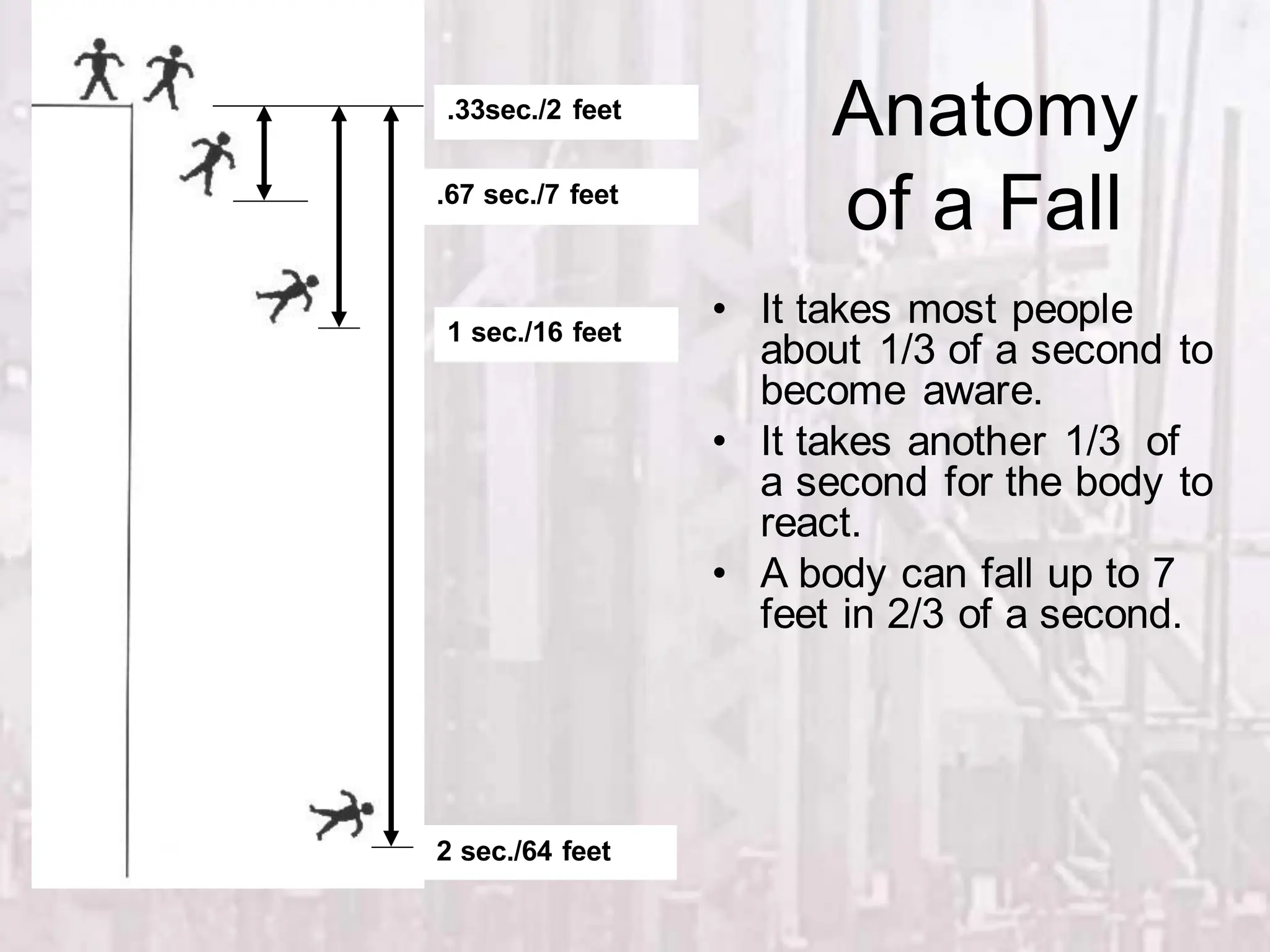
Anatomy
of a Fall
• It takes most people
about 1/3 of a second to
become aware.
• It takes another 1/3 of
a second for the body to
react.
• A body can fall up to 7
feet in 2/3 of a second.
.33sec./2 feet
.67 sec./7 feet
1 sec./16 feet
2 sec./64 feet
Statistics
How Can the Numbers Focus Our Efforts?
Falls
• Falls are one of the leading cause of
fatalities in the construction industry.
• In 2005 there where approximately 469
fatal falls, with the trend on the increase.
• The cost of care for injuries related to falls
is a financial burden for the entire industry.
What Is Fall Protection?
• A series of reasonable steps taken to
eliminate or control the injury effects
of an unintentional fall while working
at a height.
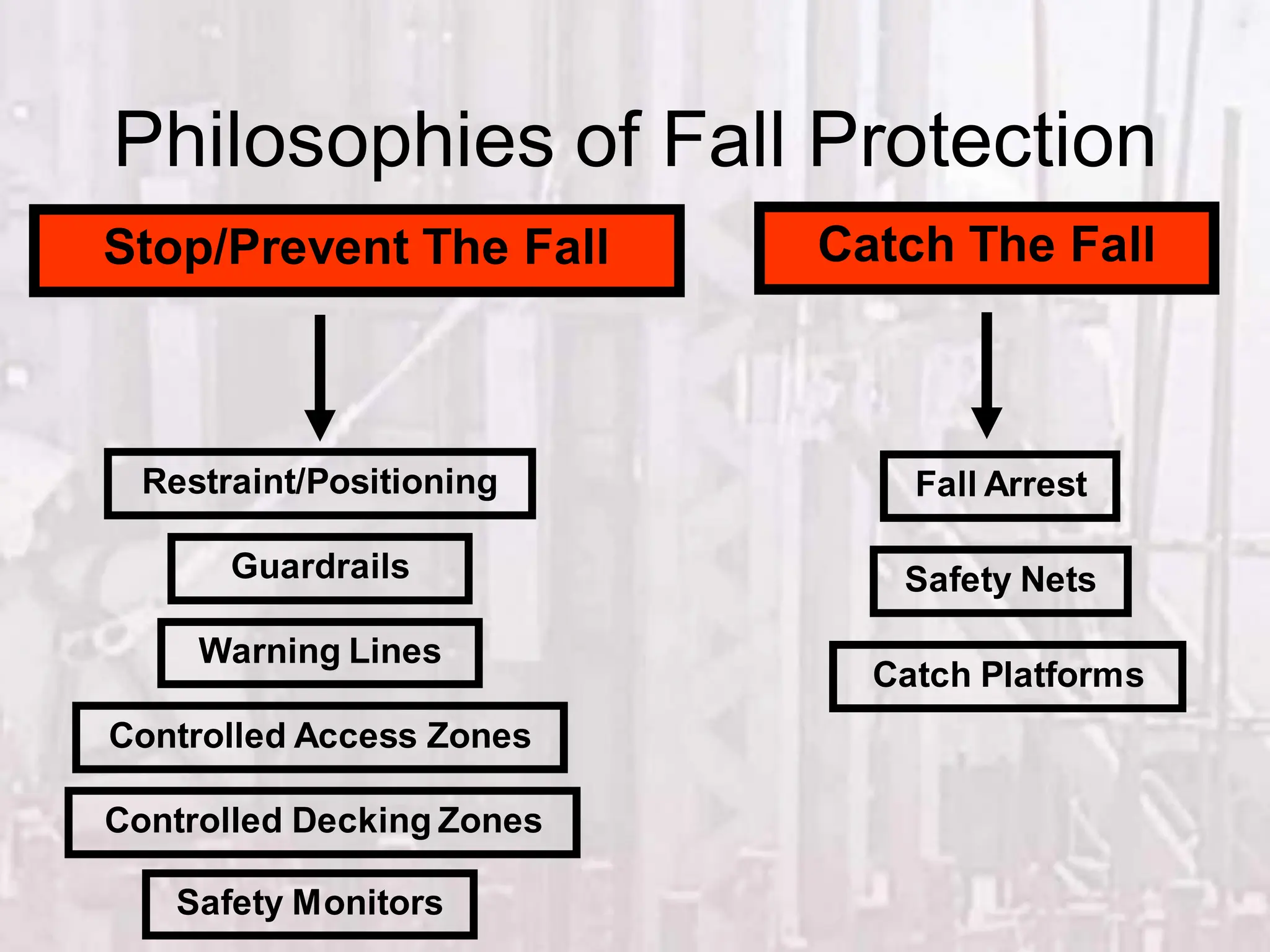
Philosophies of Fall Protection
Restraint/Positioning
Guardrails
Warning Lines
Safety Monitors
Controlled Access Zones
Safety Nets
Catch Platforms
Fall Arrest
Stop/Prevent The Fall Catch The Fall
Controlled Decking Zones
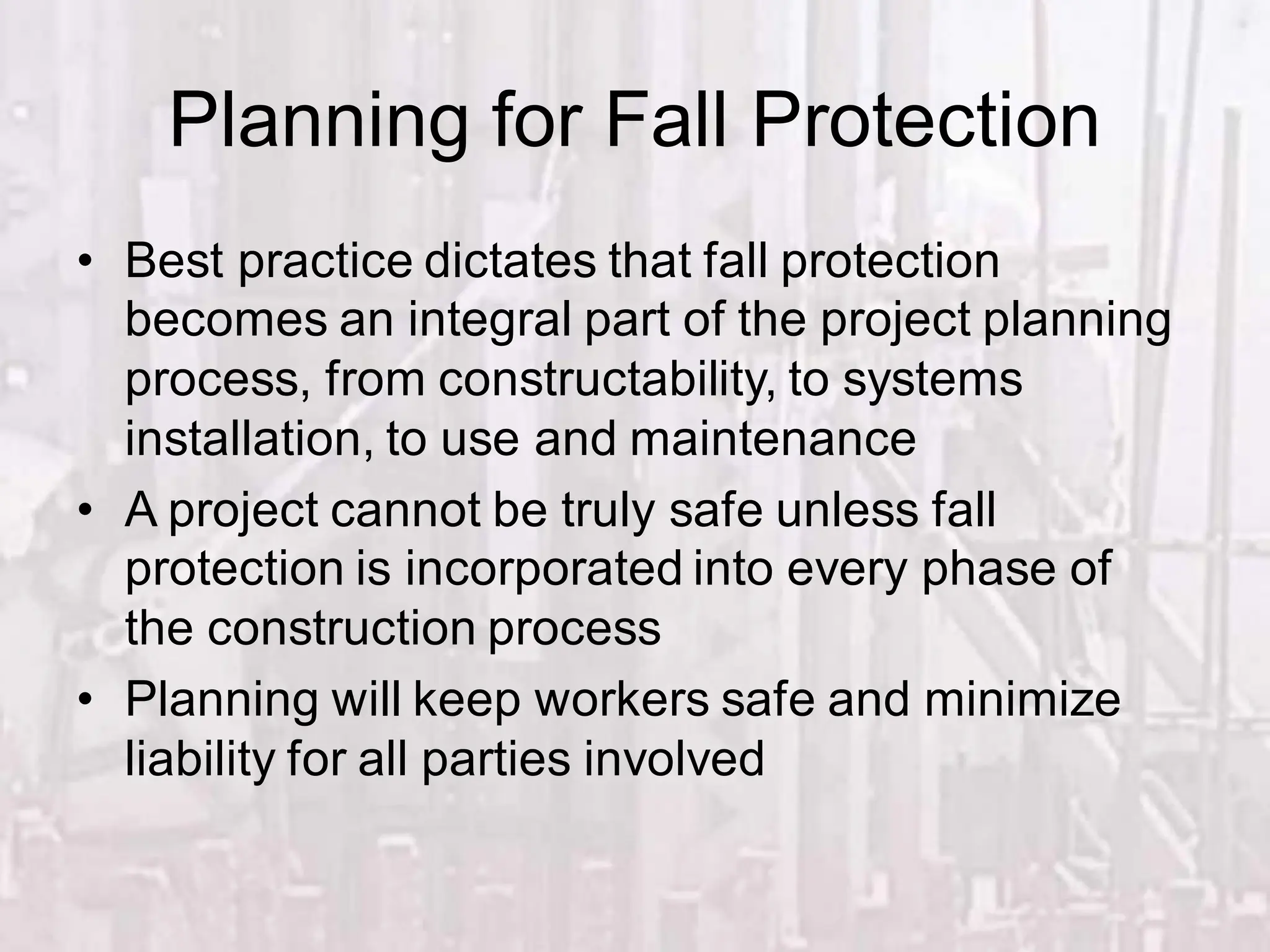
Planning for Fall Protection
• Best practice dictates that fall protection
becomes an integral part of the project planning
process, from constructability, to systems
installation, to use and maintenance
• A project cannot be truly safe unless fall
protection is incorporated into every phase of
the construction process
• Planning will keep workers safe and minimize
liability for all parties involved
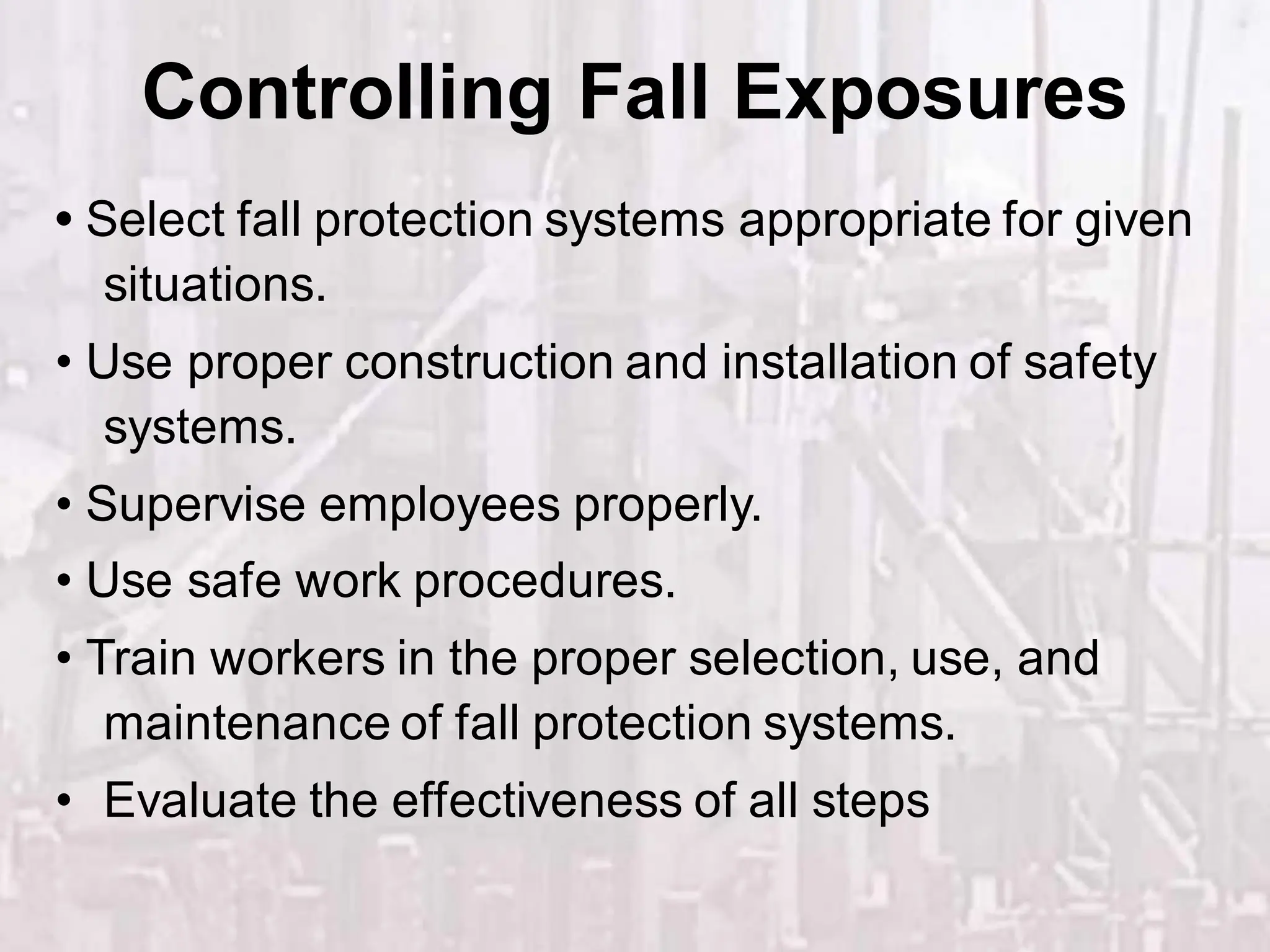
• Select fall protection systems appropriate for given
situations.
• Use proper construction and installation of safety
systems.
• Supervise employees properly.
• Use safe work procedures.
• Train workers in the proper selection, use, and
maintenance of fall protection systems.
• Evaluate the effectiveness of all steps
Controlling Fall Exposures
Fall Protection Systems and
Components.
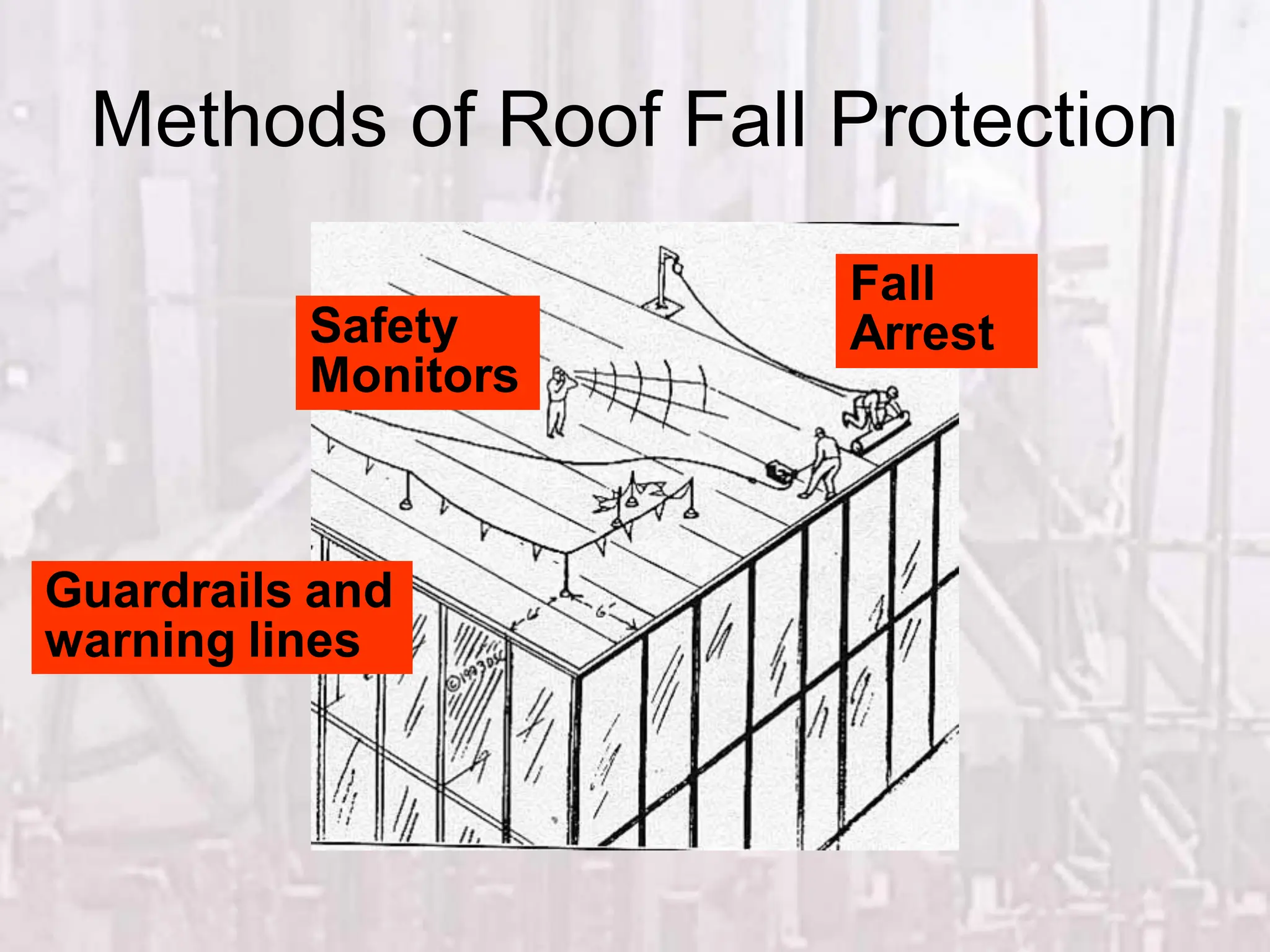
Methods of Roof Fall Protection
Safety
Monitors
Guardrails and
warning lines
Fall
Arrest
Flat/Low Slope
• 4:12 Slope or Less
• Beyond the Use of Guardrails, OSHA
Allows the Use of
– Warning Lines
– Safety Monitors
• Recommended:
– Guardrails or PFAS where feasible
– Limited use of lines and monitors on flat roofs
only
Roof Warning Lines
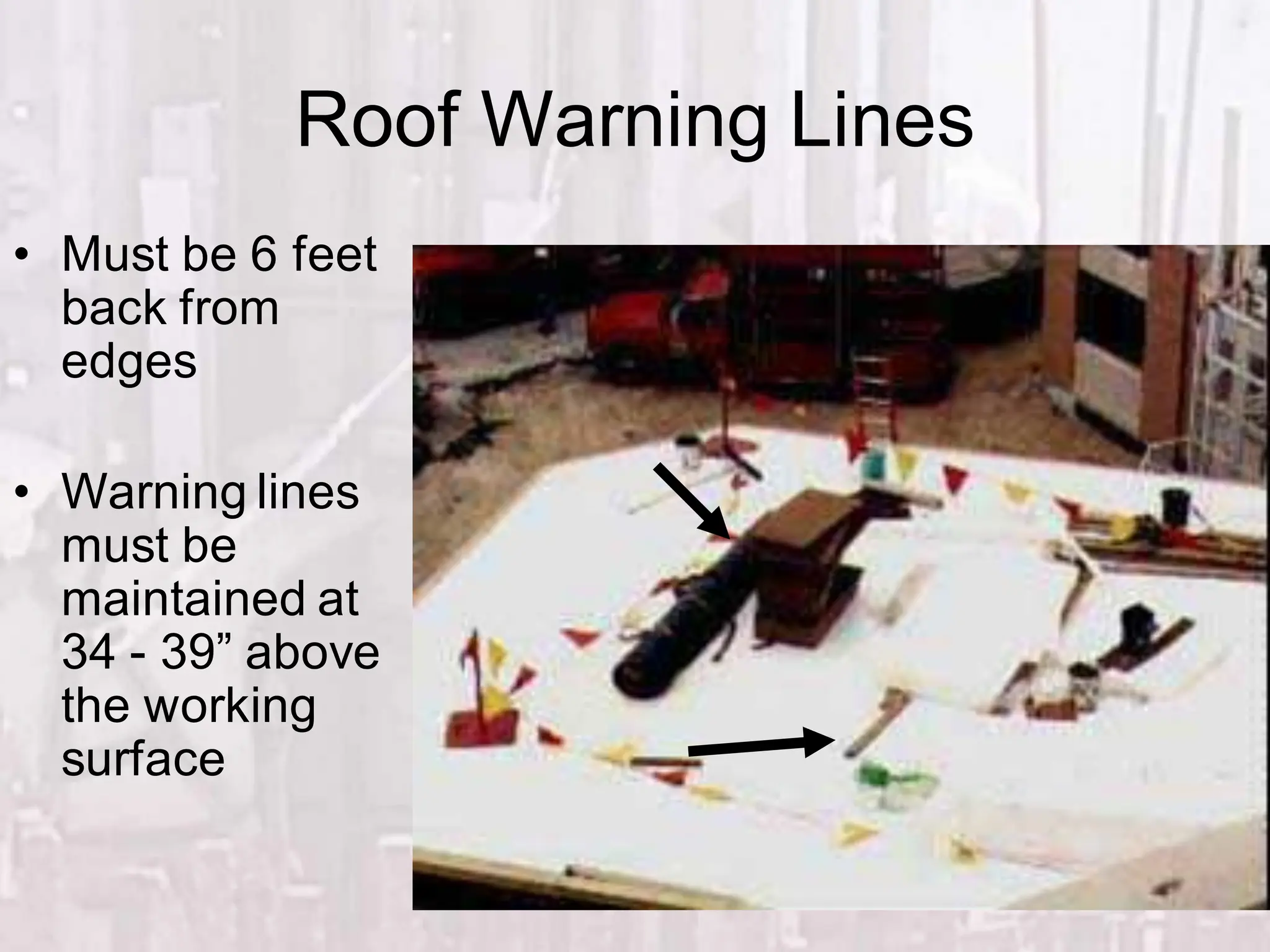
• Must be 6 feet
back from
edges
• Warning lines
must be
maintained at
34 - 39” above
the working
surface
Safety Monitor
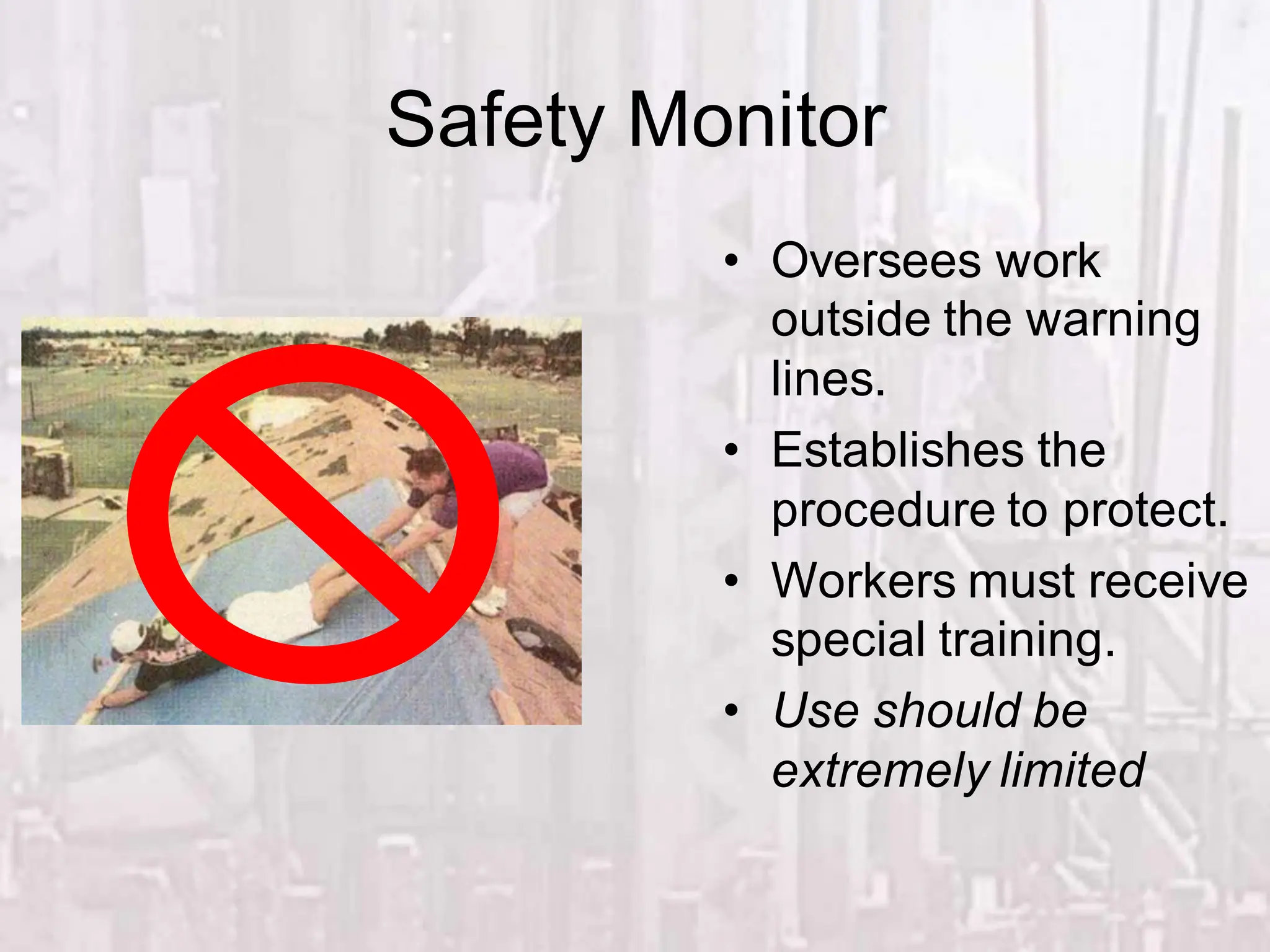
• Oversees work
outside the warning
lines.
• Establishes the
procedure to protect.
• Workers must receive
special training.
• Use should be
extremely limited
High Slope
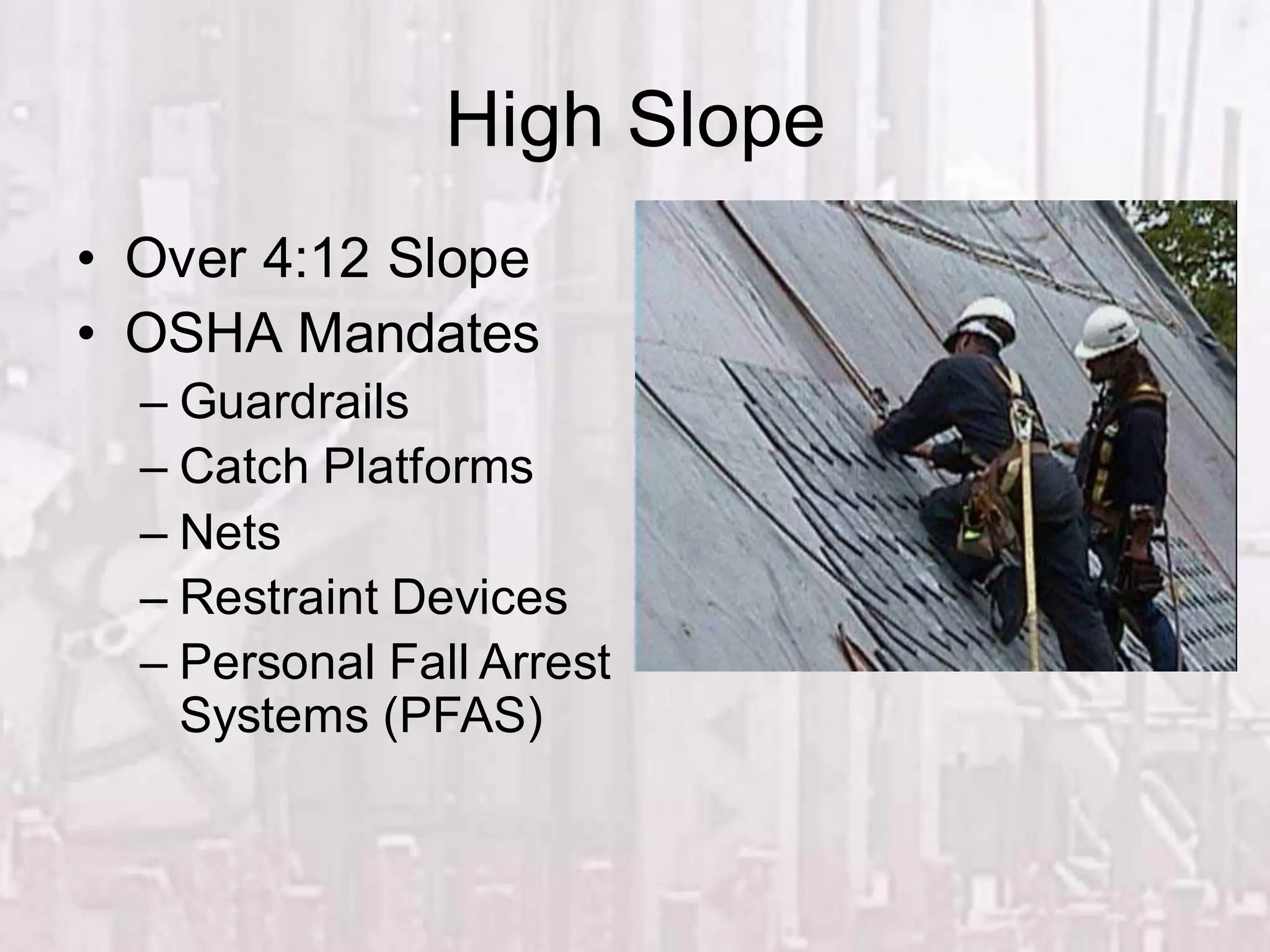
• Over 4:12 Slope
• OSHA Mandates
– Guardrails
– Catch Platforms
– Nets
– Restraint Devices
– Personal Fall Arrest
Systems (PFAS)
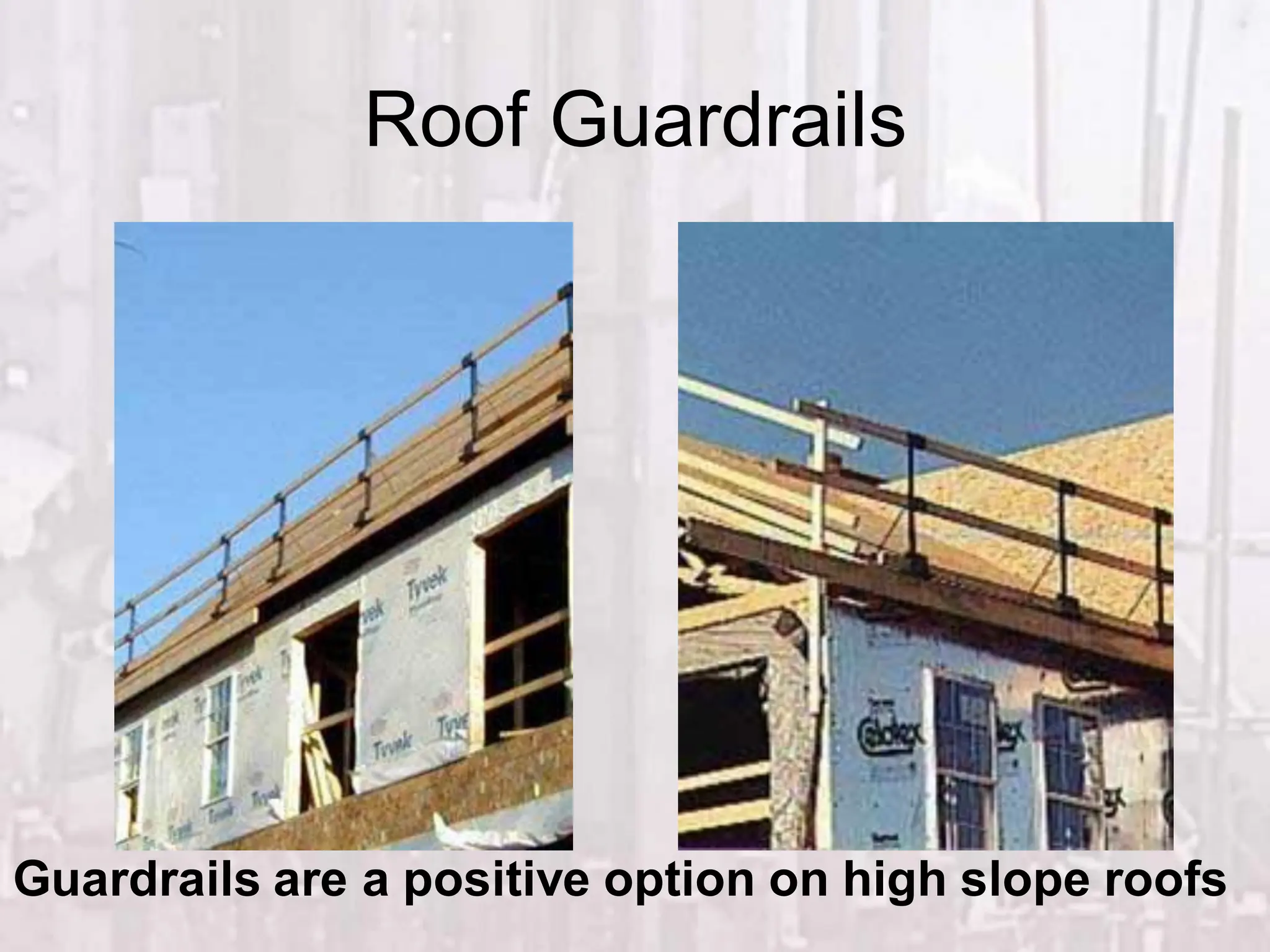
Roof Guardrails
Guardrails are a positive option on high slope roofs
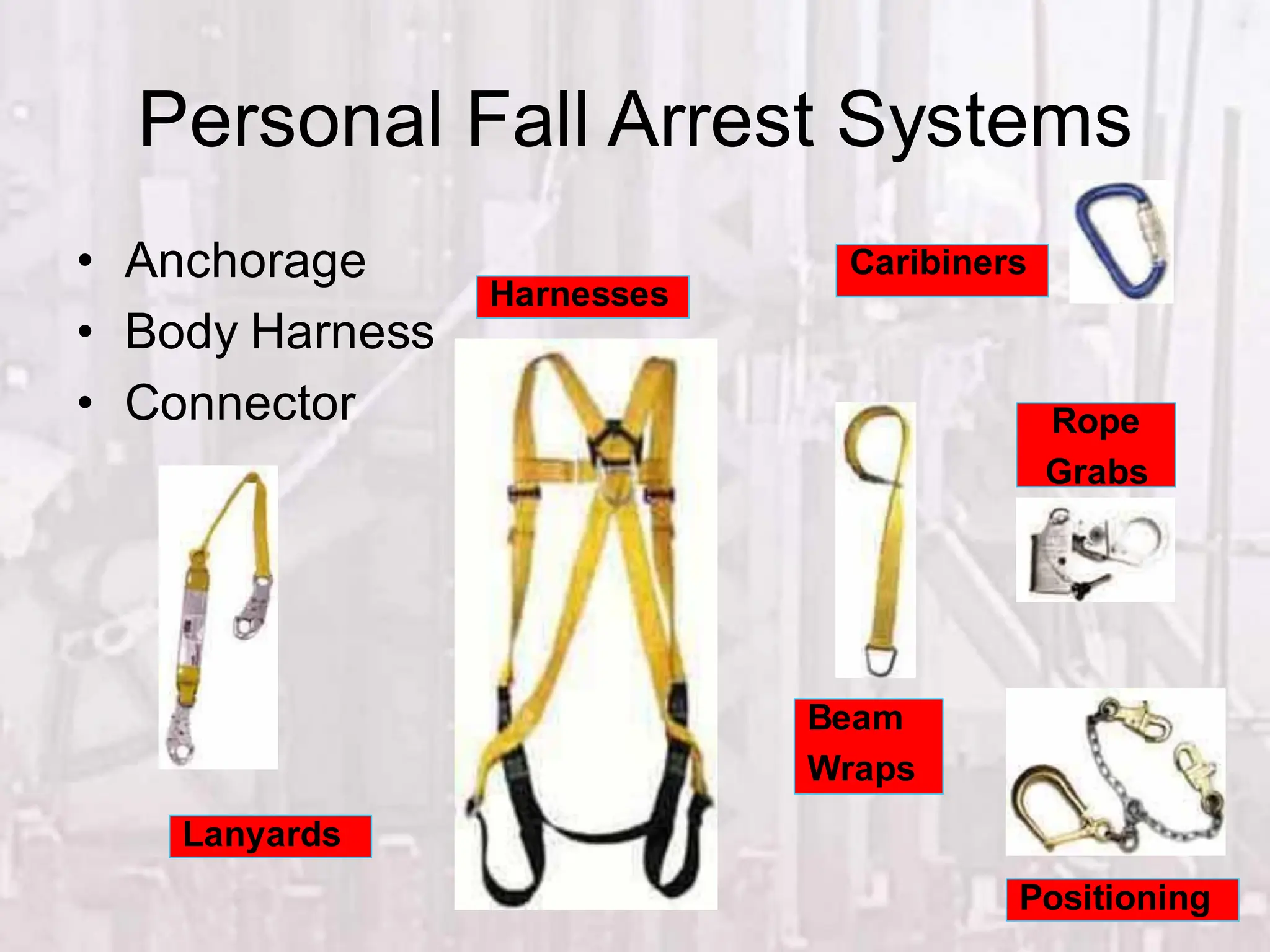
Personal Fall Arrest Systems
• Anchorage
• Body Harness
• Connector
Beam
Wraps
Lanyards
Caribiners
Rope
Grabs
Positioning
Harnesses
Anchorages
• Must support 5000 lbs. per employee
attached,
– Or as part of a complete personal fall arrest
system which maintains a safety factor of at least
two
– Or 3000 lbs. when using fall restraint or a Self-
Retracting Lifeline (SRL, Retractable, or “yo-yo”)
which limits free fall distance to 2 feet
• Should always be at or above D-ring height
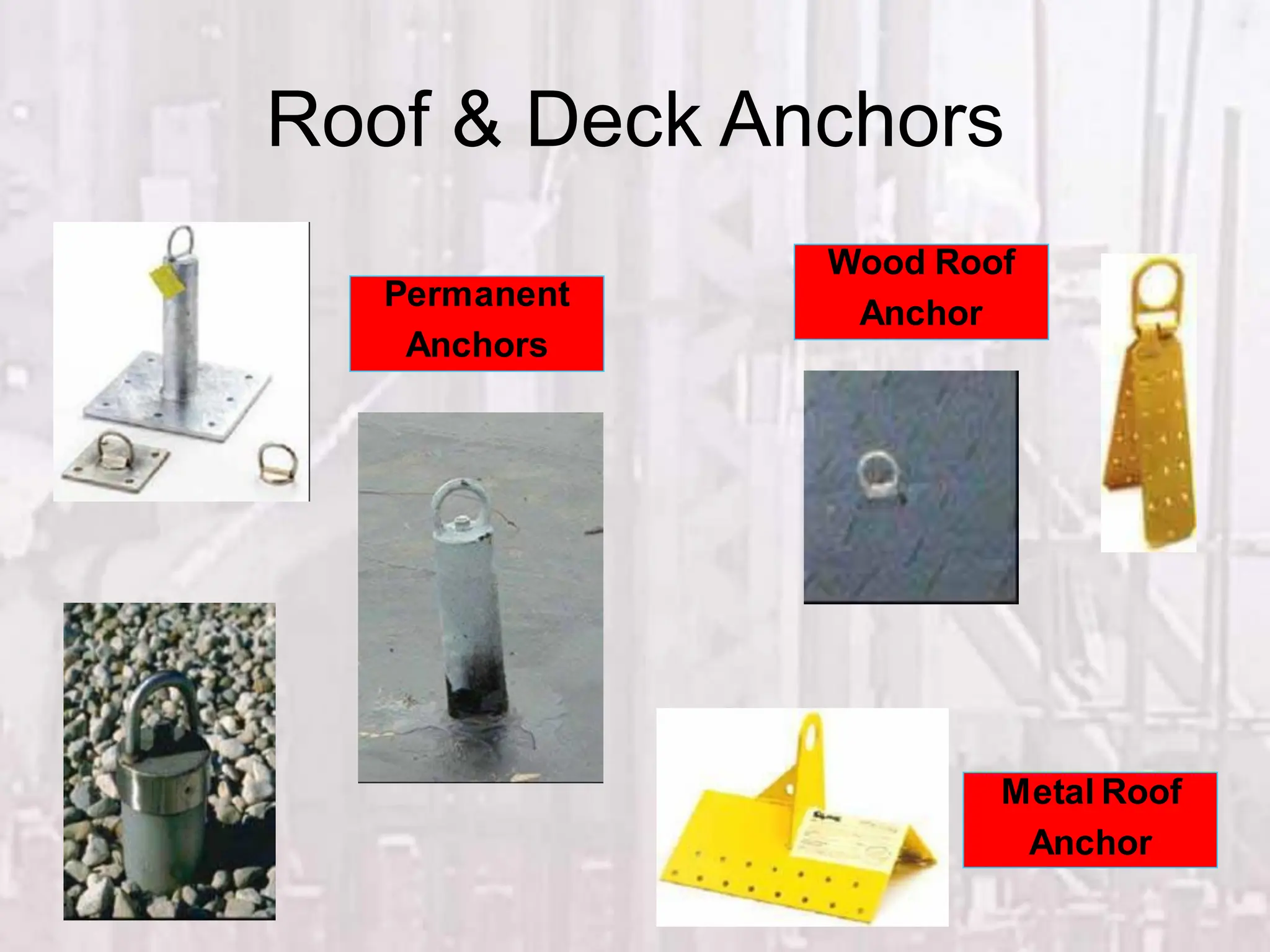
Roof & Deck Anchors
Wood Roof
Anchor
Metal Roof
Anchor
Permanent
Anchors
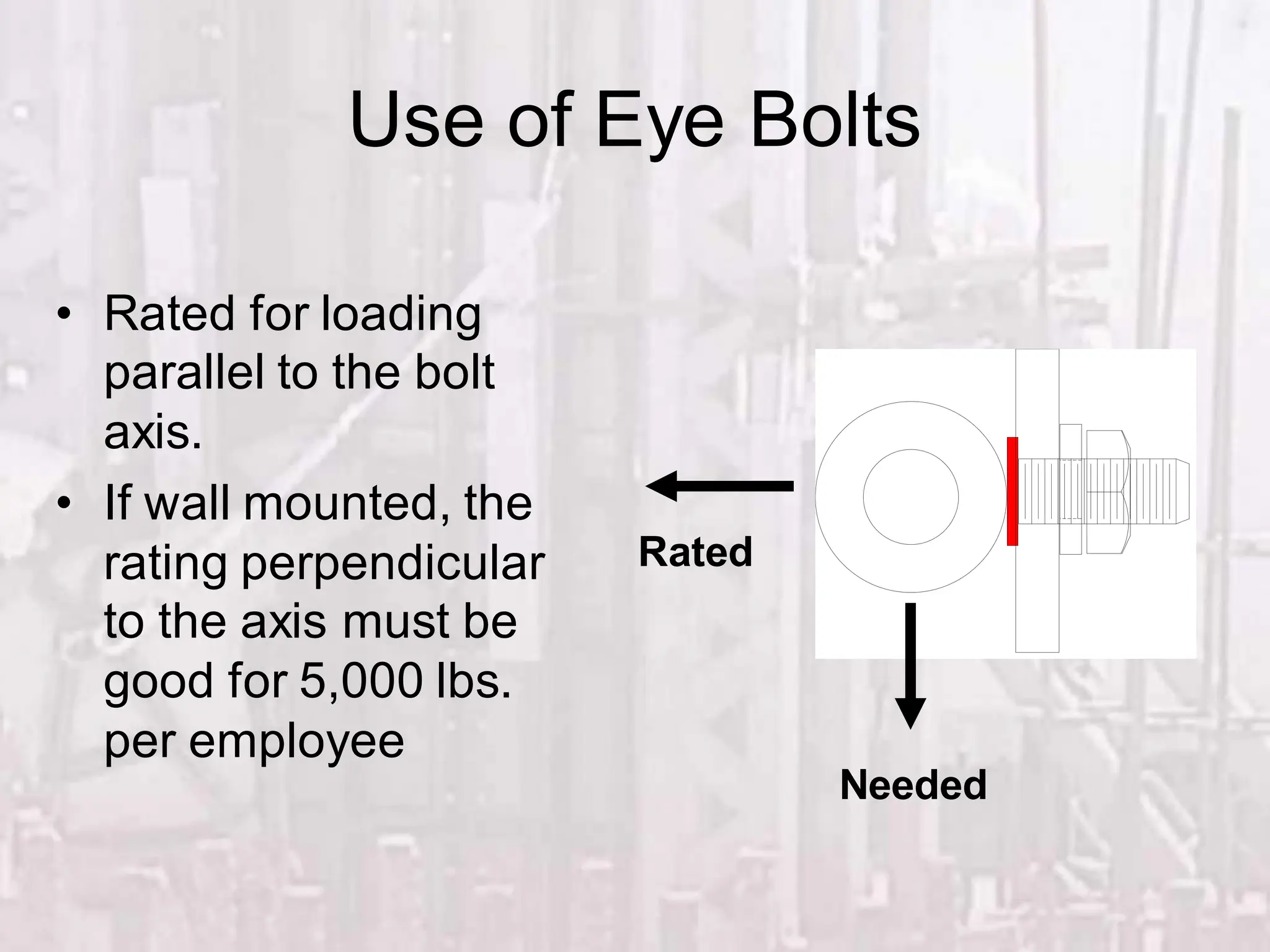
Use of Eye Bolts
• Rated for loading
parallel to the bolt
axis.
• If wall mounted, the
rating perpendicular
to the axis must be
good for 5,000 lbs.
per employee
Rated
Needed
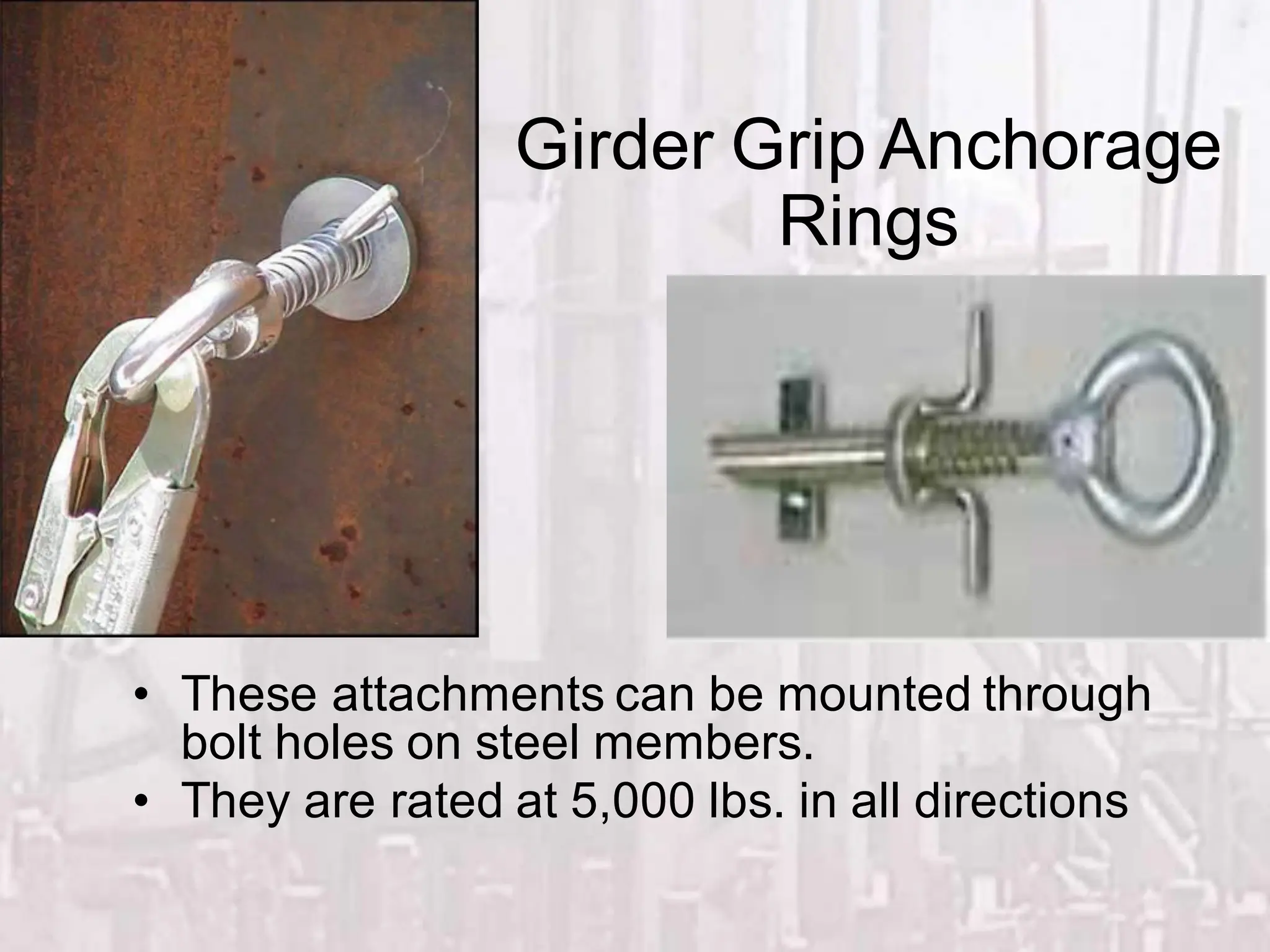
Girder Grip Anchorage
Rings
• These attachments can be mounted through
bolt holes on steel members.
• They are rated at 5,000 lbs. in all directions
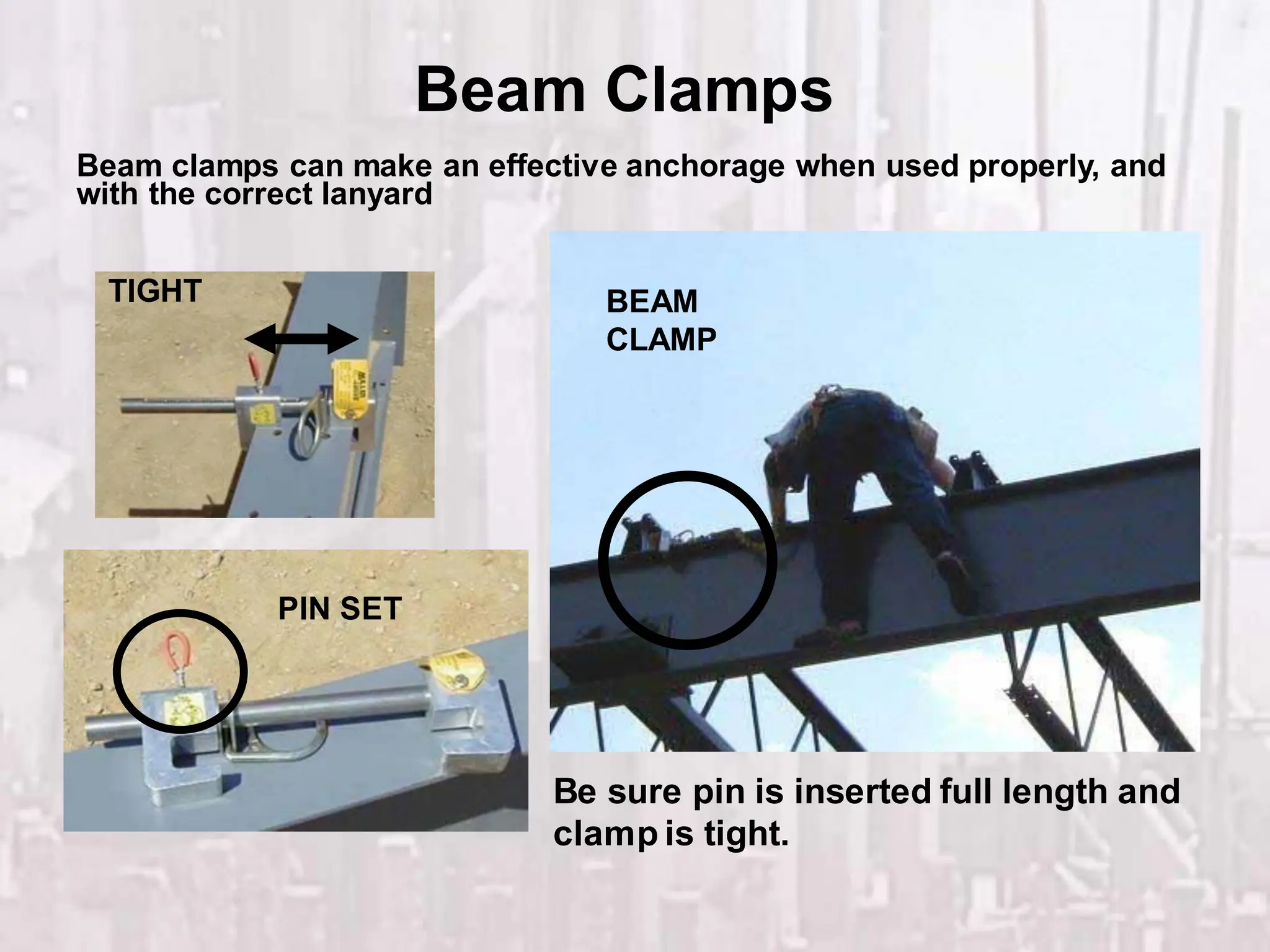
Beam Clamps
TIGHT
PIN SET
BEAM
CLAMP
Beam clamps can make an effective anchorage when used properly, and
with the correct lanyard
Be sure pin is inserted full length and
clamp is tight.
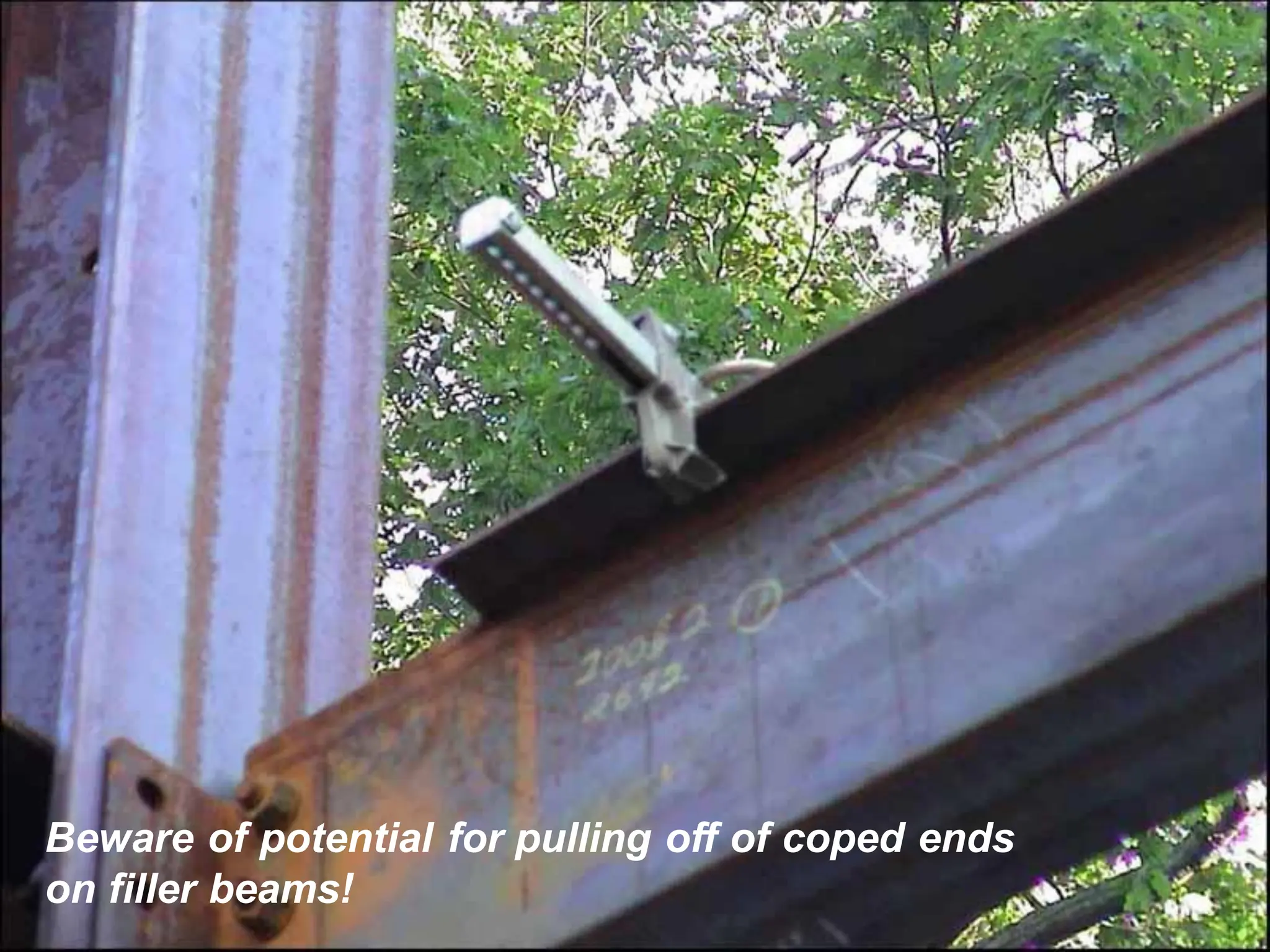
Beware of potential for pulling off of coped ends
on filler beams!
Horizontal Life Lines
• Provide maneuverability.
• Must be designed,
installed and used under
the guidance of a
qualified person
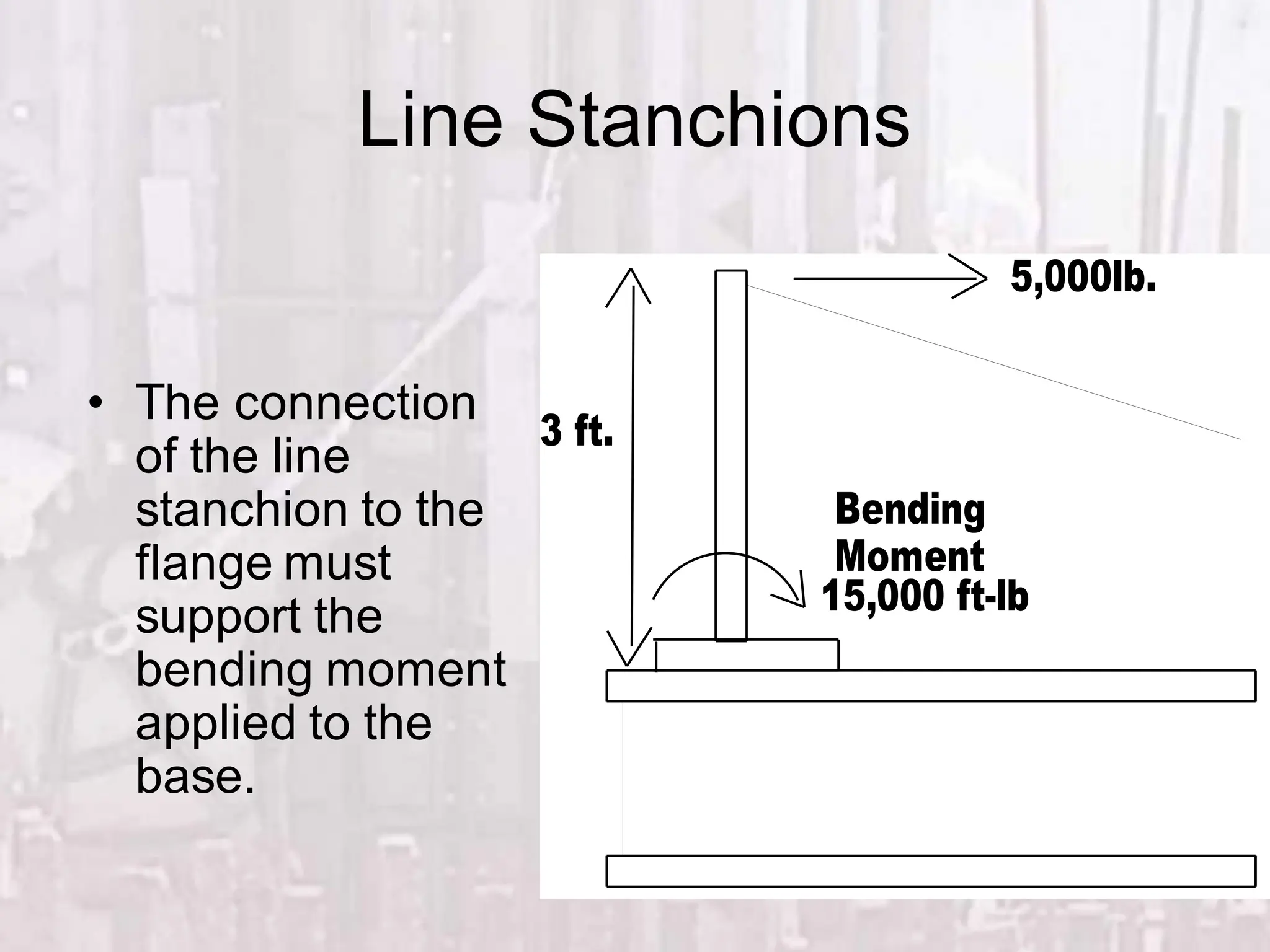
Line Stanchions
• The connection
of the line
stanchion to the
flange must
support the
bending moment
applied to the
base.
5,000lb.
Bending
Moment
15,000 ft-lb
3 ft.
Body (Harnesses)
• Need to be inspected frequently (daily
before use by the worker, at least monthly
by a Competent Person)
• Should never be modified
• Should be taken out of service
immediately if defective or exposed to an
impact
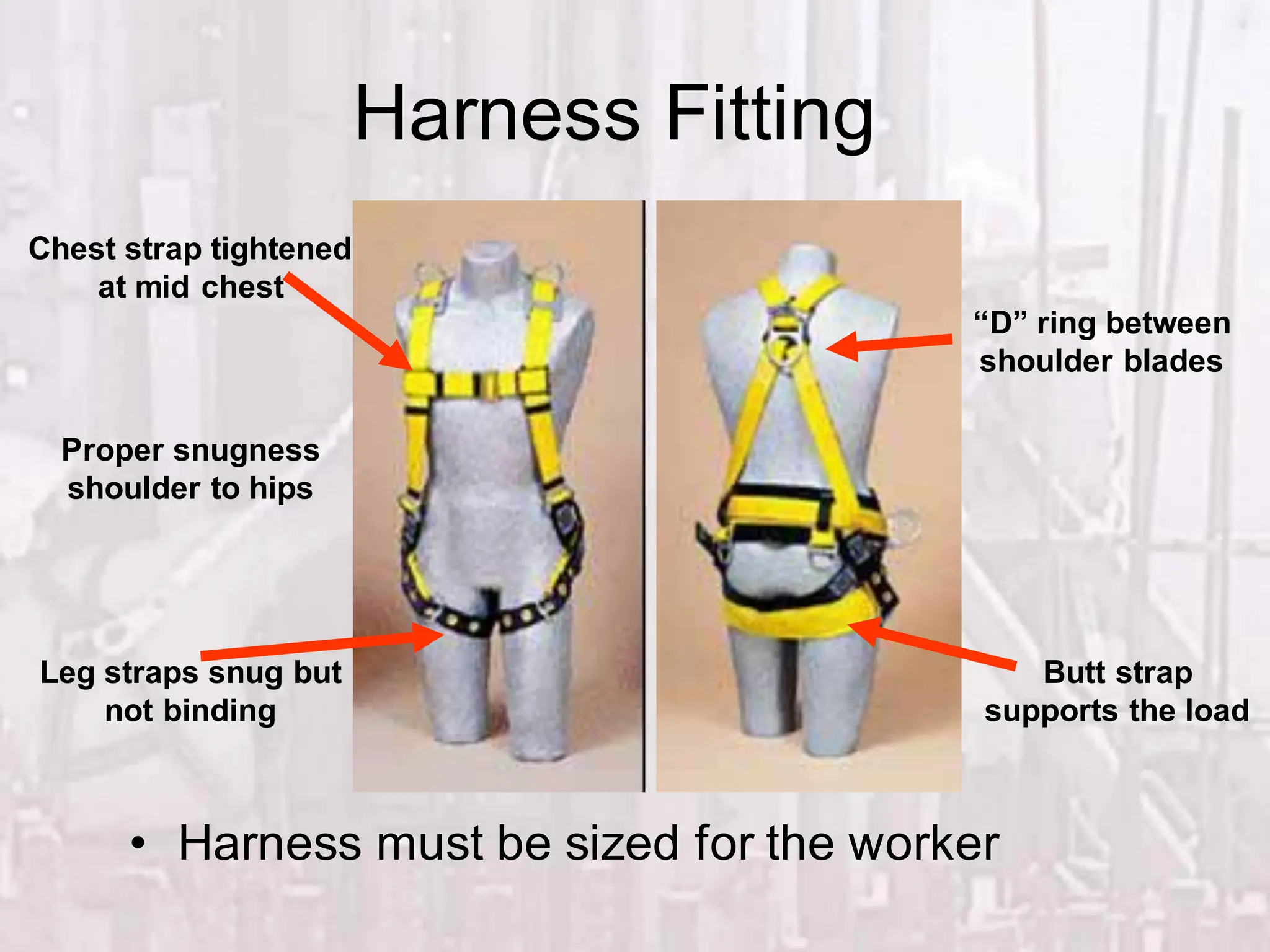
Harness Fitting
• Harness must be sized for the worker
Chest strap tightened
at mid chest
Butt strap
supports the load
Proper snugness
shoulder to hips
Leg straps snug but
not binding
“D” ring between
shoulder blades
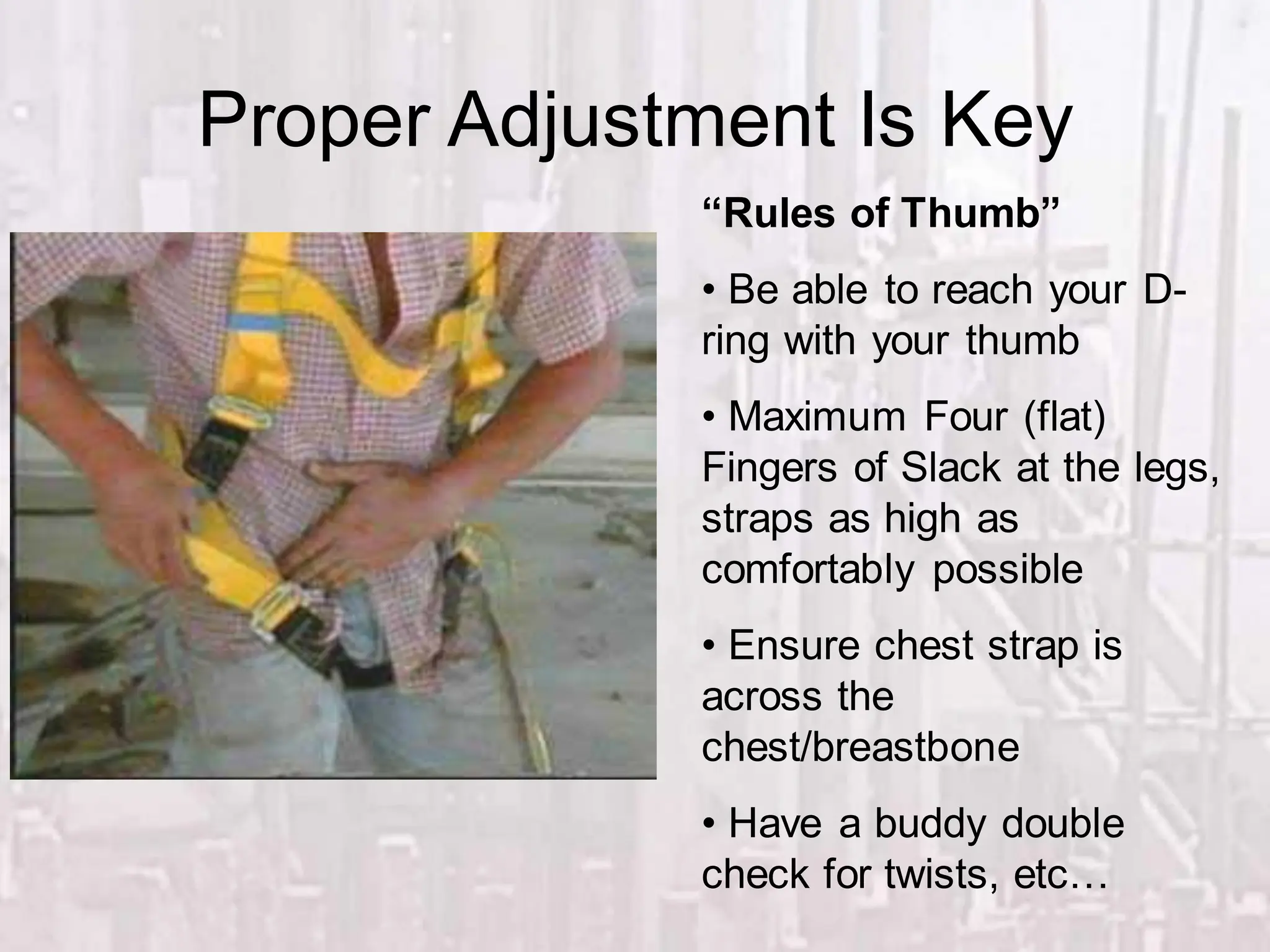
Proper Adjustment Is Key
“Rules of Thumb”
• Be able to reach your D-
ring with your thumb
• Maximum Four (flat)
Fingers of Slack at the legs,
straps as high as
comfortably possible
• Ensure chest strap is
across the
chest/breastbone
• Have a buddy double
check for twists, etc…
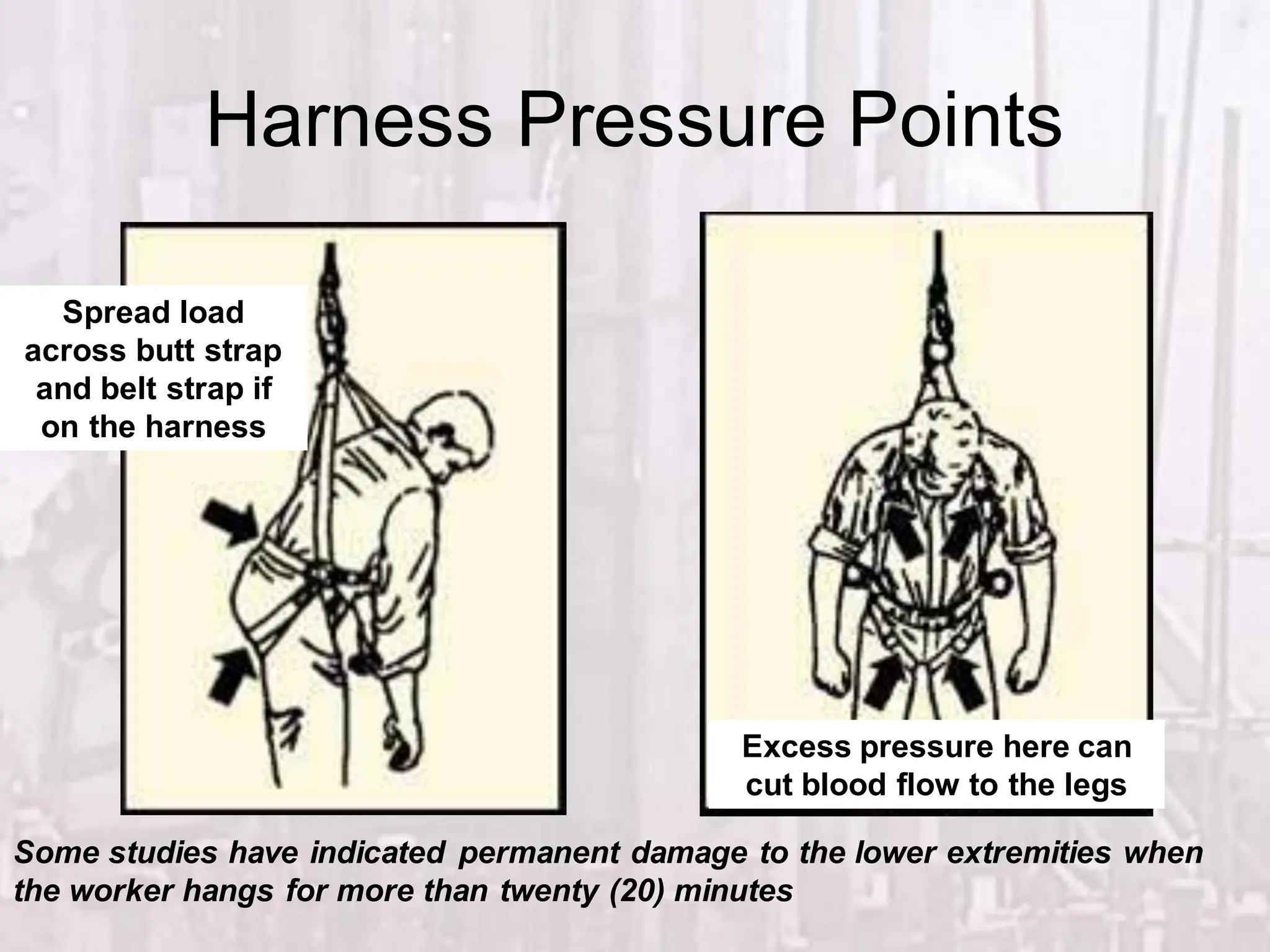
Harness Pressure Points
Spread load
across butt strap
and belt strap if
on the harness
Excess pressure here can
cut blood flow to the legs
Some studies have indicated permanent damage to the lower extremities when
the worker hangs for more than twenty (20) minutes
Connectors (Lanyards)
• Should be inspected before each use
• Should not be tied back to themselves
(unless specifically designed for such use)
• Should be worn with the impact
absorber/shock pack at the d-ring
• Should have the appropriate clip for the
intended anchorage points
– Do not use large climbing/rebar/ladder hooks
with “beamers”
Free Fall Distance
• How far a worker falls before shock absorbing
or deceleration equipment begins to take effect
– Affects both impact forces and total fall distance
• Anchorage point location in relation to D-ring
height
– Below the D-ring allows excessive falls
– Above the D-ring minimizes free fall to less than 6’
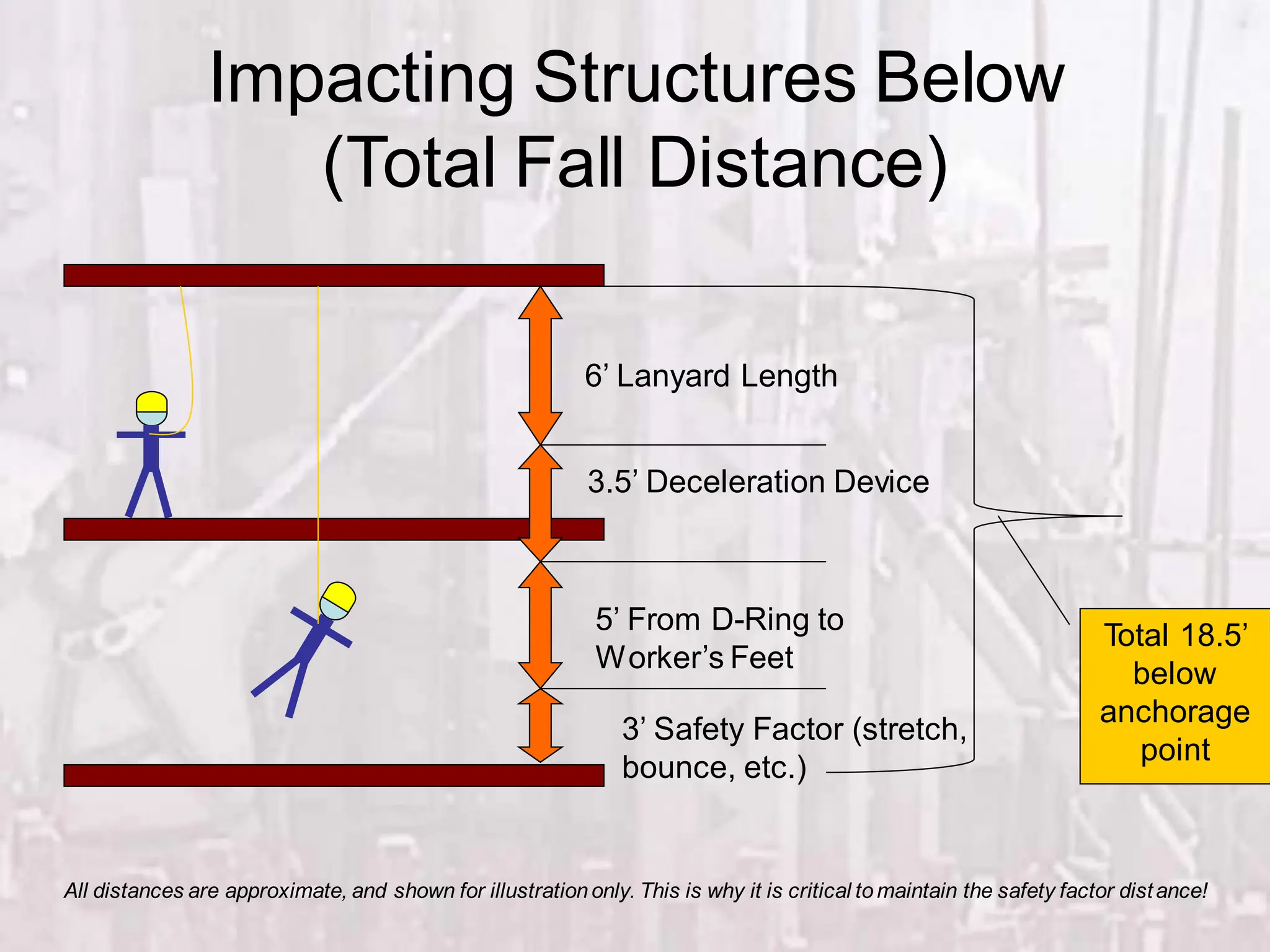
Impacting Structures Below
(Total Fall Distance)
• Consider:
– anchorage point location in relation to D-ring
height
– lanyard length,
– harness elongation,
– shock absorber opening length,
– body below D-ring
– body viscosity (soft tissue injuries!)
Impacting Structures Below
(Total Fall Distance)
6’ Lanyard Length
3.5’ Deceleration Device
5’ From D-Ring to
Worker’s Feet
3’ Safety Factor (stretch,
bounce, etc.)
Total 18.5’
below
anchorage
point
All distances are approximate, and shown for illustrationonly. This is why it is critical tomaintain the safety factor distance!
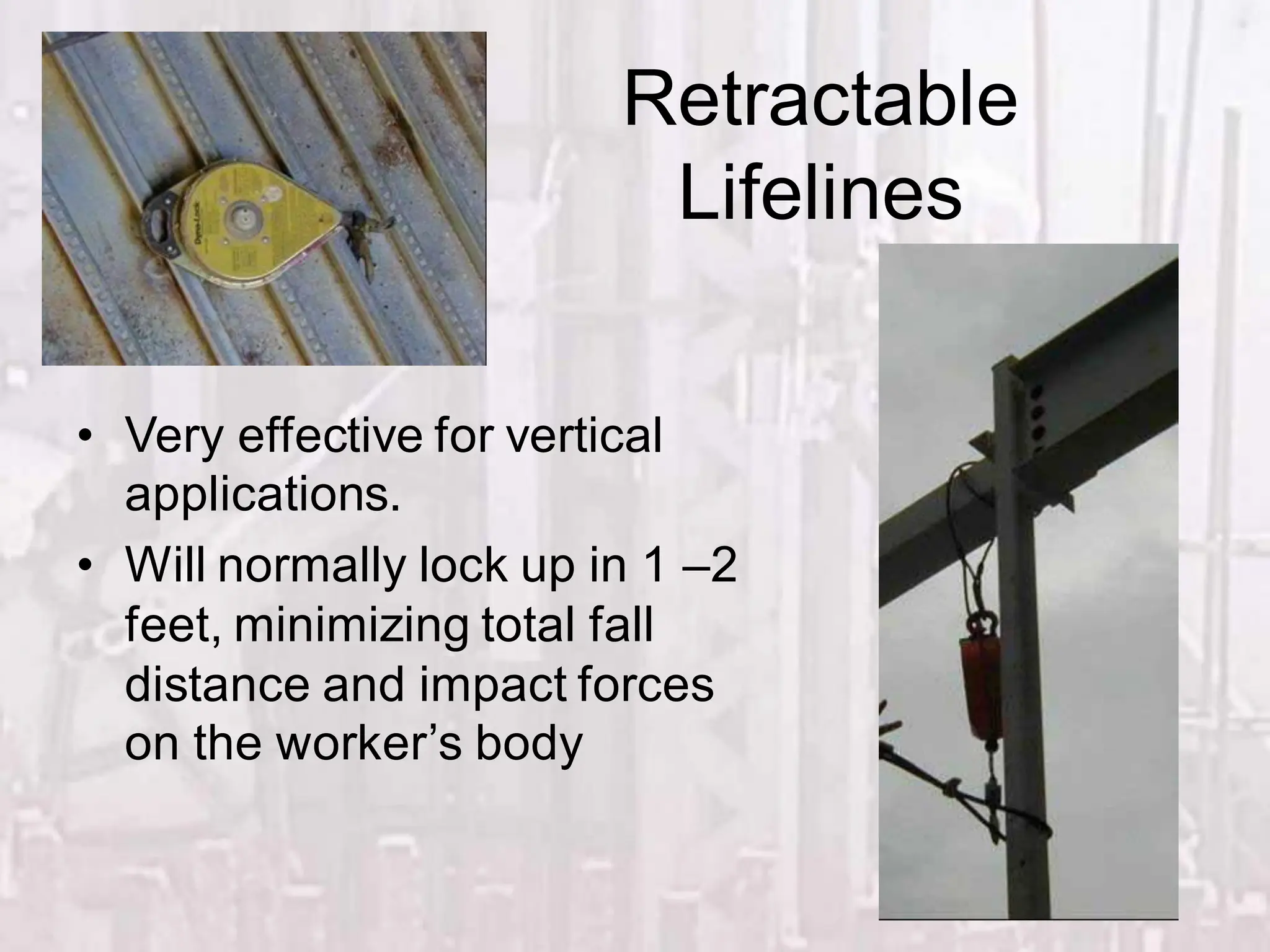
Retractable
Lifelines
• Very effective for vertical
applications.
• Will normally lock up in 1 –2
feet, minimizing total fall
distance and impact forces
on the worker’s body
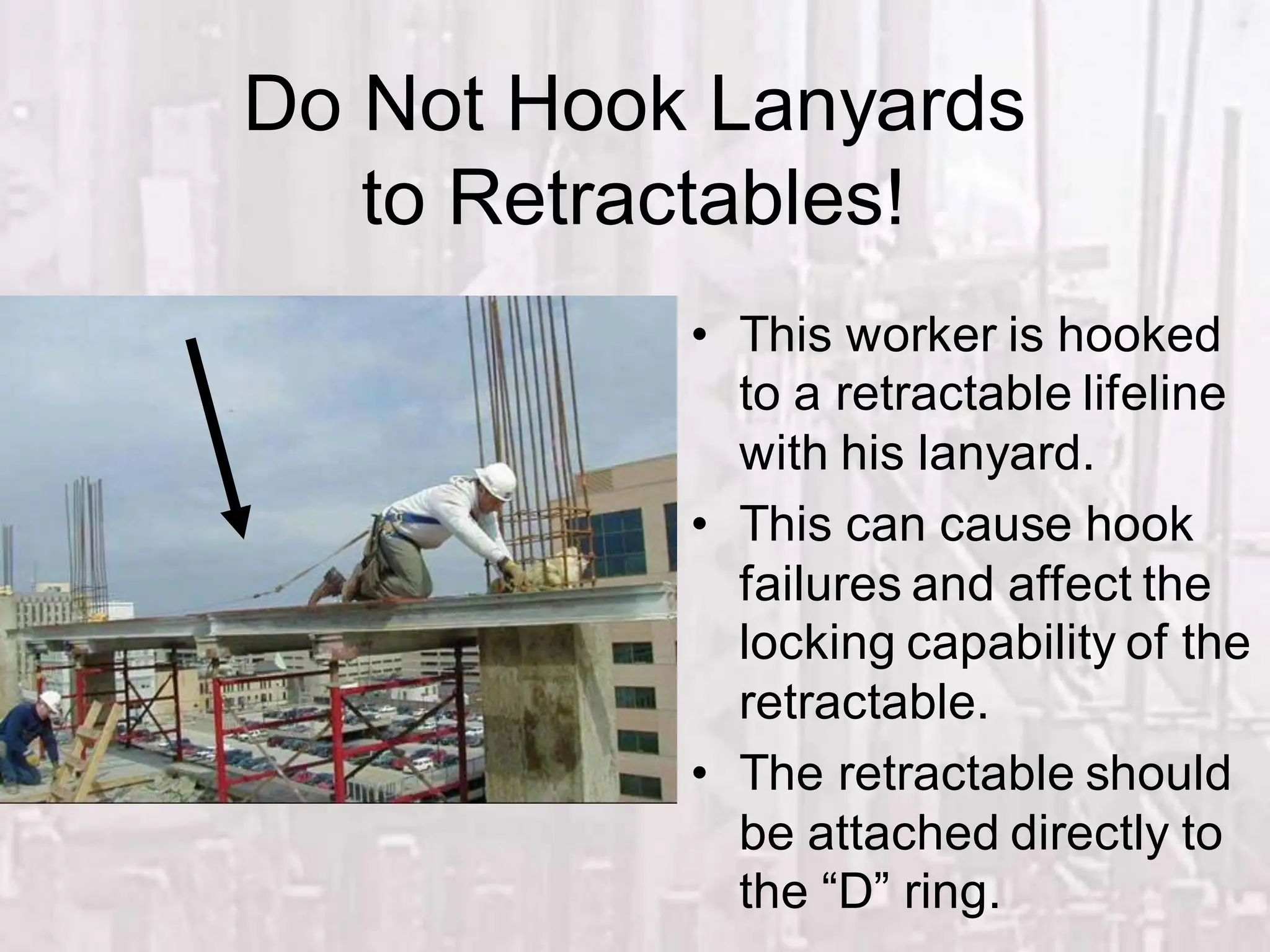
Do Not Hook Lanyards
to Retractables!
• This worker is hooked
to a retractable lifeline
with his lanyard.
• This can cause hook
failures and affect the
locking capability of the
retractable.
• The retractable should
be attached directly to
the “D” ring.
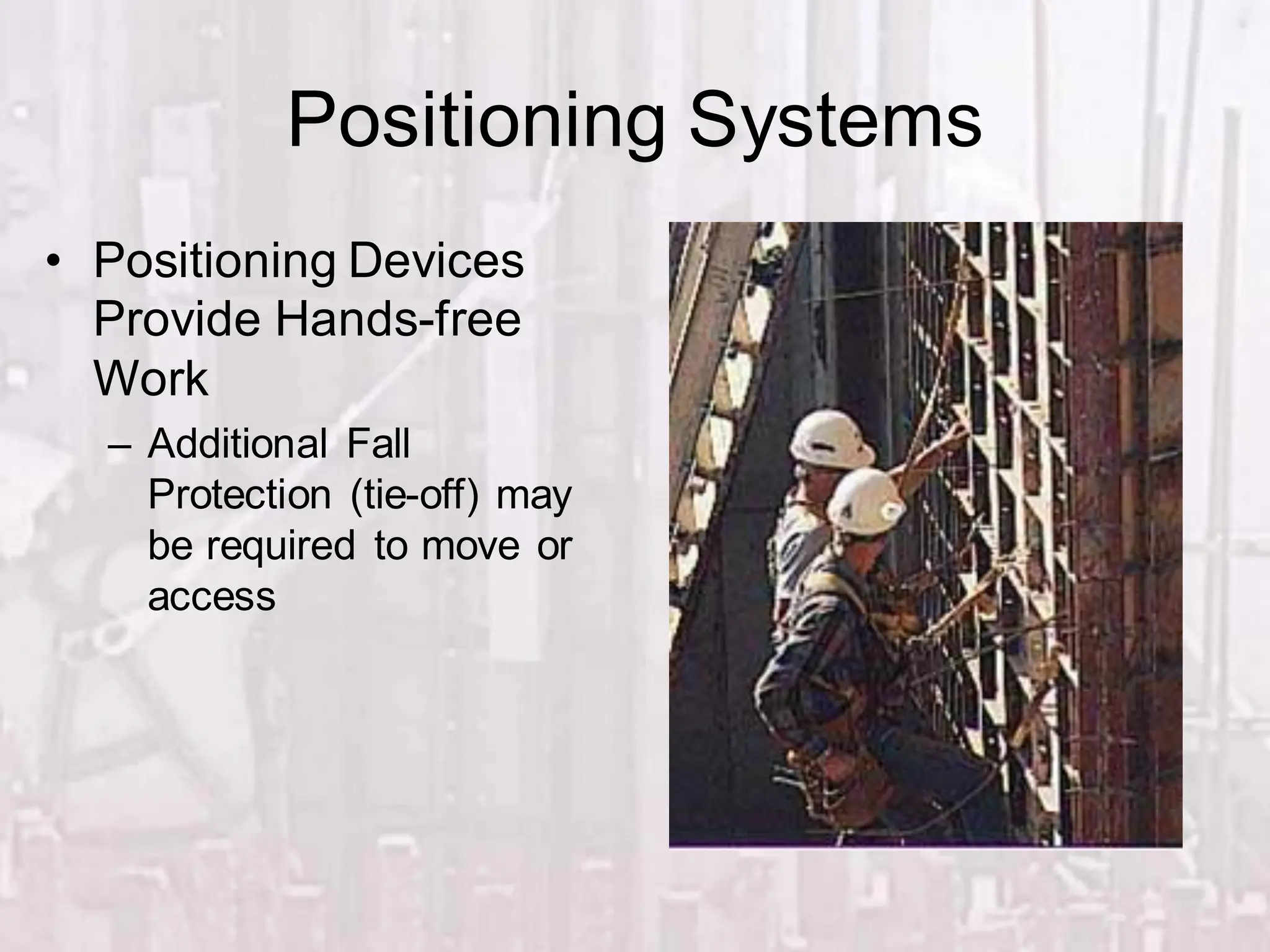
Positioning Systems
• Positioning Devices
Provide Hands-free
Work
– Additional Fall
Protection (tie-off) may
be required to move or
access
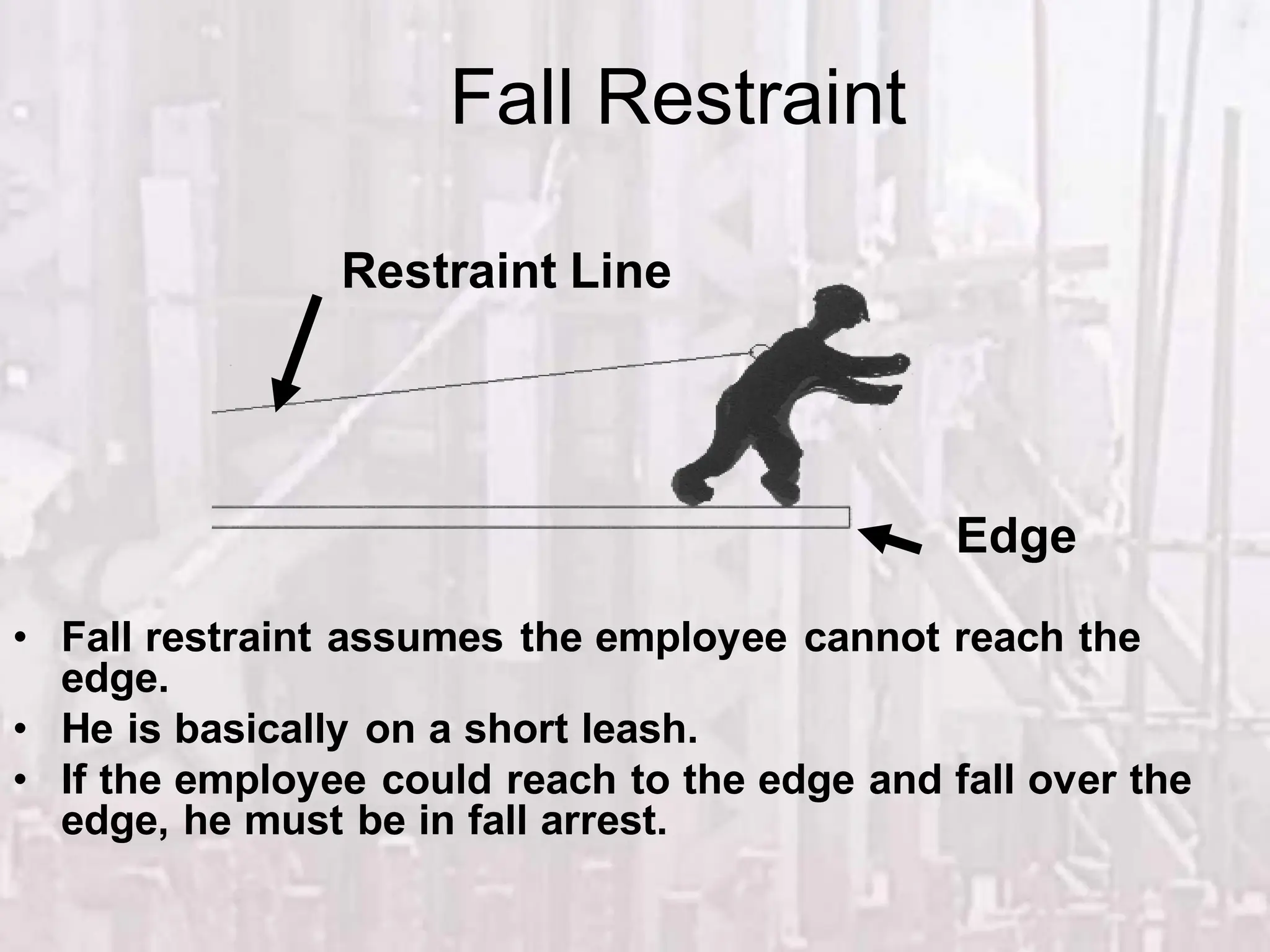
Fall Restraint
• Fall restraint assumes the employee cannot reach the
edge.
• He is basically on a short leash.
• If the employee could reach to the edge and fall over the
edge, he must be in fall arrest.
Restraint Line
Edge
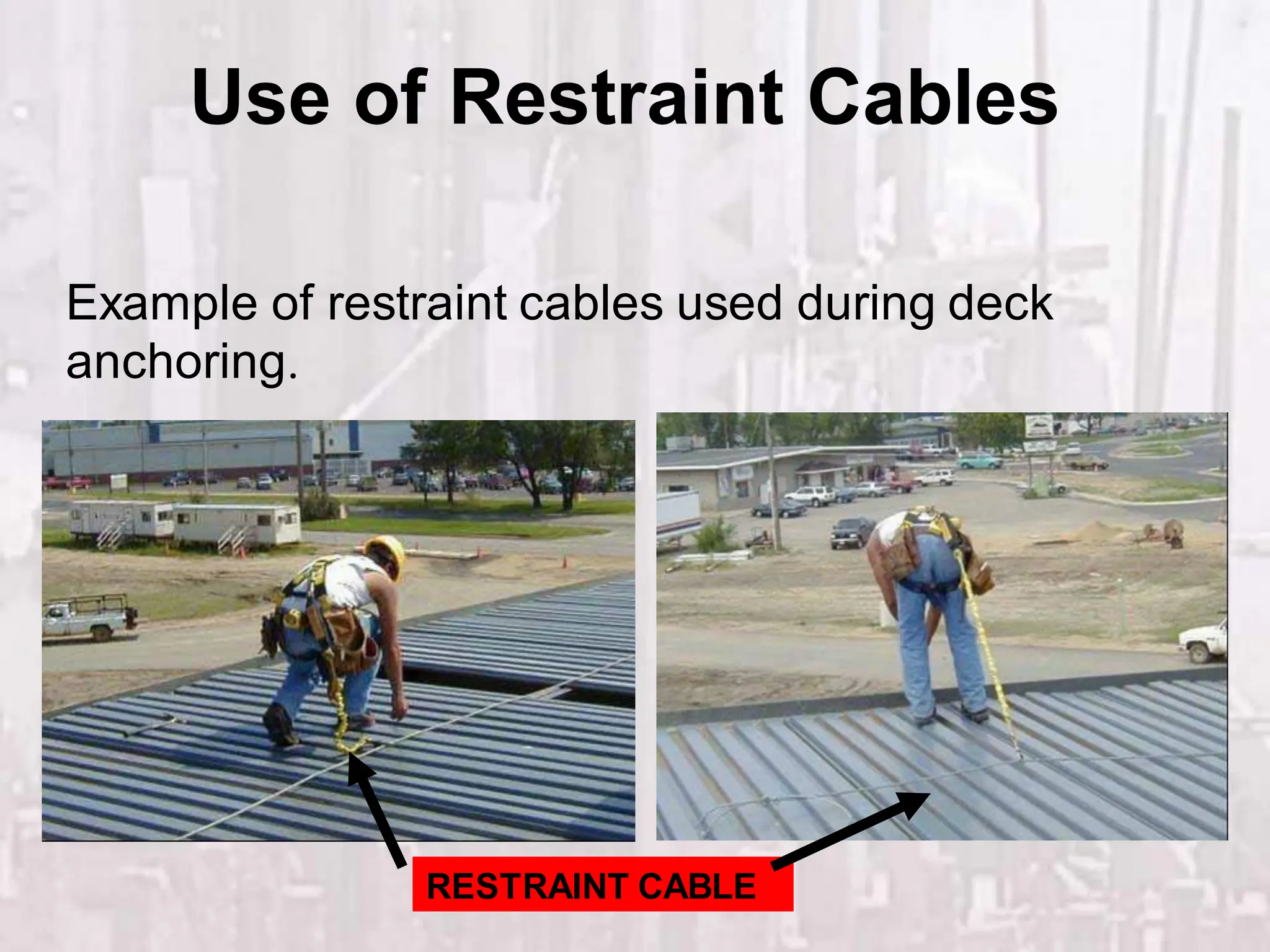
Use of Restraint Cables
RESTRAINT CABLE
Example of restraint cables used during deck
anchoring.
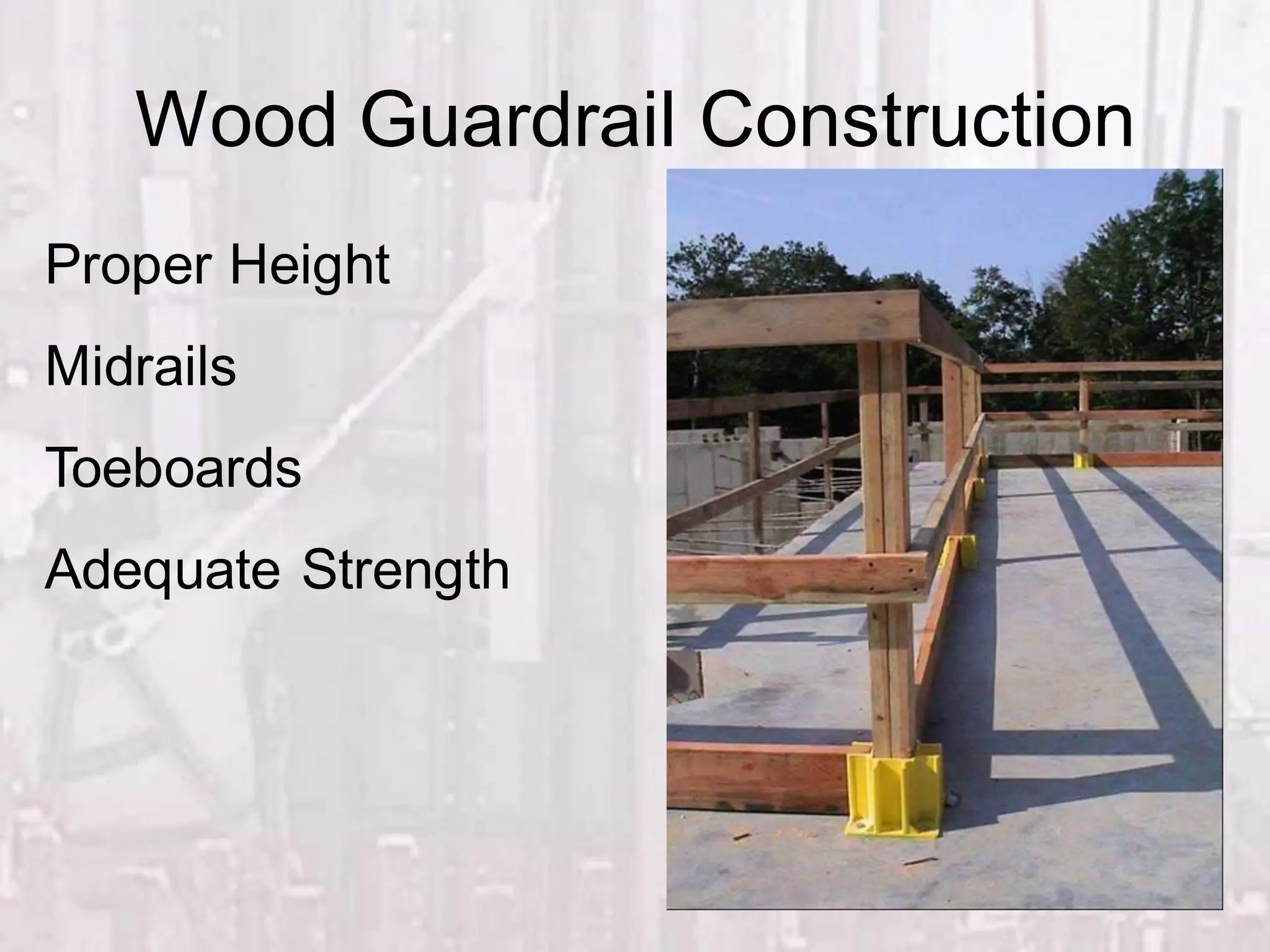
Wood Guardrail Construction
Proper Height
Midrails
Toeboards
Adequate Strength
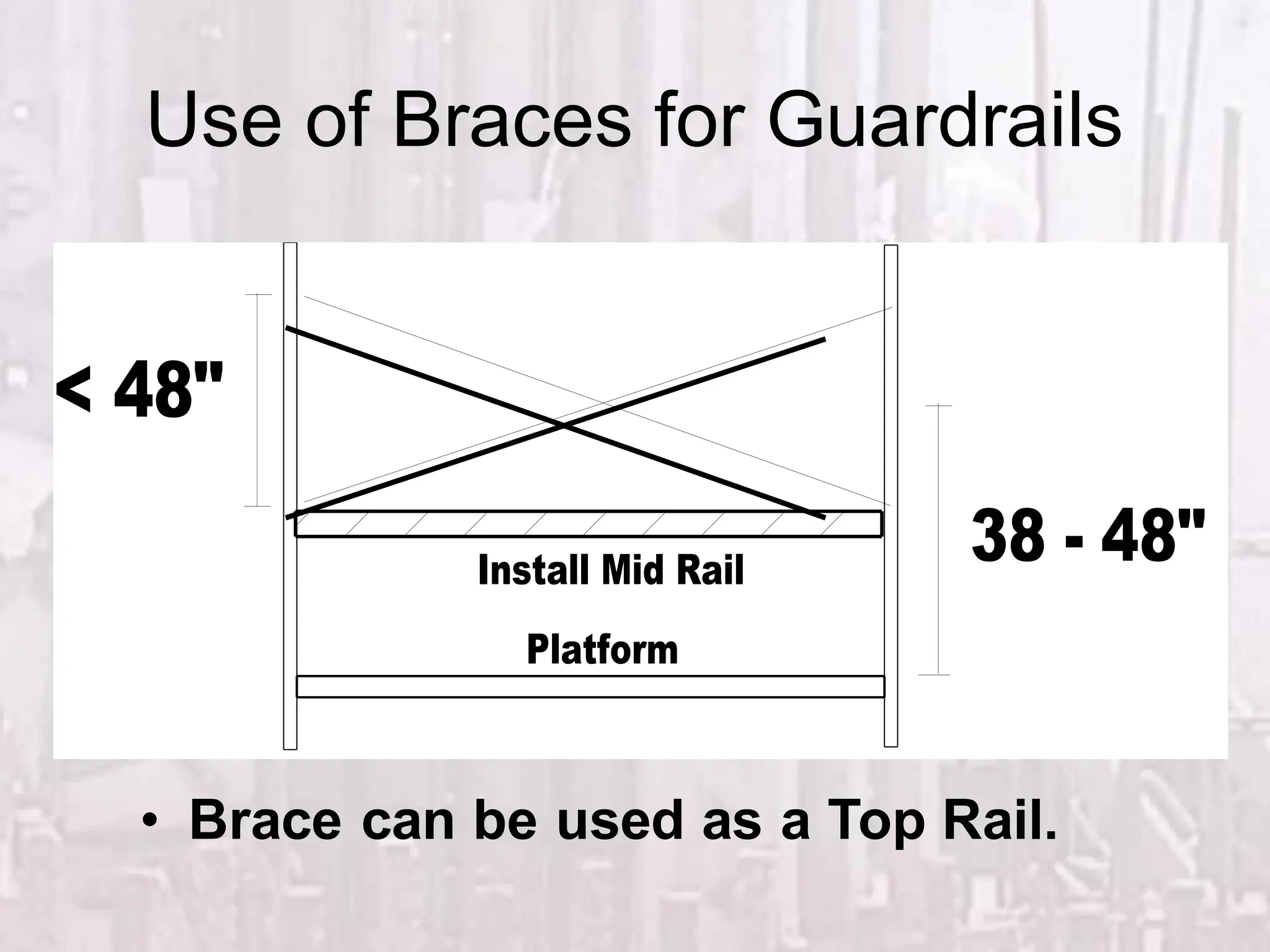
Use of Braces for Guardrails
• Brace can be used as a Top Rail.
Platform
38 - 48"
Install Mid Rail
< 48"
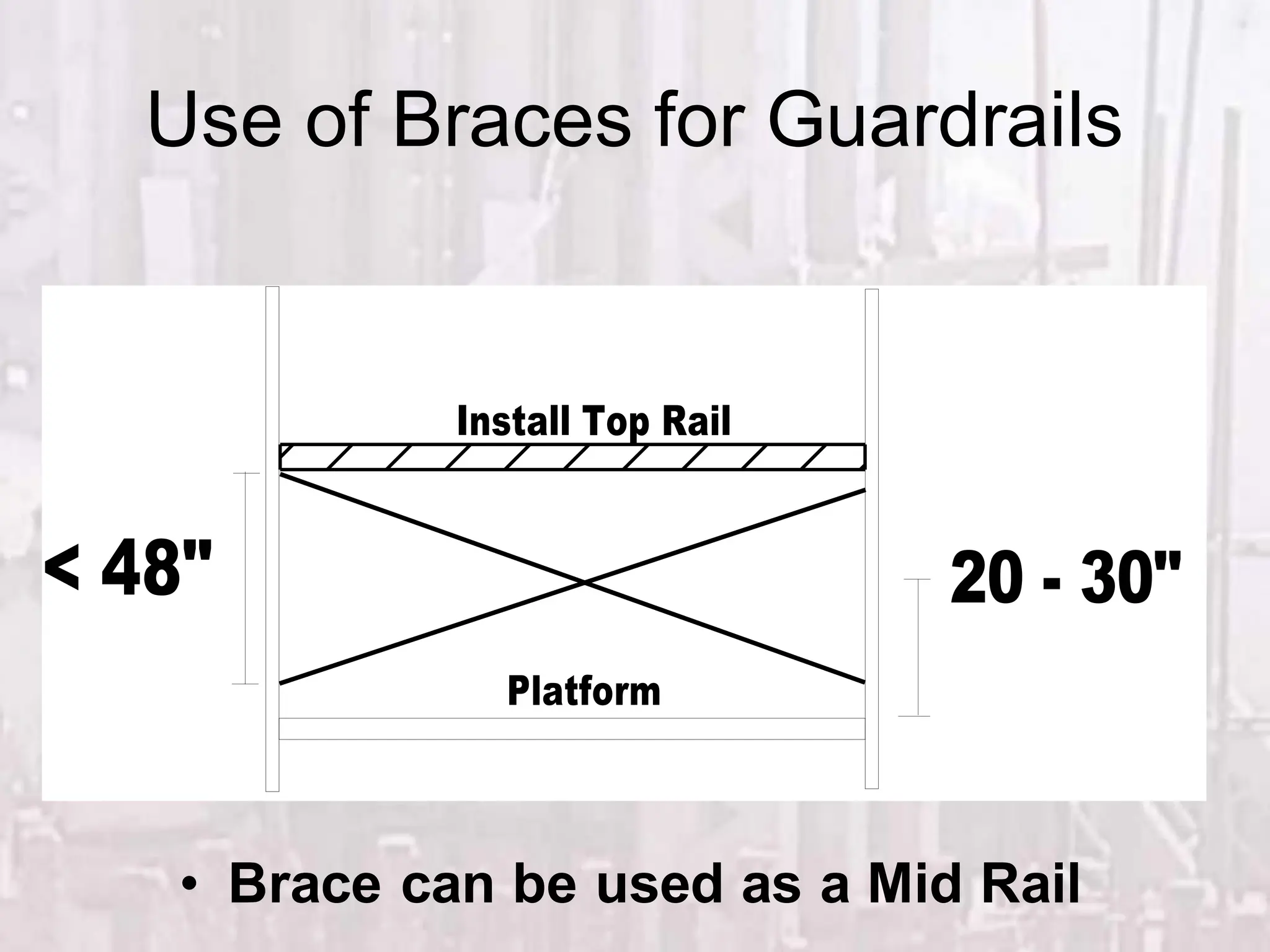
Use of Braces for Guardrails
• Brace can be used as a Mid Rail
Platform
20 - 30"
Install Top Rail
< 48"
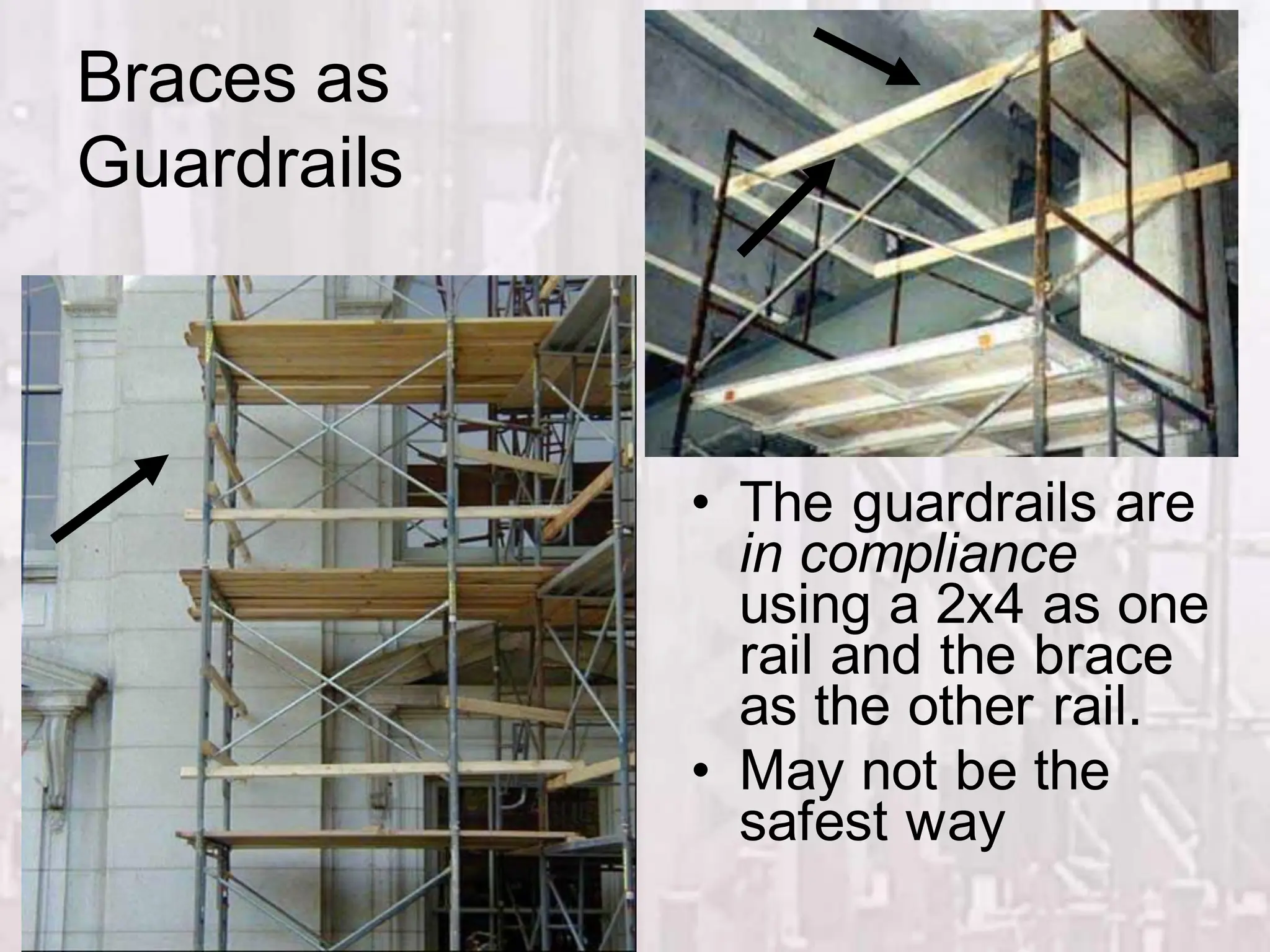
Braces as
Guardrails
• The guardrails are
in compliance
using a 2x4 as one
rail and the brace
as the other rail.
• May not be the
safest way
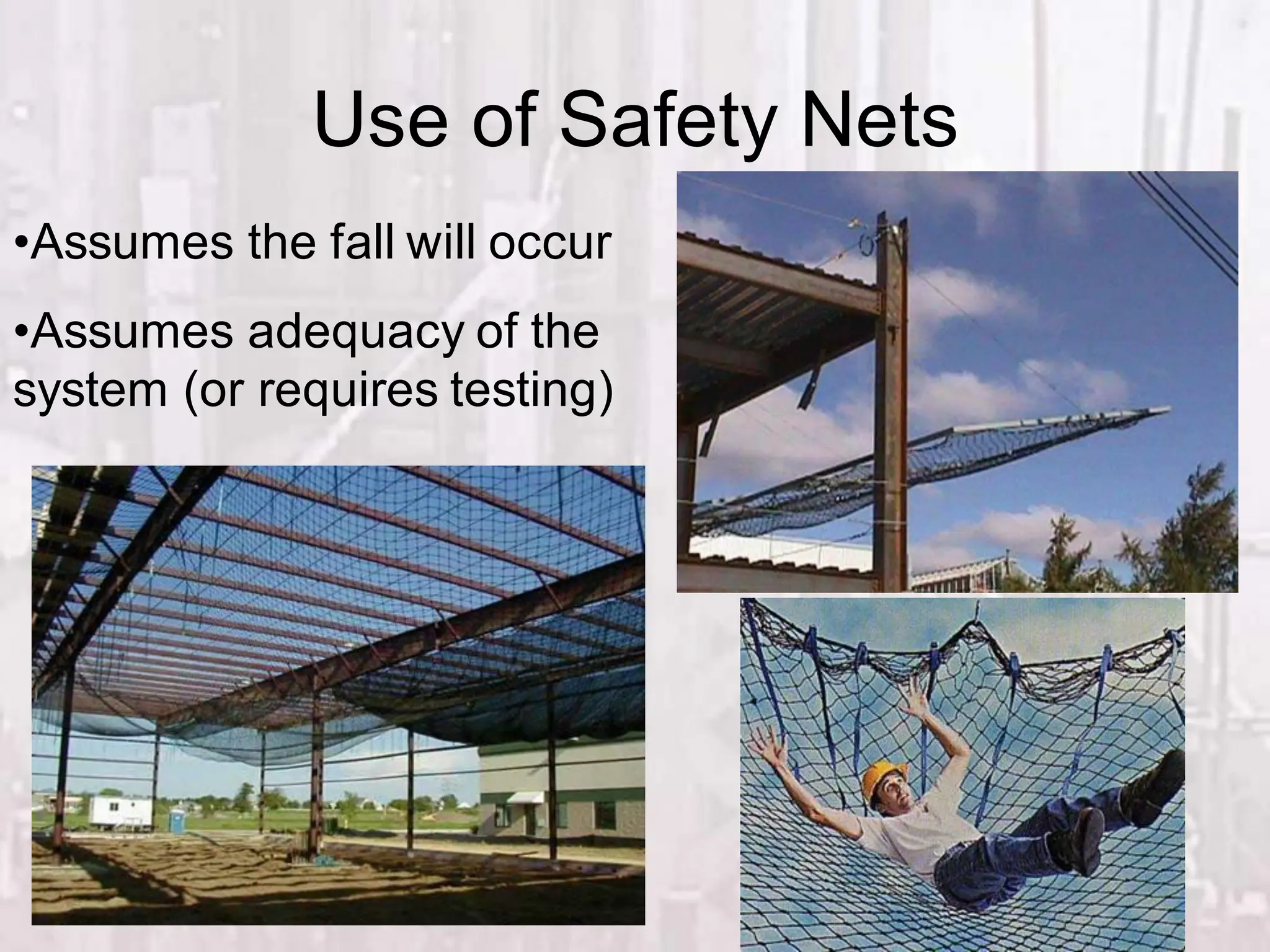
Use of Safety Nets
•Assumes the fall will occur
•Assumes adequacy of the
system (or requires testing)
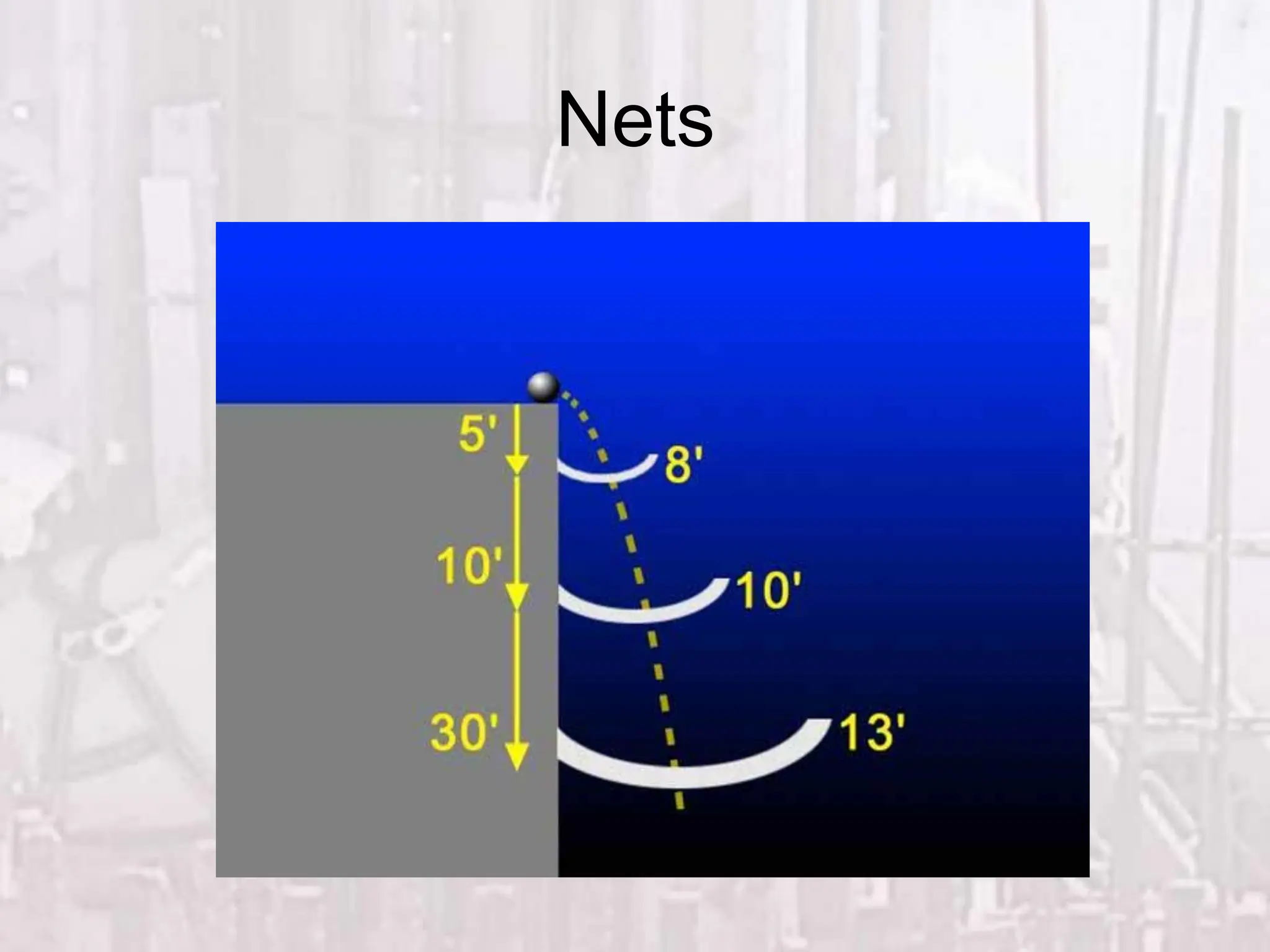
Nets
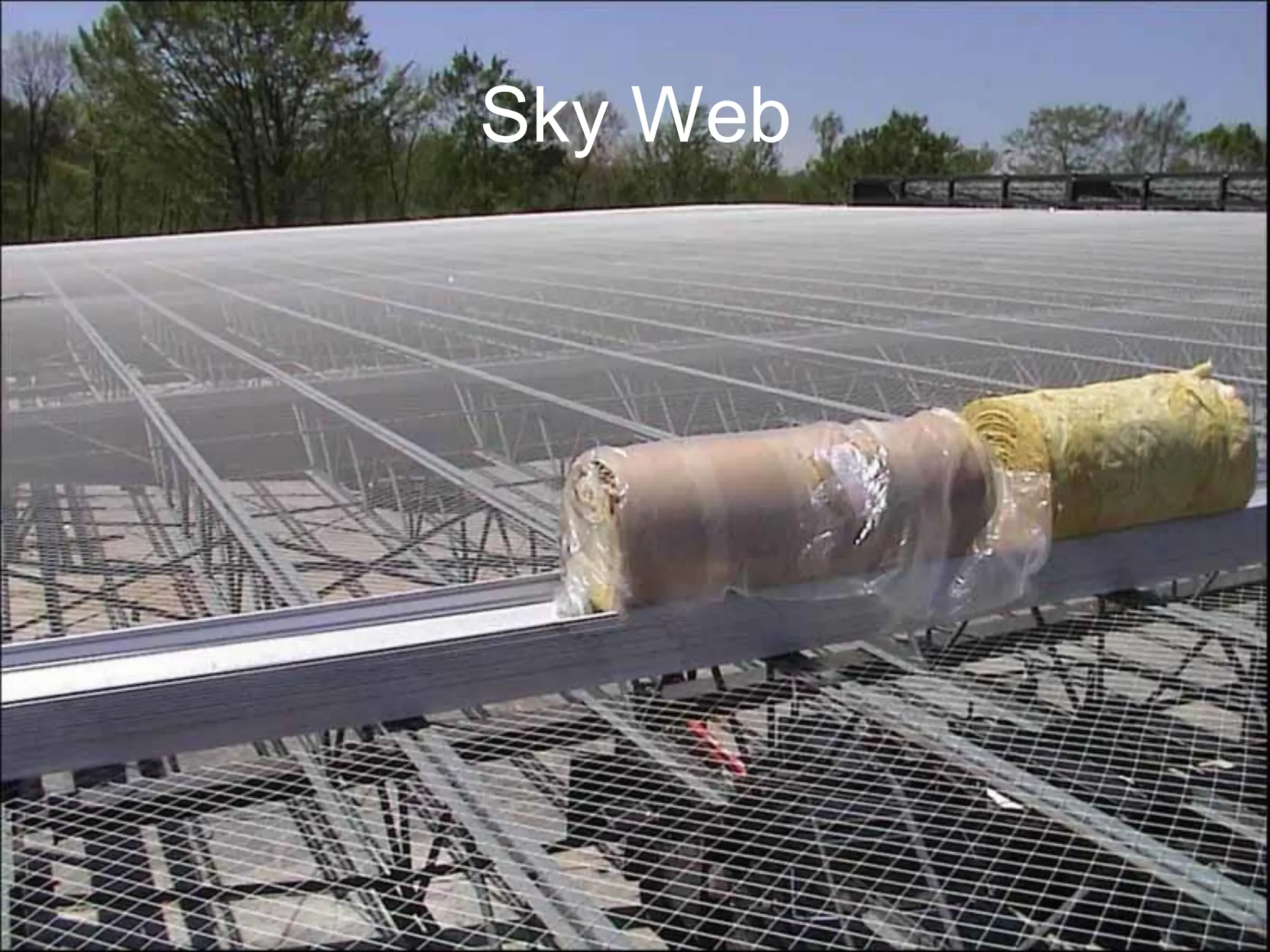
Sky Web
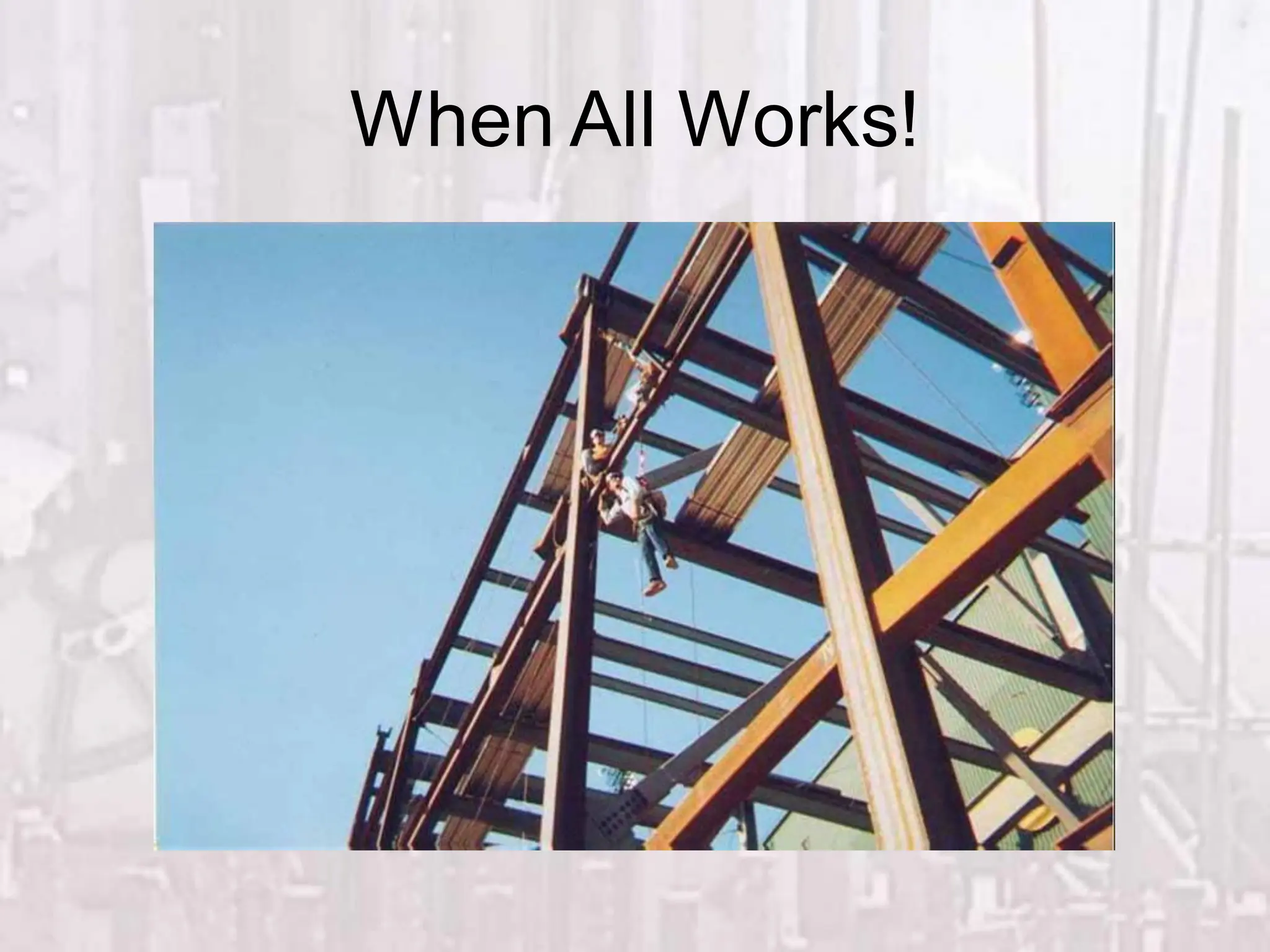
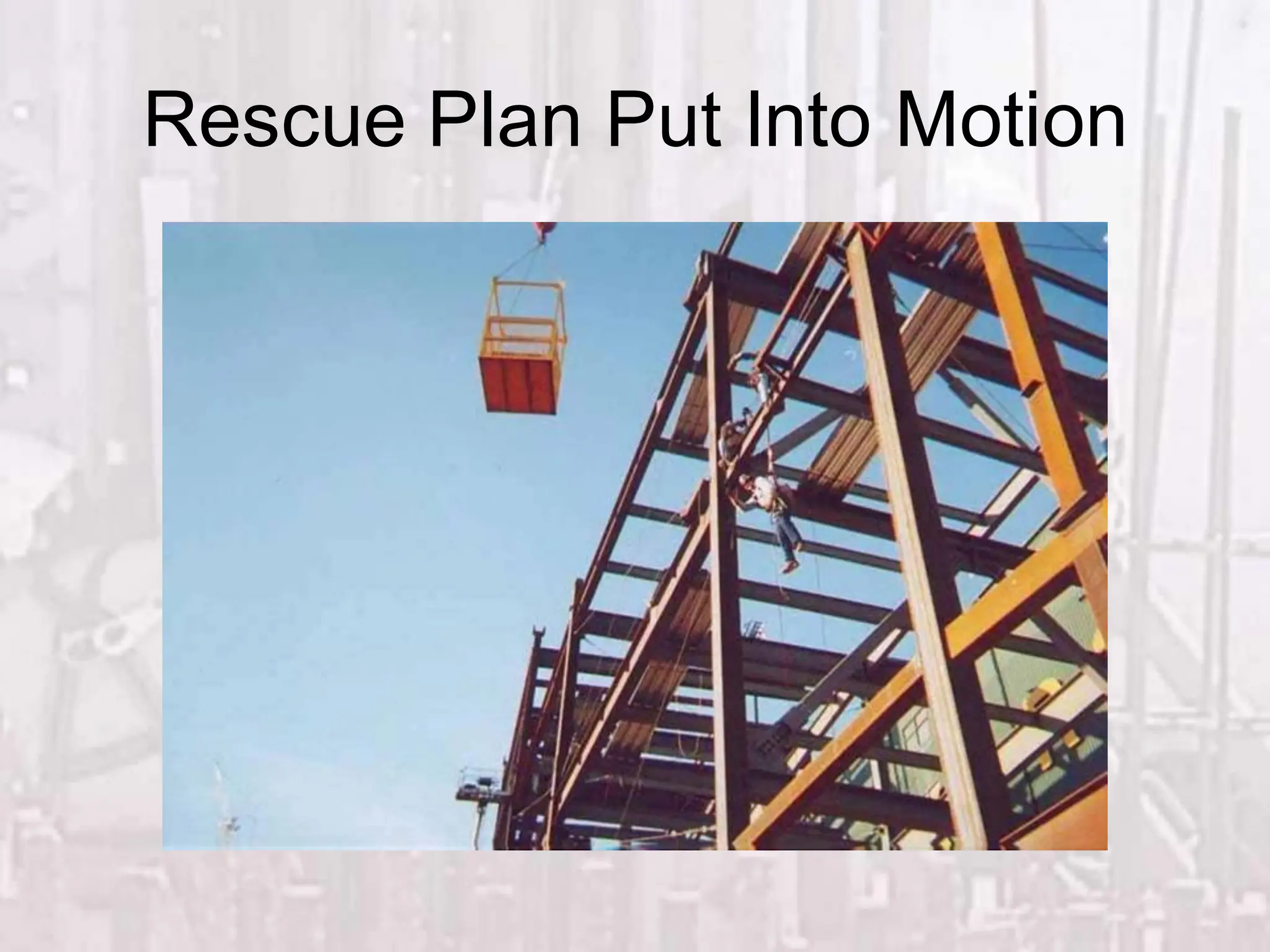
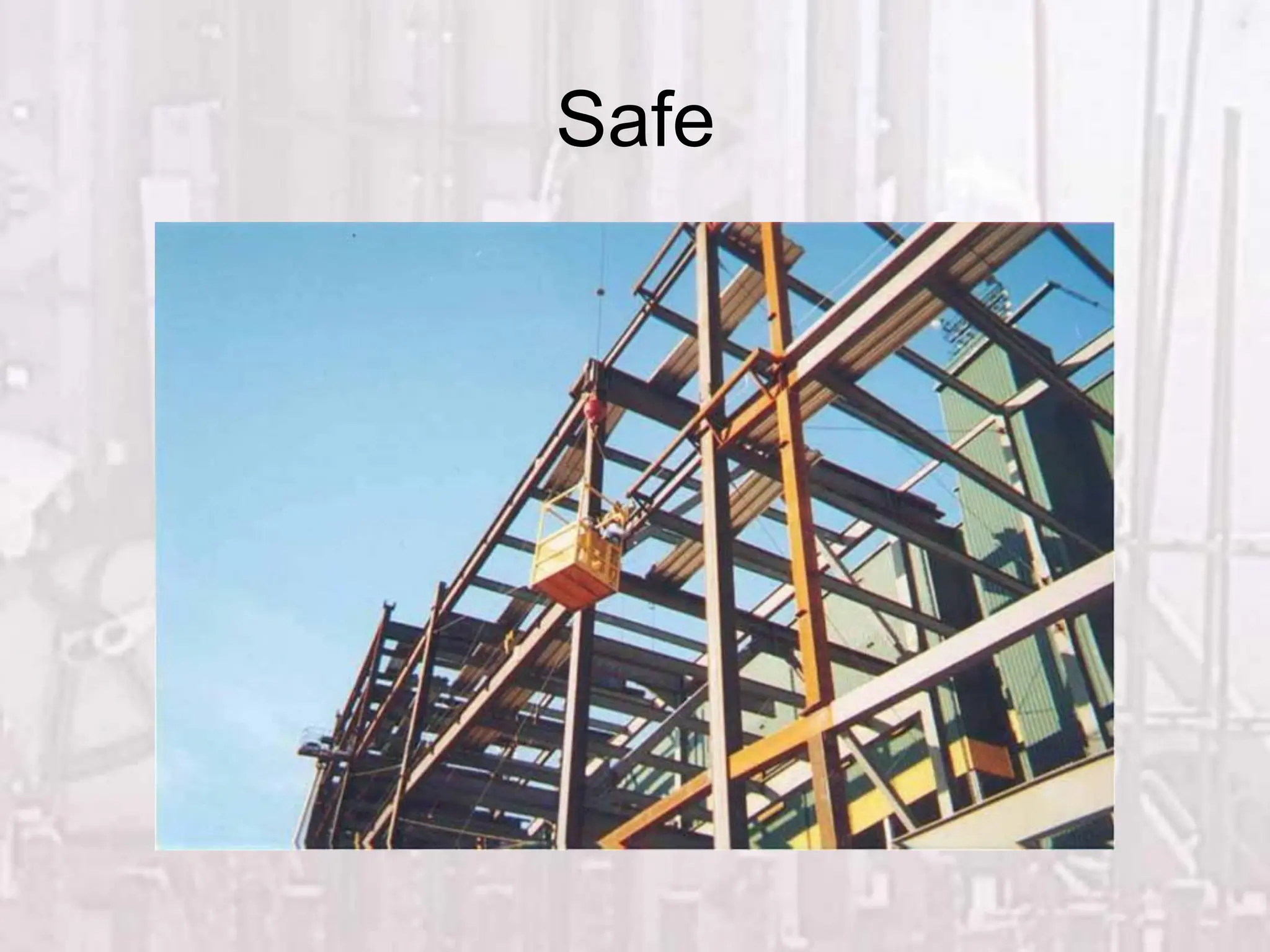
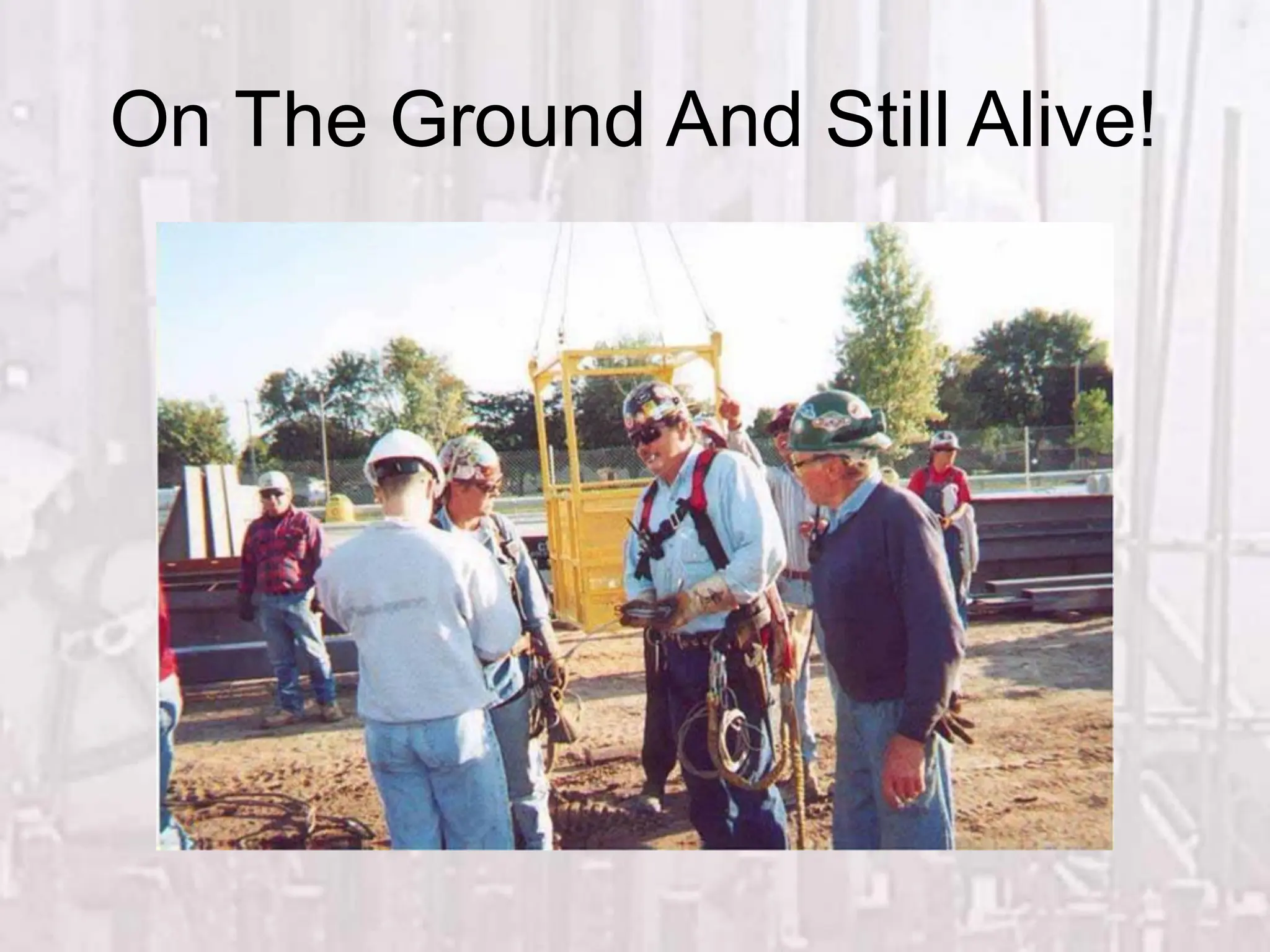
Planning For Rescue
Worst-case Scenario?
When All Works!
Rescue Plan Put Into Motion
Safe
On The Ground And Still Alive!
Any Questions?

FALL PROTECTION SYSTEMS while working at height and its equipment

  • 1.
  • 2.
    This presentation willdiscuss: Why we need Fall Protection & The systems available to protect employees.
  • 3.
    Why do weneed fall protection?
  • 4.
    Anatomy of a Fall •It takes most people about 1/3 of a second to become aware. • It takes another 1/3 of a second for the body to react. • A body can fall up to 7 feet in 2/3 of a second. .33sec./2 feet .67 sec./7 feet 1 sec./16 feet 2 sec./64 feet
  • 5.
    Statistics How Can theNumbers Focus Our Efforts?
  • 6.
    Falls • Falls areone of the leading cause of fatalities in the construction industry. • In 2005 there where approximately 469 fatal falls, with the trend on the increase. • The cost of care for injuries related to falls is a financial burden for the entire industry.
  • 7.
    What Is FallProtection? • A series of reasonable steps taken to eliminate or control the injury effects of an unintentional fall while working at a height.
  • 8.
    Philosophies of FallProtection Restraint/Positioning Guardrails Warning Lines Safety Monitors Controlled Access Zones Safety Nets Catch Platforms Fall Arrest Stop/Prevent The Fall Catch The Fall Controlled Decking Zones
  • 9.
    Planning for FallProtection • Best practice dictates that fall protection becomes an integral part of the project planning process, from constructability, to systems installation, to use and maintenance • A project cannot be truly safe unless fall protection is incorporated into every phase of the construction process • Planning will keep workers safe and minimize liability for all parties involved
  • 10.
    • Select fallprotection systems appropriate for given situations. • Use proper construction and installation of safety systems. • Supervise employees properly. • Use safe work procedures. • Train workers in the proper selection, use, and maintenance of fall protection systems. • Evaluate the effectiveness of all steps Controlling Fall Exposures
  • 11.
    Fall Protection Systemsand Components.
  • 12.
    Methods of RoofFall Protection Safety Monitors Guardrails and warning lines Fall Arrest
  • 13.
    Flat/Low Slope • 4:12Slope or Less • Beyond the Use of Guardrails, OSHA Allows the Use of – Warning Lines – Safety Monitors • Recommended: – Guardrails or PFAS where feasible – Limited use of lines and monitors on flat roofs only
  • 14.
    Roof Warning Lines •Must be 6 feet back from edges • Warning lines must be maintained at 34 - 39” above the working surface
  • 15.
    Safety Monitor • Overseeswork outside the warning lines. • Establishes the procedure to protect. • Workers must receive special training. • Use should be extremely limited
  • 16.
    High Slope • Over4:12 Slope • OSHA Mandates – Guardrails – Catch Platforms – Nets – Restraint Devices – Personal Fall Arrest Systems (PFAS)
  • 17.
    Roof Guardrails Guardrails area positive option on high slope roofs
  • 18.
    Personal Fall ArrestSystems • Anchorage • Body Harness • Connector Beam Wraps Lanyards Caribiners Rope Grabs Positioning Harnesses
  • 19.
    Anchorages • Must support5000 lbs. per employee attached, – Or as part of a complete personal fall arrest system which maintains a safety factor of at least two – Or 3000 lbs. when using fall restraint or a Self- Retracting Lifeline (SRL, Retractable, or “yo-yo”) which limits free fall distance to 2 feet • Should always be at or above D-ring height
  • 20.
    Roof & DeckAnchors Wood Roof Anchor Metal Roof Anchor Permanent Anchors
  • 21.
    Use of EyeBolts • Rated for loading parallel to the bolt axis. • If wall mounted, the rating perpendicular to the axis must be good for 5,000 lbs. per employee Rated Needed
  • 22.
    Girder Grip Anchorage Rings •These attachments can be mounted through bolt holes on steel members. • They are rated at 5,000 lbs. in all directions
  • 23.
    Beam Clamps TIGHT PIN SET BEAM CLAMP Beamclamps can make an effective anchorage when used properly, and with the correct lanyard Be sure pin is inserted full length and clamp is tight.
  • 24.
    Beware of potentialfor pulling off of coped ends on filler beams!
  • 25.
    Horizontal Life Lines •Provide maneuverability. • Must be designed, installed and used under the guidance of a qualified person
  • 26.
    Line Stanchions • Theconnection of the line stanchion to the flange must support the bending moment applied to the base. 5,000lb. Bending Moment 15,000 ft-lb 3 ft.
  • 27.
    Body (Harnesses) • Needto be inspected frequently (daily before use by the worker, at least monthly by a Competent Person) • Should never be modified • Should be taken out of service immediately if defective or exposed to an impact
  • 28.
    Harness Fitting • Harnessmust be sized for the worker Chest strap tightened at mid chest Butt strap supports the load Proper snugness shoulder to hips Leg straps snug but not binding “D” ring between shoulder blades
  • 29.
    Proper Adjustment IsKey “Rules of Thumb” • Be able to reach your D- ring with your thumb • Maximum Four (flat) Fingers of Slack at the legs, straps as high as comfortably possible • Ensure chest strap is across the chest/breastbone • Have a buddy double check for twists, etc…
  • 30.
    Harness Pressure Points Spreadload across butt strap and belt strap if on the harness Excess pressure here can cut blood flow to the legs Some studies have indicated permanent damage to the lower extremities when the worker hangs for more than twenty (20) minutes
  • 31.
    Connectors (Lanyards) • Shouldbe inspected before each use • Should not be tied back to themselves (unless specifically designed for such use) • Should be worn with the impact absorber/shock pack at the d-ring • Should have the appropriate clip for the intended anchorage points – Do not use large climbing/rebar/ladder hooks with “beamers”
  • 32.
    Free Fall Distance •How far a worker falls before shock absorbing or deceleration equipment begins to take effect – Affects both impact forces and total fall distance • Anchorage point location in relation to D-ring height – Below the D-ring allows excessive falls – Above the D-ring minimizes free fall to less than 6’
  • 33.
    Impacting Structures Below (TotalFall Distance) • Consider: – anchorage point location in relation to D-ring height – lanyard length, – harness elongation, – shock absorber opening length, – body below D-ring – body viscosity (soft tissue injuries!)
  • 34.
    Impacting Structures Below (TotalFall Distance) 6’ Lanyard Length 3.5’ Deceleration Device 5’ From D-Ring to Worker’s Feet 3’ Safety Factor (stretch, bounce, etc.) Total 18.5’ below anchorage point All distances are approximate, and shown for illustrationonly. This is why it is critical tomaintain the safety factor distance!
  • 35.
    Retractable Lifelines • Very effectivefor vertical applications. • Will normally lock up in 1 –2 feet, minimizing total fall distance and impact forces on the worker’s body
  • 36.
    Do Not HookLanyards to Retractables! • This worker is hooked to a retractable lifeline with his lanyard. • This can cause hook failures and affect the locking capability of the retractable. • The retractable should be attached directly to the “D” ring.
  • 37.
    Positioning Systems • PositioningDevices Provide Hands-free Work – Additional Fall Protection (tie-off) may be required to move or access
  • 38.
    Fall Restraint • Fallrestraint assumes the employee cannot reach the edge. • He is basically on a short leash. • If the employee could reach to the edge and fall over the edge, he must be in fall arrest. Restraint Line Edge
  • 39.
    Use of RestraintCables RESTRAINT CABLE Example of restraint cables used during deck anchoring.
  • 40.
    Wood Guardrail Construction ProperHeight Midrails Toeboards Adequate Strength
  • 41.
    Use of Bracesfor Guardrails • Brace can be used as a Top Rail. Platform 38 - 48" Install Mid Rail < 48"
  • 42.
    Use of Bracesfor Guardrails • Brace can be used as a Mid Rail Platform 20 - 30" Install Top Rail < 48"
  • 43.
    Braces as Guardrails • Theguardrails are in compliance using a 2x4 as one rail and the brace as the other rail. • May not be the safest way
  • 44.
    Use of SafetyNets •Assumes the fall will occur •Assumes adequacy of the system (or requires testing)
  • 45.
  • 46.
  • 47.
  • 48.
  • 49.
    Rescue Plan PutInto Motion
  • 50.
  • 51.
    On The GroundAnd Still Alive!
  • 52.