ADAPTIVE VS.
RESPONSIVE WEB
DESIGN: CHOOSING THE
RIGHT APPROACH FOR
YOUR DIGITAL PRESENCE
ADAPTIVE VS.
RESPONSIVE WEB
DESIGN: CHOOSING THE
RIGHT APPROACH FOR
YOUR DIGITAL PRESENCE
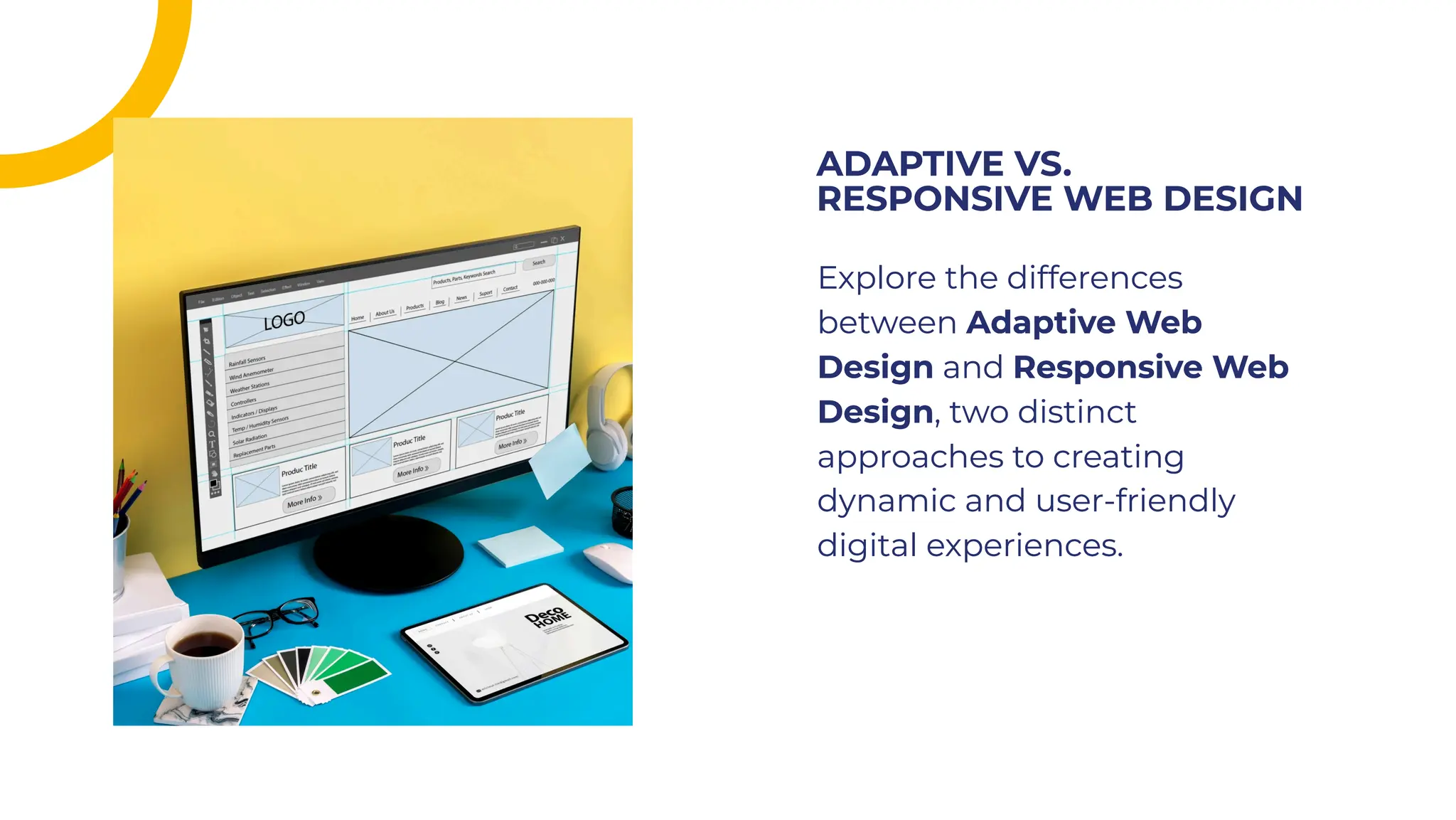
Explore the differences
between Adaptive Web
Design and Responsive Web
Design, two distinct
approaches to creating
dynamic and user-friendly
digital experiences.
Explore the differences
between Adaptive Web
Design and Responsive Web
Design, two distinct
approaches to creating
dynamic and user-friendly
digital experiences.
ADAPTIVE VS.
RESPONSIVE WEB DESIGN
ADAPTIVE VS.
RESPONSIVE WEB DESIGN
UNDERSTANDING
ADAPTIVE WEB DESIGN
UNDERSTANDING
ADAPTIVE WEB DESIGN
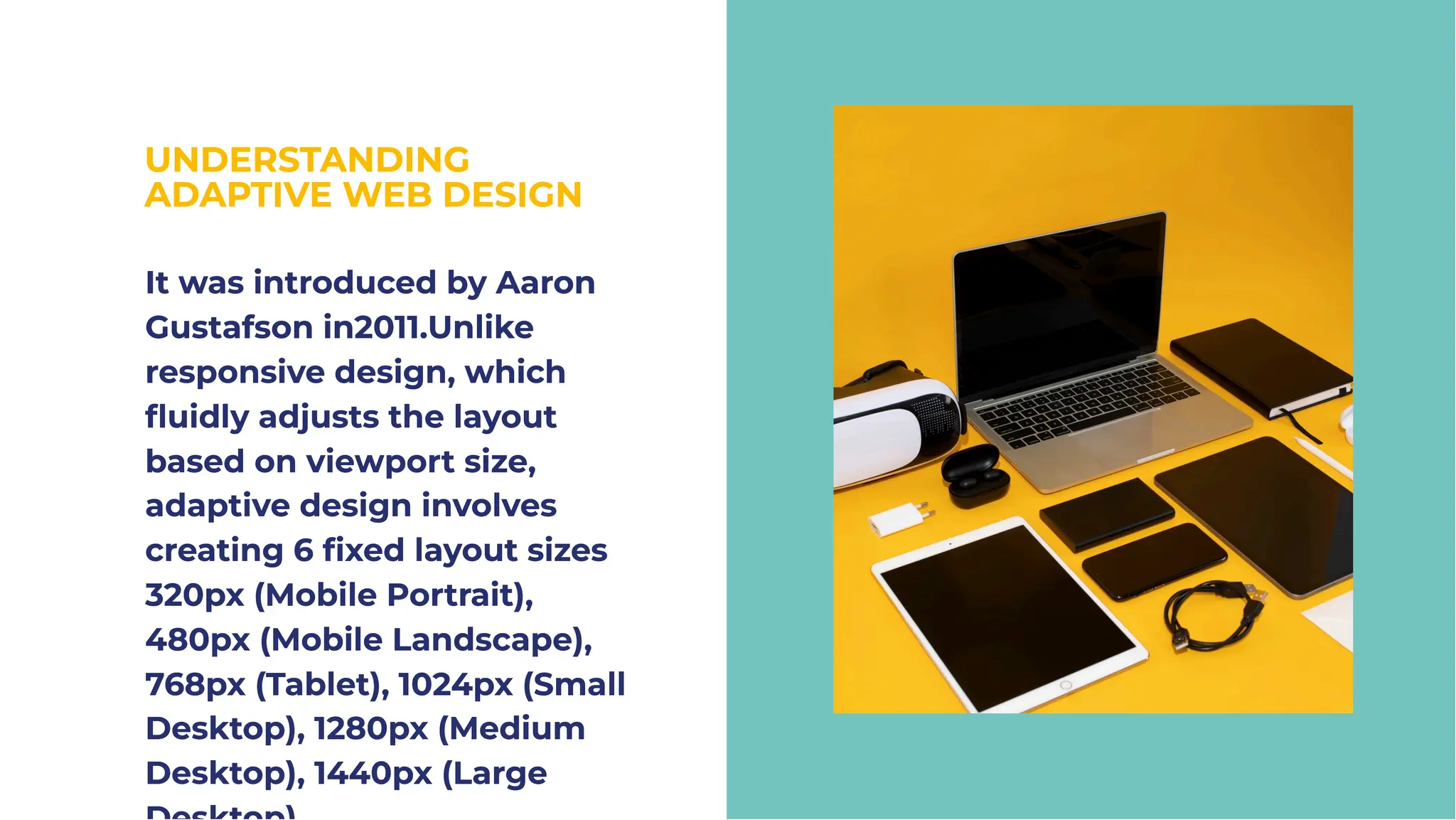
It was introduced by Aaron
Gustafson in2011.Unlike
responsive design, which
fluidly adjusts the layout
based on viewport size,
adaptive design involves
creating 6 fixed layout sizes
320px (Mobile Portrait),
480px (Mobile Landscape),
768px (Tablet), 1024px (Small
Desktop), 1280px (Medium
Desktop), 1440px (Large
It was introduced by Aaron
Gustafson in2011.Unlike
responsive design, which
fluidly adjusts the layout
based on viewport size,
adaptive design involves
creating 6 fixed layout sizes
320px (Mobile Portrait),
480px (Mobile Landscape),
768px (Tablet), 1024px (Small
Desktop), 1280px (Medium
Desktop), 1440px (Large
THE FLEXIBILITY OF
RESPONSIVE WEB DESIGN
THE FLEXIBILITY OF
RESPONSIVE WEB DESIGN
Ethan Marcotte introduced
responsive design in the
early2010s,marking a
transformative period in web
development. This approach
emerged as a solution to the
growing diversity of device
sizes and resolutions,
advocating for websites that
dynamically adjust to the
user's environment.
Ethan Marcotte introduced
responsive design in the
early2010s,marking a
transformative period in web
development. This approach
emerged as a solution to the
growing diversity of device
sizes and resolutions,
advocating for websites that
dynamically adjust to the
user's environment.
CONSIDERATIONS FOR CHOOSING
THE RIGHT APPROACH
CONSIDERATIONS FOR CHOOSING
THE RIGHT APPROACH
When selecting between
Adaptive and Responsive Web
Design, factors such as
content complexity, user
requirements, development
resources, and project
timeline should be carefully
evaluated to determine the
most suitable approach.
When selecting between
Adaptive and Responsive Web
Design, factors such as
content complexity, user
requirements, development
resources, and project
timeline should be carefully
evaluated to determine the
most suitable approach.
Balancing User Experience and
Development Efficiency
Balancing User Experience and
Development Efficiency
The choice between Adaptive
and Responsive Web Design
often involves a trade-off
between user experience and
development efficiency.
Understanding this balance is
crucial for making an informed
decision.
The choice between Adaptive
and Responsive Web Design
often involves a trade-off
between user experience and
development efficiency.
Understanding this balance is
crucial for making an informed
decision.
By understanding the strengths and limitations of
Adaptive and Responsive Web Design, businesses
can make an informed decision that aligns with their
specific needs and delivers a seamless digital
experience for their users.
By understanding the strengths and limitations of
Adaptive and Responsive Web Design, businesses
can make an informed decision that aligns with their
specific needs and delivers a seamless digital
experience for their users.
CONCLUSION: SELECTING THE
OPTIMAL WEB DESIGN APPROACH
CONCLUSION: SELECTING THE
OPTIMAL WEB DESIGN APPROACH
Thanks!
Thanks!
Let's create something extraordinary
together!
business@illuminz.com
+91-79860 60283
https://www.illuminz.com/
Let's create something extraordinary
together!
business@illuminz.com
+91-79860 60283
https://www.illuminz.com/

Adaptive vs. Responsive Web Design: Which Way to Go?

  • 1.
    ADAPTIVE VS. RESPONSIVE WEB DESIGN:CHOOSING THE RIGHT APPROACH FOR YOUR DIGITAL PRESENCE ADAPTIVE VS. RESPONSIVE WEB DESIGN: CHOOSING THE RIGHT APPROACH FOR YOUR DIGITAL PRESENCE
  • 2.
    Explore the differences betweenAdaptive Web Design and Responsive Web Design, two distinct approaches to creating dynamic and user-friendly digital experiences. Explore the differences between Adaptive Web Design and Responsive Web Design, two distinct approaches to creating dynamic and user-friendly digital experiences. ADAPTIVE VS. RESPONSIVE WEB DESIGN ADAPTIVE VS. RESPONSIVE WEB DESIGN
  • 3.
    UNDERSTANDING ADAPTIVE WEB DESIGN UNDERSTANDING ADAPTIVEWEB DESIGN It was introduced by Aaron Gustafson in2011.Unlike responsive design, which fluidly adjusts the layout based on viewport size, adaptive design involves creating 6 fixed layout sizes 320px (Mobile Portrait), 480px (Mobile Landscape), 768px (Tablet), 1024px (Small Desktop), 1280px (Medium Desktop), 1440px (Large It was introduced by Aaron Gustafson in2011.Unlike responsive design, which fluidly adjusts the layout based on viewport size, adaptive design involves creating 6 fixed layout sizes 320px (Mobile Portrait), 480px (Mobile Landscape), 768px (Tablet), 1024px (Small Desktop), 1280px (Medium Desktop), 1440px (Large
  • 4.
    THE FLEXIBILITY OF RESPONSIVEWEB DESIGN THE FLEXIBILITY OF RESPONSIVE WEB DESIGN Ethan Marcotte introduced responsive design in the early2010s,marking a transformative period in web development. This approach emerged as a solution to the growing diversity of device sizes and resolutions, advocating for websites that dynamically adjust to the user's environment. Ethan Marcotte introduced responsive design in the early2010s,marking a transformative period in web development. This approach emerged as a solution to the growing diversity of device sizes and resolutions, advocating for websites that dynamically adjust to the user's environment.
  • 5.
    CONSIDERATIONS FOR CHOOSING THERIGHT APPROACH CONSIDERATIONS FOR CHOOSING THE RIGHT APPROACH When selecting between Adaptive and Responsive Web Design, factors such as content complexity, user requirements, development resources, and project timeline should be carefully evaluated to determine the most suitable approach. When selecting between Adaptive and Responsive Web Design, factors such as content complexity, user requirements, development resources, and project timeline should be carefully evaluated to determine the most suitable approach.
  • 6.
    Balancing User Experienceand Development Efficiency Balancing User Experience and Development Efficiency The choice between Adaptive and Responsive Web Design often involves a trade-off between user experience and development efficiency. Understanding this balance is crucial for making an informed decision. The choice between Adaptive and Responsive Web Design often involves a trade-off between user experience and development efficiency. Understanding this balance is crucial for making an informed decision.
  • 7.
    By understanding thestrengths and limitations of Adaptive and Responsive Web Design, businesses can make an informed decision that aligns with their specific needs and delivers a seamless digital experience for their users. By understanding the strengths and limitations of Adaptive and Responsive Web Design, businesses can make an informed decision that aligns with their specific needs and delivers a seamless digital experience for their users. CONCLUSION: SELECTING THE OPTIMAL WEB DESIGN APPROACH CONCLUSION: SELECTING THE OPTIMAL WEB DESIGN APPROACH
  • 8.
    Thanks! Thanks! Let's create somethingextraordinary together! business@illuminz.com +91-79860 60283 https://www.illuminz.com/ Let's create something extraordinary together! business@illuminz.com +91-79860 60283 https://www.illuminz.com/