MET
project
Asking
Students
about Teaching
Student Perception Surveys
and Their Implementation
Policy and
PracTicEBriEf
ABOUT THIS REPORT: Based on the experience of the Measures of Effective Teaching (MET) project, its partners, and other
districts, states, and organizations, this report is meant for practitioners and policymakers who want to understand student
surveys as potential tools for teacher evaluation and feedback, as well as the challenges and considerations posed by their
implementation. MET project findings on the reliability and validity of student surveys are explored in depth in a separate
research report, Learning about Teaching: Initial Findings from the Measures of Effective Teaching Project.
AcknOwlEdgmEnTS: This document is based on the collective knowledge of many individuals who shared their experiences
with student surveys for the benefit of their peers in other states, districts, and organizations. Thanks to:
■ Ryan Balch, Vanderbilt University
■ Kelly Burling and colleagues, Pearson
■ Carrie Douglass, Rogers Family Foundation
■ Ronald Ferguson, Harvard University and the Tripod
Project for School Improvement
■ Tiffany Francis, Sam Franklin, and Mary Wolfson,
Pittsburgh Public Schools
■ James Gallagher, Aspire Public Schools
■ Alejandro Ganimian, Harvard University
■ Hilary Gustave, Denver Public Schools
■ Monica Jordan and Rorie Harris, Memphis City Schools
■ Kevin Keelen, Green Dot Public Schools
■ Jennifer Preston, North Carolina Department of Public
Instruction
■ Rob Ramsdell and Lorraine McAteer, Cambridge Education
■ Valerie Threlfall and colleagues, Center for Effective
Philanthropy
■ Ila Deshmukh Towery and colleagues, TNTP
■ Deborah Young, Quaglia Institute for Student Aspirations
■ Sara Brown Wessling, Johnston High School in
Johnston, Iowa
ABOUT THE mET PROjEcT: The MET project is a research partnership of academics, teachers, and education organizations
committed to investigating better ways to identify and develop effective teaching. Funding is provided by the Bill & Melinda
Gates Foundation. For more information, visit www.metproject.org.
September 2012
Contents
Why Ask Students about Teaching 2
Measure What Matters 5
Ensure Accuracy 11
Ensure Reliability 14
Support Improvement 18
Engage Stakeholders 21
Appendix: Tripod 7 C Survey Items 23
Student Perception Surveys and Their Implementation 1
2 Measures of Effective Teaching (MET) Project
no one has a bigger stake in teaching effectiveness than students. Nor
are there any better experts on how teaching is experienced by its intended
beneficiaries. But only recently have many policymakers and practitioners come
to recognize that—when asked the right questions, in the right ways—students
can be an important source of information on the quality of teaching and the
learning environment in individual classrooms.
Why Ask Students
about Teaching?
a new focus on the
classroom
As states and districts reinvent how
teachers are evaluated and provided
feedback, an increasing number are
including student perception surveys as
part of the mix. In contrast to the kinds
of school climate surveys that have been
commonly used in many systems, these
student perception surveys ask students
about specific teachers and specific
classrooms. District-wide administra-
tion of such surveys has begun in Denver,
Memphis, and Pittsburgh. Statewide
pilots have taken place in Georgia and
North Carolina. And student surveys
are now used for feedback and evalua-
tion by the New Teacher Center, TNTP
(formerly The New Teacher Project), and
such charter management organizations
as Aspire Public Schools and Green Dot
Public Schools.
There are many reasons for this new
interest. Teaching is a complex inter-
action among students, teachers, and
content that no one tool can measure.
The search for different-but-aligned
instruments has led many to use student
surveys as a complement to such other
tools as classroom observations and
measures of student achievement gains.
Analysis by the Measures of Effective
Teaching (MET) project finds that
teachers’ student survey results are
predictive of student achievement gains.
Students know an effective classroom
when they experience one. That survey
results predict student learning also
suggests surveys may provide outcome-
related results in grades and subjects
for which no standardized assessments
of student learning are available.
Further, the MET project finds student
surveys produce more consistent
results than classroom observations
or achievement gain measures (see
the MET project’s Gathering Feedback
policy and practitioner brief). Even a
high-quality observation system entails
at most a handful of classroom visits,
while student surveys aggregate the
impressions of many individuals who’ve
spent many hours with a teacher.
2 Measures of Effective Teaching (MET) Project
Asking Students about Teaching
2
Student surveys also can provide feed-
back for improvement. Teachers want
to know if their students feel sufficiently
challenged, engaged, and comfortable
asking them for help. Whereas annual
measures of student achievement gains
provide little information for improve-
ment (and generally too late to do much
about it), student surveys can be admin-
istered early enough in the year to tell
teachers where they need to focus so
that their current students may ben-
efit. As feedback tools, surveys can be
powerful complements to other instru-
ments. Surveys might suggest stu-
dents’ misunderstandings aren’t being
addressed; done well, observations can
diagnose a teacher’s specific attempts at
clarification.
imperatives for
implementation
Benefits aside, student perception
surveys present their own set of chal-
lenges and considerations to states
and districts. Some of these relate to
the survey instrument itself. Not every
survey will produce meaningful infor-
mation on teaching. Not to be confused
with popularity contests, well-designed
student perception surveys capture
important aspects of instruction and the
classroom environment. Rather than
pose, “Do you like your teacher?” typi-
cal items might ask the extent to which
students agree that, “I like the way the
teacher treats me when I need help” and
“If you don’t understand something, my
teacher explains it another way.” Survey
development is a sophisticated, data-
driven process.
But even a good instrument, imple-
mented poorly, will produce bad
information. Attending to issues such as
student confidentiality, sampling, and
accuracy of reporting takes on greater
urgency as systems look toward includ-
ing student surveys in their evaluation
systems. The care with which sys-

tems must administer surveys in such
contexts is akin to that required in the
formal administration of standardized
student assessments. Smooth admin-
istration and data integrity depend on
piloting, clear protocols, trained coordi-
nators, and quality-control checks.
clarification. “If you don’t understand something, my nators, and quality-control checks.
Student Perception Surveys and Their Implementation 3
The following pages draw on the experi-
ence of the MET project, its partners,
and other leading school systems and
organizations to clarify four overriding
requirements of any system considering
student surveys as part of formal feed-
back and evaluation for teachers:
1. Measure what matters. Good
surveys focus on what teachers do
and on the learning environment
they create. Surveys should reflect
the theory of instruction that defines
expectations for teachers in a
system. Teachers with better survey
results should also have better
outcomes on measures of student
learning.
2. Ensure accuracy. Student responses
should be honest and based on clear
understanding of the survey items.
Student confidentiality is a must.
Accuracy also means that the right
responses are attributed to the right
teacher.
3. Ensure reliability. Teachers should
have confidence that surveys can
produce reasonably consistent
results and that those results reflect
what they generally do in their
classrooms—not the idiosyncrasies
of a particular group of students.
Reliability requires adequate
sampling and an adequate number
of items—but without overtaxing
students.
4. Support improvement.
Measurement for measurement’s
sake is wasted effort. Teachers
should receive their results in
a timely manner, understand
what they mean, and have access
to professional development
resources that will help them
target improvement in areas of
need. Student surveys are as
much about evaluating systems of
support for teachers as they are
about diagnosing the needs within
particular classrooms.
Addressing these requirements amid
finite resources and competing concerns
necessarily involves trade-offs.
Although the study of student surveys
has intensified, research to date cannot
offer hard and fast rules for striking
the right balance on many issues.
Highlighted throughout this report are
some of the varied approaches that
systems are taking. But implementation
in the field is a work in progress.
Individual districts and states are
piloting before deciding how to deploy
surveys formally and at scale. This
document concludes by emphasizing the
importance of stakeholder engagement
for achieving positive results.
It will be important to monitor how
student surveys behave as they move
into the realm of formal evaluation. The
Tripod survey studied by the MET proj-
ect, developed by Harvard researcher
Ronald Ferguson, has been refined over
11 years of administration in many thou-
sands of classrooms as a research and
professional development tool. But only
recently have systems begun to con-
sider its use as part of formal teacher
evaluation.
Any instrument, when stakes are
attached, could distort behavior in
unwanted ways, or produce a less accu-
rate picture of typical practice. One can
imagine a teacher who, consciously or
not, acts more lenient if student sur-
veys are factored into evaluation, even
though well-designed surveys stress a
balance of challenge and support. This
is further reason for multiple measures.
It lets teachers stay focused on effective
teaching and not on any one result.
Benefits to Student Perception Surveys
1. Feedback. Results point to strengths and areas for improvement.
2. “Face validity.” Items reflect what teachers value.
3. “Predictive validity.” Results predict student outcomes.
4. Reliability. Results demonstrate relative consistency.
5. low cost. Expense of administration is minimal.
Asking Students about Teaching
4
Measure What Matters
if the objective of measurement is to support improved student outcomes, then
the measures used should relate to those outcomes—and to the means teachers
use to help students achieve them. It’s a problem if a measure has no relationship
to how teachers in a system are expected to teach, or to the outcomes for which
they’re held accountable. Making sure those relationships exist should be part of
adopting a student perception survey.
indicators of Teaching
To measure something broad like teaching
requires breaking the activity down into
discrete components that together rep-
resent a theory about the instruction that
supports student learning. Developers of
student perception surveys often refer to
these components as “constructs”—dif-
ferent aspects of teaching and the learn-
ing environment, the quality of which are
indicated by responses to multiple related
questions about students’ observations
and feelings.
Consider the Tripod survey employed
in the MET project study. Tripod is
designed to measure teaching, student
engagement, school norms, and student
demographics. To measure teaching, the
survey groups items under seven con-
structs, called the “7 Cs”: Care, Control,
Challenge, Clarify, Confer, Captivate,
and Consolidate. For each, the survey
poses a series of statements, asking
students’ level of agreement on a five-
point scale. Here are two items under
“Clarify”:
■ “My teacher has several good
ways to explain each topic that
we cover in class.”
■ “My teacher knows when the class
understands and when we do not.”
An important quality of any measure
of teaching is its ability to differentiate
among classrooms. If all teaching looks
the same, the instrument is not provid-
ing much information for feedback.
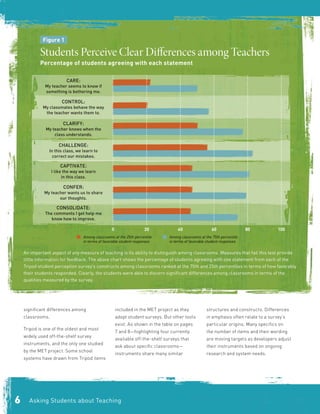
As shown in figure 1, students who
completed the Tripod survey as part of
the MET project perceived clear differ-
ences among teachers. The chart shows
the percentage of students agreeing
with one statement from each construct
among classrooms at the 75th and 25th
percentiles in terms of how favorably
their students responded.
Note the results for the item: “The
comments I get help me know how to
improve.” Among classrooms at the
75th percentile in terms of favorable
responses to that statement, more
than three-quarters of students
agreed. Among classrooms at the 25th
percentile, well under half of students
agreed. These results don’t show
how survey results relate to student
achievement—that is addressed further
on—but the contrasts suggest that
students are capable of discerning
Student Perception Surveys and Their Implementation 5
figure 1
Students Perceive Clear Differences among Teachers
Percentage of students agreeing with each statement
significant differences among
classrooms.
Tripod is one of the oldest and most
widely used off-the-shelf survey
instruments, and the only one studied
by the MET project. Some school
systems have drawn from Tripod items
included in the MET project as they
adopt student surveys. But other tools
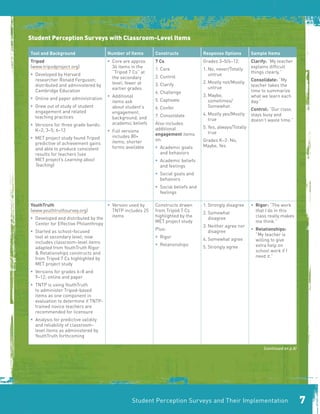
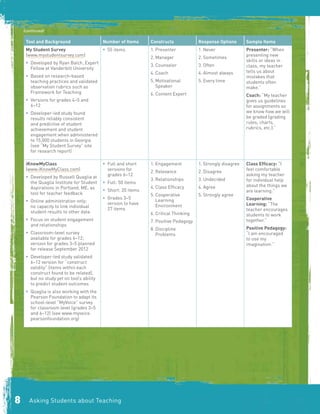
exist. As shown in the table on pages
7 and 8—highlighting four currently
available off-the-shelf surveys that
ask about specific classrooms—
instruments share many similar
structures and constructs. Differences
in emphasis often relate to a survey’s
particular origins. Many specifics on
the number of items and their wording
are moving targets as developers adjust
their instruments based on ongoing
research and system needs.
An important aspect of any measure of teaching is its ability to distinguish among classrooms. Measures that fail this test provide
little information for feedback. The above chart shows the percentage of students agreeing with one statement from each of the
Tripod student perception survey’s constructs among classrooms ranked at the 75th and 25th percentiles in terms of how favorably
their students responded. Clearly, the students were able to discern significant differences among classrooms in terms of the
qualities measured by the survey.
CARE:
My teacher seems to know if
something is bothering me.
CONTROL:
My classmates behave the way
the teacher wants them to.
CLARIFY:
My teacher knows when the
class understands.
20
0 40 60 80 100
CHALLENGE:
In this class, we learn to
correct our mistakes.
CAPTIVATE:
I like the way we learn
in this class.
CONFER:
My teacher wants us to share
our thoughts.
CONSOLIDATE:
The comments I get help me
know how to improve.
Among classrooms at the 25th percentile
in terms of favorable student responses
Among classrooms at the 75th percentile
in terms of favorable student responses
Asking Students about Teaching
6
Student Perception Surveys with classroom-level Items
Tool and Background number of items constructs response options Sample items
Tripod
(www.tripodproject.org)
 Developed by Harvard
researcher Ronald Ferguson;
distributed and administered by
Cambridge Education
 Online and paper administration
 Grew out of study of student
engagement and related
teaching practices
 Versions for three grade bands:
K–2; 3–5; 6–12
 MET project study found Tripod
predictive of achievement gains
and able to produce consistent
results for teachers (see
MET project’s Learning about
Teaching)
 Core are approx.
36 items in the
“Tripod 7 Cs” at
the secondary
level; fewer at
earlier grades
 Additional
items ask
about student’s
engagement,
background, and
academic beliefs
 Full versions
includes 80+
items; shorter
forms available
7 cs
1. Care
2. Control
3. Clarify
4. Challenge
5. Captivate
6. Confer
7. Consolidate
Also includes
additional
engagement items
on:
 Academic goals
and behaviors
 Academic beliefs
and feelings
 Social goals and
behaviors
 Social beliefs and
feelings
Grades 3–5/6–12:
1. No, never/Totally
untrue
2. Mostly not/Mostly
untrue
3. Maybe,
sometimes/
Somewhat
4. Mostly yes/Mostly
true
5. Yes, always/Totally
true
Grades K–2: No,
Maybe, Yes
clarify: “My teacher
explains difficult
things clearly.”
consolidate: “My
teacher takes the
time to summarize
what we learn each
day.”
control: “Our class
stays busy and
doesn’t waste time.”
youthTruth
(www.youthtruthsurvey.org)
 Developed and distributed by the
Center for Effective Philanthropy
 Started as school-focused
tool at secondary level; now
includes classroom-level items
adapted from YouthTruth Rigor
& Relationships constructs and
from Tripod 7 Cs highlighted by
MET project study
 Versions for grades 6–8 and
9–12; online and paper
 TNTP is using YouthTruth
to administer Tripod-based
items as one component in
evaluation to determine if TNTP-
trained novice teachers are
recommended for licensure
 Analysis for predictive validity
and reliability of classroom-
level items as administered by
YouthTruth forthcoming
 Version used by
TNTP includes 25
items
Constructs drawn
from Tripod 7 Cs
highlighted by the
MET project study
Plus:
 Rigor
 Relationships
1. Strongly disagree
2. Somewhat
disagree
3. Neither agree nor
disagree
4. Somewhat agree
5. Strongly agree
 rigor: “The work
that I do in this
class really makes
me think.”
 relationships:
“My teacher is
willing to give
extra help on
school work if I
need it.”
(continued on p.8)
Student Perception Surveys and Their Implementation 7
Tool and Background number of items constructs response options Sample items
My Student Survey
(www.mystudentsurvey.com)
 Developed by Ryan Balch, Expert
Fellow at Vanderbilt University
 Based on research-based
teaching practices and validated
observation rubrics such as
Framework for Teaching
 Versions for grades 4–5 and
6–12
 Developer-led study found
results reliably consistent
and predictive of student
achievement and student
engagement when administered
to 15,000 students in Georgia
(see “My Student Survey” site
for research report)
 55 items 1. Presenter
2. Manager
3. Counselor
4. Coach
5. Motivational
Speaker
6. Content Expert
1. Never
2. Sometimes
3. Often
4. Almost always
5. Every time
Presenter: “When
presenting new
skills or ideas in
class, my teacher
tells us about
mistakes that
students often
make.”
coach: “My teacher
gives us guidelines
for assignments so
we know how we will
be graded (grading
rules, charts,
rubrics, etc.).”
iKnowMyclass
(www.iKnowMyClass.com)
 Developed by Russell Quaglia at
the Quaglia Institute for Student
Aspirations in Portland, ME, as
tool for teacher feedback
 Online administration only;
no capacity to link individual
student results to other data
 Focus on student engagement
and relationships
 Classroom-level survey
available for grades 6–12;
version for grades 3–5 planned
for release September 2012
 Developer-led study validated
6–12 version for “construct
validity” (items within each
construct found to be related),
but no study yet on tool’s ability
to predict student outcomes
 Quaglia is also working with the
Pearson Foundation to adapt its
school-level “MyVoice” survey
for classroom level (grades 3–5
and 6–12) (see www.myvoice.
pearsonfoundation.org)
 Full and short
versions for
grades 6–12
 Full: 50 items
 Short: 20 items
 Grades 3–5
version to have
27 items
1. Engagement
2. Relevance
3. Relationships
4. Class Efficacy
5. Cooperative
Learning
Environment
6. Critical Thinking
7. Positive Pedagogy
8. Discipline
Problems
1. Strongly disagree
2. Disagree
3. Undecided
4. Agree
5. Strongly agree
class Efficacy: “I
feel comfortable
asking my teacher
for individual help
about the things we
are learning.”
cooperative
learning: “The
teacher encourages
students to work
together.”
Positive Pedagogy:
“I am encouraged
to use my
imagination.”
(continued)
(continued)
Asking Students about Teaching
8
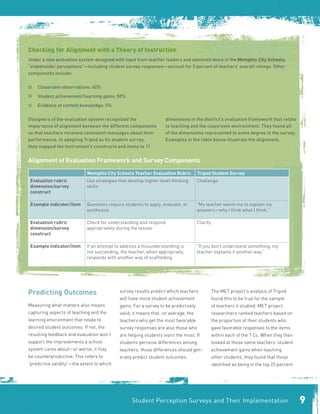
checking for Alignment with a Theory of Instruction
Under a new evaluation system designed with input from teacher leaders and administrators in the Memphis city Schools,
“stakeholder perceptions”—including student survey responses—account for 5 percent of teachers’ overall ratings. Other
components include:
■ Classroom observations: 40%
■ Student achievement/learning gains: 50%
■ Evidence of content knowledge: 5%
Designers of the evaluation system recognized the
importance of alignment between the different components
so that teachers received consistent messages about their
performance. In adopting Tripod as its student survey,
they mapped the instrument’s constructs and items to 11
dimensions in the district’s evaluation framework that relate
to teaching and the classroom environment. They found all
of the dimensions represented to some degree in the survey.
Examples in the table below illustrate the alignment.
alignment of Evaluation framework and Survey components
Memphis city Schools Teacher Evaluation rubric Tripod Student Survey
Evaluation rubric
dimension/survey
construct
Use strategies that develop higher-level thinking
skills
Challenge
Example indicator/item Questions require students to apply, evaluate, or
synthesize
“My teacher wants me to explain my
answers—why I think what I think.”
Evaluation rubric
dimension/survey
construct
Check for understanding and respond
appropriately during the lesson
Clarify
Example indicator/item If an attempt to address a misunderstanding is
not succeeding, the teacher, when appropriate,
responds with another way of scaffolding
“If you don’t understand something, my
teacher explains it another way.”
Predicting outcomes
Measuring what matters also means
capturing aspects of teaching and the
learning environment that relate to
desired student outcomes. If not, the
resulting feedback and evaluation won’t
support the improvements a school
system cares about—or worse, it may
be counterproductive. This refers to
“predictive validity”—the extent to which
survey results predict which teachers
will have more student achievement
gains. For a survey to be predictively
valid, it means that, on average, the
teachers who get the most favorable
survey responses are also those who
are helping students learn the most. If
students perceive differences among
teachers, those differences should gen-
erally predict student outcomes.
The MET project’s analysis of Tripod
found this to be true for the sample
of teachers it studied. MET project
researchers ranked teachers based on
the proportion of their students who
gave favorable responses to the items
within each of the 7 Cs. When they then
looked at those same teachers’ student
achievement gains when teaching
other students, they found that those
identified as being in the top 25 percent
Student Perception Surveys and Their Implementation 9
based on Tripod results had students
who were learning the equivalent of
about 4.6 months of schooling more
in math—over the course of the year
and measured using state tests—than
the students of teachers whose survey
results were in the bottom 25 percent.
Tripod’s predictive power accounts
for less than half as many months
difference when it came to gains based
on state English language arts (ELA)
tests (a common finding among many
measures), but a clear relationship was
found nonetheless.
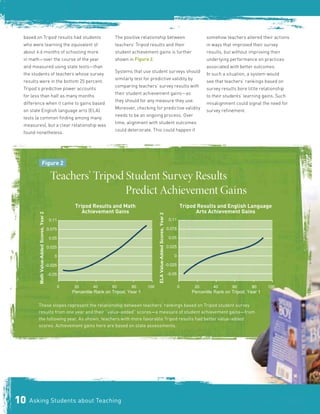
The positive relationship between
teachers’ Tripod results and their
student achievement gains is further
shown in figure 2.
Systems that use student surveys should
similarly test for predictive validity by
comparing teachers’ survey results with
their student achievement gains—as
they should for any measure they use.
Moreover, checking for predictive validity
needs to be an ongoing process. Over
time, alignment with student outcomes
could deteriorate. This could happen if
somehow teachers altered their actions
in ways that improved their survey
results, but without improving their
underlying performance on practices
associated with better outcomes.
In such a situation, a system would
see that teachers’ rankings based on
survey results bore little relationship
to their students’ learning gains. Such
misalignment could signal the need for
survey refinement.
figure 2
Teachers’ Tripod Student Survey Results
Predict Achievement Gains
Percentile Rank on Tripod, Year 1 Percentile Rank on Tripod, Year 1
0 20 40 60 80 100
0 20 40 60 80 100
0 20 40 60 80 100
Math
Value-Added
Scores,
Year
2
ELA
Value-Added
Scores,
Year
2
0.11
0.075
0.05
0.025
0
-0.025
-0.05
0.11
0.075
0.05
0.025
0
-0.025
-0.05
Tripod Results and Math
Achievement Gains
Tripod Results and English Language
Arts Achievement Gains
These slopes represent the relationship between teachers’ rankings based on Tripod student survey
results from one year and their “value-added” scores—a measure of student achievement gains—from
the following year. As shown, teachers with more favorable Tripod results had better value-added
scores. Achievement gains here are based on state assessments.
Percentile Rank on Tripod, Year 1
80
80
80 100
100
100
These slopes represent the relationship between teachers’ rankings based on Tripod student survey
results from one year and their “value-added” scores—a measure of student achievement gains—from
Asking Students about Teaching
10
Ensure Accuracy
for results to be useful, they must be correct. It’s of no benefit if survey
responses reflect misunderstanding of what’s being asked, or simply what
students think others want them to say. Worse yet are results attributed to
the wrong teacher. Honest feedback requires carefully worded items and
assurances of confidentiality. Standardized procedures for how surveys are
distributed, proctored, and collected are a must. Accurate attribution
requires verification.
item Wording
Survey items need to be clear to the
students who respond to them. A well-
crafted item asks about one thing. One
wouldn’t pose the statement: “This class
stays busy all the time and the students
act the way the teacher wants.” Good
items also avoid double-negatives,
and their language is age appropriate.
Wording for similar items may vary
depending on the grade level. Note the
slight difference in explicitness of the
following two items from Tripod:
■ Grades 3–5: “When my teacher
marks my work, he/she writes on my
papers to help me understand.”
■ Grades 6–12: “The comments that I
get on my work in this class help me
understand how to improve.”
Student perception survey develop-
ment involves discussion with students
to determine if they’re interpreting the
items as intended. Through systematic
“cognitive interviews,” survey develop-
ers probe both students’ understand-
ing of each item and whether the
item addresses its desired objective.
Items that aren’t clear are reworded
and tested again. During survey
administration, students are gener-
ally told not to answer items they don’t
understand as a further check against
meaningless results and to indicate
which items may need clarification.
young Students and
Special Populations
Well-designed surveys account for the
fact that not all students read at the
same grade level. Even still, school
systems often involve special educa-
tion teachers and teachers of English
language learners (ELL) in reviewing an
instrument’s survey items before they
are used. For some ELL students, sur-
veys that are translated into their native
language may need to be available.
Special care is also required when sur-
veying the youngest students—some of
whom are not yet able to read. Although
not part of the MET project analysis,
Tripod has a K–2 version of its survey,
which differs from the grades 3–5 and
6–12 forms in three respects:
■ It has fewer items overall;
■ It has three response options—yes/
no/maybe—instead of five; and
Student Perception Surveys and Their Implementation 11
■ Items are worded more simply, for
example:
 K–2: “My teacher is very good at
explaining things.”
 Grades 3–5: “If you don’t under-
stand something, my teacher
explains it another way.”
Survey administration in grades K–2
also requires accommodations. Given
the need to ensure confidentiality while
also reading items to younger students,
someone other than a class’ teacher
must proctor. Often, young students are
administered surveys in small groups—
not entire classes—to allow adequate
support from proctors. Even with such
accommodations, results should be
monitored for indications that items are
being understood. A lack of consistency
in responses to items within the same
construct, for example, might signal the
need for different wording.
Ensuring confidentiality
Confidentiality for students is a non-
negotiable if surveys are part of formal
feedback and evaluation. If students
believe their responses will negatively
influence how their teachers treat them,
feel about them, or grade them, then
they’ll respond so as to avoid that hap-
pening. More fundamentally, students
shouldn’t be made to feel uncomfort-
able. They should be told, in words and
actions, that their teachers will not know
what individual students say about their
classrooms.
Consistently applied protocols are
essential for providing students such
assurance. Although in many situations
teachers will distribute student percep-
tion surveys in their own classrooms, no
teacher should receive back a completed
survey form that would allow the teacher
to identify who filled it out. In the MET
project, following procedures generally
employed in administering Tripod, paper
surveys were distributed to students
with their names on peel-off labels that
they removed before completing them.
All that remained on the form when
they finished were unique bar codes to
let researchers link their responses to
other data collected for the study but
which no school personnel could use
to identify respondents. Students also
placed their completed forms in opaque
envelopes and sealed them.
Confidentiality also requires setting
a minimum number of respondents
for providing teachers with results. If
results for a class are based on surveys
from only three or four students, then
a teacher could conjecture that a highly
favorable or unfavorable result for an
item reflects how all of those students
responded individually. (Although
less likely, this still could happen if all
students in a class give the same highly
unfavorable or favorable response to a
teacher.)
accuracy of attribution
Systems must be certain about which
teacher and class each completed
survey belongs to. Part of ensuring this
requires making sure students have the
right teacher and class in mind when
responding, through verbal and writ-
ten instructions. For classes taught by
more than one teacher, systems may
Procedures for confidentiality
denver Public Schools is piloting a student survey for use in a district-wide teacher evaluation system slated for full
implementation in the 2014–15 school year. As part of the pilot, paper surveys were administered in about 130 schools in fall
2011 and spring 2012. One goal of the pilot is to hone administration guidelines. Here are a few ways current guidelines address
confidentiality:
■ Scripts are provided to teachers on survey administration
that assure students: “I will never get to see your
individual student answers, only a class summary of the
responses.” Students are also told the surveys “will help
teachers and principals understand what they do well
and how they may be able to improve.”
■ Teachers assign a student the task of collecting all
completed surveys, sealing them in an envelope, and
taking them to the school’s survey coordinator.
■ Results from classes in which fewer than 10 students
respond are not reported back to teachers because low
response rates may suggest how individual students
responded. Teachers are told to strive for classroom
response rates of at least 80 percent. (Teachers with
fewer than five students in a class do not participate.)
Asking Students about Teaching
12
need to decide who is the “teacher of
record”—the one primarily responsible
for instruction—or administer separate
surveys for each teacher in a classroom.
A significant challenge is posed by link-
ing each student’s individual responses
to a particular teacher and class.
Doing so while ensuring confidential-
ity generally requires that each survey
form be assigned a unique student
identifier before a student completes it.
While systems can administer surveys
without this feature and still attribute
a classroom’s group of surveys to the
right teacher, they wouldn’t be able
to compare how the same students
respond in different classrooms or at
different points in time. Nor could they
connect survey results with other data
for the same students. Such connections
can help in assessing the effectiveness
of interventions and the reliability of the
survey itself. They also allow for more
data integrity checks.
Distributing surveys with individual
identifiers for each student means
generating lists of the students in each
class ahead of time, and then verify-
ing them. As simple as that may sound,
determining accurate class rosters for
every teacher in a district can be vexing.
Until recently, few stakes have been
attached to the accuracy of the student
and teacher assignments recorded in
the information systems from which
rosters would be generated. Class lists
from the start of the school year may
be out of date by the time a survey is
administered.
Rosters must be verified at the point in
time that surveys are administered, with
procedures in place to assign unique
identifiers to eligible students in a class
who aren’t listed. (Typically, systems
don’t survey students unless they’ve
been with a teacher for at least sev-
eral weeks to ensure familiarity.) Many
places implementing paper student sur-
veys employ procedures similar to those
used by the MET project in administering
Tripod, in which each teacher receives a
packet that includes:
■ A class roster to check and correct if
needed;
■ Survey forms with unique identifiers
for all students on the roster; and
■ A set of extra forms that each have
unique identifiers to assign eligible
students in the class not listed in the
roster.
Similar verification procedures were
used for online administration in the
MET project, but with teachers distribut-
ing login codes with unique identifiers
instead of paper forms.
How the Pittsburgh Public Schools
Ensures Accuracy of Survey Attribution
Before survey
administration
■ After determining which
periods to survey in each
school, central office creates
lists showing what each
teacher teaches during those
periods and which students
are in those classes.
■ Principals check and correct
these lists before survey
forms are printed for each
class to be surveyed.
During survey
administration
After survey
administration
■ Teachers review and
correct roster lists they
receive with the survey
forms for their classes.
■ Teachers are given
extra survey forms
with unique identifiers
to assign to students
missing from rosters
provided.
■ Completed surveys go to
Cambridge Education—
distributors of Tripod—
which manages survey
procedures and works
with district administrators
to quality assure data
before they are released to
teachers.
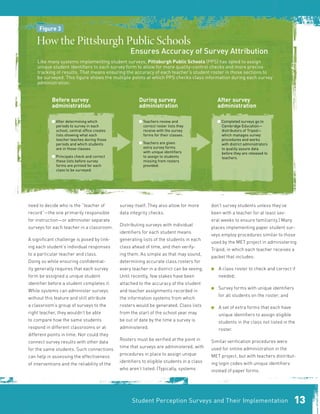
Like many systems implementing student surveys, Pittsburgh Public Schools (PPS) has opted to assign
unique student identifiers to each survey form to allow for more quality-control checks and more precise
tracking of results. That means ensuring the accuracy of each teacher’s student roster in those sections to
be surveyed. This figure shows the multiple points at which PPS checks class information during each survey
administration.
Student Perception Surveys and Their Implementation 13
figure 3
Ensure Reliablity
consistency builds confidence. Teachers want to know that any assessment of
their practice reflects what they typically do in their classrooms, and not some
quirk derived from who does the assessing, when the assessment is done, or
which students are in the class at the time. They want results to be reliable.
capturing a consistent
View
In many ways, the very nature of student
perception surveys mitigates against
inconsistency. The surveys don’t ask
about particular points in time, but
about how students perceive what typi-
cally happens in a classroom. Moreover,
a teacher’s results average together
responses from multiple students.
While one student might have a par-
ticular grudge, it’s unlikely to be shared
by most students in a class—or if it is,
that may signal a real issue that merits
addressing.
It should perhaps not be surprising then,
that the MET project found Tripod to be
more reliable than student achievement
gains or classroom observations—the
instruments studied to date. When
researchers compared multiple results
on the same measure for the same
teachers, the student surveys were
more likely than achievement gain mea-
sures or observations to demonstrate
consistency. While a single observa-
tion may provide accurate and useful
information on the instruction observed
at a particular time on a particular day,
it represents a small slice of what goes
on in a classroom over the course of the
year. In the context of the MET project’s
research, results from a single survey
administration proved to be significantly
more reliable than a single observation.
numbers of items
Although student surveys can produce
relatively consistent results, reliability
isn’t a given. Along with the quality of the
items used, reliability is in part a func-
tion of how many items are included in a
survey. Both reliability and feedback can
be enhanced by including multiple items
for each of a survey’s constructs.
Online or Paper?
Online and paper versions of the same survey have been
found to be similarly reliable. Instead, the question of which
form to use—or whether to allow for both—is largely a matter
of capacities. Online surveys allow for more automated
processing and are less prone to human error, but they
require an adequate number of computers within each school
and sufficient bandwidth to handle large numbers of students
going online at the same time.
Asking Students about Teaching
14
Adapting and Streamlining a Survey Instrument
After initially administering a version of the Tripod survey
similar to that used in the MET project (with some 75
items), denver Public Schools (DPS) officials heard from
some teachers concerned that the survey took too long
for students to complete. For this and other reasons, the
system engaged teachers in deciding how to streamline
a tool while still asking multiple items within each Tripod
construct. The result for 2011–12: a survey that includes
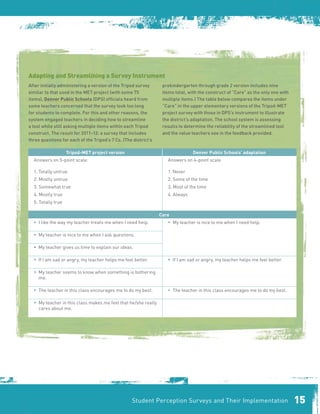
three questions for each of the Tripod’s 7 Cs. (The district’s
prekindergarten through grade 2 version includes nine
items total, with the construct of “Care” as the only one with
multiple items.) The table below compares the items under
“Care” in the upper elementary versions of the Tripod-MET
project survey with those in DPS’s instrument to illustrate
the district’s adaptation. The school system is assessing
results to determine the reliability of the streamlined tool
and the value teachers see in the feedback provided.
Tripod-MET project version denver Public Schools’ adaptation
Answers on 5-point scale:
1. Totally untrue
2. Mostly untrue
3. Somewhat true
4. Mostly true
5. Totally true
Answers on 4-point scale
1. Never
2. Some of the time
3. Most of the time
4. Always
care
 I like the way my teacher treats me when I need help.  My teacher is nice to me when I need help.
 My teacher is nice to me when I ask questions.
 My teacher gives us time to explain our ideas.
 If I am sad or angry, my teacher helps me feel better.  If I am sad or angry, my teacher helps me feel better.
 My teacher seems to know when something is bothering
me.
 The teacher in this class encourages me to do my best.  The teacher in this class encourages me to do my best.
 My teacher in this class makes me feel that he/she really
cares about me.
Student Perception Surveys and Their Implementation 15
The Tripod surveys administered in
the MET project included more than 75
items, but analysis for reliability and
predictive validity was based on 36 items
that related to the 7 Cs (see the appendix
for a complete list of the 7 C items in the
MET project’s analysis). Other questions
asked about students’ backgrounds,
effort, and sense of self-efficacy. To
understand how different-but-related
items can add informational value, con-
sider these two under the construct of
“Clarify” in the Tripod survey:
■ “If you don’t understand something,
my teacher explains it another way.”
■ “My teacher has several good ways
to explain each topic that we cover in
class.”
Both relate to a similar quality, but in
different ways. A favorable response on
both presumably is a stronger indica-
tor of Clarify than a favorable response
on just one. Moreover, one can imagine
a teacher who often has several good
ways to explain topics but who doesn’t
recognize when students misunder-
stand. Different results for somewhat
different-but-related items can better
pinpoint areas for improvement.
At the same time, too many items might
result in a survey taking too much
instructional time to complete. Such
concerns lead many systems to shorten
their surveys after initial piloting. In
doing so, the balance they strive for is
to maintain reliability and the promise
of useful feedback while producing a
streamlined tool. Forthcoming analyses
by MET project partners will explore in
greater detail the relationship between
reliability and number of items.
Sampling
Even a comparatively reliable measure
could be made more so by using
bigger samples. When the MET project
analyzed a subset of participating
classrooms in which Tripod surveys
were given in December and March,
researchers found significant stability
across the two months for the same
teacher. However, averaging together
results from different groups of
students for the same teacher would
reduce the effects of any variance due
to the make-up of a particular class.
MET project research partners now are
analyzing results to determine the pay-
off in increased reliability from doing so.
But in practice, many school systems
are including two survey administrations
per year in their pilots as they weigh the
costs of the approach against the benefit
of being able to gauge improvement
during the year and of distributing the
stakes attached to survey results across
multiple points in time. Such systems
often survey different sections during
each administration for teachers who
teach multiple sections.
Asking Students about Teaching
16
Sampling for Teachers who Teach multiple Sections
Deciding which students to survey for a teacher who teaches a self-contained classroom is straightforward: survey the entire
class. But a more considered approach is needed for teachers who teach multiple sections. Systems have experimented with
varied approaches:
■ Survey all students on all of their teachers. One option
that requires minimal planning to implement is to survey
all students on all of their teachers. But doing so would
have individual students completing surveys on several
teachers, which could prompt concerns of overburdening
students. aspire Public Schools has recently tried
this approach but only after reducing the number of
questions in its survey.
■ Survey one class period per teacher with each
administration. While reducing the potential for
overburdening students, this approach still results in
some students completing surveys on more than one
teacher because typically in a school there is no one
class period during which all teachers teach. Whenever
surveys are given during more than one period, chances
are some students will complete surveys on more
than one teacher. Pittsburgh Public Schools, which
has surveyed twice a year, determines guidelines for
teachers at each school on which period to survey based
on analysis of class rosters meant to minimize the
burden on students. The district surveys during different
periods in the fall and spring to capture the views of
different students.
■ Survey a random sample across sections. After trying
various strategies, Green dot Public Schools settled
on one designed to minimize the burden on students
while addressing concerns teachers expressed that one
section may not be adequately representative. Twice
a year, Green Dot uses software to randomly draw the
names of at least 25 students from all of those taught by
each teacher. It does so in such a way that no student in
a school is listed for more than two teachers. Charter
management organization officials use those lists to
create surveys that are then administered to students in
“advisory classes,” a kind of homeroom period focused
on study skills and youth development. So different
students in the same advisory complete surveys for
different teachers—but across all advisories, each
teacher has at least 25 randomly selected students
who are surveyed. Green Dot stresses that the strategy
requires a highly accurate and up-to-date student
information system.
Student Perception Surveys and Their Implementation 17
accurate measurement is essential, but it is insufficient to improve effectiveness.
Imagine the athlete whose performance is closely monitored but who never receives
feedback or coaching. Likewise, without providing support for improvement, school
systems will not realize a return on their investments in student surveys. That
means helping teachers understand what to make of their results and the kinds of
changes they can make in their in practice to improve them.
The MET project has not completed
analysis on the effectiveness of feedback
and coaching, instead focusing initial
research on what it takes to produce
the kind of valid and reliable informa-
tion on which such support depends. But
examples of how survey results can be
used in feedback and support may be
found among those school systems at
the forefront of implementation.
Making results
Meaningful
Meaning comes from specificity, points
of reference, and relevance. It’s of little
help to a teacher to be told simply “you
scored a 2.7 out of 4.0 on ‘Care.’ ” To
understand what that means requires
knowing each question within the con-
struct, one’s own results for each item,
and how those results compare with
those of other teachers. It also requires
knowledge of how “Care,” as defined by
the instrument, relates to the overall
expectations for teachers within the
school system.
For these reasons, how and when
results are presented to teachers is
critically important if student surveys
are to support improvement. Data
displays should be complete and easy to
interpret, allowing teachers to see the
strengths and weaknesses within their
classrooms and to see how the evidence
supports those judgments. Ideally, they
should integrate results from multiple
measures, calling out the connections
among results from surveys and class-
room observations, student achievement
gains, and other evaluation components.
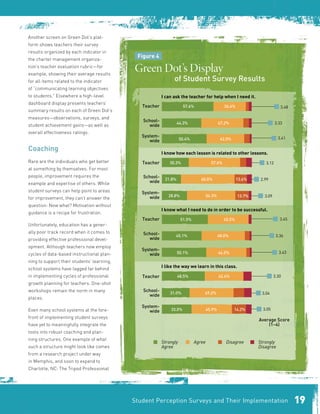
The online teacher-evaluation informa-
tion system developed by Green dot
Public Schools illustrates how survey
results can be presented meaning-
fully. As shown in the excerpt in figure
4, teachers who access their results via
the platform can compare their results
on each item to school-wide averages
and to average results across all Green
Dot schools. Overall averages are
provided, as well as the distribution of
responses for each item—showing the
extent to which students in a class feel
similarly.
Support
Improvement
Asking Students about Teaching
18
Another screen on Green Dot’s plat-
form shows teachers their survey
results organized by each indicator in
the charter management organiza-
tion’s teacher evaluation rubric—for
example, showing their average results
for all items related to the indicator
of “communicating learning objectives
to students.” Elsewhere a high-level
dashboard display presents teachers’
summary results on each of Green Dot’s
measures—observations, surveys, and
student achievement gains—as well as
overall effectiveness ratings.
coaching
Rare are the individuals who get better
at something by themselves. For most
people, improvement requires the
example and expertise of others. While
student surveys can help point to areas
for improvement, they can’t answer the
question: Now what? Motivation without
guidance is a recipe for frustration.
Unfortunately, education has a gener-
ally poor track record when it comes to
providing effective professional devel-
opment. Although teachers now employ
cycles of data-based instructional plan-
ning to support their students’ learning,
school systems have lagged far behind
in implementing cycles of professional
growth planning for teachers. One-shot
workshops remain the norm in many
places.
Even many school systems at the fore-
front of implementing student surveys
have yet to meaningfully integrate the
tools into robust coaching and plan-
ning structures. One example of what
such a structure might look like comes
from a research project under way
in Memphis, and soon to expand to
Charlotte, NC: The Tripod Professional
figure 4
Green Dot’s Display
of Student Survey Results
3.48
3.33
3.41
3.12
2.99
3.09
3.45
3.36
3.43
3.30
3.04
3.05
I can ask the teacher for help when I need it.
I like the way we learn in this class.
I know what I need to do in order to be successful.
I know how each lesson is related to other lessons.
Strongly
Disagree
Disagree
Agree
Strongly
Agree
Teacher
School-
wide
System-
wide
Teacher
School-
wide
System-
wide
Teacher
School-
wide
System-
wide
Teacher
School-
wide
System-
wide
Average Score
(1–4)
57.6% 36.4%
44.3% 47.2%
50.4% 42.0%
30.3% 57.6%
21.8% 60.0%
28.8% 54.3%
51.5% 45.5%
45.1% 48.0%
50.1% 44.5%
48.5% 42.4%
31.0% 49.2%
33.0% 45.9% 14.2%
13.6%
13.7%
Student Perception Surveys and Their Implementation 19
Development (PD) research project,
which includes several MET project
partners: Cambridge Education (dis-
tributors of the Tripod survey), Memphis
city Schools and the charlotte-
Mecklenburg Schools, and researchers
from the University of Virginia, Harvard,
and the University of Chicago. Funding
comes from the Bill & Melinda Gates
Foundation.
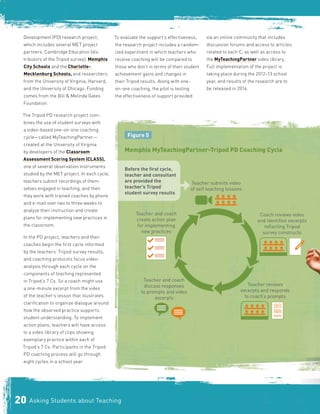
The Tripod PD research project com-
bines the use of student surveys with
a video-based one-on-one coaching
cycle—called MyTeachingPartner—
created at the University of Virginia
by developers of the classroom
assessment Scoring System (claSS),
one of several observation instruments
studied by the MET project. In each cycle,
teachers submit recordings of them-
selves engaged in teaching, and then
they work with trained coaches by phone
and e-mail over two to three weeks to
analyze their instruction and create
plans for implementing new practices in
the classroom.
In the PD project, teachers and their
coaches begin the first cycle informed
by the teachers’ Tripod survey results,
and coaching protocols focus video-
analysis through each cycle on the
components of teaching represented
in Tripod’s 7 Cs. So a coach might use
a one-minute excerpt from the video
of the teacher’s lesson that illustrates
clarification to organize dialogue around
how the observed practice supports
student understanding. To implement
action plans, teachers will have access
to a video library of clips showing
exemplary practice within each of
Tripod’s 7 Cs. Participants in the Tripod
PD coaching process will go through
eight cycles in a school year.
To evaluate the support’s effectiveness,
the research project includes a random-
ized experiment in which teachers who
receive coaching will be compared to
those who don’t in terms of their student
achievement gains and changes in
their Tripod results. Along with one-
on-one coaching, the pilot is testing
the effectiveness of support provided
via an online community that includes
discussion forums and access to articles
related to each C, as well as access to
the MyTeachingPartner video library.
Full implementation of the project is
taking place during the 2012–13 school
year, and results of the research are to
be released in 2014.
Teacher submits video
of self teaching lessons
Coach reviews video
and identifies excerpts
reflecting Tripod
survey constructs
Teacher reviews
excerpts and responds
to coach’s prompts
Teacher and coach
discuss responses
to prompts and video
excerpts
Teacher and coach
create action plan
for implementing
new practices
memphis myTeachingPartner-Tripod Pd coaching cycle
Before the first cycle,
teacher and consultant
are provided the
teacher’s Tripod
student survey results
figure 5
and identifies excerpts
survey constructs
Asking Students about Teaching
20
no policy can succeed without the trust and understanding of those who
implement it. Although often ill-defined, collaboration is key to effective
implementation of new practices that have consequences for students
and teachers. Every system referenced in this brief has made stakeholder
engagement central to its rollout of student surveys—involving teachers in the
review of survey items, administration procedures, and plans for using results in
feedback and evaluation.
Engage Stakeholders
Familiarity can go a long way toward
building trust. Hearing the term
“student survey,” some teachers will
imagine popularity contests, or think
students will be expected to know what
makes for good instruction. Often the
best way to help teachers understand
what student perception surveys are,
and what they are not, is to share
the items, to point out what makes
them well-designed, and to show
their alignment with teachers’ own
views of quality instruction. Teachers
also appreciate hearing the research
that supports student surveys and
the quality-control and data checks
employed in their administration.
But familiarity goes beyond the tool
itself. It includes familiarity with the
survey administration process and with
one’s own results. This is part of why
systems typically pilot survey adminis-
tration at scale before full implementa-
tion. Not only does it let them work out
any kinks in administration—and signal
a commitment to getting things right—
but it also ensures a safe environment
in which teachers can experience the
process for the first time.
Another useful engagement strategy
is dialogue. Systems at the leading
edge of survey implementation have
opened multiple lines of two-way com-
munication focused on their tools and
procedures. They’ve held focus groups,
polled teachers on their experiences
taking part in student survey pilots, and
provided clear points of contact on all
survey-related issues. This increases
the likelihood that people’s questions
will be answered, communicates that
teachers’ opinions matter, and can
reveal problems that need fixing.
Finally, effective engagement means
communicating a commitment to learn.
The use of student perception surveys
in feedback and evaluation is a practice
in its infancy. Although much has been
learned in recent years about the prom-
ise of surveys as an important source of
information, many approaches toward
their implementation are only now being
tested in the field for the first time.
Lessons learned from those experi-
ences, combined with further research,
will suggest clearer guidance than this
document provides. Working together
will produce better practice.
Student Perception Surveys and Their Implementation 21
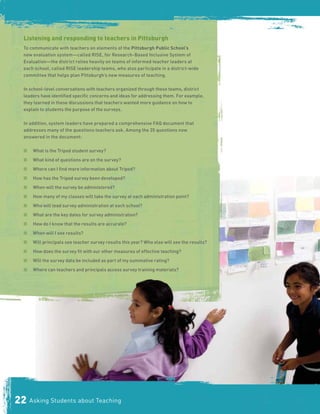
listening and responding to teachers in Pittsburgh
To communicate with teachers on elements of the Pittsburgh Public School’s
new evaluation system—called RISE, for Research-Based Inclusive System of
Evaluation—the district relies heavily on teams of informed teacher leaders at
each school, called RISE leadership teams, who also participate in a district-wide
committee that helps plan Pittsburgh’s new measures of teaching.
In school-level conversations with teachers organized through these teams, district
leaders have identified specific concerns and ideas for addressing them. For example,
they learned in these discussions that teachers wanted more guidance on how to
explain to students the purpose of the surveys.
In addition, system leaders have prepared a comprehensive FAQ document that
addresses many of the questions teachers ask. Among the 35 questions now
answered in the document:
■ What is the Tripod student survey?
■ What kind of questions are on the survey?
■ Where can I find more information about Tripod?
■ How has the Tripod survey been developed?
■ When will the survey be administered?
■ How many of my classes will take the survey at each administration point?
■ Who will lead survey administration at each school?
■ What are the key dates for survey administration?
■ How do I know that the results are accurate?
■ When will I see results?
■ Will principals see teacher survey results this year? Who else will see the results?
■ How does the survey fit with our other measures of effective teaching?
■ Will the survey data be included as part of my summative rating?
■ Where can teachers and principals access survey training materials?
Asking Students about Teaching
22
(continued on p.24)
* Reverse coded item. Agreement represents an unfavorable response.
Appendix
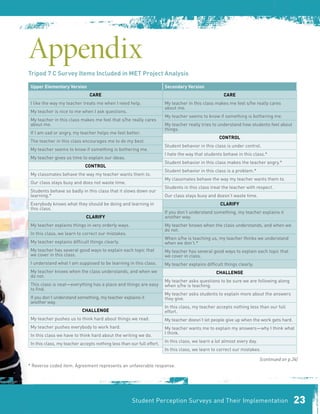
Secondary Version
carE
My teacher in this class makes me feel s/he really cares
about me.
My teacher seems to know if something is bothering me.
My teacher really tries to understand how students feel about
things.
conTrol
Student behavior in this class is under control.
I hate the way that students behave in this class.*
Student behavior in this class makes the teacher angry.*
Student behavior in this class is a problem.*
My classmates behave the way my teacher wants them to.
Students in this class treat the teacher with respect.
Our class stays busy and doesn’t waste time.
clarify
If you don’t understand something, my teacher explains it
another way.
My teacher knows when the class understands, and when we
do not.
When s/he is teaching us, my teacher thinks we understand
when we don’t.*
My teacher has several good ways to explain each topic that
we cover in class.
My teacher explains difficult things clearly.
cHallEnGE
My teacher asks questions to be sure we are following along
when s/he is teaching.
My teacher asks students to explain more about the answers
they give.
In this class, my teacher accepts nothing less than our full
effort.
My teacher doesn’t let people give up when the work gets hard.
My teacher wants me to explain my answers—why I think what
I think.
In this class, we learn a lot almost every day.
In this class, we learn to correct our mistakes.
* Reverse coded item. Agreement represents an unfavorable response.
Tripod 7 c Survey items included in MET Project analysis
Upper Elementary Version
carE
I like the way my teacher treats me when I need help.
My teacher is nice to me when I ask questions.
My teacher in this class makes me feel that s/he really cares
about me.
If I am sad or angry, my teacher helps me feel better.
The teacher in this class encourages me to do my best.
My teacher seems to know if something is bothering me.
My teacher gives us time to explain our ideas.
conTrol
My classmates behave the way my teacher wants them to.
Our class stays busy and does not waste time.
Students behave so badly in this class that it slows down our
learning.*
Everybody knows what they should be doing and learning in
this class.
clarify
My teacher explains things in very orderly ways.
In this class, we learn to correct our mistakes.
My teacher explains difficult things clearly.
My teacher has several good ways to explain each topic that
we cover in this class.
I understand what I am supposed to be learning in this class.
My teacher knows when the class understands, and when we
do not.
This class is neat—everything has a place and things are easy
to find.
If you don’t understand something, my teacher explains it
another way.
cHallEnGE
My teacher pushes us to think hard about things we read.
My teacher pushes everybody to work hard.
In this class we have to think hard about the writing we do.
In this class, my teacher accepts nothing less than our full effort.
Student Perception Surveys and Their Implementation 23
(continued)
* Reverse coded item. Agreement represents an unfavorable response.
Upper Elementary Version
caPTiVaTE
School work is interesting.
We have interesting homework.
Homework helps me learn.
School work is not very enjoyable.* (Do you agree?)
confEr
When s/he is teaching us, my teacher asks us whether we
understand.
My teacher asks questions to be sure we are following along when
s/he is teaching.
My teacher checks to make sure we understand what s/he is
teaching us.
My teacher tells us what we are learning and why.
My teacher wants us to share our thoughts.
Students speak up and share their ideas about class work.
My teacher wants me to explain my answers—why I think what I
think.
conSolidaTE
My teacher takes the time to summarize what we learn each day.
When my teacher marks my work, s/he writes on my papers to
help me understand.
* Reverse coded item. Agreement represents an unfavorable response.
Asking Students about Teaching
24
Secondary Version
caPTiVaTE
This class does not keep my attention—I get bored.*
My teacher makes learning enjoyable.
My teacher makes lessons interesting.
I like the way we learn in this class.
confEr
My teacher wants us to share our thoughts.
Students get to decide how activities are done in this class.
My teacher gives us time to explain our ideas.
Students speak up and share their ideas about class work.
My teacher respects my ideas and suggestions.
conSolidaTE
My teacher takes the time to summarize what we learn each day.
My teacher checks to make sure we understand what s/he is
teaching us.
We get helpful comments to let us know what we did wrong on
assignments.
The comments that I get on my work in this class help me
understand how to improve.
©2012 Bill & Melinda Gates Foundation. All Rights Reserved.
Bill & Melinda Gates Foundation is a registered trademark
in the United States and other countries.
Bill & melinda gates Foundation
Guided by the belief that every life has equal
value, the Bill & Melinda Gates Foundation
works to help all people lead healthy,
productive lives. In developing countries, it
focuses on improving people’s health and
giving them the chance to lift themselves out
of hunger and extreme poverty. In the United
States, it seeks to ensure that all people—
especially those with the fewest resources—
have access to the opportunities they need to
succeed in school and life. Based in Seattle,
Washington, the foundation is led by CEO Jeff
Raikes and Co-chair William H. Gates Sr.,
under the direction of Bill and Melinda Gates
and Warren Buffett.
For more information on the U.S. Program,
which works primarily to improve high school
and postsecondary education, please visit
www.gatesfoundation.org.
Share:
www.gatesfoundation.org

Adaptive Questionnaire for Teaching Survey

  • 1.
    MET project Asking Students about Teaching Student PerceptionSurveys and Their Implementation Policy and PracTicEBriEf
  • 2.
    ABOUT THIS REPORT:Based on the experience of the Measures of Effective Teaching (MET) project, its partners, and other districts, states, and organizations, this report is meant for practitioners and policymakers who want to understand student surveys as potential tools for teacher evaluation and feedback, as well as the challenges and considerations posed by their implementation. MET project findings on the reliability and validity of student surveys are explored in depth in a separate research report, Learning about Teaching: Initial Findings from the Measures of Effective Teaching Project. AcknOwlEdgmEnTS: This document is based on the collective knowledge of many individuals who shared their experiences with student surveys for the benefit of their peers in other states, districts, and organizations. Thanks to: ■ Ryan Balch, Vanderbilt University ■ Kelly Burling and colleagues, Pearson ■ Carrie Douglass, Rogers Family Foundation ■ Ronald Ferguson, Harvard University and the Tripod Project for School Improvement ■ Tiffany Francis, Sam Franklin, and Mary Wolfson, Pittsburgh Public Schools ■ James Gallagher, Aspire Public Schools ■ Alejandro Ganimian, Harvard University ■ Hilary Gustave, Denver Public Schools ■ Monica Jordan and Rorie Harris, Memphis City Schools ■ Kevin Keelen, Green Dot Public Schools ■ Jennifer Preston, North Carolina Department of Public Instruction ■ Rob Ramsdell and Lorraine McAteer, Cambridge Education ■ Valerie Threlfall and colleagues, Center for Effective Philanthropy ■ Ila Deshmukh Towery and colleagues, TNTP ■ Deborah Young, Quaglia Institute for Student Aspirations ■ Sara Brown Wessling, Johnston High School in Johnston, Iowa ABOUT THE mET PROjEcT: The MET project is a research partnership of academics, teachers, and education organizations committed to investigating better ways to identify and develop effective teaching. Funding is provided by the Bill & Melinda Gates Foundation. For more information, visit www.metproject.org. September 2012
  • 3.
    Contents Why Ask Studentsabout Teaching 2 Measure What Matters 5 Ensure Accuracy 11 Ensure Reliability 14 Support Improvement 18 Engage Stakeholders 21 Appendix: Tripod 7 C Survey Items 23 Student Perception Surveys and Their Implementation 1
  • 4.
    2 Measures ofEffective Teaching (MET) Project no one has a bigger stake in teaching effectiveness than students. Nor are there any better experts on how teaching is experienced by its intended beneficiaries. But only recently have many policymakers and practitioners come to recognize that—when asked the right questions, in the right ways—students can be an important source of information on the quality of teaching and the learning environment in individual classrooms. Why Ask Students about Teaching? a new focus on the classroom As states and districts reinvent how teachers are evaluated and provided feedback, an increasing number are including student perception surveys as part of the mix. In contrast to the kinds of school climate surveys that have been commonly used in many systems, these student perception surveys ask students about specific teachers and specific classrooms. District-wide administra- tion of such surveys has begun in Denver, Memphis, and Pittsburgh. Statewide pilots have taken place in Georgia and North Carolina. And student surveys are now used for feedback and evalua- tion by the New Teacher Center, TNTP (formerly The New Teacher Project), and such charter management organizations as Aspire Public Schools and Green Dot Public Schools. There are many reasons for this new interest. Teaching is a complex inter- action among students, teachers, and content that no one tool can measure. The search for different-but-aligned instruments has led many to use student surveys as a complement to such other tools as classroom observations and measures of student achievement gains. Analysis by the Measures of Effective Teaching (MET) project finds that teachers’ student survey results are predictive of student achievement gains. Students know an effective classroom when they experience one. That survey results predict student learning also suggests surveys may provide outcome- related results in grades and subjects for which no standardized assessments of student learning are available. Further, the MET project finds student surveys produce more consistent results than classroom observations or achievement gain measures (see the MET project’s Gathering Feedback policy and practitioner brief). Even a high-quality observation system entails at most a handful of classroom visits, while student surveys aggregate the impressions of many individuals who’ve spent many hours with a teacher. 2 Measures of Effective Teaching (MET) Project Asking Students about Teaching 2
  • 5.
    Student surveys alsocan provide feed- back for improvement. Teachers want to know if their students feel sufficiently challenged, engaged, and comfortable asking them for help. Whereas annual measures of student achievement gains provide little information for improve- ment (and generally too late to do much about it), student surveys can be admin- istered early enough in the year to tell teachers where they need to focus so that their current students may ben- efit. As feedback tools, surveys can be powerful complements to other instru- ments. Surveys might suggest stu- dents’ misunderstandings aren’t being addressed; done well, observations can diagnose a teacher’s specific attempts at clarification. imperatives for implementation Benefits aside, student perception surveys present their own set of chal- lenges and considerations to states and districts. Some of these relate to the survey instrument itself. Not every survey will produce meaningful infor- mation on teaching. Not to be confused with popularity contests, well-designed student perception surveys capture important aspects of instruction and the classroom environment. Rather than pose, “Do you like your teacher?” typi- cal items might ask the extent to which students agree that, “I like the way the teacher treats me when I need help” and “If you don’t understand something, my teacher explains it another way.” Survey development is a sophisticated, data- driven process. But even a good instrument, imple- mented poorly, will produce bad information. Attending to issues such as student confidentiality, sampling, and accuracy of reporting takes on greater urgency as systems look toward includ- ing student surveys in their evaluation systems. The care with which sys- tems must administer surveys in such contexts is akin to that required in the formal administration of standardized student assessments. Smooth admin- istration and data integrity depend on piloting, clear protocols, trained coordi- nators, and quality-control checks. clarification. “If you don’t understand something, my nators, and quality-control checks. Student Perception Surveys and Their Implementation 3

  • 6.
    The following pagesdraw on the experi- ence of the MET project, its partners, and other leading school systems and organizations to clarify four overriding requirements of any system considering student surveys as part of formal feed- back and evaluation for teachers: 1. Measure what matters. Good surveys focus on what teachers do and on the learning environment they create. Surveys should reflect the theory of instruction that defines expectations for teachers in a system. Teachers with better survey results should also have better outcomes on measures of student learning. 2. Ensure accuracy. Student responses should be honest and based on clear understanding of the survey items. Student confidentiality is a must. Accuracy also means that the right responses are attributed to the right teacher. 3. Ensure reliability. Teachers should have confidence that surveys can produce reasonably consistent results and that those results reflect what they generally do in their classrooms—not the idiosyncrasies of a particular group of students. Reliability requires adequate sampling and an adequate number of items—but without overtaxing students. 4. Support improvement. Measurement for measurement’s sake is wasted effort. Teachers should receive their results in a timely manner, understand what they mean, and have access to professional development resources that will help them target improvement in areas of need. Student surveys are as much about evaluating systems of support for teachers as they are about diagnosing the needs within particular classrooms. Addressing these requirements amid finite resources and competing concerns necessarily involves trade-offs. Although the study of student surveys has intensified, research to date cannot offer hard and fast rules for striking the right balance on many issues. Highlighted throughout this report are some of the varied approaches that systems are taking. But implementation in the field is a work in progress. Individual districts and states are piloting before deciding how to deploy surveys formally and at scale. This document concludes by emphasizing the importance of stakeholder engagement for achieving positive results. It will be important to monitor how student surveys behave as they move into the realm of formal evaluation. The Tripod survey studied by the MET proj- ect, developed by Harvard researcher Ronald Ferguson, has been refined over 11 years of administration in many thou- sands of classrooms as a research and professional development tool. But only recently have systems begun to con- sider its use as part of formal teacher evaluation. Any instrument, when stakes are attached, could distort behavior in unwanted ways, or produce a less accu- rate picture of typical practice. One can imagine a teacher who, consciously or not, acts more lenient if student sur- veys are factored into evaluation, even though well-designed surveys stress a balance of challenge and support. This is further reason for multiple measures. It lets teachers stay focused on effective teaching and not on any one result. Benefits to Student Perception Surveys 1. Feedback. Results point to strengths and areas for improvement. 2. “Face validity.” Items reflect what teachers value. 3. “Predictive validity.” Results predict student outcomes. 4. Reliability. Results demonstrate relative consistency. 5. low cost. Expense of administration is minimal. Asking Students about Teaching 4
  • 7.
    Measure What Matters ifthe objective of measurement is to support improved student outcomes, then the measures used should relate to those outcomes—and to the means teachers use to help students achieve them. It’s a problem if a measure has no relationship to how teachers in a system are expected to teach, or to the outcomes for which they’re held accountable. Making sure those relationships exist should be part of adopting a student perception survey. indicators of Teaching To measure something broad like teaching requires breaking the activity down into discrete components that together rep- resent a theory about the instruction that supports student learning. Developers of student perception surveys often refer to these components as “constructs”—dif- ferent aspects of teaching and the learn- ing environment, the quality of which are indicated by responses to multiple related questions about students’ observations and feelings. Consider the Tripod survey employed in the MET project study. Tripod is designed to measure teaching, student engagement, school norms, and student demographics. To measure teaching, the survey groups items under seven con- structs, called the “7 Cs”: Care, Control, Challenge, Clarify, Confer, Captivate, and Consolidate. For each, the survey poses a series of statements, asking students’ level of agreement on a five- point scale. Here are two items under “Clarify”: ■ “My teacher has several good ways to explain each topic that we cover in class.” ■ “My teacher knows when the class understands and when we do not.” An important quality of any measure of teaching is its ability to differentiate among classrooms. If all teaching looks the same, the instrument is not provid- ing much information for feedback. As shown in figure 1, students who completed the Tripod survey as part of the MET project perceived clear differ- ences among teachers. The chart shows the percentage of students agreeing with one statement from each construct among classrooms at the 75th and 25th percentiles in terms of how favorably their students responded. Note the results for the item: “The comments I get help me know how to improve.” Among classrooms at the 75th percentile in terms of favorable responses to that statement, more than three-quarters of students agreed. Among classrooms at the 25th percentile, well under half of students agreed. These results don’t show how survey results relate to student achievement—that is addressed further on—but the contrasts suggest that students are capable of discerning Student Perception Surveys and Their Implementation 5
  • 8.
    figure 1 Students PerceiveClear Differences among Teachers Percentage of students agreeing with each statement significant differences among classrooms. Tripod is one of the oldest and most widely used off-the-shelf survey instruments, and the only one studied by the MET project. Some school systems have drawn from Tripod items included in the MET project as they adopt student surveys. But other tools exist. As shown in the table on pages 7 and 8—highlighting four currently available off-the-shelf surveys that ask about specific classrooms— instruments share many similar structures and constructs. Differences in emphasis often relate to a survey’s particular origins. Many specifics on the number of items and their wording are moving targets as developers adjust their instruments based on ongoing research and system needs. An important aspect of any measure of teaching is its ability to distinguish among classrooms. Measures that fail this test provide little information for feedback. The above chart shows the percentage of students agreeing with one statement from each of the Tripod student perception survey’s constructs among classrooms ranked at the 75th and 25th percentiles in terms of how favorably their students responded. Clearly, the students were able to discern significant differences among classrooms in terms of the qualities measured by the survey. CARE: My teacher seems to know if something is bothering me. CONTROL: My classmates behave the way the teacher wants them to. CLARIFY: My teacher knows when the class understands. 20 0 40 60 80 100 CHALLENGE: In this class, we learn to correct our mistakes. CAPTIVATE: I like the way we learn in this class. CONFER: My teacher wants us to share our thoughts. CONSOLIDATE: The comments I get help me know how to improve. Among classrooms at the 25th percentile in terms of favorable student responses Among classrooms at the 75th percentile in terms of favorable student responses Asking Students about Teaching 6
  • 9.
    Student Perception Surveyswith classroom-level Items Tool and Background number of items constructs response options Sample items Tripod (www.tripodproject.org)  Developed by Harvard researcher Ronald Ferguson; distributed and administered by Cambridge Education  Online and paper administration  Grew out of study of student engagement and related teaching practices  Versions for three grade bands: K–2; 3–5; 6–12  MET project study found Tripod predictive of achievement gains and able to produce consistent results for teachers (see MET project’s Learning about Teaching)  Core are approx. 36 items in the “Tripod 7 Cs” at the secondary level; fewer at earlier grades  Additional items ask about student’s engagement, background, and academic beliefs  Full versions includes 80+ items; shorter forms available 7 cs 1. Care 2. Control 3. Clarify 4. Challenge 5. Captivate 6. Confer 7. Consolidate Also includes additional engagement items on:  Academic goals and behaviors  Academic beliefs and feelings  Social goals and behaviors  Social beliefs and feelings Grades 3–5/6–12: 1. No, never/Totally untrue 2. Mostly not/Mostly untrue 3. Maybe, sometimes/ Somewhat 4. Mostly yes/Mostly true 5. Yes, always/Totally true Grades K–2: No, Maybe, Yes clarify: “My teacher explains difficult things clearly.” consolidate: “My teacher takes the time to summarize what we learn each day.” control: “Our class stays busy and doesn’t waste time.” youthTruth (www.youthtruthsurvey.org)  Developed and distributed by the Center for Effective Philanthropy  Started as school-focused tool at secondary level; now includes classroom-level items adapted from YouthTruth Rigor & Relationships constructs and from Tripod 7 Cs highlighted by MET project study  Versions for grades 6–8 and 9–12; online and paper  TNTP is using YouthTruth to administer Tripod-based items as one component in evaluation to determine if TNTP- trained novice teachers are recommended for licensure  Analysis for predictive validity and reliability of classroom- level items as administered by YouthTruth forthcoming  Version used by TNTP includes 25 items Constructs drawn from Tripod 7 Cs highlighted by the MET project study Plus:  Rigor  Relationships 1. Strongly disagree 2. Somewhat disagree 3. Neither agree nor disagree 4. Somewhat agree 5. Strongly agree  rigor: “The work that I do in this class really makes me think.”  relationships: “My teacher is willing to give extra help on school work if I need it.” (continued on p.8) Student Perception Surveys and Their Implementation 7
  • 10.
    Tool and Backgroundnumber of items constructs response options Sample items My Student Survey (www.mystudentsurvey.com)  Developed by Ryan Balch, Expert Fellow at Vanderbilt University  Based on research-based teaching practices and validated observation rubrics such as Framework for Teaching  Versions for grades 4–5 and 6–12  Developer-led study found results reliably consistent and predictive of student achievement and student engagement when administered to 15,000 students in Georgia (see “My Student Survey” site for research report)  55 items 1. Presenter 2. Manager 3. Counselor 4. Coach 5. Motivational Speaker 6. Content Expert 1. Never 2. Sometimes 3. Often 4. Almost always 5. Every time Presenter: “When presenting new skills or ideas in class, my teacher tells us about mistakes that students often make.” coach: “My teacher gives us guidelines for assignments so we know how we will be graded (grading rules, charts, rubrics, etc.).” iKnowMyclass (www.iKnowMyClass.com)  Developed by Russell Quaglia at the Quaglia Institute for Student Aspirations in Portland, ME, as tool for teacher feedback  Online administration only; no capacity to link individual student results to other data  Focus on student engagement and relationships  Classroom-level survey available for grades 6–12; version for grades 3–5 planned for release September 2012  Developer-led study validated 6–12 version for “construct validity” (items within each construct found to be related), but no study yet on tool’s ability to predict student outcomes  Quaglia is also working with the Pearson Foundation to adapt its school-level “MyVoice” survey for classroom level (grades 3–5 and 6–12) (see www.myvoice. pearsonfoundation.org)  Full and short versions for grades 6–12  Full: 50 items  Short: 20 items  Grades 3–5 version to have 27 items 1. Engagement 2. Relevance 3. Relationships 4. Class Efficacy 5. Cooperative Learning Environment 6. Critical Thinking 7. Positive Pedagogy 8. Discipline Problems 1. Strongly disagree 2. Disagree 3. Undecided 4. Agree 5. Strongly agree class Efficacy: “I feel comfortable asking my teacher for individual help about the things we are learning.” cooperative learning: “The teacher encourages students to work together.” Positive Pedagogy: “I am encouraged to use my imagination.” (continued) (continued) Asking Students about Teaching 8
  • 11.
    checking for Alignmentwith a Theory of Instruction Under a new evaluation system designed with input from teacher leaders and administrators in the Memphis city Schools, “stakeholder perceptions”—including student survey responses—account for 5 percent of teachers’ overall ratings. Other components include: ■ Classroom observations: 40% ■ Student achievement/learning gains: 50% ■ Evidence of content knowledge: 5% Designers of the evaluation system recognized the importance of alignment between the different components so that teachers received consistent messages about their performance. In adopting Tripod as its student survey, they mapped the instrument’s constructs and items to 11 dimensions in the district’s evaluation framework that relate to teaching and the classroom environment. They found all of the dimensions represented to some degree in the survey. Examples in the table below illustrate the alignment. alignment of Evaluation framework and Survey components Memphis city Schools Teacher Evaluation rubric Tripod Student Survey Evaluation rubric dimension/survey construct Use strategies that develop higher-level thinking skills Challenge Example indicator/item Questions require students to apply, evaluate, or synthesize “My teacher wants me to explain my answers—why I think what I think.” Evaluation rubric dimension/survey construct Check for understanding and respond appropriately during the lesson Clarify Example indicator/item If an attempt to address a misunderstanding is not succeeding, the teacher, when appropriate, responds with another way of scaffolding “If you don’t understand something, my teacher explains it another way.” Predicting outcomes Measuring what matters also means capturing aspects of teaching and the learning environment that relate to desired student outcomes. If not, the resulting feedback and evaluation won’t support the improvements a school system cares about—or worse, it may be counterproductive. This refers to “predictive validity”—the extent to which survey results predict which teachers will have more student achievement gains. For a survey to be predictively valid, it means that, on average, the teachers who get the most favorable survey responses are also those who are helping students learn the most. If students perceive differences among teachers, those differences should gen- erally predict student outcomes. The MET project’s analysis of Tripod found this to be true for the sample of teachers it studied. MET project researchers ranked teachers based on the proportion of their students who gave favorable responses to the items within each of the 7 Cs. When they then looked at those same teachers’ student achievement gains when teaching other students, they found that those identified as being in the top 25 percent Student Perception Surveys and Their Implementation 9
  • 12.
    based on Tripodresults had students who were learning the equivalent of about 4.6 months of schooling more in math—over the course of the year and measured using state tests—than the students of teachers whose survey results were in the bottom 25 percent. Tripod’s predictive power accounts for less than half as many months difference when it came to gains based on state English language arts (ELA) tests (a common finding among many measures), but a clear relationship was found nonetheless. The positive relationship between teachers’ Tripod results and their student achievement gains is further shown in figure 2. Systems that use student surveys should similarly test for predictive validity by comparing teachers’ survey results with their student achievement gains—as they should for any measure they use. Moreover, checking for predictive validity needs to be an ongoing process. Over time, alignment with student outcomes could deteriorate. This could happen if somehow teachers altered their actions in ways that improved their survey results, but without improving their underlying performance on practices associated with better outcomes. In such a situation, a system would see that teachers’ rankings based on survey results bore little relationship to their students’ learning gains. Such misalignment could signal the need for survey refinement. figure 2 Teachers’ Tripod Student Survey Results Predict Achievement Gains Percentile Rank on Tripod, Year 1 Percentile Rank on Tripod, Year 1 0 20 40 60 80 100 0 20 40 60 80 100 0 20 40 60 80 100 Math Value-Added Scores, Year 2 ELA Value-Added Scores, Year 2 0.11 0.075 0.05 0.025 0 -0.025 -0.05 0.11 0.075 0.05 0.025 0 -0.025 -0.05 Tripod Results and Math Achievement Gains Tripod Results and English Language Arts Achievement Gains These slopes represent the relationship between teachers’ rankings based on Tripod student survey results from one year and their “value-added” scores—a measure of student achievement gains—from the following year. As shown, teachers with more favorable Tripod results had better value-added scores. Achievement gains here are based on state assessments. Percentile Rank on Tripod, Year 1 80 80 80 100 100 100 These slopes represent the relationship between teachers’ rankings based on Tripod student survey results from one year and their “value-added” scores—a measure of student achievement gains—from Asking Students about Teaching 10
  • 13.
    Ensure Accuracy for resultsto be useful, they must be correct. It’s of no benefit if survey responses reflect misunderstanding of what’s being asked, or simply what students think others want them to say. Worse yet are results attributed to the wrong teacher. Honest feedback requires carefully worded items and assurances of confidentiality. Standardized procedures for how surveys are distributed, proctored, and collected are a must. Accurate attribution requires verification. item Wording Survey items need to be clear to the students who respond to them. A well- crafted item asks about one thing. One wouldn’t pose the statement: “This class stays busy all the time and the students act the way the teacher wants.” Good items also avoid double-negatives, and their language is age appropriate. Wording for similar items may vary depending on the grade level. Note the slight difference in explicitness of the following two items from Tripod: ■ Grades 3–5: “When my teacher marks my work, he/she writes on my papers to help me understand.” ■ Grades 6–12: “The comments that I get on my work in this class help me understand how to improve.” Student perception survey develop- ment involves discussion with students to determine if they’re interpreting the items as intended. Through systematic “cognitive interviews,” survey develop- ers probe both students’ understand- ing of each item and whether the item addresses its desired objective. Items that aren’t clear are reworded and tested again. During survey administration, students are gener- ally told not to answer items they don’t understand as a further check against meaningless results and to indicate which items may need clarification. young Students and Special Populations Well-designed surveys account for the fact that not all students read at the same grade level. Even still, school systems often involve special educa- tion teachers and teachers of English language learners (ELL) in reviewing an instrument’s survey items before they are used. For some ELL students, sur- veys that are translated into their native language may need to be available. Special care is also required when sur- veying the youngest students—some of whom are not yet able to read. Although not part of the MET project analysis, Tripod has a K–2 version of its survey, which differs from the grades 3–5 and 6–12 forms in three respects: ■ It has fewer items overall; ■ It has three response options—yes/ no/maybe—instead of five; and Student Perception Surveys and Their Implementation 11
  • 14.
    ■ Items areworded more simply, for example:  K–2: “My teacher is very good at explaining things.”  Grades 3–5: “If you don’t under- stand something, my teacher explains it another way.” Survey administration in grades K–2 also requires accommodations. Given the need to ensure confidentiality while also reading items to younger students, someone other than a class’ teacher must proctor. Often, young students are administered surveys in small groups— not entire classes—to allow adequate support from proctors. Even with such accommodations, results should be monitored for indications that items are being understood. A lack of consistency in responses to items within the same construct, for example, might signal the need for different wording. Ensuring confidentiality Confidentiality for students is a non- negotiable if surveys are part of formal feedback and evaluation. If students believe their responses will negatively influence how their teachers treat them, feel about them, or grade them, then they’ll respond so as to avoid that hap- pening. More fundamentally, students shouldn’t be made to feel uncomfort- able. They should be told, in words and actions, that their teachers will not know what individual students say about their classrooms. Consistently applied protocols are essential for providing students such assurance. Although in many situations teachers will distribute student percep- tion surveys in their own classrooms, no teacher should receive back a completed survey form that would allow the teacher to identify who filled it out. In the MET project, following procedures generally employed in administering Tripod, paper surveys were distributed to students with their names on peel-off labels that they removed before completing them. All that remained on the form when they finished were unique bar codes to let researchers link their responses to other data collected for the study but which no school personnel could use to identify respondents. Students also placed their completed forms in opaque envelopes and sealed them. Confidentiality also requires setting a minimum number of respondents for providing teachers with results. If results for a class are based on surveys from only three or four students, then a teacher could conjecture that a highly favorable or unfavorable result for an item reflects how all of those students responded individually. (Although less likely, this still could happen if all students in a class give the same highly unfavorable or favorable response to a teacher.) accuracy of attribution Systems must be certain about which teacher and class each completed survey belongs to. Part of ensuring this requires making sure students have the right teacher and class in mind when responding, through verbal and writ- ten instructions. For classes taught by more than one teacher, systems may Procedures for confidentiality denver Public Schools is piloting a student survey for use in a district-wide teacher evaluation system slated for full implementation in the 2014–15 school year. As part of the pilot, paper surveys were administered in about 130 schools in fall 2011 and spring 2012. One goal of the pilot is to hone administration guidelines. Here are a few ways current guidelines address confidentiality: ■ Scripts are provided to teachers on survey administration that assure students: “I will never get to see your individual student answers, only a class summary of the responses.” Students are also told the surveys “will help teachers and principals understand what they do well and how they may be able to improve.” ■ Teachers assign a student the task of collecting all completed surveys, sealing them in an envelope, and taking them to the school’s survey coordinator. ■ Results from classes in which fewer than 10 students respond are not reported back to teachers because low response rates may suggest how individual students responded. Teachers are told to strive for classroom response rates of at least 80 percent. (Teachers with fewer than five students in a class do not participate.) Asking Students about Teaching 12
  • 15.
    need to decidewho is the “teacher of record”—the one primarily responsible for instruction—or administer separate surveys for each teacher in a classroom. A significant challenge is posed by link- ing each student’s individual responses to a particular teacher and class. Doing so while ensuring confidential- ity generally requires that each survey form be assigned a unique student identifier before a student completes it. While systems can administer surveys without this feature and still attribute a classroom’s group of surveys to the right teacher, they wouldn’t be able to compare how the same students respond in different classrooms or at different points in time. Nor could they connect survey results with other data for the same students. Such connections can help in assessing the effectiveness of interventions and the reliability of the survey itself. They also allow for more data integrity checks. Distributing surveys with individual identifiers for each student means generating lists of the students in each class ahead of time, and then verify- ing them. As simple as that may sound, determining accurate class rosters for every teacher in a district can be vexing. Until recently, few stakes have been attached to the accuracy of the student and teacher assignments recorded in the information systems from which rosters would be generated. Class lists from the start of the school year may be out of date by the time a survey is administered. Rosters must be verified at the point in time that surveys are administered, with procedures in place to assign unique identifiers to eligible students in a class who aren’t listed. (Typically, systems don’t survey students unless they’ve been with a teacher for at least sev- eral weeks to ensure familiarity.) Many places implementing paper student sur- veys employ procedures similar to those used by the MET project in administering Tripod, in which each teacher receives a packet that includes: ■ A class roster to check and correct if needed; ■ Survey forms with unique identifiers for all students on the roster; and ■ A set of extra forms that each have unique identifiers to assign eligible students in the class not listed in the roster. Similar verification procedures were used for online administration in the MET project, but with teachers distribut- ing login codes with unique identifiers instead of paper forms. How the Pittsburgh Public Schools Ensures Accuracy of Survey Attribution Before survey administration ■ After determining which periods to survey in each school, central office creates lists showing what each teacher teaches during those periods and which students are in those classes. ■ Principals check and correct these lists before survey forms are printed for each class to be surveyed. During survey administration After survey administration ■ Teachers review and correct roster lists they receive with the survey forms for their classes. ■ Teachers are given extra survey forms with unique identifiers to assign to students missing from rosters provided. ■ Completed surveys go to Cambridge Education— distributors of Tripod— which manages survey procedures and works with district administrators to quality assure data before they are released to teachers. Like many systems implementing student surveys, Pittsburgh Public Schools (PPS) has opted to assign unique student identifiers to each survey form to allow for more quality-control checks and more precise tracking of results. That means ensuring the accuracy of each teacher’s student roster in those sections to be surveyed. This figure shows the multiple points at which PPS checks class information during each survey administration. Student Perception Surveys and Their Implementation 13 figure 3
  • 16.
    Ensure Reliablity consistency buildsconfidence. Teachers want to know that any assessment of their practice reflects what they typically do in their classrooms, and not some quirk derived from who does the assessing, when the assessment is done, or which students are in the class at the time. They want results to be reliable. capturing a consistent View In many ways, the very nature of student perception surveys mitigates against inconsistency. The surveys don’t ask about particular points in time, but about how students perceive what typi- cally happens in a classroom. Moreover, a teacher’s results average together responses from multiple students. While one student might have a par- ticular grudge, it’s unlikely to be shared by most students in a class—or if it is, that may signal a real issue that merits addressing. It should perhaps not be surprising then, that the MET project found Tripod to be more reliable than student achievement gains or classroom observations—the instruments studied to date. When researchers compared multiple results on the same measure for the same teachers, the student surveys were more likely than achievement gain mea- sures or observations to demonstrate consistency. While a single observa- tion may provide accurate and useful information on the instruction observed at a particular time on a particular day, it represents a small slice of what goes on in a classroom over the course of the year. In the context of the MET project’s research, results from a single survey administration proved to be significantly more reliable than a single observation. numbers of items Although student surveys can produce relatively consistent results, reliability isn’t a given. Along with the quality of the items used, reliability is in part a func- tion of how many items are included in a survey. Both reliability and feedback can be enhanced by including multiple items for each of a survey’s constructs. Online or Paper? Online and paper versions of the same survey have been found to be similarly reliable. Instead, the question of which form to use—or whether to allow for both—is largely a matter of capacities. Online surveys allow for more automated processing and are less prone to human error, but they require an adequate number of computers within each school and sufficient bandwidth to handle large numbers of students going online at the same time. Asking Students about Teaching 14
  • 17.
    Adapting and Streamlininga Survey Instrument After initially administering a version of the Tripod survey similar to that used in the MET project (with some 75 items), denver Public Schools (DPS) officials heard from some teachers concerned that the survey took too long for students to complete. For this and other reasons, the system engaged teachers in deciding how to streamline a tool while still asking multiple items within each Tripod construct. The result for 2011–12: a survey that includes three questions for each of the Tripod’s 7 Cs. (The district’s prekindergarten through grade 2 version includes nine items total, with the construct of “Care” as the only one with multiple items.) The table below compares the items under “Care” in the upper elementary versions of the Tripod-MET project survey with those in DPS’s instrument to illustrate the district’s adaptation. The school system is assessing results to determine the reliability of the streamlined tool and the value teachers see in the feedback provided. Tripod-MET project version denver Public Schools’ adaptation Answers on 5-point scale: 1. Totally untrue 2. Mostly untrue 3. Somewhat true 4. Mostly true 5. Totally true Answers on 4-point scale 1. Never 2. Some of the time 3. Most of the time 4. Always care  I like the way my teacher treats me when I need help.  My teacher is nice to me when I need help.  My teacher is nice to me when I ask questions.  My teacher gives us time to explain our ideas.  If I am sad or angry, my teacher helps me feel better.  If I am sad or angry, my teacher helps me feel better.  My teacher seems to know when something is bothering me.  The teacher in this class encourages me to do my best.  The teacher in this class encourages me to do my best.  My teacher in this class makes me feel that he/she really cares about me. Student Perception Surveys and Their Implementation 15
  • 18.
    The Tripod surveysadministered in the MET project included more than 75 items, but analysis for reliability and predictive validity was based on 36 items that related to the 7 Cs (see the appendix for a complete list of the 7 C items in the MET project’s analysis). Other questions asked about students’ backgrounds, effort, and sense of self-efficacy. To understand how different-but-related items can add informational value, con- sider these two under the construct of “Clarify” in the Tripod survey: ■ “If you don’t understand something, my teacher explains it another way.” ■ “My teacher has several good ways to explain each topic that we cover in class.” Both relate to a similar quality, but in different ways. A favorable response on both presumably is a stronger indica- tor of Clarify than a favorable response on just one. Moreover, one can imagine a teacher who often has several good ways to explain topics but who doesn’t recognize when students misunder- stand. Different results for somewhat different-but-related items can better pinpoint areas for improvement. At the same time, too many items might result in a survey taking too much instructional time to complete. Such concerns lead many systems to shorten their surveys after initial piloting. In doing so, the balance they strive for is to maintain reliability and the promise of useful feedback while producing a streamlined tool. Forthcoming analyses by MET project partners will explore in greater detail the relationship between reliability and number of items. Sampling Even a comparatively reliable measure could be made more so by using bigger samples. When the MET project analyzed a subset of participating classrooms in which Tripod surveys were given in December and March, researchers found significant stability across the two months for the same teacher. However, averaging together results from different groups of students for the same teacher would reduce the effects of any variance due to the make-up of a particular class. MET project research partners now are analyzing results to determine the pay- off in increased reliability from doing so. But in practice, many school systems are including two survey administrations per year in their pilots as they weigh the costs of the approach against the benefit of being able to gauge improvement during the year and of distributing the stakes attached to survey results across multiple points in time. Such systems often survey different sections during each administration for teachers who teach multiple sections. Asking Students about Teaching 16
  • 19.
    Sampling for Teacherswho Teach multiple Sections Deciding which students to survey for a teacher who teaches a self-contained classroom is straightforward: survey the entire class. But a more considered approach is needed for teachers who teach multiple sections. Systems have experimented with varied approaches: ■ Survey all students on all of their teachers. One option that requires minimal planning to implement is to survey all students on all of their teachers. But doing so would have individual students completing surveys on several teachers, which could prompt concerns of overburdening students. aspire Public Schools has recently tried this approach but only after reducing the number of questions in its survey. ■ Survey one class period per teacher with each administration. While reducing the potential for overburdening students, this approach still results in some students completing surveys on more than one teacher because typically in a school there is no one class period during which all teachers teach. Whenever surveys are given during more than one period, chances are some students will complete surveys on more than one teacher. Pittsburgh Public Schools, which has surveyed twice a year, determines guidelines for teachers at each school on which period to survey based on analysis of class rosters meant to minimize the burden on students. The district surveys during different periods in the fall and spring to capture the views of different students. ■ Survey a random sample across sections. After trying various strategies, Green dot Public Schools settled on one designed to minimize the burden on students while addressing concerns teachers expressed that one section may not be adequately representative. Twice a year, Green Dot uses software to randomly draw the names of at least 25 students from all of those taught by each teacher. It does so in such a way that no student in a school is listed for more than two teachers. Charter management organization officials use those lists to create surveys that are then administered to students in “advisory classes,” a kind of homeroom period focused on study skills and youth development. So different students in the same advisory complete surveys for different teachers—but across all advisories, each teacher has at least 25 randomly selected students who are surveyed. Green Dot stresses that the strategy requires a highly accurate and up-to-date student information system. Student Perception Surveys and Their Implementation 17
  • 20.
    accurate measurement isessential, but it is insufficient to improve effectiveness. Imagine the athlete whose performance is closely monitored but who never receives feedback or coaching. Likewise, without providing support for improvement, school systems will not realize a return on their investments in student surveys. That means helping teachers understand what to make of their results and the kinds of changes they can make in their in practice to improve them. The MET project has not completed analysis on the effectiveness of feedback and coaching, instead focusing initial research on what it takes to produce the kind of valid and reliable informa- tion on which such support depends. But examples of how survey results can be used in feedback and support may be found among those school systems at the forefront of implementation. Making results Meaningful Meaning comes from specificity, points of reference, and relevance. It’s of little help to a teacher to be told simply “you scored a 2.7 out of 4.0 on ‘Care.’ ” To understand what that means requires knowing each question within the con- struct, one’s own results for each item, and how those results compare with those of other teachers. It also requires knowledge of how “Care,” as defined by the instrument, relates to the overall expectations for teachers within the school system. For these reasons, how and when results are presented to teachers is critically important if student surveys are to support improvement. Data displays should be complete and easy to interpret, allowing teachers to see the strengths and weaknesses within their classrooms and to see how the evidence supports those judgments. Ideally, they should integrate results from multiple measures, calling out the connections among results from surveys and class- room observations, student achievement gains, and other evaluation components. The online teacher-evaluation informa- tion system developed by Green dot Public Schools illustrates how survey results can be presented meaning- fully. As shown in the excerpt in figure 4, teachers who access their results via the platform can compare their results on each item to school-wide averages and to average results across all Green Dot schools. Overall averages are provided, as well as the distribution of responses for each item—showing the extent to which students in a class feel similarly. Support Improvement Asking Students about Teaching 18
  • 21.
    Another screen onGreen Dot’s plat- form shows teachers their survey results organized by each indicator in the charter management organiza- tion’s teacher evaluation rubric—for example, showing their average results for all items related to the indicator of “communicating learning objectives to students.” Elsewhere a high-level dashboard display presents teachers’ summary results on each of Green Dot’s measures—observations, surveys, and student achievement gains—as well as overall effectiveness ratings. coaching Rare are the individuals who get better at something by themselves. For most people, improvement requires the example and expertise of others. While student surveys can help point to areas for improvement, they can’t answer the question: Now what? Motivation without guidance is a recipe for frustration. Unfortunately, education has a gener- ally poor track record when it comes to providing effective professional devel- opment. Although teachers now employ cycles of data-based instructional plan- ning to support their students’ learning, school systems have lagged far behind in implementing cycles of professional growth planning for teachers. One-shot workshops remain the norm in many places. Even many school systems at the fore- front of implementing student surveys have yet to meaningfully integrate the tools into robust coaching and plan- ning structures. One example of what such a structure might look like comes from a research project under way in Memphis, and soon to expand to Charlotte, NC: The Tripod Professional figure 4 Green Dot’s Display of Student Survey Results 3.48 3.33 3.41 3.12 2.99 3.09 3.45 3.36 3.43 3.30 3.04 3.05 I can ask the teacher for help when I need it. I like the way we learn in this class. I know what I need to do in order to be successful. I know how each lesson is related to other lessons. Strongly Disagree Disagree Agree Strongly Agree Teacher School- wide System- wide Teacher School- wide System- wide Teacher School- wide System- wide Teacher School- wide System- wide Average Score (1–4) 57.6% 36.4% 44.3% 47.2% 50.4% 42.0% 30.3% 57.6% 21.8% 60.0% 28.8% 54.3% 51.5% 45.5% 45.1% 48.0% 50.1% 44.5% 48.5% 42.4% 31.0% 49.2% 33.0% 45.9% 14.2% 13.6% 13.7% Student Perception Surveys and Their Implementation 19
  • 22.
    Development (PD) researchproject, which includes several MET project partners: Cambridge Education (dis- tributors of the Tripod survey), Memphis city Schools and the charlotte- Mecklenburg Schools, and researchers from the University of Virginia, Harvard, and the University of Chicago. Funding comes from the Bill & Melinda Gates Foundation. The Tripod PD research project com- bines the use of student surveys with a video-based one-on-one coaching cycle—called MyTeachingPartner— created at the University of Virginia by developers of the classroom assessment Scoring System (claSS), one of several observation instruments studied by the MET project. In each cycle, teachers submit recordings of them- selves engaged in teaching, and then they work with trained coaches by phone and e-mail over two to three weeks to analyze their instruction and create plans for implementing new practices in the classroom. In the PD project, teachers and their coaches begin the first cycle informed by the teachers’ Tripod survey results, and coaching protocols focus video- analysis through each cycle on the components of teaching represented in Tripod’s 7 Cs. So a coach might use a one-minute excerpt from the video of the teacher’s lesson that illustrates clarification to organize dialogue around how the observed practice supports student understanding. To implement action plans, teachers will have access to a video library of clips showing exemplary practice within each of Tripod’s 7 Cs. Participants in the Tripod PD coaching process will go through eight cycles in a school year. To evaluate the support’s effectiveness, the research project includes a random- ized experiment in which teachers who receive coaching will be compared to those who don’t in terms of their student achievement gains and changes in their Tripod results. Along with one- on-one coaching, the pilot is testing the effectiveness of support provided via an online community that includes discussion forums and access to articles related to each C, as well as access to the MyTeachingPartner video library. Full implementation of the project is taking place during the 2012–13 school year, and results of the research are to be released in 2014. Teacher submits video of self teaching lessons Coach reviews video and identifies excerpts reflecting Tripod survey constructs Teacher reviews excerpts and responds to coach’s prompts Teacher and coach discuss responses to prompts and video excerpts Teacher and coach create action plan for implementing new practices memphis myTeachingPartner-Tripod Pd coaching cycle Before the first cycle, teacher and consultant are provided the teacher’s Tripod student survey results figure 5 and identifies excerpts survey constructs Asking Students about Teaching 20
  • 23.
    no policy cansucceed without the trust and understanding of those who implement it. Although often ill-defined, collaboration is key to effective implementation of new practices that have consequences for students and teachers. Every system referenced in this brief has made stakeholder engagement central to its rollout of student surveys—involving teachers in the review of survey items, administration procedures, and plans for using results in feedback and evaluation. Engage Stakeholders Familiarity can go a long way toward building trust. Hearing the term “student survey,” some teachers will imagine popularity contests, or think students will be expected to know what makes for good instruction. Often the best way to help teachers understand what student perception surveys are, and what they are not, is to share the items, to point out what makes them well-designed, and to show their alignment with teachers’ own views of quality instruction. Teachers also appreciate hearing the research that supports student surveys and the quality-control and data checks employed in their administration. But familiarity goes beyond the tool itself. It includes familiarity with the survey administration process and with one’s own results. This is part of why systems typically pilot survey adminis- tration at scale before full implementa- tion. Not only does it let them work out any kinks in administration—and signal a commitment to getting things right— but it also ensures a safe environment in which teachers can experience the process for the first time. Another useful engagement strategy is dialogue. Systems at the leading edge of survey implementation have opened multiple lines of two-way com- munication focused on their tools and procedures. They’ve held focus groups, polled teachers on their experiences taking part in student survey pilots, and provided clear points of contact on all survey-related issues. This increases the likelihood that people’s questions will be answered, communicates that teachers’ opinions matter, and can reveal problems that need fixing. Finally, effective engagement means communicating a commitment to learn. The use of student perception surveys in feedback and evaluation is a practice in its infancy. Although much has been learned in recent years about the prom- ise of surveys as an important source of information, many approaches toward their implementation are only now being tested in the field for the first time. Lessons learned from those experi- ences, combined with further research, will suggest clearer guidance than this document provides. Working together will produce better practice. Student Perception Surveys and Their Implementation 21
  • 24.
    listening and respondingto teachers in Pittsburgh To communicate with teachers on elements of the Pittsburgh Public School’s new evaluation system—called RISE, for Research-Based Inclusive System of Evaluation—the district relies heavily on teams of informed teacher leaders at each school, called RISE leadership teams, who also participate in a district-wide committee that helps plan Pittsburgh’s new measures of teaching. In school-level conversations with teachers organized through these teams, district leaders have identified specific concerns and ideas for addressing them. For example, they learned in these discussions that teachers wanted more guidance on how to explain to students the purpose of the surveys. In addition, system leaders have prepared a comprehensive FAQ document that addresses many of the questions teachers ask. Among the 35 questions now answered in the document: ■ What is the Tripod student survey? ■ What kind of questions are on the survey? ■ Where can I find more information about Tripod? ■ How has the Tripod survey been developed? ■ When will the survey be administered? ■ How many of my classes will take the survey at each administration point? ■ Who will lead survey administration at each school? ■ What are the key dates for survey administration? ■ How do I know that the results are accurate? ■ When will I see results? ■ Will principals see teacher survey results this year? Who else will see the results? ■ How does the survey fit with our other measures of effective teaching? ■ Will the survey data be included as part of my summative rating? ■ Where can teachers and principals access survey training materials? Asking Students about Teaching 22
  • 25.
    (continued on p.24) *Reverse coded item. Agreement represents an unfavorable response. Appendix Secondary Version carE My teacher in this class makes me feel s/he really cares about me. My teacher seems to know if something is bothering me. My teacher really tries to understand how students feel about things. conTrol Student behavior in this class is under control. I hate the way that students behave in this class.* Student behavior in this class makes the teacher angry.* Student behavior in this class is a problem.* My classmates behave the way my teacher wants them to. Students in this class treat the teacher with respect. Our class stays busy and doesn’t waste time. clarify If you don’t understand something, my teacher explains it another way. My teacher knows when the class understands, and when we do not. When s/he is teaching us, my teacher thinks we understand when we don’t.* My teacher has several good ways to explain each topic that we cover in class. My teacher explains difficult things clearly. cHallEnGE My teacher asks questions to be sure we are following along when s/he is teaching. My teacher asks students to explain more about the answers they give. In this class, my teacher accepts nothing less than our full effort. My teacher doesn’t let people give up when the work gets hard. My teacher wants me to explain my answers—why I think what I think. In this class, we learn a lot almost every day. In this class, we learn to correct our mistakes. * Reverse coded item. Agreement represents an unfavorable response. Tripod 7 c Survey items included in MET Project analysis Upper Elementary Version carE I like the way my teacher treats me when I need help. My teacher is nice to me when I ask questions. My teacher in this class makes me feel that s/he really cares about me. If I am sad or angry, my teacher helps me feel better. The teacher in this class encourages me to do my best. My teacher seems to know if something is bothering me. My teacher gives us time to explain our ideas. conTrol My classmates behave the way my teacher wants them to. Our class stays busy and does not waste time. Students behave so badly in this class that it slows down our learning.* Everybody knows what they should be doing and learning in this class. clarify My teacher explains things in very orderly ways. In this class, we learn to correct our mistakes. My teacher explains difficult things clearly. My teacher has several good ways to explain each topic that we cover in this class. I understand what I am supposed to be learning in this class. My teacher knows when the class understands, and when we do not. This class is neat—everything has a place and things are easy to find. If you don’t understand something, my teacher explains it another way. cHallEnGE My teacher pushes us to think hard about things we read. My teacher pushes everybody to work hard. In this class we have to think hard about the writing we do. In this class, my teacher accepts nothing less than our full effort. Student Perception Surveys and Their Implementation 23
  • 26.
    (continued) * Reverse codeditem. Agreement represents an unfavorable response. Upper Elementary Version caPTiVaTE School work is interesting. We have interesting homework. Homework helps me learn. School work is not very enjoyable.* (Do you agree?) confEr When s/he is teaching us, my teacher asks us whether we understand. My teacher asks questions to be sure we are following along when s/he is teaching. My teacher checks to make sure we understand what s/he is teaching us. My teacher tells us what we are learning and why. My teacher wants us to share our thoughts. Students speak up and share their ideas about class work. My teacher wants me to explain my answers—why I think what I think. conSolidaTE My teacher takes the time to summarize what we learn each day. When my teacher marks my work, s/he writes on my papers to help me understand. * Reverse coded item. Agreement represents an unfavorable response. Asking Students about Teaching 24 Secondary Version caPTiVaTE This class does not keep my attention—I get bored.* My teacher makes learning enjoyable. My teacher makes lessons interesting. I like the way we learn in this class. confEr My teacher wants us to share our thoughts. Students get to decide how activities are done in this class. My teacher gives us time to explain our ideas. Students speak up and share their ideas about class work. My teacher respects my ideas and suggestions. conSolidaTE My teacher takes the time to summarize what we learn each day. My teacher checks to make sure we understand what s/he is teaching us. We get helpful comments to let us know what we did wrong on assignments. The comments that I get on my work in this class help me understand how to improve.
  • 27.
    ©2012 Bill &Melinda Gates Foundation. All Rights Reserved. Bill & Melinda Gates Foundation is a registered trademark in the United States and other countries. Bill & melinda gates Foundation Guided by the belief that every life has equal value, the Bill & Melinda Gates Foundation works to help all people lead healthy, productive lives. In developing countries, it focuses on improving people’s health and giving them the chance to lift themselves out of hunger and extreme poverty. In the United States, it seeks to ensure that all people— especially those with the fewest resources— have access to the opportunities they need to succeed in school and life. Based in Seattle, Washington, the foundation is led by CEO Jeff Raikes and Co-chair William H. Gates Sr., under the direction of Bill and Melinda Gates and Warren Buffett. For more information on the U.S. Program, which works primarily to improve high school and postsecondary education, please visit www.gatesfoundation.org. Share:
  • 28.