

8/5/2014 Department of electronics and
communication
1
Adaptive Multi Rate
Speech Coding
ABHIRAM.S
8/5/2014 Department of electronics and
communication
2
What is speech signal?
• Speech is the primary method of human
communication. Or it is the vocal method
of communication.
3Department of electronics and communication
What is speech coding?
• Speech coding means the conversion of
speech signal which already has been
digitalized, into another digital signal
featuring a lower bit rate than original.
• To transmit/store a speech waveform
using as few bits as possible while
retaining high quality
4Department of electronics and communication
Why coding necessary
• Speech coding systems is to transmit
speech with the highest possible quality
using the least possible channel
capacity.
• To save bandwidth in telecoms
applications and to reduce memory
storage requirements.
5Department of electronics and communication
Limitations of fixed coding rate
• If the source coding and channel coding
rates are independent of channel quality;
fading occur
• Unnecessary coding for a good channel,
wastage of channel
• Information loss due to bad channel,
fading
6Department of electronics and communication
Why Multi Rate Coding?
• Multi rate coding helps to provide different
coding rate for different bits.
• Signal can be coded by different channel
coding rate according to their significance.
• Audio data compression can be done by
reducing bit rate.
8/5/2014 Department of electronics and communication 7
Rate adaptation in speech
coding
• The source/channel coding rate can be
adapted according to some conditions.
• Adaptation provides better flexibility of
channel
• Improved utilization of channels
• Channel/Source/Receiver condition are
the main factors affecting rate adaptation.
8/5/2014 Department of electronics and communication 8
Adaptive multi rate coding of
speech
• The ratio between source bit rate and error
protecting redundancy is adapted according to
channel conditions.
• The AMR concept solves the source channel rate
allocation problem in a more intelligent way.
• That is when the channel is bad, source encoder
operate at low bit rate. When the channel is good,
highest rate of speech encoding is used.
9Department of electronics and communication
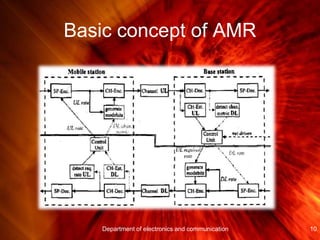
Basic concept of AMR
10Department of electronics and communication
• a speech codec with variable bit rate (SP-
Enc,
• SP-Dec),
• a channel codec with variable error
protection rate, matching to the bit rate of
the speech codec (CH-Enc, CH-Dec),
• a Channel estimation entity (CH-Est),
• a control unit for the rate adaptation.
11Department of electronics and communication
Source coding
• Information source is coded to reduce the
bit rates.
• That is to reduce the redundancy of
message
• According to channel conditions there are
14 modes of operations with different bit
rate.
8/5/2014 Department of electronics and communication 12
Channel coding of source
encoded bit
• Unequal error protection(UEP)
• Recursive systematic convolutional
codes(RSCC)
• Transmission of mode bits
• Decoding an RSC code with a standard
NSC decoder.
8/5/2014 Department of electronics and communication 13
Unequal error protection(UEP)
• Information is classified based on their
sensitivity and protected.
• More error protection is provided for most
significant bit.
I.e.; Redundancy for MSB is greater than
that of LSB
• A high SNR is provided for most significant
bit
8/5/2014 Department of electronics and communication 14
Recursive systematic
convolutional codes (RSCC)
• BER is lower than Non Systematic
Convolutional Codes (NSCC)
• SNR is higher than NSCC
• Systematic bits can be collected before
channel decoding
8/5/2014 Department of electronics and communication 15
Transmission of mode bits
• Mode bits are the most significant bits.
• Error detection techniques such as ‘cyclic
redundancy check’ , ‘quality estimation’
are used to detect error in mode bit.
• Mode bits are assigned at the beginning of
a block of codes.
• Many sub classes are provided.
8/5/2014 Department of electronics and communication 16
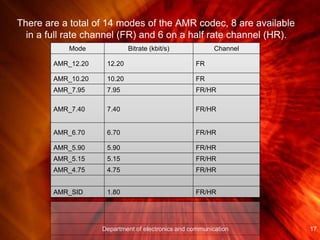
There are a total of 14 modes of the AMR codec, 8 are available
in a full rate channel (FR) and 6 on a half rate channel (HR).
Department of electronics and communication 17
Mode Bitrate (kbit/s) Channel
AMR_12.20 12.20 FR
AMR_10.20 10.20 FR
AMR_7.95 7.95 FR/HR
AMR_7.40 7.40 FR/HR
AMR_6.70 6.70 FR/HR
AMR_5.90 5.90 FR/HR
AMR_5.15 5.15 FR/HR
AMR_4.75 4.75 FR/HR
AMR_SID 1.80 FR/HR
Features
• It is the 4th speech compression algorithm
standardized by ETSI.
The first 3 are
i)Full Rate
ii)Half Rate
iii)Enhanced Full Rate
• The AMR codec uses eight source coders
with different bit-rates
• AMR is a hybrid speech coder which
uses Algebraic Code Excited Linear
Prediction (ACELP)
18Department of electronics and communication
Cntnd…
• Sampling frequency 8 kHz or 160 samples for 20
ms frames
• The AMR codec uses eight source codecs with bit-
rates of
12.2 kbit/s,
10.2 kbit/s,
7.95 kbit/s,
7.40 kbit/s,
6.70 kbit/s,
5.90 kbit/s,
5.15 kbit/s,
4.75 kbit/s.
Department of electronics and communication 19
It Generates
frame length of bit rates
95bits 4.75bits
103bits 5.15bits
118bits 5.90bits
134bits 6.70bits
148bits 7.40bits
159bits 7.95 bits
204bits 10.2bits
244bits 12.2bits
Respectively.
8/5/2014 Department of electronics and communication 20
• AMR utilizes Discontinuous
transmission (DTX), with Voice Activity
Detection (VAD) and Comfort Noise
Generation (CNG) to reduce bandwidth
usage during silence periods.
• The complexity of the algorithm is rated at
5 based on the standard scale
8/5/2014 Department of electronics and communication 21
Applications
• In GSM mobile communication
• In 3G mobile systems.
• Low bit rate high quality speech
communication systems.
• Digital radio systems
• Used in UTMS
22Department of electronics and communication
Reference
• A. Antoniou: Digital Filters, Analysis, Design and Applications,
2nd edition, New York: McGraw-Hill, 1993
• T. Fingscheidt, 0. Scheufen, “Robust GSM Speech Decoding
• Using the Channel Decoders Soft Output,” in Proc. Of
EUROSPEECH’97, Rhodos, Greece, pp. 1315-1318,
Sept.1997
• S. Heinen, M. Adrat, 0. Steil, P. Vary, W.Xu, “A 6.1 to 13.3
kb/s variable rate CELP codec (VR-VCELP) for
• AMR speech coding,” in Proc. of ICASSP’99, Phoenix,
Arizona, vol. 1, pp. 9-12, March 1999
• J. Hagenauer, “Rate-compatible punctured convolutional
codes (RCPC codes) and their applications,” in IEEE
23Department of electronics and communication
Questions?
Department of electronics and communication 24
Thank you
25Department of electronics and communication

adaptive multirate speech coding

  • 1.
    8/5/2014 Department ofelectronics and communication 1
  • 2.
    Adaptive Multi Rate SpeechCoding ABHIRAM.S 8/5/2014 Department of electronics and communication 2
  • 3.
    What is speechsignal? • Speech is the primary method of human communication. Or it is the vocal method of communication. 3Department of electronics and communication
  • 4.
    What is speechcoding? • Speech coding means the conversion of speech signal which already has been digitalized, into another digital signal featuring a lower bit rate than original. • To transmit/store a speech waveform using as few bits as possible while retaining high quality 4Department of electronics and communication
  • 5.
    Why coding necessary •Speech coding systems is to transmit speech with the highest possible quality using the least possible channel capacity. • To save bandwidth in telecoms applications and to reduce memory storage requirements. 5Department of electronics and communication
  • 6.
    Limitations of fixedcoding rate • If the source coding and channel coding rates are independent of channel quality; fading occur • Unnecessary coding for a good channel, wastage of channel • Information loss due to bad channel, fading 6Department of electronics and communication
  • 7.
    Why Multi RateCoding? • Multi rate coding helps to provide different coding rate for different bits. • Signal can be coded by different channel coding rate according to their significance. • Audio data compression can be done by reducing bit rate. 8/5/2014 Department of electronics and communication 7
  • 8.
    Rate adaptation inspeech coding • The source/channel coding rate can be adapted according to some conditions. • Adaptation provides better flexibility of channel • Improved utilization of channels • Channel/Source/Receiver condition are the main factors affecting rate adaptation. 8/5/2014 Department of electronics and communication 8
  • 9.
    Adaptive multi ratecoding of speech • The ratio between source bit rate and error protecting redundancy is adapted according to channel conditions. • The AMR concept solves the source channel rate allocation problem in a more intelligent way. • That is when the channel is bad, source encoder operate at low bit rate. When the channel is good, highest rate of speech encoding is used. 9Department of electronics and communication
  • 10.
    Basic concept ofAMR 10Department of electronics and communication
  • 11.
    • a speechcodec with variable bit rate (SP- Enc, • SP-Dec), • a channel codec with variable error protection rate, matching to the bit rate of the speech codec (CH-Enc, CH-Dec), • a Channel estimation entity (CH-Est), • a control unit for the rate adaptation. 11Department of electronics and communication
  • 12.
    Source coding • Informationsource is coded to reduce the bit rates. • That is to reduce the redundancy of message • According to channel conditions there are 14 modes of operations with different bit rate. 8/5/2014 Department of electronics and communication 12
  • 13.
    Channel coding ofsource encoded bit • Unequal error protection(UEP) • Recursive systematic convolutional codes(RSCC) • Transmission of mode bits • Decoding an RSC code with a standard NSC decoder. 8/5/2014 Department of electronics and communication 13
  • 14.
    Unequal error protection(UEP) •Information is classified based on their sensitivity and protected. • More error protection is provided for most significant bit. I.e.; Redundancy for MSB is greater than that of LSB • A high SNR is provided for most significant bit 8/5/2014 Department of electronics and communication 14
  • 15.
    Recursive systematic convolutional codes(RSCC) • BER is lower than Non Systematic Convolutional Codes (NSCC) • SNR is higher than NSCC • Systematic bits can be collected before channel decoding 8/5/2014 Department of electronics and communication 15
  • 16.
    Transmission of modebits • Mode bits are the most significant bits. • Error detection techniques such as ‘cyclic redundancy check’ , ‘quality estimation’ are used to detect error in mode bit. • Mode bits are assigned at the beginning of a block of codes. • Many sub classes are provided. 8/5/2014 Department of electronics and communication 16
  • 17.
    There are atotal of 14 modes of the AMR codec, 8 are available in a full rate channel (FR) and 6 on a half rate channel (HR). Department of electronics and communication 17 Mode Bitrate (kbit/s) Channel AMR_12.20 12.20 FR AMR_10.20 10.20 FR AMR_7.95 7.95 FR/HR AMR_7.40 7.40 FR/HR AMR_6.70 6.70 FR/HR AMR_5.90 5.90 FR/HR AMR_5.15 5.15 FR/HR AMR_4.75 4.75 FR/HR AMR_SID 1.80 FR/HR
  • 18.
    Features • It isthe 4th speech compression algorithm standardized by ETSI. The first 3 are i)Full Rate ii)Half Rate iii)Enhanced Full Rate • The AMR codec uses eight source coders with different bit-rates • AMR is a hybrid speech coder which uses Algebraic Code Excited Linear Prediction (ACELP) 18Department of electronics and communication
  • 19.
    Cntnd… • Sampling frequency8 kHz or 160 samples for 20 ms frames • The AMR codec uses eight source codecs with bit- rates of 12.2 kbit/s, 10.2 kbit/s, 7.95 kbit/s, 7.40 kbit/s, 6.70 kbit/s, 5.90 kbit/s, 5.15 kbit/s, 4.75 kbit/s. Department of electronics and communication 19
  • 20.
    It Generates frame lengthof bit rates 95bits 4.75bits 103bits 5.15bits 118bits 5.90bits 134bits 6.70bits 148bits 7.40bits 159bits 7.95 bits 204bits 10.2bits 244bits 12.2bits Respectively. 8/5/2014 Department of electronics and communication 20
  • 21.
    • AMR utilizesDiscontinuous transmission (DTX), with Voice Activity Detection (VAD) and Comfort Noise Generation (CNG) to reduce bandwidth usage during silence periods. • The complexity of the algorithm is rated at 5 based on the standard scale 8/5/2014 Department of electronics and communication 21
  • 22.
    Applications • In GSMmobile communication • In 3G mobile systems. • Low bit rate high quality speech communication systems. • Digital radio systems • Used in UTMS 22Department of electronics and communication
  • 23.
    Reference • A. Antoniou:Digital Filters, Analysis, Design and Applications, 2nd edition, New York: McGraw-Hill, 1993 • T. Fingscheidt, 0. Scheufen, “Robust GSM Speech Decoding • Using the Channel Decoders Soft Output,” in Proc. Of EUROSPEECH’97, Rhodos, Greece, pp. 1315-1318, Sept.1997 • S. Heinen, M. Adrat, 0. Steil, P. Vary, W.Xu, “A 6.1 to 13.3 kb/s variable rate CELP codec (VR-VCELP) for • AMR speech coding,” in Proc. of ICASSP’99, Phoenix, Arizona, vol. 1, pp. 9-12, March 1999 • J. Hagenauer, “Rate-compatible punctured convolutional codes (RCPC codes) and their applications,” in IEEE 23Department of electronics and communication
  • 24.
  • 25.
    Thank you 25Department ofelectronics and communication