Introduction to
                                       AMR


 Place your image on
 top of this gray box.
    If no graphic is                                                                            Kausik Raychaudhuri
applicable, delete gray
  box and notch-out
behind gray box, from
   the Title Master


                                          Jonathan Hopkinson 20/8/03
                                         Motorola Confidential Proprietary
               MOTOROLA and the Stylized M Logo are registered in the US Patent & Trademark Office. All other
                 product or service names are the property of their respective owners. © Motorola, Inc. 2002.
Existing types of Speech Coding
• Currently there are two speech coding schemes used in
  GSM.
   – FR - Full Rate (The original coding scheme)
   – EFR - Enhanced Full Rate ( An enhancement of FR)

• EFR offers better quality speech.
• Most modern mobiles are EFR capable.
• The majority of Network Operators have EFR capable
  Networks.
• Motorola’s BSS has supported EFR since GSR3 - with
  a GDP board fitted at the Transcoder function.
Why change from what we’ve got ?

•The traditional “fixed” coding schemes (FR or EFR) use a
fixed amount of bandwidth - some dedicated to encode the
speech and the rest used to offer data protection - Forward
Error Coding, Checksums etc.
•When poor RF conditions exist, there may be “errors” in
the speech data which cannot be corrected or recovered.
The “errors” will be heard as an interruption in the speech.
•With EFR or FR, we can only achieve a “best effort” with
the coding scheme and protection available - AMR offers
some improvements.
AMR Concept
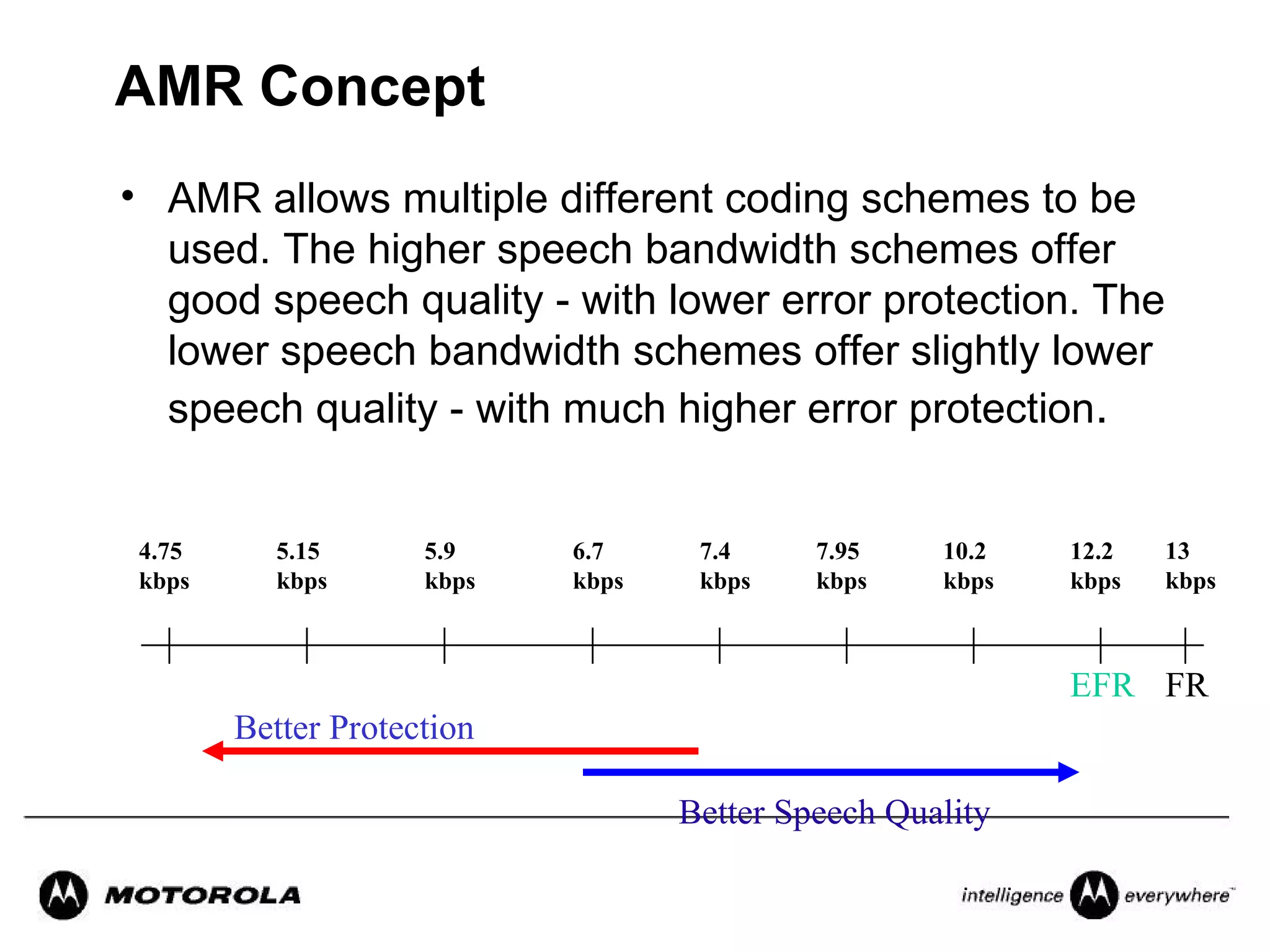
• AMR allows multiple different coding schemes to be
  used. The higher speech bandwidth schemes offer
  good speech quality - with lower error protection. The
  lower speech bandwidth schemes offer slightly lower
  speech quality - with much higher error protection.


 4.75     5.15       5.9    6.7     7.4     7.95    10.2   12.2   13
 kbps     kbps       kbps   kbps    kbps    kbps    kbps   kbps   kbps


                                                           EFR FR
        Better Protection

                                   Better Speech Quality
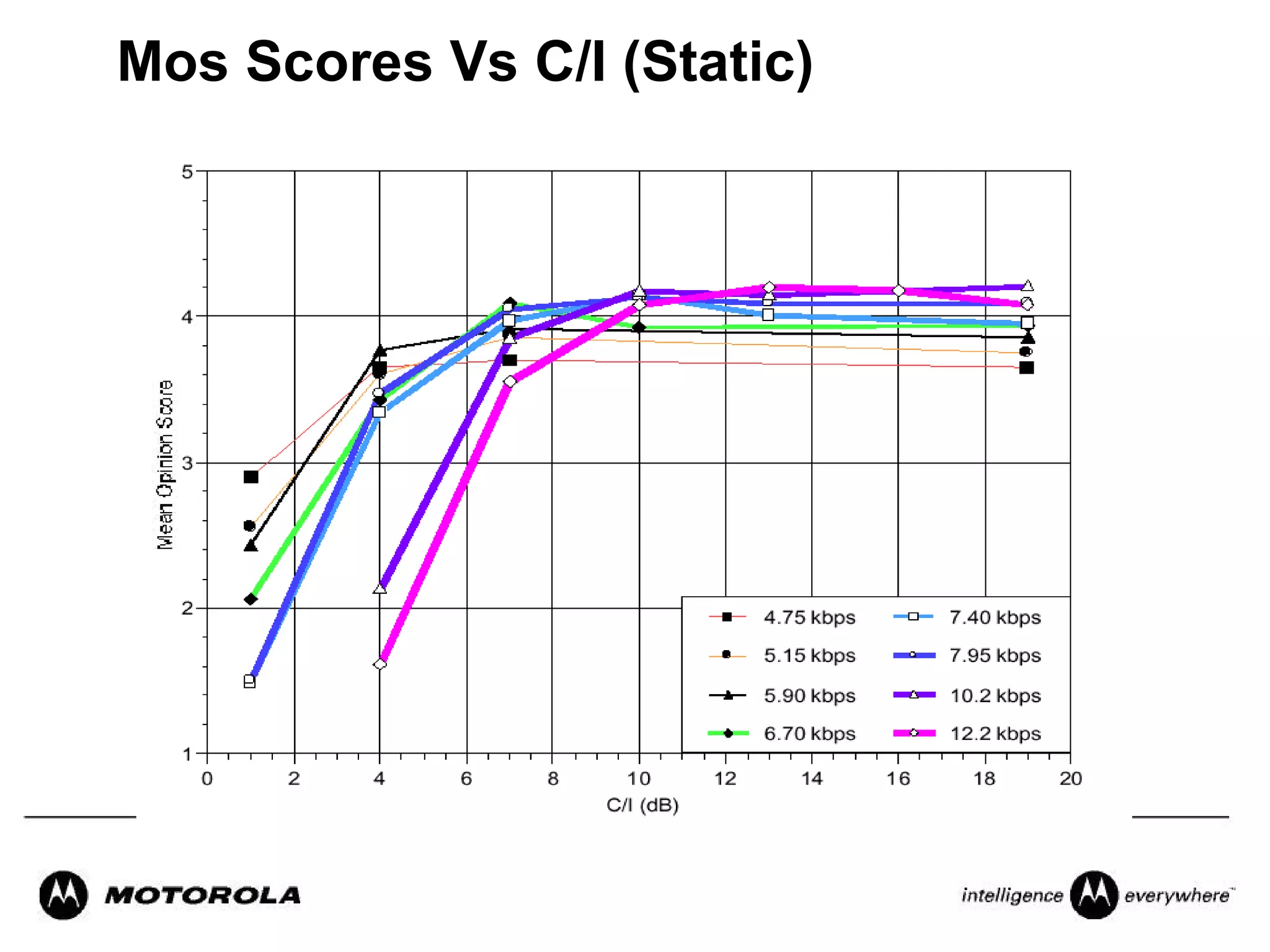
Mos Scores Vs C/I (Static)
AMR Codec Rates
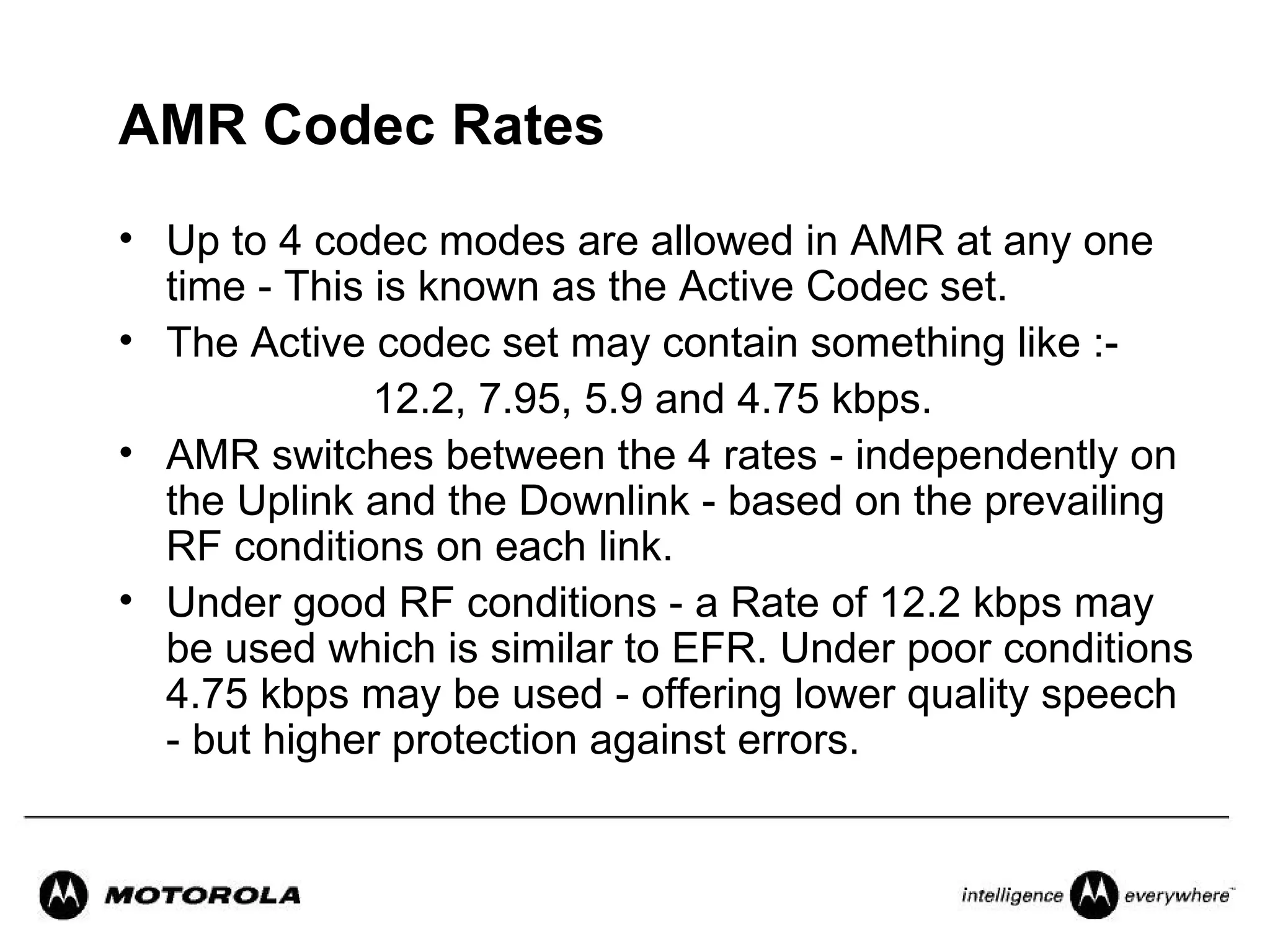
• Up to 4 codec modes are allowed in AMR at any one
  time - This is known as the Active Codec set.
• The Active codec set may contain something like :-
              12.2, 7.95, 5.9 and 4.75 kbps.
• AMR switches between the 4 rates - independently on
  the Uplink and the Downlink - based on the prevailing
  RF conditions on each link.
• Under good RF conditions - a Rate of 12.2 kbps may
  be used which is similar to EFR. Under poor conditions
  4.75 kbps may be used - offering lower quality speech
  - but higher protection against errors.
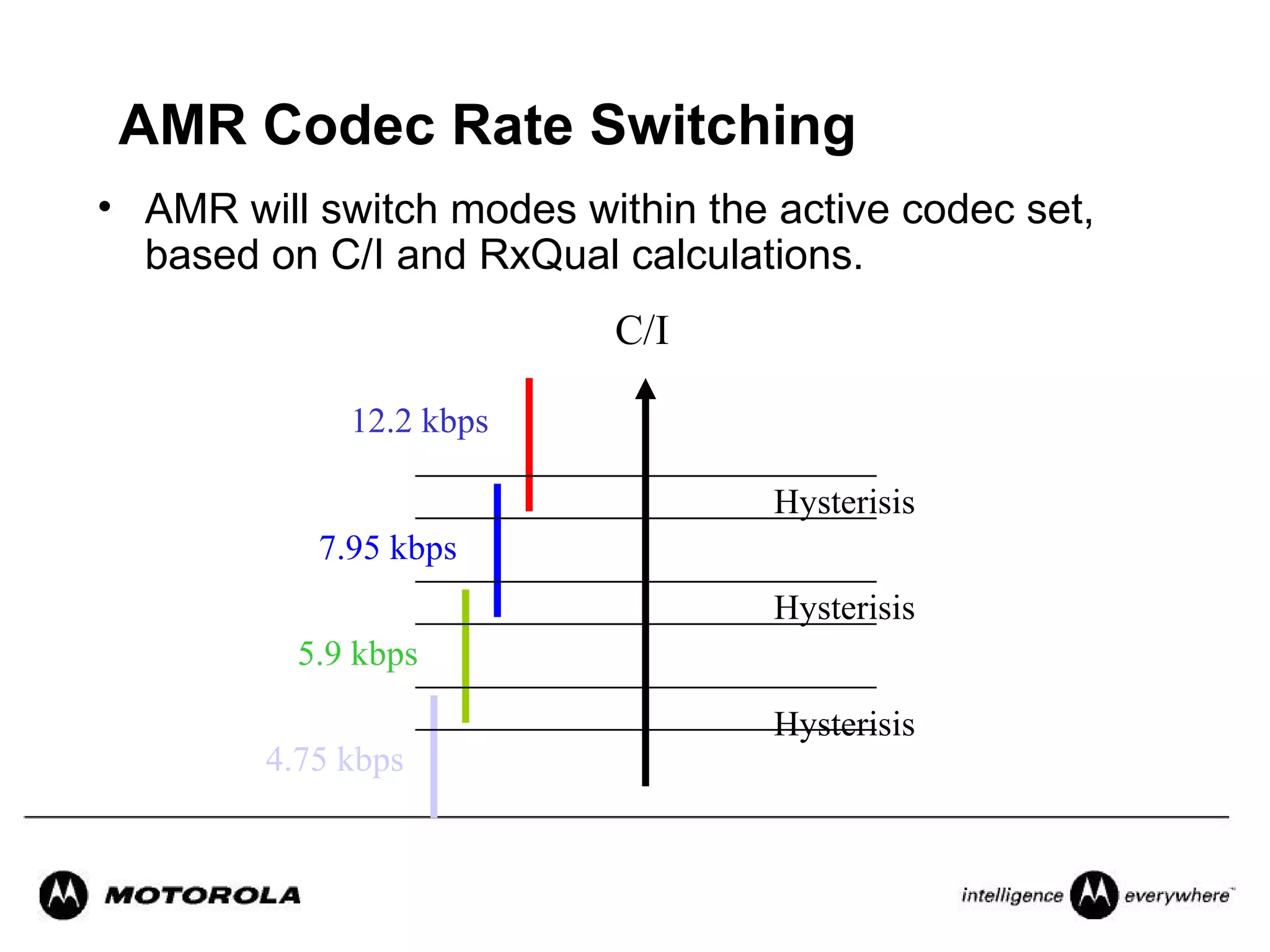
AMR Codec Rate Switching
• AMR will switch modes within the active codec set,
  based on C/I and RxQual calculations.
                          C/I

             12.2 kbps

                                   Hysterisis
           7.95 kbps
                                   Hysterisis
          5.9 kbps

                                   Hysterisis
        4.75 kbps
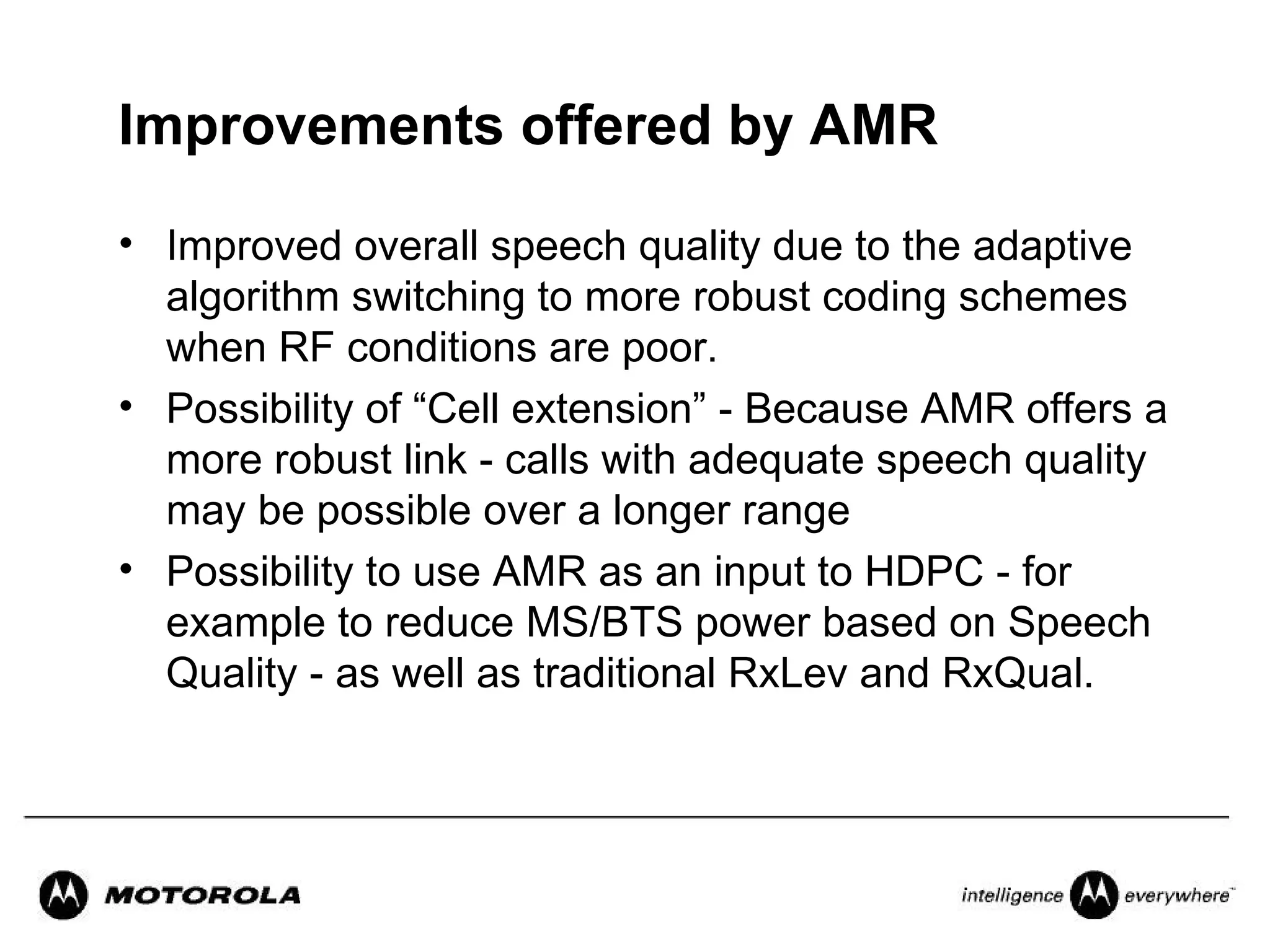
Improvements offered by AMR

• Improved overall speech quality due to the adaptive
  algorithm switching to more robust coding schemes
  when RF conditions are poor.
• Possibility of “Cell extension” - Because AMR offers a
  more robust link - calls with adequate speech quality
  may be possible over a longer range
• Possibility to use AMR as an input to HDPC - for
  example to reduce MS/BTS power based on Speech
  Quality - as well as traditional RxLev and RxQual.
Half Rate AMR
• AMR allows for Half Rate speech channels.
• Half Rate can mean twice as many subscribers using
  the same amount of infrastructure (RF) equipment.
  This is a very attractive proposition to Network
  operators.
• The Half Rate codec modes are only suitable when the
  C/I is ~> 15dB.
• Half Rate AMR will be possible on Motorola
  infrastructure - new hardware is required at the BSC
  and Transcoding functions.
• Half Rate offers worse speech quality - but more traffic
  capacity. - Call tariffs will probably sell Half Rate.

Adaptive multi rate (amr) document

  • 1.
    Introduction to AMR Place your image on top of this gray box. If no graphic is Kausik Raychaudhuri applicable, delete gray box and notch-out behind gray box, from the Title Master Jonathan Hopkinson 20/8/03 Motorola Confidential Proprietary MOTOROLA and the Stylized M Logo are registered in the US Patent & Trademark Office. All other product or service names are the property of their respective owners. © Motorola, Inc. 2002.
  • 2.
    Existing types ofSpeech Coding • Currently there are two speech coding schemes used in GSM. – FR - Full Rate (The original coding scheme) – EFR - Enhanced Full Rate ( An enhancement of FR) • EFR offers better quality speech. • Most modern mobiles are EFR capable. • The majority of Network Operators have EFR capable Networks. • Motorola’s BSS has supported EFR since GSR3 - with a GDP board fitted at the Transcoder function.
  • 3.
    Why change fromwhat we’ve got ? •The traditional “fixed” coding schemes (FR or EFR) use a fixed amount of bandwidth - some dedicated to encode the speech and the rest used to offer data protection - Forward Error Coding, Checksums etc. •When poor RF conditions exist, there may be “errors” in the speech data which cannot be corrected or recovered. The “errors” will be heard as an interruption in the speech. •With EFR or FR, we can only achieve a “best effort” with the coding scheme and protection available - AMR offers some improvements.
  • 4.
    AMR Concept • AMRallows multiple different coding schemes to be used. The higher speech bandwidth schemes offer good speech quality - with lower error protection. The lower speech bandwidth schemes offer slightly lower speech quality - with much higher error protection. 4.75 5.15 5.9 6.7 7.4 7.95 10.2 12.2 13 kbps kbps kbps kbps kbps kbps kbps kbps kbps EFR FR Better Protection Better Speech Quality
  • 5.
    Mos Scores VsC/I (Static)
  • 6.
    AMR Codec Rates •Up to 4 codec modes are allowed in AMR at any one time - This is known as the Active Codec set. • The Active codec set may contain something like :- 12.2, 7.95, 5.9 and 4.75 kbps. • AMR switches between the 4 rates - independently on the Uplink and the Downlink - based on the prevailing RF conditions on each link. • Under good RF conditions - a Rate of 12.2 kbps may be used which is similar to EFR. Under poor conditions 4.75 kbps may be used - offering lower quality speech - but higher protection against errors.
  • 7.
    AMR Codec RateSwitching • AMR will switch modes within the active codec set, based on C/I and RxQual calculations. C/I 12.2 kbps Hysterisis 7.95 kbps Hysterisis 5.9 kbps Hysterisis 4.75 kbps
  • 8.
    Improvements offered byAMR • Improved overall speech quality due to the adaptive algorithm switching to more robust coding schemes when RF conditions are poor. • Possibility of “Cell extension” - Because AMR offers a more robust link - calls with adequate speech quality may be possible over a longer range • Possibility to use AMR as an input to HDPC - for example to reduce MS/BTS power based on Speech Quality - as well as traditional RxLev and RxQual.
  • 9.
    Half Rate AMR •AMR allows for Half Rate speech channels. • Half Rate can mean twice as many subscribers using the same amount of infrastructure (RF) equipment. This is a very attractive proposition to Network operators. • The Half Rate codec modes are only suitable when the C/I is ~> 15dB. • Half Rate AMR will be possible on Motorola infrastructure - new hardware is required at the BSC and Transcoding functions. • Half Rate offers worse speech quality - but more traffic capacity. - Call tariffs will probably sell Half Rate.

Editor's Notes