Agenda
2
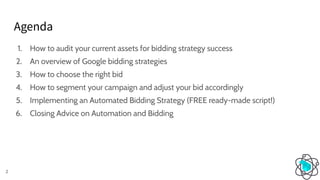
1. How to audit your current assets for bidding strategy success
2. An overview of Google bidding strategies
3. How to choose the right bid
4. How to segment your campaign and adjust your bid accordingly
5. Implementing an Automated Bidding Strategy (FREE ready-made script!)
6. Closing Advice on Automation and Bidding
About Us
3
We’re the best* scientific performance marketing
agency
4
That’s quite a mouthful, but it’s just a way to say that we love numbers and the scientific
method.
We have been running wildly successful international Paid and Brand Media Campaigns
since July of 2016.
* we are the best according to our mums and now that we’ve won an award as the Best small PPC agency in Europe, it’s official: mums are always right.
What do we do?
Digital performance.
That’s it.
5
Who are we?
6
● A multi-talented team of 32
consisting of Developers, Data
Scientists, and Media Experts.
● Based in Pietrasanta (Tuscany,
Italy), Milan and London.
Our philosophy: Paid Media is a science
● With millions of metrics & endless experimentation possibilities: Paid Media is the
pinnacle of mathematical marketing.
● As digital marketing scientists, we have infused the scientific method across all of
our activities.
7
Who am I?
● 14y experience in online advertising
● 6.5y at Google between Dublin, NYC & London
● Managed Quarterly $XXM in advertising for
Google as part of the SEM in-house team that
promotes Google’s products (in FB, Bing,
Google, Linkedin etc)
● Advisor for Google’s own equity fund Capital G
● Voted 2nd Most Influential PPC Person in 2019
Chapter #1
How to audit your current assets for
bidding strategy success
9
11
Automate or Die
12
What shall we pack?
Before Getting Started
13
How do we set up the right bid and how do we identify the right value?
● AdGroup with correct match type and Granular Structure
Before Getting Started
14
How do we set up the right bid and how do we identify the right value?
● AdGroup with correct match type and Granular Structure
● Relevant Ads and landing pages
Before Getting Started
15
How do we set up the right bid and how do we identify the right value?
● AdGroup with correct match type and Granular Structure
● Relevant Ads and landing pages
● Complete Goals (micro-conversions)
Before Getting Started
16
How do we set up the right bid and how do we identify the right value?
● AdGroup with correct match type and Granular Structure
● Relevant Ads and landing pages
● Complete Goals (micro-conversions)
● Complete and correct tracking in place
Before Getting Started
17
How do we set up the right bid and how do we identify the right value?
● AdGroup with correct match type and Granular Structure
● Relevant Ads and landing pages
● Complete Goals (micro-conversions)
● Complete and correct tracking in place
● Proper attribution model
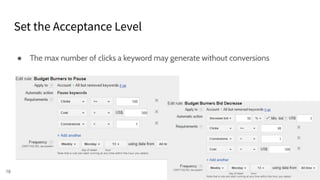
Set the Acceptance Level
18
● The max number of clicks a keyword may generate without conversions
Details
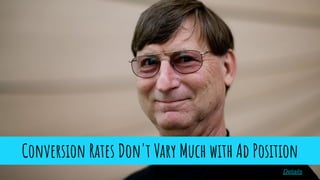
Conversion Rates Don't Vary Much with Ad Position
Details
Not everyone agrees
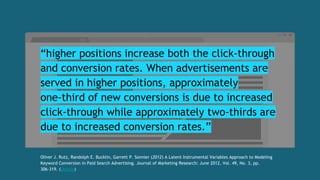
“higher positions increase both the click-through
and conversion rates. When advertisements are
served in higher positions, approximately
one-third of new conversions is due to increased
click-through while approximately two-thirds are
due to increased conversion rates.”
Oliver J. Rutz, Randolph E. Bucklin, Garrett P. Sonnier (2012) A Latent Instrumental Variables Approach to Modeling
Keyword Conversion in Paid Search Advertising. Journal of Marketing Research: June 2012, Vol. 49, No. 3, pp.
306-319. (Details)
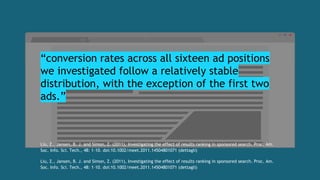
“conversion rates across all sixteen ad positions
we investigated follow a relatively stable
distribution, with the exception of the first two
ads.”
Liu, Z., Jansen, B. J. and Simon, Z. (2011), Investigating the effect of results ranking in sponsored search. Proc. Am.
Soc. Info. Sci. Tech., 48: 1–10. doi:10.1002/meet.2011.14504801071 (dettagli)
Liu, Z., Jansen, B. J. and Simon, Z. (2011), Investigating the effect of results ranking in sponsored search. Proc. Am.
Soc. Info. Sci. Tech., 48: 1–10. doi:10.1002/meet.2011.14504801071 (dettagli)
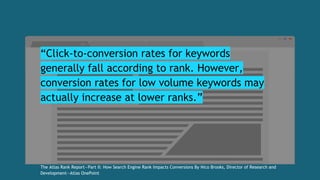
“Click-to-conversion rates for keywords
generally fall according to rank. However,
conversion rates for low volume keywords may
actually increase at lower ranks.”
The Atlas Rank Report—Part II: How Search Engine Rank Impacts Conversions By Nico Brooks, Director of Research and
Development—Atlas OnePoint
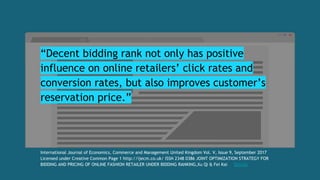
“Decent bidding rank not only has positive
influence on online retailers’ click rates and
conversion rates, but also improves customer’s
reservation price.”
International Journal of Economics, Commerce and Management United Kingdom Vol. V, Issue 9, September 2017
Licensed under Creative Common Page 1 http://ijecm.co.uk/ ISSN 2348 0386 JOINT OPTIMIZATION STRATEGY FOR
BIDDING AND PRICING OF ONLINE FASHION RETAILER UNDER BIDDING RANKING,Xu Qi & Fei Kai Details
Why is it difficult to measure?
25
● Tautology: higher positions
= Better QS
= Better Landing Page Experience
= Better Conversion Rate
● Avg. Position = not reliable enough
Average position doesn’t reflect an ad’s actual position on
the page, but rather represents the order an ad shows up
against other ads in the auction
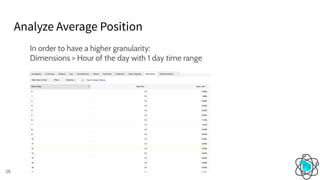
Analyze Average Position
26
In order to have a higher granularity:
Dimensions > Hour of the day with 1 day time range
Chapter #2
An overview of Google bidding strategies
27
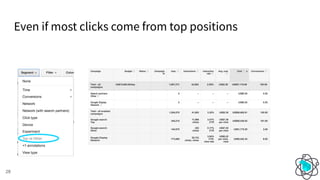
Even if most clicks come from top positions
28
Target CPA
29
● sets bids to help get as many conversions as possible at or below the target
cost-per-action (CPA) you set
Target ROAS
30
● helps you get more conversion value or revenue at the target return-on-ad-spend
(ROAS) you set
Maximize Conversions
31
● automatically sets bids to help get the most conversions for your campaign while
spending your budget
Enhanced CPC
32
● Google has the right to increase or decrease your bid amount based on the
likelihood of driving the sale
Manual CPC Bidding
33
● Good for control-conscious
● Keyword level bids override AdGroup level (more control)
Maximize Clicks
34
● Maximizes number of clicks given a certain budget
○ Ideal for those mainly interested in traffic
Target Impression Share
35
● Ideal for brand awareness, it helps you reach as many people as possible
a. Target Top of Page Rate
b. Target Absolute Top of Page Rate
Chapter #3
How to choose the right bid
36
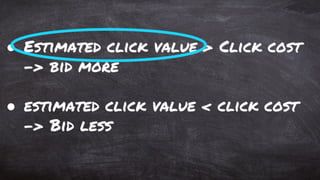
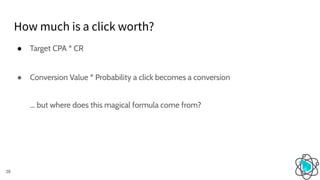
How much is a click worth?
38
● Target CPA * CR
● Conversion Value * Probability a click becomes a conversion
… but where does this magical formula come from?
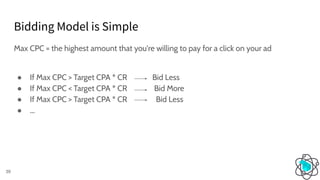
Bidding Model is Simple
39
Max CPC = the highest amount that you're willing to pay for a click on your ad
● If Max CPC > Target CPA * CR Bid Less
● If Max CPC < Target CPA * CR Bid More
● If Max CPC > Target CPA * CR Bid Less
● ...
Example
40
● We are an e-commerce of time machines
● Sale price: $1000
$1000
Example
41
● So far we have sold 3 time machines
● Investing $500 in GAds
42
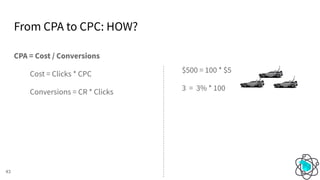
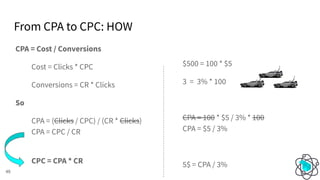
From CPA to CPC: HOW?
43
CPA = Cost / Conversions
Cost = Clicks * CPC
Conversions = CR * Clicks
$500 = 100 * $5
3 = 3% * 100
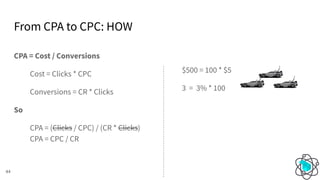
From CPA to CPC: HOW
44
CPA = Cost / Conversions
Cost = Clicks * CPC
Conversions = CR * Clicks
So
CPA = (Clicks / CPC) / (CR * Clicks)
CPA = CPC / CR
$500 = 100 * $5
3 = 3% * 100
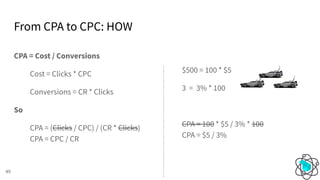
From CPA to CPC: HOW
45
CPA = Cost / Conversions
Cost = Clicks * CPC
Conversions = CR * Clicks
So
CPA = (Clicks / CPC) / (CR * Clicks)
CPA = CPC / CR
$500 = 100 * $5
3 = 3% * 100
CPA = 100 * $5 / 3% * 100
CPA = $5 / 3%
From CPA to CPC: HOW
46
CPA = Cost / Conversions
Cost = Clicks * CPC
Conversions = CR * Clicks
So
CPA = (Clicks / CPC) / (CR * Clicks)
CPA = CPC / CR
CPC = CPA * CR
$500 = 100 * $5
3 = 3% * 100
CPA = 100 * $5 / 3% * 100
CPA = $5 / 3%
5$ = CPA / 3%
From CPA to CPC: HOW
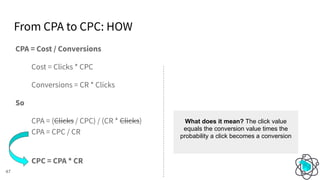
47
CPA = Cost / Conversions
Cost = Clicks * CPC
Conversions = CR * Clicks
So
CPA = (Clicks / CPC) / (CR * Clicks)
CPA = CPC / CR
CPC = CPA * CR
What does it mean? The click value
equals the conversion value times the
probability a click becomes a conversion
48
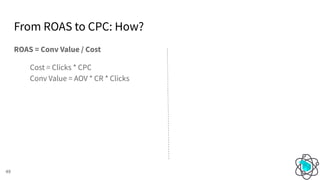
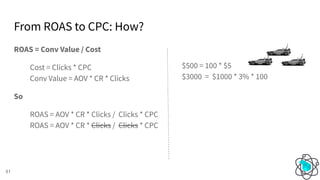
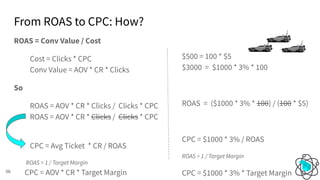
From ROAS to CPC: How?
49
ROAS = Conv Value / Cost
Cost = Clicks * CPC
Conv Value = AOV * CR * Clicks
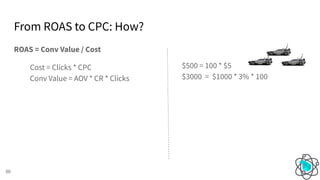
From ROAS to CPC: How?
50
ROAS = Conv Value / Cost
Cost = Clicks * CPC
Conv Value = AOV * CR * Clicks
$500 = 100 * $5
$3000 = $1000 * 3% * 100
From ROAS to CPC: How?
51
ROAS = Conv Value / Cost
Cost = Clicks * CPC
Conv Value = AOV * CR * Clicks
So
ROAS = AOV * CR * Clicks / Clicks * CPC
$500 = 100 * $5
$3000 = $1000 * 3% * 100
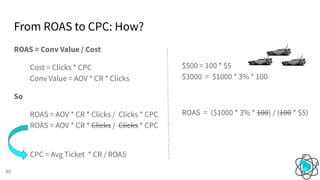
From ROAS to CPC: How?
52
ROAS = Conv Value / Cost
Cost = Clicks * CPC
Conv Value = AOV * CR * Clicks
So
ROAS = AOV * CR * Clicks / Clicks * CPC
$500 = 100 * $5
$3000 = $1000 * 3% * 100
ROAS = ($1000 * 3% * 100) / (100 * $5)
From ROAS to CPC: How?
53
ROAS = Conv Value / Cost
Cost = Clicks * CPC
Conv Value = AOV * CR * Clicks
So
ROAS = AOV * CR * Clicks / Clicks * CPC
CPC = Avg Ticket * CR / ROAS
$500 = 100 * $5
$3000 = $1000 * 3% * 100
ROAS = ($1000 * 3% * 100) / (100 * $5)
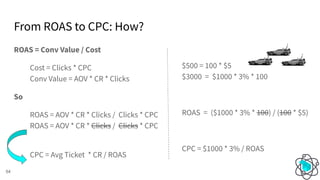
From ROAS to CPC: How?
54
ROAS = Conv Value / Cost
Cost = Clicks * CPC
Conv Value = AOV * CR * Clicks
So
ROAS = AOV * CR * Clicks / Clicks * CPC
CPC = Avg Ticket * CR / ROAS
$500 = 100 * $5
$3000 = $1000 * 3% * 100
ROAS = ($1000 * 3% * 100) / (100 * $5)
CPC = $1000 * 3% / ROAS
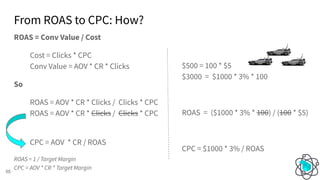
From ROAS to CPC: How?
55
ROAS = Conv Value / Cost
Cost = Clicks * CPC
Conv Value = AOV * CR * Clicks
So
ROAS = AOV * CR * Clicks / Clicks * CPC
CPC = AOV * CR / ROAS
ROAS = 1 / Target Margin
CPC = AOV * CR * Target Margin
$500 = 100 * $5
$3000 = $1000 * 3% * 100
ROAS = ($1000 * 3% * 100) / (100 * $5)
CPC = $1000 * 3% / ROAS
From ROAS to CPC: How?
56
ROAS = Conv Value / Cost
Cost = Clicks * CPC
Conv Value = AOV * CR * Clicks
So
ROAS = AOV * CR * Clicks / Clicks * CPC
CPC = Avg Ticket * CR / ROAS
ROAS = 1 / Target Margin
CPC = AOV * CR * Target Margin
$500 = 100 * $5
$3000 = $1000 * 3% * 100
ROAS = ($1000 * 3% * 100) / (100 * $5)
CPC = $1000 * 3% / ROAS
ROAS = 1 / Target Margin
CPC = $1000 * 3% * Target Margin
From ROAS to CPC: How?
57
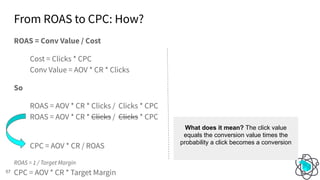
ROAS = Conv Value / Cost
Cost = Clicks * CPC
Conv Value = AOV * CR * Clicks
So
ROAS = AOV * CR * Clicks / Clicks * CPC
CPC = AOV * CR / ROAS
ROAS = 1 / Target Margin
CPC = AOV * CR * Target Margin
What does it mean? The click value
equals the conversion value times the
probability a click becomes a conversion
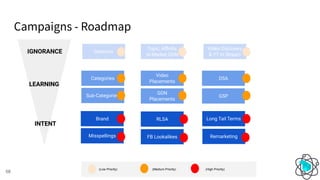
Campaigns - Roadmap
58
Brand Long Tail Terms
Misspellings
Categories
Sub-Categories
Generics
RLSA
Remarketing
FB Lookalikes
GDN
Placements
Video
Placements
Topic, Affinity,
In-Market GDN
DSA
GSP
Video Discovery
& YT In Stream
IGNORANCE
LEARNING
INTENT
(Low Priority) (Medium Priority) (High Priority)
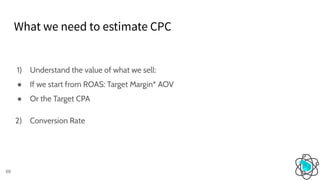
What we need to estimate CPC
59
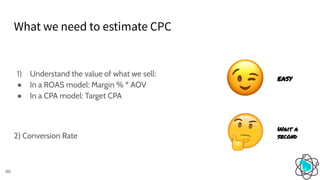
1) Understand the value of what we sell:
● If we start from ROAS: Target Margin* AOV
● Or the Target CPA
2) Conversion Rate
What we need to estimate CPC
60
1) Understand the value of what we sell:
● In a ROAS model: Margin % * AOV
● In a CPA model: Target CPA
2) Conversion Rate
EASY
Wait a
second
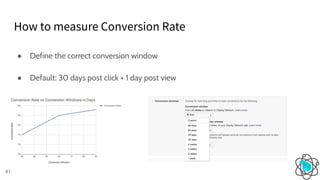
How to measure Conversion Rate
61
● Define the correct conversion window
● Default: 30 days post click + 1 day post view
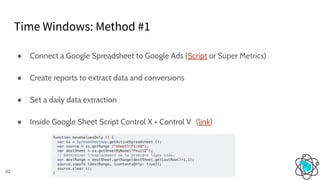
Time Windows: Method #1
62
● Connect a Google Spreadsheet to Google Ads (Script or Super Metrics)
● Create reports to extract data and conversions
● Set a daily data extraction
● Inside Google Sheet Script Control X + Control V (link)
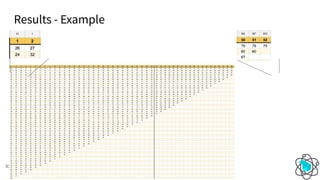
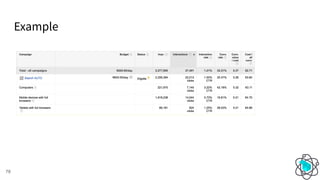
Results - Example
63
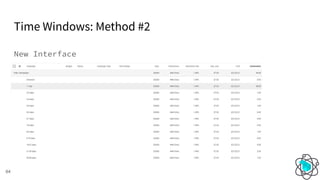
Time Windows: Method #2
64
New Interface
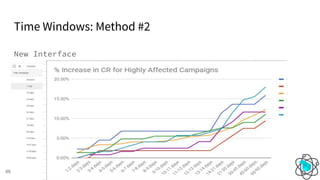
Time Windows: Method #2
65
New Interface
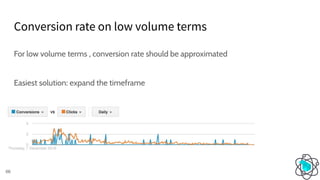
Conversion rate on low volume terms
66
For low volume terms , conversion rate should be approximated
Easiest solution: expand the timeframe
67
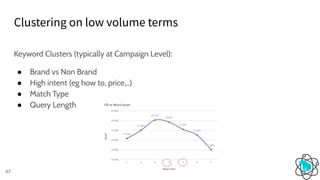
Clustering on low volume terms
Keyword Clusters (typically at Campaign Level):
● Brand vs Non Brand
● High intent (eg how to, price,..)
● Match Type
● Query Length
Chapter #4
How to segment your campaign and adjust
your bid accordingly
68
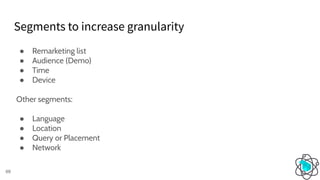
● Remarketing list
● Audience (Demo)
● Time
● Device
Other segments:
● Language
● Location
● Query or Placement
● Network
Segments to increase granularity
69
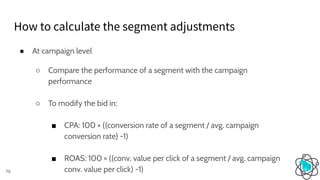
● At campaign level
○ Compare the performance of a segment with the campaign
performance
○ To modify the bid in:
■ CPA: 100 × ((conversion rate of a segment / avg. campaign
conversion rate) -1)
■ ROAS: 100 × ((conv. value per click of a segment / avg. campaign
conv. value per click) -1)
How to calculate the segment adjustments
70
● It’s enough to use Bid Adjustement
Device
71
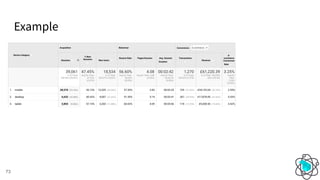
● In GA > Audience > Mobile Overview
Example
72
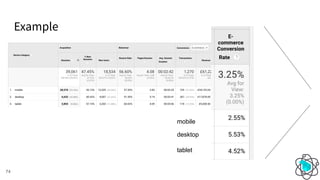
Example
73
Example
mobile
desktop
tablet
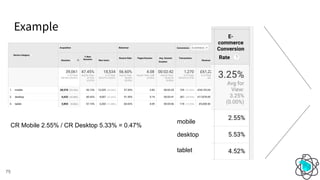
74
Example
mobile
desktop
tablet
CR Mobile 2.55% / CR Desktop 5.33% = 0.47%
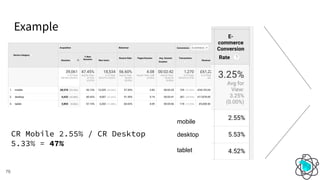
75
Example
mobile
desktop
tablet
CR Mobile 2.55% / CR Desktop
5.33% = 47%
76
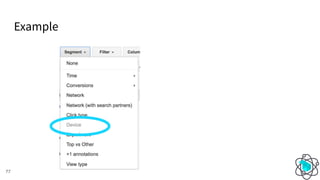
Example
77
Example
78
Example
CR Mobile 16.81% / CR Desktop 42.18% = 39%
79
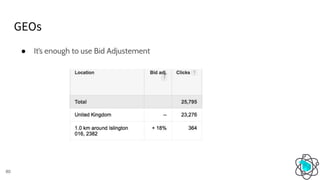
● It’s enough to use Bid Adjustement
GEOs
80
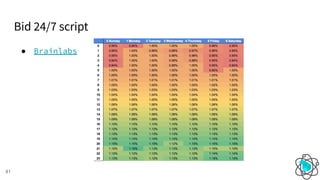
● Brainlabs
Bid 24/7 script
81
● Script
● Suggestion: Modify the bid early in the morning and use forecasts for the day
Weather
82
● Script
TV Coordination
Chapter #5
Implementing an Automated Bidding
Strategy
84
● Connect a Google Spreadsheet to Google Ads (Script or Super Metrics)
● Calculate bid
● Upload with script
Example of Automation
Chapter #6
Closing Advice on Automation and Bidding
86
Checklist
● Define Max CPC (using the formulas we showed)
● Test different models to calculate conversion rate. Areas to test:
○ Lookback windows
○ Keywords Clusters (typically at Campaign Level)
■ Brand vs Non Brand
■ Match Type
■ Query Length
● Bid testing (script)
● Implementa bid adjustments within segments
● 3 Advanced Tips For Bid Adjustments In Google Enhanced Campaigns
(Search Engine Land) here
● The Definitive Framework for Bidding in AdWords - Hero Conf London 2016
(Wijnand Meijer) here
● Hero conference 2016 - advanced bidding (Chris Haleua) here
● The complete AdWords Audit Part 13: Bid Management (Brad Geddes) here
Further details
89
gianluca@boosterboxdigital.com

Ad Espresso - Google Ads Bidding

  • 2.
    Agenda 2 1. How toaudit your current assets for bidding strategy success 2. An overview of Google bidding strategies 3. How to choose the right bid 4. How to segment your campaign and adjust your bid accordingly 5. Implementing an Automated Bidding Strategy (FREE ready-made script!) 6. Closing Advice on Automation and Bidding
  • 3.
  • 4.
    We’re the best*scientific performance marketing agency 4 That’s quite a mouthful, but it’s just a way to say that we love numbers and the scientific method. We have been running wildly successful international Paid and Brand Media Campaigns since July of 2016. * we are the best according to our mums and now that we’ve won an award as the Best small PPC agency in Europe, it’s official: mums are always right.
  • 5.
    What do wedo? Digital performance. That’s it. 5
  • 6.
    Who are we? 6 ●A multi-talented team of 32 consisting of Developers, Data Scientists, and Media Experts. ● Based in Pietrasanta (Tuscany, Italy), Milan and London.
  • 7.
    Our philosophy: PaidMedia is a science ● With millions of metrics & endless experimentation possibilities: Paid Media is the pinnacle of mathematical marketing. ● As digital marketing scientists, we have infused the scientific method across all of our activities. 7
  • 8.
    Who am I? ●14y experience in online advertising ● 6.5y at Google between Dublin, NYC & London ● Managed Quarterly $XXM in advertising for Google as part of the SEM in-house team that promotes Google’s products (in FB, Bing, Google, Linkedin etc) ● Advisor for Google’s own equity fund Capital G ● Voted 2nd Most Influential PPC Person in 2019
  • 9.
    Chapter #1 How toaudit your current assets for bidding strategy success 9
  • 11.
  • 12.
  • 13.
    Before Getting Started 13 Howdo we set up the right bid and how do we identify the right value? ● AdGroup with correct match type and Granular Structure
  • 14.
    Before Getting Started 14 Howdo we set up the right bid and how do we identify the right value? ● AdGroup with correct match type and Granular Structure ● Relevant Ads and landing pages
  • 15.
    Before Getting Started 15 Howdo we set up the right bid and how do we identify the right value? ● AdGroup with correct match type and Granular Structure ● Relevant Ads and landing pages ● Complete Goals (micro-conversions)
  • 16.
    Before Getting Started 16 Howdo we set up the right bid and how do we identify the right value? ● AdGroup with correct match type and Granular Structure ● Relevant Ads and landing pages ● Complete Goals (micro-conversions) ● Complete and correct tracking in place
  • 17.
    Before Getting Started 17 Howdo we set up the right bid and how do we identify the right value? ● AdGroup with correct match type and Granular Structure ● Relevant Ads and landing pages ● Complete Goals (micro-conversions) ● Complete and correct tracking in place ● Proper attribution model
  • 18.
    Set the AcceptanceLevel 18 ● The max number of clicks a keyword may generate without conversions
  • 19.
    Details Conversion Rates Don'tVary Much with Ad Position
  • 20.
  • 21.
    “higher positions increaseboth the click-through and conversion rates. When advertisements are served in higher positions, approximately one-third of new conversions is due to increased click-through while approximately two-thirds are due to increased conversion rates.” Oliver J. Rutz, Randolph E. Bucklin, Garrett P. Sonnier (2012) A Latent Instrumental Variables Approach to Modeling Keyword Conversion in Paid Search Advertising. Journal of Marketing Research: June 2012, Vol. 49, No. 3, pp. 306-319. (Details)
  • 22.
    “conversion rates acrossall sixteen ad positions we investigated follow a relatively stable distribution, with the exception of the first two ads.” Liu, Z., Jansen, B. J. and Simon, Z. (2011), Investigating the effect of results ranking in sponsored search. Proc. Am. Soc. Info. Sci. Tech., 48: 1–10. doi:10.1002/meet.2011.14504801071 (dettagli) Liu, Z., Jansen, B. J. and Simon, Z. (2011), Investigating the effect of results ranking in sponsored search. Proc. Am. Soc. Info. Sci. Tech., 48: 1–10. doi:10.1002/meet.2011.14504801071 (dettagli)
  • 23.
    “Click-to-conversion rates forkeywords generally fall according to rank. However, conversion rates for low volume keywords may actually increase at lower ranks.” The Atlas Rank Report—Part II: How Search Engine Rank Impacts Conversions By Nico Brooks, Director of Research and Development—Atlas OnePoint
  • 24.
    “Decent bidding ranknot only has positive influence on online retailers’ click rates and conversion rates, but also improves customer’s reservation price.” International Journal of Economics, Commerce and Management United Kingdom Vol. V, Issue 9, September 2017 Licensed under Creative Common Page 1 http://ijecm.co.uk/ ISSN 2348 0386 JOINT OPTIMIZATION STRATEGY FOR BIDDING AND PRICING OF ONLINE FASHION RETAILER UNDER BIDDING RANKING,Xu Qi & Fei Kai Details
  • 25.
    Why is itdifficult to measure? 25 ● Tautology: higher positions = Better QS = Better Landing Page Experience = Better Conversion Rate ● Avg. Position = not reliable enough Average position doesn’t reflect an ad’s actual position on the page, but rather represents the order an ad shows up against other ads in the auction
  • 26.
    Analyze Average Position 26 Inorder to have a higher granularity: Dimensions > Hour of the day with 1 day time range
  • 27.
    Chapter #2 An overviewof Google bidding strategies 27
  • 28.
    Even if mostclicks come from top positions 28
  • 29.
    Target CPA 29 ● setsbids to help get as many conversions as possible at or below the target cost-per-action (CPA) you set
  • 30.
    Target ROAS 30 ● helpsyou get more conversion value or revenue at the target return-on-ad-spend (ROAS) you set
  • 31.
    Maximize Conversions 31 ● automaticallysets bids to help get the most conversions for your campaign while spending your budget
  • 32.
    Enhanced CPC 32 ● Googlehas the right to increase or decrease your bid amount based on the likelihood of driving the sale
  • 33.
    Manual CPC Bidding 33 ●Good for control-conscious ● Keyword level bids override AdGroup level (more control)
  • 34.
    Maximize Clicks 34 ● Maximizesnumber of clicks given a certain budget ○ Ideal for those mainly interested in traffic
  • 35.
    Target Impression Share 35 ●Ideal for brand awareness, it helps you reach as many people as possible a. Target Top of Page Rate b. Target Absolute Top of Page Rate
  • 36.
    Chapter #3 How tochoose the right bid 36
  • 38.
    How much isa click worth? 38 ● Target CPA * CR ● Conversion Value * Probability a click becomes a conversion … but where does this magical formula come from?
  • 39.
    Bidding Model isSimple 39 Max CPC = the highest amount that you're willing to pay for a click on your ad ● If Max CPC > Target CPA * CR Bid Less ● If Max CPC < Target CPA * CR Bid More ● If Max CPC > Target CPA * CR Bid Less ● ...
  • 40.
    Example 40 ● We arean e-commerce of time machines ● Sale price: $1000 $1000
  • 41.
    Example 41 ● So farwe have sold 3 time machines ● Investing $500 in GAds
  • 42.
  • 43.
    From CPA toCPC: HOW? 43 CPA = Cost / Conversions Cost = Clicks * CPC Conversions = CR * Clicks $500 = 100 * $5 3 = 3% * 100
  • 44.
    From CPA toCPC: HOW 44 CPA = Cost / Conversions Cost = Clicks * CPC Conversions = CR * Clicks So CPA = (Clicks / CPC) / (CR * Clicks) CPA = CPC / CR $500 = 100 * $5 3 = 3% * 100
  • 45.
    From CPA toCPC: HOW 45 CPA = Cost / Conversions Cost = Clicks * CPC Conversions = CR * Clicks So CPA = (Clicks / CPC) / (CR * Clicks) CPA = CPC / CR $500 = 100 * $5 3 = 3% * 100 CPA = 100 * $5 / 3% * 100 CPA = $5 / 3%
  • 46.
    From CPA toCPC: HOW 46 CPA = Cost / Conversions Cost = Clicks * CPC Conversions = CR * Clicks So CPA = (Clicks / CPC) / (CR * Clicks) CPA = CPC / CR CPC = CPA * CR $500 = 100 * $5 3 = 3% * 100 CPA = 100 * $5 / 3% * 100 CPA = $5 / 3% 5$ = CPA / 3%
  • 47.
    From CPA toCPC: HOW 47 CPA = Cost / Conversions Cost = Clicks * CPC Conversions = CR * Clicks So CPA = (Clicks / CPC) / (CR * Clicks) CPA = CPC / CR CPC = CPA * CR What does it mean? The click value equals the conversion value times the probability a click becomes a conversion
  • 48.
  • 49.
    From ROAS toCPC: How? 49 ROAS = Conv Value / Cost Cost = Clicks * CPC Conv Value = AOV * CR * Clicks
  • 50.
    From ROAS toCPC: How? 50 ROAS = Conv Value / Cost Cost = Clicks * CPC Conv Value = AOV * CR * Clicks $500 = 100 * $5 $3000 = $1000 * 3% * 100
  • 51.
    From ROAS toCPC: How? 51 ROAS = Conv Value / Cost Cost = Clicks * CPC Conv Value = AOV * CR * Clicks So ROAS = AOV * CR * Clicks / Clicks * CPC ROAS = AOV * CR * Clicks / Clicks * CPC $500 = 100 * $5 $3000 = $1000 * 3% * 100
  • 52.
    From ROAS toCPC: How? 52 ROAS = Conv Value / Cost Cost = Clicks * CPC Conv Value = AOV * CR * Clicks So ROAS = AOV * CR * Clicks / Clicks * CPC ROAS = AOV * CR * Clicks / Clicks * CPC $500 = 100 * $5 $3000 = $1000 * 3% * 100 ROAS = ($1000 * 3% * 100) / (100 * $5)
  • 53.
    From ROAS toCPC: How? 53 ROAS = Conv Value / Cost Cost = Clicks * CPC Conv Value = AOV * CR * Clicks So ROAS = AOV * CR * Clicks / Clicks * CPC ROAS = AOV * CR * Clicks / Clicks * CPC CPC = Avg Ticket * CR / ROAS $500 = 100 * $5 $3000 = $1000 * 3% * 100 ROAS = ($1000 * 3% * 100) / (100 * $5)
  • 54.
    From ROAS toCPC: How? 54 ROAS = Conv Value / Cost Cost = Clicks * CPC Conv Value = AOV * CR * Clicks So ROAS = AOV * CR * Clicks / Clicks * CPC ROAS = AOV * CR * Clicks / Clicks * CPC CPC = Avg Ticket * CR / ROAS $500 = 100 * $5 $3000 = $1000 * 3% * 100 ROAS = ($1000 * 3% * 100) / (100 * $5) CPC = $1000 * 3% / ROAS
  • 55.
    From ROAS toCPC: How? 55 ROAS = Conv Value / Cost Cost = Clicks * CPC Conv Value = AOV * CR * Clicks So ROAS = AOV * CR * Clicks / Clicks * CPC ROAS = AOV * CR * Clicks / Clicks * CPC CPC = AOV * CR / ROAS ROAS = 1 / Target Margin CPC = AOV * CR * Target Margin $500 = 100 * $5 $3000 = $1000 * 3% * 100 ROAS = ($1000 * 3% * 100) / (100 * $5) CPC = $1000 * 3% / ROAS
  • 56.
    From ROAS toCPC: How? 56 ROAS = Conv Value / Cost Cost = Clicks * CPC Conv Value = AOV * CR * Clicks So ROAS = AOV * CR * Clicks / Clicks * CPC ROAS = AOV * CR * Clicks / Clicks * CPC CPC = Avg Ticket * CR / ROAS ROAS = 1 / Target Margin CPC = AOV * CR * Target Margin $500 = 100 * $5 $3000 = $1000 * 3% * 100 ROAS = ($1000 * 3% * 100) / (100 * $5) CPC = $1000 * 3% / ROAS ROAS = 1 / Target Margin CPC = $1000 * 3% * Target Margin
  • 57.
    From ROAS toCPC: How? 57 ROAS = Conv Value / Cost Cost = Clicks * CPC Conv Value = AOV * CR * Clicks So ROAS = AOV * CR * Clicks / Clicks * CPC ROAS = AOV * CR * Clicks / Clicks * CPC CPC = AOV * CR / ROAS ROAS = 1 / Target Margin CPC = AOV * CR * Target Margin What does it mean? The click value equals the conversion value times the probability a click becomes a conversion
  • 58.
    Campaigns - Roadmap 58 BrandLong Tail Terms Misspellings Categories Sub-Categories Generics RLSA Remarketing FB Lookalikes GDN Placements Video Placements Topic, Affinity, In-Market GDN DSA GSP Video Discovery & YT In Stream IGNORANCE LEARNING INTENT (Low Priority) (Medium Priority) (High Priority)
  • 59.
    What we needto estimate CPC 59 1) Understand the value of what we sell: ● If we start from ROAS: Target Margin* AOV ● Or the Target CPA 2) Conversion Rate
  • 60.
    What we needto estimate CPC 60 1) Understand the value of what we sell: ● In a ROAS model: Margin % * AOV ● In a CPA model: Target CPA 2) Conversion Rate EASY Wait a second
  • 61.
    How to measureConversion Rate 61 ● Define the correct conversion window ● Default: 30 days post click + 1 day post view
  • 62.
    Time Windows: Method#1 62 ● Connect a Google Spreadsheet to Google Ads (Script or Super Metrics) ● Create reports to extract data and conversions ● Set a daily data extraction ● Inside Google Sheet Script Control X + Control V (link)
  • 63.
  • 64.
    Time Windows: Method#2 64 New Interface
  • 65.
    Time Windows: Method#2 65 New Interface
  • 66.
    Conversion rate onlow volume terms 66 For low volume terms , conversion rate should be approximated Easiest solution: expand the timeframe
  • 67.
    67 Clustering on lowvolume terms Keyword Clusters (typically at Campaign Level): ● Brand vs Non Brand ● High intent (eg how to, price,..) ● Match Type ● Query Length
  • 68.
    Chapter #4 How tosegment your campaign and adjust your bid accordingly 68
  • 69.
    ● Remarketing list ●Audience (Demo) ● Time ● Device Other segments: ● Language ● Location ● Query or Placement ● Network Segments to increase granularity 69
  • 70.
    ● At campaignlevel ○ Compare the performance of a segment with the campaign performance ○ To modify the bid in: ■ CPA: 100 × ((conversion rate of a segment / avg. campaign conversion rate) -1) ■ ROAS: 100 × ((conv. value per click of a segment / avg. campaign conv. value per click) -1) How to calculate the segment adjustments 70
  • 71.
    ● It’s enoughto use Bid Adjustement Device 71
  • 72.
    ● In GA> Audience > Mobile Overview Example 72
  • 73.
  • 74.
  • 75.
    Example mobile desktop tablet CR Mobile 2.55%/ CR Desktop 5.33% = 0.47% 75
  • 76.
  • 77.
  • 78.
  • 79.
    Example CR Mobile 16.81%/ CR Desktop 42.18% = 39% 79
  • 80.
    ● It’s enoughto use Bid Adjustement GEOs 80
  • 81.
  • 82.
    ● Script ● Suggestion:Modify the bid early in the morning and use forecasts for the day Weather 82
  • 83.
  • 84.
    Chapter #5 Implementing anAutomated Bidding Strategy 84
  • 85.
    ● Connect aGoogle Spreadsheet to Google Ads (Script or Super Metrics) ● Calculate bid ● Upload with script Example of Automation
  • 86.
    Chapter #6 Closing Adviceon Automation and Bidding 86
  • 87.
    Checklist ● Define MaxCPC (using the formulas we showed) ● Test different models to calculate conversion rate. Areas to test: ○ Lookback windows ○ Keywords Clusters (typically at Campaign Level) ■ Brand vs Non Brand ■ Match Type ■ Query Length ● Bid testing (script) ● Implementa bid adjustments within segments
  • 88.
    ● 3 AdvancedTips For Bid Adjustments In Google Enhanced Campaigns (Search Engine Land) here ● The Definitive Framework for Bidding in AdWords - Hero Conf London 2016 (Wijnand Meijer) here ● Hero conference 2016 - advanced bidding (Chris Haleua) here ● The complete AdWords Audit Part 13: Bid Management (Brad Geddes) here Further details
  • 89.