ACUTE INFLAMMATION
Introduction To Inflammation
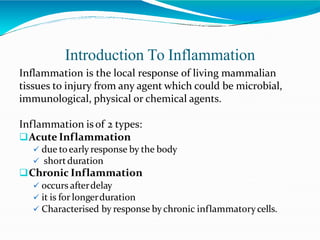
Inflammation is the local response of living mammalian
tissues to injury from any agent which could be microbial,
immunological, physical or chemical agents.
Inflammation isof 2 types:
Acute Inflammation
 due toearly response by the body
 shortduration
Chronic Inflammation
 occurs afterdelay
 it is for longerduration
 Characterised by response bychronic inflammatorycells.
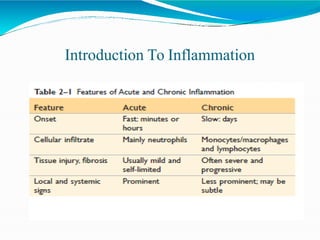
Introduction To Inflammation
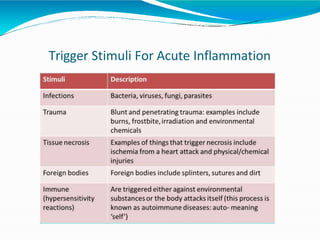
Trigger Stimuli For Acute Inflammation
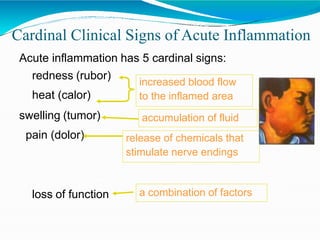
Cardinal Clinical Signs of Acute Inflammation
Acute inflammation has 5 cardinal signs:
redness (rubor)
heat (calor)
swelling (tumor)
pain (dolor)
loss of function
increased blood flow
to the inflamed area
accumulation of fluid
release of chemicals that
stimulate nerve endings
a combination of factors
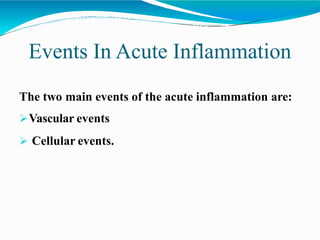
Events In Acute Inflammation
The two main events of the acute inflammation are:
Vascular events
 Cellular events.
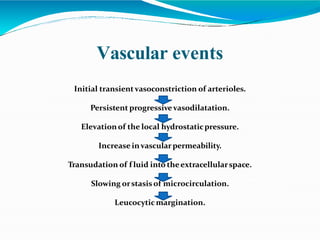
Vascular events
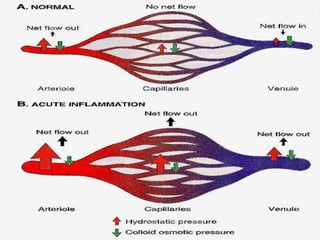
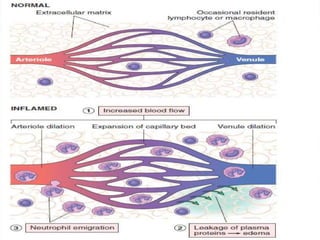
Initial transientvasoconstriction of arterioles.
Persistent progressivevasodilatation.
Elevationof the local hydrostaticpressure.
Increase invascularpermeability.
Transudation of f luid into theextracellularspace.
Slowing orstasis of microcirculation.
Leucocyticmargination.
Causes of increased vascular permeability
⚫Endothelial cell contraction  intercellular gaps in
postcapillary venules .
⚫Endothelial injury
⚫ Direct
⚫ Leukocyte induced
⚫Increased transcytosisof fluid
⚫Leakage from new blood vessels
Direct Endothelial Injury
⚫Immediatesustained response - Occurs immediately
and lasts until vessel repaired.
⚫Resultsof severe injuries (burns) or infections.
⚫Results in vascular leakage by causing endothelial cell
necrosis and detachment.
Leukocyte Dependent Endothelial Injury
⚫Endothelial cells may also be damaged as a
consequenceof leukocyteaccumulationalong the
vessel wall.
⚫ Activated leukocytes release many toxic mediators
that maycauseendothelial injuryordetachment.
Cellular Events
⚫Leukocyte Recruitment to site of injury
Extravasation  Sequenceof events in the recruitment
of leukocytes from thevascular lumen to the
extravascularspace.
⚫LeukocyteActivationat the siteof injury
⚫Phagocytosis of particles  Processof engulfmentof
⚫solid particulate material by the leukocytes
(neutrophilsand monocytes)
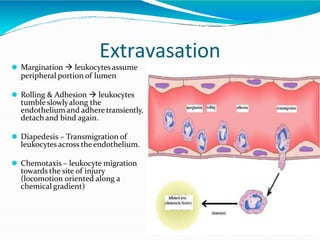
Extravasation
⚫ Margination  leukocytes assume
peripheral portion of lumen
⚫ Rolling & Adhesion  leukocytes
tumble slowlyalong the
endothelium and adheretransiently,
detachand bind again.
⚫ Diapedesis – Transmigration of
leukocytes across theendothelium.
⚫ Chemotaxis – leukocyte migration
towards the site of injury
(locomotion oriented along a
chemical gradient)
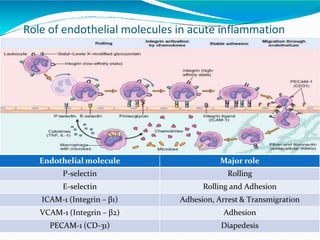
Role of endothelial molecules in acute inflammation
Endothelial molecule Major role
P-selectin Rolling
E-selectin Rolling and Adhesion
ICAM-1 (Integrin – β1) Adhesion, Arrest & Transmigration
VCAM-1 (Integrin – β2) Adhesion
PECAM-1 (CD-31) Diapedesis
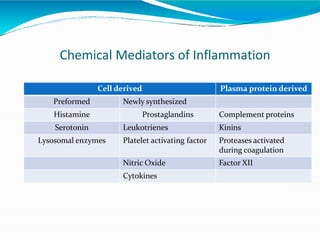
Chemical Mediators of Inflammation
Cell derived Plasma protein derived
Preformed Newly synthesized
Histamine Prostaglandins Complement proteins
Serotonin Leukotrienes Kinins
Lysosomal enzymes Platelet activating factor Proteases activated
during coagulation
Nitric Oxide Factor XII
Cytokines
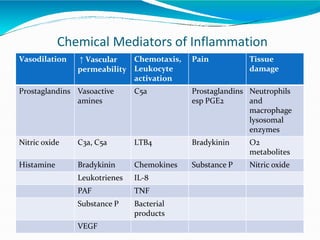
Chemical Mediators of Inflammation
Vasodilation ↑ Vascular
permeability
Chemotaxis,
Leukocyte
activation
Pain Tissue
damage
Prostaglandins Vasoactive
amines
C5a Prostaglandins
esp PGE2
Neutrophils
and
macrophage
lysosomal
enzymes
Nitric oxide C3a, C5a LTB4 Bradykinin O2
metabolites
Histamine Bradykinin Chemokines Substance P Nitric oxide
Leukotrienes IL-8
PAF TNF
Substance P Bacterial
products
VEGF
Chemotaxis
Both exogenousand endogenoussubstances can be chemotactic for
leukocytes (Chemoattractants)
⚫ Bacterial products, peptides with N-formylmethionine termini.
⚫ Cytokines, especially those of the chemokine family, IL-8.
⚫ Components of thecomplement system, particularly C5a.
⚫ Products of the lipoxygenase pathwayof arachidonicacid (AA) metabolism,
particularly leukotriene B4 (LTB4).
In most forms of acute inflammation,
 Neutrophils predominate in the inflammatory infiltrate during the first 6 -24 hrs
 Neutrophils are replaced by monocytes in 24 -48 hrs.
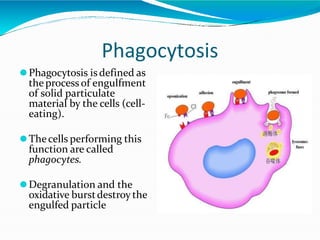
Phagocytosis
⚫Phagocytosis isdefined as
theprocess of engulfment
of solid particulate
material by the cells (cell-
eating).
⚫Thecells performing this
function are called
phagocytes.
⚫Degranulation and the
oxidative burstdestroy the
engulfed particle
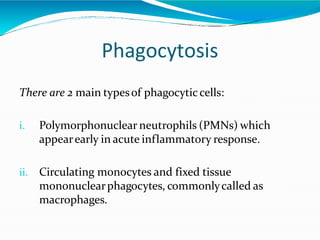
Phagocytosis
There are 2 main typesof phagocyticcells:
i. Polymorphonuclear neutrophils (PMNs) which
appearearly in acute inflammatory response.
ii. Circulating monocytes and fixed tissue
mononuclearphagocytes, commonlycalled as
macrophages.
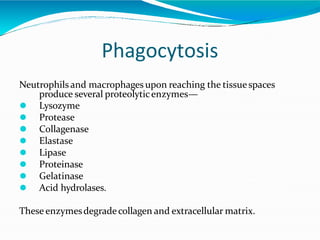
Phagocytosis
Neutrophils and macrophages upon reaching the tissuespaces
produce several proteolyticenzymes—
⚫ Lysozyme
⚫ Protease
⚫ Collagenase
⚫ Elastase
⚫ Lipase
⚫ Proteinase
⚫ Gelatinase
⚫ Acid hydrolases.
These enzymesdegradecollagen and extracellular matrix.
Phagocytosis
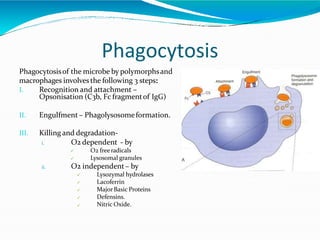
Phagocytosisof the microbe by polymorphsand
macrophages involvesthe following 3 steps:
I. Recognition and attachment –
Opsonisation (C3b, Fc fragmentof IgG)
II. Engulfment – Phagolysosomeformation.
III. Killing and degradation-
i. O2 dependent - by


O2 freeradicals
Lysosomal granules
ii. O2 independent– by





Lysozymal hydrolases
Lacoferrin
MajorBasic Proteins
Defensins.
Nitric Oxide.
MORPHOLOGIC PATTERNS OF ACUTE INFLAMMATION
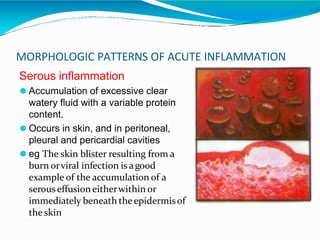
Serous inflammation
⚫ Accumulation of excessive clear
watery fluid with a variable protein
content.
⚫ Occurs in skin, and in peritoneal,
pleural and pericardial cavities
⚫ eg The skin blister resulting from a
burn orviral infection is agood
example of the accumulation of a
serouseffusioneitherwithin or
immediately beneath theepidermisof
the skin
MORPHOLOGIC PATTERNS OF ACUTE INFLAMMATION
Fibrinous inflammation
⚫ Large amounts of fibrinogen
pass the vessel wall, and
fibrins are formed in the fluid
exudate of extracellular
spaces.
⚫ eg Fibrinous pericarditis in
which fibrin is deposited on
the pericardium.
MORPHOLOGIC PATTERNS OF ACUTE INFLAMMATION
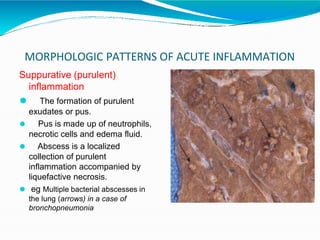
Suppurative (purulent)
inflammation
⚫ The formation of purulent
exudates or pus.
⚫ Pus is made up of neutrophils,
necrotic cells and edema fluid.
⚫ Abscess is a localized
collection of purulent
inflammation accompanied by
liquefactive necrosis.
⚫ eg Multiple bacterial abscesses in
the lung (arrows) in a case of
bronchopneumonia
MORPHOLOGIC PATTERNS OF ACUTE INFLAMMATION
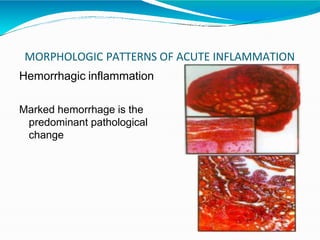
Hemorrhagic inflammation
Marked hemorrhage is the
predominant pathological
change
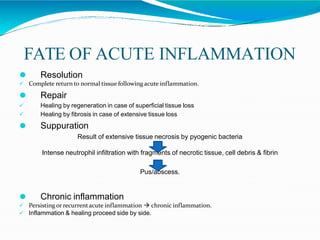
FATE OF ACUTE INFLAMMATION
⚫ Resolution
 Complete return to normal tissue following acute inflammation.
⚫ Repair
 Healing by regeneration in case of superficial tissue loss
 Healing by fibrosis in case of extensive tissue loss
⚫ Suppuration
Result of extensive tissue necrosis by pyogenic bacteria
Intense neutrophil infiltration with fragments of necrotic tissue, cell debris & fibrin
Pus/abscess.
⚫ Chronic inflammation
 Persisting or recurrentacute inflammation  chronic inflammation.
 Inflammation & healing proceed side by side.
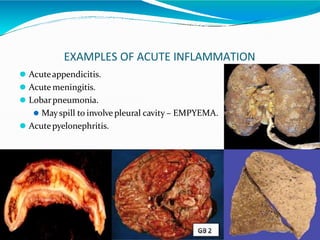
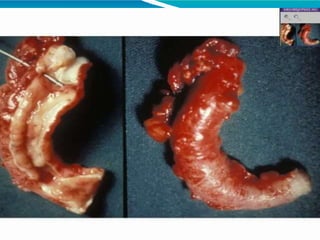
EXAMPLES OF ACUTE INFLAMMATION
⚫ Acuteappendicitis.
⚫ Acute meningitis.
⚫ Lobarpneumonia.
⚫ Mayspill to involvepleural cavity – EMPYEMA.
⚫ Acutepyelonephritis.
THANK YOU

acuteinflammation-161003171647.pptx

  • 1.
  • 2.
    Introduction To Inflammation Inflammationis the local response of living mammalian tissues to injury from any agent which could be microbial, immunological, physical or chemical agents. Inflammation isof 2 types: Acute Inflammation  due toearly response by the body  shortduration Chronic Inflammation  occurs afterdelay  it is for longerduration  Characterised by response bychronic inflammatorycells.
  • 3.
  • 4.
    Trigger Stimuli ForAcute Inflammation
  • 5.
    Cardinal Clinical Signsof Acute Inflammation Acute inflammation has 5 cardinal signs: redness (rubor) heat (calor) swelling (tumor) pain (dolor) loss of function increased blood flow to the inflamed area accumulation of fluid release of chemicals that stimulate nerve endings a combination of factors
  • 6.
    Events In AcuteInflammation The two main events of the acute inflammation are: Vascular events  Cellular events.
  • 7.
    Vascular events Initial transientvasoconstrictionof arterioles. Persistent progressivevasodilatation. Elevationof the local hydrostaticpressure. Increase invascularpermeability. Transudation of f luid into theextracellularspace. Slowing orstasis of microcirculation. Leucocyticmargination.
  • 10.
    Causes of increasedvascular permeability ⚫Endothelial cell contraction  intercellular gaps in postcapillary venules . ⚫Endothelial injury ⚫ Direct ⚫ Leukocyte induced ⚫Increased transcytosisof fluid ⚫Leakage from new blood vessels
  • 11.
    Direct Endothelial Injury ⚫Immediatesustainedresponse - Occurs immediately and lasts until vessel repaired. ⚫Resultsof severe injuries (burns) or infections. ⚫Results in vascular leakage by causing endothelial cell necrosis and detachment.
  • 12.
    Leukocyte Dependent EndothelialInjury ⚫Endothelial cells may also be damaged as a consequenceof leukocyteaccumulationalong the vessel wall. ⚫ Activated leukocytes release many toxic mediators that maycauseendothelial injuryordetachment.
  • 13.
    Cellular Events ⚫Leukocyte Recruitmentto site of injury Extravasation  Sequenceof events in the recruitment of leukocytes from thevascular lumen to the extravascularspace. ⚫LeukocyteActivationat the siteof injury ⚫Phagocytosis of particles  Processof engulfmentof ⚫solid particulate material by the leukocytes (neutrophilsand monocytes)
  • 14.
    Extravasation ⚫ Margination leukocytes assume peripheral portion of lumen ⚫ Rolling & Adhesion  leukocytes tumble slowlyalong the endothelium and adheretransiently, detachand bind again. ⚫ Diapedesis – Transmigration of leukocytes across theendothelium. ⚫ Chemotaxis – leukocyte migration towards the site of injury (locomotion oriented along a chemical gradient)
  • 15.
    Role of endothelialmolecules in acute inflammation Endothelial molecule Major role P-selectin Rolling E-selectin Rolling and Adhesion ICAM-1 (Integrin – β1) Adhesion, Arrest & Transmigration VCAM-1 (Integrin – β2) Adhesion PECAM-1 (CD-31) Diapedesis
  • 16.
    Chemical Mediators ofInflammation Cell derived Plasma protein derived Preformed Newly synthesized Histamine Prostaglandins Complement proteins Serotonin Leukotrienes Kinins Lysosomal enzymes Platelet activating factor Proteases activated during coagulation Nitric Oxide Factor XII Cytokines
  • 17.
    Chemical Mediators ofInflammation Vasodilation ↑ Vascular permeability Chemotaxis, Leukocyte activation Pain Tissue damage Prostaglandins Vasoactive amines C5a Prostaglandins esp PGE2 Neutrophils and macrophage lysosomal enzymes Nitric oxide C3a, C5a LTB4 Bradykinin O2 metabolites Histamine Bradykinin Chemokines Substance P Nitric oxide Leukotrienes IL-8 PAF TNF Substance P Bacterial products VEGF
  • 18.
    Chemotaxis Both exogenousand endogenoussubstancescan be chemotactic for leukocytes (Chemoattractants) ⚫ Bacterial products, peptides with N-formylmethionine termini. ⚫ Cytokines, especially those of the chemokine family, IL-8. ⚫ Components of thecomplement system, particularly C5a. ⚫ Products of the lipoxygenase pathwayof arachidonicacid (AA) metabolism, particularly leukotriene B4 (LTB4). In most forms of acute inflammation,  Neutrophils predominate in the inflammatory infiltrate during the first 6 -24 hrs  Neutrophils are replaced by monocytes in 24 -48 hrs.
  • 19.
    Phagocytosis ⚫Phagocytosis isdefined as theprocessof engulfment of solid particulate material by the cells (cell- eating). ⚫Thecells performing this function are called phagocytes. ⚫Degranulation and the oxidative burstdestroy the engulfed particle
  • 20.
    Phagocytosis There are 2main typesof phagocyticcells: i. Polymorphonuclear neutrophils (PMNs) which appearearly in acute inflammatory response. ii. Circulating monocytes and fixed tissue mononuclearphagocytes, commonlycalled as macrophages.
  • 21.
    Phagocytosis Neutrophils and macrophagesupon reaching the tissuespaces produce several proteolyticenzymes— ⚫ Lysozyme ⚫ Protease ⚫ Collagenase ⚫ Elastase ⚫ Lipase ⚫ Proteinase ⚫ Gelatinase ⚫ Acid hydrolases. These enzymesdegradecollagen and extracellular matrix.
  • 22.
    Phagocytosis Phagocytosisof the microbeby polymorphsand macrophages involvesthe following 3 steps: I. Recognition and attachment – Opsonisation (C3b, Fc fragmentof IgG) II. Engulfment – Phagolysosomeformation. III. Killing and degradation- i. O2 dependent - by   O2 freeradicals Lysosomal granules ii. O2 independent– by      Lysozymal hydrolases Lacoferrin MajorBasic Proteins Defensins. Nitric Oxide.
  • 23.
    MORPHOLOGIC PATTERNS OFACUTE INFLAMMATION Serous inflammation ⚫ Accumulation of excessive clear watery fluid with a variable protein content. ⚫ Occurs in skin, and in peritoneal, pleural and pericardial cavities ⚫ eg The skin blister resulting from a burn orviral infection is agood example of the accumulation of a serouseffusioneitherwithin or immediately beneath theepidermisof the skin
  • 24.
    MORPHOLOGIC PATTERNS OFACUTE INFLAMMATION Fibrinous inflammation ⚫ Large amounts of fibrinogen pass the vessel wall, and fibrins are formed in the fluid exudate of extracellular spaces. ⚫ eg Fibrinous pericarditis in which fibrin is deposited on the pericardium.
  • 25.
    MORPHOLOGIC PATTERNS OFACUTE INFLAMMATION Suppurative (purulent) inflammation ⚫ The formation of purulent exudates or pus. ⚫ Pus is made up of neutrophils, necrotic cells and edema fluid. ⚫ Abscess is a localized collection of purulent inflammation accompanied by liquefactive necrosis. ⚫ eg Multiple bacterial abscesses in the lung (arrows) in a case of bronchopneumonia
  • 26.
    MORPHOLOGIC PATTERNS OFACUTE INFLAMMATION Hemorrhagic inflammation Marked hemorrhage is the predominant pathological change
  • 27.
    FATE OF ACUTEINFLAMMATION ⚫ Resolution  Complete return to normal tissue following acute inflammation. ⚫ Repair  Healing by regeneration in case of superficial tissue loss  Healing by fibrosis in case of extensive tissue loss ⚫ Suppuration Result of extensive tissue necrosis by pyogenic bacteria Intense neutrophil infiltration with fragments of necrotic tissue, cell debris & fibrin Pus/abscess. ⚫ Chronic inflammation  Persisting or recurrentacute inflammation  chronic inflammation.  Inflammation & healing proceed side by side.
  • 28.
    EXAMPLES OF ACUTEINFLAMMATION ⚫ Acuteappendicitis. ⚫ Acute meningitis. ⚫ Lobarpneumonia. ⚫ Mayspill to involvepleural cavity – EMPYEMA. ⚫ Acutepyelonephritis.
  • 30.