Acute inflammation: 
1. How can you indicate the inflammation?
 By local signs (redness, hotness, swelling, pain, loss of function) 
or by systemic manifestations (fever, malaise, loss of appetite 
and weight, leukocytosis, changes in plasma proteins level) 
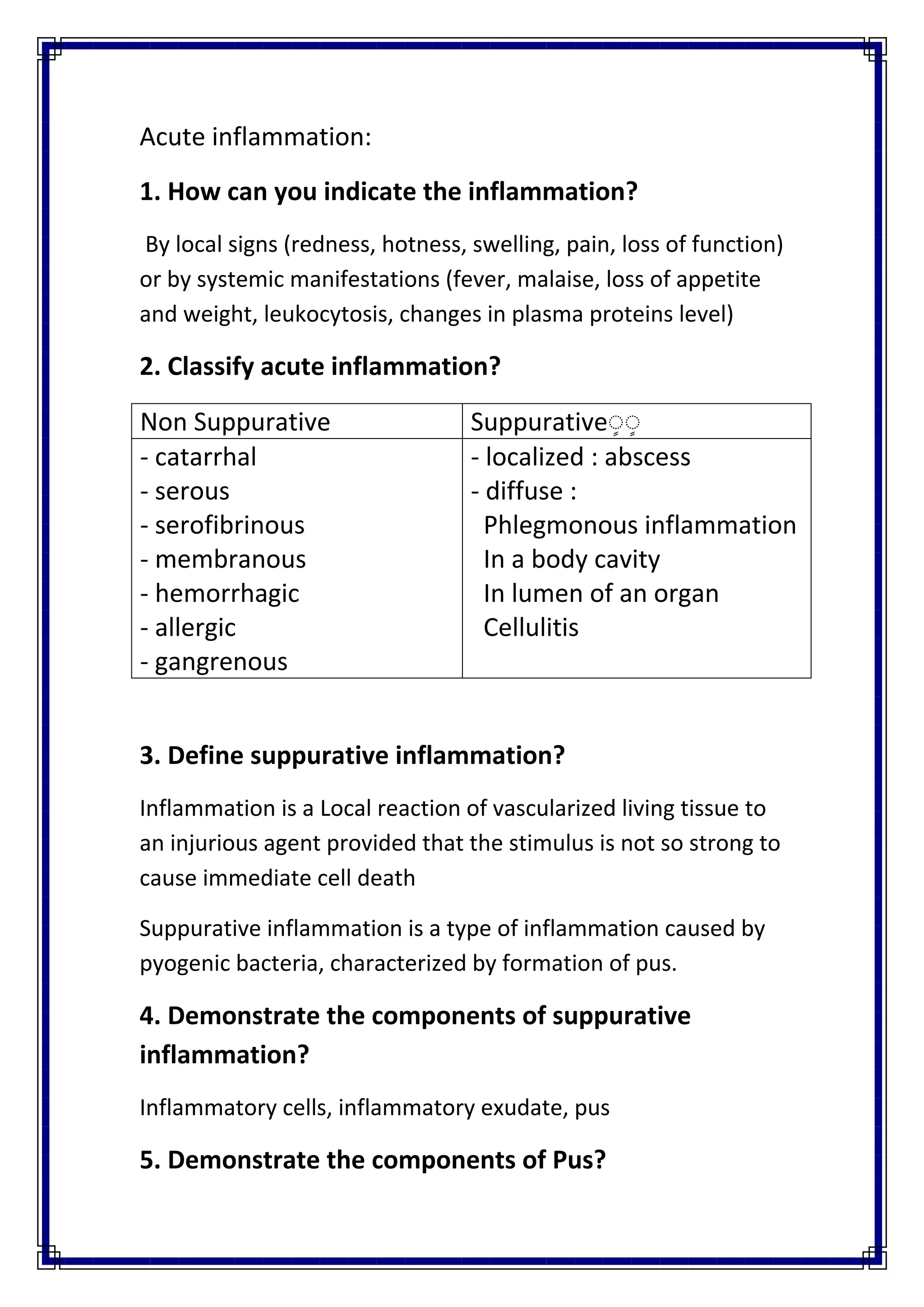
2. Classify acute inflammation?
ٍ◌ ٍ◌SuppurativeNon Suppurative
‐ localized : abscess
‐ diffuse :
  Phlegmonous inflammation
  In a body cavity
  In lumen of an organ
  Cellulitis
‐ catarrhal
‐ serous
‐ serofibrinous
‐ membranous
‐ hemorrhagic
‐ allergic
‐ gangrenous
 
3. Define suppurative inflammation? 
Inflammation is a Local reaction of vascularized living tissue to 
an injurious agent provided that the stimulus is not so strong to 
cause immediate cell death 
Suppurative inflammation is a type of inflammation caused by 
pyogenic bacteria, characterized by formation of pus. 
4. Demonstrate the components of suppurative 
inflammation?
Inflammatory cells, inflammatory exudate, pus 
5. Demonstrate the components of Pus?  
Living & dead bacteria & their toxins, living & dead neutrophils, 
necrotic cells, macrophages, exudate. 
6. What's suppurative inflammation characterized by? 
Formation of pus (yellow, turbid, odorless, thick, alkaline fluid) 
7. Why doesn't pus (fluid of suppurative inflammation) 
clot on standing? 
Because its fibrinogen is destroyed by proteolytic enzymes 
8. Demonstrate the pathogenesis of suppurative 
inflammation?  
Pathogenesis of acute inflammation in addition to pus 
formation by 
Toxins of microorganisms (excessive necrosis, chemotaxins) 
Pus cells/neutrophils (liquefaction of necrotic tissue) 
9. Enumerate the types of suppurative inflammation? 
‐ Localized (abscess) 
‐ Diffuse (Phlegmonous inflammation, in a body cavity, in 
lumen of an organ, Cellulitis)  
10. Classify suppurative inflammation?  
Same answer as 9 
11. Give an account about: 
• Abscess suppurative inflammation 
Localized area of suppuration characterized by cavity formation 
full of pus. Caused commonly by staphylococcus aureus that 
release coagulase enzyme 
• Diffuse suppurative inflammation 
Wide area of suppuration can happen in a hollow organ, body 
cavity, lumen of an organ, connective tissue. Caused commonly 
by streptococcus hemolyticus that release streptokinase and 
hyaluronidase enzymes. 
12. Define abscess? 
Localized area of suppuration characterized by cavity formation 
full of pus. Caused commonly by staphylococcus aureus that 
release coagulase enzyme 
13. What is abscess characterized by?  
Cavity formation full of pus (yellow, turbid, odorless, thick, 
alkaline fluid).  
14. Mention the causation of abscess? 
Staphylococcus aureus that release coagulase enzyme 
15. Which enzymes are involved in: 
• Abscess formation 
Coagulase enzyme 
• Non clotting of pus 
Streptokinase 
• Pathogenesis of pus formation 
Proteolytic enzymes 
• Cellulitis 
Streptokinase and hyaluronidase enzymes.  
16. Demonstrate the pathogenesis of abscess 
formation?  
Pus formation by 
Toxins of microorganisms (excessive necrosis, chemotaxins) 
Pus cells/neutrophils (liquefaction of necrotic tissue)  
17. Demonstrate the morphology of abscess?  
Central large necrotic area composed of pus, rimmed by layer 
of living neutrophils, surrounded by zone of dilated vessels and 
fibroblastic proliferation 
18. Enumerate some special types of abscess? 
Boil, stye, carbuncle 
19. Give an account on: 
• Boil 
Small abscess related to hair follicle or sebaceous gland  
• Stye 
Abscess in eyelid related to eyelashes 
• Carbuncle 
Multiocular abscess in skin or subcutaneous tissue discharging 
pus through multiple openings. 
20. Mention the positions of the body that is usually 
affected by: 
• Boil
Face, neck, back, axilla 
• Stye 
Eyelid 
• Carbuncle 
Back of the neck especially in diabetics 
21. Enumerate the types of diffuse suppurative 
inflammation? 
Phlegmonous inflammation, diffuse suppuration in a body 
cavity, collection of pus I in lumen of an organ, cellulitis 
22. Give an account on: 
• Phlegmonous inflammation 
Acute diffuse suppurative inflammation of a hollow organ. Ex. 
Phlegmonous appendicitis 
• Diffuse suppurative in body cavities 
Suppurative pleuritis, pericarditis, peritonitis, meningitis 
• Collection of pus in the lumen of the organ 
Ex. Empyema of gall bladder 
• Cellulitis 
Suppurative inflammation spreads in connective tissue, caused 
by streptococcus hemolyticus, happens in loose, areolar 
connective tissue 
23. Demonstrate the mechanisms produced by 
Cellulitis? 
Prevents fibrin formation by streptokinase enzyme 
Destroys tissue cements by hyaluronidase enzymes 
These enzymes are produced by streptococcus bacteria 
24. Compare between the causes of abscess and 
Cellulitis? 
Abscess ……. Staphylococcus aureus  
Cellulitis …….. Streptococcus hemolyticus 
25. Define Phlegmonous inflammation? 
Acute diffuse suppurative inflammation of a hollow organ. 
26. Which types of non‐suppurative inflammation 
affect: 
• Mucous membranes  
Catarrhal, membranous inflammation 
• Serous membranes 
Serous, serofibrinous inflammation 
27. Classify non‐suppurative acute inflammation?  
Catarrhal, serous, serofibrinous, fibrinous, membranous, 
hemorrhagic, allergic, gangrenous. 
28. Demonstrate the severity of: 
• Catarrhal inflammation: Mild 
• Serous inflammation: Mild 
• Membranous inflammation: Severe 
•  Allergic  inflammation:  It  is  due  to  hypersensitivity 
reaction which causes tissue injury and exudate rich in 
eosinophils. 
• Gangrenous inflammation: Severe 
• Serofibrinous & fibrinous inflammation:  
•  Hemorrhagic  inflammation:  It  is  characterized  by  a 
cellular exudate rich in RBCs. It is usually associated with 
vascular damage. 
 
29. Give an account on: 
• Serous inflammation 
Mild inflammation affects serous cavities and skin, 
characterized by excessive clear watery fluid with variable 
protein content but no fibrin. 
Ex. Blisters of burn 
• Catarrhal inflammation 
Mild inflammation affects any mucous surfaces, characterized 
by excessive mucus secretion. 
Ex. Common cold, some forms of colitis 
• Hemorrhagic inflammation 
Usually associated with vascular damage, characterized by 
exudate rich in RBCs. 
Ex. Hemorrhagic pancreatitis 
• Membranous inflammation 
Bacterial toxins on mucosal surfaces cause mucosal necrosis 
and inflammation of the submucosa, characterized by 
formation of false membrane on the mucous surface. 
Ex. Bacillary dysentery 
• Allergic inflammation 
Due to hypersensitivity reaction, characterized by exudate rich 
in eosinophils.  
• Gangrenous inflammation 
Complicated acute inflammation with superadded death and 
putrefaction of tissues. 
Ex. Gangrenous appendicitis. 
• Serofibrinous & fibrinous inflammation 
Affects serous cavities, joints, lung alveoli. 
Characterized by exudate rich in fibrin. 
30. Enumerate the positions of catarrhal inflammation? 
Mucous surface: nasal passage, bronchi, GIT. 
Ex. Common cold, some forms of colitis. 
31. Mention the manifestation of catarrhal 
inflammation? 
Excessive mucus secretion 
32. Enumerate the characteristics of serous 
inflammation? 
Excessive clear watery fluid with variable protein content but 
no fibrin. 
33. What does serous inflammation affect? 
Serous cavities, skin. 
34. Demonstrate the morphology of Serofibrinous & 
fibrinous inflammation? (Grossly & 
Microscopically). 
Grossly: pinkish yellow mantle exudate covering serous lining, 
like bread and butter appearance. 
Microscopically: fibrin network surrounding inflammatory cells. 
35. What is membranous inflammation characterized 
by? 
Formation of false membrane on the mucous surface. 
36. Demonstrate the pathogenesis of membranous 
inflammation? 
Bacterial toxins on mucosal surfaces cause mucosal necrosis 
and inflammation of the submucosa 
37. Demonstrate the morphology of membranous 
inflammation? 
Grossly: superficial dull opaque yellowish white membrane 
leaves a bleeding surface when peeled off. 
Microscopically: membrane is formed of necrotic mucosal cells, 
bacteria, inflammatory cells, held together by fibrin network. 
38. What is hemorrhagic inflammation characterized 
by? 
Exudate rich in RBCs. 
39. Demonstrate the characteristics of cellular exudate 
of: 
• Allergic inflammation 
Rich in eosinophils 
• Hemorrhagic inflammation 
Rich in RBCs. 
40. What is the most severe type of non‐suppurative 
inflammation? Give an account on it? 
Membranous inflammation 
41. Which type of suppurative inflammation is caused 
by? 
• Streptococcus hemolyticus 
Cellulitis (diffuse suppurative inflammation) 
• Staphylococcus aureus 
Abscess (localized suppurative inflammation) 
 
 
‫ﺍﻟﻠﻪ‬ ‫ﺷﺎﺀ‬ ‫ﺇﻥ‬ ‫ﻟﻠﺠﻤﻴﻊ‬ ‫ﺑﺎﻟﺘﻮﻓﻴﻖ‬
 

Acute inflammation answers+(2)