“Night”
Activity D2

 BY KYLE HEBL
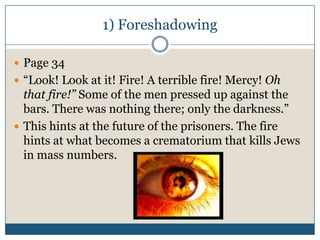
1) Foreshadowing

 Page 34
 “Look! Look at it! Fire! A terrible fire! Mercy! Oh
  that fire!” Some of the men pressed up against the
  bars. There was nothing there; only the darkness.”
 This hints at the future of the prisoners. The fire
  hints at what becomes a crematorium that kills Jews
  in mass numbers.
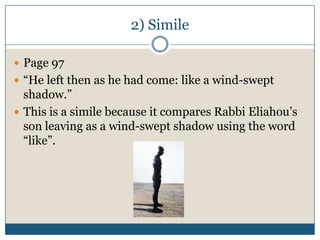
2) Simile

 Page 97
 “He left then as he had come: like a wind-swept
  shadow.”
 This is a simile because it compares Rabbi Eliahou’s
  son leaving as a wind-swept shadow using the word
  “like”.
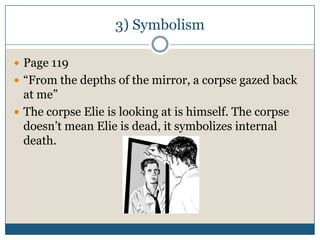
3) Symbolism

 Page 119
 “From the depths of the mirror, a corpse gazed back
  at me”
 The corpse Elie is looking at is himself. The corpse
  doesn’t mean Elie is dead, it symbolizes internal
  death.
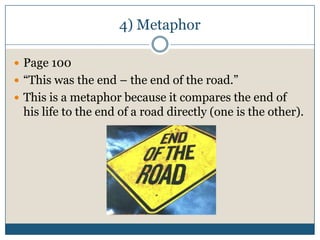
4) Metaphor

 Page 100
 “This was the end – the end of the road.”
 This is a metaphor because it compares the end of
 his life to the end of a road directly (one is the other).
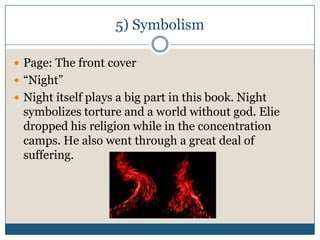
5) Symbolism

 Page: The front cover
 “Night”
 Night itself plays a big part in this book. Night
 symbolizes torture and a world without god. Elie
 dropped his religion while in the concentration
 camps. He also went through a great deal of
 suffering.
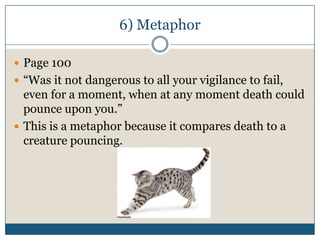
6) Metaphor

 Page 100
 “Was it not dangerous to all your vigilance to fail,
  even for a moment, when at any moment death could
  pounce upon you.”
 This is a metaphor because it compares death to a
  creature pouncing.
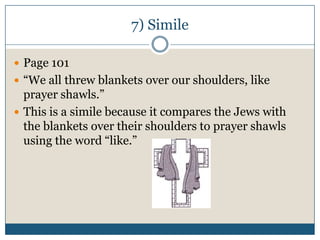
7) Simile

 Page 101
 “We all threw blankets over our shoulders, like
  prayer shawls.”
 This is a simile because it compares the Jews with
  the blankets over their shoulders to prayer shawls
  using the word “like.”
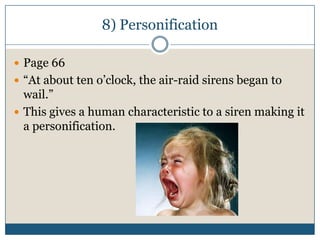
8) Personification

 Page 66
 “At about ten o’clock, the air-raid sirens began to
  wail.”
 This gives a human characteristic to a siren making it
  a personification.
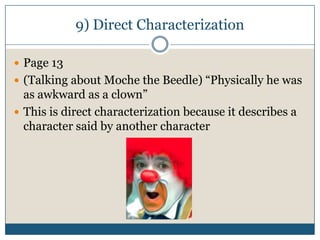
9) Direct Characterization

 Page 13
 (Talking about Moche the Beedle) “Physically he was
  as awkward as a clown”
 This is direct characterization because it describes a
  character said by another character
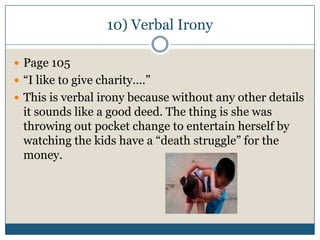
10) Verbal Irony

 Page 105
 “I like to give charity….”
 This is verbal irony because without any other details
 it sounds like a good deed. The thing is she was
 throwing out pocket change to entertain herself by
 watching the kids have a “death struggle” for the
 money.

Activity d2

  • 1.
  • 2.
    1) Foreshadowing  Page34  “Look! Look at it! Fire! A terrible fire! Mercy! Oh that fire!” Some of the men pressed up against the bars. There was nothing there; only the darkness.”  This hints at the future of the prisoners. The fire hints at what becomes a crematorium that kills Jews in mass numbers.
  • 3.
    2) Simile  Page97  “He left then as he had come: like a wind-swept shadow.”  This is a simile because it compares Rabbi Eliahou’s son leaving as a wind-swept shadow using the word “like”.
  • 4.
    3) Symbolism  Page119  “From the depths of the mirror, a corpse gazed back at me”  The corpse Elie is looking at is himself. The corpse doesn’t mean Elie is dead, it symbolizes internal death.
  • 5.
    4) Metaphor  Page100  “This was the end – the end of the road.”  This is a metaphor because it compares the end of his life to the end of a road directly (one is the other).
  • 6.
    5) Symbolism  Page:The front cover  “Night”  Night itself plays a big part in this book. Night symbolizes torture and a world without god. Elie dropped his religion while in the concentration camps. He also went through a great deal of suffering.
  • 7.
    6) Metaphor  Page100  “Was it not dangerous to all your vigilance to fail, even for a moment, when at any moment death could pounce upon you.”  This is a metaphor because it compares death to a creature pouncing.
  • 8.
    7) Simile  Page101  “We all threw blankets over our shoulders, like prayer shawls.”  This is a simile because it compares the Jews with the blankets over their shoulders to prayer shawls using the word “like.”
  • 9.
    8) Personification  Page66  “At about ten o’clock, the air-raid sirens began to wail.”  This gives a human characteristic to a siren making it a personification.
  • 10.
    9) Direct Characterization Page 13  (Talking about Moche the Beedle) “Physically he was as awkward as a clown”  This is direct characterization because it describes a character said by another character
  • 11.
    10) Verbal Irony Page 105  “I like to give charity….”  This is verbal irony because without any other details it sounds like a good deed. The thing is she was throwing out pocket change to entertain herself by watching the kids have a “death struggle” for the money.