Activity D2
Literary/Rhetorical Devices
Similes
  Page 16
“By eight o’clock weariness had settled into our veins like
molten lead.”
This is a simile because it is comparing the weariness they felt
to molten lead because it weighs down on their hearts.
Metaphors
  Page 21
“The stars were like sparks or an immense fire that were
consuming us.”
This is a metaphor because it is comparing the stars and fire
without using like or as.
Personification
  Page 84
"Around me everything was dancing a dance of death. It made
my head reel"
This is personification because it is personifying the pronoun
everything which isn't a human but giving it human
characteristics.
Verbal Irony
 Page 95
 "Why not, I like to give charity“
This was happening when Elie and his father were in the cattle
cart and men were throwing bread into the cart. It is ironic
because this generally innocent statement has a bad double
meaning.
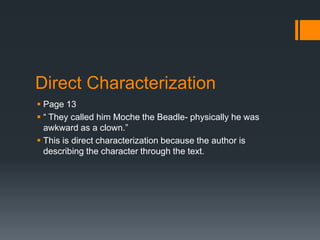
Direct Characterization
 Page 13
 “ They called him Moche the Beadle- physically he was
  awkward as a clown.”
 This is direct characterization because the author is
  describing the character through the text.
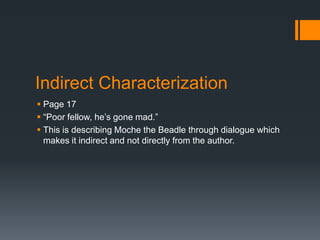
Indirect Characterization
 Page 17
 “Poor fellow, he’s gone mad.”
 This is describing Moche the Beadle through dialogue which
  makes it indirect and not directly from the author.
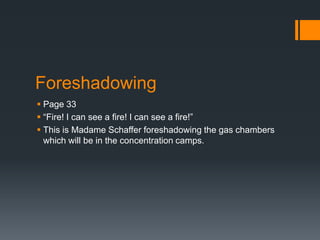
Foreshadowing
 Page 33
 “Fire! I can see a fire! I can see a fire!”
 This is Madame Schaffer foreshadowing the gas chambers
  which will be in the concentration camps.
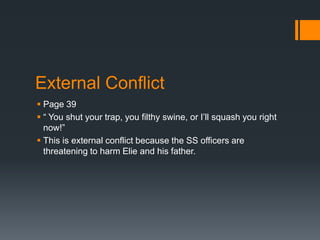
External Conflict
 Page 39
 “ You shut your trap, you filthy swine, or I’ll squash you right
  now!”
 This is external conflict because the SS officers are
  threatening to harm Elie and his father.
Internal Conflict
 Page 42
 “For the first time, I felt revolt rise up in me. Why should I
  bless his name?”
 This is internal conflict because Elie is struggling with himself
  to find faith in God during this horrible time.
Irony
 Page 53
 “I’m going to see them tomorrow. They’ll be sure to have
  good news.” “We were not to see him again.”
 This is ironic because it was expected that his wife and
  children were alive and that is what he was living for. It turns
  out they were not so he stopped fighting to live.

New d2

  • 1.
  • 2.
    Similes  Page16 “By eight o’clock weariness had settled into our veins like molten lead.” This is a simile because it is comparing the weariness they felt to molten lead because it weighs down on their hearts.
  • 3.
    Metaphors  Page21 “The stars were like sparks or an immense fire that were consuming us.” This is a metaphor because it is comparing the stars and fire without using like or as.
  • 4.
    Personification  Page84 "Around me everything was dancing a dance of death. It made my head reel" This is personification because it is personifying the pronoun everything which isn't a human but giving it human characteristics.
  • 5.
    Verbal Irony  Page95  "Why not, I like to give charity“ This was happening when Elie and his father were in the cattle cart and men were throwing bread into the cart. It is ironic because this generally innocent statement has a bad double meaning.
  • 6.
    Direct Characterization  Page13  “ They called him Moche the Beadle- physically he was awkward as a clown.”  This is direct characterization because the author is describing the character through the text.
  • 7.
    Indirect Characterization  Page17  “Poor fellow, he’s gone mad.”  This is describing Moche the Beadle through dialogue which makes it indirect and not directly from the author.
  • 8.
    Foreshadowing  Page 33 “Fire! I can see a fire! I can see a fire!”  This is Madame Schaffer foreshadowing the gas chambers which will be in the concentration camps.
  • 9.
    External Conflict  Page39  “ You shut your trap, you filthy swine, or I’ll squash you right now!”  This is external conflict because the SS officers are threatening to harm Elie and his father.
  • 10.
    Internal Conflict  Page42  “For the first time, I felt revolt rise up in me. Why should I bless his name?”  This is internal conflict because Elie is struggling with himself to find faith in God during this horrible time.
  • 11.
    Irony  Page 53 “I’m going to see them tomorrow. They’ll be sure to have good news.” “We were not to see him again.”  This is ironic because it was expected that his wife and children were alive and that is what he was living for. It turns out they were not so he stopped fighting to live.