• ‘It is teachers who in the end that
will change the world of school
by understanding it. Teachers
need to be active meaning
makers in their own professional
practice’ (Stenhouse,1985).
Activity
What is Action Research?
What do you already know
about doing action
research?
INTRODUCTION
• The question of the practical significance of
research findings has increasingly become an
issue in educational research during the past two
decades…
• Although research may be helpful for educators
in schools to solve the problems confronting
them…
most published research does not speak directly
to the “real world” needs that educators in
schools have
or is difficult to access, understand, and use
in addition, the focus of most research is “
“out there” rather than “in the practice".
Focusing upon these needs…
…educators started conducting practice-
oriented research to improve their classroom
practice.
• “The idea of action research is that
educational problems and issues are best
identified and investigated where the action
is; at the classroom and school level.
• By integrating research into these settings
and engaging those who work at this level in
research activities, findings can be applied
immediately and problems solved more
quickly” (Guskey, 2000).
What is Action research?
Action research is conceived differently by
different people and at different times. In
teaching learning context, action research is
known by many other names such as:
 school-based research
Teacher research
Practitioner research
Self-reflective enquiry
• Action research is systematic inquiry done by
teachers (or other individuals in an
educational setting) to gather information
about, and subsequently improve, the ways
their particular educational setting operates,
how they teach, and how well their students
learn (Mills, 2000).
• It is teacher-initiated, school-based research
used to improve the practitioner’s practice by
doing or changing something.
• Action research is a form of enquiry that enables
practitioners everywhere to investigate and
evaluate their work. They ask, ‘What am I doing?
What do I need to improve? How do I improve
it?’Their accounts of practice show how they are
trying to improve their own learning, and
influence the learning of others (McNiff and
Whitehead 2006)
• AR is a three step spiral process of (1) planning
which involves reconnaissance; (2) taking actions;
and (3) fact finding about the results of the
action( Kurt Lewin, 1947).
Cont’d
Cont’d
• Action Research is a collaborative activity
among colleagues searching for solutions to
every day, real problems experienced in
schools, or looking for ways to improve
instruction and increase students
achievement.
• Rather than dealing with the theoretical,
action research allows practitioners to address
those concerns closer to them.
“Action (teacher) research is a natural extension
of good teaching.
Observing students closely,
analyzing their needs, and
adjusting the curriculum to fit the needs of all
students have always been important skills
demonstrated by fine teachers” (Hubbard &
Power, 1999).
Action
research
is
a
process
through
which
practitioners
investigate
their
own
practice.
is learning
by doing
=AL
ተግባር ተኮር ምርምር ማለት ምን ማለት
ነው?
• ተግባር ተኮር ምርምር የዕለት ተዕለት ስራችንን በጥልቀት
እየተረዳን የማስተማር ስራ የሚጠይቀውን የሁሌም አዲስነት
ባህሪ ጋር የሚሄዱ ውሳኔዎችን በቀጣይነት በመዎሰን እና
ስራችንን ሁሌም ውጤታማ የምናደርግበት ነው፡፡
1. ተተም በየዕለቱ ስናስተምር የሚያጋጥሙንን በጎ የሆኑም ሆነ
ያልሆኑ ነገሮች ለምን ሊፈጠሩ እንደቻሉ ቆም ብሎ መመርመርን
እና መረዳትን ይጠይቃል፡፡
2. ተተም አንድ አጠንክረን ልንቀጥለው የምንፈልገውም ሆነ
ልንቀይረው ወይም ልናሻሽለው የምንፈልገውን ነገር በጥልቀት
ከተረዳን በºላ የመፍትሄ ሃሳቦችን የማቅረብ እና በዚህ መሰረት
እርምጃ ለመውሰድ መወሰን እና የውሳኔ ሀሳቦችን እኛው ራሳችን
ተግባራዊ ማድረግ ይጠይቃል፡፡
3. ተተም አንዴ ተሰርቶ የሚቆም አይደለም፡፡ ሂደቱ ቀጣይነት
ያለውና ዑደታዊ ሲሆን እያንዳንዱ ዑደት ልንቀይረው
የምንፈልገውን ነገር ለይቶ በጥልቀት ማጥናትን# የመፍትሄ
ሃሳቦችን ወይም ሊወሰዱ የሚገቡ እርምጃዎችን
የመተግበርና አፈጻጸማቸውንና ውጤታቸውን የመገምገም
ስራዎችን ያካትታል፡፡ ቀጣዩ ዑደት ከቀዳሚው ዑደት
ግምገማ ተነስቶ ማሻሻል የሚገባቸውን በማስተካከል
የሚቀጥል ይሆናል፡፡
4. በተተም የምንሰራው እኛው መምህራን የዕለት ከዕለት
የማስተማር ስራችንን በጥልቀት በመመርመር የበለጠ
የምናሻሽልበትን መንገድ በመፈለግና እርምጃውን እ¾ው
እራሳችን በመውሰድ የምናከናውነው ሙያዊ ግዴታችን
ነው፡፡
5. በተተም መምህራን የሚሰሩትን ስራ እና ውጤቱን እየሰሩም
ሆነ ከሰሩ በºላ ስራውን መገምገም አለባቸው፡፡
Importance of Action Research
Activity
• Why is action research important for
teachers?
• As primary school teacher in Ethiopia
what benefits do you expect from
learning and conducting AR?(What are
the advantages of being a teacher
researcher?) 10 min.
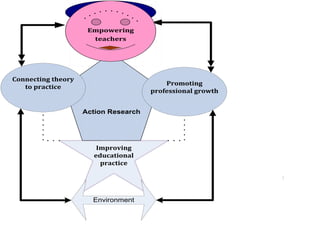
Improving
educational
practice
Action Research
Promoting
professional growth
Connecting theory
to practice
Empowering
teachers
Environment
Importance of Action Research
Connecting theory to practice: it narrow down
or avoid the gap between theory and practice in
the field of teaching, AR tries to test ideas in
practice. AR resolves theory-practice dilemma.
• A means of improving the normally poor
communications between the practicing teachers and
the academic researchers and of remedying the failure
of traditional research to give clear prescription
Improvement of classroom practice:
Action research aims at improvement in 3 areas
1) improvement of practice
2) improvement of the understanding of the practice by
the practitioners.
3) improvement of situation in which the practice takes
place
Importance of AR
contn’d
 Teacher empowerment: empowerment entails
professional autonomy, accountability and
commitment of teachers to do the right things right.
• It allows teachers to bring in to their classroom their
own unique expertise, talent and creativity so that they
can implement instructional programs to best meet the
needs of their students.
• Teachers are allowed even encouraged to take risk and
make changes to their instructional practice whenever
and wherever they believe it to be appropriate.
Contn’d
 Professional growth: It is a means of improving
teachers problem-solving skills and their attitude
towards professional development and institutional
change as well as of increasing their confidence and
professional self-esteem. AR affirms the
professionalism of teaching by giving teachers a real
voice in their professional advancement as opposed to
being told by someone else.
• A means of in-service training by equipping the
teachers with new skills and methods, sharpening
analytical powers and heightening self-awareness.
• A means of remedying problems in a specific
situations or somewhat improving a given set
of circumstances.
• A means of injecting additional or innovatory
approaches to teaching and learning into an
ongoing system which normally inhibits,
innovation and change.
Why AR?
• The main reason for teachers to engage in action
research is to learn from and to improve their own
teaching activities by re-examining their practice and
altering their taken-for-granted beliefs and
understandings.
• AR gives educators new opportunities to reflect on and
assess their teaching;
• To explore and test new ideas, methods, and materials;
• To assess how effective the new approaches were;
• To make decisions about which new approaches to
include in the practice.
When do you use action research?
1. To solve an educational problem;
2. To help educators reflect on their own
practices
3. To address school-wide problems
4. When teachers want to improve their
practices
Activity
What are the characteristics of AR? Explain the
characterizing features of AR.(10 min)
Characteristics of AR
• It is on-the-spot procedure: designed to deal with a concrete
problem located in an immediate situation(situational).
• It is usually (though not inevitably)Collaborative
• Not hierarchical
• Self-evaluative
• Sample is restricted and unrepresentative
• Its findings are not generalizable, restricted to the environment
in which the research is carried out.
• Spiraling cycles of problem identification
• It is participant-driven and reflective
• it is carried out by practitioners (classroom teachers) rather
than outside researchers;
Part Two
Process of Conducting Action research
Activity
What steps are involved in doing action
research?
List down the basic process of conducting AR
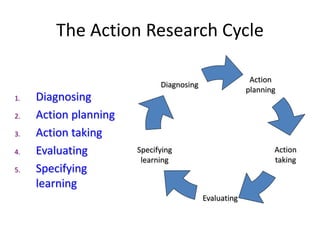
The Action Research Cycle
Action
planning
Evaluating
Diagnosing
Specifying
learning
Action
taking
1. Diagnosing
2. Action planning
3. Action taking
4. Evaluating
5. Specifying
learning
Smith, (2001)
1. መነሻ ሀሳብ
መለየት
2.የመነሻ ሀሳቡን
በጥልቀት መመርመር
5. መፍትሄውን
መገምገም
3. የመፍትሄ ዕቅድ
ማውጣት
4. መፍትሄውን
ተግባራዊ ማድረግ
ለቀጣዩ ዙር አስተያየት
መስጠት/በግምገማ
Steps to Planning an
Action Research Project
To Do:
1. Select an appropriate area of focus( find a
starting point.
2. Do reconnaissance.
3. Data collection
4. Data analysis.
5. Develop action strategies and putting them in
to practice.
6. Reflect
Steps in AR
Find a stating point Initial Reflection  plan 
Act observe reflect revised plan Act 
McNiff (2002) Action research steps:
• review our current practice,
• identify an aspect we want to improve,
• imagine a way forward,
• try it out, and
• take stock of what happens.
• modify our plan in the light of what we have
found, and continue with the 'action',
• monitor what we do,
• evaluate the modified action,
• [continue] until we are satisfied with that aspect
of our work.
What do I want to improve? Choosing a Concern:
• Think of one thing, small, in your daily teaching
with one class that troubles you.
• It must be one small thing in one class, not a huge
thing in many classes.
• For example, you might want to improve the
confidence of some poor students in a class.
• Once you have decided on the area of your concern,
then try to phrase the answer to the first question on
the action plan like this: How can I improve/help to
improve/help the students to improve?
What are the reasons for my concern? Uncovering the
Reasons for your Concern
• The reasons can be anything that is true for you. You
might want to improve students speaking. Why?
Because, perhaps, you worry they won’t be able to
increase their knowledge, or confidence, or
examination-ability.
• You might worry that if they don’t make progress they
will fail their examinations and if they fail, then they
might not get jobs.
• You might also be concerned that poor studentship
means a poor country.
How can I improve it?
• Make a list of all the ways you might help the
students improve the particular aspect you
are focusing on.
Who can help me and how?
• The fourth question on the action plan is
designed for collaboration
• No action enquiry can be done in isolation
from its context and the people who make up
your daily professional life. So, who can help
you and HOW?
How will I know it has improved? The
standards of judgment for your research:
• Ask your learning partner to give you some
ideas about what success might look like. Ask
other colleagues.
1. Identifying Issue/finding a starting
point
• Usually starting points for action research
begin with experiences of discrepancies.
• Interest
• Difficulty
• Unclear situation
12-Nov-22 38
Usually starting points for action research
begin with experience of discrepancies/
differences between:
plans and expectations and actual
practices,
the present situation and a general value
orientation,
the way in which different people view
one or the same situation
Eg. Is ability grouping effective or not?
39
Three types of starting points for research
1. An interest- trying out a promising idea
developing strength, or coping with routine
obligation in a more considerate and
economic way.
2. A difficulty- wanting to improve a difficult
situation, solve a problem, or compensate for
a deficiency.
3. An ‘unclear’ situation – teachers often begin
research with bigger or smaller doubtful
situations which are neither clearly positive nor
negative, neither enjoyable nor burdensome.
• በተተም መነሻ ሃሳብ/ ችግር የምንለው አዕም…ችን
ውስጥ የሚጉላላና ልንመልሰው የምንፈልገው
ከmማር ማሰተማሩ ጋር የተገናኘ ጥያቄ ነው፡፡
• ለምሳሌ፡አንድ መምህር በክፍል ውስጥ የተወሰኑ
ተማሪዎች ያለተገባ ባህሪ በሚያሳዩበት ጊዜ ወደ
አዕምሮው ሊመጣ የሚችለው ጥያቄ እንዴት
አድርጌ የነዚህን ተማሪዎች ባህሪ ልቀይረው? የሚል
ነው፡፡
Activity
Identify topics of action research from the issues listed below and
Justify your answers with reasons.
1. A teacher investigating parents’ perception of the innovatory
relation ship s/he established with them.
2. A lecturer at the university researched her/his own teaching of new
courses and developed modifications of teaching and learning
strategies.
3. A teacher researched to improve females’ participation in the
classroom.
4. A teacher experimented with a new form of assessment of her
pupils’ work and carried out research to improve and refine it.
5. The attitude of parents towards the provision of sex education.
6. Primary school teachers attitude towards self contained classroom.
7. Assessing teachers’ effectiveness on the implementation of the new
curriculum
1 Think of your own practical experience as a teacher:
• Is there any question which you have been wanting
to investigate for a long time already?
• Which of your strengths would you like to develop?
• Are there any aspects of your work which you find
puzzling and which have already been a focus for
your reflection?
• Are there any situations which cause difficulties and
which you would like to cope with more effectively?
Brainstorm on the ff question and
identify two starting points for action
research
• Is there something in your teaching situation that you
would like to change?
• What ‘burning questions’ do you have about your
students’ learning?
• Are there aspects of the way you teach that you would
like to improve?
• What new approaches to learning or teaching are you
interested in trying?
• What gaps are there between your current teaching
situation and what you would like to see happening?
• What needs of your students are not being met?
• What do you want your students to know, understand, or
do better than they currently do?
Approaches in choosing a starting point
a general idea or area of focus :
• should involve teaching and learning and should focus on
your own practice
Does the situation comes from my field of experience?
Can I really do something about this?
• Avoid questions you can do nothing about.
• should be within your locus of control (manageable) don’t
choose an issue that is ‘too big’(Limit the scope and
duration of your research)
• Make sure that your question is answerable
• should be something you feel passionate about
• should be something you would like to change or improve
• Relevant(how important is the situation to me and my
professional concern?) choose area of research which are
of direct relevance and interest to yourself and your school
circumstance
• Should be compatible with the rest of our activity
Starting Points
I want to improve…
I want to learn more
about…
I’m perplexed by…
Some are unhappy
about…
I’m curious about
I have a difficulty..
Continuing Starting Points
I want to try…
I want to change…
I’m interested in
1. When they are doing group work, the students
seem to waste a lot of time. How can I
increase the amount of task-oriented time for
pupils engaging in-group work?
2. My pupils are not satisfied with the methods I
use to assess their work. How can I improve
assessment methods with their help?
3. Most parents want to help their children and
the school by supervising homework. What
can we do to make their help more
productive?
Reconnaissance/learning more about
your issue
This is a step where by a teacher clearly and
critically understand the nature of the
problem to be solved or the issue to be
improved
• Describing the facts of the situation
• Explaining the facts of the situation
• Describe the Who, What, When & Where of
the situation you want to change
• Explain the Why of the situation
Data collection and analysis
• Interview
• Diaries
• Document analysis
• Observation……
Developing strategies and putting
them in to practice
• Action strategies are actions which are
planned and put in to practice by teacher
researcher in order to improve the situation
• Experimental solution to problems the
researcher is investigating
Selection of action strategies
• Usefulness: how useful is this action strategy
to solve the problem/ improve the situation
• Practicality: how practical and feasible is this
action strategies?
• Acceptability: will this action strategy be
acceptable to the teachers’ pupils and other
concerned?
Reflecting on the overall process and
results
• In action research project, reflection occurs
before, during and after the research process.
The more formal reflection, nonetheless,
comes at the final stage to reiterate the
process passed and the results obtained. This
stage is a learning process you experienced as
a result of completing the action research
project
Action Research Report
Components of an action research report
• Background
• What was my concern?
• Why was I concerned?
• What could I do?
• Who did help me?
• What did I do?
• How can I evaluate my work?
• What have I learned from doing my action research?
• Reference
• Appendix

action research @a.pptx

  • 2.
    • ‘It isteachers who in the end that will change the world of school by understanding it. Teachers need to be active meaning makers in their own professional practice’ (Stenhouse,1985).
  • 3.
    Activity What is ActionResearch? What do you already know about doing action research?
  • 4.
    INTRODUCTION • The questionof the practical significance of research findings has increasingly become an issue in educational research during the past two decades… • Although research may be helpful for educators in schools to solve the problems confronting them… most published research does not speak directly to the “real world” needs that educators in schools have or is difficult to access, understand, and use
  • 5.
    in addition, thefocus of most research is “ “out there” rather than “in the practice". Focusing upon these needs… …educators started conducting practice- oriented research to improve their classroom practice.
  • 6.
    • “The ideaof action research is that educational problems and issues are best identified and investigated where the action is; at the classroom and school level. • By integrating research into these settings and engaging those who work at this level in research activities, findings can be applied immediately and problems solved more quickly” (Guskey, 2000).
  • 7.
    What is Actionresearch? Action research is conceived differently by different people and at different times. In teaching learning context, action research is known by many other names such as:  school-based research Teacher research Practitioner research Self-reflective enquiry
  • 8.
    • Action researchis systematic inquiry done by teachers (or other individuals in an educational setting) to gather information about, and subsequently improve, the ways their particular educational setting operates, how they teach, and how well their students learn (Mills, 2000). • It is teacher-initiated, school-based research used to improve the practitioner’s practice by doing or changing something.
  • 9.
    • Action researchis a form of enquiry that enables practitioners everywhere to investigate and evaluate their work. They ask, ‘What am I doing? What do I need to improve? How do I improve it?’Their accounts of practice show how they are trying to improve their own learning, and influence the learning of others (McNiff and Whitehead 2006) • AR is a three step spiral process of (1) planning which involves reconnaissance; (2) taking actions; and (3) fact finding about the results of the action( Kurt Lewin, 1947). Cont’d
  • 10.
    Cont’d • Action Researchis a collaborative activity among colleagues searching for solutions to every day, real problems experienced in schools, or looking for ways to improve instruction and increase students achievement. • Rather than dealing with the theoretical, action research allows practitioners to address those concerns closer to them.
  • 11.
    “Action (teacher) researchis a natural extension of good teaching. Observing students closely, analyzing their needs, and adjusting the curriculum to fit the needs of all students have always been important skills demonstrated by fine teachers” (Hubbard & Power, 1999).
  • 12.
  • 13.
    ተግባር ተኮር ምርምርማለት ምን ማለት ነው? • ተግባር ተኮር ምርምር የዕለት ተዕለት ስራችንን በጥልቀት እየተረዳን የማስተማር ስራ የሚጠይቀውን የሁሌም አዲስነት ባህሪ ጋር የሚሄዱ ውሳኔዎችን በቀጣይነት በመዎሰን እና ስራችንን ሁሌም ውጤታማ የምናደርግበት ነው፡፡ 1. ተተም በየዕለቱ ስናስተምር የሚያጋጥሙንን በጎ የሆኑም ሆነ ያልሆኑ ነገሮች ለምን ሊፈጠሩ እንደቻሉ ቆም ብሎ መመርመርን እና መረዳትን ይጠይቃል፡፡ 2. ተተም አንድ አጠንክረን ልንቀጥለው የምንፈልገውም ሆነ ልንቀይረው ወይም ልናሻሽለው የምንፈልገውን ነገር በጥልቀት ከተረዳን በºላ የመፍትሄ ሃሳቦችን የማቅረብ እና በዚህ መሰረት እርምጃ ለመውሰድ መወሰን እና የውሳኔ ሀሳቦችን እኛው ራሳችን ተግባራዊ ማድረግ ይጠይቃል፡፡
  • 14.
    3. ተተም አንዴተሰርቶ የሚቆም አይደለም፡፡ ሂደቱ ቀጣይነት ያለውና ዑደታዊ ሲሆን እያንዳንዱ ዑደት ልንቀይረው የምንፈልገውን ነገር ለይቶ በጥልቀት ማጥናትን# የመፍትሄ ሃሳቦችን ወይም ሊወሰዱ የሚገቡ እርምጃዎችን የመተግበርና አፈጻጸማቸውንና ውጤታቸውን የመገምገም ስራዎችን ያካትታል፡፡ ቀጣዩ ዑደት ከቀዳሚው ዑደት ግምገማ ተነስቶ ማሻሻል የሚገባቸውን በማስተካከል የሚቀጥል ይሆናል፡፡ 4. በተተም የምንሰራው እኛው መምህራን የዕለት ከዕለት የማስተማር ስራችንን በጥልቀት በመመርመር የበለጠ የምናሻሽልበትን መንገድ በመፈለግና እርምጃውን እ¾ው እራሳችን በመውሰድ የምናከናውነው ሙያዊ ግዴታችን ነው፡፡ 5. በተተም መምህራን የሚሰሩትን ስራ እና ውጤቱን እየሰሩም ሆነ ከሰሩ በºላ ስራውን መገምገም አለባቸው፡፡
  • 15.
    Importance of ActionResearch Activity • Why is action research important for teachers? • As primary school teacher in Ethiopia what benefits do you expect from learning and conducting AR?(What are the advantages of being a teacher researcher?) 10 min.
  • 16.
  • 17.
    Importance of ActionResearch Connecting theory to practice: it narrow down or avoid the gap between theory and practice in the field of teaching, AR tries to test ideas in practice. AR resolves theory-practice dilemma. • A means of improving the normally poor communications between the practicing teachers and the academic researchers and of remedying the failure of traditional research to give clear prescription Improvement of classroom practice: Action research aims at improvement in 3 areas 1) improvement of practice 2) improvement of the understanding of the practice by the practitioners. 3) improvement of situation in which the practice takes place
  • 18.
    Importance of AR contn’d Teacher empowerment: empowerment entails professional autonomy, accountability and commitment of teachers to do the right things right. • It allows teachers to bring in to their classroom their own unique expertise, talent and creativity so that they can implement instructional programs to best meet the needs of their students. • Teachers are allowed even encouraged to take risk and make changes to their instructional practice whenever and wherever they believe it to be appropriate.
  • 19.
    Contn’d  Professional growth:It is a means of improving teachers problem-solving skills and their attitude towards professional development and institutional change as well as of increasing their confidence and professional self-esteem. AR affirms the professionalism of teaching by giving teachers a real voice in their professional advancement as opposed to being told by someone else. • A means of in-service training by equipping the teachers with new skills and methods, sharpening analytical powers and heightening self-awareness.
  • 20.
    • A meansof remedying problems in a specific situations or somewhat improving a given set of circumstances. • A means of injecting additional or innovatory approaches to teaching and learning into an ongoing system which normally inhibits, innovation and change.
  • 21.
    Why AR? • Themain reason for teachers to engage in action research is to learn from and to improve their own teaching activities by re-examining their practice and altering their taken-for-granted beliefs and understandings. • AR gives educators new opportunities to reflect on and assess their teaching; • To explore and test new ideas, methods, and materials; • To assess how effective the new approaches were; • To make decisions about which new approaches to include in the practice.
  • 22.
    When do youuse action research? 1. To solve an educational problem; 2. To help educators reflect on their own practices 3. To address school-wide problems 4. When teachers want to improve their practices
  • 23.
    Activity What are thecharacteristics of AR? Explain the characterizing features of AR.(10 min)
  • 24.
    Characteristics of AR •It is on-the-spot procedure: designed to deal with a concrete problem located in an immediate situation(situational). • It is usually (though not inevitably)Collaborative • Not hierarchical • Self-evaluative • Sample is restricted and unrepresentative • Its findings are not generalizable, restricted to the environment in which the research is carried out. • Spiraling cycles of problem identification • It is participant-driven and reflective • it is carried out by practitioners (classroom teachers) rather than outside researchers;
  • 25.
    Part Two Process ofConducting Action research Activity What steps are involved in doing action research? List down the basic process of conducting AR
  • 26.
    The Action ResearchCycle Action planning Evaluating Diagnosing Specifying learning Action taking 1. Diagnosing 2. Action planning 3. Action taking 4. Evaluating 5. Specifying learning
  • 27.
  • 28.
    1. መነሻ ሀሳብ መለየት 2.የመነሻሀሳቡን በጥልቀት መመርመር 5. መፍትሄውን መገምገም 3. የመፍትሄ ዕቅድ ማውጣት 4. መፍትሄውን ተግባራዊ ማድረግ ለቀጣዩ ዙር አስተያየት መስጠት/በግምገማ
  • 29.
    Steps to Planningan Action Research Project To Do: 1. Select an appropriate area of focus( find a starting point. 2. Do reconnaissance. 3. Data collection 4. Data analysis. 5. Develop action strategies and putting them in to practice. 6. Reflect
  • 30.
    Steps in AR Finda stating point Initial Reflection  plan  Act observe reflect revised plan Act 
  • 31.
    McNiff (2002) Actionresearch steps: • review our current practice, • identify an aspect we want to improve, • imagine a way forward, • try it out, and • take stock of what happens. • modify our plan in the light of what we have found, and continue with the 'action', • monitor what we do, • evaluate the modified action, • [continue] until we are satisfied with that aspect of our work.
  • 32.
    What do Iwant to improve? Choosing a Concern: • Think of one thing, small, in your daily teaching with one class that troubles you. • It must be one small thing in one class, not a huge thing in many classes. • For example, you might want to improve the confidence of some poor students in a class. • Once you have decided on the area of your concern, then try to phrase the answer to the first question on the action plan like this: How can I improve/help to improve/help the students to improve?
  • 33.
    What are thereasons for my concern? Uncovering the Reasons for your Concern • The reasons can be anything that is true for you. You might want to improve students speaking. Why? Because, perhaps, you worry they won’t be able to increase their knowledge, or confidence, or examination-ability. • You might worry that if they don’t make progress they will fail their examinations and if they fail, then they might not get jobs. • You might also be concerned that poor studentship means a poor country.
  • 34.
    How can Iimprove it? • Make a list of all the ways you might help the students improve the particular aspect you are focusing on.
  • 35.
    Who can helpme and how? • The fourth question on the action plan is designed for collaboration • No action enquiry can be done in isolation from its context and the people who make up your daily professional life. So, who can help you and HOW?
  • 36.
    How will Iknow it has improved? The standards of judgment for your research: • Ask your learning partner to give you some ideas about what success might look like. Ask other colleagues.
  • 37.
    1. Identifying Issue/findinga starting point • Usually starting points for action research begin with experiences of discrepancies. • Interest • Difficulty • Unclear situation
  • 38.
    12-Nov-22 38 Usually startingpoints for action research begin with experience of discrepancies/ differences between: plans and expectations and actual practices, the present situation and a general value orientation, the way in which different people view one or the same situation Eg. Is ability grouping effective or not?
  • 39.
    39 Three types ofstarting points for research 1. An interest- trying out a promising idea developing strength, or coping with routine obligation in a more considerate and economic way. 2. A difficulty- wanting to improve a difficult situation, solve a problem, or compensate for a deficiency. 3. An ‘unclear’ situation – teachers often begin research with bigger or smaller doubtful situations which are neither clearly positive nor negative, neither enjoyable nor burdensome.
  • 40.
    • በተተም መነሻሃሳብ/ ችግር የምንለው አዕም…ችን ውስጥ የሚጉላላና ልንመልሰው የምንፈልገው ከmማር ማሰተማሩ ጋር የተገናኘ ጥያቄ ነው፡፡ • ለምሳሌ፡አንድ መምህር በክፍል ውስጥ የተወሰኑ ተማሪዎች ያለተገባ ባህሪ በሚያሳዩበት ጊዜ ወደ አዕምሮው ሊመጣ የሚችለው ጥያቄ እንዴት አድርጌ የነዚህን ተማሪዎች ባህሪ ልቀይረው? የሚል ነው፡፡
  • 41.
    Activity Identify topics ofaction research from the issues listed below and Justify your answers with reasons. 1. A teacher investigating parents’ perception of the innovatory relation ship s/he established with them. 2. A lecturer at the university researched her/his own teaching of new courses and developed modifications of teaching and learning strategies. 3. A teacher researched to improve females’ participation in the classroom. 4. A teacher experimented with a new form of assessment of her pupils’ work and carried out research to improve and refine it. 5. The attitude of parents towards the provision of sex education. 6. Primary school teachers attitude towards self contained classroom. 7. Assessing teachers’ effectiveness on the implementation of the new curriculum
  • 43.
    1 Think ofyour own practical experience as a teacher: • Is there any question which you have been wanting to investigate for a long time already? • Which of your strengths would you like to develop? • Are there any aspects of your work which you find puzzling and which have already been a focus for your reflection? • Are there any situations which cause difficulties and which you would like to cope with more effectively?
  • 44.
    Brainstorm on theff question and identify two starting points for action research • Is there something in your teaching situation that you would like to change? • What ‘burning questions’ do you have about your students’ learning? • Are there aspects of the way you teach that you would like to improve? • What new approaches to learning or teaching are you interested in trying? • What gaps are there between your current teaching situation and what you would like to see happening? • What needs of your students are not being met? • What do you want your students to know, understand, or do better than they currently do?
  • 45.
    Approaches in choosinga starting point a general idea or area of focus : • should involve teaching and learning and should focus on your own practice Does the situation comes from my field of experience? Can I really do something about this? • Avoid questions you can do nothing about. • should be within your locus of control (manageable) don’t choose an issue that is ‘too big’(Limit the scope and duration of your research) • Make sure that your question is answerable • should be something you feel passionate about • should be something you would like to change or improve • Relevant(how important is the situation to me and my professional concern?) choose area of research which are of direct relevance and interest to yourself and your school circumstance • Should be compatible with the rest of our activity
  • 47.
    Starting Points I wantto improve… I want to learn more about… I’m perplexed by… Some are unhappy about… I’m curious about I have a difficulty..
  • 48.
    Continuing Starting Points Iwant to try… I want to change… I’m interested in
  • 49.
    1. When theyare doing group work, the students seem to waste a lot of time. How can I increase the amount of task-oriented time for pupils engaging in-group work? 2. My pupils are not satisfied with the methods I use to assess their work. How can I improve assessment methods with their help? 3. Most parents want to help their children and the school by supervising homework. What can we do to make their help more productive?
  • 50.
    Reconnaissance/learning more about yourissue This is a step where by a teacher clearly and critically understand the nature of the problem to be solved or the issue to be improved • Describing the facts of the situation • Explaining the facts of the situation • Describe the Who, What, When & Where of the situation you want to change • Explain the Why of the situation
  • 51.
    Data collection andanalysis • Interview • Diaries • Document analysis • Observation……
  • 52.
    Developing strategies andputting them in to practice • Action strategies are actions which are planned and put in to practice by teacher researcher in order to improve the situation • Experimental solution to problems the researcher is investigating
  • 53.
    Selection of actionstrategies • Usefulness: how useful is this action strategy to solve the problem/ improve the situation • Practicality: how practical and feasible is this action strategies? • Acceptability: will this action strategy be acceptable to the teachers’ pupils and other concerned?
  • 54.
    Reflecting on theoverall process and results • In action research project, reflection occurs before, during and after the research process. The more formal reflection, nonetheless, comes at the final stage to reiterate the process passed and the results obtained. This stage is a learning process you experienced as a result of completing the action research project
  • 55.
    Action Research Report Componentsof an action research report • Background • What was my concern? • Why was I concerned? • What could I do? • Who did help me? • What did I do? • How can I evaluate my work? • What have I learned from doing my action research? • Reference • Appendix