a simpler approach
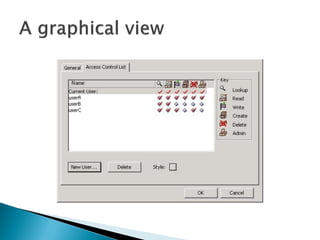
   ACL stands for Access Control List
   Used for Authorization purpose (eg: who
    access what)
   Zend, CakePHP features ACL as key
    component of their framework
   What about CodeIgniter?
   Using our custom control check
function loadPage($pageID)
{
  if($_SESSION[„userType‟] != “member”)
  {
     die(“you do not have access to this page”);
  }
}
   And the check goes on & on, Hard coded in
    our controller files…..
   What is this hook?
    ◦ a means to tap into and modify the inner workings
      of the framework without hacking the core files
    ◦ Have you heard of wordpress or mediawiki hook?
    ◦ Examples:
      We want to execute a functionality before controllers
       are loaded
   Hooks must be enabled in CodeIgniter Config file
    $config['enable_hooks'] = True;
   Hooks are defined in
    application/config/hooks.php file. Each hook is
    specified as a part of a global array named $hook

$hook[„Hook_Point‟] = array(
                     'class' => 'MyClass',
                     'function' => 'Myfunction',
                     'filename' => 'Myclass.php',
                     'filepath' => 'hooks',
                     'params' => array()
                     );
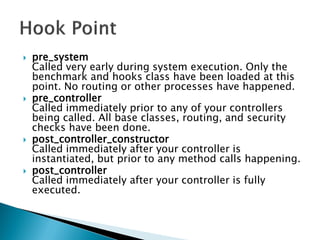
   pre_system
    Called very early during system execution. Only the
    benchmark and hooks class have been loaded at this
    point. No routing or other processes have happened.
   pre_controller
    Called immediately prior to any of your controllers
    being called. All base classes, routing, and security
    checks have been done.
   post_controller_constructor
    Called immediately after your controller is
    instantiated, but prior to any method calls happening.
   post_controller
    Called immediately after your controller is fully
    executed.
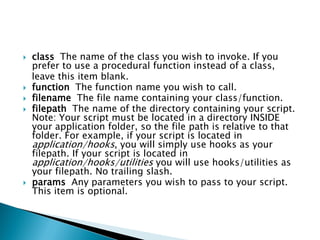
   class The name of the class you wish to invoke. If you
    prefer to use a procedural function instead of a class,
    leave this item blank.
   function The function name you wish to call.
   filename The file name containing your class/function.
   filepath The name of the directory containing your script.
    Note: Your script must be located in a directory INSIDE
    your application folder, so the file path is relative to that
    folder. For example, if your script is located in
    application/hooks, you will simply use hooks as your
    filepath. If your script is located in
    application/hooks/utilities you will use hooks/utilities as
    your filepath. No trailing slash.
   params Any parameters you wish to pass to your script.
    This item is optional.
/* application/config/hooks.php */

$hook['pre_controller'] = array(
                    'class' => 'Accesscheck',
                    'function' => 'index',
                    'filename' => 'accesscheck.php',
                    'filepath' => 'hooks');
class Accesscheck
{
   public function index($params)
   {
        require_once('permissions.php');
        $baseURL = $GLOBALS['CFG']->config['base_url'];
        $routing =& load_class('Router');
        $class = $routing->fetch_class();
        $method = $routing->fetch_method();
if(! empty($doesNotRequireLogin[$class][$method])) { return true; }
else {
           if(! $_SESSION['userType']) {     //checking authentication
                    header("location: {$baseURL}common/login"); exit;
           }
           else {

if(empty($permissions[$_SESSION['userType']][$class][$method])
                 ||
$permissions[$_SESSION['userType']][$class][$method]!=true) {

                     header("location: {$baseURL}common/unauthorized");
exit;
                     } else {
                            return true;
                     }
                 }
        }
            header("location: {$baseURL}common/unauthorized");
<?php
$doesNotRequireLogin = array();
$permissions = array();
$doesNotRequireLogin['common']['index'] = true;
$doesNotRequireLogin['common']['login'] = true;
$doesNotRequireLogin['common']['dologin'] = true;
$doesNotRequireLogin['common']['unauthorized'] = true;
$doesNotRequireLogin['common']['message'] = true;
$doesNotRequireLogin['common']['forgotpassword'] = true;
$permissions[„member‟][„blog'][„post‟] = true;
$permissions[„member‟][„blog'][„view‟] = true;
$permissions[„member‟][„blog'][„save‟] = true;
$permissions[„member‟][„blog'][„rating‟] = true;
$permissions[„guest‟][„blog'][„view‟] = true;
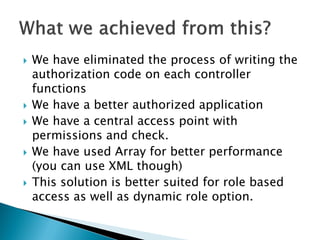
   We have eliminated the process of writing the
    authorization code on each controller
    functions
   We have a better authorized application
   We have a central access point with
    permissions and check.
   We have used Array for better performance
    (you can use XML though)
   This solution is better suited for role based
    access as well as dynamic role option.
   ACL as a Library
    ◦ There are few libraries available from CodeIgniter
      wiki page and other sources which can be used for
      ACL purpose.
M. MIZANUR RAHMAN
          Founder & C.T.O
  Informatix Technologies
[mizan@informatixbd.com]

ACL in CodeIgniter

  • 1.
  • 2.
    ACL stands for Access Control List  Used for Authorization purpose (eg: who access what)  Zend, CakePHP features ACL as key component of their framework  What about CodeIgniter?
  • 4.
    Using our custom control check function loadPage($pageID) { if($_SESSION[„userType‟] != “member”) { die(“you do not have access to this page”); } }  And the check goes on & on, Hard coded in our controller files…..
  • 5.
    What is this hook? ◦ a means to tap into and modify the inner workings of the framework without hacking the core files ◦ Have you heard of wordpress or mediawiki hook? ◦ Examples:  We want to execute a functionality before controllers are loaded
  • 6.
    Hooks must be enabled in CodeIgniter Config file $config['enable_hooks'] = True;  Hooks are defined in application/config/hooks.php file. Each hook is specified as a part of a global array named $hook $hook[„Hook_Point‟] = array( 'class' => 'MyClass', 'function' => 'Myfunction', 'filename' => 'Myclass.php', 'filepath' => 'hooks', 'params' => array() );
  • 7.
    pre_system Called very early during system execution. Only the benchmark and hooks class have been loaded at this point. No routing or other processes have happened.  pre_controller Called immediately prior to any of your controllers being called. All base classes, routing, and security checks have been done.  post_controller_constructor Called immediately after your controller is instantiated, but prior to any method calls happening.  post_controller Called immediately after your controller is fully executed.
  • 8.
    class The name of the class you wish to invoke. If you prefer to use a procedural function instead of a class, leave this item blank.  function The function name you wish to call.  filename The file name containing your class/function.  filepath The name of the directory containing your script. Note: Your script must be located in a directory INSIDE your application folder, so the file path is relative to that folder. For example, if your script is located in application/hooks, you will simply use hooks as your filepath. If your script is located in application/hooks/utilities you will use hooks/utilities as your filepath. No trailing slash.  params Any parameters you wish to pass to your script. This item is optional.
  • 9.
    /* application/config/hooks.php */ $hook['pre_controller']= array( 'class' => 'Accesscheck', 'function' => 'index', 'filename' => 'accesscheck.php', 'filepath' => 'hooks');
  • 10.
    class Accesscheck { public function index($params) { require_once('permissions.php'); $baseURL = $GLOBALS['CFG']->config['base_url']; $routing =& load_class('Router'); $class = $routing->fetch_class(); $method = $routing->fetch_method();
  • 11.
    if(! empty($doesNotRequireLogin[$class][$method])) {return true; } else { if(! $_SESSION['userType']) { //checking authentication header("location: {$baseURL}common/login"); exit; } else { if(empty($permissions[$_SESSION['userType']][$class][$method]) || $permissions[$_SESSION['userType']][$class][$method]!=true) { header("location: {$baseURL}common/unauthorized"); exit; } else { return true; } } } header("location: {$baseURL}common/unauthorized");
  • 12.
    <?php $doesNotRequireLogin = array(); $permissions= array(); $doesNotRequireLogin['common']['index'] = true; $doesNotRequireLogin['common']['login'] = true; $doesNotRequireLogin['common']['dologin'] = true; $doesNotRequireLogin['common']['unauthorized'] = true; $doesNotRequireLogin['common']['message'] = true; $doesNotRequireLogin['common']['forgotpassword'] = true;
  • 13.
    $permissions[„member‟][„blog'][„post‟] = true; $permissions[„member‟][„blog'][„view‟]= true; $permissions[„member‟][„blog'][„save‟] = true; $permissions[„member‟][„blog'][„rating‟] = true; $permissions[„guest‟][„blog'][„view‟] = true;
  • 14.
    We have eliminated the process of writing the authorization code on each controller functions  We have a better authorized application  We have a central access point with permissions and check.  We have used Array for better performance (you can use XML though)  This solution is better suited for role based access as well as dynamic role option.
  • 15.
    ACL as a Library ◦ There are few libraries available from CodeIgniter wiki page and other sources which can be used for ACL purpose.
  • 16.
    M. MIZANUR RAHMAN Founder & C.T.O Informatix Technologies [mizan@informatixbd.com]