Recommended
PPTX
Analysis of oils and fats
PPTX
DOCX
PPTX
PPTX
Determination of Acid value, Saponification value and Ester value
PPT
Fats and oils technology and advancements
PPTX
B-Pharmacy Organic Chemistry 3rd semester Practical
PPTX
3rd sem organic chemistry practical Gcop.pptx
PPTX
Analysis of fats and oil (acid value).pptx
PPTX
PPTX
Acetyl value and ester value
PPT
Identification of fatty acid and glycerol
PPTX
Fats and oil 3rd sem b pharmacy
PDF
CP LM.pdfCP LM.pdfCP LM.pdfCP LM.pdfCP LM.pdfCP LM.pdfCP LM.pdfCP LM.pdfCP LM...
PPTX
B. Pharmacy Unit-3 (Fats and Oils Reaction and Analytical Constant)
PPTX
Saponification_Value_PPT.pptx. Saponific
PPTX
MACSYMA introduction,working,application
PPTX
Cost of Capital - Cost of Equity, Cost of debenture, Cost of Preference share...
PDF
Blue / Green: Troop Leading Procedure (TLP) Overview.pdf
PPTX
Campfens "The Data Qualify Challenge: Publishers, institutions, and funders r...
PPTX
Unit I — Introduction to Anatomical Terms and Organization of the Human Body
PDF
Ketogenic diet in Epilepsy in children..
PDF
Types of Vegetable Gardens, College of Agriculture Balaghat.pdf
PPTX
Vitamins and mineral deficiency , signs and symptoms associated with exercise
PDF
The Tale of Melon City poem ppt by Sahasra
PPTX
Unit I — General Physiology: Basic Concepts
PDF
Handwritten notes of Toxicity 1. Genotoxicity 2 Carcinogenicity 3 Teratogenic...
PPTX
Details of Muscular-and-Nervous-Tissues.pptx
PPTX
SOCIAL SYSTEM.......................pptx
PDF
Projecte de la porta de primer B: L'antic Egipte
More Related Content
PPTX
Analysis of oils and fats
PPTX
DOCX
PPTX
PPTX
Determination of Acid value, Saponification value and Ester value
PPT
Fats and oils technology and advancements
PPTX
B-Pharmacy Organic Chemistry 3rd semester Practical
PPTX
3rd sem organic chemistry practical Gcop.pptx
Similar to Acid_Value_Presentation.pptx.acidvaluein
PPTX
Analysis of fats and oil (acid value).pptx
PPTX
PPTX
Acetyl value and ester value
PPT
Identification of fatty acid and glycerol
PPTX
Fats and oil 3rd sem b pharmacy
PDF
CP LM.pdfCP LM.pdfCP LM.pdfCP LM.pdfCP LM.pdfCP LM.pdfCP LM.pdfCP LM.pdfCP LM...
PPTX
B. Pharmacy Unit-3 (Fats and Oils Reaction and Analytical Constant)
PPTX
Saponification_Value_PPT.pptx. Saponific
Recently uploaded
PPTX
MACSYMA introduction,working,application
PPTX
Cost of Capital - Cost of Equity, Cost of debenture, Cost of Preference share...
PDF
Blue / Green: Troop Leading Procedure (TLP) Overview.pdf
PPTX
Campfens "The Data Qualify Challenge: Publishers, institutions, and funders r...
PPTX
Unit I — Introduction to Anatomical Terms and Organization of the Human Body
PDF
Ketogenic diet in Epilepsy in children..
PDF
Types of Vegetable Gardens, College of Agriculture Balaghat.pdf
PPTX
Vitamins and mineral deficiency , signs and symptoms associated with exercise
PDF
The Tale of Melon City poem ppt by Sahasra
PPTX
Unit I — General Physiology: Basic Concepts
PDF
Handwritten notes of Toxicity 1. Genotoxicity 2 Carcinogenicity 3 Teratogenic...
PPTX
Details of Muscular-and-Nervous-Tissues.pptx
PPTX
SOCIAL SYSTEM.......................pptx
PDF
Projecte de la porta de primer B: L'antic Egipte
PDF
Principles and Practices of GST 2.0 Study material
PDF
Projecte de la porta d'i5B: Els animals marins
PDF
DHA OPTOMETRY MCQ Question /HAAD/MOH.pdf
PDF
Nutrients & Role in Horticulture.pdf, Dr. Sharad Bisen Horticulture
PPTX
The Art Pastor's Guide to the Liturgical Calendar
PDF
Basics of Systematic Literature Search - Nasra Gathoni
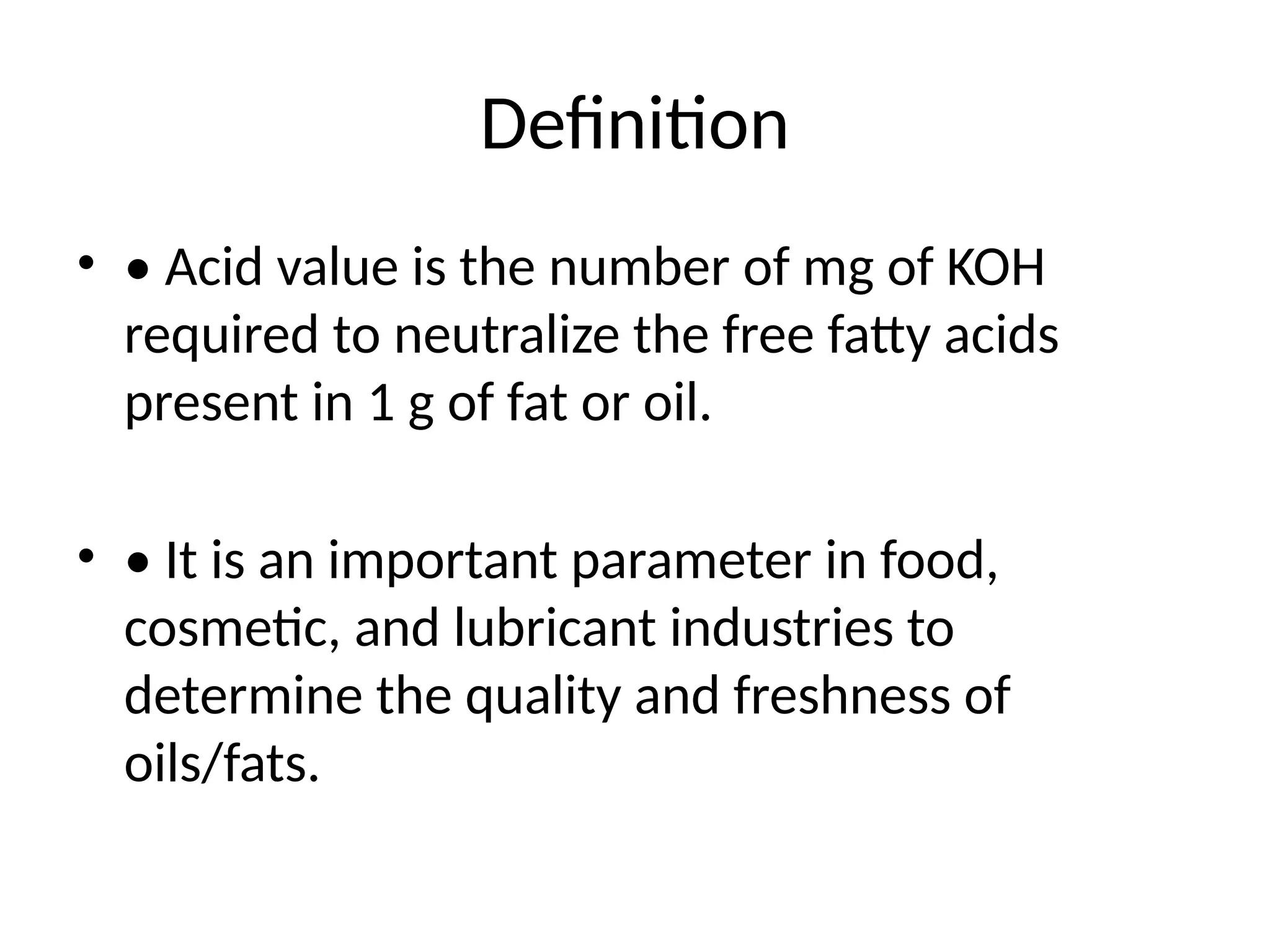
Acid_Value_Presentation.pptx.acidvaluein 1. 2. Definition
• • Acid value is the number of mg of KOH
required to neutralize the free fatty acids
present in 1 g of fat or oil.
• • It is an important parameter in food,
cosmetic, and lubricant industries to
determine the quality and freshness of
oils/fats.
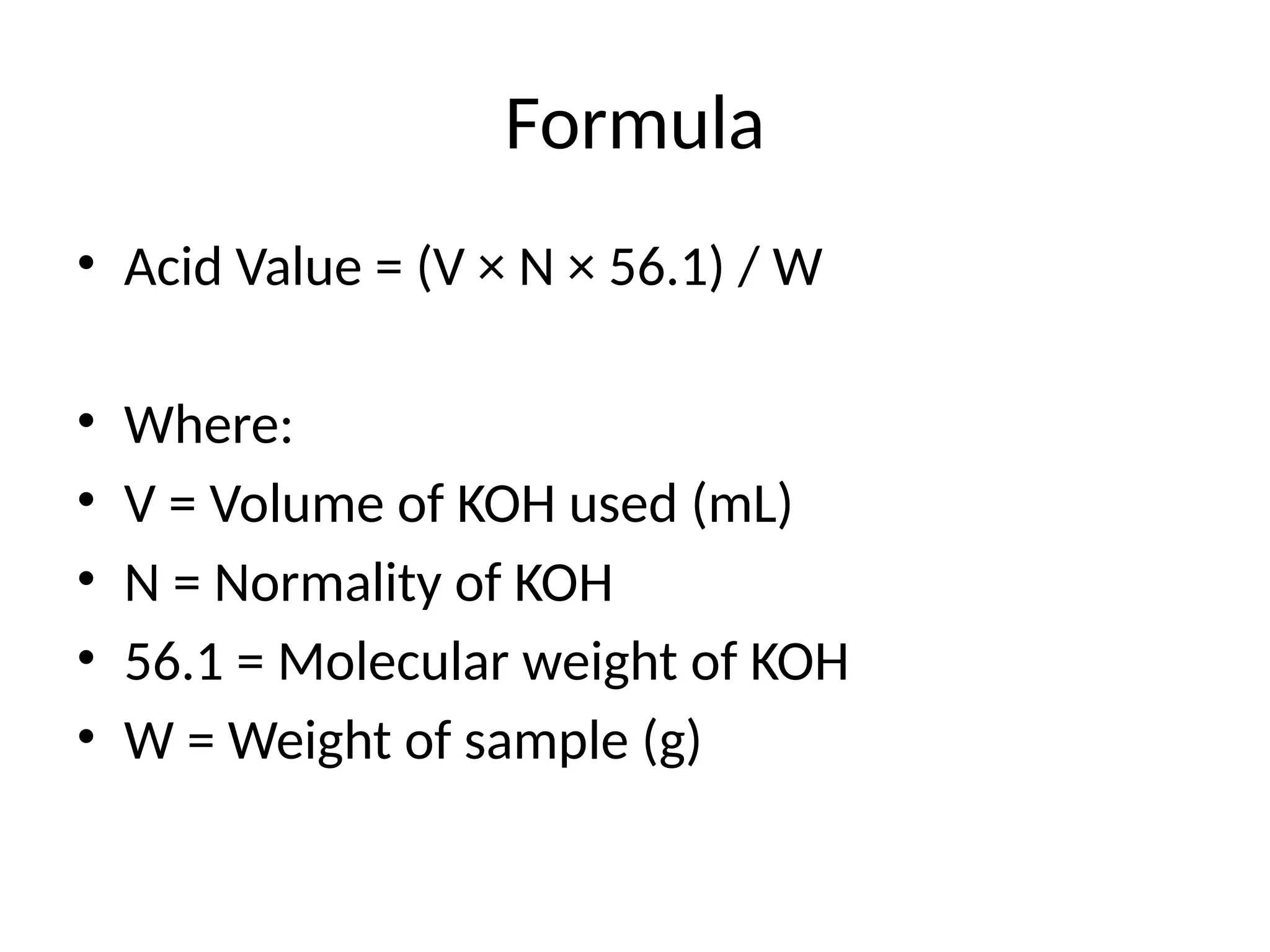
3. Formula
• Acid Value = (V × N × 56.1) / W
• Where:
• V = Volume of KOH used (mL)
• N = Normality of KOH
• 56.1 = Molecular weight of KOH
• W = Weight of sample (g)
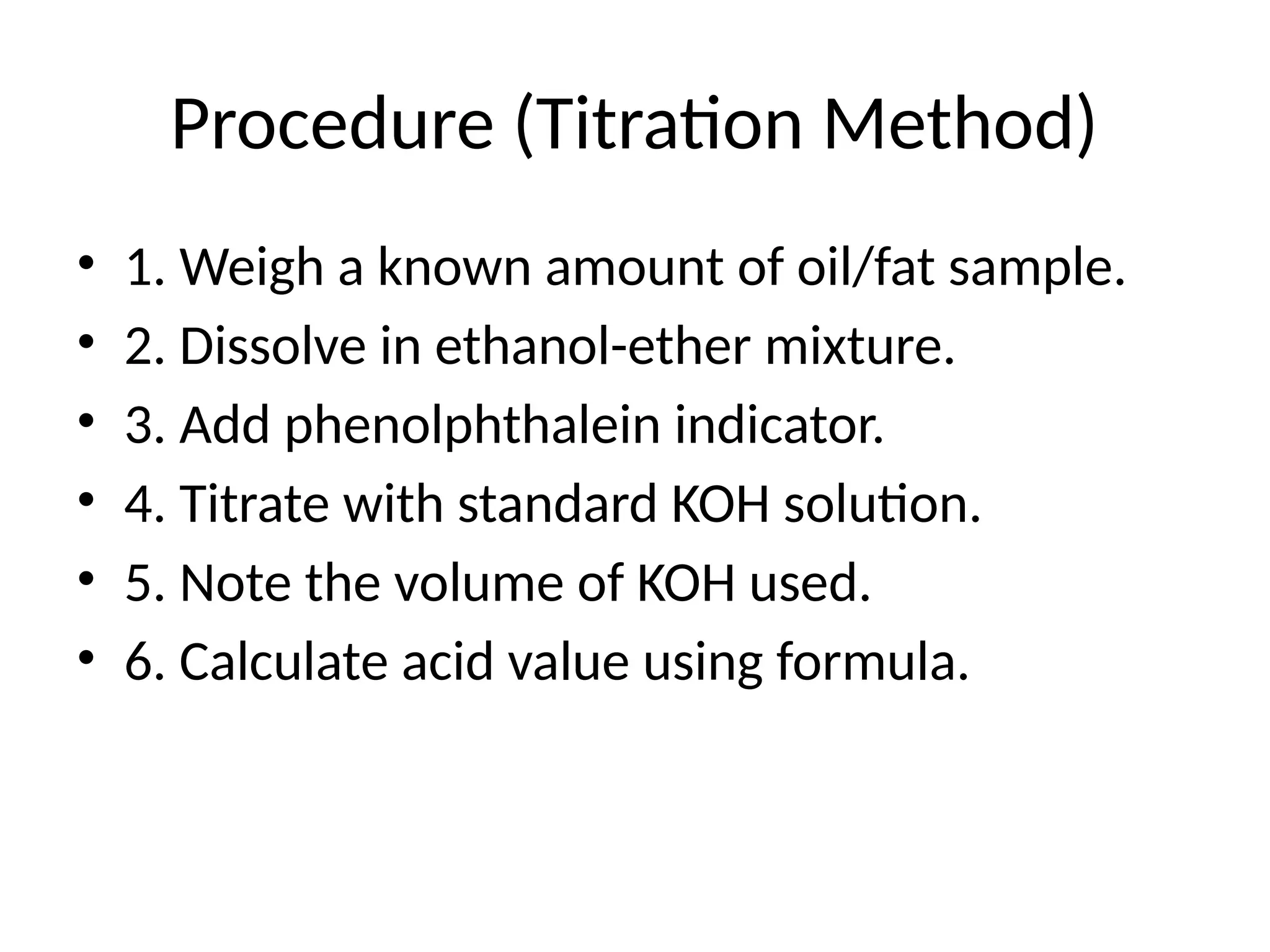
4. Procedure (Titration Method)
• 1. Weigh a known amount of oil/fat sample.
• 2. Dissolve in ethanol-ether mixture.
• 3. Add phenolphthalein indicator.
• 4. Titrate with standard KOH solution.
• 5. Note the volume of KOH used.
• 6. Calculate acid value using formula.
5. Applications
• • To assess the freshness of edible oils.
• • To check rancidity in fats and oils.
• • Used in cosmetic industry for oil quality
control.
• • In lubricants, high acid value indicates
degradation.
6. Conclusion
• • Acid value is a key parameter for
determining the quality of oils and fats.
• • Lower acid value indicates better quality and
freshness.
• • Regular monitoring ensures safety and
stability of products.