Achieving DevOps
Automation for the
Database at NBCUniversal
John Comas
Manager, Platform DevOps
NBCUniversal
Robert Reeves
CTO
Datical
Panelists
John Comas
Manager, Platform DevOps
NBCUniversal
Robert Reeves
CTO
Datical
Software as Inventory
3
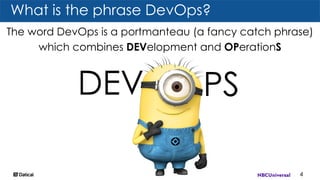
What is the phrase DevOps?
4
The word DevOps is a portmanteau (a fancy catch phrase)
which combines DEVelopment and OPerationS
DEV PS
Industry Definition of DevOps
5
• “DevOps is a software development and delivery process that
emphasizes communication and collaboration between
product management, software development, operations
professionals and close alignment with business objectives. It
supports this by automating and monitoring the process of
software integration, testing, deployment, and infrastructure
changes by establishing a culture and environment where
building, testing, and releasing software can happen rapidly,
frequently, and more reliably.”
• From: https://en.wikipedia.org/wiki/DevOps
How Do We Define DevOps?
So How Does the DevOps Team at
NBCUniversal Define DevOps?
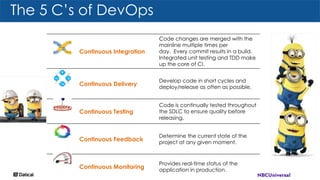
The 5 C’s of DevOps
Continuous Integration
Code changes are merged with the
mainline multiple times per
day. Every commit results in a build.
Integrated unit testing and TDD make
up the core of CI.
Continuous Delivery
Develop code in short cycles and
deploy/release as often as possible.
Continuous Testing
Code is continually tested throughout
the SDLC to ensure quality before
releasing.
Continuous Feedback
Determine the current state of the
project at any given moment.
Continuous Monitoring
Provides real-time status of the
application in production.
That’s great, but why did we need DevOps at NBCU?
8
?
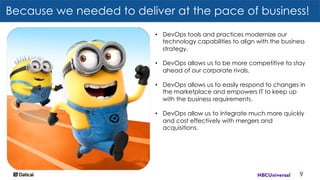
Because we needed to deliver at the pace of business!
9
• DevOps tools and practices modernize our
technology capabilities to align with the business
strategy.
• DevOps allows us to be more competitive to stay
ahead of our corporate rivals.
• DevOps allows us to easily respond to changes in
the marketplace and empowers IT to keep up
with the business requirements.
• DevOps allow us to integrate much more quickly
and cost effectively with mergers and
acquisitions.
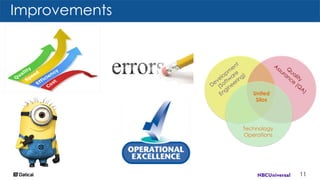
Improvements
10
So what did DevOps improve?
Improvements
11
Q
uality
Assurance
(Q
A)
Developm
ent
(Softw
are
Engineering)
Technology
Operations
United
Silos
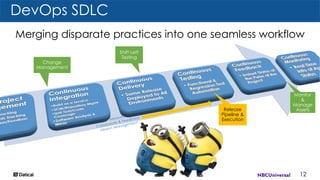
DevOps SDLC
12
Merging disparate practices into one seamless workflow
Change
Management
Shift Left
Testing
Release
Pipeline &
Execution
Monitor
&
Manage
Assets
Measure
Collaborate & Feedback
Version Management
DevOps 1.0 – Our Newborn DevOps
13
When we embarked on our newborn DevOps 1.0
workflow, we began with integrating the typical
DevOps practices of:
• Agile Project Management
• Source Code Management
• Build Automation
• Deployment Automation
• Unit Testing Integration
• QA Test Automation
Lessons Learned from DevOps 1.0
• Most of our applications have releases which consist of a
code deployment and a DB backend dependency.
• Although we were able to build and deploy apps much more
quickly and reliably through CI/CD, sprint cycle times were
not greatly improved due to the continued need for manual
database changes.
• We weren’t able to achieve the desired process and speed
improvements until we automated the database portion
(DevOps for the DB).
• If we could do it all over again, would have done our
DevOps automation of the Database FIRST!
• Automation of code deployments and database objects
must be done together.
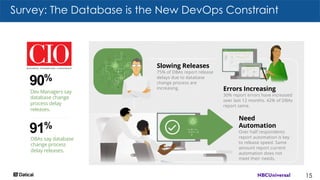
Slowing Releases
75% of DBAs report release
delays due to database
change process are
increasing.
Need
Automation
Over half respondents
report automation is key
to release speed. Same
amount report current
automation does not
meet their needs.
Errors Increasing
30% report errors have increased
over last 12 months. 42% of DBAs
report same.
Dev Managers say
database change
process delay
releases.
90%
DBAs say database
change process
delay releases.
91%
Survey: The Database is the New DevOps Constraint
15
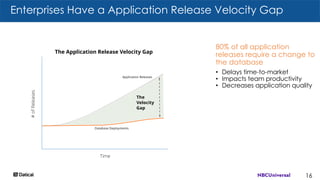
Enterprises Have a Application Release Velocity Gap
80% of all application
releases require a change to
the database
• Delays time-to-market
• Impacts team productivity
• Decreases application quality
16
#ofReleases
Time
Database Deployments
Application Releases
The
Velocity
Gap
The Application Release Velocity Gap
Application Release and the Database
17
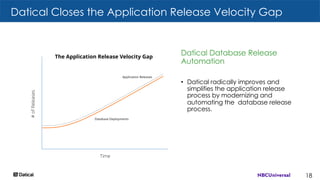
Datical Closes the Application Release Velocity Gap
Datical Database Release
Automation
• Datical radically improves and
simplifies the application release
process by modernizing and
automating the database release
process.
18
#ofReleases
Time
Database Deployments
Application Releases
The Application Release Velocity Gap
POLL QUESTION
Are database change deployments slowing
down your application release process?
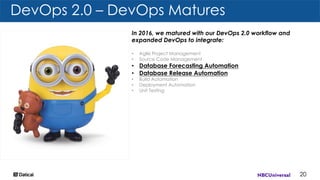
DevOps 2.0 – DevOps Matures
20
In 2016, we matured with our DevOps 2.0 workflow and
expanded DevOps to integrate:
• Agile Project Management
• Source Code Management
• Database Forecasting Automation
• Database Release Automation
• Build Automation
• Deployment Automation
• Unit Testing
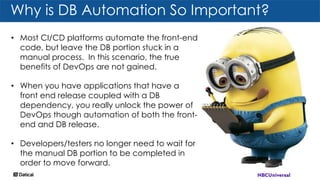
Why is DB Automation So Important?
• Most CI/CD platforms automate the front-end
code, but leave the DB portion stuck in a
manual process. In this scenario, the true
benefits of DevOps are not gained.
• When you have applications that have a
front end release coupled with a DB
dependency, you really unlock the power of
DevOps though automation of both the front-
end and DB release.
• Developers/testers no longer need to wait for
the manual DB portion to be completed in
order to move forward.
DB Deployments Can’t Be “Good Enough”
Good
Enough
Development and DBAs
23
Teamwork Makes the Dream Work
24
POLL QUESTION
Has your organization automation its
database deployment process?
Summary
• Database Forecasting and Deployment Automation has elevated our
DevOps practice to be among the most comprehensive in the industry.
• Our state-of-the-art DevOps SDLC is robust enough to support any
technology platform and deployment endpoint.
• DevOps has empowered our IT to enable the business to achieve its
goals and continue to accelerate our growth and leadership in the
industry.
Thank you!
28
Learn more!
Check out the white paper
How to get Started with
Database Release Automation
in 4 easy Steps

Achieving DevOps Automation for the Database at NBCUniversal

  • 1.
    Achieving DevOps Automation forthe Database at NBCUniversal John Comas Manager, Platform DevOps NBCUniversal Robert Reeves CTO Datical
  • 2.
    Panelists John Comas Manager, PlatformDevOps NBCUniversal Robert Reeves CTO Datical
  • 3.
  • 4.
    What is thephrase DevOps? 4 The word DevOps is a portmanteau (a fancy catch phrase) which combines DEVelopment and OPerationS DEV PS
  • 5.
    Industry Definition ofDevOps 5 • “DevOps is a software development and delivery process that emphasizes communication and collaboration between product management, software development, operations professionals and close alignment with business objectives. It supports this by automating and monitoring the process of software integration, testing, deployment, and infrastructure changes by establishing a culture and environment where building, testing, and releasing software can happen rapidly, frequently, and more reliably.” • From: https://en.wikipedia.org/wiki/DevOps
  • 6.
    How Do WeDefine DevOps? So How Does the DevOps Team at NBCUniversal Define DevOps?
  • 7.
    The 5 C’sof DevOps Continuous Integration Code changes are merged with the mainline multiple times per day. Every commit results in a build. Integrated unit testing and TDD make up the core of CI. Continuous Delivery Develop code in short cycles and deploy/release as often as possible. Continuous Testing Code is continually tested throughout the SDLC to ensure quality before releasing. Continuous Feedback Determine the current state of the project at any given moment. Continuous Monitoring Provides real-time status of the application in production.
  • 8.
    That’s great, butwhy did we need DevOps at NBCU? 8 ?
  • 9.
    Because we neededto deliver at the pace of business! 9 • DevOps tools and practices modernize our technology capabilities to align with the business strategy. • DevOps allows us to be more competitive to stay ahead of our corporate rivals. • DevOps allows us to easily respond to changes in the marketplace and empowers IT to keep up with the business requirements. • DevOps allow us to integrate much more quickly and cost effectively with mergers and acquisitions.
  • 10.
  • 11.
  • 12.
    DevOps SDLC 12 Merging disparatepractices into one seamless workflow Change Management Shift Left Testing Release Pipeline & Execution Monitor & Manage Assets Measure Collaborate & Feedback Version Management
  • 13.
    DevOps 1.0 –Our Newborn DevOps 13 When we embarked on our newborn DevOps 1.0 workflow, we began with integrating the typical DevOps practices of: • Agile Project Management • Source Code Management • Build Automation • Deployment Automation • Unit Testing Integration • QA Test Automation
  • 14.
    Lessons Learned fromDevOps 1.0 • Most of our applications have releases which consist of a code deployment and a DB backend dependency. • Although we were able to build and deploy apps much more quickly and reliably through CI/CD, sprint cycle times were not greatly improved due to the continued need for manual database changes. • We weren’t able to achieve the desired process and speed improvements until we automated the database portion (DevOps for the DB). • If we could do it all over again, would have done our DevOps automation of the Database FIRST! • Automation of code deployments and database objects must be done together.
  • 15.
    Slowing Releases 75% ofDBAs report release delays due to database change process are increasing. Need Automation Over half respondents report automation is key to release speed. Same amount report current automation does not meet their needs. Errors Increasing 30% report errors have increased over last 12 months. 42% of DBAs report same. Dev Managers say database change process delay releases. 90% DBAs say database change process delay releases. 91% Survey: The Database is the New DevOps Constraint 15
  • 16.
    Enterprises Have aApplication Release Velocity Gap 80% of all application releases require a change to the database • Delays time-to-market • Impacts team productivity • Decreases application quality 16 #ofReleases Time Database Deployments Application Releases The Velocity Gap The Application Release Velocity Gap
  • 17.
    Application Release andthe Database 17
  • 18.
    Datical Closes theApplication Release Velocity Gap Datical Database Release Automation • Datical radically improves and simplifies the application release process by modernizing and automating the database release process. 18 #ofReleases Time Database Deployments Application Releases The Application Release Velocity Gap
  • 19.
    POLL QUESTION Are databasechange deployments slowing down your application release process?
  • 20.
    DevOps 2.0 –DevOps Matures 20 In 2016, we matured with our DevOps 2.0 workflow and expanded DevOps to integrate: • Agile Project Management • Source Code Management • Database Forecasting Automation • Database Release Automation • Build Automation • Deployment Automation • Unit Testing
  • 21.
    Why is DBAutomation So Important? • Most CI/CD platforms automate the front-end code, but leave the DB portion stuck in a manual process. In this scenario, the true benefits of DevOps are not gained. • When you have applications that have a front end release coupled with a DB dependency, you really unlock the power of DevOps though automation of both the front- end and DB release. • Developers/testers no longer need to wait for the manual DB portion to be completed in order to move forward.
  • 22.
    DB Deployments Can’tBe “Good Enough” Good Enough
  • 23.
  • 24.
    Teamwork Makes theDream Work 24
  • 25.
    POLL QUESTION Has yourorganization automation its database deployment process?
  • 26.
    Summary • Database Forecastingand Deployment Automation has elevated our DevOps practice to be among the most comprehensive in the industry. • Our state-of-the-art DevOps SDLC is robust enough to support any technology platform and deployment endpoint. • DevOps has empowered our IT to enable the business to achieve its goals and continue to accelerate our growth and leadership in the industry.
  • 28.
    Thank you! 28 Learn more! Checkout the white paper How to get Started with Database Release Automation in 4 easy Steps