ACETAMINOPHEN
MONGERA MWAMBA
▪ Tylenol/paracetamol
▪ Popular analgesic and antipyretic found in many OTC and
prescription drugs
▪ Active metabolite of phenacetin and the only p-aminophenol
available in clinical practice
▪ weak COX-1 and COX-2 inhibitor in peripheral tissues with no
significant anti-inflammatory
▪ In recommended doses it is safe with remarkably few s/e
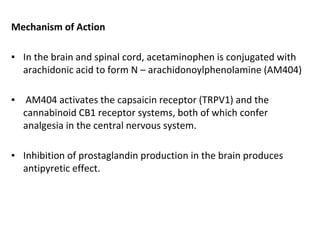
Mechanism of Action
▪ In the brain and spinal cord, acetaminophen is conjugated with
arachidonic acid to form N – arachidonoylphenolamine (AM404)
▪ AM404 activates the capsaicin receptor (TRPV1) and the
cannabinoid CB1 receptor systems, both of which confer
analgesia in the central nervous system.
▪ Inhibition of prostaglandin production in the brain produces
antipyretic effect.
Pharmacokinetics
▪ Routes of administration
a) Oral
- Rapidly absorbed from small intestine
- peak plasma concentration in 30 – 60 mins
- oral bioavailability is 63-89%
- Half life : 1.25 – 3 h(adolescents); 2 – 5 h (children) ; 4h (infants)
and 2 – 3 h (adults) – unaffected by renal function
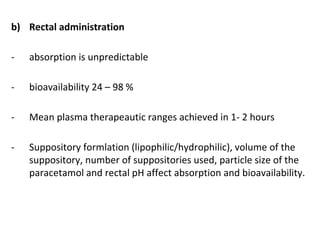
b) Rectal administration
- absorption is unpredictable
- bioavailability 24 – 98 %
- Mean plasma therapeautic ranges achieved in 1- 2 hours
- Suppository formlation (lipophilic/hydrophilic), volume of the
suppository, number of suppositories used, particle size of the
paracetamol and rectal pH affect absorption and bioavailability.
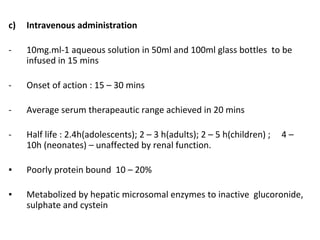
c) Intravenous administration
- 10mg.ml-1 aqueous solution in 50ml and 100ml glass bottles to be
infused in 15 mins
- Onset of action : 15 – 30 mins
- Average serum therapeautic range achieved in 20 mins
- Half life : 2.4h(adolescents); 2 – 3 h(adults); 2 – 5 h(children) ; 4 –
10h (neonates) – unaffected by renal function.
▪ Poorly protein bound 10 – 20%
▪ Metabolized by hepatic microsomal enzymes to inactive glucoronide,
sulphate and cystein
▪ larger doses (>4mg/kg/d) , a highly reactive ad hepatotoxic
metabolite N-acetyl-p-benzoquinone imine. It leads to liver failure
by depleting the liver’s natural antioxidant glutathione and
directly damaging liver cells.
▪ Antidote : acetylcysteine acts as precursor for glutathione and
directly neutralizes N-acetyl-p-benzoquinone imine
Pharmacodynamics
▪ Reduces postoperative opioid requirement by 30%
▪ Effective antipyretic
Indications
▪ mild to moderate pain e.g headache, myalgia, postpartum pain
▪ Fever
Contraindications
▪ paracetamol hypersensitivity
▪ severe hepatocellular insufficiency
Adverse effects
▪ In therapeutic doses – mild reversible increase in hepatic
enzymes may occur
▪ larger doses – dizziness , excitement, and disorientation
▪ Ingestion of 15 g – fatal : death being caused by severe
hepatotoxicity with centrilobular necrosis, sometimes associated
with acute renal tubular necrosis
ACETAMINOPHEN POSOLOGY
Regular strength: (PO/PR)
▪ Adults : 325 – 650 mg every 4- 6 h ,max dose 4g/24hrs
Extra strength : PO
▪ 1000 mg , 6 – 8 hourly , max 4g/24hrs
▪ Onset : 10 – 60 mins, duration : 3 – 4 h
Pediatric Oral Acetaminophen
▪ Neonates 28 – 31 weeks gestation
- LD 20mg/kg
- 10 – 15 mg/kg/dose q12h PRN ,max 40mg/kg/d
▪ Neonates 32 -37 weeks gestation
- LD 20mg/kg
- 10 – 15 mg/kg/dose, max dose 60mg/kg/d
▪ Neonates 10 – 29 days
- LD 20mg/kg
- 10 – 15mg/kg/dose ,max 90mg/kg/d
▪ Children and adolescents :
- <60kgs : 10 – 15mg/kg/dose , max 15mg/kg/dose or 1g/dose
whichever is less or
- 75mg/kg/d or < 4000mg/d whichever is less
Intravenous
▪ Neonates : 12.5mg/kg q6h max dose 50mg/kg/d
▪ Infants : 29 days – 2 years : 15mg/kg q6h max dose 60mg/kg/d
▪ 2 – 12 years : 12.5mg/kg q4h or 15mg/kg q6h max 75mg/kg/d
▪ < 15kgs :12.5mg/kg q4h or 15mg/kg q6h max 750mg/dose or 3.5g/d
▪ ≥ 50kgs : 650mg q4h or 1000mg q6h max dose 4g/d
ACETAMINOPHEN ANTIDOTE
▪ Methionine : effective protection up to 10 – 12 h post ingestion
▪ Acetylcysteine : effective within 24h post ingestion.
REFFERENCES:
1. Morgan and Mikhail’s .2018. Clinical anesthesiology. 6th Edition. McGraw Hill
education . New York. USA
2. Dr. Paul Clyburn, Dr.Rachel Collis and Dr. Sarah Harries .2010 .Obstetric
Anesthesia for Developing Countries . 1st Edition.
3. Manuel C. Padro Jr. and Ronald Miller. .2018. Basics of Anesthesia Seventh
Edition .
4. Chris Oscier, Nicki Bosley and Quentin Milner. 2007. Paracetamol - A Review of
Three Routes of Administration. Updates in Anesthesia . Vol 23 ,p 111 – 114.
5. Robert K. Stoelting, MD. 2015. STOELTING ’S HANDBOOK OF Pharmacology
and Physiology in Anesthetic Practice. Third Edition. Wolters Kluwer Health.
Pune – Maharashtra ,India .
6. Alan R. Aitkenhead. 2007. Smith and Aitkenhead’s Textbook of Anaesthesia.
6th Edition. Churchill Livingstone – Elsevier . China .

ACETAMINOPHEN.pptx

  • 1.
  • 2.
    ▪ Tylenol/paracetamol ▪ Popularanalgesic and antipyretic found in many OTC and prescription drugs ▪ Active metabolite of phenacetin and the only p-aminophenol available in clinical practice ▪ weak COX-1 and COX-2 inhibitor in peripheral tissues with no significant anti-inflammatory ▪ In recommended doses it is safe with remarkably few s/e
  • 3.
    Mechanism of Action ▪In the brain and spinal cord, acetaminophen is conjugated with arachidonic acid to form N – arachidonoylphenolamine (AM404) ▪ AM404 activates the capsaicin receptor (TRPV1) and the cannabinoid CB1 receptor systems, both of which confer analgesia in the central nervous system. ▪ Inhibition of prostaglandin production in the brain produces antipyretic effect.
  • 4.
    Pharmacokinetics ▪ Routes ofadministration a) Oral - Rapidly absorbed from small intestine - peak plasma concentration in 30 – 60 mins - oral bioavailability is 63-89% - Half life : 1.25 – 3 h(adolescents); 2 – 5 h (children) ; 4h (infants) and 2 – 3 h (adults) – unaffected by renal function
  • 5.
    b) Rectal administration -absorption is unpredictable - bioavailability 24 – 98 % - Mean plasma therapeautic ranges achieved in 1- 2 hours - Suppository formlation (lipophilic/hydrophilic), volume of the suppository, number of suppositories used, particle size of the paracetamol and rectal pH affect absorption and bioavailability.
  • 6.
    c) Intravenous administration -10mg.ml-1 aqueous solution in 50ml and 100ml glass bottles to be infused in 15 mins - Onset of action : 15 – 30 mins - Average serum therapeautic range achieved in 20 mins - Half life : 2.4h(adolescents); 2 – 3 h(adults); 2 – 5 h(children) ; 4 – 10h (neonates) – unaffected by renal function. ▪ Poorly protein bound 10 – 20% ▪ Metabolized by hepatic microsomal enzymes to inactive glucoronide, sulphate and cystein
  • 7.
    ▪ larger doses(>4mg/kg/d) , a highly reactive ad hepatotoxic metabolite N-acetyl-p-benzoquinone imine. It leads to liver failure by depleting the liver’s natural antioxidant glutathione and directly damaging liver cells. ▪ Antidote : acetylcysteine acts as precursor for glutathione and directly neutralizes N-acetyl-p-benzoquinone imine Pharmacodynamics ▪ Reduces postoperative opioid requirement by 30% ▪ Effective antipyretic
  • 8.
    Indications ▪ mild tomoderate pain e.g headache, myalgia, postpartum pain ▪ Fever Contraindications ▪ paracetamol hypersensitivity ▪ severe hepatocellular insufficiency
  • 9.
    Adverse effects ▪ Intherapeutic doses – mild reversible increase in hepatic enzymes may occur ▪ larger doses – dizziness , excitement, and disorientation ▪ Ingestion of 15 g – fatal : death being caused by severe hepatotoxicity with centrilobular necrosis, sometimes associated with acute renal tubular necrosis
  • 10.
    ACETAMINOPHEN POSOLOGY Regular strength:(PO/PR) ▪ Adults : 325 – 650 mg every 4- 6 h ,max dose 4g/24hrs Extra strength : PO ▪ 1000 mg , 6 – 8 hourly , max 4g/24hrs ▪ Onset : 10 – 60 mins, duration : 3 – 4 h
  • 11.
    Pediatric Oral Acetaminophen ▪Neonates 28 – 31 weeks gestation - LD 20mg/kg - 10 – 15 mg/kg/dose q12h PRN ,max 40mg/kg/d ▪ Neonates 32 -37 weeks gestation - LD 20mg/kg - 10 – 15 mg/kg/dose, max dose 60mg/kg/d ▪ Neonates 10 – 29 days - LD 20mg/kg - 10 – 15mg/kg/dose ,max 90mg/kg/d ▪ Children and adolescents : - <60kgs : 10 – 15mg/kg/dose , max 15mg/kg/dose or 1g/dose whichever is less or - 75mg/kg/d or < 4000mg/d whichever is less
  • 12.
    Intravenous ▪ Neonates :12.5mg/kg q6h max dose 50mg/kg/d ▪ Infants : 29 days – 2 years : 15mg/kg q6h max dose 60mg/kg/d ▪ 2 – 12 years : 12.5mg/kg q4h or 15mg/kg q6h max 75mg/kg/d ▪ < 15kgs :12.5mg/kg q4h or 15mg/kg q6h max 750mg/dose or 3.5g/d ▪ ≥ 50kgs : 650mg q4h or 1000mg q6h max dose 4g/d ACETAMINOPHEN ANTIDOTE ▪ Methionine : effective protection up to 10 – 12 h post ingestion ▪ Acetylcysteine : effective within 24h post ingestion.
  • 13.
    REFFERENCES: 1. Morgan andMikhail’s .2018. Clinical anesthesiology. 6th Edition. McGraw Hill education . New York. USA 2. Dr. Paul Clyburn, Dr.Rachel Collis and Dr. Sarah Harries .2010 .Obstetric Anesthesia for Developing Countries . 1st Edition. 3. Manuel C. Padro Jr. and Ronald Miller. .2018. Basics of Anesthesia Seventh Edition . 4. Chris Oscier, Nicki Bosley and Quentin Milner. 2007. Paracetamol - A Review of Three Routes of Administration. Updates in Anesthesia . Vol 23 ,p 111 – 114. 5. Robert K. Stoelting, MD. 2015. STOELTING ’S HANDBOOK OF Pharmacology and Physiology in Anesthetic Practice. Third Edition. Wolters Kluwer Health. Pune – Maharashtra ,India . 6. Alan R. Aitkenhead. 2007. Smith and Aitkenhead’s Textbook of Anaesthesia. 6th Edition. Churchill Livingstone – Elsevier . China .