THE ACCOUNTING MODEL

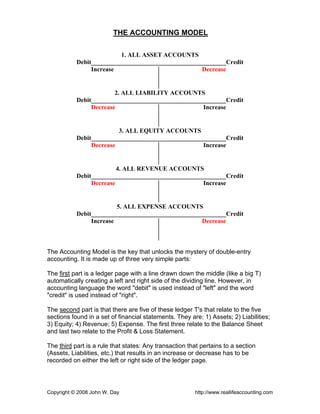
                          1. ALL ASSET ACCOUNTS
           Debit___________________________________________Credit
                Increase                           Decrease


                        2. ALL LIABILITY ACCOUNTS
           Debit___________________________________________Credit
                Decrease                            Increase


                         3. ALL EQUITY ACCOUNTS
           Debit___________________________________________Credit
                Decrease                            Increase


                         4. ALL REVENUE ACCOUNTS
           Debit___________________________________________Credit
                Decrease                            Increase


                         5. ALL EXPENSE ACCOUNTS
           Debit___________________________________________Credit
                Increase                           Decrease


The Accounting Model is the key that unlocks the mystery of double-entry
accounting. It is made up of three very simple parts:

The first part is a ledger page with a line drawn down the middle (like a big T)
automatically creating a left and right side of the dividing line. However, in
accounting language the word "debit" is used instead of "left" and the word
"credit" is used instead of "right".

The second part is that there are five of these ledger T's that relate to the five
sections found in a set of financial statements. They are: 1) Assets; 2) Liabilities;
3) Equity; 4) Revenue; 5) Expense. The first three relate to the Balance Sheet
and last two relate to the Profit & Loss Statement.

The third part is a rule that states: Any transaction that pertains to a section
(Assets, Liabilities, etc.) that results in an increase or decrease has to be
recorded on either the left or right side of the ledger page.


Copyright © 2008 John W. Day                            http://www.reallifeaccounting.com

Accounting model

  • 1.
    THE ACCOUNTING MODEL 1. ALL ASSET ACCOUNTS Debit___________________________________________Credit Increase Decrease 2. ALL LIABILITY ACCOUNTS Debit___________________________________________Credit Decrease Increase 3. ALL EQUITY ACCOUNTS Debit___________________________________________Credit Decrease Increase 4. ALL REVENUE ACCOUNTS Debit___________________________________________Credit Decrease Increase 5. ALL EXPENSE ACCOUNTS Debit___________________________________________Credit Increase Decrease The Accounting Model is the key that unlocks the mystery of double-entry accounting. It is made up of three very simple parts: The first part is a ledger page with a line drawn down the middle (like a big T) automatically creating a left and right side of the dividing line. However, in accounting language the word "debit" is used instead of "left" and the word "credit" is used instead of "right". The second part is that there are five of these ledger T's that relate to the five sections found in a set of financial statements. They are: 1) Assets; 2) Liabilities; 3) Equity; 4) Revenue; 5) Expense. The first three relate to the Balance Sheet and last two relate to the Profit & Loss Statement. The third part is a rule that states: Any transaction that pertains to a section (Assets, Liabilities, etc.) that results in an increase or decrease has to be recorded on either the left or right side of the ledger page. Copyright © 2008 John W. Day http://www.reallifeaccounting.com