Promoting Literacy through Conversation Workshop II:  Accountable Talk for Elementary Students c . Sarah  De Bruin  Fall 2010
c Sarah  De Bruin  Fall 2010 Please take a few minutes to respond to the Minute Reflection on the following slide. Leave your comments on the post labeled Workshop II Minute Reflection.”  Thank you!
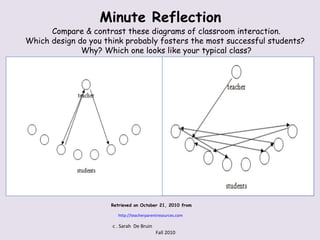
Minute Reflection Compare & contrast these diagrams of classroom interaction. Which design do you think probably fosters the most successful students?  Why? Which one looks like your typical class? http://teacherparentresources.com c . Sarah  De Bruin  Fall 2010 Retrieved on October 21, 2010 from
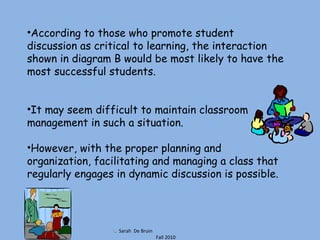
According to those who promote student discussion as critical to learning, the interaction shown in diagram B would be most likely to have the most successful students.  It may seem difficult to maintain classroom management in such a situation. However, with the proper planning and organization, facilitating and managing a class that regularly engages in dynamic discussion is possible. c .  Sarah  De Bruin  Fall 2010
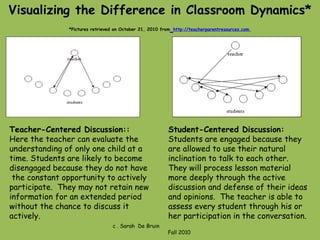
Student-Centered Discussion:  Students are engaged because they are allowed to use their natural inclination to talk to each other.  They will process lesson material more deeply through the active discussion and defense of their ideas and opinions.  The teacher is able to assess every student through his or her participation in the conversation. Teacher-Centered Discussion:: Here the teacher can evaluate the understanding of only one child at a  time. Students are likely to become disengaged because they do not have the constant opportunity to actively participate.  They may not retain new information for an extended period without the chance to discuss it  actively. Visualizing the Difference in Classroom Dynamics* *Pictures retrieved on October 21, 2010 from   http://teacherparentresources.com  c . Sarah  De Bruin  Fall 2010
Accountable Talk Does Not Occur Naturally You will need to: use gradual release of responsibility to scaffold and model the conversation process for your Clinic client/students. identify clearly the responsibilities your client/students will have during the conversations. Students need to realize they are expected to: show through body language, active questioning, and connection making that they listen to and value others’ statements. convey accurate information. justify their statements with evidence. explain their thinking process. take time to think before speaking. ask for clarification and justification of unclear information. Institute of Learning c . Sarah  De Bruin  Fall 2010
STARTING THE CONVERSATION c . Sarah  De Bruin  Fall 2010
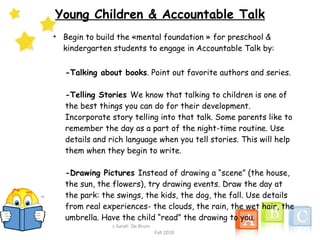
Young Children & Accountable Talk Begin to build the «mental foundation » for preschool & kindergarten students to engage in Accountable Talk by: -Talking about books . Point out favorite authors and series. -Telling Stories  We know that talking to children is one of the best things you can do for their development. Incorporate story telling into that talk. Some parents like to remember the day as a part of the night-time routine. Use details and rich language when you tell stories. This will help them when they begin to write. -Drawing Pictures  Instead of drawing a “scene” (the house, the sun, the flowers), try drawing events. Draw the day at the park: the swings, the kids, the dog, the fall. Use details from real experiences- the clouds, the rain, the wet hair, the umbrella. Have the child “read” the drawing to you.   c Sarah  De Bruin  Fall 2010
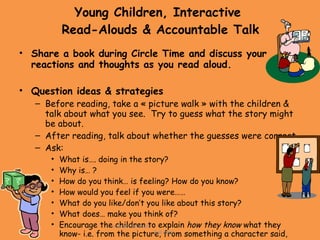
Young Children, Interactive  Read-Alouds & Accountable Talk Share a book during Circle Time and discuss your reactions and thoughts as you read aloud. Question ideas & strategies Before reading, take a « picture walk » with the children & talk about what you see.  Try to guess what the story might be about. After reading, talk about whether the guesses were correct.  Ask: What is…. doing in the story? Why is… ? How do you think… is feeling? How do you know? How would you feel if you were…… What do you like/don’t you like about this story? What does… make you think of? Encourage the children to explain  how   they know  what they know- i.e. from the picture, from something a character said, etc. c Sarah  De Bruin  Fall 2010
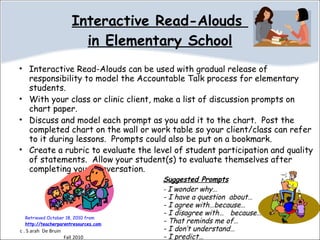
Interactive Read-Alouds  in Elementary School Interactive Read-Alouds can be used with gradual release of responsibility to model the Accountable Talk process for elementary students. With your class or clinic client, make a list of discussion prompts on chart paper. Discuss and model each prompt as you add it to the chart.  Post the completed chart on the wall or work table so your client/class can refer to it during lessons.  Prompts could also be put on a bookmark. Create a rubric to evaluate the level of student participation and quality of statements.  Allow your student(s) to evaluate themselves after completing your conversation.    Suggested Prompts -  I wonder why… - I have a question  about… - I agree with…because… - I disagree with…  because… - That reminds me of… - I don’t understand… - I predict… - I figured out… -  I liked/disliked… Retrieved October 18, 2010 from http://teacherparentresources.com c . S arah  De Bruin  Fall 2010
1.  On the Wiki space page, you will find several  sample mini-lesson plans and resources for introducing & implementing  Accountable Talk in your classroom. Please take some time to review them & consider how you might adapt them for use with your Clinic client as well as in your own classroom. Answer the following questions on the post labeled “Workshop II Reflection & Application Activity:” Do you believe that Accountable Talk is a worthwhile tool for your students to learn? Why or why not? What challenges do you foresee? How could you use the resources provided here to guide your students?  If you do not feel  they are useful, how would you go about ensuring  that your students are able to think critically? c Sarah  De Bruin  Fall 2010 Reflection & Application Activity
c Sarah  De Bruin  Fall 2010 References Accountable Talk Prompts.  February 14, 2008.  Retrieved October 18, 2010 from  www.teacherparentresources.com Pre-reading Activities:  Laying the Foundations for Literacy with Toddlers.  February 6, 2008.  Retrieved October 18,  2010 from  www.teacherparentresources.com . Accountable Talk: Providing Feedback on Group Discussions.  March 27, 2008. Retrieved October 20, 2010 from www.teacherparentresources.com . Institute for Learning (2001).  Accountable talk: Classroom  conversation that works.  Pittsburgh, Pa.: Learning Research &Development Center, University of Pittsburgh. Retrieved October 20, 2010 from  www.instituteforlearning.org

Accountable talk and elementary students

  • 1.
    Promoting Literacy throughConversation Workshop II: Accountable Talk for Elementary Students c . Sarah De Bruin Fall 2010
  • 2.
    c Sarah De Bruin Fall 2010 Please take a few minutes to respond to the Minute Reflection on the following slide. Leave your comments on the post labeled Workshop II Minute Reflection.” Thank you!
  • 3.
    Minute Reflection Compare& contrast these diagrams of classroom interaction. Which design do you think probably fosters the most successful students? Why? Which one looks like your typical class? http://teacherparentresources.com c . Sarah De Bruin Fall 2010 Retrieved on October 21, 2010 from
  • 4.
    According to thosewho promote student discussion as critical to learning, the interaction shown in diagram B would be most likely to have the most successful students. It may seem difficult to maintain classroom management in such a situation. However, with the proper planning and organization, facilitating and managing a class that regularly engages in dynamic discussion is possible. c . Sarah De Bruin Fall 2010
  • 5.
    Student-Centered Discussion: Students are engaged because they are allowed to use their natural inclination to talk to each other. They will process lesson material more deeply through the active discussion and defense of their ideas and opinions. The teacher is able to assess every student through his or her participation in the conversation. Teacher-Centered Discussion:: Here the teacher can evaluate the understanding of only one child at a time. Students are likely to become disengaged because they do not have the constant opportunity to actively participate. They may not retain new information for an extended period without the chance to discuss it actively. Visualizing the Difference in Classroom Dynamics* *Pictures retrieved on October 21, 2010 from http://teacherparentresources.com c . Sarah De Bruin Fall 2010
  • 6.
    Accountable Talk DoesNot Occur Naturally You will need to: use gradual release of responsibility to scaffold and model the conversation process for your Clinic client/students. identify clearly the responsibilities your client/students will have during the conversations. Students need to realize they are expected to: show through body language, active questioning, and connection making that they listen to and value others’ statements. convey accurate information. justify their statements with evidence. explain their thinking process. take time to think before speaking. ask for clarification and justification of unclear information. Institute of Learning c . Sarah De Bruin Fall 2010
  • 7.
    STARTING THE CONVERSATIONc . Sarah De Bruin Fall 2010
  • 8.
    Young Children &Accountable Talk Begin to build the «mental foundation » for preschool & kindergarten students to engage in Accountable Talk by: -Talking about books . Point out favorite authors and series. -Telling Stories We know that talking to children is one of the best things you can do for their development. Incorporate story telling into that talk. Some parents like to remember the day as a part of the night-time routine. Use details and rich language when you tell stories. This will help them when they begin to write. -Drawing Pictures Instead of drawing a “scene” (the house, the sun, the flowers), try drawing events. Draw the day at the park: the swings, the kids, the dog, the fall. Use details from real experiences- the clouds, the rain, the wet hair, the umbrella. Have the child “read” the drawing to you. c Sarah De Bruin Fall 2010
  • 9.
    Young Children, Interactive Read-Alouds & Accountable Talk Share a book during Circle Time and discuss your reactions and thoughts as you read aloud. Question ideas & strategies Before reading, take a « picture walk » with the children & talk about what you see. Try to guess what the story might be about. After reading, talk about whether the guesses were correct. Ask: What is…. doing in the story? Why is… ? How do you think… is feeling? How do you know? How would you feel if you were…… What do you like/don’t you like about this story? What does… make you think of? Encourage the children to explain how they know what they know- i.e. from the picture, from something a character said, etc. c Sarah De Bruin Fall 2010
  • 10.
    Interactive Read-Alouds in Elementary School Interactive Read-Alouds can be used with gradual release of responsibility to model the Accountable Talk process for elementary students. With your class or clinic client, make a list of discussion prompts on chart paper. Discuss and model each prompt as you add it to the chart. Post the completed chart on the wall or work table so your client/class can refer to it during lessons. Prompts could also be put on a bookmark. Create a rubric to evaluate the level of student participation and quality of statements. Allow your student(s) to evaluate themselves after completing your conversation. Suggested Prompts - I wonder why… - I have a question about… - I agree with…because… - I disagree with… because… - That reminds me of… - I don’t understand… - I predict… - I figured out… - I liked/disliked… Retrieved October 18, 2010 from http://teacherparentresources.com c . S arah De Bruin Fall 2010
  • 11.
    1. Onthe Wiki space page, you will find several sample mini-lesson plans and resources for introducing & implementing Accountable Talk in your classroom. Please take some time to review them & consider how you might adapt them for use with your Clinic client as well as in your own classroom. Answer the following questions on the post labeled “Workshop II Reflection & Application Activity:” Do you believe that Accountable Talk is a worthwhile tool for your students to learn? Why or why not? What challenges do you foresee? How could you use the resources provided here to guide your students? If you do not feel they are useful, how would you go about ensuring that your students are able to think critically? c Sarah De Bruin Fall 2010 Reflection & Application Activity
  • 12.
    c Sarah De Bruin Fall 2010 References Accountable Talk Prompts. February 14, 2008. Retrieved October 18, 2010 from www.teacherparentresources.com Pre-reading Activities: Laying the Foundations for Literacy with Toddlers. February 6, 2008. Retrieved October 18, 2010 from www.teacherparentresources.com . Accountable Talk: Providing Feedback on Group Discussions. March 27, 2008. Retrieved October 20, 2010 from www.teacherparentresources.com . Institute for Learning (2001). Accountable talk: Classroom conversation that works. Pittsburgh, Pa.: Learning Research &Development Center, University of Pittsburgh. Retrieved October 20, 2010 from www.instituteforlearning.org