Report Date, 200xPage 2
Objectives, Scope & Procedures Performed 2
Executive Summary 3
Detailed Issues & Observations 5
Appendices
Appendix A: General Background 20
Appendix B: Internal Control Scorecard 22
Appendix C: Best Practices Scorecard 23
Appendix D: Best Practices Details 24
Appendix E: Testing Summary 29
Appendix F: Performance Measures 32
Appendix G: Process Flowcharts 33
Table of Contents
This report provides management with information about the condition of risks and internal controls at a specific point in time. Future changes
in environmental factors and actions by personnel will impact these risks and internal controls in ways that this report cannot anticipate.
3.
Report Date, 200xPage 3
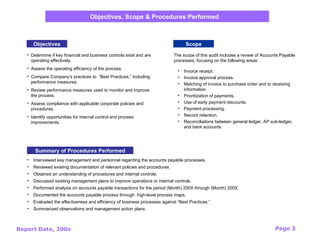
The scope of this audit includes a review of Accounts Payable
processes, focusing on the following areas:
• Invoice receipt.
• Invoice approval process.
• Matching of invoice to purchase order and to receiving
information.
• Prioritization of payments.
• Use of early payment discounts.
• Payment processing.
• Record retention.
• Reconciliations between general ledger, AP sub-ledger,
and bank accounts.
• Determine if key financial and business controls exist and are
operating effectively.
• Assess the operating efficiency of the process.
• Compare Company’s practices to “Best Practices,” including
performance measures.
• Review performance measures used to monitor and improve
the process.
• Assess compliance with applicable corporate policies and
procedures.
• Identify opportunities for internal control and process
improvements.
• Interviewed key management and personnel regarding the accounts payable processes.
• Reviewed existing documentation of relevant policies and procedures.
• Obtained an understanding of procedures and internal controls.
• Discussed existing management plans to improve operations or internal controls.
• Performed analysis on accounts payable transactions for the period (Month) 200X through (Month) 200X.
• Documented the accounts payable process through high-level process maps.
• Evaluated the effectiveness and efficiency of business processes against “Best Practices.”
• Summarized observations and management action plans.
Objectives, Scope & Procedures Performed
Summary of Procedures Performed
Objectives Scope
4.
Report Date, 200xPage 4
Executive Summary
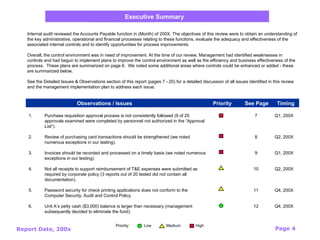
Internal audit reviewed the Accounts Payable function in (Month) of 200X. The objectives of this review were to obtain an understanding of
the key administrative, operational and financial processes relating to these functions, evaluate the adequacy and effectiveness of the
associated internal controls and to identify opportunities for process improvements.
Overall, the control environment was in need of improvement. At the time of our review, Management had identified weaknesses in
controls and had begun to implement plans to improve the control environment as well as the efficiency and business effectiveness of the
process. These plans are summarized on page 6. We noted some additional areas where controls could be enhanced or added - these
are summarized below.
See the Detailed Issues & Observations section of this report (pages 7 - 20) for a detailed discussion of all issues identified in this review
and the management implementation plan to address each issue.
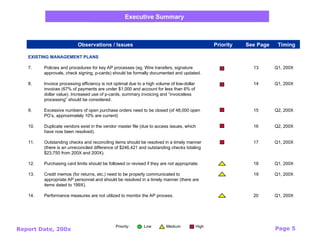
Observations / Issues Priority See Page Timing
Q1, 200X
Q2, 200X
Q1, 200X
Q2, 200X
Q4, 200X
Q4, 200X
Low Medium High
Priority:
1. Purchase requisition approval process is not consistently followed (9 of 25
approvals examined were completed by personnel not authorized in the “Approval
List”).
2. Review of purchasing card transactions should be strengthened (we noted
numerous exceptions in our testing).
3. Invoices should be recorded and processed on a timely basis (we noted numerous
exceptions in our testing).
4. Not all receipts to support reimbursement of T&E expenses were submitted as
required by corporate policy (3 reports out of 20 tested did not contain all
documentation).
5. Password security for check printing applications does not conform to the
Computer Security, Audit and Control Policy.
6. Unit A’s petty cash ($3,000) balance is larger than necessary (management
subsequently decided to eliminate the fund).
7
8
9
10
11
12
5.
Report Date, 200xPage 5
Low Medium High
Priority:
Executive Summary
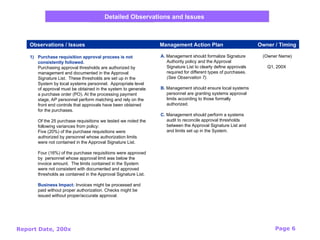
EXISTING MANAGEMENT PLANS
7. Policies and procedures for key AP processes (eg. Wire transfers, signature
approvals, check signing, p-cards) should be formally documented and updated.
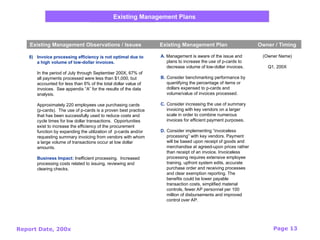
8. Invoice processing efficiency is not optimal due to a high volume of low-dollar
invoices (67% of payments are under $1,000 and account for less than 6% of
dollar value). Increased use of p-cards, summary invoicing and “invoiceless
processing” should be considered.
9. Excessive numbers of open purchase orders need to be closed (of 48,000 open
PO’s, approximately 10% are current)
10. Duplicate vendors exist in the vendor master file (due to access issues, which
have now been resolved).
11. Outstanding checks and reconciling items should be resolved in a timely manner
(there is an unreconciled difference of $246,421 and outstanding checks totaling
$23,750 from 200X and 200X).
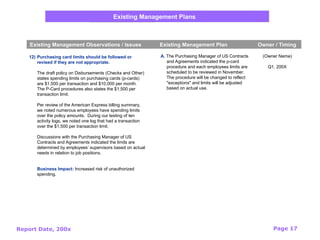
12. Purchasing card limits should be followed or revised if they are not appropriate.
13. Credit memos (for returns, etc.) need to be properly communicated to
appropriate AP personnel and should be resolved in a timely manner (there are
items dated to 199X).
14. Performance measures are not utilized to monitor the AP process.
Observations / Issues Priority See Page Timing
Q1, 200X
Q1, 200X
Q2, 200X
Q2, 200X
Q1, 200X
Q1, 200X
Q1, 200X
Q1, 200X
13
14
15
16
17
18
19
20
6.
Report Date, 200xPage 6
1) Purchase requisition approval process is not
consistently followed.
Purchasing approval thresholds are authorized by
management and documented in the Approval
Signature List. These thresholds are set up in the
System by local systems personnel. Appropriate level
of approval must be obtained in the system to generate
a purchase order (PO). At the processing payment
stage, AP personnel perform matching and rely on the
front end controls that approvals have been obtained
for the purchases.
Of the 25 purchase requisitions we tested we noted the
following variances from policy:
Five (20%) of the purchase requisitions were
authorized by personnel whose authorization limits
were not contained in the Approval Signature List.
Four (16%) of the purchase requisitions were approved
by personnel whose approval limit was below the
invoice amount. The limits contained in the System
were not consistent with documented and approved
thresholds as contained in the Approval Signature List.
Business Impact: Invoices might be processed and
paid without proper authorization. Checks might be
issued without proper/accurate approval.
(Owner Name)
Q1, 200X
A. Management should formalize Signature
Authority policy and the Approval
Signature List to clearly define approvals
required for different types of purchases.
(See Observation 7).
B. Management should ensure local systems
personnel are granting systems approval
limits according to those formally
authorized.
C. Management should perform a systems
audit to reconcile approval thresholds
between the Approval Signature List and
and limits set up in the System.
Observations / Issues Management Action Plan Owner / Timing
Detailed Observations and Issues
7.
Report Date, 200xPage 7
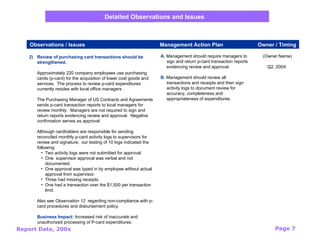
2) Review of purchasing card transactions should be
strengthened.
Approximately 220 company employees use purchasing
cards (p-card) for the acquisition of lower cost goods and
services. The process to review p-card expenditures
currently resides with local office managers .
The Purchasing Manager of US Contracts and Agreements
sends p-card transaction reports to local managers for
review monthly. Managers are not required to sign and
return reports evidencing review and approval. Negative
confirmation serves as approval.
Although cardholders are responsible for sending
reconciled monthly p-card activity logs to supervisors for
review and signature, our testing of 10 logs indicated the
following:
• Two activity logs were not submitted for approval.
• One supervisor approval was verbal and not
documented.
• One approval was typed in by employee without actual
approval from supervisor.
• Three had missing receipts.
• One had a transaction over the $1,500 per transaction
limit.
Also see Observation 12 regarding non-compliance with p-
card procedures and disbursement policy.
Business Impact: Increased risk of inaccurate and
unauthorized processing of P-card expenditures.
(Owner Name)
Q2, 200X
A. Management should require managers to
sign and return p-card transaction reports
evidencing review and approval.
B. Management should review all
transactions and receipts and then sign
activity logs to document review for
accuracy, completeness and
appropriateness of expenditures.
Observations / Issues Management Action Plan Owner / Timing
Detailed Observations and Issues
8.
Report Date, 200xPage 8
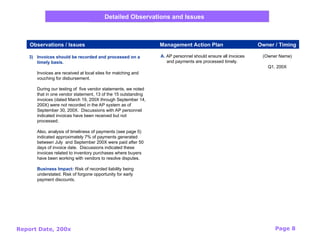
3) Invoices should be recorded and processed on a
timely basis.
Invoices are received at local sites for matching and
vouching for disbursement.
During our testing of five vendor statements, we noted
that in one vendor statement, 13 of the 15 outstanding
invoices (dated March 19, 200X through September 14,
200X) were not recorded in the AP system as of
September 30, 200X. Discussions with AP personnel
indicated invoices have been received but not
processed.
Also, analysis of timeliness of payments (see page 5)
indicated approximately 7% of payments generated
between July and September 200X were paid after 50
days of invoice date. Discussions indicated these
invoices related to inventory purchases where buyers
have been working with vendors to resolve disputes.
Business Impact: Risk of recorded liability being
understated. Risk of forgone opportunity for early
payment discounts.
(Owner Name)
Q1, 200X
A. AP personnel should ensure all invoices
and payments are processed timely.
Observations / Issues Management Action Plan Owner / Timing
Detailed Observations and Issues
9.
Report Date, 200xPage 9
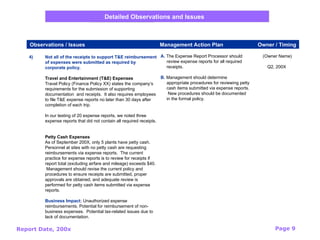
4) Not all of the receipts to support T&E reimbursement
of expenses were submitted as required by
corporate policy.
Travel and Entertainment (T&E) Expenses
Travel Policy (Finance Policy XX) states the company’s
requirements for the submission of supporting
documentation and receipts. It also requires employees
to file T&E expense reports no later than 30 days after
completion of each trip.
In our testing of 20 expense reports, we noted three
expense reports that did not contain all required receipts.
Petty Cash Expenses
As of September 200X, only 5 plants have petty cash.
Personnel at sites with no petty cash are requesting
reimbursements via expense reports. The current
practice for expense reports is to review for receipts if
report total (excluding airfare and mileage) exceeds $40.
Management should revise the current policy and
procedures to ensure receipts are submitted, proper
approvals are obtained, and adequate review is
performed for petty cash items submitted via expense
reports.
Business Impact: Unauthorized expense
reimbursements. Potential for reimbursement of non-
business expenses. Potential tax-related issues due to
lack of documentation.
(Owner Name)
Q2, 200X
A. The Expense Report Processor should
review expense reports for all required
receipts.
B. Management should determine
appropriate procedures for reviewing petty
cash items submitted via expense reports.
New procedures should be documented
in the formal policy.
Observations / Issues Management Action Plan Owner / Timing
Detailed Observations and Issues
10.
Report Date, 200xPage 10
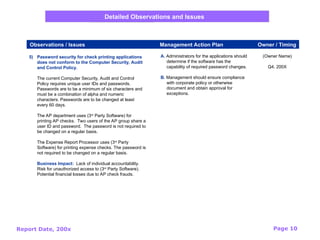
5) Password security for check printing applications
does not conform to the Computer Security, Audit
and Control Policy.
The current Computer Security, Audit and Control
Policy requires unique user IDs and passwords.
Passwords are to be a minimum of six characters and
must be a combination of alpha and numeric
characters. Passwords are to be changed at least
every 60 days.
The AP department uses (3rd
Party Software) for
printing AP checks. Two users of the AP group share a
user ID and password. The password is not required to
be changed on a regular basis.
The Expense Report Processor uses (3rd
Party
Software) for printing expense checks. The password is
not required to be changed on a regular basis.
Business Impact: Lack of individual accountability.
Risk for unauthorized access to (3rd
Party Software).
Potential financial losses due to AP check frauds.
(Owner Name)
Q4, 200X
A. Administrators for the applications should
determine if the software has the
capability of required password changes.
B. Management should ensure compliance
with corporate policy or otherwise
document and obtain approval for
exceptions.
Observations / Issues Management Action Plan Owner / Timing
Detailed Observations and Issues
11.
Report Date, 200xPage 11
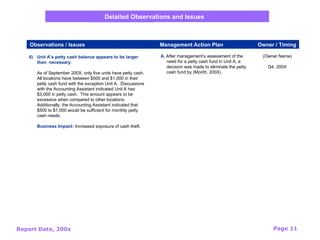
6) Unit A’s petty cash balance appears to be larger
than necessary.
As of September 200X, only five units have petty cash.
All locations have between $500 and $1,000 in their
petty cash fund with the exception Unit A. Discussions
with the Accounting Assistant indicated Unit A has
$3,000 in petty cash. This amount appears to be
excessive when compared to other locations.
Additionally, the Accounting Assistant indicated that
$500 to $1,000 would be sufficient for monthly petty
cash needs.
Business Impact: Increased exposure of cash theft.
(Owner Name)
Q4, 200X
A. After management’s assessment of the
need for a petty cash fund in Unit A, a
decision was made to eliminate the petty
cash fund by (Month, 200X)
Observations / Issues Management Action Plan Owner / Timing
Detailed Observations and Issues
12.
Report Date, 200xPage 12
Existing Management Plans
Observations / Issues Existing Management Plan Owner / Timing
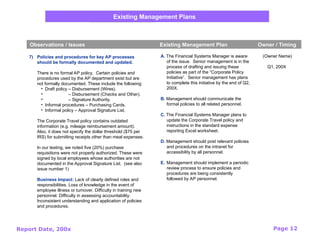
7) Policies and procedures for key AP processes
should be formally documented and updated.
There is no formal AP policy. Certain policies and
procedures used by the AP department exist but are
not formally documented. These include the following:
• Draft policy – Disbursement (Wires).
• – Disbursement (Checks and Other).
• – Signature Authority.
• Informal procedures – Purchasing Cards.
• Informal policy – Approval Signature List.
The Corporate Travel policy contains outdated
information (e.g. mileage reimbursement amount).
Also, it does not specify the dollar threshold ($75 per
IRS) for submitting receipts other than meal expenses.
In our testing, we noted five (20%) purchase
requisitions were not properly authorized. These were
signed by local employees whose authorities are not
documented in the Approval Signature List. (see also
issue number 1)
Business Impact: Lack of clearly defined roles and
responsibilities. Loss of knowledge in the event of
employee illness or turnover. Difficulty in training new
personnel. Difficulty in assessing accountability.
Inconsistent understanding and application of policies
and procedures.
(Owner Name)
Q1, 200X
A. The Financial Systems Manager is aware
of the issue. Senior management is in the
process of drafting and issuing these
policies as part of the “Corporate Policy
Initiative”. Senior management has plans
to complete this initiative by the end of Q2,
200X.
B. Management should communicate the
formal policies to all related personnel.
C. The Financial Systems Manager plans to
update the Corporate Travel policy and
instructions in the standard expense
reporting Excel worksheet.
D. Management should post relevant policies
and procedures on the intranet for
accessibility by all personnel.
E. Management should implement a periodic
review process to ensure policies and
procedures are being consistently
followed by AP personnel.
13.
Report Date, 200xPage 13
Existing Management Plans
Existing Management Observations / Issues Existing Management Plan Owner / Timing
8) Invoice processing efficiency is not optimal due to
a high volume of low-dollar invoices.
In the period of July through September 200X, 67% of
all payments processed were less than $1,000, but
accounted for less than 6% of the total dollar value of
invoices. See appendix “A” for the results of the data
analysis.
Approximately 220 employees use purchasing cards
(p-cards). The use of p-cards is a proven best practice
that has been successfully used to reduce costs and
cycle times for low dollar transactions. Opportunities
exist to increase the efficiency of the procurement
function by expanding the utilization of p-cards and/or
requesting summary invoicing from vendors with whom
a large volume of transactions occur at low dollar
amounts.
Business Impact: Inefficient processing. Increased
processing costs related to issuing, reviewing and
clearing checks.
(Owner Name)
Q1, 200X
A. Management is aware of the issue and
plans to increase the use of p-cards to
decrease volume of low-dollar invoices.
B. Consider benchmarking performance by
quantifying the percentage of items or
dollars expensed to p-cards and
volume/value of invoices processed.
C. Consider increasing the use of summary
invoicing with key vendors on a larger
scale in order to combine numerous
invoices for efficient payment purposes.
D. Consider implementing “invoiceless
processing” with key vendors. Payment
will be based upon receipt of goods and
merchandise at agreed-upon prices rather
than receipt of an invoice. Invoiceless
processing requires extensive employee
training, upfront system edits, accurate
purchase order and receiving processes
and clear exemption reporting. The
benefits could be lower payable
transaction costs, simplified material
controls, fewer AP personnel per 100
million of disbursements and improved
control over AP.
14.
Report Date, 200xPage 14
Existing Management Plans
Existing Management Observations / Issues Existing Management Plan Owner / Timing
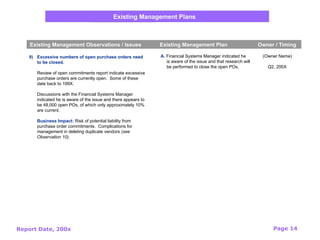
9) Excessive numbers of open purchase orders need
to be closed.
Review of open commitments report indicate excessive
purchase orders are currently open. Some of these
date back to 199X.
Discussions with the Financial Systems Manager
indicated he is aware of the issue and there appears to
be 48,000 open POs, of which only approximately 10%
are current.
Business Impact: Risk of potential liability from
purchase order commitments. Complications for
management in deleting duplicate vendors (see
Observation 10).
(Owner Name)
Q2, 200X
A. Financial Systems Manager indicated he
is aware of the issue and that research will
be performed to close the open POs.
15.
Report Date, 200xPage 15
Existing Management Plans
Existing Management Observations / Issues Existing Management Plan Owner / Timing
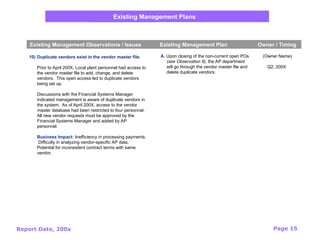
10) Duplicate vendors exist in the vendor master file.
Prior to April 200X, Local plant personnel had access to
the vendor master file to add, change, and delete
vendors. This open access led to duplicate vendors
being set up.
Discussions with the Financial Systems Manager
indicated management is aware of duplicate vendors in
the system. As of April 200X, access to the vendor
master database had been restricted to four personnel.
All new vendor requests must be approved by the
Financial Systems Manager and added by AP
personnel.
Business Impact: Inefficiency in processing payments.
Difficulty in analyzing vendor-specific AP data.
Potential for inconsistent contract terms with same
vendor.
(Owner Name)
Q2, 200X
A. Upon closing of the non-current open POs
(see Observation 9), the AP department
will go through the vendor master file and
delete duplicate vendors.
16.
Report Date, 200xPage 16
Existing Management Plans
Existing Management Observations / Issues Existing Management Plan Owner / Timing
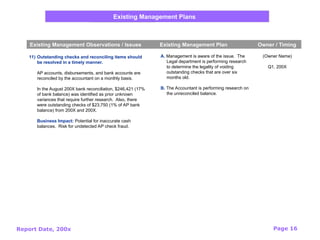
11) Outstanding checks and reconciling items should
be resolved in a timely manner.
AP accounts, disbursements, and bank accounts are
reconciled by the accountant on a monthly basis.
In the August 200X bank reconciliation, $246,421 (17%
of bank balance) was identified as prior unknown
variances that require further research. Also, there
were outstanding checks of $23,750 (1% of AP bank
balance) from 200X and 200X.
Business Impact: Potential for inaccurate cash
balances. Risk for undetected AP check fraud.
(Owner Name)
Q1, 200X
A. Management is aware of the issue. The
Legal department is performing research
to determine the legality of voiding
outstanding checks that are over six
months old.
B. The Accountant is performing research on
the unreconciled balance.
17.
Report Date, 200xPage 17
Existing Management Plans
Existing Management Observations / Issues Existing Management Plan Owner / Timing
12) Purchasing card limits should be followed or
revised if they are not appropriate.
The draft policy on Disbursements (Checks and Other)
states spending limits on purchasing cards (p-cards)
are $1,500 per transaction and $10,000 per month.
The P-Card procedures also states the $1,500 per
transaction limit.
Per review of the American Express billing summary,
we noted numerous employees have spending limits
over the policy amounts. During our testing of ten
activity logs, we noted one log that had a transaction
over the $1,500 per transaction limit.
Discussions with the Purchasing Manager of US
Contracts and Agreements indicated the limits are
determined by employees’ supervisors based on actual
needs in relation to job positions.
Business Impact: Increased risk of unauthorized
spending.
(Owner Name)
Q1, 200X
A. The Purchasing Manager of US Contracts
and Agreements indicated the p-card
procedure and each employees limits are
scheduled to be reviewed in November.
The procedure will be changed to reflect
"exceptions" and limits will be adjusted
based on actual use.
18.
Report Date, 200xPage 18
Existing Management Plans
Existing Management Observations / Issues Existing Management Plan Owner / Timing
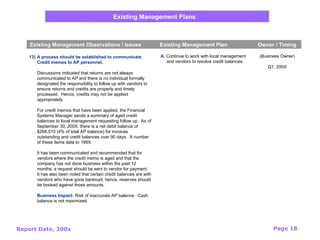
13) A process should be established to communicate
Credit memos to AP personnel.
Discussions indicated that returns are not always
communicated to AP and there is no individual formally
designated the responsibility to follow up with vendors to
ensure returns and credits are properly and timely
processed. Hence, credits may not be applied
appropriately.
For credit memos that have been applied, the Financial
Systems Manager sends a summary of aged credit
balances to local management requesting follow up. As of
September 30, 200X, there is a net debit balance of
$268,510 (4% of total AP balance) for invoices
outstanding and credit balances over 90 days. A number
of these items date to 199X.
It has been communicated and recommended that for
vendors where the credit memo is aged and that the
company has not done business within the past 12
months, a request should be sent to vendor for payment.
It has also been noted that certain credit balances are with
vendors who have gone bankrupt; hence, reserves should
be booked against those amounts.
Business Impact: Risk of inaccurate AP balance. Cash
balance is not maximized.
(Business Owner)
Q1, 200X
A. Continue to work with local management
and vendors to resolve credit balances.
19.
Report Date, 200xPage 19
Existing Management Plans
Existing Management Observations / Issues Existing Management Plan Owner / Timing
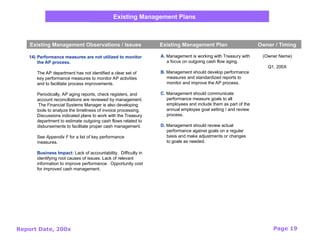
14) Performance measures are not utilized to monitor
the AP process.
The AP department has not identified a clear set of
key performance measures to monitor AP activities
and to facilitate process improvements.
Periodically, AP aging reports, check registers, and
account reconciliations are reviewed by management.
The Financial Systems Manager is also developing
tools to analyze the timeliness of invoice processing.
Discussions indicated plans to work with the Treasury
department to estimate outgoing cash flows related to
disbursements to facilitate proper cash management.
See Appendix F for a list of key performance
measures.
Business Impact: Lack of accountability. Difficulty in
identifying root causes of issues. Lack of relevant
information to improve performance. Opportunity cost
for improved cash management.
(Owner Name)
Q1, 200X
A. Management is working with Treasury with
a focus on outgoing cash flow aging.
B. Management should develop performance
measures and standardized reports to
monitor and improve the AP process.
C. Management should communicate
performance measure goals to all
employees and include them as part of the
annual employee goal setting / and review
process.
D. Management should review actual
performance against goals on a regular
basis and make adjustments or changes
to goals as needed.
Report Date, 200xPage 21
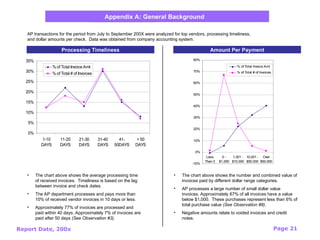
• The chart above shows the number and combined value of
invoices paid by different dollar range categories.
• AP processes a large number of small dollar value
invoices. Approximately 67% of all invoices have a value
below $1,000. These purchases represent less than 6% of
total purchase value (See Observation #8).
• Negative amounts relate to voided invoices and credit
notes.
Appendix A: General Background
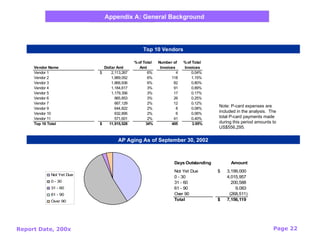
AP transactions for the period from July to September 200X were analyzed for top vendors, processing timeliness,
and dollar amounts per check. Data was obtained from company accounting system.
• The chart above shows the average processing time
of received invoices. Timeliness is based on the lag
between invoice and check dates.
• The AP department processes and pays more than
10% of received vendor invoices in 10 days or less.
• Approximately 77% of invoices are processed and
paid within 40 days. Approximately 7% of invoices are
paid after 50 days (See Observation #3).
0%
5%
10%
15%
20%
25%
30%
35%
1-10
DAYS
11-20
DAYS
21-30
DAYS
31-40
DAYS
41-
50DAYS
> 50
DAYS
% of Total Invoice Amt
% of Total # of Invoices
-10%
0%
10%
20%
30%
40%
50%
60%
70%
80%
Less
Than 0
0 -
$1,000
1,001 -
$10,000
10,001 -
$50,000
Over
$50,000
% of Total Invoice Amt
% of Total # of Invoices
Processing Timeliness Amount Per Payment
22.
Report Date, 200xPage 22
Appendix A: General Background
Note: P-card expenses are
included in the analysis. The
total P-card payments made
during this period amounts to
US$556,295.
Days Outstanding Amount
Not Yet Due 3,199,000
$
0 - 30 4,015,957
31 - 60 200,588
61 - 90 9,083
Over 90 (268,511)
Total 7,156,119
$
Not Yet Due
0 - 30
31 - 60
61 - 90
Over 90
Top 10 Vendors
AP Aging As of September 30, 2002
Vendor Name Dollar Amt
%of Total
Amt
Number of
Invoices
%of Total
Invoices
Vendor 1 2,113,267
$ 6% 4 0.04%
Vendor 2 1,989,052 6% 118 1.15%
Vendor 3 1,966,936 6% 82 0.80%
Vendor 4 1,184,617 3% 91 0.89%
Vendor 5 1,179,356 3% 17 0.17%
Vendor 6 965,853 3% 26 0.25%
Vendor 7 667,129 2% 12 0.12%
Vendor 9 644,822 2% 8 0.08%
Vendor 10 632,895 2% 6 0.06%
Vendor 11 571,601 2% 41 0.40%
Top 10 Total 11,915,528
$ 34% 405 3.95%
23.
Report Date, 200xPage 23
Appendix B: Internal Control Scorecard
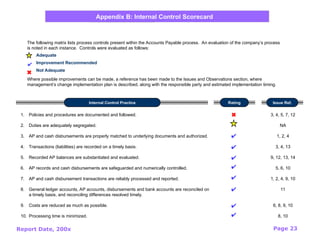
The following matrix lists process controls present within the Accounts Payable process. An evaluation of the company’s process
is noted in each instance. Controls were evaluated as follows:
1. Policies and procedures are documented and followed.
2. Duties are adequately segregated.
3. AP and cash disbursements are properly matched to underlying documents and authorized.
4. Transactions (liabilities) are recorded on a timely basis.
5. Recorded AP balances are substantiated and evaluated.
6. AP records and cash disbursements are safeguarded and numerically controlled.
7. AP and cash disbursement transactions are reliably processed and reported.
8. General ledger accounts, AP accounts, disbursements and bank accounts are reconciled on
a timely basis, and reconciling differences resolved timely.
9. Costs are reduced as much as possible.
10. Processing time is minimized.
3, 4, 5, 7, 12
NA
1, 2, 4
3, 4, 13
9, 12, 13, 14
5, 6, 10
1, 2, 4, 9, 10
11
6, 8, 9, 10
8, 10
Adequate
Improvement Recommended
Not Adequate
Internal Control Practice Rating Issue Ref.
Where possible improvements can be made, a reference has been made to the Issues and Observations section, where
management’s change implementation plan is described, along with the responsible party and estimated implementation timing.
24.
Report Date, 200xPage 24
Appendix C: Best Practices Scorecard
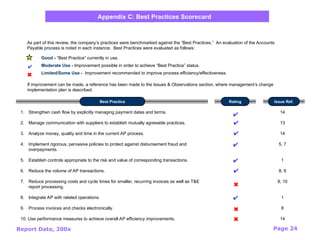
As part of this review, the company’s practices were benchmarked against the “Best Practices.” An evaluation of the Accounts
Payable process is noted in each instance. Best Practices were evaluated as follows:
1. Strengthen cash flow by explicitly managing payment dates and terms.
2. Manage communication with suppliers to establish mutually agreeable practices.
3. Analyze money, quality and time in the current AP process.
4. Implement rigorous, pervasive policies to protect against disbursement fraud and
overpayments.
5. Establish controls appropriate to the risk and value of corresponding transactions.
6. Reduce the volume of AP transactions.
7. Reduce processing costs and cycle times for smaller, recurring invoices as well as T&E
report processing.
8. Integrate AP with related operations.
9. Process invoices and checks electronically.
10. Use performance measures to achieve overall AP efficiency improvements.
Best Practice Issue Ref.
Rating
Good - “Best Practice” currently in use.
Moderate Use - Improvement possible in order to achieve “Best Practice” status.
Limited/Some Use - Improvement recommended to improve process efficiency/effectiveness.
If improvement can be made, a reference has been made to the Issues & Observations section, where management’s change
implementation plan is described.
14
13
14
5, 7
1
8, 9
8, 10
1
8
14
25.
Report Date, 200xPage 25
Appendix D: Best Practices Detail
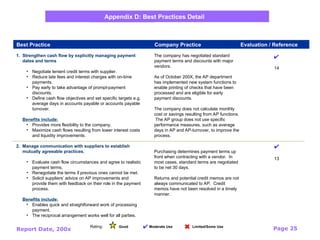
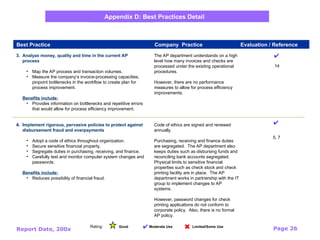
1. Strengthen cash flow by explicitly managing payment
dates and terms
• Negotiate lenient credit terms with supplier.
• Reduce late fees and interest charges with on-time
payments.
• Pay early to take advantage of prompt-payment
discounts.
• Define cash flow objectives and set specific targets e.g.
average days in accounts payable or accounts payable
turnover.
Benefits include:
• Provides more flexibility to the company.
• Maximize cash flows resulting from lower interest costs
and liquidity improvements.
2. Manage communication with suppliers to establish
mutually agreeable practices.
• Evaluate cash flow circumstances and agree to realistic
payment terms.
• Renegotiate the terms if previous ones cannot be met.
• Solicit suppliers’ advice on AP improvements and
provide them with feedback on their role in the payment
process.
Benefits include:
• Enables quick and straightforward work of processing
payment.
• The reciprocal arrangement works well for all parties.
The company has negotiated standard
payment terms and discounts with major
vendors.
As of October 200X, the AP department
has implemented new system functions to
enable printing of checks that have been
processed and are eligible for early
payment discounts.
The company does not calculate monthly
cost or savings resulting from AP functions.
The AP group does not use specific
performance measures, such as average
days in AP and AP-turnover, to improve the
process.
Purchasing determines payment terms up
front when contracting with a vendor. In
most cases, standard terms are negotiated
to be net 30 days.
Returns and potential credit memos are not
always communicated to AP. Credit
memos have not been resolved in a timely
manner.
Rating: Moderate Use
Good Limited/Some Use
14
13
Best Practice Company Practice Evaluation / Reference
26.
Report Date, 200xPage 26
Appendix D: Best Practices Detail
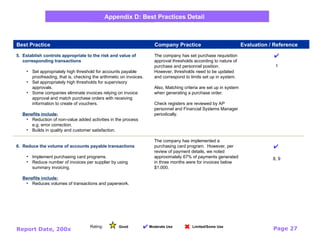
3. Analyze money, quality and time in the current AP
process
• Map the AP process and transaction volumes.
• Measure the company’s invoice-processing capacities,
pinpoint bottlenecks in the workflow to create plan for
process improvement.
Benefits include:
• Provides information on bottlenecks and repetitive errors
that would allow for process efficiency improvement.
4. Implement rigorous, pervasive policies to protect against
disbursement fraud and overpayments
• Adopt a code of ethics throughout organization.
• Secure sensitive financial property.
• Segregate duties in purchasing, receiving, and finance.
• Carefully test and monitor computer system changes and
passwords.
Benefits include:
• Reduces possibility of financial fraud.
The AP department understands on a high
level how many invoices and checks are
processed under the existing operational
procedures.
However, there are no performance
measures to allow for process efficiency
improvements.
Code of ethics are signed and renewed
annually.
Purchasing, receiving and finance duties
are segregated. The AP department also
keeps duties such as disbursing funds and
reconciling bank accounts segregated.
Physical limits to sensitive financial
properties such as check stock and check
printing facility are in place. The AP
department works in partnership with the IT
group to implement changes to AP
systems.
However, password changes for check
printing applications do not conform to
corporate policy. Also, there is no formal
AP policy.
14
5, 7
Best Practice Company Practice Evaluation / Reference
Rating: Moderate Use
Good Limited/Some Use
27.
Report Date, 200xPage 27
Appendix D: Best Practices Detail
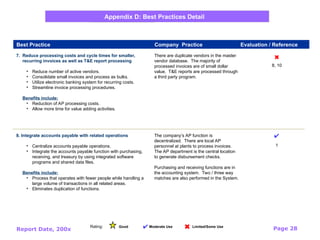
5. Establish controls appropriate to the risk and value of
corresponding transactions
• Set appropriately high threshold for accounts payable
proofreading, that is, checking the arithmetic on invoices.
• Set appropriately high thresholds for supervisory
approvals.
• Some companies eliminate invoices relying on invoice
approval and match purchase orders with receiving
information to create of vouchers.
Benefits include:
• Reduction of non-value added activities in the process
e.g. error correction.
• Builds in quality and customer satisfaction.
6. Reduce the volume of accounts payable transactions
• Implement purchasing card programs.
• Reduce number of invoices per supplier by using
summary invoicing.
Benefits include:
• Reduces volumes of transactions and paperwork.
The company has set purchase requisition
approval thresholds according to nature of
purchase and personnel position.
However, thresholds need to be updated
and correspond to limits set up in system.
Also, Matching criteria are set up in system
when generating a purchase order.
Check registers are reviewed by AP
personnel and Financial Systems Manager
periodically.
The company has implemented a
purchasing card program. However, per
review of payment details, we noted
approximately 67% of payments generated
in three months were for invoices below
$1,000.
1
8, 9
Best Practice Company Practice Evaluation / Reference
Rating: Moderate Use
Good Limited/Some Use
28.
Report Date, 200xPage 28
Appendix D: Best Practices Detail
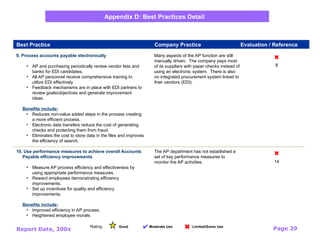
7. Reduce processing costs and cycle times for smaller,
recurring invoices as well as T&E report processing
• Reduce number of active vendors.
• Consolidate small invoices and process as bulks.
• Utilize electronic banking system for recurring costs.
• Streamline invoice processing procedures.
Benefits include:
• Reduction of AP processing costs.
• Allow more time for value adding activities.
8. Integrate accounts payable with related operations
• Centralize accounts payable operations.
• Integrate the accounts payable function with purchasing,
receiving, and treasury by using integrated software
programs and shared data files.
Benefits include:
• Process that operates with fewer people while handling a
large volume of transactions in all related areas.
• Eliminates duplication of functions.
There are duplicate vendors in the master
vendor database. The majority of
processed invoices are of small dollar
value. T&E reports are processed through
a third party program.
The company’s AP function is
decentralized. There are local AP
personnel at plants to process invoices.
The AP department is the central location
to generate disbursement checks.
Purchasing and receiving functions are in
the accounting system. Two / three way
matches are also performed in the System.
8, 10
1
Best Practice Company Practice Evaluation / Reference
Rating: Moderate Use
Good Limited/Some Use
29.
Report Date, 200xPage 29
Appendix D: Best Practices Detail
9. Process accounts payable electronically
• AP and purchasing periodically review vendor lists and
banks for EDI candidates.
• All AP personnel receive comprehensive training to
utilize EDI effectively.
• Feedback mechanisms are in place with EDI partners to
review goals/objectives and generate improvement
ideas.
Benefits include:
• Reduces non-value added steps in the process creating
a more efficient process.
• Electronic data transfers reduce the cost of generating
checks and protecting them from fraud.
• Eliminates the cost to store data in the files and improves
the efficiency of search.
10. Use performance measures to achieve overall Accounts
Payable efficiency improvements
• Measure AP process efficiency and effectiveness by
using appropriate performance measures.
• Reward employees demonstrating efficiency
improvements.
• Set up incentives for quality and efficiency
improvements.
Benefits include:
• Improved efficiency in AP process.
• Heightened employee morale.
Many aspects of the AP function are still
manually driven. The company pays most
of its suppliers with paper checks instead of
using an electronic system. There is also
no integrated procurement system linked to
their vendors (EDI).
The AP department has not established a
set of key performance measures to
monitor the AP activities.
8
14
Best Practice Company Practice Evaluation / Reference
Rating: Moderate Use
Good Limited/Some Use
30.
Report Date, 200xPage 30
1) Monthly vendor statements
Sampled 5 vendor statements to verify all
invoices / liabilities are recorded accurately and
timely.
2) Expense reports
Sampled 20 expense reports to review for the
following:
– Supporting documentation.
– Proper approval.
– Lag time between completion of trip,
submission of expense reports, and
processing of reimbursements.
3) Petty cash
Sampled 15 petty cash reimbursement
requests to review for the following:
– Supporting documentation.
– Proper approval.
The tests were performed to evaluate
the following:
– Accuracy of recorded liabilities.
– Completeness of recorded
liabilities.
– Timeliness of recording
transactions.
– Existence of documentation.
– Existence of approval.
– Timeliness of submitting expense
reports and processing of
reimbursements.
– Existence of documentation.
– Existence of approval.
Testing Performed Purpose Observations
Appendix E: Testing Summary
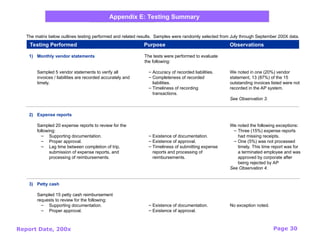
The matrix below outlines testing performed and related results. Samples were randomly selected from July through September 200X data.
We noted in one (20%) vendor
statement, 13 (87%) of the 15
outstanding invoices listed were not
recorded in the AP system.
See Observation 3.
We noted the following exceptions:
– Three (15%) expense reports
had missing receipts.
– One (5%) was not processed
timely. This time report was for
a terminated employee and was
approved by corporate after
being rejected by AP
See Observation 4.
No exception noted.
31.
Report Date, 200xPage 31
4) Reconciliations
Reviewed the latest AP reconciliation for AP
system postings vs. actual GL postings.
Reviewed the latest AP account bank
reconciliations and determine if the balances tied
to the GL.
5) Invoices
Sampled 25 invoices to review for the following:
– Purchase requisition approval.
– Invoice approval.
– Two / three way matching.
– Supporting documentation.
– Payment of applicable taxes.
The tests were performed to evaluate
the following:
– Accuracy of data.
– Existence, timeliness and
completeness of reconciliation.
– Existence of management review
– Existence of approval for
purchase.
– Existence of approval for payment.
– Accuracy of receipt and payment.
– Existence of supporting
documents.
– Existence of taxes paid.
Testing Performed Purpose Observations
Appendix E: Testing Summary
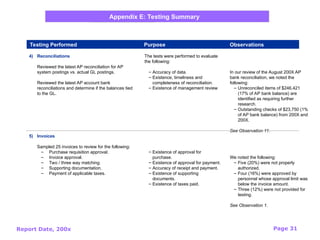
In our review of the August 200X AP
bank reconciliation, we noted the
following:
– Unreconciled items of $246,421
(17% of AP bank balance) are
identified as requiring further
research.
– Outstanding checks of $23,750 (1%
of AP bank balance) from 200X and
200X.
See Observation 11.
We noted the following:
– Five (20%) were not properly
authorized.
– Four (16%) were approved by
personnel whose approval limit was
below the invoice amount.
– Three (12%) were not provided for
testing.
See Observation 1.
32.
Report Date, 200xPage 32
6) Purchasing card expenditures
Sampled 10 purchasing card activity logs to
review for the following:
– Supporting documentation.
– Proper approval.
– Payment of applicable sales taxes.
7) Potential duplicate payments
Sampled 80 transactions to review for the
following:
– Duplicate payments.
The tests were performed to evaluate
the following:
– Existence of documentation.
– Existence of approval.
– Existence of taxes paid.
– Validity of payments of same
amounts.
Testing Performed Purpose Observations
Appendix E: Testing Summary
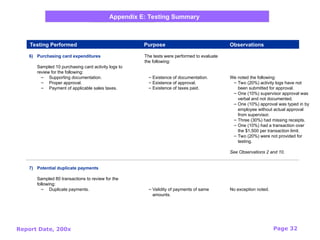
We noted the following:
– Two (20%) activity logs have not
been submitted for approval.
– One (10%) supervisor approval was
verbal and not documented.
– One (10%) approval was typed in by
employee without actual approval
from supervisor.
– Three (30%) had missing receipts.
– One (10%) had a transaction over
the $1,500 per transaction limit.
– Two (20%) were not provided for
testing.
See Observations 2 and 10.
No exception noted.
33.
Report Date, 200xPage 33
Appendix F: Performance Measures
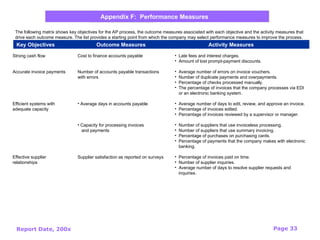
The following matrix shows key objectives for the AP process, the outcome measures associated with each objective and the activity measures that
drive each outcome measure. The list provides a starting point from which the company may select performance measures to improve the process.
Strong cash flow
Accurate invoice payments
Efficient systems with
adequate capacity
Effective supplier
relationships
• Late fees and interest charges.
• Amount of lost prompt-payment discounts.
• Average number of errors on invoice vouchers.
• Number of duplicate payments and overpayments.
• Percentage of checks processed manually.
• The percentage of invoices that the company processes via EDI
or an electronic banking system.
• Average number of days to edit, review, and approve an invoice.
• Percentage of invoices edited.
• Percentage of invoices reviewed by a supervisor or manager.
• Number of suppliers that use invoiceless processing.
• Number of suppliers that use summary invoicing.
• Percentage of purchases on purchasing cards.
• Percentage of payments that the company makes with electronic
banking.
• Percentage of invoices paid on time.
• Number of supplier inquiries.
• Average number of days to resolve supplier requests and
inquiries.
Cost to finance accounts payable
Number of accounts payable transactions
with errors
• Average days in accounts payable
• Capacity for processing invoices
and payments
Supplier satisfaction as reported on surveys
Key Objectives Outcome Measures Activity Measures
34.
Report Date, 200xPage 34
Input Invoice
into System
Generating
Payments
Generate PO
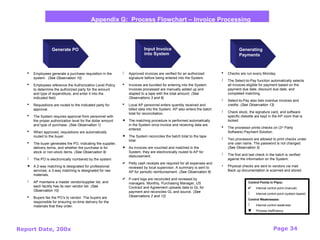
Employees generate a purchase requisition in the
system. (See Observation 10)
Employees reference the Authorization Level Policy
to determine the authorized party for the amount
and type of expenditure, and enter it into the
indicated field.
Requisitions are routed to the indicated party for
approval.
The System requires approval from personnel with
the proper authorization level for the dollar amount
and type of purchase. (See Observation 1)
When approved, requisitions are automatically
routed to the buyer.
The buyer generates the PO, indicating the supplier,
delivery terms, and whether the purchase is for
stock or non-stock items. (See Observation 9)
The PO is electronically numbered by the system.
A 2-way matching is designated for professional
services; a 3-way matching is designated for raw
materials.
AP maintains a master vendor/supplier list, and
each facility has its own vendor list. (See
Observation 10)
Buyers fax the PO’s to vendor. The buyers are
responsible for ensuring on-time delivery for the
materials that they order.
Approved invoices are verified for an authorized
signature before being entered into the System.
Invoices are bundled for entering into the System.
Invoices processed are manually added up and
stapled to a tape with the total amount. (See
Observations 3 and 8)
Local AP personnel enters quantity received and
billed data into the System. AP also enters the batch
total for reconciliation.
The matching procedure is performed automatically
in the System once invoice and receiving data are
entered.
The System reconciles the batch total to the tape
total.
As invoices are vouched and matched in the
System, they are electronically routed to AP for
disbursement.
Petty cash receipts are required for all expenses and
reviewed by local supervisor. A summary is sent to
AP for periodic reimbursement. (See Observation 6)
P-card logs are reconciled and reviewed by
managers. Monthly, Purchasing Manager, US
Contract and Agreement uploads data to GL for
payment and reconciles GL and source. (See
Observations 2 and 12)
Checks are run every Monday.
The Select-to-Pay function automatically selects
all invoices eligible for payment based on the
payment due date, discount due date, and
completed matching.
Select-to-Pay also lists overdue invoices and
credits. (See Observation 13)
Check stock, the signature card, and software
specific diskette are kept in the AP room that is
locked.
The processor prints checks on (3rd
Party
Software) Payment Solution.
Two processors are allowed to print checks under
one user name. The password is not changed.
(See Observation 5)
The first and last check in the batch is verified
against the information on the System.
• Physical checks are sent to vendors via mail.
Back up documentation is scanned and stored.
Control Points In Place:
Internal control point (manual)
Internal control point (system based)
Control Weaknesses:
Internal control weakness
Process Inefficiency
Appendix G: Process Flowchart – Invoice Processing
35.
Report Date, 200xPage 35
Expense
Report
Processing
Expense
Report Posting
Expense
Report
Approval
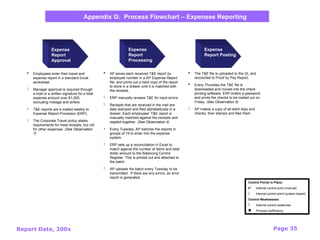
Employees enter their travel and
expense report in a standard Excel
worksheet.
Manager approval is required through
e-mail or a written signature for a total
expense amount over $1,000,
excluding mileage and airfare.
• T&E reports are e-mailed weekly to
Expense Report Processor (ERP).
The Corporate Travel policy states
requirements for meal receipts, but not
for other expenses. (See Observation
7)
AP saves each received T&E report by
employee number in a AP Expense Report
file, and prints out a hard copy of the report
to store in a drawer until it is matched with
the receipts.
ERP manually reviews T&E for input errors.
Receipts that are received in the mail are
date stamped and filed alphabetically in a
drawer. Each employees’ T&E report is
manually matched against the receipts and
stapled together. (See Observation 4)
• Every Tuesday, AP batches the reports in
groups of 15 to enter into the expense
system.
ERP sets up a reconciliation in Excel to
match against the number of items and total
dollar amount to the Balancing Control
Register. This is printed out and attached to
the batch.
AP uploads the batch every Tuesday to be
transmitted. If there are any errors, an error
report is generated.
The T&E file is uploaded to the GL and
reconciled to Proof by Pay Report.
Every Thursday the T&E file is
downloaded and moved into the check
printing software. ERP enters a password
and prints the checks to be mailed out on
Friday. (See Observation 5)
AP makes a copy of all debit slips and
checks, then stamps and files them.
Appendix G: Process Flowchart – Expenses Reporting
Control Points In Place:
Internal control point (manual)
Internal control point (system based)
Control Weaknesses:
Internal control weakness
Process Inefficiency