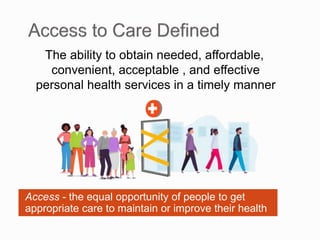
Access - the equal opportunity of people to get
appropriate care to maintain or improve their health
The ability to obtain needed, affordable,
convenient, acceptable , and effective
personal health services in a timely manner
 Health care resources don’t mean much if not all
communities have access to them. Whether it’s
through a lack of affordability, availability, or any of
the other “Five A’s of Access,” too many people
are struggling to receive the services they need to
live healthy lives
 The inability to access adequate care has
profoundly negative consequences on the health
and well-being of the people, especially on most
vulnerable groups.
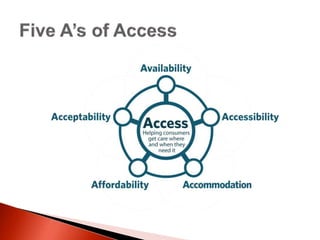
Five A’s of Access
Affordability Prices of services meet client’s income and ability to pay
•Costs: transportation, lost time and income, cost of care, etc.
•Perception of worth, relative to cost, knowledge of prices,
total cost and credit arrangements
Accessibility Location of supply aligns with location of clients or
demand
•Accounts for geographical, economic and social distance,
transportations resources, etc.
•Measured in Distance
Availability Volume and Type of services meets the client’s need
•Volume and Size of services VS Resources to client’s volume
and type of needs
•Measured in Congestion, Coverage
Accommodation Delivery of healthcare accommodates client’s needs
•Appointment systems, hours of operation, walk-in facilities,
telephone or web-services
•Cultural and Language barriers
Acceptability Healthcare providers accept all clients regardless of their
characteristics
•Clients characteristics: age, sex, social class, ethnicity, type
of insurance
 Increase the proportion of persons with health
insurance (Medical, Dental, & Prescription Drug)
 Increase the proportion of insured persons with
coverage for clinical preventive services
 Increase the proportion of persons with a usual
primary care provider
 Increase the number of practicing primary care
providers (medical doctor, physician assistant, &
nurse practitioner)
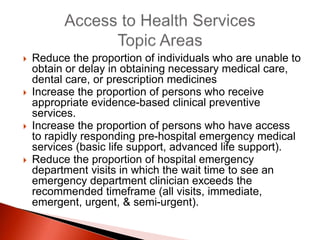
 Reduce the proportion of individuals who are unable to
obtain or delay in obtaining necessary medical care,
dental care, or prescription medicines
 Increase the proportion of persons who receive
appropriate evidence-based clinical preventive
services.
 Increase the proportion of persons who have access
to rapidly responding pre-hospital emergency medical
services (basic life support, advanced life support).
 Reduce the proportion of hospital emergency
department visits in which the wait time to see an
emergency department clinician exceeds the
recommended timeframe (all visits, immediate,
emergent, urgent, & semi-urgent).
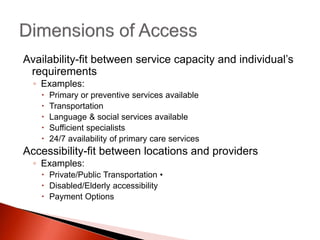
Availability-fit between service capacity and individual’s
requirements
◦ Examples:
 Primary or preventive services available
 Transportation
 Language & social services available
 Sufficient specialists
 24/7 availability of primary care services
Accessibility-fit between locations and providers
◦ Examples:
 Private/Public Transportation •
 Disabled/Elderly accessibility
 Payment Options
Affordability-individual’s ability to pay.
◦ Examples:
 High insurance premiums
 Co-payments/deductibles reasonable
 Prescription prices affordability
Accommodation-the fit between how resources are
organized to provide services and the individual’s
ability to use the arrangement.
◦ Examples:
 Appointment availability
 Office hours compatibility
 Routine appointments within 1 week; walk-ins services
 Urgent cases seen within 1 hour; non-emergency within 1 day
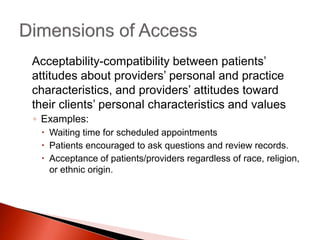
Acceptability-compatibility between patients’
attitudes about providers’ personal and practice
characteristics, and providers’ attitudes toward
their clients’ personal characteristics and values
◦ Examples:
 Waiting time for scheduled appointments
 Patients encouraged to ask questions and review records.
 Acceptance of patients/providers regardless of race, religion,
or ethnic origin.
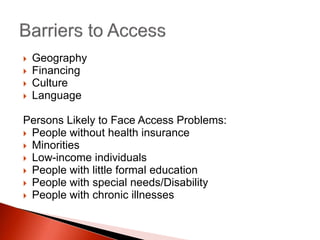
 Geography
 Financing
 Culture
 Language
Persons Likely to Face Access Problems:
 People without health insurance
 Minorities
 Low-income individuals
 People with little formal education
 People with special needs/Disability
 People with chronic illnesses
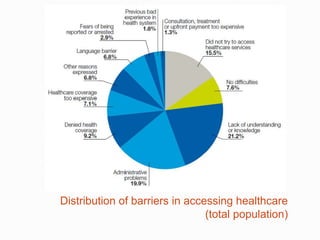
Distribution of barriers in accessing healthcare
(total population)
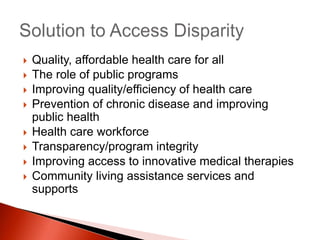
 Quality, affordable health care for all
 The role of public programs
 Improving quality/efficiency of health care
 Prevention of chronic disease and improving
public health
 Health care workforce
 Transparency/program integrity
 Improving access to innovative medical therapies
 Community living assistance services and
supports

Access-to-Care_2.pptx

  • 2.
    Access - theequal opportunity of people to get appropriate care to maintain or improve their health The ability to obtain needed, affordable, convenient, acceptable , and effective personal health services in a timely manner
  • 3.
     Health careresources don’t mean much if not all communities have access to them. Whether it’s through a lack of affordability, availability, or any of the other “Five A’s of Access,” too many people are struggling to receive the services they need to live healthy lives  The inability to access adequate care has profoundly negative consequences on the health and well-being of the people, especially on most vulnerable groups.
  • 5.
    Five A’s ofAccess Affordability Prices of services meet client’s income and ability to pay •Costs: transportation, lost time and income, cost of care, etc. •Perception of worth, relative to cost, knowledge of prices, total cost and credit arrangements Accessibility Location of supply aligns with location of clients or demand •Accounts for geographical, economic and social distance, transportations resources, etc. •Measured in Distance Availability Volume and Type of services meets the client’s need •Volume and Size of services VS Resources to client’s volume and type of needs •Measured in Congestion, Coverage Accommodation Delivery of healthcare accommodates client’s needs •Appointment systems, hours of operation, walk-in facilities, telephone or web-services •Cultural and Language barriers Acceptability Healthcare providers accept all clients regardless of their characteristics •Clients characteristics: age, sex, social class, ethnicity, type of insurance
  • 6.
     Increase theproportion of persons with health insurance (Medical, Dental, & Prescription Drug)  Increase the proportion of insured persons with coverage for clinical preventive services  Increase the proportion of persons with a usual primary care provider  Increase the number of practicing primary care providers (medical doctor, physician assistant, & nurse practitioner)
  • 7.
     Reduce theproportion of individuals who are unable to obtain or delay in obtaining necessary medical care, dental care, or prescription medicines  Increase the proportion of persons who receive appropriate evidence-based clinical preventive services.  Increase the proportion of persons who have access to rapidly responding pre-hospital emergency medical services (basic life support, advanced life support).  Reduce the proportion of hospital emergency department visits in which the wait time to see an emergency department clinician exceeds the recommended timeframe (all visits, immediate, emergent, urgent, & semi-urgent).
  • 8.
    Availability-fit between servicecapacity and individual’s requirements ◦ Examples:  Primary or preventive services available  Transportation  Language & social services available  Sufficient specialists  24/7 availability of primary care services Accessibility-fit between locations and providers ◦ Examples:  Private/Public Transportation •  Disabled/Elderly accessibility  Payment Options
  • 9.
    Affordability-individual’s ability topay. ◦ Examples:  High insurance premiums  Co-payments/deductibles reasonable  Prescription prices affordability Accommodation-the fit between how resources are organized to provide services and the individual’s ability to use the arrangement. ◦ Examples:  Appointment availability  Office hours compatibility  Routine appointments within 1 week; walk-ins services  Urgent cases seen within 1 hour; non-emergency within 1 day
  • 10.
    Acceptability-compatibility between patients’ attitudesabout providers’ personal and practice characteristics, and providers’ attitudes toward their clients’ personal characteristics and values ◦ Examples:  Waiting time for scheduled appointments  Patients encouraged to ask questions and review records.  Acceptance of patients/providers regardless of race, religion, or ethnic origin.
  • 11.
     Geography  Financing Culture  Language Persons Likely to Face Access Problems:  People without health insurance  Minorities  Low-income individuals  People with little formal education  People with special needs/Disability  People with chronic illnesses
  • 12.
    Distribution of barriersin accessing healthcare (total population)
  • 13.
     Quality, affordablehealth care for all  The role of public programs  Improving quality/efficiency of health care  Prevention of chronic disease and improving public health  Health care workforce  Transparency/program integrity  Improving access to innovative medical therapies  Community living assistance services and supports

Editor's Notes

  • #3 https://teambuilding.com/blog/communication-games