Access and Use of the Internet: A case of
Undergraduate
Students in Public Universities of Uganda
3rd Seminar 16th June 2011
By
Ndawula Stephen (PhD), Visiting Professor CICE
University education in Uganda: Background
•University education in Uganda began in 1922
•In 1937 it evolved into an institution of higher education
•In 1949 it became a University College in special relationship with
the College of London.
•In 1963 Makerere was established as the University of East Africa
•In 1970 Makerere became an independent national University of the
Republic of Uganda.
•At the moment has 22 faculties merged into 8 colleges
•Makerere University has a student population of about 40,000.
•The best in Uganda and 736th university in the world (URAP, 2010)
Kyambogo University
• Kyambogo is the second largest University in the
country
• Established on 18th July 2003 as a Public University by
merging three institutions
• Has a total of six Faculties with total student enrolment
nearer to 16,547 students (KYU, 2010).
• Before 2003, all bachelors’ degree programs Kyambogo
University were affiliated to Makerere University.
The concept of the Internet
*Source: Affordable Website Design Colorado Springs, CO 80906
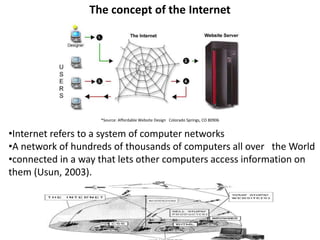
•Internet refers to a system of computer networks
•A network of hundreds of thousands of computers all over the World
•connected in a way that lets other computers access information on
them (Usun, 2003).
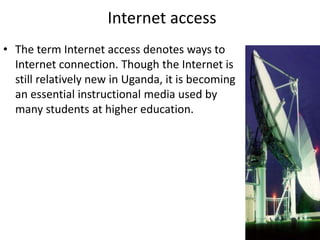
Internet access
• The term Internet access denotes ways to
Internet connection. Though the Internet is
still relatively new in Uganda, it is becoming
an essential instructional media used by
many students at higher education.
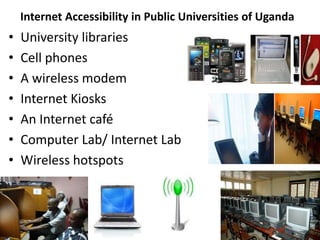
Internet Accessibility in Public Universities of Uganda
• University libraries
• Cell phones
• A wireless modem
• Internet Kiosks
• An Internet café
• Computer Lab/ Internet Lab
• Wireless hotspots
Internet Use
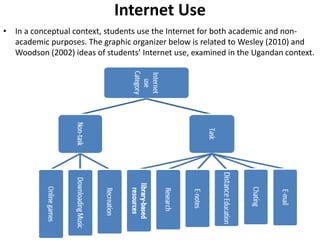
• In a conceptual context, students use the Internet for both academic and non-
academic purposes. The graphic organizer below is related to Wesley (2010) and
Woodson (2002) ideas of students’ Internet use, examined in the Ugandan context.
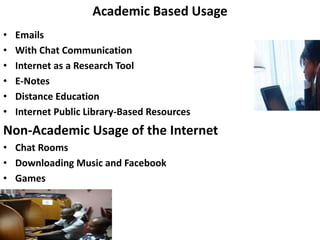
Academic Based Usage
• Emails
• With Chat Communication
• Internet as a Research Tool
• E-Notes
• Distance Education
• Internet Public Library-Based Resources
Non-Academic Usage of the Internet
• Chat Rooms
• Downloading Music and Facebook
• Games
The implication of Internet utilization to the universities of Uganda
• More computers to supplement the existing stock.
• Acquisition of ICT skills
• The ‘bulkiness’ of information acquired
• Time consuming
• Cooperativeness of staff
• ICT infrastructure with the UNAPD Accessibility
Standards
Conclusions and Recommendations
Since Modern university education worldwide is dependent on use of automated
media to support and facilitate academic programs (URAP, 2010).
A number of issues need addressed ahead of time to guarantee success of Internet
use:-
• All university teaching staff to acquire training in IT
• An IT course for all university students regardless of their discipline
• Academic to commend students who use Internet materials
• More Internet access should be provided on campus.
• Staffs that is concerned and willing to assist students.
• Governing rules should be reinforced
Thank you

Access slides

  • 1.
    Access and Useof the Internet: A case of Undergraduate Students in Public Universities of Uganda 3rd Seminar 16th June 2011 By Ndawula Stephen (PhD), Visiting Professor CICE
  • 2.
    University education inUganda: Background •University education in Uganda began in 1922 •In 1937 it evolved into an institution of higher education •In 1949 it became a University College in special relationship with the College of London. •In 1963 Makerere was established as the University of East Africa •In 1970 Makerere became an independent national University of the Republic of Uganda. •At the moment has 22 faculties merged into 8 colleges •Makerere University has a student population of about 40,000. •The best in Uganda and 736th university in the world (URAP, 2010)
  • 3.
    Kyambogo University • Kyambogois the second largest University in the country • Established on 18th July 2003 as a Public University by merging three institutions • Has a total of six Faculties with total student enrolment nearer to 16,547 students (KYU, 2010). • Before 2003, all bachelors’ degree programs Kyambogo University were affiliated to Makerere University.
  • 4.
    The concept ofthe Internet *Source: Affordable Website Design Colorado Springs, CO 80906 •Internet refers to a system of computer networks •A network of hundreds of thousands of computers all over the World •connected in a way that lets other computers access information on them (Usun, 2003).
  • 5.
    Internet access • Theterm Internet access denotes ways to Internet connection. Though the Internet is still relatively new in Uganda, it is becoming an essential instructional media used by many students at higher education.
  • 6.
    Internet Accessibility inPublic Universities of Uganda • University libraries • Cell phones • A wireless modem • Internet Kiosks • An Internet café • Computer Lab/ Internet Lab • Wireless hotspots
  • 7.
    Internet Use • Ina conceptual context, students use the Internet for both academic and non- academic purposes. The graphic organizer below is related to Wesley (2010) and Woodson (2002) ideas of students’ Internet use, examined in the Ugandan context.
  • 8.
    Academic Based Usage •Emails • With Chat Communication • Internet as a Research Tool • E-Notes • Distance Education • Internet Public Library-Based Resources Non-Academic Usage of the Internet • Chat Rooms • Downloading Music and Facebook • Games
  • 9.
    The implication ofInternet utilization to the universities of Uganda • More computers to supplement the existing stock. • Acquisition of ICT skills • The ‘bulkiness’ of information acquired • Time consuming • Cooperativeness of staff • ICT infrastructure with the UNAPD Accessibility Standards
  • 10.
    Conclusions and Recommendations SinceModern university education worldwide is dependent on use of automated media to support and facilitate academic programs (URAP, 2010). A number of issues need addressed ahead of time to guarantee success of Internet use:- • All university teaching staff to acquire training in IT • An IT course for all university students regardless of their discipline • Academic to commend students who use Internet materials • More Internet access should be provided on campus. • Staffs that is concerned and willing to assist students. • Governing rules should be reinforced
  • 11.