Accelerating the project
delivery with Agile
Robert Gresser Former Exec
VP Innovation leader at Solvay
robert.gresser@gmail.com
Agenda
 Agile, Scrum what does it mean?
 Practical Implementation
 Benefits and Learnings
Agile and Scrum, what does it mean?
Framework used to implement Agile in the
management of a project. Can be used for
any complex project in the industry .
SCRUM
Methods and practices based on values
and principles: Collaboration, trust,
autonomy, multi-disciplinary teams…
AGILE
Effective way to accelerate and de-risk your
innovation in an uncertain environment.
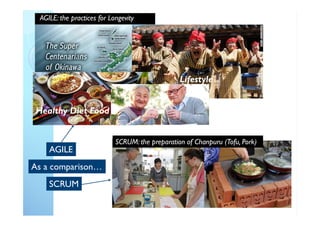
Lifestyle
Healthy Diet Food
AGILE: the practices for Longevity
SCRUM: the preparation of Chanpuru (Tofu, Pork)
SCRUM
As a comparison…
AGILE
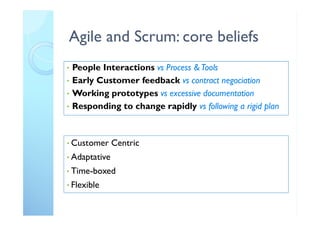
Agile and Scrum: core beliefs
• Customer Centric
• Adaptative
• Time-boxed
• Flexible
• People Interactions vs Process &Tools
• Early Customer feedback vs contract negociation
• Working prototypes vs excessive documentation
• Responding to change rapidly vs following a rigid plan
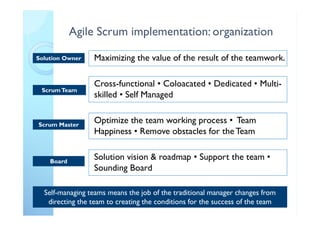
Agile Scrum implementation: organization
Solution vision & roadmap • Support the team •
Sounding Board
Board
Maximizing the value of the result of the teamwork.Solution Owner
Cross-functional • Coloacated • Dedicated • Multi-
skilled • Self Managed
ScrumTeam
Optimize the team working process • Team
Happiness • Remove obstacles for the Team
Scrum Master
Self-managing teams means the job of the traditional manager changes from
directing the team to creating the conditions for the success of the team
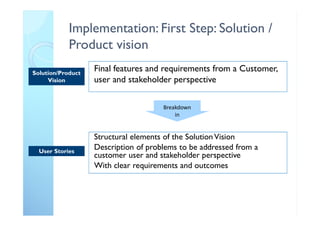
Implementation: First Step: Solution /
Product vision
Structural elements of the SolutionVision
Description of problems to be addressed from a
customer user and stakeholder perspective
With clear requirements and outcomes
User Stories
Final features and requirements from a Customer,
user and stakeholder perspective
Solution/Product
Vision
Breakdown
in
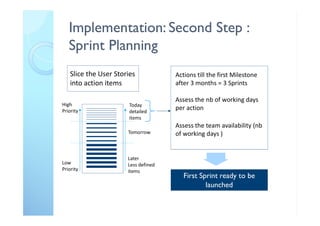
Implementation: Second Step :
Sprint Planning
Tomorrow
Later
Less defined
items
Today
detailed
items
Low
Priority
High
Priority
Assess the team availability (nb
of working days )
Slice the User Stories
into action items
Actions till the first Milestone
after 3 months = 3 Sprints
Assess the nb of working days
per action
First Sprint ready to be
launched
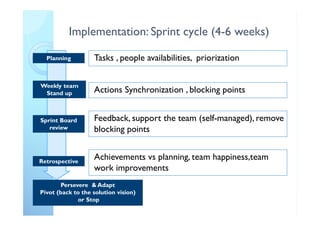
Implementation: Sprint cycle (4-6 weeks)
Achievements vs planning, team happiness,team
work improvements
Retrospective
Tasks , people availabilities, priorizationPlanning
Actions Synchronization , blocking points
Weekly team
Stand up
Feedback, support the team (self-managed), remove
blocking points
Sprint Board
review
Persevere & Adapt
Pivot (back to the solution vision)
or Stop
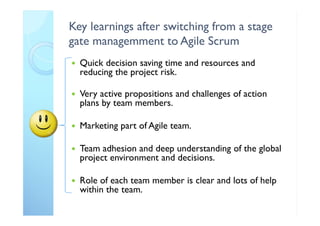
Key learnings after switching from a stage
gate managemment to Agile Scrum
 Quick decision saving time and resources and
reducing the project risk.
 Very active propositions and challenges of action
plans by team members.
 Marketing part of Agile team.
 Team adhesion and deep understanding of the global
project environment and decisions.
 Role of each team member is clear and lots of help
within the team.
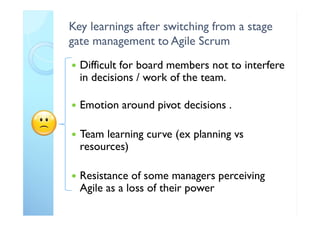
Key learnings after switching from a stage
gate management to Agile Scrum
 Difficult for board members not to interfere
in decisions / work of the team.
 Emotion around pivot decisions .
 Team learning curve (ex planning vs
resources)
 Resistance of some managers perceiving
Agile as a loss of their power
Conditions for successfull implementation
of Agile & Scrum
 Adapted Enterprise culture.
◦ Centered on people not on structures and
processes
◦ Allow those who are doing to decide
◦ Managers should see Agile as an opportunity and
not as a loss of power.
 Clarify the roles, accountabilities and the
organization (solution Owner,Team, Board)
 Importance of the Agile coach.
And Finally, just do it and learn by doing
ThankYou
Robert Gresser Former ExecVP
Innovation leader at at Solvay
robert.gresser@gmail.com

Accelerate the project delivery with Agile

  • 1.
    Accelerating the project deliverywith Agile Robert Gresser Former Exec VP Innovation leader at Solvay robert.gresser@gmail.com
  • 2.
    Agenda  Agile, Scrumwhat does it mean?  Practical Implementation  Benefits and Learnings
  • 3.
    Agile and Scrum,what does it mean? Framework used to implement Agile in the management of a project. Can be used for any complex project in the industry . SCRUM Methods and practices based on values and principles: Collaboration, trust, autonomy, multi-disciplinary teams… AGILE Effective way to accelerate and de-risk your innovation in an uncertain environment.
  • 4.
    Lifestyle Healthy Diet Food AGILE:the practices for Longevity SCRUM: the preparation of Chanpuru (Tofu, Pork) SCRUM As a comparison… AGILE
  • 5.
    Agile and Scrum:core beliefs • Customer Centric • Adaptative • Time-boxed • Flexible • People Interactions vs Process &Tools • Early Customer feedback vs contract negociation • Working prototypes vs excessive documentation • Responding to change rapidly vs following a rigid plan
  • 6.
    Agile Scrum implementation:organization Solution vision & roadmap • Support the team • Sounding Board Board Maximizing the value of the result of the teamwork.Solution Owner Cross-functional • Coloacated • Dedicated • Multi- skilled • Self Managed ScrumTeam Optimize the team working process • Team Happiness • Remove obstacles for the Team Scrum Master Self-managing teams means the job of the traditional manager changes from directing the team to creating the conditions for the success of the team
  • 7.
    Implementation: First Step:Solution / Product vision Structural elements of the SolutionVision Description of problems to be addressed from a customer user and stakeholder perspective With clear requirements and outcomes User Stories Final features and requirements from a Customer, user and stakeholder perspective Solution/Product Vision Breakdown in
  • 8.
    Implementation: Second Step: Sprint Planning Tomorrow Later Less defined items Today detailed items Low Priority High Priority Assess the team availability (nb of working days ) Slice the User Stories into action items Actions till the first Milestone after 3 months = 3 Sprints Assess the nb of working days per action First Sprint ready to be launched
  • 9.
    Implementation: Sprint cycle(4-6 weeks) Achievements vs planning, team happiness,team work improvements Retrospective Tasks , people availabilities, priorizationPlanning Actions Synchronization , blocking points Weekly team Stand up Feedback, support the team (self-managed), remove blocking points Sprint Board review Persevere & Adapt Pivot (back to the solution vision) or Stop
  • 10.
    Key learnings afterswitching from a stage gate managemment to Agile Scrum  Quick decision saving time and resources and reducing the project risk.  Very active propositions and challenges of action plans by team members.  Marketing part of Agile team.  Team adhesion and deep understanding of the global project environment and decisions.  Role of each team member is clear and lots of help within the team.
  • 11.
    Key learnings afterswitching from a stage gate management to Agile Scrum  Difficult for board members not to interfere in decisions / work of the team.  Emotion around pivot decisions .  Team learning curve (ex planning vs resources)  Resistance of some managers perceiving Agile as a loss of their power
  • 12.
    Conditions for successfullimplementation of Agile & Scrum  Adapted Enterprise culture. ◦ Centered on people not on structures and processes ◦ Allow those who are doing to decide ◦ Managers should see Agile as an opportunity and not as a loss of power.  Clarify the roles, accountabilities and the organization (solution Owner,Team, Board)  Importance of the Agile coach. And Finally, just do it and learn by doing
  • 13.
    ThankYou Robert Gresser FormerExecVP Innovation leader at at Solvay robert.gresser@gmail.com